
















The researchers had spent two weeks working their way through the lower Sepik and its tributaries in Papua New Guinea, checking nets, checking market stalls, asking in village after village, and they had not found the fish. They were near the end of the survey. In Imbando Village they showed their photographs to a woman named Helen Asu, who fishes for freshwater prawns with a traditional handheld net called an umben. She looked at the picture and recognised it immediately. She knew the fish. She knew where it lived, in the weedy margins of the river. She said she would help.
The next morning she came back with two of them.
The fish was the spinach pipefish, Microphis spinachioides, a slender freshwater relative of the seahorse found nowhere in the world except the Sepik and Ramu river systems. Science had no record of a living specimen since 1985. It had sat on a conservation list of the world’s most wanted lost freshwater fishes, one of ten species chosen at the launch of a global search in 2021, for the simple reason that nobody with a collecting permit and a scientific journal behind them had been able to put their hands on one in four decades.
Helen Asu found two in a morning, with a net she already owned, in water she already knew.
That sentence is the whole story, and it is worth being careful about what it means. Because the fish was never lost. It was lost to science, which is a different thing entirely, and the gap between those two statements is where this piece lives.
The people who live along the Sepik and its tributaries have names for this fish. Several names, in fact, depending on where you are: Karuweng, Inap, Karuwena, Sako. Communities the researchers spoke to could describe its habitat, the vegetated shallows and river edges where it hangs in the water column. They were not being introduced to a mystery animal. They were being asked about a fish they had seen. The four decades of silence were a silence in the scientific literature, not in the lives of the people who fish that river. A species can be absent from every museum catalogue and every peer-reviewed paper on Earth while being an ordinary Tuesday for the person holding the net.
That distinction sounds pedantic until you consider what conservation does with it. A species with no recent records gets classified as data deficient, which is what the International Union for Conservation of Nature has listed the spinach pipefish as, and data deficient is a bad place to be. It is not a clean bill of health and it is not a warning. It is a shrug. You cannot argue for protecting a river reach, or against a logging concession, or for a fisheries rule, on the basis of a shrug. The absence of data is itself the problem, and the fastest way to fix it turned out to be asking the people who were there.
The expedition that did the asking was run out of the New Guinea Binatang Research Centre in Madang, an institution built substantially around exactly this principle, that local researchers and local knowledge are the method rather than a courtesy. The survey was led by Jerrica Agebigo, a master’s student at the Papua New Guinea University of Technology attached to the centre, working with her colleague Roger Maikei. They covered the lower Sepik and its tributary systems over roughly two weeks, surveying the river directly, going through what came up in fishing catches, and sitting down with communities to ask what they had seen.
A note on her name, because it is not consistent in the coverage. Her surname appears as Agebigo in the conservation organisation’s own account and in Papua New Guinea’s national broadcaster, and as Agebo in one international outlet. Two independent sources closer to the work, one of them her own programme partner and one of them a national news service in her own country, agree on Agebigo, and that is the spelling used here. The variant appears to be a transcription error downstream.
Agebigo has been direct about who made the rediscovery possible. Without Helen Asu’s knowledge, her initiative and her willingness to help, she has said, it might not have happened at all. That is not a diplomatic aside in a press release. It is a description of the mechanism.
The umben matters here too, more than it might seem. A scientific survey net is built to sample: to sweep a volume of water and catch whatever is in it, indiscriminately, so the catch can be counted and compared. A working net is built to catch a specific thing in a specific place, and the person using it has spent years learning where that place is and what time of day the thing is there. Asu was not out to survey the river. She was out for prawns, which live in the same weedy shallow margins the pipefish does, and she had presumably taken pipefish in that net countless times before without any reason to think twice about it. The survey had the permits and the taxonomy. She had the search image.
The fish itself is not spectacular to look at, which is part of why it is easy to overlook. It grows to about fifteen centimetres, roughly six inches, thin as a pencil lead, armoured in bony rings like all pipefish, and it holds itself in vegetation where its outline disappears. It moves between fresh and brackish water over the course of its life. Records place it as far as 570 kilometres upstream in the Sepik system, in the May River, and it is also known from the Ramu.
And like its relatives, it has one of the more remarkable reproductive arrangements in the animal kingdom: it is the male who carries the young. He holds the eggs in a brood pouch beneath his tail, up to around 150 embryos at a time, and gives birth to live young. That is the family trait that makes seahorses famous, and this freshwater cousin in one river system in Papua New Guinea does the same thing.
It helps to understand the size of the haystack. The Sepik runs more than a thousand kilometres from the highlands to the sea, and it is not a single channel so much as a system: a main river, a web of tributaries with names most atlases leave off, oxbow lakes, floodplain swamps, seasonal wetlands that are water for part of the year and ground for the rest. The whole of it shifts. Channels move, lakes fill and drain, margins advance and retreat with the rains. Dropping a fifteen centimetre fish into that and asking a handful of researchers on a two-week budget to find it is not a reasonable request. It only becomes reasonable if you stop treating the river as a search area and start treating the people who live on it as the survey.
That is also why the four-decade gap is less mysterious than it sounds. Nobody was looking. Sustained ichthyological fieldwork in the Sepik effectively stopped when the surveys of the late twentieth century wrapped up, and fieldwork of that kind is expensive, logistically punishing, and funded in cycles that rarely last. The fish did not hide. The funding moved.
The confirmation route is the part that makes this defensible as science rather than as a nice anecdote, and it turns on one man. Identifying a small fish from a photograph is normally a weak claim. Photographs lose the fin ray counts, the ring counts, the proportions that separate similar species, and a careful ichthyologist will refuse to commit. In this case the photographs went to Gerald Allen, the Australian ichthyologist who knows this fish better than anyone living, because he is the reason there were any modern records of it at all.
Here the popular framing needs correcting. Allen did not describe the species. Microphis spinachioides was described in 1915 by the German ichthyologist Georg Duncker, from material collected long before either living memory or living taxonomy. What Allen did was survey the Sepik. With David Coates, then working for a United Nations development programme in Port Moresby, he carried out an ichthyological survey of the Sepik River system across the years 1978 to 1985, published by the Western Australian Museum, recording 57 species and identifying the spinach pipefish as one of a small handful of fishes endemic to the Ramu and Sepik system alone. Those surveys are where the last scientific records of this fish come from. When the record went quiet in 1985, it went quiet because his survey ended.
So the symmetry is real, and it is better than the version usually told. The man whose fieldwork produced the last confirmed sighting of this fish looked at photographs taken forty years later, checked them against the features he knew mattered, and confirmed that what Helen Asu had in her hands was the same animal. Very few scientists get to close a loop they opened themselves at the other end of a career.
The programme behind the expedition is called the Search for Lost Fishes, run by the conservation organisation SHOAL with Re:wild, and it started in 2021. The scope of what it is trying to do is genuinely startling. There are over 300 freshwater fish species worldwide that have not been scientifically recorded for at least a decade and that nobody is willing to declare extinct. Freshwater fish are the blind spot of global conservation: they live in water nobody surveys, in countries where field budgets are thin, and they are small, and they are not charismatic, and when a river changes they disappear without anyone filing a report.
From the original list of ten most wanted, the spinach pipefish is the third to be found. The Batman River loach in Turkey came back in 2021. The leopard barbel in the Tigris and Euphrates system came back in 2024. Three out of ten in five years is, depending on how you look at it, either an encouraging hit rate or a reminder that seven are still missing.
Amanda Vincent, the marine biologist who chairs the IUCN specialist group covering seahorses and pipefishes, said the news made her heart sing, which for a scientist speaking about a fifteen centimetre fish in a river most of the world cannot find on a map is about as unguarded as it gets. Her group is the body that will eventually have to decide what the spinach pipefish’s conservation status actually is, and that decision needs numbers the rediscovery does not yet provide.
Which is why the finding is a beginning rather than an ending for the researchers. Two fish prove existence. They do not tell you how many there are, how far along the river system they range, whether the population is stable or collapsing, or what a viable habitat looks like. The team’s stated next steps are more surveys across the wider Sepik and Ramu basin, and developing environmental DNA methods, which detect a species from genetic traces in a water sample and mean you can confirm presence over a large area without catching anything at all. For a fish this small and this well hidden, that is likely to be the only practical way to map it.
There is also a warning folded into what the communities told them. People along these rivers report that native fish are declining and that introduced species are becoming more common. They point to sedimentation, to logging, to mining, to riverbank vegetation being cleared, which for a fish that lives in the weedy fringe is the specific habitat being removed. The Sepik is one of the great rivers of the world, over a thousand kilometres of it, largely undammed, and it is not immune to any of that. A species that has just been confirmed alive after forty years of silence has been confirmed alive in a system its own residents say is changing.
So what actually ended here. The spinach pipefish came off the most wanted list. It went from a gap in a record to a living species with a location, a habitat description, a set of local names, and a photograph confirmed by the person best qualified on Earth to confirm it. A master’s student from Papua New Guinea led the survey that found it, in her own country, on her own river.
And the fish was found because a woman going out for prawns was asked what she knew, and answered, and then went and got it. The scientific literature will record a rediscovery in 2026. What it should record is that the information had been sitting in Imbando Village the entire time, available to anyone who thought to ask.
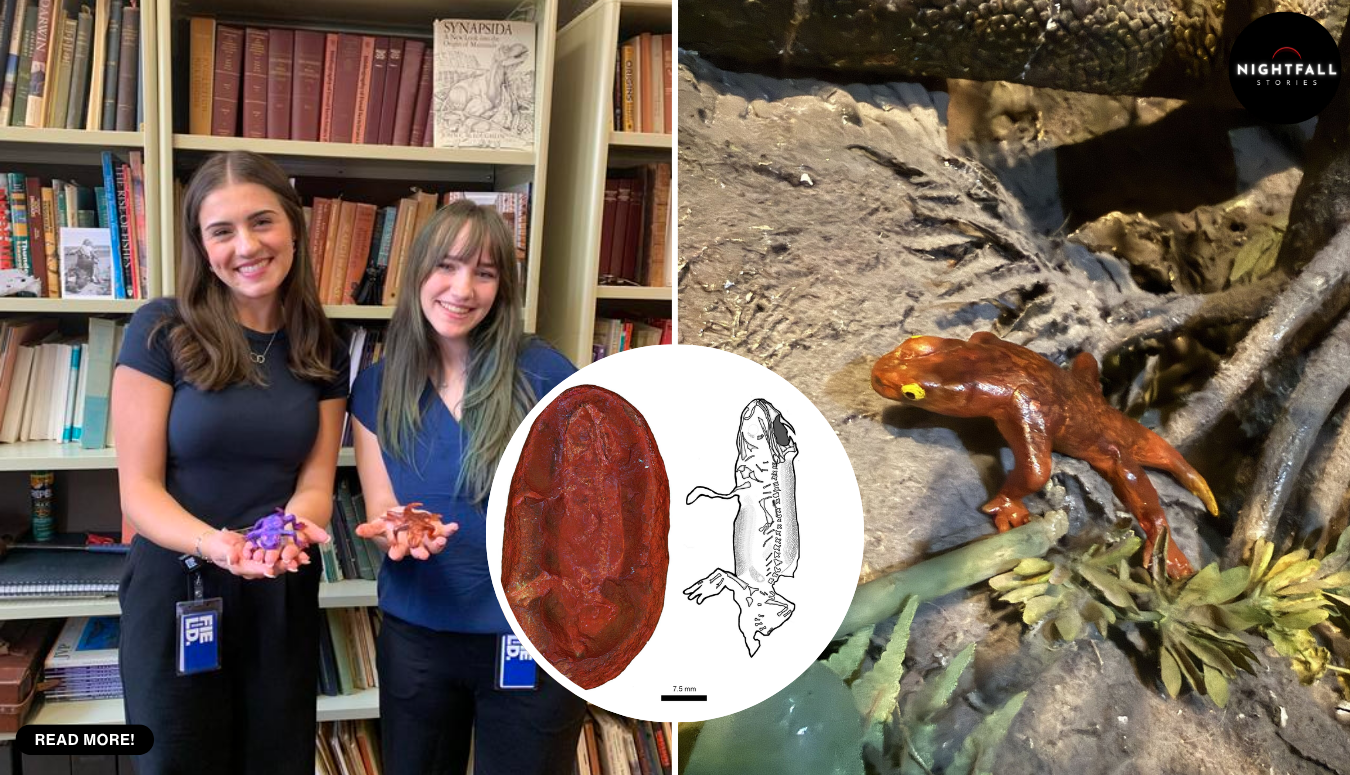
The fossil had been sitting in a drawer at the Field Museum in Chicago under the wrong name, and nobody had looked at it closely enough to notice. It had been collected years earlier at Mazon Creek in Illinois by an amateur fossil hunter, given to the museum, filed as a specimen of a species called Amphibamus grandiceps, and left there. Two undergraduate interns pulled it out, spent a summer working on it, and established that it was not Amphibamus grandiceps at all but an animal science had never described. Which meant they got to name it. Which meant a problem, because there were two of them and only one name.
They solved it the way you would hope. Allison Sefcovic and Payton Kohlberg both went to their mothers for the honour, and it turned out both of their mothers are called Jean. The animal is now Jeanerpeton mazonensis, which reads roughly as Jean’s crawler from Mazon Creek, and the name went into the permanent scientific record when their paper appeared in the Journal of Vertebrate Paleontology. Two mothers with the same name are attached to a 309 million year old proto-amphibian for as long as the name stands, which under the rules of zoological naming means indefinitely.
That is a lovely piece of luck and it is also the smallest interesting thing about this story. The bigger one is how the fossil got into that drawer in the first place, because it did not arrive through a funded expedition or a professional dig. It arrived because somebody who does this for love walked a spoil pile in northern Illinois, picked up a lump of ironstone, cracked it open, found something inside, and eventually handed it to a museum instead of a shelf in a spare room. That is not an accident of this one specimen. That is how the entire Mazon Creek record exists.
Mazon Creek is not a single site. It is a scatter of more than 250 fossil localities across northern Illinois, roughly between the towns of Morris and Essex, about sixty miles southwest of Chicago. Around 309 million years ago, in the Carboniferous, this was a swampy river delta grading into a shallow inland sea, thick with tree ferns and horsetails and the enormous insects that period is famous for. When plants and animals died there, they were buried fast in fine sediment, and iron carbonate cemented around them into hard nodules called concretions. The nodule sealed the body off. What happened next is the reason paleontologists care so much: the soft parts did not simply rot away and leave bone. They left impressions.
That is unusual to the point of being freakish. Most of the fossil record is bone, shell and tooth, the hard parts, and everything that made the animal an animal is gone. Mazon Creek gives up outlines of bodies, the texture of skin, the shape of an eye. Nearly 800 species have come out of those concretions, including the Tully monster, a creature so strange that arguments about what it even was have run for decades and are not settled. It is found nowhere else on Earth.
The study of the place began in the middle of the 1800s, and it began with locals. Natural exposures along the creek and its banks started producing fossils near Braidwood around 1855 and near Coal City a few years later, and the first collectors were farmers and townspeople. Some of their names survive in the literature, Joseph Even, S. S. Strong, J. C. Carr, men who were not scientists and who fed material to the scientists who were. Leo Lesquereux had described 71 species of fossil plants from Mazon Creek by 1866 and 180 by 1870. Amos Worthen and Fielding Meek published a run of papers over the following decades. None of that happens without the people who were actually out there in the mud.
Then came the mine, and the mine changed everything. The Peabody Coal Company ran a strip mine known as Pit 11 near Essex from 1945 to 1974, and stripping coal meant stripping off the fossil-bearing shale above it and dumping it in spoil piles. Peabody let collectors onto those piles. You applied at the mine office on a weekday or found the foreman at the machine shop on a Sunday, and then you walked the heaps looking for nodules of the right shape and colour. This was, for about twenty years, the most productive amateur fossil collecting ground in the world, and the Tully monster came out of it.
The technique those collectors developed is beautifully low technology. You do not smash a concretion, because smashing it tends to destroy whatever is inside. You take it home, soak it, and put it through freeze and thaw cycles, letting water work into the natural seam until the nodule splits itself along the plane of the fossil. Some collectors have buckets going through that cycle for a year. And the odds are not good. Early accounts of Pit 11 talk about a great number of duds, nodules that open on nothing at all. Others produced shapes so indistinct that collectors just called them blobs, and the blobs were only later worked out to be jellyfish.
When the mining stopped, Peabody sold Pit 11 to a utility company that built a nuclear generating station there, and land around the cooling pond was leased to the state as a conservation area where collecting is allowed on a seasonal, permitted basis. The community kept going. The Earth Science Club of Northern Illinois has been the institutional home of that community for generations, and the Field Museum now works with its volunteers directly rather than around them.
That relationship has history behind it. Eugene Stanley Richardson Jr, a Field Museum paleontologist through the Pit 11 decades, made a habit of taking amateur finds seriously, publishing them, and sometimes naming the new species after the person who found it. And the collections themselves came in by the truckload. One collector, Jerry Herdina, left the museum more than 14,000 specimens, nearly all of them from Mazon Creek. A museum drawer holding an undescribed animal is not a sign of neglect so much as a sign of scale. There is far more material in those cabinets than there are people to study it.
Which brings us back to a misfiled fossil and two students with a summer to spend. Sefcovic, who studies at the University of Michigan, and Kohlberg, at the University of Illinois, came in through the museum’s Women in Science internship programme, in the 2025 cohort. The programme takes high school and undergraduate students from the region around the museum, and it is not a shadowing exercise. Interns work in person, full time, Monday to Friday, on a real project with a real output. Past cohorts have georeferenced insect collections, digitised specimens, and trained machine learning to sort beetles. This one described a new species.
Their fossil had been swallowed by what paleontologists call a waste bin taxon. When you have a pile of specimens that all look vaguely similar and nobody has the time to sort out which is which, they get lumped under one existing name, and the pile becomes a kind of holding pen. Amphibamus grandiceps was that pen here. Anything squat and salamander-shaped from Mazon Creek could end up inside it. The label is a placeholder pretending to be an identification, and it can sit unchallenged for a century.
Getting something out of a waste bin taxon is unglamorous work. You prepare the specimen, you photograph it under different lighting to bring out impressions the eye misses, you measure everything, you compare it feature by feature against the animals it has been lumped with and against everything else in the group, and you build the case in the form of a character matrix, a table of anatomical traits that lets you argue formally about where the animal sits. Then you write it up in a form a journal’s reviewers will accept. The postdoctoral researcher Cam So worked with them on that, and the museum’s assistant curator of fossil fishes and early tetrapods, Arjan Mann, ran the lab the work was done in. This was a supervised museum project, not two students alone in a basement, and it is a better story for it.
What they found was worth the summer. In the Jeanerpeton fossil you can see scales along its back, the small belly ribs called gastralia, and impressions where its eyes were. Sefcovic has said that what is really remarkable about Mazon Creek is that it preserves details you almost never get, things like toe pads and the outline of a body. So explained that the team found enough evidence of an anatomically distinct animal to pull Jeanerpeton out of the waste bin and stand it up on its own.
The animal itself was small, squat, somewhere between a frog and a salamander in overall build, living in a hot coastal swamp where the American Midwest is now. It is not an amphibian in the modern sense. It belongs to the broad early group that modern amphibians came out of, which is why the museum has been calling it a proto-amphibian, and the point of describing it properly is that it pushes features we think of as amphibian characteristics back to about 309 million years ago. Soft tissue, not bone, is what made that case possible. Bone alone would have left it in the bin.
Naming is also more procedural than it sounds, and the procedure is what makes it permanent. A new animal name is only valid if it is published in a form the international rules recognise, with a description that distinguishes the animal from its relatives, and with one physical specimen designated as the anchor for the name. That specimen becomes the reference point forever. If anyone in two hundred years wants to argue about what Jeanerpeton mazonensis actually is, the argument has to be settled against that one nodule in a Chicago drawer. This is why getting a specimen out of a waste bin taxon matters beyond tidiness. Until somebody does the work, the animal has no anchor and effectively does not exist as a unit that science can reason about.
It also helps to know what the world around this animal looked like, because it explains why so much of it survived. The Carboniferous is the period that laid down most of the coal humanity has burned, and it did that by growing enormous quantities of plant matter in wet lowlands and then burying it before it could fully decay. Low oxygen in waterlogged sediment is what stopped the rot, and the same conditions that made coal seams made the concretions above them. The mine and the museum are looking at two products of the same process. The coal company was after the seam. What it shovelled aside to reach the seam was the fossil record, and the only reason any of it was saved is that people with no professional stake showed up to carry it away by hand.
There is a wider run of work behind this. Mann and the research associate Jason Pardo published in Science earlier this year on juvenile fossils of embolomeres, crocodile-shaped early tetrapods, from the same deposits, and the finding was that these animals had no tadpole stage and nothing like amphibian metamorphosis. That contradicts an assumption that had stood for a long time about how vertebrates made the move onto land. The specimens were centimetres long. And they came from collectors: Mann named Paul Demkovich, Ben Riegler, Rich Rock and Tom Testa, and said plainly that the discovery would not have been possible without citizen science.
He has also said something that ought to unsettle anyone who assumes the site is worked out, which is that he believes more concretions are still sitting in those spoil piles than have ever been collected. Nearly two centuries in, the best guess is that most of Mazon Creek has not been opened yet.
So there is a chain here, and it is worth naming in full. An amateur collector walked a pile of mine waste and found a nodule. They cracked it, kept it, and gave it away to an institution rather than keeping it as an ornament. A museum accessioned it and filed it, wrongly, and it waited. Two undergraduates were handed a summer and the drawer, and with a postdoc and a curator behind them they worked out that the label was wrong. A journal agreed. And the name that now sits in the permanent record belongs to two women called Jean who did not dig anything up, who as far as the public record shows had nothing to do with paleontology, and whose daughters decided that this was the thing they wanted to do with a once in a lifetime privilege.
The collector’s name is not in any of the public accounts of this species, and that is worth sitting with. The person whose find made the whole thing possible is described only as an amateur collector who donated the specimen. It is entirely possible they are still alive, still in northern Illinois, still cracking nodules, and have no idea that the lump they pulled out of a spoil heap has a name now, and two mothers behind the name.
That is the part that will stay with you. A formal species name is one of the very few things a person can put into the world that does not expire. Papers get superseded. Museums reorganise. Exhibits come down. But once a name is validly published, it is in the nomenclatural record, and the only way it moves is if later researchers decide the animal belongs somewhere else, in which case the species half of the name usually travels with it. Two students had that in their hands for one summer, and they gave it to their mothers.

In a river town in southern Ohio there is a long art deco building with glass block columns down its front, and for most of the last half century the only thing happening inside it was decay. The Ro-Na Theatre in Ironton opened in the summer of 1949 with about a thousand seats and a reputation as one of the best rooms of its kind in the state. It closed in 1973. The film on the screen at the end, according to the man who has led the effort to bring the place back, was The Godfather.
Then nothing, for thirty five years. No projector, no audience, a roof that gave up, a building on the main street of a town that had been losing its industry and could not afford a ruin.
The next film to play in that auditorium ran late last September. It was We Are Marshall, it was free, and about eight hundred and fifty people could get in on a first come basis. Between those two screenings sits a story that has almost nothing to do with cinema and everything to do with a small group of people who kept turning up for nearly two decades to work on a building that did not belong to them at the start and did not pay them at any point.
Jeff Mowery, one of the people who has driven it, puts the figure at nineteen years, and says they have spent a lot of time and a lot of blood, sweat and tears in that building. The paperwork is slightly kinder to the calendar than he is. The Hampton family, who owned the Ro-Na, said in the first weeks of 2008 that they wanted to give it away, and the deed passed to the City of Ironton a month later, which makes the formal clock closer to eighteen and a half years, and one report has put it at eighteen. Mowery has been at it long enough that the difference is not worth arguing about. Nearly two decades is the honest description.
What is genuinely unusual about this restoration is how well documented the slow part is, because most stories of this kind skip straight from ruin to ribbon and leave out the years that actually take the years. The Ro-Na’s own timeline is unsparing. The family offered the building in January. The deed transferred in February. In May the city council set a goal of getting a roof on it, which tells you what state the roof was in. Volunteers started clearing the inside out that July. And then the roof, the thing everyone had agreed was urgent, was not removed and rebuilt until July of the following year.
That is the actual rhythm of a volunteer restoration. A year to get to the first structural job, because the money has to be found before the work can start and there is no budget line anywhere for a closed cinema. Then another five years before the next visible milestone, which came in the spring of 2014, when the Ro-Na’s marquee was put back up and lit for the first time since the early 1970s.
Think about what that means as a piece of strategy rather than sentiment. Six years in, with no seats to sell and no film to show, the volunteers spent their money on the one part of the building the whole town could see from the street. It worked, in the way such things work. A lit marquee on a dark block is an argument that something is happening, and you need that argument when you are going back to the same donors and the same council for the eleventh year running.
The building they were arguing for was worth it. Ironton sits on the Ohio River, and when the Ro-Na opened it was a serious room in a working town, streamline moderne with neon and those glass block columns, a single screen with a thousand seats, the kind of house that showed The Ten Commandments and King Kong to a population that had nowhere else to go on a Friday night. When it shut in 1973 nobody demolished it, which is the only reason any of the rest of this was possible. A great many American towns of that size lost the same building in the same decade and have a car park where it was.
There is a thing worth saying about the donation itself, because a gift like that is not straightforwardly a gift. When a family hands over a closed cinema they are handing over a liability: a large uninsurable structure with a failing roof, a tax bill, a facade over a public pavement and no income. The Hamptons gave the town something valuable and something expensive in the same envelope, and the city took it on knowing which of the two it would feel like first. Everything that followed, the council setting a roof goal within months and the volunteers spending that summer carrying rubbish out by hand, is the sound of a town working out what it has just accepted.
Money for that stage does not come in one piece. It comes from raffles, memberships, small foundation grants, sponsored seats, donated labour from local trades and the sort of fundraising where somebody’s uncle has a lift and does not charge for a weekend. It arrives slowly and it is spent immediately, and it produces years in which nothing visible changes. The hardest part of a nineteen year project is not the first year or the last; it is year eleven, when the novelty is gone, the original committee has aged and the building is still not open.
The turn came when the state money arrived. Ohio ran a programme aimed at its Appalachian counties, and the City of Ironton was awarded about 5.28 million dollars under it for a riverfront and downtown scheme, of which roughly 2.7 million dollars was assigned to the Ro-Na itself. That is a different order of magnitude from what volunteers can raise at a fish fry, and it is what turned a saved shell into a usable theatre. The list of what it bought is the least glamorous list imaginable and the most important one: walls, ceilings, a levelled floor, heating and cooling, lighting, lavatories, the balcony, the facade. There was also a 50,000 dollar grant from a telecoms company’s community fund, and that one went to the parts a cinema needs to be a cinema, the screen itself and the digital projection and sound.
Work began in the summer of 2025, with a local firm, Collier Construction, doing the building and an architect, Jake Henderson, who summed up the job in a line worth repeating: the building needed to come up to where the community is now, not the other way around. The plan was to extend the stage, level the floors, add seating and redo the walls, and to be finished inside a year.
The finish line, when it came, came in two parts, and it matters that they are kept separate. In late June of this year the Ro-Na held its ribbon cutting. Rick Jansen of Friends of Ironton, the nonprofit that has held and run the building since 2008, cut the ribbon. Brad Bear ran the event and said the lights were back on, the doors were open and the Ro-Na was once again ready to serve Ironton. The mayor, Sam Cramblit, called the building a symbol of hope and resilience. A state representative, Jason Stephens, said the crowd was watching the old made new again. John Carey, from the state’s Appalachian office, made the point that none of the money would have mattered without the community behind it. School students let off confetti poppers. There were classic cars parked outside and children playing games in the lobby, and at one point Casablanca went up on the new screen.
That was the building being declared open. It was not a film screening, and the distinction is the sort of thing that gets flattened in the retelling. A clip on a screen at a party in June is not a public showing. The first of those came three months later.
The choice of what to show was not left to nostalgia, and it was not left to the volunteers alone. The state’s committee for the national 250th anniversary asked for something with local meaning, and Jansen has said the first thing that came to mind was We Are Marshall. It is not a film about Ironton. It is a film about Marshall University, an hour or so down the same river, and about what happened after 14 November 1970, when a chartered flight bringing the football team home came down near Kenova in West Virginia and seventy five people were killed, among them most of the players, the coaching staff, medical staff and supporters travelling with them. The film is about the years afterwards, and the decision to field a team again.
That is a heavy piece of programming for a reopening, and it was chosen deliberately. In this part of the river valley the crash is not history that happened to somebody else; it is inside living memory and inside a lot of families. Screening that film in a town an hour away, for free, with the doors open at six, is a specific kind of gesture and the organisers were clear about the reason. Jansen said plainly that they wanted younger people in the room who did not know the story, and local football teams were invited for exactly that purpose. Before the film there was a panel, with Mark Snyder, a former head coach at Marshall, and half a dozen of the actors who appeared in the picture. Snyder, who was there, talked about what the restoration meant and about the building’s job of teaching people something.
So on a Thursday evening in late September, more than fifty years after the last time, a film ran on the Ro-Na’s screen. Suzie Hamlin of Friends of Ironton was reported to have been overcome when she saw the room as it now is, which after that long is not surprising. The auditorium seats about eight hundred and fifty now rather than the original thousand, which is what happens when a 1949 house is brought up to modern requirements for access, sightlines and comfort. Fewer seats, better ones.
It is worth being careful about one detail in this story, because it is doing a lot of work and it rests on less than it seems. The Godfather as the last film shown before the doors closed comes from the volunteers’ own account of the building’s history. The Ro-Na’s records confirm that the film played there. That it was the final one is what the people who saved the place have always said, and it is how the local broadcaster reported it. It has the ring of a fact a town keeps rather than a fact a town checks, and it should be read that way: the story Ironton tells about the night the lights went out, entirely plausible, sourced to the people who were there and not to a surviving ticket stub.
The larger question the Ro-Na now has to answer is the one that faces every restored single screen in a small town, and it is not a question about films at all. Nobody drives to a thousand seat house to watch a new release; that battle was lost to the multiplex and then lost again to streaming. What a room like this can do is be the only large indoor space in a small town that is not a church or a school gymnasium. The renovation was designed for that from the start, which is why the money went into a levelled floor and an extended stage and a flexible ground level rather than into rows of fixed seating. Bear described the aim as a cultural arts centre that is also a multi purpose space, and the programme since the reopening has run to concerts and classic films rather than first runs.
That is a more modest ambition than saving a cinema, and a more useful one. The Ro-Na is not going to make money showing movies. It can host a graduation, a touring band, a Christmas show, a free screening for eight hundred and fifty people who did not pay anything to get in, and it can do all of that on a downtown street that badly needs a reason for people to be on it after six in the evening.
What the volunteers actually did, across nineteen years by Mowery’s count, was keep a large building standing through the period when it was worth nothing at all, so that it would still be there when public money finally turned up. That is the whole trick, and it is almost never recognised as a skill. A roof in 2009. A marquee in 2014. Decades of meetings, small grants, clean up days, and the steady work of being the people who did not let it be knocked down.
Then the state wrote a cheque, a phone company paid for the screen, and last September a film about a town rebuilding after the worst thing that ever happened to it played in a room that had been dark since 1973. Nobody planned that echo when the grant applications were being written. It is just what fit, chosen by a committee looking for something local, in the only building in Ironton big enough to hold everyone who wanted to see it.

Brian Tyler was in his studio in the late summer of last year, in the last stretch of work on a score about the Nuremberg trials, when something happened in his head that he has since described as thunder. He had no frame of reference for it. He is an active man in his early fifties who had spent the previous two decades conducting orchestras and turning films around on deadlines that do not move. By his own account what he had suffered was a double subarachnoid brain haemorrhage, and he spent the next three weeks in hospital.
Four days in, he started writing music again.
Not in a metaphorical sense. He had no piano and no keyboard and no way of playing anything back, and he has said that the saving grace was that he composes in his head anyway. So from a hospital bed, with two films running at once, he wrote a large part of the main themes for a children’s adventure about a plumber in outer space, and he kept working on the score for a drama about the men who ran the Third Reich. Nobody on either production knew where the music was coming from. He did not tell them.
That is the part of this story that is worth sitting with, because it is not obviously admirable and he has never presented it as though it were. The two films were The Super Mario Galaxy Movie and Nuremberg. The first has taken more than 747 million dollars worldwide and stands among the biggest releases of the year. The second, directed by James Vanderbilt with Russell Crowe as Hermann Goering and Rami Malek as the US Army psychiatrist Douglas Kelley, premiered at Toronto and went out in cinemas a couple of months later, taking about 71 million dollars against a budget of 40 million. Both scores were delivered. Both films came out on time. And the reason anyone knows what it cost is that Tyler decided, months afterwards, to say so.
To understand why he made the choice he made, it helps to know what a composer’s position in a film actually is. The score is close to the last thing added. Everything ahead of it in the queue, the shoot, the edit, the visual effects, the sound mix, has already eaten whatever slack the schedule ever had, and by the time the music is written the release date is not a plan, it is a contract. Cinemas have been booked. Trailers have run. A film that does not deliver its final sound mix on a fixed date does not simply arrive a month late; it collides with other studios’ release weekends and loses its screens. Composers routinely get six to eight weeks to write and record an hour or more of orchestral music, and a scoring stage booking with seventy players on it costs enough per hour that it cannot be casually rebooked.
So when Tyler says he did not want to let anyone down, he is describing a real structure and not a vague feeling. If he had made a phone call from that bed, the honest version of the conversation would not have been about giving him time. It would have been about replacing him. And in the case of the Mario film, replacing him meant handing over a job that had taken years of relationship to earn.
Tyler had scored The Super Mario Bros. Movie in 2023, which put him in an unusual position with Nintendo’s own composer, Koji Kondo, the man who wrote the themes that hundreds of millions of people can hum without being able to name them. Kondo served as a score consultant on the Galaxy film. Tyler has said that after the first film Kondo essentially told him that he knew the material and should see what he came up with, which is about as much creative latitude as anyone is ever handed with somebody else’s melodies. There is also a fair amount of affection in the relationship. When Kondo was inducted into the Academy of Interactive Arts and Sciences Hall of Fame, Tyler was the one who introduced the award.
That is the trust that Tyler was weighing in the hospital, against a medical situation he had no experience of and no way of predicting. He chose the work. He has been open that part of it was not selflessness at all. Composing gave him something to aim at while he was lying still, and he has described coming back to the music as cathartic, a goal to hold onto rather than a burden he shouldered for other people’s benefit.
You can read that as remarkable and you can also read it as a man doing something no employer should ever want from anyone, and both readings survive contact with the facts. He has said that the staff around him were visibly baffled, that people were sitting there wondering what exactly was going on with this guy, and that his answer was simply that he was determined. He also says he stayed quiet later, after he got out, because he did not want people to worry. He went straight back to conducting and recording sessions without telling the musicians in front of him what had happened a few weeks earlier.
What he was writing during that period is worth describing, because the tonal distance between the two jobs is almost comic and it was not a distance he could take a break from crossing.
For Nuremberg, Tyler did not start with the film. He started with 1933. He wrote a four hour concert work in five parts that traces the rise of the Third Reich from the beginning, and only the fifth part became the score of the film. That is an enormous amount of unpaid architecture for a two hour drama, and his reasoning was that the music had to earn the right to be in the room with the subject. He has said he wanted the score to feel emotionally current rather than period correct, because in the span of human history this was yesterday. One detail from that work tells you how carefully he was thinking. He tracked down the musical notation of the alarm bells used in the camps and built them into three chords, and those chords sit underneath Goering’s final scenes, holding the weight of what the man was responsible for without offering him any sympathy.
For The Super Mario Galaxy Movie he was doing something close to the opposite: building a huge, bright, symphonic ride that has to work for a small child who has never held a controller and for an adult who knows every bar of a twenty year old game soundtrack. Tyler has said he packed more than 300 references into the score, pulling from the Galaxy games, other Mario titles and even Star Fox, and he is firm that none of it is decorative. If a reference does not serve the scene, it comes out. He is a fan himself, which he cheerfully admits makes the job fun, but his rule is that nothing is allowed to get in the way of the story.
The recording of that music is the quiet proof of the timeline. A seventy piece orchestra worked on the score at the Eastwood Scoring Stage at Warner Bros in Burbank across the winter and into the spring, and the soundtrack came out alongside the film. Standing on a podium in front of seventy players is not a thing you do gently. That was months after the haemorrhage, and the people in the room did not know.
There is a practical reason the Nuremberg job was the harder of the two to abandon. A film about the International Military Tribunal, built around a psychiatrist’s long conversations with a man in a cell, has almost no action for music to ride on. The score has to carry the moral temperature of a room where two people are talking, and get it wrong in either direction and the film either turns into melodrama or goes cold. Tyler was writing the most delicate music of his year in the least suitable circumstances anyone could design for it, and the only person who knew that was him.
The Mario film had the opposite problem and the same consequence. A studio animation aimed at families is scheduled years ahead, with toys, parks, promotions and a release date that several companies have planned their year around, and the score is the last piece to land. Kondo was involved throughout as a consultant, which means the music was being checked against thirty years of house style by the person who invented it. Handing that relationship to a substitute in the middle of the process would not have been a scheduling problem. It would have been the end of Tyler’s place in it.
Tyler’s route into this work was never conventional. He studied at UCLA and at Harvard, and not in music. Early on he had an ordinary decision in front of him, a desk job or a first film for a dollar, and he took the dollar. Roughly 150 scores later, his films have taken something in the region of 20 billion dollars worldwide, which puts him among the ten highest grossing composers who have ever worked. He wrote the fanfares that play over the Universal and Marvel logos, so a great many people have heard his music without ever seeing his name. He has scored Fast and Furious films, Rambo films, Iron Man 3, Thor: The Dark World, and long stretches of the Yellowstone world. He has said that he does not take films because he has to, which he knows is rare for an artist.
There is one more thing about how he hears, and it matters to the hospital story more than it sounds. Tyler has chromesthesia, a form of synaesthesia in which sound arrives as colour and shape. He calls it a cheat code when he is conducting, because he can see the orchestra’s balance rather than only hear it. It also means that composing without an instrument is less strange for him than it would be for almost anyone else. Music in his head is not an abstraction he has to imagine; it is a thing he can look at. That does not make what he did in that bed reasonable, but it does explain how it was even possible.
He is now building something out of that particular wiring, a live electronic and visual show called Are We Dreaming, which he has described as somewhere between Fantasia and 2001: A Space Odyssey, an attempt to put an audience inside the way he perceives sound. He calls it the most ambitious thing he has taken on. For a man who spent three weeks in a hospital bed a year ago, the choice of next project is not subtle.
None of the medical detail in any of this comes from a doctor. Every word of it comes from Tyler, in interviews he gave long after the fact, and he has been careful about what he claims and no one should add to it. He has not offered a prognosis and there is no reason to invent one for him. What is on the record is that it happened, that he describes it as a double brain haemorrhage, that he was hospitalised for three weeks, and that he went back to work sooner than anyone would have advised.
The part that keeps nagging is the silence. Two productions, several hundred people between them, a studio with a hard release date and a Japanese composer who had handed over his life’s most recognisable melodies, and not one of them was given the chance to say that the music could wait. Tyler made that call alone, on the grounds that the alternative was letting people down, and the alternative he was actually protecting them from was the inconvenience of knowing. There is a version of this story in which that is heroic and a version in which it is simply the logic of an industry that has trained its best people to believe they are replaceable and unmissable at the same time, and the honest answer is that both versions are in play.
What settles it, a little, is how the information finally came out. Not through a leak, not through a publicist managing a narrative around an awards campaign, and not while either film was still in the balance. He first mentioned the medical emergency in a conversation about the Nuremberg score, deep in the craft of it, while explaining why he had come to think differently about what he was doing and why. Only later, once both films were out and one of them was the biggest thing in cinemas, did he sit down and describe the hospital bed and the four days and the themes he wrote there.
By then nothing was riding on it. The scores existed. The films had been seen. Telling it could not buy him a deadline or a job or sympathy that would change anything, and it could only ever make him look less invulnerable than a composer with 150 credits is supposed to look. He told it anyway, which is the actual end of this story. The music was always going to get finished; that was never in doubt, because he had decided it in a hospital bed before anybody else got a vote. What was in doubt was whether anyone would ever know the price of it, and that was a second choice, made much later, and the only one he made in the open.













Earlier this month, for the first time in the history of the Academy Awards, Cyprus entered the race for Best International Feature Film. The entry is Hold Onto Me, the debut feature of the Cypriot writer and director Myrsini Aristidou, chosen by a seven-member national selection committee appointed by the island’s Department of Contemporary Culture under its deputy ministry of culture. The film will compete for a place at the 99th Academy Awards, to be held in Los Angeles in the spring of 2027.
That is a first in the plainest sense. Cyprus had never submitted a film to the category before. Not once, in the seven decades the Academy has been handing the award out under one name or another.
The obvious explanation is the wrong one. Cyprus has not been absent from that category because nobody on the island was making films worth sending. It has been absent because of a piece of administrative machinery that did not exist.
Best International Feature does not work the way the other Oscar categories work. You cannot enter it yourself. A director with a finished film and a good festival run cannot submit it, however many awards it has won. The Academy accepts exactly one film per country per year, and that film has to be chosen and submitted by an approved national selecting body. If your country does not have one, you are not eligible. The quality of your film is irrelevant, because nobody is looking at it.
So the actual news, underneath the headline, is not that Cyprus found a good film. It is that Cyprus built a committee.
It is worth knowing how old the hole is. The Academy has been giving a competitive award for films from outside the United States since the mid 1950s, and for most of that time it was called Best Foreign Language Film. It was renamed Best International Feature Film only a few years ago, on the reasoning that foreign was a strange word to apply to most of the planet. The rule requiring a single submission chosen by a national body has been the spine of the category throughout. Which means that for the entire life of the award, a country without that body has simply not been in the running, and no amount of festival success by an individual filmmaker could change it.
The one-film limit deserves a moment too, because it is unlike anything else at the Oscars. Every other category is open. A country with a strong year can put forward several contenders for directing or acting, and American studios can enter as many films as they like. Here, a nation with twelve good films and a nation with one good film each get exactly one slot. It makes the selecting committee’s job genuinely consequential, and it also means that in a strong year somewhere, excellent films are eliminated by their own compatriots before the Academy ever sees them.
The deputy ministry of culture opened submissions over the summer, running an open call for the first time to choose the island’s official entry. The eligibility conditions published with that call are the Academy’s own, and reading them tells you exactly why small film nations struggle. A film has to run over forty minutes. It has to be a fully Cypriot production, or a co-production in which Cyprus is the majority producer. More than half its dialogue has to be in a language other than English. It needs English subtitles. And it must have had a commercial theatrical run inside Cyprus of at least seven consecutive days, falling within a specific twelve-month window.
Look at that last condition again, because it is the one that quietly does the damage. Somebody has to put the film in a cinema, in the country, for a week, on a commercial basis. In a large market that happens automatically. In a small one it requires a distributor willing to give up a screen for seven days to a local drama, and a film finished in time to do it. Plenty of films that could have represented small nations over the years simply never met that condition, and nobody was tracking it on their behalf, because there was no body whose job that was.
The deputy ministry’s own framing when it opened the call was that the decision reflected the growing importance of the industry on the island and the recent international success of Cypriot cinema at major festivals. Which is a diplomatic way of saying that the films had started travelling far enough that the absence had become conspicuous.
One film in particular made it conspicuous.
Hold Onto Me premiered at the Sundance Film Festival at the start of this year, in the World Cinema Dramatic Competition. It was the first Cypriot film ever selected for that competition. Reports from the festival describe a sold-out premiere that drew a double standing ovation, and by the end of the festival the film had taken the Audience Award for World Cinema Dramatic, voted by the people in the seats rather than a jury. It has also been reported as the first Greek-language film to win an award at Sundance, a claim worth treating with a little care, but one that has been repeated in the record of the film since.
It went on from there. Best Film and Best Director at Cyprus Film Days, the island’s own festival. Best Film at the Los Angeles Greek Film Festival. A special mention for its young lead at Sofia. A hundred per cent score on the main review aggregator, off a small but real critical sample.
The film itself is quiet, and small, and has nothing in it that looks like an awards campaign. An eleven-year-old girl called Iris learns that her estranged father has come back for her great-grandfather’s funeral. She goes looking for him and finds him at an old shipyard, where he has been living more or less alone. What follows is the two of them working out whether they can be anything to each other, described by those who have seen it as a bond that is fragile and imperfect rather than redemptive. It runs a little over a hundred minutes, in Greek, and Aristidou has said the Cyprus she wanted on screen was the worn-out one, the backdrops that have been used up.
Christos Passalis plays the father. He is a familiar face from Greek cinema, including Dogtooth. The daughter is played by Maria Petrova, and this is her first performance on screen of any kind. Aristidou found her through auditions and has said what drew her was how naturally the two of them read as family, and that children have a particular advantage in front of a camera because they are not self-conscious about it and do not much care that it is there.
The route Aristidou took to this film is worth laying out, because it is not the route of somebody who stayed home and waited for an industry to grow around her.
She was born and raised in Limassol, on the south coast, and by her own account she spent her childhood wanting to be elsewhere. She has said she always wanted to leave, always, all the time. At eighteen she went to New York. She took a bachelor’s degree in film and art history at Pratt Institute, then a master’s in film directing at NYU’s Tisch School of the Arts. She lived abroad for more than a decade, including a spell in Paris, and travelled to China looking for material.
The shorts came first, and they are the reason the feature exists. Not Now, her directorial debut, won a directing prize at the international short film festival in Cyprus. Semele premiered at the Toronto International Film Festival and then played well over seventy festivals worldwide, collecting a string of awards and a jury commendation in Berlin for what was described as a sober and unsentimental approach. Aria, set in contemporary Athens, premiered in the Orizzonti section at Venice and later played Sundance, which means she had been to that festival before, with a short, years before she went back with a feature.
Both Semele and Aria are about fathers and daughters. Aristidou has described Hold Onto Me as the final part of a triptych, which means the film that has just become her country’s first Oscar entry is the third movement of something she has been working on for roughly a decade.
She also built the infrastructure she needed. She founded her own production company, One Six One Films, a decade ago, and it is one of the two Cypriot producers on the feature alongside Filmblades. She has passed through the development programmes that exist for exactly this kind of filmmaker, including the Cannes Cinefondation residence and the Talent Lab at Toronto, and she won an emerging filmmaker prize from the Sam Spiegel screenwriting lab in Jerusalem.
The money tells its own story about what it takes. Hold Onto Me is a co-production between Cyprus, Denmark and Greece. The Cypriot producers are joined by Fredo Pictures in Denmark and Graal in Greece. The funding list runs from the Cyprus deputy ministry of culture to the Greek public broadcaster, the Danish Film Institute, the Greek Film Centre and NYU’s Tisch School, and the support is dated across roughly six years. Cercamon handles international sales.
And a shipyard is a telling place to set it. Limassol, where Aristidou grew up, is a port, and the working coast of a small island is full of half-used industrial spaces that were built for a busier version of the economy. Putting an estranged father in one of those is a choice about the country as well as the character, and it lines up with what she has said about wanting the worn-out Cyprus on screen rather than the postcard one.
Six years of assembling money from five or six institutions across three countries, for a hundred-minute film about a girl and her father at a shipyard. That is the real cost of a first feature from a small country, and it is why the theatrical-week condition and the missing committee mattered so much. A filmmaker who has spent six years on this cannot also be the person lobbying a government to create a submission process.
There is a second country in the same position this year, and the parallel is the whole point. El Salvador has also entered the Best International Feature race for the first time in its history, in the same cycle, and it got there by the same mechanism: it formed a national selection committee for the first time and invited filmmakers to submit their films for consideration by a summer deadline. Its entry is Vertices, directed by Arturo Lopez Rodas.
Two countries, thousands of miles apart, with nothing in common except that neither of them had a committee, and now both do. The running record of this year’s submissions also flags Papua New Guinea, Rwanda and Sri Lanka as first-time entrants, which suggests something broader than coincidence is happening. That list is compiled by journalists working at speed as announcements come in, so the exact roster of first-timers should be treated as provisional until the Academy publishes its own final list. The pattern, though, is hard to miss. The category has been steadily filling in the parts of the map it never covered, and it has been doing so not because the films appeared but because the paperwork did.
It is also worth being clear about what has and has not happened, because this is where coverage of Oscar submissions usually overreaches. Cyprus has entered. That is all. The Academy will narrow the field to a shortlist, then to five nominations, in the new year. A submission is not a nomination and it is not a shortlisting. The great majority of the films submitted in any year go no further, and a film from a country with no institutional history in the category, no local awards-campaign industry and a small sales operation behind it faces a field that includes entries from countries with decades of practice at this.
That practice is a real advantage and it is not mysterious. Getting from submission to shortlist means getting Academy members to actually watch your film, in a season when they have dozens of other things to watch and the competition is spending money to reach them. Countries that have been doing this for decades know which screenings to book, which publicists to hire and how early to start. A first-time entrant is learning all of it at once, in a language that is not the industry’s first, with a sales company rather than a studio behind it.
None of which diminishes the thing that actually happened. For seventy years there was a category with a Cyprus-shaped hole in it, and the hole was not made of talent.
Cyprus is a small island, and one with a complicated political history that has left it divided since the 1970s. Its film industry is young, and a good deal of what it produces travels through co-productions with Greece and with the rest of Europe, because that is how films from small countries get made anywhere. The island has not lacked stories. It has lacked scale, and the institutions that scale usually buys.
Which is why the interesting part of this is not the entry but what the entry leaves behind. A committee that has met once will meet again. The deputy ministry has now run an open call, published eligibility rules, assembled seven people to read them and produced a decision. Next year there will be a process to enter rather than a process to invent, and the year after that as well, and the question for Cypriot filmmakers becomes whether their film can meet the conditions rather than whether the country will bother to have any.
Aristidou did not build that. She made a film about a girl looking for her father in a shipyard, and made it well enough that the absence of a system became embarrassing. The system arrived afterwards. It will be there for whoever is next, long after the result of this particular race is forgotten, and that is a better outcome than a nomination.

When the King approved ten new judges of the High Court of England and Wales in late September, one of the ten had spent his twenties earning a living with a cello between his knees. This is not a colourful rumour attached to him by the music press. It is in his official biography, published by the Judicial Appointments Commission on the day the appointments were announced, which states that Aidan Eardley KC read French and Philosophy at Merton College, Oxford, completed a postgraduate performance course at the Royal Academy of Music, and then worked as a professional cellist in the BBC National Orchestra of Wales before retraining as a lawyer.
That is the whole shape of it in one sentence, and it is worth slowing down, because almost nobody makes that particular move. Plenty of lawyers play an instrument well. Plenty of musicians end up doing something else for money. A salaried chair in a national broadcast orchestra, given up in order to start again at the bottom of a profession where the entry queue is famously brutal, is a different order of decision.
And there is a detail buried in his chambers profile that most readers, including most lawyers, will glide straight past. Among his qualifications, alongside a First from Oxford and a Diploma in Law from City University taken with distinction, sits a line reading DipRAM, the Royal Academy of Music, 1993 to 1995.
Here is the thing about a DipRAM. It is not a qualification. The Academy’s own regulations say so in plain institutional language: the DipRAM is an institutional prize and not a qualification outcome that follows a programme of study. It is awarded at the discretion of the examination board for outstanding performance in a postgraduate final recital. You cannot enrol in it. You cannot revise for it. You play your final recital, and afterwards a board of examiners decides, entirely at its own discretion, whether what it just heard was outstanding. If it decides yes, you carry three letters for the rest of your life. If it decides no, you carry the course and not the prize.
Those regulations are the Academy’s current ones, and a conservatoire can adjust its awards over thirty years, so the precise wording he was judged against in the mid 1990s may have differed in its details. The principle has been consistent for a long time, though. The DipRAM has always been a distinction, not a certificate of attendance.
So the first fact about the new judge is that when he was in his early twenties, a room full of professional musicians listened to him play and concluded he was exceptional at it. Then he went and did something else.
To understand why that is less strange than it sounds, it helps to be honest about what an orchestral career actually is, because the popular picture of it is wrong in a specific way. People imagine the difficulty is getting good enough. The difficulty is arithmetic. In any country, at any time, there is a small and almost fixed number of salaried orchestral chairs. They do not multiply when a good generation comes through the conservatoires, and they do not open when somebody is ready. They open when somebody retires or moves on. Every year the Academy and its equivalents send out a cohort of players who are, by any historical standard, superbly trained, into a job market that has not grown to meet them.
Eardley got one of those chairs. That is the part of his story that is hardest to do and easiest to skip over. Winning a place in a broadcast orchestra means surviving a blind audition process designed specifically to strip away everything except how you sound, usually against a field of people who have also been told they were exceptional.
Then consider what the job is, once you have it. A section cellist is not a soloist. The work is to make your line disappear into fifteen other people’s and to subordinate your reading of a phrase to the conductor’s and the section leader’s. You rehearse one thing in the morning and record something else in the afternoon, then take a third programme on the road next week. It is craft of a very high order and it is also, structurally, a life of executing other people’s decisions with enormous precision. Some players find that deeply satisfying for forty years. Others find, somewhere around thirty, that they want to be the one deciding.
His chambers profile records what happened next in the driest possible terms. A Diploma in Law at City University in London, taken over a single year around the turn of the millennium, with distinction. The Bar Vocational Course at the Inns of Court School of Law, graded outstanding. Called to the Bar in 2002. Then media and communications law, first at 1 Brick Court and later at 5RB, silk in 2022, twenty years after call.
That one-year law diploma is worth a sentence of its own, because it is the piece of infrastructure that makes this whole story possible. It exists precisely for people who already have a degree in something else and want to convert. Without it, a cellist in his late twenties would have faced starting an undergraduate law degree from scratch. With it, the gap between leaving the orchestra and standing up in court was measured in a handful of years rather than most of a decade. A great many second careers at the Bar run through a door like that one.
What the door does not do is make the years afterwards easy. Converting is the cheap part. The expensive part is pupillage, the apprenticeship year that every barrister in England and Wales has to win before practising, for which there have always been far more applicants than places. Someone arriving from an orchestra had no legal family, no set of chambers with a familiar surname on the door, and a CV whose most striking line was a music prize. He would have been competing against people who had been aiming at the Bar since they were nineteen. He got in anyway, and then spent two decades building a practice before anyone put silk in front of his name.
The beat he chose is also, as it happens, the most explicable area of English law for a general reader, because it is about what newspapers, broadcasters and websites are allowed to say about people. Media and communications work sits on a permanent fault line between two things most people believe in simultaneously. One is that the press should be able to publish uncomfortable truths about the powerful. The other is that an ordinary person should be able to keep their private life to themselves. Almost every case in the field is a fight over where the line between those two falls in one specific set of circumstances.
That is also why it is a field with an unusually high proportion of ordinary people in it. The reported cases tend to involve public figures, because public figures are the ones with the resources to litigate, but the law those cases make applies to everybody. Whether a newspaper may name the children in a story, whether a person acquitted of something can stop that story being republished forever, whether a photograph taken in a hospital car park is private: those are not abstractions to the people involved. A media barrister spends a career deciding, on behalf of one side or the other, how much of a stranger’s life is public property.
The best illustration on his own case list is a contempt case that had nothing to do with privacy at all. A few years ago the UK Supreme Court was preparing to hand down its judgment on the expansion of Heathrow Airport. As is standard, the result went out in advance to the parties under embargo, the ordinary mechanism that lets lawyers prepare and journalists write before publication. Tim Crosland, an unregistered barrister involved with a climate campaign group, deliberately published the outcome early, and said so openly. His argument was that the breach was a proportionate response to what he described as suppressed evidence of extreme danger to the public.
Eardley appeared for the Attorney General. The court found Crosland in criminal contempt and fined him five thousand pounds, roughly six thousand dollars at the time, with costs. Presiding, Lord Lloyd-Jones set out the principle that decided it: there is no such thing as a justifiable contempt of court, though the court accepted that acts of conscientious civil disobedience may attract some leniency in what follows.
It is a small case with a very large idea inside it, and it is a useful window into what the work involves. Crosland was not accused of lying. He published something true. The question was whether a person who believes strongly enough in their cause may decide unilaterally which of a court’s rules bind them. Arguing the government’s side of that is not glamorous. It is the unshowy, structural end of the law, where somebody has to make the case that the machinery matters even when the person breaking it has decent motives.
His profile lists other matters in the same territory, including a Court of Appeal case brought by the businessman Raffaele Mincione against the Italian publisher GEDI Gruppo Editoriale, and a libel claim between two members of the UK Parliament, Andrew Bridgen and Matt Hancock. Read together, the list is a fairly precise portrait of a practice: who can sue a publisher, where they can sue, and what a publisher is entitled to print.
There is an obvious temptation here, and it should be handled carefully rather than indulged. It is very easy to write that a chamber musician and a judge are doing the same thing, that both are trained to hold several lines at once and decide which one governs, and that a person who has spent years listening for the moment a second violin is fractionally early will make a good listener on the bench. There is something in that. Ensemble playing genuinely is the discipline of tracking multiple simultaneous arguments without losing any of them, and a trial is genuinely the business of following several competing accounts of the same events and deciding which one holds.
But it should be said plainly that Eardley does not appear to have made this claim about himself anywhere on the public record, and that the profession is full of excellent judges who cannot read a note of music. The honest version is narrower and more interesting. Both jobs demand an unusual tolerance for preparation that nobody will ever see. A cellist practises a passage two hundred times so that the audience hears it once and notices nothing. A barrister reads eleven thousand pages so that thirty minutes of argument sounds obvious. The person who can do the invisible part without resenting it is rare in either trade.
One more thing in the official biography deserves attention, because it is the least musical and possibly the most consequential detail in it. Eardley grew up in Buckinghamshire and attended state schools, and he is the first lawyer in his family. The senior judiciary of England and Wales has spent years being criticised, accurately, for drawing from an extremely narrow slice of the population, and the Judicial Appointments Commission now says so directly in its own announcements, noting how many of the new appointees were the first lawyers in their families or the first to go to university. A man who financed his twenties playing in an orchestra, with no legal relatives to explain the route to him, is a data point in a slow correction that is nowhere near finished.
The path to the bench itself was gradual and entirely conventional once he was on it. Fee-paid judge of the First-tier Tribunal in the Social Entitlement Chamber from 2013, which is unglamorous work on benefits and entitlements and about as far from media law as it is possible to sit. Recorder from 2020, hearing criminal cases on the Wales Circuit. Deputy High Court Judge from 2024, sitting in the King’s Bench Division, including in the Media and Communications List and the Administrative Court. Fifteen years of sitting part time before anyone made him a judge full time.
That Welsh criminal work is worth pausing on, because it is the opposite of everything else on his record. Media and communications law is a small and highly specialised practice, concentrated in London, with clients who can afford it. Sitting as a Recorder in the Crown Courts of Wales means burglary, assault, dishonesty and the daily traffic of criminal justice, with defendants who have never met a lawyer before and juries who need the law explained in ordinary words. Judges who have only ever done one kind of case are a known weakness of the English system, and part-time criminal sitting is the mechanism by which the profession tries to fix it before anyone gets a permanent seat.
And that appointment is not quite a finished fact yet, which is worth stating precisely rather than dramatising. The ten appointments were approved and published in late September, and they take effect in stages across the following months, into the end of the year. Eardley will sit in the King’s Bench Division, the division that handles, among much else, the media and communications cases he has spent two decades arguing. In court he will be addressed as Mr Justice Eardley, and in writing he becomes The Honourable Mr Justice Eardley, a formula that has been in use a great deal longer than the Royal Academy of Music has existed.
There is a neat symmetry in where he ends up, and it is not the one about music and law being secretly the same. It is about who does the deciding. Thirty years ago a young cellist walked into a recital room and played for an examination board that had absolute discretion over whether what he did was outstanding. He could prepare for it, but he could not control it. Somebody else listened, and somebody else ruled.
Shortly he will take his seat in a division of the High Court, and for the rest of his working life he will be the one doing the listening, with people who have prepared for months standing in front of him, unable to control the outcome, waiting to hear what he has decided. The same room, viewed from the other chair.
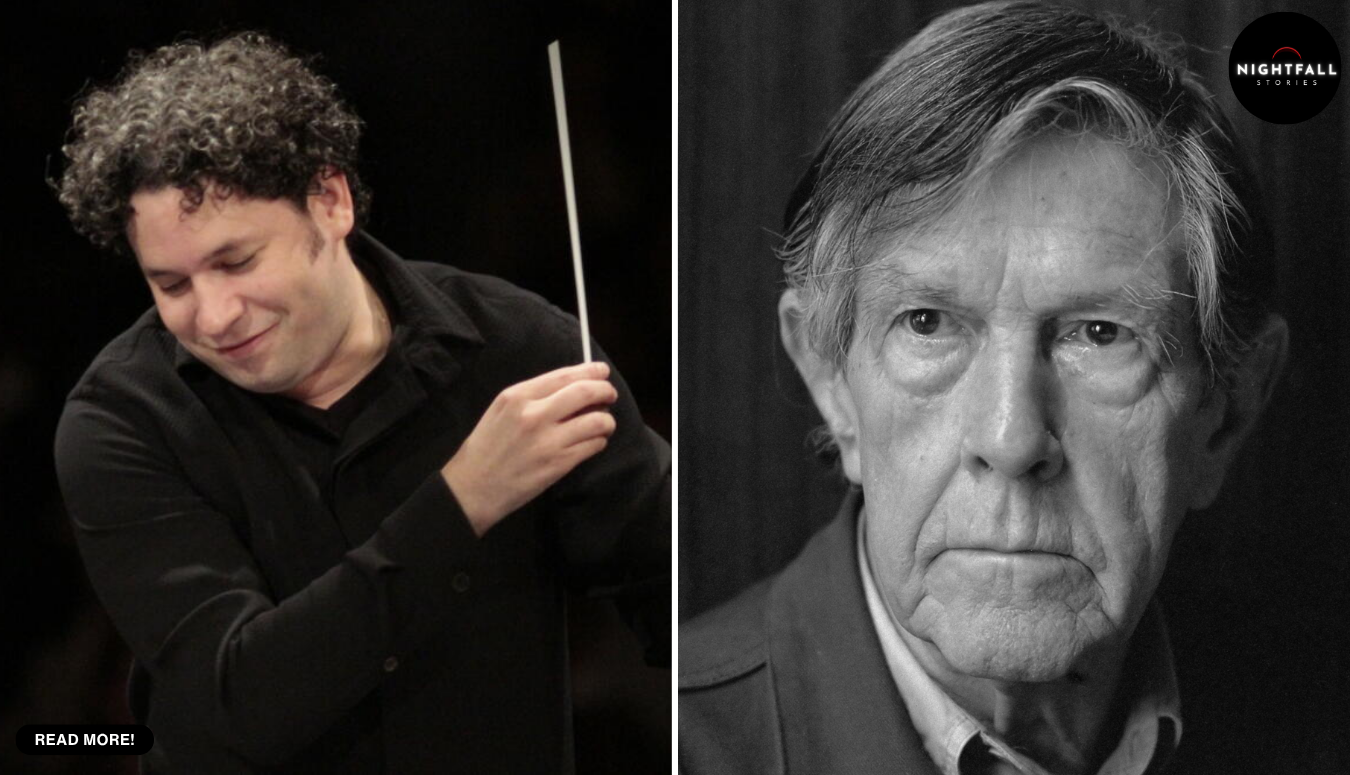
The final article Mark Swed filed as the staff classical music critic of the Los Angeles Times was not a summing up of his own career. It was about somebody else’s mother. Digging through his own newspaper’s archive, he had found a society page editor who worked there in the 1930s, a woman called Crete Cage, who used her column to argue that the city ought to build a permanent home for its orchestra. The campaign she pushed did not succeed in her lifetime as she imagined it, but it fed into the effort that produced the Music Center three decades later. Her son was John Cage, the composer who spent his life insisting that there is no wrong place to listen from and no such thing as the wrong sound.
Swed had been quoting Cage for decades without knowing that Cage’s mother had worked the same building he did. He found her because somebody had been paid to write in that paper ninety years ago, and because the record survived. That is not a small thing to notice on your way out of a job that is being discontinued.
He stepped down after thirty years. His newspaper announced it in its arts newsletter and described him, in its own words, as the last full-time classical music critic at a major American newspaper. Nobody is being hired to replace him.
That description deserves to be handled carefully, because it is a claim by the paper about its own departing employee, and a looser version of it went around immediately. One well-read classical news site ran the headline that America’s last classical music critic had retired, full stop, which is not true and would insult a lot of people who are still filing reviews. Classical criticism has not ended. It continues in specialist magazines, at broadcasters, on subscriber newsletters, at university-affiliated outlets and in a large ecosystem of writers paid per piece or not paid at all. What the narrow claim says is something specific and much easier to check: that no major American general-interest newspaper now employs somebody full time, on staff, whose job is to go and hear the music and report back. On the evidence available, that appears to be right.
The evidence is a run of separate decisions at separate companies, none of which was presented as a change of policy about classical music. Early last year the Washington Post cut around three hundred staff, and its classical music critic, Michael Andor Brodeur, was among them. No replacement has been announced. At the New York Times, Zachary Woolfe, who had been the paper’s classical music critic, was moved off the beat the year before that as part of a wider reshuffle of critics and is now an editor on the obituaries desk. At The New Yorker, Alex Ross, who joined the magazine in the same year Swed joined the Times and had held the post for three decades, announced his own decision to stop being the magazine’s music critic, though he stays on staff writing features. He was explicit that it was his choice and that the travel had worn him down.
Put those next to each other and the pattern is not a conspiracy against Mozart. It is what happens to any specialised full-time post when the economics of a newspaper tighten and nobody is willing to be the person who defends it in a budget meeting. Two of those four departures were voluntary. One was a layoff. One was a reassignment. The outcome in every case is the same: a chair that is not refilled.
Swed’s own exit was his choice too. He is eighty-one, and he had been reviewing for half a century. He filed his first music review fifty years before his last one, for the Los Angeles Herald Examiner, which no longer exists. He went on to be chief music critic at the Herald Examiner, at The Wall Street Journal and at a magazine called 7 Days, and he edited the twentieth-century section of a scholarly music quarterly through the 1990s. He arrived at the Los Angeles Times in 1996, taking over from Martin Bernheimer, a critic so feared and so quotable that following him was an unenviable assignment.
Bernheimer is worth a paragraph of his own, because he is the measure of what the post used to be. He held the chief music and dance critic’s chair at the same paper from 1965 until 1996, thirty-one years, and won the Pulitzer Prize for criticism in 1982. He was famous for being severe. People who worked in Los Angeles music in those decades still describe his prose as something that could end an evening. Between the two of them, Bernheimer and Swed, one newspaper had a full-time classical critic continuously for sixty-one years. That run finished this year and nothing follows it. When Bernheimer left the paper he went freelance and kept reviewing for a magazine and a financial daily until ill health slowed him, which is roughly the arrangement now being offered to everyone in the trade as a first option rather than a second.
It is worth being plain about what the job involved, because from the outside it can look like being given free tickets. A staff critic goes out four or five nights a week for most of the year. He hears music he has heard two hundred times before and has to find something honest to say about this particular performance of it. He hears new work that nobody has any received opinion about and has to form one in a few hours, in public, under his own name, knowing that the composer and the players will read it. Then he files, often the same night, and the next morning several hundred thousand people know what he thought. Do that for thirty years in one city and you are no longer a reviewer. You are the institutional memory of that city’s musical life.
Los Angeles in 1996 was not the place it is now in classical terms. The orchestra was a century old and well regarded, and it had recently appointed a young Finnish conductor, Esa-Pekka Salonen, who ran it from 1992 until 2009 and turned it into one of the most adventurous large ensembles anywhere. It had no proper winter home. The hall that Frank Gehry designed for it, funded in part by the Disney family, spent years mired in cost problems before it finally opened in 2003. Swed covered all of that: the argument about whether the building would work, the opening, and the two decades of music made in it since. Salonen’s tenure and then the whole of Gustavo Dudamel’s, which began in 2009, were reviewed by the same pair of ears from start to finish, which almost never happens any more. Salonen is due back with the orchestra as creative director for the coming season, which means Swed is leaving just as the story loops around again.
He tried, without much success, to get the concert hall to adopt a motto he borrowed from Cage: every seat is the best seat in the house. It sounds like a marketing line and is actually an argument. Cage’s position was that a listener’s position is never wrong, that what you hear from where you are sitting is the piece, and Gehry’s design happens to make that literally true in a way that traditional shoebox halls do not. A critic who spends thirty years pushing that idea in a mass-circulation newspaper is doing something other than handing out marks out of ten.
Swed was a finalist for the Pulitzer Prize in criticism. The citation on record is for a series of essays written during the pandemic, when there were no concerts to review at all, in which he recommended recordings as something closer to necessary company than entertainment and drew lines back across seven centuries of written music. That is the part of his work that survives best on rereading, partly because the essays were not tied to an event. He had to justify the whole enterprise from scratch to readers sitting at home, and he did it without condescending to anyone.
The question underneath all of this is not whether classical music can survive without newspaper critics. It obviously can; it predates newspapers. The question is narrower and more practical. When a reader who is not an expert wonders whether a concert was any good, or whether a new piece is worth two hours of their evening, who tells them, and who is paying that person.
The answers available now are mostly interested parties. Orchestras have marketing departments and they are good at their jobs. Artists have publicists. Streaming services have recommendation systems that are trained on what you already liked, which is the opposite of what a critic is for. Specialist publications do serious work but are read almost entirely by people already committed. What disappears with a staff post at a general newspaper is not the verdict. It is the accident: the reader who was not looking for classical music and encountered a piece of writing about it next to the film reviews, and went.
The other thing that disappears is the record, and that is the part Swed’s final piece quietly demonstrated. A newspaper critic writing several times a week produces, without meaning to, a continuous account of what a city’s musical life actually sounded like. Not the press releases and not the programmes, but whether the hall was full, whether the new commission worked, what the audience did. Historians use that. Biographers use it. Swed used it himself, in his last week, to find a woman whose contribution to the building of an orchestra’s home had gone uncredited for ninety years, and to connect her to a philosophy her son would later make famous.
For the 2020s in Los Angeles, that layer of the record now thins out. Somebody will still be writing. The people doing it will be freelancers filing occasionally, bloggers writing for the pleasure of it, and broadcasters covering the biggest events. Between them they will produce something, and some of it will be excellent. What they will not produce is the same thing, because coverage that depends on whether an individual can afford the evening is coverage with holes in it, and the holes will be in exactly the places that matter least commercially and most artistically, which is to say small ensembles, new work and anything outside the main season.
None of this is a complaint about editors. A newspaper arts desk in the 2020s is generally a small number of people covering film, television, music, theatre, art, architecture, books and whatever the internet did that week, for an audience that is measured in clicks by the hour. A full-time classical critic in that structure is the most expensive coverage per reader on the desk, and the numbers say so unambiguously every single month. Anyone defending the post has to argue that some things are worth publishing whether or not they perform, which is a difficult argument to win twice, let alone every budget cycle for thirty years. Swed’s tenure is better understood as an unusually long stay of execution than as a norm that has suddenly broken.
There is one softening detail, and it should be stated accurately rather than dressed up. Swed is not vanishing from the paper. His editor said publicly that she hoped he would keep writing a monthly column and asked him, more or less in print, to come back now and again. Swed’s own wording was more modest: he said he still planned to contribute on an irregular basis. Those two sentences are not the same offer, and the gap between them is the story in miniature. A monthly column is a commitment with a slot in the budget. An irregular contribution is a favour. Either way it is a reduction rather than a silence, and nobody involved has pretended otherwise. A deputy editor at the paper put it about as bluntly as an employee can, saying that with no full-time critic writing about classical music at any newspaper, American journalism will be poorer.
He is not retiring from music, either. He holds a fellowship at a humanities institute attached to the University of Southern California, and he has been working on a biography of Cage, which is presumably how he ended up in the archive that produced his last piece. A critic who leaves a staff job at eighty-one with a book in progress is not a sad figure. He got fifty years of going out to hear music and being paid to say what he thought about it, which is a better run than almost anybody in that trade has had.
What is worth holding on to is the shape of the thing he did on the way out. He did not write about the decline of criticism, or about himself, or about the industry that is closing the job behind him. He went into a ninety-year-old archive, found somebody who had been overlooked, and gave her the credit. It was a working critic’s instinct, applied one last time on deadline. The reason he could do it is that in the 1930s a newspaper paid a woman to write about the arts in her own city, and kept what she wrote. Whether anyone in 2116 will be able to do the same for Los Angeles now depends on people who are doing the work for nothing.

A sign-up sheet went out at eight in the morning on a side street in Berkeley, California, and the first fifty people in line were let into a 6,200 square foot warehouse at ten. Inside were the contents of one of the most influential effects workshops in the history of cinema, priced to move. Three of the holographic chess creatures from the first Star Wars film. An AT-AT walker from The Empire Strikes Back. Puppets, armatures, prototypes, moulds, motion-capture rigs, 3D printers, welding gear, toolboxes, vintage posters, and vehicles from Jurassic Park. Cash, credit or debit. Sold as is, no returns, no warranty, bring your own boxes and your own packing material.
The man whose studio it was, Phil Tippett, stood in the middle of it and told a local television crew that he got a small twinge of regret now and then, but that he did not have anywhere to put any of it. He is an Oscar winner twice over. He held on to both statues and let almost everything else walk out of the door in a stranger’s arms.
That is the part of the story that gets reported. The part worth sitting with is longer, and it turns on a decision he made more than thirty years ago that almost nobody would have made in his position.
Tippett was born in Berkeley in 1951 and has spent most of his working life within a short drive of where he grew up. He has said that the whole direction of his life was set at the age of seven, when he watched Ray Harryhausen’s The 7th Voyage of Sinbad and understood that the skeleton fighting with a sword had been made to move by a person, one frame at a time. Stop-motion animation is exactly that unglamorous. You build a figure with a jointed metal skeleton inside it, you photograph a single frame, you move the figure a fraction of an inch, you photograph another frame, and you repeat that until the light changes or your back gives out. Twenty-four of those adjustments buys you one second of film.
In 1975 he joined a small, chaotic outfit called Industrial Light and Magic, which had been set up to solve the effects problems on a science fiction film nobody expected much from. His contribution to the original Star Wars was the scene most people remember without remembering why: the little snarling creatures on the chess board aboard the Millennium Falcon. He animated them.
By The Empire Strikes Back he was running the animation department, and he had a problem that had bothered stop-motion artists since the beginning. A real object photographed while it is moving smears slightly across the frame. A puppet photographed while it is standing perfectly still does not. Put those still frames in sequence and the creature moves with a faint, crisp jitter that the eye reads as unreal, no matter how beautifully it has been sculpted. Tippett and his colleagues built a system that moved the figure a small amount during each exposure, so the blur appeared in the negative the way it does in life. They called it go-motion. The walking armoured machines on the ice planet in Empire were animated that way, as were the two-legged snow lizards the characters ride. That work brought him his first Academy Award nomination, for a fantasy film called Dragonslayer, and then the award itself for Return of the Jedi.
It is worth understanding what that award actually rewarded, because the effort involved is invisible on screen by design. A stop-motion animator does not perform. He calculates. Before touching the figure he has to decide how far a limb should travel in one twenty-fourth of a second, then hold that decision in his head across hours of small adjustments, in a darkened room, with no ability to review the result until the film comes back from processing. A single ten second shot can take weeks. Get one frame wrong and the creature flickers, and you shoot the sequence again. The dragon Tippett and his colleagues built for Dragonslayer is still cited by people who study this work as the most convincing creature of the pre-computer era, and it exists because a small number of people were willing to do arithmetic in the dark for months at a time.
In 1984 he left to start his own place with the producer Jules Roman. The studio’s calling card was a short film he had made of a dinosaur, built and animated with the blur technique, moving with a weight and a patience that no other effects house could match at the time. Through the rest of that decade the work came steadily. The clanking police robot in RoboCop, which lurches down a corridor and falls over a flight of stairs, is his, and it began a long working partnership with the designer Craig Hayes.
Then came the job that should have ended him.
Steven Spielberg hired him to supervise the dinosaurs for Jurassic Park. The plan, agreed and budgeted, was that the animals would be built as go-motion puppets, because that was the only technique on earth that could do it. Partway through, a small team at Industrial Light and Magic put together a computer-generated test of a herd of dinosaurs running across open ground. It was not a finished shot. It was enough. Tippett watched it and said out loud that he had just become extinct. The line went around the production and ended up, in slightly altered form, in the finished film, spoken by a character who is being told that his entire field of study has been overtaken by events.
Here is where almost anybody else would have gone home. His technique had been publicly retired in front of his employer, on the biggest film of the decade, by people he had trained. Instead he stayed on the picture and rebuilt his own job around the new tool. The computers could render a dinosaur; they had no idea how a dinosaur should move. Tippett and his animators became the people who decided that, working out the timing, the weight shifts, the way a huge animal turns its head before it turns its body, and then feeding those decisions into the digital pipeline. His team built an input device that let a stop-motion animator pose a physical armature and have the computer record the movement, which meant that hands trained over twenty years on puppets could still do the work. He took a second Academy Award for it.
That is the choice the whole story rests on. He did not defend the craft he had spent his life perfecting against the thing that replaced it. He went and taught the replacement how to act. There is a reasonable argument that the digital creature animation of the following thirty years, an industry worth an enormous amount of money and employing tens of thousands of people, carries his fingerprints precisely because he refused to sulk.
The studio adapted with him. Giant insects for Starship Troopers, creature work across a long list of films and television series, and a steady stream of commercial jobs. But the economics of the business he had helped create were never going to be kind to a mid-sized independent house. Visual effects work is bid competitively, often below cost, on schedules set by other people, with the money arriving late and the changes arriving early. Studios in that position win awards and go broke, sometimes in the same year. It has happened repeatedly to firms far larger than his. The best known case is a company called Rhythm and Hues, which filed for Chapter 11 protection in early 2013 and then, a fortnight or so later, won the Academy Award for visual effects for Life of Pi. The artist accepting it tried to talk about the state of the industry from the stage and the orchestra played him off. Nothing about the structure that produced that moment has changed since. Effects houses are suppliers competing on price for work that is essential to films earning billions, and the margin sits almost entirely at the other end of the chain.
In 2024 Tippett Studio agreed to sell a majority stake to PhantomFX, a visual effects company based in India, and filed for Chapter 11 bankruptcy protection. It is worth being precise about what that filing means, because the shorthand version is wrong. Chapter 11 is not a liquidation. It is a court-supervised reorganisation that lets a company keep trading while it restructures what it owes. The reorganisation was completed the following year. The Tippett Studio name is still in use, the company’s Toronto operation was reported to be in active production on a large feature at the time of the sale, and the man himself said he has no intention of retiring.
What closed was the Berkeley building, and what was sold was its contents. The studio was founded in 1984, and different accounts described the span as thirty-five years or as close to forty depending on whether they were counting the company or the physical facility. Tippett’s own summary was that it had been almost a forty year run and a good one.
The sale itself was the kind of event that tells you what a workshop actually was. Collectors came for the obvious trophies. So did former employees, including a man who had worked on Jurassic Park props in the late 1980s and came back to look at them one more time. A neighbour turned up hoping for a rare poster. Two hundred and seventy-three photographs of the stock went up on the liquidation company’s listing, and scrolling them is an odd experience, because roughly half the items are not film history at all. They are tools. Clamps, drills, paint, wire, the sort of inventory you would find in any well-run fabrication shop, accumulated over four decades by people who had to invent the thing they needed before they could use it.
There is no version of this that is not a loss. A working archive assembled over forty years has now been distributed among several hundred private buyers, which means that as a research collection it no longer exists. Museums hold some of Tippett’s work already, and individual pieces will surface at auction for years, but the shop as an organism is gone. Anyone who wanted to study how a practical effects house of that era actually functioned, what was kept, what was reused, what was scribbled on the back of a mould, has lost the chance.
There is a quieter loss inside that one. A workshop is also a teaching institution. Skills like armature fabrication, mould making and the specific judgment of how to weight a puppet are not written down in any useful form; they pass from a person who can do them to a person standing next to them, over years. Berkeley was one of a very small number of places on earth where that transfer was still happening as a matter of routine, on paid work, at professional standard. The people who learned it there have scattered into other companies and other countries, and some of them will keep teaching it. But the room where it happened is a warehouse for lease.
It is also true that Tippett had already done the thing that makes the archive less important than it sounds. For roughly three decades he was building a film of his own in the gaps between paying jobs, a wordless, hand-made stop-motion feature called Mad God, set in a ruined underworld and populated by creatures he sculpted himself. He started it, shelved it, came back to it, shelved it again as the studio’s workload allowed, and finally finished it. It premiered in 2021 to a reception that surprised people who had assumed the technique was a museum piece. It belongs to him rather than to any studio, which in rights terms makes it one of the few things in his long career he can do whatever he likes with.
He is now developing another stop-motion feature. He has also been open about using new digital tools in the making of it, which is entirely consistent with a man who once watched a computer render his obsolescence and then went to work for it.
The two Academy Awards stayed out of the sale. Tippett explained the decision in the plainest possible terms when a reporter asked: they were the big-ticket items, and they were the most significant moments in his journey. He could have sold them. Awards of that kind change hands, and two visual effects Oscars from Return of the Jedi and Jurassic Park would have fetched a great deal more than a box of clamps. He kept them and sold the tools instead, which is close to the opposite of what a sentimentalist would do. The tools can be bought again. The record of the two times he was right about where the medium was going cannot.
He told an interviewer he expects to die with his sword in his hand. The warehouse is empty, the company that bears his name is working out of another country, and the man who animated the creatures that ended his own technique is in his mid seventies and building puppets for one more film.