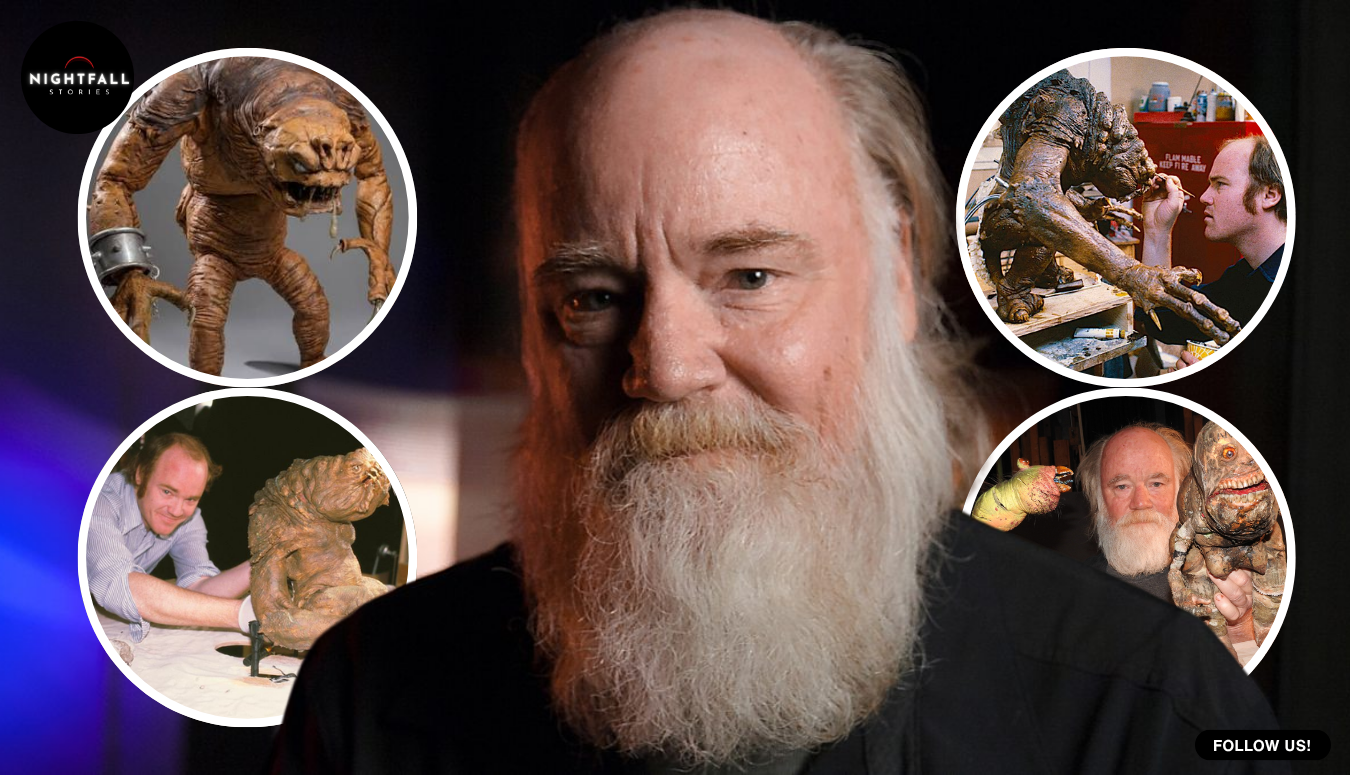
A sign-up sheet went out at eight in the morning on a side street in Berkeley, California, and the first fifty people in line were let into a 6,200 square foot warehouse at ten. Inside were the contents of one of the most influential effects workshops in the history of cinema, priced to move. Three of the holographic chess creatures from the first Star Wars film. An AT-AT walker from The Empire Strikes Back. Puppets, armatures, prototypes, moulds, motion-capture rigs, 3D printers, welding gear, toolboxes, vintage posters, and vehicles from Jurassic Park. Cash, credit or debit. Sold as is, no returns, no warranty, bring your own boxes and your own packing material.
The man whose studio it was, Phil Tippett, stood in the middle of it and told a local television crew that he got a small twinge of regret now and then, but that he did not have anywhere to put any of it. He is an Oscar winner twice over. He held on to both statues and let almost everything else walk out of the door in a stranger’s arms.
That is the part of the story that gets reported. The part worth sitting with is longer, and it turns on a decision he made more than thirty years ago that almost nobody would have made in his position.
Tippett was born in Berkeley in 1951 and has spent most of his working life within a short drive of where he grew up. He has said that the whole direction of his life was set at the age of seven, when he watched Ray Harryhausen’s The 7th Voyage of Sinbad and understood that the skeleton fighting with a sword had been made to move by a person, one frame at a time. Stop-motion animation is exactly that unglamorous. You build a figure with a jointed metal skeleton inside it, you photograph a single frame, you move the figure a fraction of an inch, you photograph another frame, and you repeat that until the light changes or your back gives out. Twenty-four of those adjustments buys you one second of film.
In 1975 he joined a small, chaotic outfit called Industrial Light and Magic, which had been set up to solve the effects problems on a science fiction film nobody expected much from. His contribution to the original Star Wars was the scene most people remember without remembering why: the little snarling creatures on the chess board aboard the Millennium Falcon. He animated them.
By The Empire Strikes Back he was running the animation department, and he had a problem that had bothered stop-motion artists since the beginning. A real object photographed while it is moving smears slightly across the frame. A puppet photographed while it is standing perfectly still does not. Put those still frames in sequence and the creature moves with a faint, crisp jitter that the eye reads as unreal, no matter how beautifully it has been sculpted. Tippett and his colleagues built a system that moved the figure a small amount during each exposure, so the blur appeared in the negative the way it does in life. They called it go-motion. The walking armoured machines on the ice planet in Empire were animated that way, as were the two-legged snow lizards the characters ride. That work brought him his first Academy Award nomination, for a fantasy film called Dragonslayer, and then the award itself for Return of the Jedi.
It is worth understanding what that award actually rewarded, because the effort involved is invisible on screen by design. A stop-motion animator does not perform. He calculates. Before touching the figure he has to decide how far a limb should travel in one twenty-fourth of a second, then hold that decision in his head across hours of small adjustments, in a darkened room, with no ability to review the result until the film comes back from processing. A single ten second shot can take weeks. Get one frame wrong and the creature flickers, and you shoot the sequence again. The dragon Tippett and his colleagues built for Dragonslayer is still cited by people who study this work as the most convincing creature of the pre-computer era, and it exists because a small number of people were willing to do arithmetic in the dark for months at a time.
In 1984 he left to start his own place with the producer Jules Roman. The studio’s calling card was a short film he had made of a dinosaur, built and animated with the blur technique, moving with a weight and a patience that no other effects house could match at the time. Through the rest of that decade the work came steadily. The clanking police robot in RoboCop, which lurches down a corridor and falls over a flight of stairs, is his, and it began a long working partnership with the designer Craig Hayes.
Then came the job that should have ended him.
Steven Spielberg hired him to supervise the dinosaurs for Jurassic Park. The plan, agreed and budgeted, was that the animals would be built as go-motion puppets, because that was the only technique on earth that could do it. Partway through, a small team at Industrial Light and Magic put together a computer-generated test of a herd of dinosaurs running across open ground. It was not a finished shot. It was enough. Tippett watched it and said out loud that he had just become extinct. The line went around the production and ended up, in slightly altered form, in the finished film, spoken by a character who is being told that his entire field of study has been overtaken by events.
Here is where almost anybody else would have gone home. His technique had been publicly retired in front of his employer, on the biggest film of the decade, by people he had trained. Instead he stayed on the picture and rebuilt his own job around the new tool. The computers could render a dinosaur; they had no idea how a dinosaur should move. Tippett and his animators became the people who decided that, working out the timing, the weight shifts, the way a huge animal turns its head before it turns its body, and then feeding those decisions into the digital pipeline. His team built an input device that let a stop-motion animator pose a physical armature and have the computer record the movement, which meant that hands trained over twenty years on puppets could still do the work. He took a second Academy Award for it.
That is the choice the whole story rests on. He did not defend the craft he had spent his life perfecting against the thing that replaced it. He went and taught the replacement how to act. There is a reasonable argument that the digital creature animation of the following thirty years, an industry worth an enormous amount of money and employing tens of thousands of people, carries his fingerprints precisely because he refused to sulk.
The studio adapted with him. Giant insects for Starship Troopers, creature work across a long list of films and television series, and a steady stream of commercial jobs. But the economics of the business he had helped create were never going to be kind to a mid-sized independent house. Visual effects work is bid competitively, often below cost, on schedules set by other people, with the money arriving late and the changes arriving early. Studios in that position win awards and go broke, sometimes in the same year. It has happened repeatedly to firms far larger than his. The best known case is a company called Rhythm and Hues, which filed for Chapter 11 protection in early 2013 and then, a fortnight or so later, won the Academy Award for visual effects for Life of Pi. The artist accepting it tried to talk about the state of the industry from the stage and the orchestra played him off. Nothing about the structure that produced that moment has changed since. Effects houses are suppliers competing on price for work that is essential to films earning billions, and the margin sits almost entirely at the other end of the chain.
In 2024 Tippett Studio agreed to sell a majority stake to PhantomFX, a visual effects company based in India, and filed for Chapter 11 bankruptcy protection. It is worth being precise about what that filing means, because the shorthand version is wrong. Chapter 11 is not a liquidation. It is a court-supervised reorganisation that lets a company keep trading while it restructures what it owes. The reorganisation was completed the following year. The Tippett Studio name is still in use, the company’s Toronto operation was reported to be in active production on a large feature at the time of the sale, and the man himself said he has no intention of retiring.
What closed was the Berkeley building, and what was sold was its contents. The studio was founded in 1984, and different accounts described the span as thirty-five years or as close to forty depending on whether they were counting the company or the physical facility. Tippett’s own summary was that it had been almost a forty year run and a good one.
The sale itself was the kind of event that tells you what a workshop actually was. Collectors came for the obvious trophies. So did former employees, including a man who had worked on Jurassic Park props in the late 1980s and came back to look at them one more time. A neighbour turned up hoping for a rare poster. Two hundred and seventy-three photographs of the stock went up on the liquidation company’s listing, and scrolling them is an odd experience, because roughly half the items are not film history at all. They are tools. Clamps, drills, paint, wire, the sort of inventory you would find in any well-run fabrication shop, accumulated over four decades by people who had to invent the thing they needed before they could use it.
There is no version of this that is not a loss. A working archive assembled over forty years has now been distributed among several hundred private buyers, which means that as a research collection it no longer exists. Museums hold some of Tippett’s work already, and individual pieces will surface at auction for years, but the shop as an organism is gone. Anyone who wanted to study how a practical effects house of that era actually functioned, what was kept, what was reused, what was scribbled on the back of a mould, has lost the chance.
There is a quieter loss inside that one. A workshop is also a teaching institution. Skills like armature fabrication, mould making and the specific judgment of how to weight a puppet are not written down in any useful form; they pass from a person who can do them to a person standing next to them, over years. Berkeley was one of a very small number of places on earth where that transfer was still happening as a matter of routine, on paid work, at professional standard. The people who learned it there have scattered into other companies and other countries, and some of them will keep teaching it. But the room where it happened is a warehouse for lease.
It is also true that Tippett had already done the thing that makes the archive less important than it sounds. For roughly three decades he was building a film of his own in the gaps between paying jobs, a wordless, hand-made stop-motion feature called Mad God, set in a ruined underworld and populated by creatures he sculpted himself. He started it, shelved it, came back to it, shelved it again as the studio’s workload allowed, and finally finished it. It premiered in 2021 to a reception that surprised people who had assumed the technique was a museum piece. It belongs to him rather than to any studio, which in rights terms makes it one of the few things in his long career he can do whatever he likes with.
He is now developing another stop-motion feature. He has also been open about using new digital tools in the making of it, which is entirely consistent with a man who once watched a computer render his obsolescence and then went to work for it.
The two Academy Awards stayed out of the sale. Tippett explained the decision in the plainest possible terms when a reporter asked: they were the big-ticket items, and they were the most significant moments in his journey. He could have sold them. Awards of that kind change hands, and two visual effects Oscars from Return of the Jedi and Jurassic Park would have fetched a great deal more than a box of clamps. He kept them and sold the tools instead, which is close to the opposite of what a sentimentalist would do. The tools can be bought again. The record of the two times he was right about where the medium was going cannot.
He told an interviewer he expects to die with his sword in his hand. The warehouse is empty, the company that bears his name is working out of another country, and the man who animated the creatures that ended his own technique is in his mid seventies and building puppets for one more film.