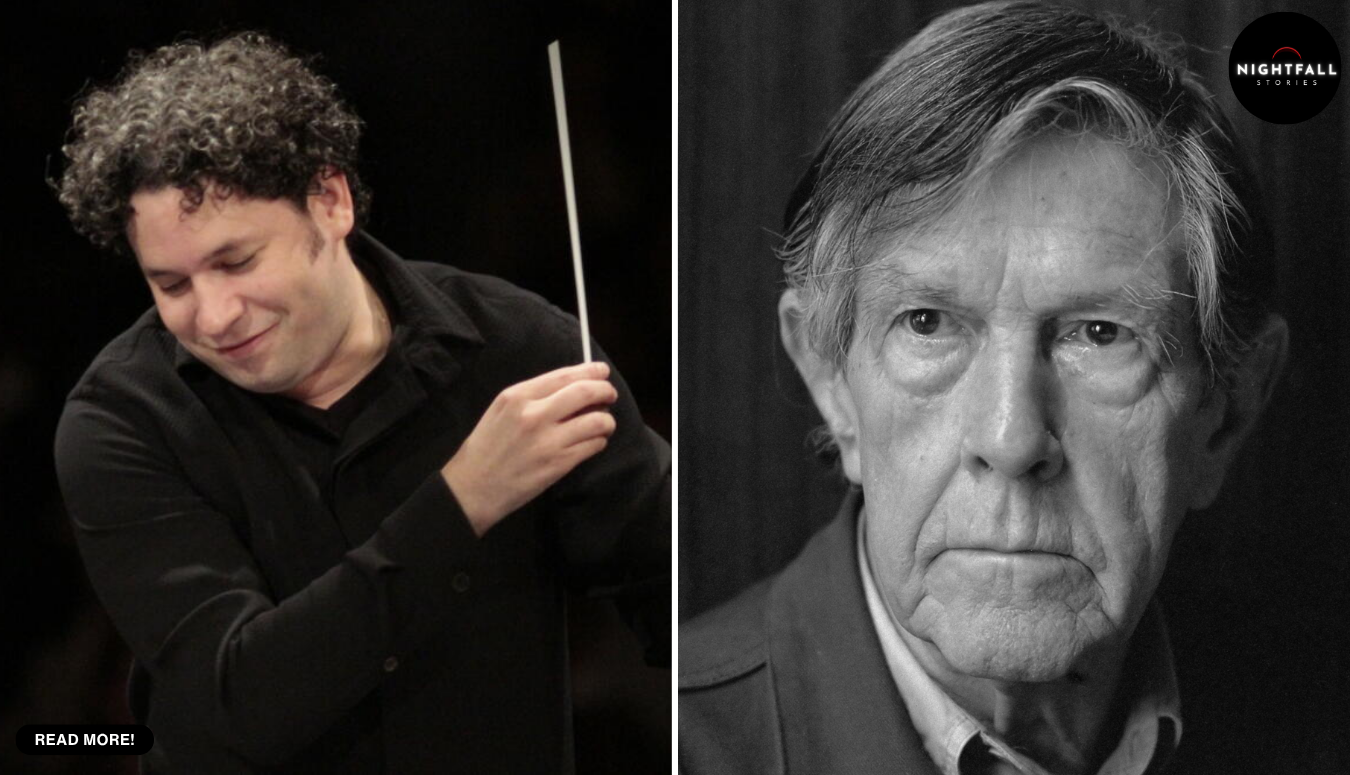
The final article Mark Swed filed as the staff classical music critic of the Los Angeles Times was not a summing up of his own career. It was about somebody else’s mother. Digging through his own newspaper’s archive, he had found a society page editor who worked there in the 1930s, a woman called Crete Cage, who used her column to argue that the city ought to build a permanent home for its orchestra. The campaign she pushed did not succeed in her lifetime as she imagined it, but it fed into the effort that produced the Music Center three decades later. Her son was John Cage, the composer who spent his life insisting that there is no wrong place to listen from and no such thing as the wrong sound.
Swed had been quoting Cage for decades without knowing that Cage’s mother had worked the same building he did. He found her because somebody had been paid to write in that paper ninety years ago, and because the record survived. That is not a small thing to notice on your way out of a job that is being discontinued.
He stepped down after thirty years. His newspaper announced it in its arts newsletter and described him, in its own words, as the last full-time classical music critic at a major American newspaper. Nobody is being hired to replace him.
That description deserves to be handled carefully, because it is a claim by the paper about its own departing employee, and a looser version of it went around immediately. One well-read classical news site ran the headline that America’s last classical music critic had retired, full stop, which is not true and would insult a lot of people who are still filing reviews. Classical criticism has not ended. It continues in specialist magazines, at broadcasters, on subscriber newsletters, at university-affiliated outlets and in a large ecosystem of writers paid per piece or not paid at all. What the narrow claim says is something specific and much easier to check: that no major American general-interest newspaper now employs somebody full time, on staff, whose job is to go and hear the music and report back. On the evidence available, that appears to be right.
The evidence is a run of separate decisions at separate companies, none of which was presented as a change of policy about classical music. Early last year the Washington Post cut around three hundred staff, and its classical music critic, Michael Andor Brodeur, was among them. No replacement has been announced. At the New York Times, Zachary Woolfe, who had been the paper’s classical music critic, was moved off the beat the year before that as part of a wider reshuffle of critics and is now an editor on the obituaries desk. At The New Yorker, Alex Ross, who joined the magazine in the same year Swed joined the Times and had held the post for three decades, announced his own decision to stop being the magazine’s music critic, though he stays on staff writing features. He was explicit that it was his choice and that the travel had worn him down.
Put those next to each other and the pattern is not a conspiracy against Mozart. It is what happens to any specialised full-time post when the economics of a newspaper tighten and nobody is willing to be the person who defends it in a budget meeting. Two of those four departures were voluntary. One was a layoff. One was a reassignment. The outcome in every case is the same: a chair that is not refilled.
Swed’s own exit was his choice too. He is eighty-one, and he had been reviewing for half a century. He filed his first music review fifty years before his last one, for the Los Angeles Herald Examiner, which no longer exists. He went on to be chief music critic at the Herald Examiner, at The Wall Street Journal and at a magazine called 7 Days, and he edited the twentieth-century section of a scholarly music quarterly through the 1990s. He arrived at the Los Angeles Times in 1996, taking over from Martin Bernheimer, a critic so feared and so quotable that following him was an unenviable assignment.
Bernheimer is worth a paragraph of his own, because he is the measure of what the post used to be. He held the chief music and dance critic’s chair at the same paper from 1965 until 1996, thirty-one years, and won the Pulitzer Prize for criticism in 1982. He was famous for being severe. People who worked in Los Angeles music in those decades still describe his prose as something that could end an evening. Between the two of them, Bernheimer and Swed, one newspaper had a full-time classical critic continuously for sixty-one years. That run finished this year and nothing follows it. When Bernheimer left the paper he went freelance and kept reviewing for a magazine and a financial daily until ill health slowed him, which is roughly the arrangement now being offered to everyone in the trade as a first option rather than a second.
It is worth being plain about what the job involved, because from the outside it can look like being given free tickets. A staff critic goes out four or five nights a week for most of the year. He hears music he has heard two hundred times before and has to find something honest to say about this particular performance of it. He hears new work that nobody has any received opinion about and has to form one in a few hours, in public, under his own name, knowing that the composer and the players will read it. Then he files, often the same night, and the next morning several hundred thousand people know what he thought. Do that for thirty years in one city and you are no longer a reviewer. You are the institutional memory of that city’s musical life.
Los Angeles in 1996 was not the place it is now in classical terms. The orchestra was a century old and well regarded, and it had recently appointed a young Finnish conductor, Esa-Pekka Salonen, who ran it from 1992 until 2009 and turned it into one of the most adventurous large ensembles anywhere. It had no proper winter home. The hall that Frank Gehry designed for it, funded in part by the Disney family, spent years mired in cost problems before it finally opened in 2003. Swed covered all of that: the argument about whether the building would work, the opening, and the two decades of music made in it since. Salonen’s tenure and then the whole of Gustavo Dudamel’s, which began in 2009, were reviewed by the same pair of ears from start to finish, which almost never happens any more. Salonen is due back with the orchestra as creative director for the coming season, which means Swed is leaving just as the story loops around again.
He tried, without much success, to get the concert hall to adopt a motto he borrowed from Cage: every seat is the best seat in the house. It sounds like a marketing line and is actually an argument. Cage’s position was that a listener’s position is never wrong, that what you hear from where you are sitting is the piece, and Gehry’s design happens to make that literally true in a way that traditional shoebox halls do not. A critic who spends thirty years pushing that idea in a mass-circulation newspaper is doing something other than handing out marks out of ten.
Swed was a finalist for the Pulitzer Prize in criticism. The citation on record is for a series of essays written during the pandemic, when there were no concerts to review at all, in which he recommended recordings as something closer to necessary company than entertainment and drew lines back across seven centuries of written music. That is the part of his work that survives best on rereading, partly because the essays were not tied to an event. He had to justify the whole enterprise from scratch to readers sitting at home, and he did it without condescending to anyone.
The question underneath all of this is not whether classical music can survive without newspaper critics. It obviously can; it predates newspapers. The question is narrower and more practical. When a reader who is not an expert wonders whether a concert was any good, or whether a new piece is worth two hours of their evening, who tells them, and who is paying that person.
The answers available now are mostly interested parties. Orchestras have marketing departments and they are good at their jobs. Artists have publicists. Streaming services have recommendation systems that are trained on what you already liked, which is the opposite of what a critic is for. Specialist publications do serious work but are read almost entirely by people already committed. What disappears with a staff post at a general newspaper is not the verdict. It is the accident: the reader who was not looking for classical music and encountered a piece of writing about it next to the film reviews, and went.
The other thing that disappears is the record, and that is the part Swed’s final piece quietly demonstrated. A newspaper critic writing several times a week produces, without meaning to, a continuous account of what a city’s musical life actually sounded like. Not the press releases and not the programmes, but whether the hall was full, whether the new commission worked, what the audience did. Historians use that. Biographers use it. Swed used it himself, in his last week, to find a woman whose contribution to the building of an orchestra’s home had gone uncredited for ninety years, and to connect her to a philosophy her son would later make famous.
For the 2020s in Los Angeles, that layer of the record now thins out. Somebody will still be writing. The people doing it will be freelancers filing occasionally, bloggers writing for the pleasure of it, and broadcasters covering the biggest events. Between them they will produce something, and some of it will be excellent. What they will not produce is the same thing, because coverage that depends on whether an individual can afford the evening is coverage with holes in it, and the holes will be in exactly the places that matter least commercially and most artistically, which is to say small ensembles, new work and anything outside the main season.
None of this is a complaint about editors. A newspaper arts desk in the 2020s is generally a small number of people covering film, television, music, theatre, art, architecture, books and whatever the internet did that week, for an audience that is measured in clicks by the hour. A full-time classical critic in that structure is the most expensive coverage per reader on the desk, and the numbers say so unambiguously every single month. Anyone defending the post has to argue that some things are worth publishing whether or not they perform, which is a difficult argument to win twice, let alone every budget cycle for thirty years. Swed’s tenure is better understood as an unusually long stay of execution than as a norm that has suddenly broken.
There is one softening detail, and it should be stated accurately rather than dressed up. Swed is not vanishing from the paper. His editor said publicly that she hoped he would keep writing a monthly column and asked him, more or less in print, to come back now and again. Swed’s own wording was more modest: he said he still planned to contribute on an irregular basis. Those two sentences are not the same offer, and the gap between them is the story in miniature. A monthly column is a commitment with a slot in the budget. An irregular contribution is a favour. Either way it is a reduction rather than a silence, and nobody involved has pretended otherwise. A deputy editor at the paper put it about as bluntly as an employee can, saying that with no full-time critic writing about classical music at any newspaper, American journalism will be poorer.
He is not retiring from music, either. He holds a fellowship at a humanities institute attached to the University of Southern California, and he has been working on a biography of Cage, which is presumably how he ended up in the archive that produced his last piece. A critic who leaves a staff job at eighty-one with a book in progress is not a sad figure. He got fifty years of going out to hear music and being paid to say what he thought about it, which is a better run than almost anybody in that trade has had.
What is worth holding on to is the shape of the thing he did on the way out. He did not write about the decline of criticism, or about himself, or about the industry that is closing the job behind him. He went into a ninety-year-old archive, found somebody who had been overlooked, and gave her the credit. It was a working critic’s instinct, applied one last time on deadline. The reason he could do it is that in the 1930s a newspaper paid a woman to write about the arts in her own city, and kept what she wrote. Whether anyone in 2116 will be able to do the same for Los Angeles now depends on people who are doing the work for nothing.