Blog

  • He built bridges for villages the state never reached. One village asked him three times

    He built bridges for villages the state never reached. One village asked him three times

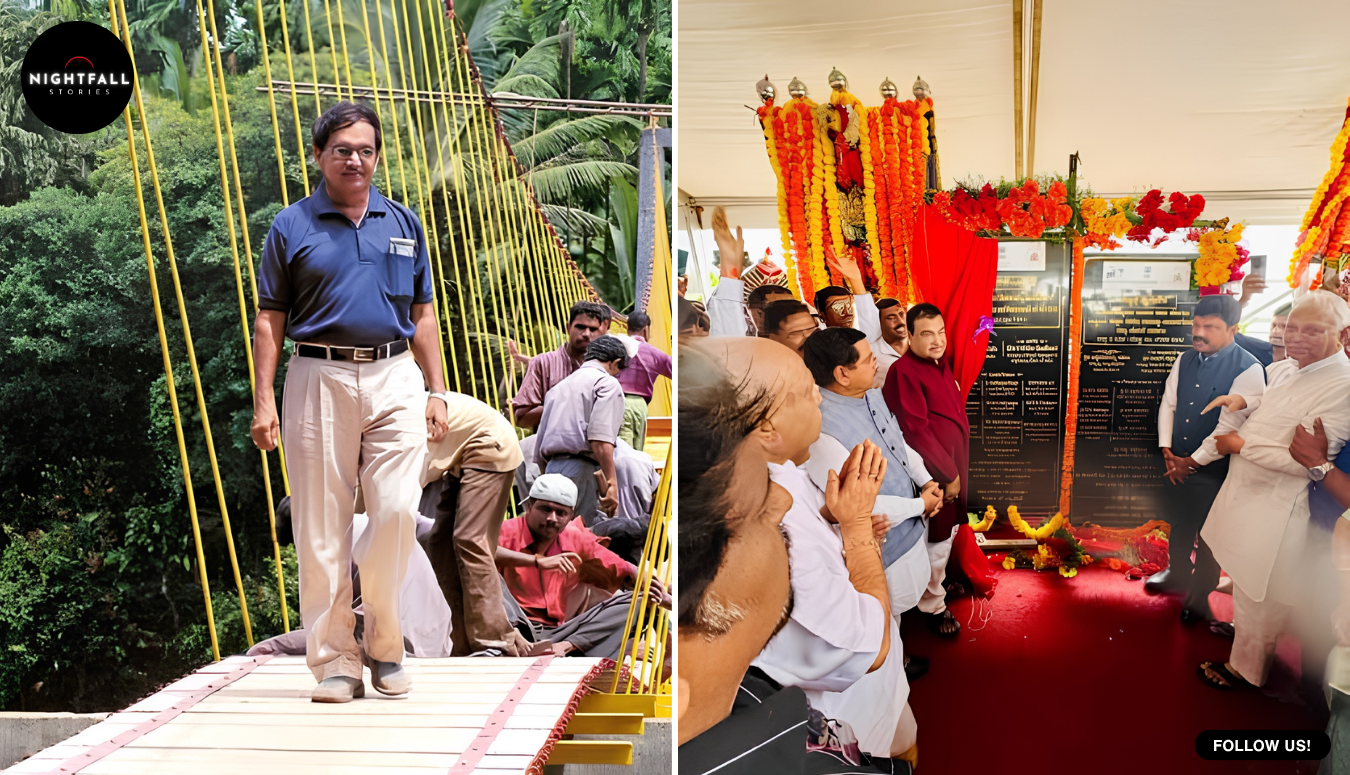
    In a village in Kerala’s Kasaragod district, a schoolteacher called Prashanth Nerolu can tell you exactly how many times the man came. Three. Three separate visits to the bank of the Shiriya river, walking the ground, looking at where the water rises, working out what it would take and what it would cost. Each time he went away and wrote the numbers down. Each time the paperwork went up the chain and stopped somewhere.

    The man was Girish Bharadwaj, and he had built well over a hundred footbridges across rural India by then, which is why Adkasthala had asked for him specifically rather than waiting any longer for anyone else. He died earlier this year, aged 76, at a hospital in his own home town of Sullia. Adkasthala still has no bridge across the Shiriya.

    That is the shape of it, and it is worth putting at the front rather than saving, because the tidy version of this man’s life leaves it out. The tidy version is a national award, a nickname the newspapers liked, and a large number of bridges. The number itself turns out to be one of the strangest things about him, and we will come to that.

    He was not a bridge engineer. He trained as a mechanical engineer and graduated first class from P.E.S. College of Engineering in Mandya in 1973, and he had job offers of the kind that take a young man in that part of Karnataka out of it for good. His father, a farmer, told him to stay and fix things people actually needed fixing. So he set up a workshop in Sullia and spent the next decade and a half repairing farm machinery and fabricating whatever the surrounding district brought through the door. Nothing about that is a career heading towards suspension bridges.

    Then, in 1989, a group of residents from Aramburu, a village in the same taluk, came to see him. They were separated from the other side of the Payaswini river by water, and their arrangement for crossing it was a country boat, which is an arrangement that fails at exactly the moments you need it most. They had heard he could build things. They asked him whether he could build them a bridge.

    He said no. This is the detail that most of the obituaries skipped and it is the one that makes him legible as a person rather than a plaque. He was nearly forty, he had never designed a bridge, and the cost of the kind of bridge he understood a bridge to be was far beyond anything Aramburu could raise. Refusing was not cowardice. It was an accurate assessment.

    What changed his mind was that the villagers did not accept the refusal. They kept coming back, and their confidence in him was, by his own later account, out of all proportion to anything he had done to earn it. So he went to look at the river. Then he went and read about suspension bridges, and talked to engineers who had built them, and worked out what the cheapest honest version of one would be.

    The bridge he built across the Payaswini was a pedestrian suspension span of somewhere between eighty seven and ninety seven metres, depending on which account you take. It took three months. It cost in the region of one hundred thousand rupees, which even allowing for the exchange rates of the time is a remarkably small figure for a river crossing, and it was raised locally rather than granted from above. The villagers themselves did much of the labour, without pay, which was not a cost saving dressed up as participation. He came to believe it was the point. A village that had carried the cable and dug the anchor pits owned the bridge afterwards in a way that a village handed a finished structure by a contractor did not, and would look after it.

    Everything he did for the next thirty seven years was a refinement of that first job. The design stayed deliberately modest: a walkway, not a road. No vehicles, no lorries, nothing that requires piers sunk into a riverbed or months of concrete curing. That restriction is what made the economics work. A conventional concrete bridge in that terrain takes at minimum eighteen months and a budget in a different order of magnitude. His took about three months. He could put up roughly three a year with a working team of about thirty people, which sounds unambitious until you consider that he was doing it in places where the alternative was nothing at all, indefinitely.

    The engineering behind the cost is not mysterious, and he never pretended it was. A vehicle bridge has to hold up a moving mass of many tonnes at unpredictable points along its length, which forces you into deep foundations in a riverbed, heavy decking, and the long slow business of concrete. A footbridge carries people. Suspend the walkway from cables anchored into the banks and you do not have to touch the riverbed at all, which in monsoon country removes the single most expensive and most weather dependent part of the job. The components are fabricable in a workshop, which is precisely the workshop he already had, and assembled on site by people who do not need to be specialists. What he spent nearly four decades doing was tightening that formula: lighter where it could be lighter, stronger at the two or three places where failure would actually matter, and standardised enough that the next village’s bridge did not need to be designed from nothing.

    The other half of the method was social rather than structural, and it is the half that most schemes get wrong. Because the village supplied labour, the village knew how the thing was put together. He was also insistent on being physically present while a span went up, on the grounds that he was watching two things at once, the quality of the work and the safety of the men doing it. A bridge built that way tends to still be standing twenty years later, because somebody local notices a frayed cable before it becomes a collapse.

    It is easy to write about rural connectivity in the abstract and lose what a footbridge actually is. So: it is a child not missing school for four months of the monsoon. It is a market reachable on foot on the day the crop is ready rather than the day the water goes down. It is, most bluntly, the difference between a person having a heart attack at nine in the evening and a person having a heart attack at nine in the evening on the wrong side of a river. Villages with no crossing do not simply travel further. They make different decisions about their whole lives, and most of those decisions are worse. A hundred metres of walkway changes the arithmetic of everything.

    The work spread outward from Dakshina Kannada in a way he never seems to have planned. A forest officer who had been transferred from Sullia to Kushalnagar asked him whether he could connect an island in the Cauvery to the mainland, and he did. Kerala took him up in numbers, with something like thirty bridges there. Then Telangana, Andhra Pradesh, Odisha, and by most accounts Tamil Nadu. In Odisha he put a hundred and fifty one metre span across the Nagavali river at Chekaguda in Rayagada, begun in late 2011 and finished the following March, working with a state agency, at a cost of about fifteen million rupees. He set up a foundation, Bharat Grama Sethu Pratisthana, to carry the work. His son Pathanjali came into the design and construction side.

    And here is the odd thing about the total, which matters because it says something about how invisible this kind of work is even when it is being praised. Nobody knows how many bridges he built. Not approximately. Not within a reasonable margin.

    The Kerala outlet that reported his death and the Adkasthala story put it at more than one hundred and forty. A national broadcaster’s headline on the same day said more than three hundred, and repeated the figure in its own text, while a Kannada post embedded in that same page said more than one hundred and forty. One major Indian daily settled on more than a hundred and fifty. A development sector write up said a hundred and forty plus, noting that the figure had been given as a hundred and twenty eight back in 2017 and nearly a hundred and fifty by the end of his life. His encyclopaedia entry says around a hundred and twenty seven. A profile written years earlier, mid career, said nearly eighty in twelve years, with over a hundred more requests outstanding.

    Those numbers are not variations on a theme. The gap between one hundred and forty and three hundred is not a rounding difference or a translation slip. It is more than a hundred and fifty bridges, each of them a real structure standing over a real river that somebody walks across, and the Indian press could not agree on whether they exist. I am not going to split the difference and print an average, because an average of two contradictory figures is not a fact, it is a way of hiding that you do not know. The defensible floor, supported by nearly every source and by his own foundation’s accounts, is well over a hundred. Beyond that, the honest answer is that the record is a mess.

    There is a reason for the mess, and it is not sloppiness so much as the nature of what he did. He built where the state had not, for communities that do not generate paperwork, often funded by a mixture of village collections, local donations and whatever government scheme could be persuaded to contribute. There was no single register. A man who had built ninety bridges and a man who had built two hundred and ninety would look the same from Delhi, because neither of them appears in the national accounts in any form that adds up.

    Delhi did notice him eventually. In 2017 he was given the Padma Shri, India’s fourth highest civilian honour, in the social work category. He collected honorary doctorates. Journalists gave him the nickname that stuck, the Bridge Man of India, and by his own account in later years the thing people said to him most often was thank you, from villagers describing what the crossing had changed.

    What the award did not do is what awards generally do not do. It did not put a fast lane in front of the files. Which brings us back to Adkasthala.

    The village sits in the Enmakaje panchayat in Kasaragod, on the wrong side of the Shiriya, along with the hamlets of Nerolu, Gurinerolu and Manjalagiri. It has been asking for a crossing for more than three decades. The specific project has been formally under consideration since 2010, which is sixteen years of being considered. Bharadwaj went there three times, at their request, and produced estimates each time. The approval never came.

    Nerolu, the teacher, has made the argument in the plainest available terms. He has a car, so for him the detour is an inconvenience. He asks people to think instead about the schoolchildren and the college students who make the same journey every day, in both directions, without one. That is the whole case. It has been the whole case since before some of those students were born.

    Nobody has published a villain here, and inventing one would be dishonest. There is no record of a minister refusing, no scandal, no single decision to point at. What there is instead is the ordinary machinery: a proposal that needs clearance from more than one department, in a place where a river forms a boundary between jurisdictions, with no constituency loud enough to make delay expensive for anyone. Files like that do not get rejected. They get considered, which is a thing that can be done forever.

    He died on a Tuesday in early July, at a private hospital in Sullia, after a brief illness that was reported as heart related. He was 76, born in Sullia in 1950 and dead in it. He is survived by his wife Usha and their children. The tributes were warm and largely accurate and used the nickname a great deal.

    It would be easy to end by saying the bridges are his monument, and easier still to say that the one he never built is somehow the most eloquent of them. Both of those are ways of making an unfinished thing sound complete, and the second one is close to obscene, because an unbuilt bridge is not poetry. It is a river that children still have to go round.

    So the honest ending is the one the village is living in. Girish Bharadwaj spent thirty seven years demonstrating that a footbridge over a rural river in India is a three month job, requires no exotic technology, and can be paid for with a sum that would not cover the landscaping on a flyover. He proved it well over a hundred times, in at least five states, well enough that the government pinned a medal on him for it. Then he went to Adkasthala three times, wrote down what it would cost, and waited with them for an approval that did not arrive in his lifetime.

    The bridge is still not built. The estimates presumably still exist in a file somewhere. The man who knew how to do it is dead, and the children are still walking the long way.

  • Before he took a breath, a surgeon had already reached inside and moved his intestines back

    Before he took a breath, a surgeon had already reached inside and moved his intestines back

    At the twenty week scan, the sonographer stopped moving the probe. Maisie Savage was on the table in a London hospital expecting the ordinary reassurance of a mid pregnancy appointment, the kind where you find out whether you are having a boy, and instead the screen showed her son’s intestines floating outside his body. They had pushed through a small opening in his abdominal wall, just beside where his navel was going to be.

    Late last year, in an operating room in Houston, a surgical team went into her uterus through incisions barely wide enough to pass an instrument, drained away the amniotic fluid, filled the space with gas so they could see, moved the loops of bowel back inside the boy, and closed the wall. He was still fourteen weeks away from being born. He had no name yet in public, no birthday, no weight. He had a repaired abdomen.

    He is Theo French, and the reason anyone outside two families and one hospital knows about him is what happened after the birth rather than before it. He arrived full term at normal weight. He was feeding fully within two days. He went home on the third.

    To understand why a day three discharge is the part that made surgeons put down their coffee, you have to know what the condition normally costs a newborn. Gastroschisis is an abdominal wall defect in which the intestines develop outside the body during pregnancy, and it is not rare in the way that word usually implies. Most cases are what surgeons call simple: the bowel is out, but it is otherwise intact. Those babies are delivered, the intestines are returned in one or two operations, and they go home after roughly a month.

    Theo’s case was the other kind. Complex gastroschisis means the exposed bowel has also been damaged while it was outside, twisted, narrowed, atretic, part of it sometimes dead. It accounts for a minority of cases, somewhere around one in six in published series, and the difference in what follows is not marginal. In one recent single centre study of seventy seven infants, the babies with simple gastroschisis had a median hospital stay of thirty four days. The babies with complex gastroschisis had a median stay of one hundred and ten. Sixty nine per cent of the complex group needed two or more operations, against eight per cent of the simple group. Sepsis rates were more than double.

    Those are the numbers that a specialist in London would have had in mind when Maisie and Josh French, both of them teachers, sat down to hear what the scan meant. Months in intensive care. A staged closure, where the bowel is held in a silo above the body and eased back a little at a time over days or weeks. Feeding through a line into a vein because the gut cannot cope with milk. More operations later for the narrowed sections. And a real chance of a childhood organised around a digestive system that never quite works.

    Survival, it should be said plainly, is high. Better than ninety five per cent of babies born with gastroschisis now live. The question was never whether Theo would survive. The question was what kind of first year he would have, and what the damage already happening to his bowel in the amniotic fluid would cost him for the rest of his life.

    That is the pressure that makes the fetal argument worth having at all. Amniotic fluid is not neutral to intestine. Over the second and third trimesters, bowel sitting outside the body is bathed in it, and the longer that goes on, the thicker and more inflamed and more matted it becomes. Every week of waiting is another week of injury. So the obvious thought, which people have had for decades, is why wait for the birth at all.

    The reason is that opening a pregnant uterus is a serious thing to do. Traditional fetal surgery means a hysterotomy, a large incision in the womb. It carries real risk of preterm labour, membrane rupture, bleeding, and a uterine scar that affects every pregnancy afterwards. For a condition with a ninety five per cent survival rate, trading a manageable neonatal course for a threat to the whole pregnancy and to the mother is not an obvious bargain. It is why in utero repair of gastroschisis stayed theoretical for so long. The maths did not work.

    What changed the maths was the keyhole. Doctors at Great Ormond Street Hospital in London, having diagnosed the complex form, told the family about a clinical trial in the United States, at Texas Children’s Hospital in Houston, that was attempting the repair fetoscopically. Not a hysterotomy. Small ports, a camera, instruments on the end of long shafts, the same basic idea that turned gallbladder surgery from a week in hospital into a day case, applied to an operation performed on a patient who has not been born.

    So the family did what a small number of families end up doing when the only version of the care they want exists on another continent. They left London and relocated to Texas for the rest of the pregnancy. On the way there was a stop in Belgium, at the hospital in Leuven, where Theo was given an injection of botulinum toxin to relax the muscle of his abdominal wall and make the opening easier to work through and to close. Two continents, three countries, one unborn patient, before the actual operation had even started.

    There is an uncomfortable thing sitting underneath that itinerary, and it is worth naming rather than stepping around. The reason the family had to move is that the trial exists in one place. Fetal surgery of this kind is concentrated in a handful of centres worldwide, because it needs a fetal surgeon, a maternal fetal medicine specialist, a neonatal team and an anaesthetic team who have all done it together enough times to be calm. That concentration is the right way to build a difficult operation safely, and it also means that access to it is decided partly by whether a family can pick up their life and relocate for a trimester. The London referral was the system working. The plane ticket was the part the system does not cover.

    The decision itself is the part that is easy to skate past. Read it quickly and it sounds like an obvious yes. It was not. They were being offered a place in a trial, which by definition means the outcome was not known. Theo was the third candidate enrolled. The alternative on the table was a difficult but well understood path: have the baby, hand him to a good neonatal unit, and accept months of intensive care. Instead they were being asked to accept an experimental operation on a fetus at twenty six weeks, performed through the wall of a uterus that was carrying him, with the risk that the pregnancy would end that week and there would be no baby at all.

    There is no calculator for that. Maisie has described the period as an anxious and frightening one, and she has not dressed it up. They were not brave in the film version of the word. They were two teachers in an unfamiliar city, a long way from their own families, agreeing to something nobody could promise them.

    They also had to hold two ideas at once for about six weeks, which is the part parents in trials rarely get credit for. One was hope, because that is what gets you on the plane. The other was that the honest answer to what will happen to my son was that nobody knew, and that pretending otherwise would have been a kindness nobody was offering them.

    The operation went ahead late last year, at twenty six weeks. The team was led by Dr Michael Belfort, the obstetrician and gynaecologist in chief at Texas Children’s Pavilion for Women, who has spent his career on fetal intervention, alongside Dr Sundeep Keswani, the hospital’s associate surgeon in chief and the principal investigator on the trial, and colleagues including Dr Luc Joyeux and Dr Magdalena Sanz Cortes. It is a formal, FDA authorised clinical trial with a registration number, not a one off act of improvisation, and that distinction matters more than it sounds. A single dramatic case can be luck. A trial is an attempt to find out.

    The technique, described plainly, is strange to sit with. The uterus is partially exposed so the team can position it and position the baby inside it. The amniotic fluid is drained out and replaced with carbon dioxide gas, which opens up a working space and lets the camera see. Then the intestines are eased back through the defect and the abdominal wall is closed, on a patient the size of a large aubergine whose heart has been beating for about five months. Afterwards the fluid goes back and the pregnancy continues as if nothing had happened, which for the next fourteen weeks is more or less what it did.

    By the accounts published since, there were no complications during the fetal surgery and none afterwards. Theo went to term. He was born at a normal weight. His intestines were inside him, his abdominal wall was closed, and the months of injury that the fluid would otherwise have done had been stopped in the second trimester rather than the third.

    He started breastfeeding straight away. He was on full feeds by day two. On day three his parents carried him out of the hospital, which is a sentence that would be unremarkable for almost any other newborn and is close to unbelievable for a baby with complex gastroschisis. Set it against that median of one hundred and ten days and you can see why the surgeons involved have been careful with their language and still cannot quite keep the astonishment out of it.

    The hospital and the family said nothing publicly for months, and that gap is worth explaining rather than treating as secrecy. In a trial, a single early result is fragile. A baby can do beautifully for six weeks and then develop a stricture, a feeding problem, an obstruction that needs the very operation the whole exercise was meant to avoid. Announcing a triumph at week two and correcting it at week twelve is how public trust in surgical innovation gets spent. So they waited, and watched, and let the child accumulate the only evidence that actually counts, which is uneventful time.

    When the family did speak, last month, Theo was five months old. His father’s summary was that he is doing everything a normal baby should be doing. Keswani’s was that the boy is behaving like any other healthy baby. Neither man reached for anything grander than that, and neither needed to. The case has since been written up in the Journal of the American College of Surgeons, described as the first procedure of its kind reported in the United States.

    That phrasing is deliberately narrow, and it should stay narrow. This is not the first time anyone has operated on a fetus, or the first time a surgeon has claimed a womb based first. What is defensible is the specific thing: the first fetoscopic, keyhole repair of complex gastroschisis reported in the United States, done inside a registered trial, with a documented outcome. Everything beyond that is marketing.

    It is also, so far, one baby. That is the honest limit of the story. One successful case does not establish that in utero repair is better than good neonatal care for complex gastroschisis, and the people running the trial would be the first to say so. The next patients will tell you whether Theo was the beginning of a standard or an extraordinarily good day. There will be cases that do not go like this, and a trial that reports only its best outcome is not a trial.

    What the case does establish is narrower and still enormous. It shows that the operation is technically possible without opening the uterus, which is the barrier that kept the idea on paper for thirty years. Once you can do it through ports, the risk side of the ledger changes, and a bargain that made no sense for a condition with high survival starts to make some. That is the door this has opened, and it is the reason a case report about a single infant ended up in a surgical journal rather than a hospital newsletter.

    For the people at the centre of it there is no ledger. There is a boy who is now a good deal older than five months, in a family that went to another hemisphere to have him and came back with an ordinary baby. He will grow up with a small scar and a story that he will get very tired of hearing. He will not remember Houston, or Leuven, or the gas that replaced the water he was floating in while three surgeons worked in the space it left.

    His parents will remember all of it. They also had to decide, on incomplete information, in a country not their own, whether to let someone reach into a pregnancy and touch their son before anybody had held him. They said yes, and nobody could tell them it would work.

    It worked. The trial goes on, which is the sentence that matters most, because the point of what happened to Theo French is not that one baby got lucky. It is that the next one might not have to be.

  • Eighteen of twenty crane pairs hatched chicks in Louisiana this year. The number the biologists actually celebrated was much smaller

    Eighteen of twenty crane pairs hatched chicks in Louisiana this year. The number the biologists actually celebrated was much smaller

    Ten whooping crane chicks in the marshes of southern Louisiana got big enough to fly this year. That is the record. It beats the previous best of eight, set four years earlier, and the state wildlife agency that runs the programme says it is the most ever produced by any whooping crane reintroduction project in the country.

    Ten. Not eighteen, and not twenty, even though those are the numbers that ended up in most of the headlines.

    Twenty pairs built nests. Eighteen of those pairs hatched chicks. Ten chicks fledged.

    Those three figures describe three completely different things, and collapsing them is the single most common error in coverage of this kind of work. A nest is an intention. A hatch is an egg that opened. A fledge is a young bird that survived long enough to leave the nest on its own wings, which in a whooping crane means roughly three months of being large, conspicuous, flightless and edible in a landscape full of alligators, bobcats, coyotes and raccoons.

    Eighteen of twenty pairs hatching something is a hatching statistic, and it is a genuinely striking one. Sara Zimorski, the Louisiana Department of Wildlife and Fisheries biologist who has overseen the crane project, says it is the highest proportion the programme has ever recorded. It tells you the adults are finding mates, holding territories, building nests in the right places and incubating successfully. That is a lot to get right.

    But eighteen hatches producing ten fledglings also tells you that eight of those families lost their chicks. Nobody writes that number in a headline, and it is the honest other half of a record season.

    Fledging is the number that counts because fledging is the only one that adds a bird to the population. An egg that hatches and then disappears in week five has changed nothing about the flock’s size. This is why the distinction is not pedantry. It is the whole measure of whether a reintroduction is working, and it is exactly where optimistic reporting tends to quietly inflate a result.

    The Louisiana flock now stands at 84 birds, by the count published at the end of the nesting season. Thirty two of them were hatched in the wild, in Louisiana, by wild parents.

    To understand why that second figure is the one the biologists care about, you have to go back to what was there before.

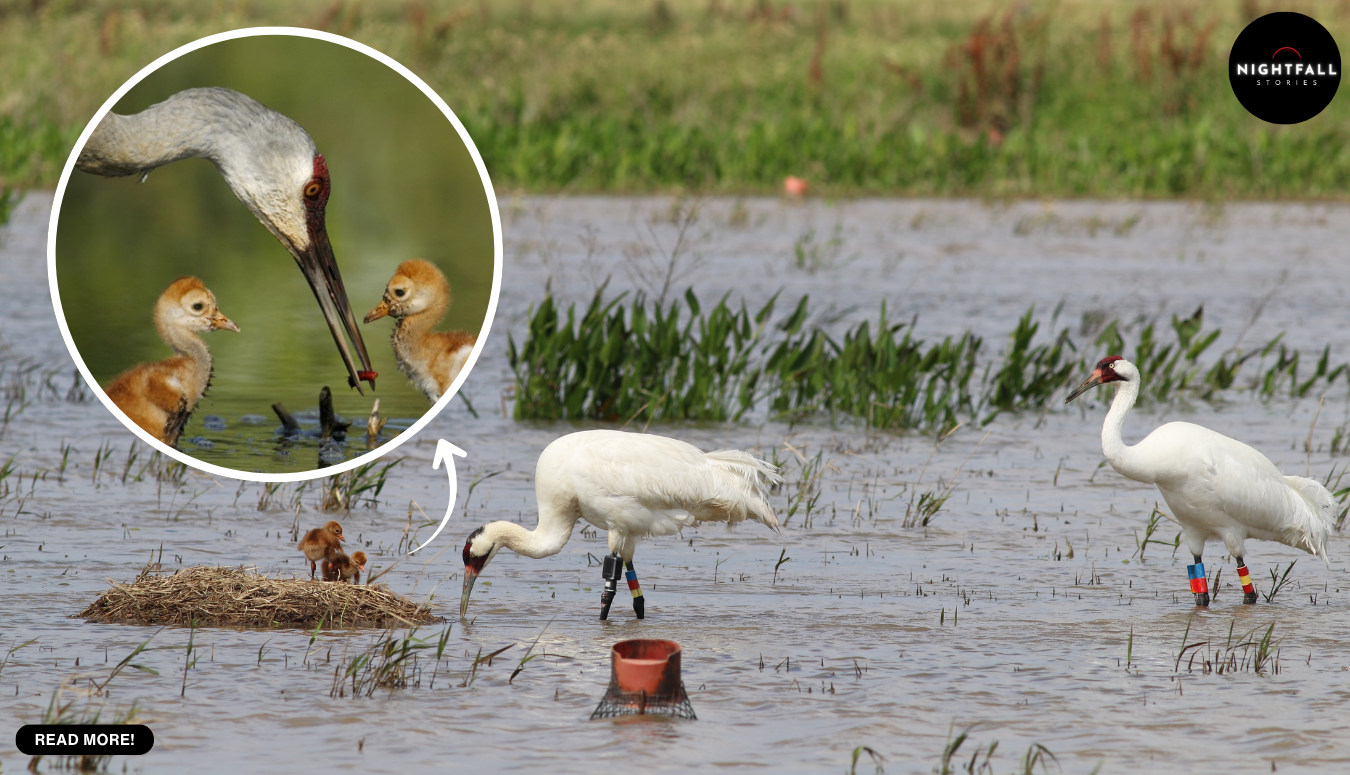
    It helps to know what kind of animal is being counted. A whooping crane stands close to five feet tall, which makes it the tallest bird in North America, with a wingspan that opens to well over seven feet. It is white, with black wingtips and a patch of bare red skin on the crown, and it has a call that carries for miles across flat ground. There is nothing else remotely like it in a Louisiana marsh. You cannot mistake one for anything, and you cannot miss one either.

    Whooping cranes once nested across a large part of North America, including the coastal prairies and marshes of Louisiana. Then they were shot, and their wetlands were drained, and by 1941 there were twenty one left on the entire planet. Twenty one. The species survived the twentieth century on a margin that thin.

    Louisiana lost its resident cranes entirely. For more than seventy five years, no whooping crane hatched naturally anywhere in the state. That gap belongs to Louisiana specifically, not to the species, which continued breeding in Canada throughout. But for the marshes themselves, the bird was simply gone within living memory and then beyond it.

    In 2011, the state started putting them back. Ten captive-reared juveniles were released at the White Lake Wetlands Conservation Area in Vermilion Parish, chosen because the coastal habitat there is still extensive and still wet. The plan was unusual in one important respect: this flock was never meant to migrate. Whooping cranes are famous for enormous seasonal journeys, and teaching reintroduced birds to make them has been one of the hardest problems in the field. Louisiana’s historic population did not migrate, so the reintroduction did not ask the new birds to either.

    Dropping the migration was a real simplification and it came with a real trade. What it removed was the hardest and most failure-prone part of other whooping crane reintroductions: teaching captive-reared young birds a route they had never flown, and then hoping they survived a wintering ground, a summering ground and two long journeys a year between them. Every one of those is a place something can go wrong, and a migratory reintroduction has to succeed in all of them at once.

    What it could not remove was the flip side. A bird that never leaves cannot leave. A migratory flock that loses its breeding grounds still has a wintering ground. A resident flock in a single stretch of coastal marsh has nowhere else, and southern Louisiana is not a place where nothing ever happens to coastal marsh.

    Five years later, in 2016, a pair in the wild hatched a chick. It was the first whooping crane to hatch naturally in Louisiana in more than seventy five years.

    Going from that to ten fledglings in a single season took another decade, and it did not happen because anything dramatic changed. It happened because the birds got older.

    This is the part Zimorski keeps coming back to, and it is one of the least intuitive things about restoring a long-lived species. Whooping cranes are not good at breeding when they are young. A first-time pair is often a bad pair. They pick poor nest sites, they mishandle incubation, they lose chicks to predators they should have avoided, and they frequently fail outright. Then they try again the following year and do slightly better. As a population ages, the proportion of experienced breeders climbs, and the success rate climbs with it. Zimorski’s explanation of this season is essentially that: as the population gets older, more of the breeding pairs are getting it right.

    Which means a reintroduction cannot be judged on its early years, and also cannot be declared finished on one good one. Ten fledglings is what fifteen years of patience looks like arriving all at once.

    The word fledged is doing quiet work in all of this, and it is worth being clear about what it does and does not promise. A fledged crane is a bird that can fly. It is not yet a bird that has survived a year, or found a territory, or bred. Plenty of fledglings die in their first winter. So ten fledglings is not ten future breeders, and nobody involved is pretending otherwise.

    What it is, though, is ten birds that got past the stage where reintroduced populations usually fail. Chick mortality in the first weeks is the bottleneck. Clear it, and the odds improve sharply.

    The counting is unusually honest here, and it is worth saying why. In plenty of conservation stories, the encouraging number is a hatch count, or a nest count, or an estimate of animals released, and the figure that would actually matter, how many survived, is left for a future report that sometimes never comes. This is not one of those. The fledging count is the published number. The chicks reached flight age before anyone announced anything. There is no deferred reckoning hiding inside the good news.

    That does not make the flock safe. Eighty four birds in one place is a small population in a single location, and Zimorski has been direct about what that means. If every bird you have lives in one population in one area, a single bad event, a hurricane, a disease outbreak, a chemical spill across a coastal marsh, could take out the lot. That is the entire logic behind maintaining separate whooping crane populations in different parts of the continent instead of concentrating them where conditions look best. You are not optimising. You are spreading risk.

    There is also the awkward fact of where these birds actually live. The coastal prairie that whooping cranes want in Louisiana is not a wilderness. It is working agricultural country, and cranes forage readily in flooded rice fields and crawfish ponds, which are excellent shallow wetlands from a bird’s point of view and private property from everybody else’s. That is why the crane killed this year was killed at a crawfish pond. It is also why landowner relations are not a soft add-on to this programme but a core part of it. A flock that nests and feeds on farmland survives or does not survive largely at the discretion of farmers, and a reintroduction that has not brought those farmers with it will lose birds faster than it can produce them.

    Most of them have come along, which is the quiet reason any of this works. A great many Louisiana landowners now have enormous white birds wandering their fields and simply let them get on with it.

    The losses are not all environmental either. Cranes in Louisiana get shot. It keeps happening, year after year, to a bird that stands nearly as tall as a person, is bright white, is federally protected and is entirely unmistakable. One was killed at a privately owned crawfish pond earlier this year. Another died over the summer, bringing the count reported in later coverage slightly below the end-of-season figure. Power lines take birds too; a large crane flying at dusk does not see a thin wire in time.

    So every fledgling is expensive. Behind the ten there is a captive breeding operation, with birds raised at facilities including the Freeport-McMoRan Audubon Species Survival Center in New Orleans, where Richard Dunn works as assistant curator. There is tracking, banding, monitoring, nest observation, landowner relations across private farmland and marsh, and law enforcement following up shootings. There are fifteen years of field seasons.

    Against the species as a whole, eighty four birds is a modest share. Fewer than a thousand whooping cranes exist across all populations, wild and captive combined. The one genuinely self-sustaining wild population, which breeds in Wood Buffalo National Park in Canada and winters on the Texas coast, numbered around 557 birds in the most recent count. Everything else, including Louisiana, is still assisted.

    Which brings us to the thing that actually happened this year, and which is not the number ten.

    One of the chicks that fledged in Louisiana was raised by a pair in which both parents had themselves been hatched in the wild, in Louisiana.

    Read that slowly, because it is the point of the entire programme. Neither of those adults came out of a captive breeding facility. Neither was reared by people in a pen, fed by handlers in crane costumes, crated, transported and released into a landscape it had never seen. Both of them hatched in a Louisiana marsh, to parents who were raising chicks there, and grew up as wild birds. And then they built a nest of their own, incubated an egg, and got a chick through to flight.

    That is a second generation of wild-hatched Louisiana cranes producing a third. It is the specific outcome that the 2011 release was designed to reach, and until it happens, a reintroduction is not a population. It is a maintained collection. Birds are added by people, they breed or they do not, and if the additions stop, the numbers fall.

    A pair of wild-hatched parents raising a wild-hatched chick means the loop has closed. The flock is now, at least in part, making itself.

    It is a single pair and a single chick, and nobody involved is claiming otherwise. Thirty two of eighty four birds are wild-hatched, which means the majority of the flock still traces directly to captive rearing, and the release programme has not ended. One second-generation success does not make a self-sustaining population any more than one good season makes a recovered species.

    But it is a threshold, and thresholds only get crossed once. Fifteen years ago there were no whooping cranes breeding in Louisiana at all, and had not been for three quarters of a century. Ten years ago there was one wild-hatched chick, the first in more than seventy five years. This year there were ten fledglings, the most any whooping crane reintroduction anywhere in the country has produced, according to the agency that produced them.

    And in among those ten, in a marsh in southern Louisiana, there is one young crane whose mother and father were both born in that same landscape, wild, to wild parents, with no human hand in it at any point.

    That bird is what the programme was built for. It took fifteen years, a captive breeding network, an agency that kept counting honestly, and a biologist who stayed with the same flock long enough to watch the young pairs become good at it. The ten is the record. The one is the proof.

  • Divers found 400 gold coins off Devon in 1995. The answer to whose ship they fell from was sitting in a London archive the whole time

    Divers found 400 gold coins off Devon in 1995. The answer to whose ship they fell from was sitting in a London archive the whole time

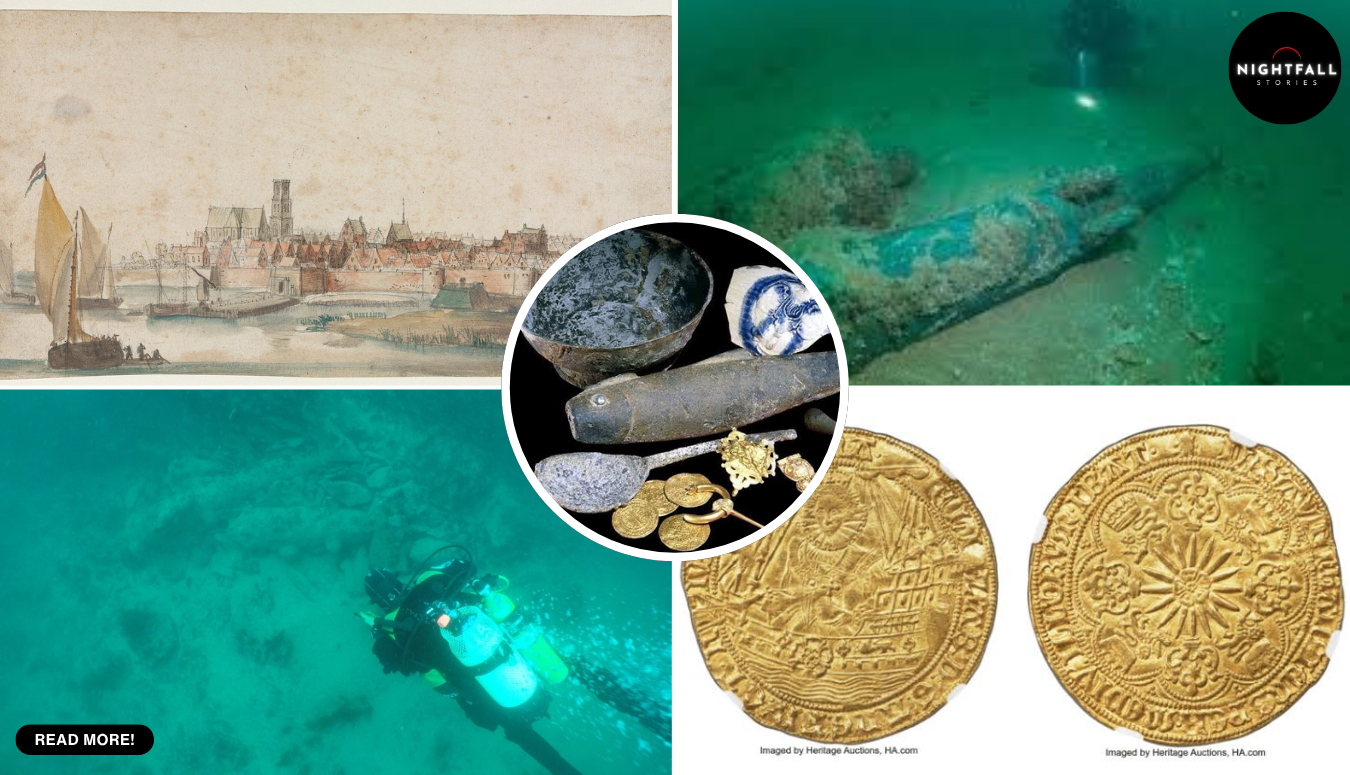
    Somewhere off the south coast of Devon, about 18 metres down, there is a scatter of iron and timber roughly 30 metres long. Divers have known about it since 1995. They have brought up cannons and anchors, a pewter bowl, a spoon, gold jewellery, a small ceramic weight carved into the shape of a fish, a merchant’s stamp seal, and more than 400 gold coins struck in Morocco. It is the largest hoard of Moroccan gold ever recovered in Europe.

    For thirty one years, nobody could say what the ship was called.

    That is a strange thing to sit with. The wreck was never lost. Its position was recorded, it was designated a protected site under law, diving on it was restricted to licence holders, and its finds went into the British Museum. Everything about it was known except the one thing that would turn a pile of objects into a story: a name, a crew, a voyage, a reason for being there.

    The answer did not come from the seabed. It came from an independent historian named Ian Friel, sitting in the reading room of the National Archives at Kew, going through the records of the High Court of Admiralty.

    The ship was called the Dom van Keulen. It was Dutch. It sailed from the Moroccan port of Safi in the autumn of 1633, bound for Amsterdam, and it never got there.

    What Friel found was not a logbook or a captain’s account. It was a lawsuit. After the ship went down, two merchants, recorded as João de Pas and Andrea de Azevedo, brought a salvage claim, and the court took testimony from members of the crew. That is the paper trail. Somebody wanted their property back, and the legal machinery of the seventeenth century obligingly wrote down where the cargo had been, what it consisted of, and how it came to be on the bottom of the English Channel.

    The crew described meeting with much tempestuous weather. The ship took a beating in the Channel, sprang a serious leak, put her anchors down off Salcombe, and foundered there.

    And here is the part of the story that keeps it from being a tragedy. Every single member of the crew survived.

    That detail changes the whole texture of it. Most shipwrecks that leave behind gold also leave behind bodies, and the writing about them tends to lean on the drowning. This one has no drowning in it. What it has is a leaking hull, a crew working the pumps in bad weather, a decision to anchor rather than run for it, and then a slow, undignified loss of the ship while everybody got off. It is closer to an insurance dispute than to a disaster.

    Which is exactly why the documents exist, and why Friel could find them.

    To understand why a Dutch merchantman was coming north out of Morocco loaded with gold, you have to know something about who was running Morocco at the time. The Sa’dian dynasty held power there from the middle of the sixteenth century until the middle of the seventeenth, and their wealth rested on gold coming up out of West Africa. The coins recovered from the wreck were struck under Sa’dian rulers, and taken together they form the largest known assemblage of Sa’dian gold anywhere. Before this site, that material was scarce enough that numismatists worked from scraps.

    The gold moved north and Dutch manufactured goods moved south. That was the trade. But the gold was not travelling alone, and the rest of the manifest is the part of this story that most people skate past, which is a shame, because it is the most interesting thing in it.

    Alongside roughly 9,000 Barbary ducats, the Dom van Keulen was carrying 150 bags of gum arabic, 64 bags of saltpetre, and 320 goat skins.

    Read that list again and a whole economy opens up. Gum arabic is the hardened sap of acacia trees, and in the seventeenth century it was an industrial material. It bound pigments in ink and paint, it sized and stiffened textiles, it went into medicines and confectionery. Saltpetre is potassium nitrate, and saltpetre is gunpowder. A Dutch republic in the middle of a long war with Spain had an appetite for saltpetre that was effectively bottomless. Goat skins became leather, and leather became boots, bindings, bellows, straps, gloves and armour padding.

    So the ship was not a treasure galleon. It was a working freighter carrying money, chemicals, and raw hide on a route that connected North African gold to a northern European war economy. The gold is what makes headlines. The saltpetre is what explains the voyage.

    It is also worth being precise about the coins, because two numbers get merged constantly and they are not the same number. Roughly 9,000 ducats appear on the documented manifest. Just over 400 gold coins were actually recovered from the seabed. The gap between those figures is not a mystery, and it is not a hint that thousands of coins are still down there waiting.

    It is because the wreck was salvaged almost immediately.

    That is what the salvage claim was about. The ship went down in shallow water, close to shore, in a place where local people knew the ground. Most of the cargo appears to have been lifted within a short time of the sinking. What stayed on the bottom was what nobody could find in 1633: coins that had worked their way into the sediment and gravel, where they sat for more than 360 years until the seabed shifted and divers from the South West Maritime Archaeology Group came across them.

    So the site is poor in objects and rich in information, and those two things are connected. A wreck that was never salvaged gives you a full cargo. A wreck that was salvaged gives you a court case, and a court case gives you names.

    There is one more thing the documents did, and it is easy to miss. They killed a theory.

    When hundreds of Moroccan gold coins start coming up off the English coast alongside cannons, the first idea everybody reaches for is piracy. It is the obvious reading. Barbary corsairs operated in these waters in the seventeenth century, they did reach as far north as the Channel and beyond, and a wreck full of North African gold with guns on board fits that picture almost too neatly. That speculation hung around this site for years, and it is reported in the coverage of the new volume as the assumption the research had to clear away.

    The manifest is what clears it away. Pirates do not carry 150 bags of gum arabic. Pirates do not carry 320 goat skins. Bulk industrial commodities, itemised, insured, and then sued over in an Admiralty court by named merchants, are the signature of legitimate freight. The gold was not loot. It was payment, moving north on a commercial route, in the hold of a chartered trader alongside everything else the same voyage could profitably carry.

    That correction matters more than it looks. A pirate wreck is a curiosity. A merchant wreck is evidence of a trade relationship, and a trade relationship between Sa’dian Morocco and the Dutch republic is a genuinely underexamined piece of economic history that most readers have never had any reason to think about. One ship, properly identified, turns a romantic guess into a documented route.

    The coins themselves only surfaced because the seabed moved. The site was first noted as little more than cannons with nothing else visible around them. It took a shift in the sediment in the mid-1990s to expose the rest, and once material began appearing, divers from the South West Maritime Archaeology Group started the slow work of recording it properly rather than simply lifting what shone. That restraint is why there is anything to write about. A site stripped by souvenir hunters produces no manifest to match against a court record.

    The identification, it should be said plainly, rests on paper rather than on a nameplate. No hull timber came up with the ship’s name carved into it. The sequence was that analysis of the recovered objects made a Dutch origin look overwhelmingly likely, the coins put the earliest possible date of loss at 1632 because that is the date of the youngest coin in the hoard, and Friel’s archival work then supplied a documented Dutch loss off Salcombe in the autumn of 1633 that matched the cargo on the seabed item for item. The British Museum’s own published description is carefully worded, saying the vessel reportedly sank off Salcombe in 1633.

    That hedge is honest and it is worth respecting rather than sanding off. This is a very strong identification built from convergence: the right nationality, the right date window, the right port of origin, the right commodities, the right stretch of coast. It is not a signature on a beam. Archaeology almost never gets a signature on a beam.

    What makes it satisfying is that it is falsifiable in a way that speculation is not. Anyone can go and read the documents. They are catalogued, they are in a public archive, and the reasoning is set out in full in a volume that came out this year.

    That volume is called From Morocco to the Coast of England: The Story of the Dom van Keulen and its Remarkable Cargo. It is a British Museum research publication, edited by Venetia Porter, formerly the Museum’s senior curator for Islamic and contemporary Middle Eastern art, and Dave Parham, professor of maritime archaeology at Bournemouth University. Friel is one of the contributors, alongside David Gaimster, Caroline R. Cartwright, Gwilym Lewis and Peter Davey. Jeremy D. Hill, the Museum’s head of research, was involved in bringing it out.

    You can buy a paper copy through the Museum’s shop. You can also read the whole thing online for nothing, under an open licence, which for a specialist volume on seventeenth century Moroccan numismatics and Channel shipwrecks is not a small thing. The people most likely to want it are volunteer divers, local historians and students, which is to say people without institutional library access.

    The smaller finds are where the ship stops being a cargo list and starts being a place where people lived. There is a pewter bowl and a pewter spoon, Dutch made, somebody’s dinner service. There is a sounding weight shaped like a pilchard, which would have been dropped on a line to read the depth, and somebody took the trouble to make a functional lump of ceramic look like a fish. There is a stamp seal, the tool a merchant used to press wax and close a letter. There is a small nugget of gold shaped like a finger.

    And there is a red earthenware jar containing pills coated in resin, still recognisable after nearly four centuries underwater. Nobody knows exactly what they were for. The resin coating is what preserved them. Somebody aboard that ship had a supply of medicine, carefully sealed, and it outlasted the ship, the crew, the dynasty that minted the gold and the war the saltpetre was bound for. There were preserved beans in there too.

    Those are the objects that do the real work on a reader. A hoard of gold coins is impressive but abstract. A spoon is not abstract. A jar of pills is not abstract. Somebody was ill on that voyage, or expected to be.

    The site itself remains protected. It sits inside a designated area managed by Historic England, diving is by licence only, and it is watched from the National Coastwatch Institution’s lookout at Prawle Point, which is the kind of quiet, unglamorous arrangement that actually keeps an archaeological site intact. Not a fence. A volunteer with binoculars and a phone.

    It is worth dwelling for a moment on the thirty one years, because the framing of long mysteries usually gets this backwards. Nothing was lost during those three decades. Divers surveyed, finds were conserved, the coins were acquired by the British Museum, specialists published on the numismatics. The delay was not neglect. It was the ordinary speed at which this kind of work moves when it is done by a mix of volunteers, museum staff and academics, mostly around other jobs, and when the crucial evidence is not on the site at all but in a box of legal papers in a different country, filed under a case nobody had connected to a Devon wreck.

    That is the genuinely useful lesson in it. Maritime archaeology looks like an underwater discipline, and a great deal of it happens in reading rooms. The divers found the coins. A historian with no diving involved found the ship.

    There is a version of this story that never gets to this point, and this operation has seen plenty of them: a wreck comes up, the objects are catalogued, the report concludes that further study will help identify the vessel, and nothing follows. The site becomes a permanent question mark with a good photograph attached. Most identified-but-unnamed wrecks stay that way.

    This one did not. The Dom van Keulen sailed from Safi in the autumn of 1633 with gold, gum arabic, saltpetre and goat skins in her hold, took the worst of the Channel weather, sprang a leak, anchored off Salcombe and went down with every one of her crew alive. Two merchants sued for their cargo, a court wrote down what the crew told it, and the paper sat in an archive for very nearly four centuries until somebody went looking for it.

    Thirty one years after the first coins came up out of the gravel, the ship has a name, the reasoning behind that name is published, and anyone who doubts it can read the documents and check the work for free.

  • Fashion trends that need to stay in the past

    Fashion trends that need to stay in the past

  • His drought study had been cited 337 times when he asked the journal to take it down. The four things that were wrong with it are smaller than you would expect.

    His drought study had been cited 337 times when he asked the journal to take it down. The four things that were wrong with it are smaller than you would expect.

    The paper was a year old and it was working.

    Published in Nature in the middle of 2025, it argued something that sounds obvious once you hear it and had never been pinned down at global scale before: that a large part of the world’s worsening drought is not about how much rain falls but about how thirsty the air above the ground has become. Eleven authors, led by Solomon Gebrechorkos at the University of Oxford. By the time other researchers had finished building on it, the study had been cited 337 times, a figure drawn from Clarivate’s Web of Science and one that will have moved since. For a single paper inside twelve months, that is a serious result.

    Last month it was retracted, at the authors’ request. All eleven agreed to it.

    The reasons, set out in the retraction notice, are not dramatic. There are four of them and not one involves fabricated data, a hidden dataset, or anything a reader would recognise as a scandal. They are the kind of mistakes that live inside analysis code, the sort a working scientist reads and immediately feels a small cold sensation about, because they have very nearly made all four themselves.

    Start with what the paper was actually claiming, because the whole thing rests on a phrase most people have never encountered.

    When you picture a drought you probably picture missing rain. That is half of it. Soil loses water in two directions: rain puts it in, and evaporation takes it out, with plants pulling more of it up and releasing it through their leaves. How fast that outgoing side runs depends on the state of the air. Warm air can hold much more water vapour than cool air, and as air warms, the gap between how much moisture it could hold and how much it actually holds tends to widen. A wider gap means the air pulls harder on every wet surface it touches, including soil, leaves, reservoirs and skin. Scientists call that pull atmospheric evaporative demand. The informal version, the thirst of the air, is close enough to be useful.

    The consequence is that a place can receive the same rainfall it always did and still dry out, because the air above it is now removing water faster than it used to. Drought indices that only count rainfall miss this entirely. The index the team used, the standardised precipitation evapotranspiration index, is built specifically to account for both sides of the ledger.

    The paper ran that accounting across more than a century of data, with detailed attention to the four decades up to 2022, and the headline numbers were striking. Drought severity globally had increased, and by their estimate the thirst of the air accounted for roughly forty percent of that increase. They found the area of land experiencing drought had expanded by about seventy four percent in the five years to 2022 compared with the preceding decades, that moderate to extreme drought touched about thirty percent of global land area in 2022 alone, and that evaporative demand rather than falling rainfall was responsible for most of that expansion.

    It mattered outside the literature too, which is part of why the citation count climbed so fast. If drought is being driven substantially by evaporative demand rather than rainfall, then the practical picture changes for anyone planning around water. Rainfall forecasts stop being a sufficient early warning. Irrigation demand rises in years that look normal on a rain gauge. Reservoirs lose more to the air than their operating assumptions expect. Regions that are not getting drier in terms of precipitation can still be getting drier in terms of what actually reaches a root. That is a useful and slightly unsettling idea, and a paper that quantifies it at global scale is exactly the kind of thing other researchers reach for.

    Those were the numbers that travelled. They were also the numbers the errors touched.

    The first error is about the shape of the planet. Climate data arrives on a grid, boxes of latitude and longitude laid over the globe. Because the Earth is round, those boxes are not the same size. A cell near the equator covers far more ground than a cell of identical degree width near a pole, where the lines of longitude converge. If you want a global average of anything, you must weight each cell by the actual area it represents. If you simply take the mean of all the cells, you have quietly given high latitude boxes the same vote as tropical ones many times their size. The retraction notice states that area weighted grid cells were not used when the study wide averages were calculated, which affected numbers in the main text and in three figures.

    The second error is a version number. The team used a model of evaporation called GLEAM, which had moved from its third version to its fourth. In one of the supplementary figures, values from the earlier version were used instead of the later one, which changed what the figure showed about the drought affected area in 2022. Anyone who has ever kept two folders of output from two runs of the same model, one of them stale, knows exactly how that happens and how invisible it is afterwards.

    The third is a timestepping mistake in the code that worked out how much regional land was in drought. When the data were split into periods, the dates were not parsed the way the authors intended, so some values ended up assigned to the wrong stretch of years. The notice ties it to the division between the long baseline period and the recent five year window, which is precisely the comparison the seventy four percent expansion figure rested on.

    The fourth is the least glamorous of the four and possibly the most instructive. Very dry places break drought indices. If a region receives almost no rain in a normal year, a percentage based measure of rainfall deficit can produce absurd values from tiny absolute changes. So analysts mask those regions out, excluding land below a rainfall threshold, in this case an average of under one hundred and eighty millimetres a year. The team did that for one panel of their first figure and did not apply the same mask to the panel beside it, from which several of the reported percentages came. Two panels, printed next to each other, describing slightly different worlds.

    It is worth saying why none of this was caught before publication, because the answer is structural rather than anyone’s fault. Peer review, as practised at almost every journal, means a small number of researchers reading a manuscript. It does not mean anyone downloads the code, obtains the input datasets, which can run to terabytes, and reproduces the figures. Almost nobody has the time or the compute to do that unpaid, and journals do not require it. Reviewers assess whether the method is sound, whether the interpretation follows, and whether the result is plausible. All three can be true of an analysis with an unweighted average buried in it. The errors here were not conceptual, and conceptual errors are what review is built to catch.

    That is the entire list. An unweighted average, a stale model version, a date handling bug, and a mask applied inconsistently between two panels. None of it is exotic. All of it is the residue of a large analysis assembled over a long period by people passing files and code between institutions.

    Here is the point where it is worth being careful, because it is the part of the story most easily got wrong.

    It is not publicly established who found these errors. The journal attached a note to the paper in the spring of last year telling readers that the conclusions were subject to criticisms and corrections that editors were considering. That wording tells you criticism existed and reached the journal. It does not say who raised it, what they said, or which of the four items in the eventual notice came from outside rather than from the authors’ own re checking. Gebrechorkos has characterised the problem as a coding error rather than a difficulty with the data or the methodology, and that characterisation is his. Every published account of how the errors came to light traces back to the authors. Anyone telling you a specific outside critic caught it is going beyond the record, and so would this article if it did the same.

    What is documented is what the authors chose to do about it, and that choice is the reason this is a story rather than a notice.

    A retraction is not the only option available when a paper turns out to contain mistakes. There is a correction, sometimes called an erratum or an author correction, which leaves the paper standing and amends the specific values that were wrong. It is faster, cheaper in reputational terms, and much quieter. It does not appear in the databases that track retractions. It does not get written about. For a set of errors that the authors believe changed their percentages without overturning their conclusion, a correction is the obvious defensive move, and plenty of papers with problems of this scale have taken exactly that route.

    They went the other way. The notice retracting the paper carries the agreement of all eleven authors, and according to reporting on the case it is the first retraction any of them has on their record.

    The practical cost of that is easy to underestimate. A retraction attaches permanently to every author’s publication list. It follows them into grant applications, hiring panels and collaborations, where it will be seen by people who will not read the notice closely enough to register that no misconduct was alleged, because none was. The word does most of its damage on its own. A researcher assessing an unfamiliar name does not usually distinguish between a paper withdrawn for calculation errors the authors themselves reported and a paper withdrawn for something worse. That distinction matters enormously and travels poorly.

    Then there are the 337 citations, and the honest answer about them is that nothing automatic happens. There is no mechanism that reaches into other researchers’ published work and flags a reference. Some of those citations will be passing mentions in introductions, where the retraction changes nothing material. Others will have used the paper’s specific figures as an input, a comparison, or a justification for a modelling choice, and those authors now have to decide for themselves what to do. Most will do nothing, not out of carelessness but because there is no clear process to follow. Retraction databases and reference managers are getting better at surfacing these flags, but the work of untangling a widely cited result stays distributed across hundreds of people who never made the mistake.

    Gebrechorkos’s position, as reported, is that the revised numbers will come out slightly lower than the published ones while the central conclusion holds: that warming has made global drought worse, and that the thirst of the air is a substantial part of why. He has said a revised manuscript was already prepared, incorporating additional datasets, with the code checked thoroughly. Nature’s chief editor for physical sciences, Karl Ziemelis, indicated that any resubmission would be assessed entirely independently of the retracted version.

    That last detail is the sharpest thing in the whole business. It means a paper that had already passed peer review at one of the most selective journals in science, been published, been read, and been cited hundreds of times, goes back into the queue with no standing whatsoever. No credit for having been there. No shortcut through the process it already survived once. Reviewers who may reject it. A year or more of waiting, at minimum, on work that is now genuinely more solid than the version that made his name.

    There is a temptation to file that under scientific self correction working as designed, and the temptation should be resisted a little. The system did not catch these errors before publication, and it took more than a year to resolve them afterwards. What worked was narrower and more human than the system: eleven people looked at four unglamorous mistakes in their own code, worked out that the cheap fix was available and chose the expensive one instead, and put their names on the notice saying so.

    The retracted paper is still on the journal’s site, marked, readable, with its numbers now formally off the record. The corrected analysis exists as a manuscript. Somewhere in a review queue it is waiting for strangers to decide whether it is good enough, which is exactly where its author put it on purpose.

  • A box truck was stopped in California with two thousand animals inside. The hardest night belonged to four people at an aquarium down the coast.

    A box truck was stopped in California with two thousand animals inside. The hardest night belonged to four people at an aquarium down the coast.

    There were four of them, and they worked until roughly one in the morning.

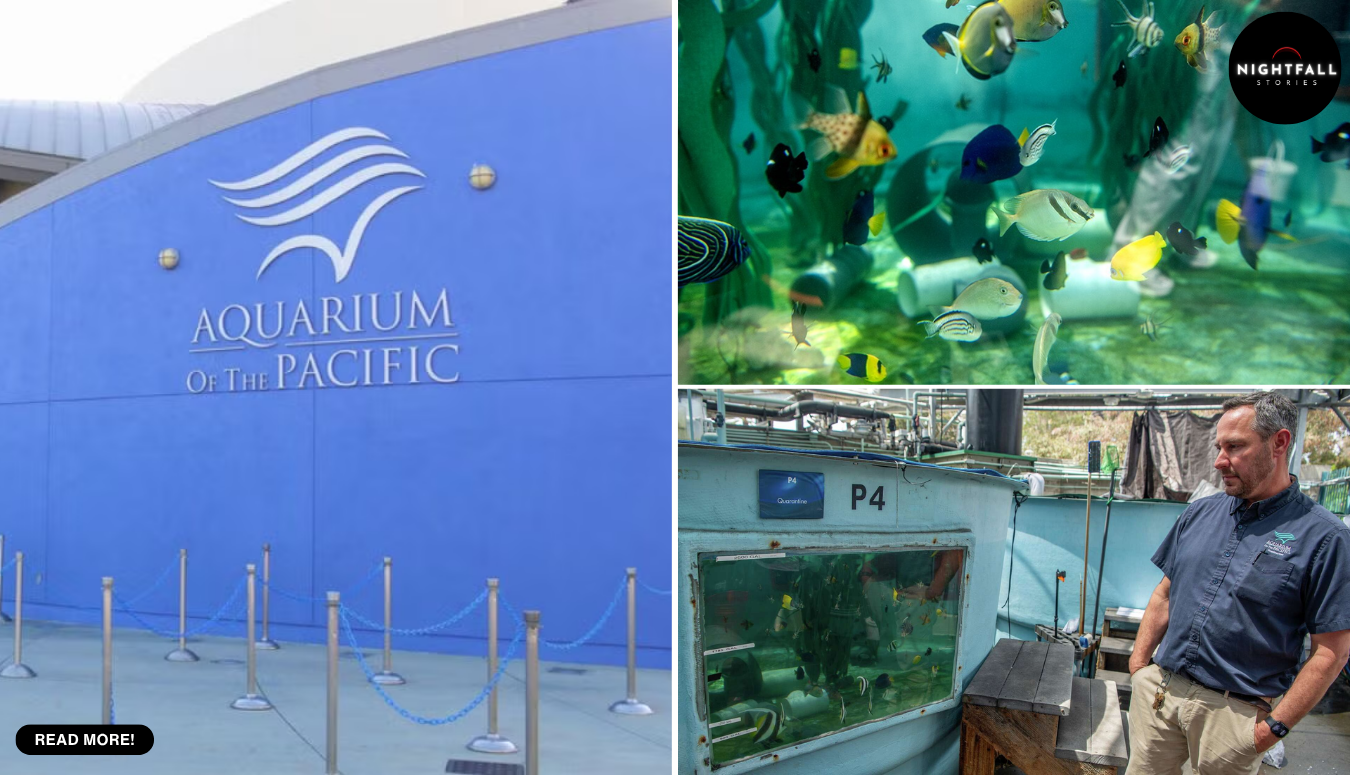
    That is the detail that stays with you once you know the rest of it. Wildlife officials in Southern California stopped a box truck carrying somewhere around two thousand live animals, a mix of reptiles, fish and invertebrates packed for transport. That number belongs to the seizure, not to any one building. Of the animals in that haul, close to five hundred marine creatures were sent on to the Aquarium of the Pacific in Long Beach, arriving in bags and boxes of water on a single day in the middle of last year. Four staff members met them.

    You cannot simply open a bag and pour a fish into a tank. That is the whole practical heart of this story, and it is the part almost nobody outside the profession has any reason to know.

    Nate Jaros, the aquarium’s Vice President of Animal Care, has described what happened next in fairly unglamorous terms. Every bag had to be tested before anything in it was moved. The water an animal travels in stops being water and starts being a chemistry problem within hours. Oxygen falls. The animal keeps breathing and keeps producing waste, and ammonia climbs. As ammonia climbs, the pH of the water tends to drift, and the particular cruelty of the situation is that a low pH partly protects the animal from the ammonia. Raise the pH suddenly, by tipping that bag into a clean, well buffered tank, and the ammonia that was chemically parked becomes chemically active. An animal that survived the truck can die in the tank.

    So the staff tested for pH, for dissolved oxygen, for ammonia, bag by bag. Then they acclimated slowly, letting clean system water in a little at a time, letting temperature and salinity close the gap over a period rather than in a moment. Jaros has called it a very careful process and a very stressful one, which is about as plain a description as the work allows. There is no dramatic version of it. It is hours of small adjustments made by tired people who know that the cost of hurrying is not abstract.

    Stress is the other thing they were fighting, and it is less visible than water chemistry. Animals collected from reefs, bagged, boxed, moved, and then confiscated have been under pressure for a long stretch before anyone at an accredited facility sees them. Most reef fish carry some parasite load in normal life without much consequence. Jaros has pointed out the problem with that: bring an animal into a stressful environment and those loads can start to increase. The animal’s own defences drop at exactly the moment the parasites find their opening. This is why the first stop was not an exhibit but quarantine.

    Alyssa Tillman, the aquarium’s Assistant Curator of Fish and Invertebrates, has explained the logic of that plainly enough. Everything arriving is watched closely in quarantine areas where staff can give immediate care and where any disease that came in with the shipment cannot spread into a collection of thousands of other animals. That is the standard for any arrival, planned or not. An emergency does not lower it. In a sense an emergency raises it, because nobody knows where these animals came from, what they were exposed to, or what they were kept alongside.

    The list of what came through the door reads like a tour of the home aquarium trade. Brownbanded bamboo sharks, a species considered near threatened. Banggai cardinalfish, which are endangered and which have been collected heavily from a very small natural range. Ocellaris clownfish, the ones almost everyone can picture. Yellow longnose butterflyfish, domino damselfish, lemonpeel angelfish, powder blue tang, juvenile emperor angelfish. Alongside the fish came the harder part of the inventory: hundreds of corals, plus clams, shrimp, prawns and snails.

    The corals were their own problem. Jaros has been candid that identification was close to impossible in the moment. There are thousands of coral species, many of them difficult to tell apart even with time and a reference collection, and some of them look nothing like the photographs once they have been out of a reef and inside a box. You cannot care for an animal properly without knowing roughly what it is, because light requirements, flow, feeding and temperature all change with species. The team had to make reasonable working judgements and correct them later.

    The Banggai cardinalfish are worth pausing on, because they explain why a box of small fish can matter out of proportion to its size. They are a striking animal, silver and black with long trailing fins, and they come from a very small natural range in the tropical Pacific. Being desirable and geographically concentrated is a bad combination for a species. Decades of collection for the ornamental trade pushed the wild population down hard enough that the species is now classified as endangered, even though it breeds readily in captivity and captive bred stock is widely available. That is the uncomfortable arithmetic behind a shipment like this one. There was no biological need to take these fish from a reef at all.

    About a quarter of the animals from that first arrival did not survive. Some were already gone when the boxes were opened. Others died within days. That is the honest figure and it deserves to be stated rather than buried, because it is the real measure of what a truck journey does. The people who took them in did not lose those animals. They inherited them already lost, and found out which ones over the following week. Nobody in that building had any control over the part of the journey that killed them.

    What makes this more than a difficult night at one aquarium is the thing that made the phone call possible in the first place, and it did not exist a few years ago.

    Until fairly recently, a wildlife officer who intercepted a shipment of living animals had a genuine institutional problem on their hands. Seized property is usually held. Seized property that breathes cannot be held in an evidence locker. Officers ended up making urgent calls to whichever zoo or aquarium they happened to know, hoping someone had space, water systems and staff free on a weekday afternoon. It worked when it worked and failed quietly when it did not.

    In 2023 the United States Fish and Wildlife Service and the Association of Zoos and Aquariums set up a Wildlife Confiscations Network to replace that improvisation with something closer to a system. The idea is unglamorous and effective. A network of accredited facilities agrees in advance to take confiscated animals, with a known route, known contacts and a vetting committee that decides which organisations are equipped for which species. The Southern California branch of it is the reason a box truck stopped on a highway turned into a set of quarantine tanks the same day rather than a set of decisions nobody was ready to make. The Aquarium of the Pacific was a founding member of that regional network and sits on its vetting committee.

    That structure was tested again a few weeks after the first haul. Near the end of July, a second operation brought roughly three hundred more marine animals, this time after a short stay at a federal wildlife centre in Torrance before they were transferred down to Long Beach. So the aquarium’s real intake across the two events was about five hundred and then about three hundred. Not two thousand. The larger figure describes what officers found in the truck, most of which went to other facilities suited to reptiles and to species an aquarium is not the right home for.

    None of this is occasional. The aquarium has taken part in more than thirty confiscation events since late 2024, and says it has now helped more than three thousand three hundred trafficked animals since joining the network. That number is the quiet headline. It means the summer’s two seizures were unusual in size but not in kind.

    Then comes the part that is a genuinely hard choice rather than a technical one, and it is the reason people in this field talk about confiscation with a certain flatness.

    These animals almost never go home. Returning a confiscated reef fish to the ocean sounds like the obvious good ending and is usually the wrong call. Nobody knows which reef it came from, and releasing an animal into the wrong population can move disease and genetics into places they were not. The animals have often been held in conditions that leave them unfit to compete. For corals and invertebrates the identification problem alone can make release impossible. So the realistic options are placement in an accredited facility with appropriate space and expertise, or a place in an exhibit in Long Beach, and someone has to make that judgement for each of hundreds of animals while they are still in quarantine.

    Quarantine is not a quick holding pen either. Depending on the species and what turns up in testing, an animal may sit behind the scenes for weeks while staff watch for parasites, treat what they find, and confirm the animal is feeding normally before it goes anywhere. Feeding is the tell. A fish that will not eat is a fish still in trouble, whatever the water readings say. Multiply that by several hundred animals across dozens of species with different diets, and the labour involved starts to become clear. This is not a rescue in the sense of one dramatic intervention. It is a long, dull, attentive process carried out by people with day jobs already attached to a working public aquarium.

    Placement was expected to happen inside about two weeks for most of the survivors, moving out to other accredited institutions or into the aquarium’s own displays. That is fast, and it has to be, because holding capacity behind the scenes is finite and the next call is not scheduled.

    It is worth being clear about why a truck like that is worth running at all, without turning it into a lecture. Marine ornamental animals are small, light, and worth a great deal relative to their weight. A single specimen of a sought after species can be worth hundreds of dollars by the time it reaches a home tank, and a coral fragment can be worth more. Much of the supply chain is legal and documented. The illegal share moves through the same channels, with paperwork that does not match the contents, protected species mixed in among unprotected ones, and volumes that make individual animals almost disposable. Losing a quarter of a shipment is a cost of doing business for a trafficker. It is a week of work for the people who end up with the survivors.

    One thing this story does not include, and it should be said rather than implied: there is no public record reachable of charges, a prosecution, or any named defendant in either seizure. Whether anyone faces a case is simply not on the record. The animals are the documented part.

    What the aquarium did get is money. Grant funding routed through the Association of Zoos and Aquariums, drawn from federal pandemic era recovery funds, has gone towards renovations, upgrades and new holding systems intended specifically to expand how much confiscated wildlife the building can absorb at once. More tanks behind the scenes is not a thrilling sentence. It is, in practice, the difference between four people working until one in the morning and four people working until four in the morning, and it is the difference between saying yes to a call and saying not this time.

    The aquarium’s president and chief executive, Jeff Flocken, has framed the whole business in terms of extinction rather than crime, arguing that trafficking damages ecosystems and pushes species towards disappearing, and that answering these calls is something the institution intends to keep doing. That is a mission statement and it reads like one. The version of it that actually happened was less lofty and more convincing: bags on a floor, a water test kit, a coral nobody could name, and a decision about pH made at midnight that determined whether a fish that had already survived a truck would also survive the rescue.

    Most of the survivors are now somewhere with a name and a record, spread across accredited facilities or in tanks in Long Beach where visitors will walk past them without knowing any of this. The quarantine systems behind those walls have been emptied, cleaned and refilled. That is the ending, and it is the right one, because the point of building a network was never any single truck. It was to make sure that the next time officers open a roller door and find two thousand living things stacked inside, the question is which facility takes which animals, and not whether anyone can be found who will pick up the phone.

  • Well over a hundred million people watched the halftime show. Some of them were watching her hands instead

    Well over a hundred million people watched the halftime show. Some of them were watching her hands instead

    Earlier this year, in a stadium in Santa Clara, California, a woman from the mountains of Puerto Rico stood in front of a camera and performed a thirteen-minute set she could not fully hear, in a language that had never once been carried on that stage, for an audience that had spent four years asking for it. Her name is Celimar Rivera Cosme. She is Deaf. And the thing she said before she went out there was not that she was going to interpret the halftime show. She said she was going to perform it.

    That distinction is the entire craft, and it is the part almost nobody explains. So let us start there, because it is more interesting than the spectacle.

    Interpreting speech is hard. Interpreting music is a different job wearing the same name. When somebody gives a speech, the interpreter’s obligation is to the meaning, and the meaning is mostly in the words. When somebody performs a reggaeton track with a hook built on rhythm, a verse stacked with island slang, an ad lib thrown in sideways and a beat that is doing half the emotional work, the words are maybe a third of what is actually being communicated. An interpreter who delivers only the lyrics has technically succeeded and has actually failed, because the Deaf person watching has been handed a transcript of a party they were not invited into.

    Rivera Cosme’s own framing of it, paraphrased, is that you have to add your flow, your vibe, your style and your attitude. That sounds like a personality note. It is not. It is a technical description of where the missing information goes. Tempo has to live somewhere, so it lives in the speed and the size of the signing. Register has to live somewhere, so it lives in the face and the shoulders. A rhyme that works in Spanish will not rhyme in any sign language, so the interpreter has to find a visual equivalence, a repeated handshape or a mirrored movement, that gives the ear’s pleasure back to the eye. A sung line held for four beats has to be held. A whispered line has to be made small. When the crowd noise swells, that has to be visible too, because otherwise the Deaf viewer has no idea the room just went up.

    And every one of those choices is a judgement about the artist’s intent, made in advance, by one person, with no way to check it mid-performance. A halftime show gives you a fixed setlist, which is a mercy. It also gives you thirteen or so minutes of live global broadcast, no second take, and a running order rehearsed to the second. Her preparation, by her account, involved sitting with the setlist through headphones while reading the lyrics, working out where the emphasis had to fall. There is no autocue for hands.

    There is a further wrinkle in how any of this reaches a Deaf viewer at home, and it is not a small one. The signed coverage went out as dedicated streams rather than as a picture-in-picture box on the main broadcast. That means a Deaf viewer had to choose. Watch the main feed and you get the director’s cut, the camera moves, the crowd, the staging, and no interpretation. Watch the signed stream and you get the language, with the performance framed however that feed frames it. Hearing viewers are never asked to make that trade. It is the single clearest illustration of why the quality of an interpreted feed matters so much: if the signing is flat, the person who chose it has given up the show to get the words, and got a bad deal.

    Which is also why the profession distinguishes between interpreting and performing at all. Music interpreting has quietly become its own specialism over the last decade, largely through festival work, and the interpreters who are good at it are treated by audiences as acts in their own right. The industry standard for high-stakes work is to pair interpreters, often a Deaf interpreter working alongside a hearing colleague who feeds the audio content, precisely because the two roles need different things: one person tracks what is being said, the other delivers it in a way a native signer experiences as language rather than as captioning with hands. A Deaf signer at the front of that arrangement is not a nice piece of representation. It is the version that produces the better output, because the person shaping the delivery shares the audience’s language.

    Now the language, which is where a lot of the coverage got sloppy and where it is worth being careful, because the sloppiness is itself part of the story.

    She signed in Puerto Rican Sign Language, known on the island as LSPR. Several outlets described it as a dialect of American Sign Language. That framing is contested, and the reference works that catalogue the world’s languages do not support it. Puerto Rican Sign Language is listed as a language in its own right, with its own international code, described as related to American Sign Language rather than a variety of it. Glottolog, the other major linguistic catalogue, lists it separately as well. The distinction is not pedantry. Calling a language a dialect of a bigger neighbour is the oldest way there is of implying it does not need protecting.

    The history explains the relationship. Signing was brought into formal education in Puerto Rico in the first decade of the twentieth century, reportedly through Catholic nuns, and American Sign Language has been in contact with the island’s signing ever since, which is why the two are related and why so much of the vocabulary overlaps. But contact is not descent. LSPR developed its own signs, its own rhythm and its own grammar, shaped by the island’s Deaf community and by Spanish rather than English, and there are signs in it that exist nowhere else. There is also a separate pidgin form, Signed Spanish, used alongside it, plus home sign systems.

    It is also worth understanding why a Spanish-speaking territory ended up with a sign language related to an English-speaking one. Sign languages do not track the spoken languages around them; they track schools. Wherever a deaf school is founded, whichever signing the founders bring becomes the seed, and the community grows a language out of it. Puerto Rico’s formal deaf education arrived with signing already attached to the American tradition, which is why the relationship to ASL exists at all, while the surrounding spoken language was Spanish, which is why fingerspelling, mouth patterns and a good deal of vocabulary went a different way. That is the mechanism behind the phrase Spanish influence, which coverage tends to use as a vague gesture at flavour. It is not flavour. It is the reason two related sign languages are not interchangeable in a Puerto Rican living room.

    Here is the part that gives the halftime show its real weight. LSPR is classified as threatened. Estimates of how many Deaf people use it range enormously, from around eight thousand to around forty thousand, and the direction of travel is not good: the catalogues note that American Sign Language is increasingly displacing it, to the point where ASL is on course to become the island’s only sign language. A threatened language does not usually get a global broadcast. It usually gets quietly replaced by the larger one next door, in classrooms and in workplaces and in exactly the kind of high-profile setting where somebody decides it is simpler to just use ASL.

    Which somebody nearly did. The broadcaster ran dedicated sign language streams for the game, and both ASL and LSPR were offered. The LSPR provision did not appear because a production team thought of it. It was secured, and the person most often credited with securing it is Zoé Rodríguez, president and co-founder of the Puerto Rican Association of the Deaf and Deaf-Blind. Somebody had to go and make the argument that the island’s own language belonged on the biggest broadcast of the year, rather than a related one that most of the audience would not have questioned.

    That pattern, the community asking rather than being offered, runs all the way back to how Rivera Cosme got into this in the first place, and it is the best fact in the story.

    Four years ago, she posted a video to Instagram addressed directly to the artist. Her argument was simple and specific: roughly a hundred thousand Deaf people in Puerto Rico enjoyed his music, and when he came to the island they had no interpreted access to his concerts. She was not asking for a favour. She was pointing out a gap with a number attached to it. Within about a week, by her account, she was on the tour as an official sign language interpreter.

    Read that timeline again, because it says something uncomfortable and true. The access was available the whole time. It cost the production almost nothing. It simply had not occurred to anyone, and it took a Deaf woman filming herself on a phone to make it occur to them. She went on to interpret his thirty-date residency on the island, a run so large it was measured in its economic effect on Puerto Rico rather than in ticket sales. Four years after the Instagram video, she was standing at the Super Bowl.

    She is careful about what the milestone is for. Her emphasis, paraphrased, is that the important thing is that they have their own language, their own identity and their own culture. Not that she personally got to the biggest stage. That the language did.

    Her own connection to the material is not incidental either. She has spoken about identifying strongly with one song in the set in particular, a track rooted in island tradition, because she grew up in the mountains, in the countryside. That is worth noting because of how easily this kind of story gets flattened into an inspiring performance by an interpreter. She was not interpreting a culture from the outside. She was interpreting her own, into her own language, for her own community, having asked for the job herself.

    On her hearing, which needs stating plainly because the reporting was inconsistent and getting it wrong would be a real error about a real person. She is not a hearing interpreter serving the Deaf community from outside it. Broadcast coverage and cultural press describe her as a Deaf performer; several of the larger outlets describe her more precisely as partially deaf. Both of those are consistent with each other, and with how she works: she gave her interviews in sign, through an interpreter, including one interview where a volunteer interpreted for her into Spanish. She prepares by listening to the setlist through headphones while reading the lyrics, which tells you she uses residual hearing as one tool among several. So: Deaf, described in some reporting as partially deaf, signing as her primary language. Anyone writing about her should say that much and no more, because the finer audiological detail is hers and is nobody else’s business.

    One more thing about preparation, since it is where the invisible labour sits. A halftime set is not a concert; it is a medley, stitched so that songs arrive in fragments and hand off mid-phrase. An interpreter has to learn not only the lyrics but the seams, because the moment a track cuts early is the moment the signing either lands with it or trails a beat behind and looks wrong to everyone watching, hearing or not. Getting that right is hours of rehearsal against a recording for thirteen minutes of output nobody is supposed to notice the effort in.

    The reception, when the clips went round, was the part that always follows this kind of performance and is always slightly beside the point. Video of her work circulated widely and admiringly in the days afterwards, and the admiration was largely from hearing people who had never watched a music interpreter before and were startled by how much performance was in it. That is a good outcome and a small one. The bigger outcome is quieter: a threatened language appeared, unmistakably and by name, in front of one of the largest audiences television assembles anywhere, and was identified as itself rather than folded into its larger relative.

    It is worth being honest that this does not fix anything structural. One broadcast does not reverse a language shift. There were still roughly a hundred thousand Deaf people on the island whose ordinary access to concerts, to theatre, to public meetings, to a doctor’s appointment, depends on whether somebody has budgeted for an interpreter that day, and a halftime show does not change that arithmetic. Music interpreting remains a specialism that very few people do well and that almost no venue pays properly for. And the pressure that has LSPR classified as threatened is still there, operating in schools and workplaces where nobody is filming.

    But the sequence matters more than the moment. A Deaf woman noticed an absence, named it publicly with a number attached, and was given a job within a week. She did that job well enough that four years later an organisation from her own community could make the case that her language, not a bigger one, should be on the year’s largest broadcast. And when the case was won, the person who had started the whole thing was the one standing there to do it.

    Nobody handed her that. She asked, on a phone, into a camera, in a language most of the people who could have said yes did not understand. Then she waited to see whether anyone was watching her hands.

  • He asked to play for people in American prisons. One state said yes, and then a letter arrived

    He asked to play for people in American prisons. One state said yes, and then a letter arrived

    The letter came from a man eleven years into his sentence, and what it described was a Yamaha keyboard, a student model with plastic keys. He had sat down at a real piano with an Italian concert pianist standing over him, working through three Chopin pieces, and he wrote afterwards that he could not remember ever being more intimidated in his life. He called the pianist a master samurai of the piano. Then he said the thing that matters most in this whole story: the encounter had rekindled his wish to play, and he meant to start practising again.

    The pianist is Filippo Gorini, and by his own account he had been trying for years to get into an American prison with a piano and had been told no, over and over, in state after state. Earlier this year, in Oregon, he finally got in. He played and taught inside two correctional facilities, Eastern Oregon Correctional Institution at Pendleton and Coffee Creek Correctional Facility at Wilsonville, as part of a month he spent in the state that also took in a church in northeast Portland, a hall at the University of Oregon in Eugene, a community church in Cannon Beach, a hundred-seat arts centre in Pendleton, a Rotary club lunch, a radio studio, a school for blind students, a recovery centre, a master class at a piano shop, and a free finale in the middle of a downtown square.

    That list is worth sitting with, because it tells you what kind of musician this is before we get anywhere near the prisons. Gorini is not a charity act with a cause. He grew up in Milan and did not start serious study until he was fifteen, which in that world is close to late. At twenty he won first prize at the Telekom Beethoven Competition in Bonn, which is the single most specialised Beethoven prize there is. He has since taken Italy’s Premio Abbiati as best soloist and the Franco Buitoni Award, and his Carnegie Hall debut came a little over a year before he arrived in Oregon. The programme he carried into a prison chapel included Beethoven’s thirty-first sonata, Opus 110, a piece that most professional pianists approach with real caution and many never programme at all. He does not soften the repertoire for the room. That is more or less the point.

    The reason the refusals matter more than the concerts is that they are the part nobody explains, and once you understand the machinery, the wonder is not that most states said no. The wonder is that one said yes.

    Start with the instrument. A concert grand piano weighs somewhere around half a ton, comes apart into a body, a lid, a lyre and three legs, and needs a crew, a dolly, a ramp and a tuner who arrives afterwards and works for an hour. In Oregon, a specialist moving firm hauled the instruments to both facilities. Now imagine proposing that to a security manager. Every item entering a correctional facility has to be accounted for going in and going out. A piano is a large hollow object with a removable lid, a cast iron frame, roughly two hundred and thirty strings under enormous tension, felt hammers, and a set of steel tools that the tuner has to bring with him and take away again. Tuning hammers, mutes and pliers are hand tools, and hand tools inside a prison are controlled property with sign-out sheets and counts. None of that is anybody being unreasonable. It is the ordinary arithmetic of a building where a missing screwdriver triggers a search.

    Then the visitor. Oregon’s own published requirements give you a clear sense of the paperwork involved in walking an outsider through a secure door. Volunteers have to be at least eighteen, citizens or legal residents, and cleared through the state’s law enforcement data system before approval. Outstanding warrants disqualify. A misdemeanour conviction inside the past two years disqualifies. A felony inside the past five years disqualifies. Certain drug offences disqualify outright. Approval is not automatic once the check clears; the department decides.

    Anyone entering repeatedly in a working capacity falls into a separate category again, with an identification card issued by the department and colour coded by role, a card they are required to carry whenever they are acting officially, and a facility orientation they have to complete before they start. That orientation covers access procedures, the count, emergency protocols, a code of ethics, what may and may not be carried inside, and the standards set by the federal Prison Rape Elimination Act. Background checks are repeated periodically rather than done once. This is a system designed around people who come back every week for a year, not around a musician who is in the country for a month.

    Layer onto that the thing nobody writes down: staffing. A concert in a prison chapel is not a concert. It is a movement. Forty people have to be brought from housing units to a room, supervised while they are there, and returned, and every one of those minutes is an officer’s shift that has to come from somewhere. In a system running short of staff, a well-meaning request from an outside artist is a request for hours that do not exist. And an entire building’s routine, meals, medication, counts, work assignments, has to bend around it.

    Insurance and liability sit on top. A visiting performer is a third party inside a state facility, and somebody has to answer for what happens if a piano leg gives way, if the tuner’s tools go astray, if an incident occurs in a room full of people who were gathered there for a concert. Departments that have no existing arts programme have no existing answer to those questions, which means the answer they give is usually no, because no requires no paperwork.

    And underneath all of it is money. Arts provision in prisons is a budget line that varies enormously from one state to the next. Some systems run long-established art and music programmes with staff, studios and annual shows. Oregon is one of them; its penitentiary has run an art programme for years, with exhibitions of work made inside. Other systems have nothing, no coordinator, no line item, nobody whose job it is to receive a letter from a pianist and know what to do with it. A request that arrives with no department to land in does not get refused so much as it simply stops moving.

    So when Gorini says he wrote and was turned down until Oregon, that is not a story about cruelty. It is a story about a door that opens only when there is already somebody standing behind it. In Oregon there was. Portland Piano International, the presenting organisation that anchored his residency, has a director and a staff who did the coordinating with corrections officials, and it was that existing relationship, not the pianist’s fame, that made the difference. His account that Oregon was the only state to let him in has not been independently checked against the other systems he approached, and it should be read as his telling of it. What is confirmed from the presenter’s side, and from local press in Pendleton, is that both prison visits happened.

    There is a detail from the public leg of that month that sits oddly well beside the prison dates. The arts centre in Pendleton that hosted him holds about a hundred people, and a week and a half before he played there, roughly two dozen tickets were still unsold. This is a pianist who had recently debuted at Carnegie Hall, playing a hundred-seat room in a small eastern Oregon town, with seats going spare, and then driving out to the correctional institution on the edge of the same town. Two days after the prison date he sat down with a Rotary club and talked and played. The following week he was in a radio studio, then a church, then a school for blind students, then a recovery centre. If you were looking for the moment where the outreach stops and the real career begins, there isn’t one. It is all the same month.

    That is what a residency actually buys, and it is why the month-long structure is not a gimmick. A soloist who flies in for a Saturday recital cannot get into a prison, because the clearance, the orientation, the scheduling around counts and the coordination with a presenter take longer than his visit does. A soloist who stays for four weeks can. The arithmetic of access is boring and it is decisive: the reason most concert pianists have never played for incarcerated people is not indifference, it is that the touring model gives them a day and a half in each city and the paperwork needs longer than that.

    The rooms themselves were nothing like a concert hall, and the details that survive are small and good. At Coffee Creek, the women incarcerated there decorated the chapel with quilts they had made by hand before he arrived. Forty people sat in it. Somebody told him afterwards that he never got to listen to music this way, and would not again until Gorini came back, which is an ordinary sentence that lands like a stone once you think about what it actually means. There is no streaming service on the other side of that door. There is no walking into a hall on a Tuesday because you feel like it. Listening, the kind where you sit still for twenty-five minutes and let a late Beethoven sonata do what it does, is not available.

    The teaching is the harder part, and the part the story would be dishonest to make pretty. Gorini gave private lessons to people working on classical pieces, which means he spent an hour showing someone how to voice a phrase, how to pedal a transition, how to get a hand around a shape, and then that person went back to a cell. He will not have a grand piano tomorrow. He may have access to a keyboard, and the letter tells us what kind of keyboard: a student Yamaha with plastic keys, which is an instrument that cannot produce most of what a Chopin nocturne asks for. Teaching someone under those conditions requires you to decide, quickly, what is worth giving them. Not the ideal interpretation, because the ideal interpretation needs an instrument they do not have. Something they can carry.

    What Gorini seems to have given, at least once, was the simplest thing a teacher can give, which is the assumption of seriousness. The man who wrote to him did not thank him for the concert. He thanked him for the lesson, for being watched closely while he played, for being treated as somebody whose playing was worth correcting. He wrote that he had been intimidated, and he meant it as a compliment. Nobody intimidates you by pitying you.

    This was not a one-off act of outreach dropped into an otherwise conventional touring life. Gorini founded a small non-profit project built on refusing the normal model of the travelling soloist. Instead of flying in for a night, he picks seven cities and stays a month in each: Vienna, Hong Kong, Cape Town, Portland, Medellín, Milan, and one more still to be named. Seven contemporary composers were commissioned to write him a new piano sonata for it, among them Beat Furrer, Stefano Gervasoni, Michelle Agnès Magalhães, Oscar Jockel, Federico Gardella, Yukiko Watanabe and Ondřej Adámek. Playing in hospitals, prisons and recovery communities is written into the project’s own description of itself as central rather than supplementary, and the project states plainly that it does not matter whether the audience is ten people or a thousand.

    Portland was on that list of seven for a sentimental reason: it was the city where he first performed in the United States. The month’s main recital, at a university hall, carried the world premiere of Magalhães’s new sonata, a piece that uses an electronic bow device to set the piano’s strings vibrating without a hammer ever striking them. So in the same few weeks he premiered a piece of music that requires a machine nobody in the audience had seen before, and he sat beside a man with a plastic-keyed keyboard and talked to him about Chopin. Both of those are the same job, done by the same person, in the same month.

    There is no neat resolution here, and it would be wrong to pretend otherwise. Gorini flew out. The man who wrote the letter is still serving his sentence, and the reporting does not say what he is in for, which is right, because it is not what this is about and it is not ours to know. The prisons that said no are still saying no, and the reasons they say it, staffing, liability, controlled property, a half-ton instrument, an absent budget line, have not changed because one Italian pianist got through.

    But something did happen that can be counted. Two facilities in one state opened a room, a presenter did the administrative work that nobody thanks anyone for, an instrument was carried in and carried out again, and a man who had stopped playing wrote to say he was going to start. He did not say he was going to be a pianist. He said he was going to practise. Out of everything in this story, that is the sentence with the most weight in it, because practising is the part that has no audience, no applause and no visitor, and he chose it anyway.

  • 15 movies everyone watched at least once in the 2000s

    15 movies everyone watched at least once in the 2000s

    A whole generation waited for their own letter from Hogwarts after watching this one.