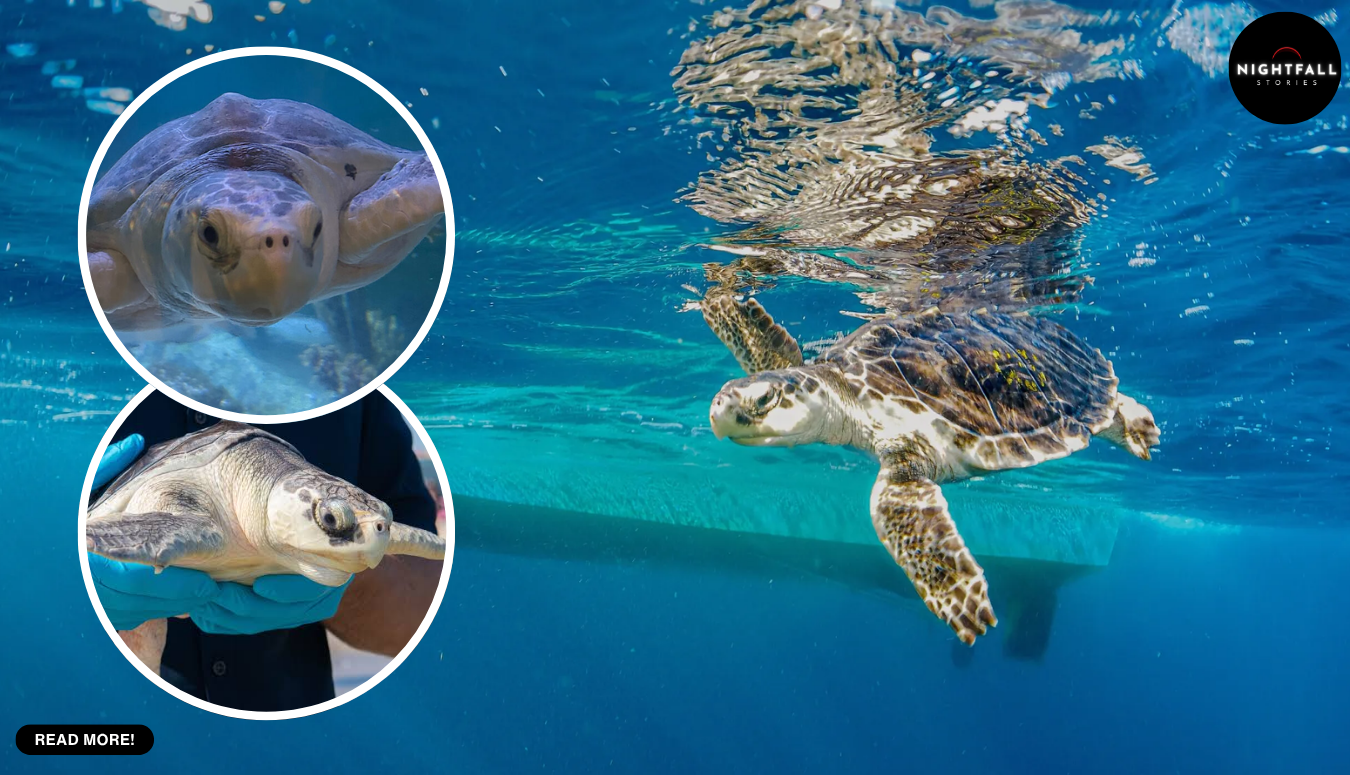
The two turtles that went into Nantucket Sound off West Dennis Beach this month were the last patients standing from a season that had brought something close to five hundred of them through one hospital door. They were Kemp’s ridleys, the smallest sea turtle in the world and the most endangered, and they had each spent roughly nine months inside the New England Aquarium’s Sea Turtle Hospital in Quincy, Massachusetts. One of them had arrived with a brain injury caused by oxygen starvation and had been treated, for two weeks in the middle of the summer, inside a hyperbaric chamber. The aquarium says that is the first documented use of hyperbaric oxygen therapy to treat a hypoxic brain injury in a sea turtle anywhere.
That is the ending. The beginning is stranger, and it happens every year on the same stretch of coast, and it looks, to anyone who stumbles across it, like a mass death.
Cape Cod is a hook. Look at it on a map and the shape is almost cartoonish: a long arm reaching east from the Massachusetts mainland and then curling sharply north and back west, closing around a body of water called Cape Cod Bay. For a sea turtle drifting north on warm summer currents to feed, that hook is a beautiful place to spend a season. Crabs, clear shallows, food everywhere. Juvenile Kemp’s ridleys in particular come up in numbers, feeding and growing, and for months nothing about the arrangement looks like a problem.
Then autumn arrives and the water starts to cool, and the turtles need to leave. To do that they have to swim south, out of the bay, around the inside of the hook, past the wrist, and back down the open coast. It is a counterintuitive route. A reptile following its instinct to head for open water and warmer latitudes swims south and hits the inside curve of the arm. It swims along the shore looking for a way out and the shore keeps bending it back. Some of them find the opening. A great many do not, and by the time they are still looking, the water has gone cold.
Sea turtles are reptiles, which means their body temperature tracks the water around them. They have no internal furnace. When the water in Cape Cod Bay drops through roughly 55 degrees Fahrenheit, about 13 degrees Celsius, a turtle’s whole system begins to shut down in sequence. The heart rate falls. Digestion stops. The immune response, which depends on the same chemistry as everything else, slows to something close to nothing. Muscles stop responding. The animal cannot swim, cannot lift its head to breathe reliably, cannot feed. This is what people mean by cold stunning, and the name undersells it, because the animal is not merely chilled. It is in a physiological collapse that will kill it if the water keeps cooling.
What happens next is why the beaches of Cape Cod Bay look the way they do in late autumn. A stunned turtle cannot swim away from wind and tide, so it goes wherever the water puts it, and the water puts it on the sand. It arrives limp, cold to the touch, sometimes with sand and weed packed around it, frequently not visibly breathing. A person walking a dog in November who finds one has almost no way of knowing it is alive. Its heart may be beating a handful of times a minute. It may take a breath every several minutes. Everything a person instinctively checks for is absent or too faint to find.
And that is the fact the whole rescue system is built on. Very often the turtle is not dead. It is somewhere that a warm-blooded animal simply does not have an equivalent for, and if it is found in time and warmed correctly, slowly, over hours, it can come back.
Finding them in time is the part that depends on people willing to walk cold beaches in the dark. Mass Audubon’s Wellfleet Bay Wildlife Sanctuary runs that effort, and it runs on staff plus a large volunteer corps who patrol the bayside beaches through the stranding season, timed to high tides and to whatever the wind has been doing, because onshore wind is what decides whether a drifting turtle lands on sand or stays out in the bay. Volunteers walk in wind chill, in the dark, at hours set by the tide rather than by anybody’s convenience. When they find an animal they mark it, note where it came from, protect it from further cooling, and get it off the beach. Those same beach walks are why the aquarium’s hospital receives live patients rather than a count of carcasses.
In 2025 that system had an extraordinary amount of work to do. Strandings began in early November. Inside the first two weeks the hospital in Quincy had taken in more than two hundred patients. Intake kept climbing through the end of November and into December. By the middle of December the aquarium’s own tally stood at 473 sea turtles admitted for the season: 404 Kemp’s ridleys, 48 green sea turtles, 21 loggerheads. Coverage of the season’s close put the final live intake at nearly five hundred. Whichever figure you use, the shape is the same. One rehabilitation facility, in a matter of weeks, absorbed several hundred critically ill animals belonging mostly to a species with very little margin left.
There is also a reason the counts have been getting larger over the years rather than staying flat. Cold stunning on Cape Cod is not new, but the scale of it is. Researchers working on the pattern have pointed to warming water as the driver: the bay stays hospitable later into the autumn, so young turtles have less reason to leave early, and more of them are still inside the hook when the temperature finally drops. The trap has not changed shape. What has changed is how late in the year it springs, and how many animals are inside it when it does. Rehabilitation facilities in the region have accordingly built capacity for seasons that would once have been considered impossible, and the 2025 intake is roughly what that looks like in practice.
It is worth pausing on what the Kemp’s ridley is, because otherwise the numbers read as a nice animal-rescue story rather than the thing they actually are. Kemp’s ridley is the smallest of the sea turtles, an adult roughly the size of a dinner tray, and it is the most endangered. Its nesting is concentrated in a very small part of the world, which means the species has almost no geographic insurance against a bad year. A juvenile turtle in Cape Cod Bay is a fraction of a percentage point of a global population, and the fraction is not small in the way that phrase usually implies. Every one of those 404 animals mattered arithmetically, not just sentimentally.
Triage on that scale is a logistics problem before it is a medical one. Each arriving turtle needs to be warmed at a controlled rate, because warming a cold-stunned reptile too quickly is dangerous in its own right. Each needs fluids, because they arrive dehydrated. Each needs assessment for the conditions that ride along with weeks of immune suppression and inhaled seawater: pneumonia, wounds and trauma picked up while being tumbled onto a beach, infections that took hold while the animal had no functioning defence against them. And recovery is measured in months rather than weeks for a straightforward reason. The same cold that stunned the turtle also switched off the immune system that would normally clear an infection, so the infections get a long unopposed head start, and the antibiotics that eventually go to work have to operate in a reptile whose metabolism moves slowly even when it is healthy. Nothing about the timetable can be hurried.
The hospital’s routine during a peak season is worth picturing, because the popular image of wildlife rescue is a person cradling an animal and the reality is closer to a hospital ward with a shift rota. Turtles occupy individual tubs, each with its own chart. Adam Kennedy, the aquarium’s director of rescue and rehabilitation, runs that side of the operation, and senior veterinarian Dr Kathy Tuxbury is among the clinicians carrying the caseload. Animals are weighed, bloods are drawn, radiographs are taken, antibiotic courses are tracked individually, and a turtle that looked stable on Monday can be the urgent case by Thursday. Multiply that by several hundred at once and the constraint stops being medical knowledge and starts being hands, tubs and heated seawater.
Most of the 2025 patients recovered through the spring and summer and went back into the ocean in batches, some off Cape Cod, some further south. Two did not, and both for reasons that pushed the hospital past ordinary practice.
The turtle logged as Shelley Volante had severe sepsis, which is what happens when an infection stops being local and gets into the bloodstream. In this animal it had also reached bone, and there was inflammation through muscle and fat. Sepsis with bone involvement is a hard problem in any species and a harder one in a reptile, because the drugs have to reach tissue with a poor blood supply in a body running at low speed. The aquarium’s team used advanced imaging to find where the damage actually was, then went in surgically and cleaned out an affected joint, a procedure called debridement, which means removing the dead and infected tissue so that what is left has a chance to heal. Then they waited, for months, and treated, and imaged again, and waited.
The other turtle, logged as Young Frankenstein, had a different and less fixable injury. At some point in the collapse, before or during stranding, the animal’s brain had gone without enough oxygen. That is a hypoxic brain injury, and it is the kind of damage that does not respond to antibiotics or surgery because there is nothing to cut out or kill. In practice it showed up as a turtle whose body was recovering while its behaviour did not. It had trouble navigating. It had trouble finding and taking food. For an animal that has to be able to feed itself and orient in open water before anyone can responsibly release it, that is not a cosmetic problem. It is the whole release criterion, failing.
Hyperbaric oxygen therapy is an old idea from human medicine, developed largely around diving injuries. The patient goes into a sealed chamber, the pressure inside is raised well above normal atmospheric pressure, and the air they breathe is oxygen rich. The physics is simple enough to state plainly: at higher pressure, far more oxygen dissolves directly into the blood plasma rather than relying on red blood cells to carry it, so oxygen can reach tissue that a normal blood supply is struggling to serve. It is standard care for decompression sickness and carbon monoxide poisoning, and it is used for certain stubborn wounds. It is not standard care for a turtle, because nobody had documented doing it for this.
Dr Melissa Joblon, the New England Aquarium’s director of animal health, is the named voice on the decision. In the middle of the summer the team began hyperbaric sessions for Young Frankenstein, twice a week over about two weeks. Joblon has described the result as a drastic improvement in the turtle’s ability to navigate and to forage, and she noted that the change was visible after only two treatments. She and the aquarium describe this as the first documented use of hyperbaric oxygen therapy to treat hypoxic brain injury in a sea turtle. That claim belongs to them, and it is worth keeping it in their hands rather than promoting it to a fact of the record. It is a claim about the documented literature, which is a thing that can be wrong in either direction, and the honest version is that the aquarium says it is a first and nobody has come forward to say otherwise.
What is not in dispute is what the turtle did afterwards. It started navigating. It started eating properly. It kept doing both long enough that the veterinary team was willing to sign off on an animal they had come very close to not being able to release at all.
Both turtles cleared their final checks in the same week, which is how the last two patients of a five hundred animal season came to go back at the same time. The release happened at West Dennis Beach on the south side of Cape Cod, which puts an animal straight into Nantucket Sound and from there into open water on the correct side of the hook. Local people came out to watch. That is normal for these releases and it is a small good thing in itself, because the same beaches that produce the emergency every November are walked by the people who end up standing in a loose line in September watching the outcome.
There is no cliffhanger here and no pending result, which is unusual and pleasant. The two turtles are gone. The 2025 cold stunning season is formally closed, nine and a half months after it opened. And the hospital in Quincy is already restocking, because the trigger for the next one is not a date on a calendar but a number on a thermometer. When the water in Cape Cod Bay comes back down through 55 degrees Fahrenheit, the turtles still feeding inside the hook will try to leave, and some of them will not find the way out, and the volunteers will start walking the beaches in the dark again.
What Young Frankenstein leaves behind is smaller than a species and bigger than one animal. It is a line in the veterinary record: that when a cold stunned sea turtle comes in with a brain that has been starved of oxygen, and it cannot find its food, and everything else you know how to do has already been done, there is now one documented case of somebody trying a diver’s chamber and watching the animal come back. The next hospital that faces the same turtle will not have to invent that from nothing.