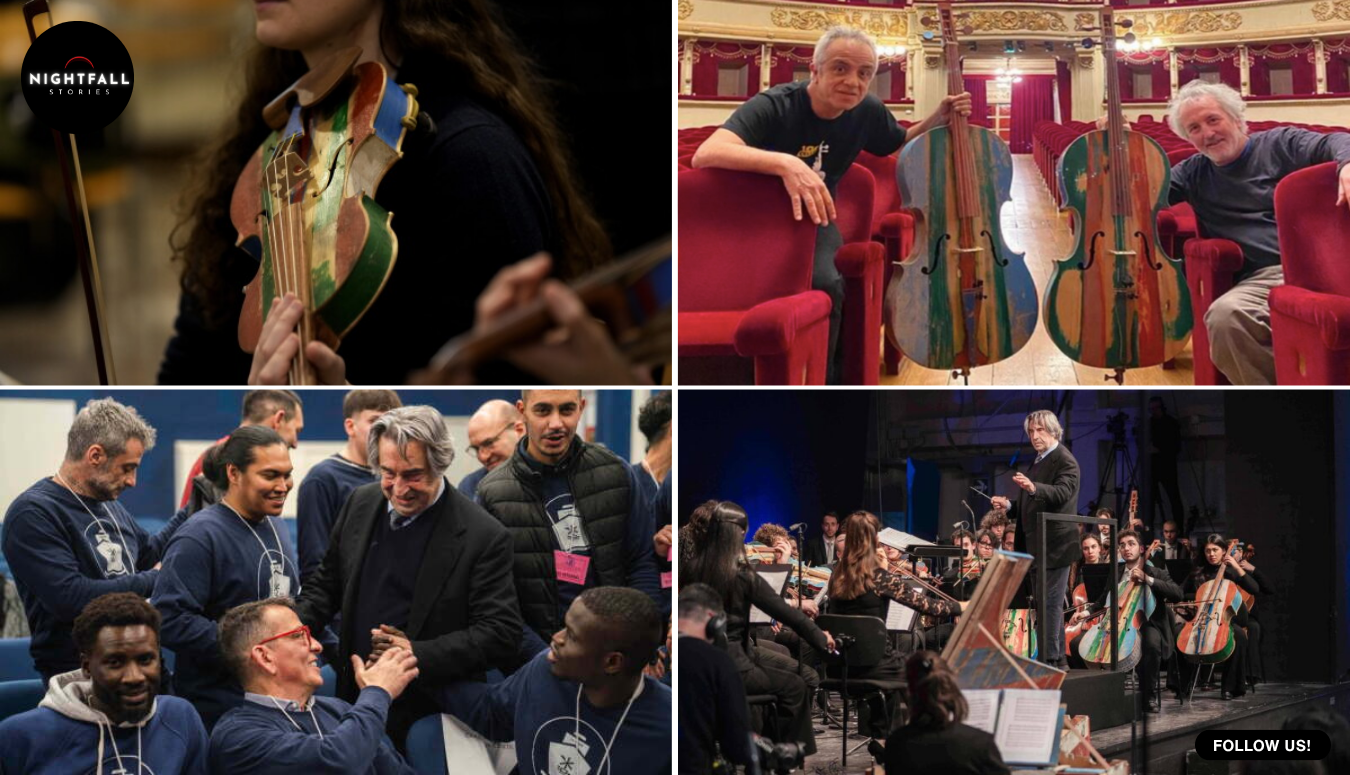
There is a particular sound that comes out of a violin made from the hull of a boat. Not a bad sound. Players who have handled these instruments describe them as warm and slightly unpredictable, the way a handmade thing usually is. What gives them away is not the tone. It is the paint. Look closely at the ribs and you can still see it, faded blue and green and yellow, the colours of a working fishing vessel that spent years in salt water before it was seized, abandoned and left to rot in a yard in southern Italy.
Earlier this year, on a Saturday in January, a youth orchestra carried a set of those instruments into the Opera prison on the southern edge of Milan and played Vivaldi and Verdi on them. Riccardo Muti conducted. Singers from San Vittore, another Milan prison, joined in for the chorus of exiles from Nabucco, the one everybody knows, the one about a homeland that is beautiful and lost. The soprano Rosa Feola sang the Ave Maria from Otello. Some of the men in the audience read out things they had written. Muti said afterwards that he had felt more emotion and more creativity inside that room than he usually feels outside it, which is the sort of thing a famous conductor says at a charity concert, except that in this case he had a reason. Several of the instruments in front of him had been built by hand, in that building, by people who were still in it.
That concert is the reason you are reading about this now. It is not the story. The story is thirteen years old and it is slow, and the slowness is more or less the whole point.
The luthiery workshop inside Opera was set up in 2013 by the Casa dello Spirito e delle Arti Foundation, a Milan organisation that works on prison projects and was founded by Arnoldo Mosca Mondadori. Opera is Italy’s largest prison. It holds somewhere around 1,400 people. A good part of it runs under a high security regime, and the average length of stay is roughly fifteen years, which is a number worth sitting with for a second. Fifteen years is not a sentence you serve by waiting it out. It is a period of life. Whatever a person does inside it becomes, in a real sense, what they did with that part of their life.
So the foundation put a bench, a set of gouges, a glue pot and a supply of seasoned spruce and maple into a room, and brought in a master luthier to teach.
His name is Enrico Allorto. He was born in 1960 and he works out of Biella, an old textile town in the foothills north of Milan, one of those places that spent a century making cloth and has spent the past few decades trying to work out what it makes now. Allorto is a musician as well as a maker, and he builds in the traditional way, following techniques that were settled in the seventeenth century and have not needed much improving since. Earlier this year he went back to Biella to talk to school students about the work, and the figure he gave them is the one that tells you most about it. A cello, he said, takes something in the region of 400 hours. A violin takes more than 300.
Three hundred hours is roughly two months of full working days. It is a long time to spend on an object smaller than a cat.
That is because almost nothing about a violin can be rushed. The top and back are carved from solid wood and thinned by hand until they are a few millimetres thick, and the thinning is done by feel, tapping and flexing and taking off another shaving, because the right thickness is not a number, it is a response. The ribs are bent over a hot iron. The bass bar is fitted by trial, glued, then shaved down again. The neck joint has to be cut so precisely that the fingerboard arrives at the bridge at exactly the right height and angle, and if it does not, the instrument is uncomfortable to play and there is no fixing it later. The varnish goes on in many thin coats over weeks, and each coat has to cure. You cannot hurry varnish. You can only wait for it.
Every one of those stages punishes impatience and rewards attention. Which is a strange and useful thing to hand to a person who has fifteen years and very little to do with them.
There is a practical argument underneath all of this, and Italy makes it openly. Article 27 of the country’s constitution says that punishment must aim at rehabilitation, which means that work and training inside prisons are not treated as a favour to the people inside but as part of what the sentence is for. Opera leans into that harder than most. It runs well over a hundred activities and workshops. Around a hundred people there are enrolled in university courses through an arrangement with a Milan university. There is a pastry operation, assembly work, contracts with outside companies. And the figures that come out of it are the reason nobody has shut the luthiery down. Across the Italian system, roughly six in ten people released from prison end up back inside. Among people who leave Opera with a trade and a job placement, the reported reoffending rate falls to around two per cent.
Two per cent. Against sixty. That gap is the entire argument for putting a glue pot in a prison, and it is a stronger argument than any amount of talk about the healing power of music.
For the first several years the workshop simply made violins. Good ones, built to the Cremonese pattern, copies in the honourable sense of the word, since almost every violin made anywhere in the world for the past three centuries has been a variation on what Antonio Stradivari and Giuseppe Guarneri worked out in one small northern Italian town. Some of the completed instruments were given away. A number went to the Milan Conservatory. Others were handed to children and teenagers who could not have afforded an instrument, including Roma students who were put through on full scholarships. One violin was taken by the artist Jannis Kounellis and turned into a public work, which is a slightly odd fate for an instrument but does at least mean it is still being looked at.
Then, around five years ago, the wood changed.
The men in the adjoining carpentry workshop had been building nativity scenes, one of which was given to Pope Francis. The carpentry side is guided by Francesco Tuccio, a joiner from Lampedusa who is known for making crosses out of the timber of boats that sank off the island. The idea of taking that same timber and making it into instruments seems to have arrived sideways, the way these things do. Allorto built a first violin from boat wood, and then the foundation gave the strand a name, Metamorfosi, and the work became systematic. The timber comes from vessels used by smugglers to carry people across the Mediterranean, boats that were confiscated and were otherwise going to be broken up or burned. Ten of them supplied the first batches. The finished instruments are varnished a deep Mediterranean blue.
It would be very easy to write that paragraph sentimentally, and a great many people have. The wood of death becomes the wood of music. You can see why the phrase travels. It is worth being careful with it, for two reasons.
The first is that the boats are not a metaphor. They are evidence of something that is still happening, and the people who were on them are mostly not part of this story, do not get asked about it, and are not the ones being rehabilitated by it. A violin does not settle anything about why the boat was in the water. It is a thing made out of the leftovers, and it is better than a bonfire, and that is the honest size of the claim.
The second is that the boat wood is the part everybody repeats, which means the same handful of facts have been recirculating for years now in a way that makes the project look newer than it is. The instruments from smugglers’ boats reached the stage of La Scala in Milan in early 2024, played by an ensemble assembled for the occasion and called the Orchestra del Mare, the orchestra of the sea. Over about two and a half years the workshop turned out fifteen instruments, violins, cellos and a double bass, and they were blessed by Pope Francis. There was a concert on Lampedusa itself, with Muti conducting, in the summer. By the time the orchestra reached the Opera prison in January, the idea was already well travelled. What is new in that January concert is not the concept. It is only that the instruments finally got played inside the building where they were made, in front of the people who made them.
Which brings up the part of this story that I cannot tell you as cleanly as I would like.
The foundation’s own account of the workshop names the people in it. The four men currently at the bench are named by first name only, Vincenzo, Claudio, Nicolae and Andrea, which is both normal and right for anyone serving a sentence. All of them are described as employed artisans rather than students, which matters, because being paid for skilled work is a different experience from being given something to do. And the foundation makes one further claim, the one that would be the whole story if it held up. It says the workshop has produced a genuine professional, a man named Fabrizio Fornara, who according to the foundation now works training people inside the prison and collaborates with established master luthiers in Cremona, including one named Edgar Ross.
I could not confirm that independently. I looked. The wire report on the January concert names no craftsman at all, not Allorto and not Fornara. Allorto himself checks out easily and from several directions, in the regional press near Biella, in Italian arts coverage, and in reporting on Opera that predates the concert by years. Fornara does not. Every trace of him leads back to the foundation’s own website and stops there. Nor does the foundation’s wording actually say what a casual reader assumes it says. It does not describe him as somebody who was serving a sentence. Read it carefully and it says only that the workshop can make real professionals, and that it did so in his case.
So I am not going to hand you the ending you can probably feel coming, the one where a man walks out of prison with a trade and goes to work in the city of violins. It may well be true. It is claimed by an organisation with no obvious reason to invent it, and it is exactly what the workshop was built to produce. But a single source with a direct interest in the outcome is not the same thing as a documented fact, and the difference between those two is where this kind of story usually goes wrong.
What is documented is quieter and harder to dress up, and I think it is actually the better ending.
Cremona is about an hour southeast of Milan. It is a small city that has somehow kept an entire craft economy alive for four centuries, with well over a hundred working violin workshops and a long established school that draws students from every continent. It is also, like every prestige craft, a place with more people who want to do the work than positions for people to do it in. Training is not a job. A qualification in luthiery is a beginning, and a hard one. If you send somebody out of a prison gate with 300 hours of bench time and no network, the trade does not automatically open.
Which is why the thing that matters about Opera’s workshop is not any single graduate. It is that the workshop kept going for thirteen years, paid people, and has had a professional turning up to teach in it for most of that time.
Think about what Allorto is actually doing. He is a working maker in a field that survives on reputation and scarcity, and he spends part of his life handing that field’s methods to people the field would never otherwise recruit, most of whom will not be free for a decade. He does not get finished apprentices out of it. He gets a slow room with four benches, and men learning to tell by touch when a plate is thin enough, and instruments that take two months and come out playable.
And on a January afternoon those instruments came back through the gate in the hands of young professional musicians, and got played, properly, in front of the people whose hands had shaped them. Nobody in that room got their sentence shortened. The boats are still crossing. But for the length of one Verdi chorus, roughly four minutes, the men in that audience were listening to something they had made being used for exactly what it was made for, which is more than most work in most prisons anywhere ever gets to be.
Three hundred hours, and then four minutes. It sounds like a poor trade. Set against fifteen years, it is not.