Blog

  • For years he went to the cinema only to sit beside his wife in the dark. This summer, for the first time in his life, he could follow the film.

    For years he went to the cinema only to sit beside his wife in the dark. This summer, for the first time in his life, he could follow the film.

    The detail that gives the whole thing away is not the date a law took effect. It is the fact that a deaf man living in rural Virginia went to see the new film of The Odyssey with a hearing neighbour, as a boys’ night out, and understood it. His wife, Nancy Anderson, describes it as the first time in his life he was able to watch a film on release the way everybody else does. Not a special screening. Not a disability accommodation booked three weeks ahead. Just the showing that happened to be on, with the words on the screen.

    She is not shy about what the years before that looked like either. The two of them can now have a date night whenever they feel like it, with an actual choice of what to see, like any other couple. She had been waiting a long while for that sentence to be true.

    Her husband is not named in any of the reporting about this, and that is deliberate on our part as well as theirs. He is described only through his wife’s account of him. Writing about a named private individual’s deafness requires his consent, and that consent is not on the record, so he stays as his wife chose to present him, which is as her husband, excited about a film. It is worth saying plainly rather than quietly working around, because the pattern in this story is people being talked about rather than asked.

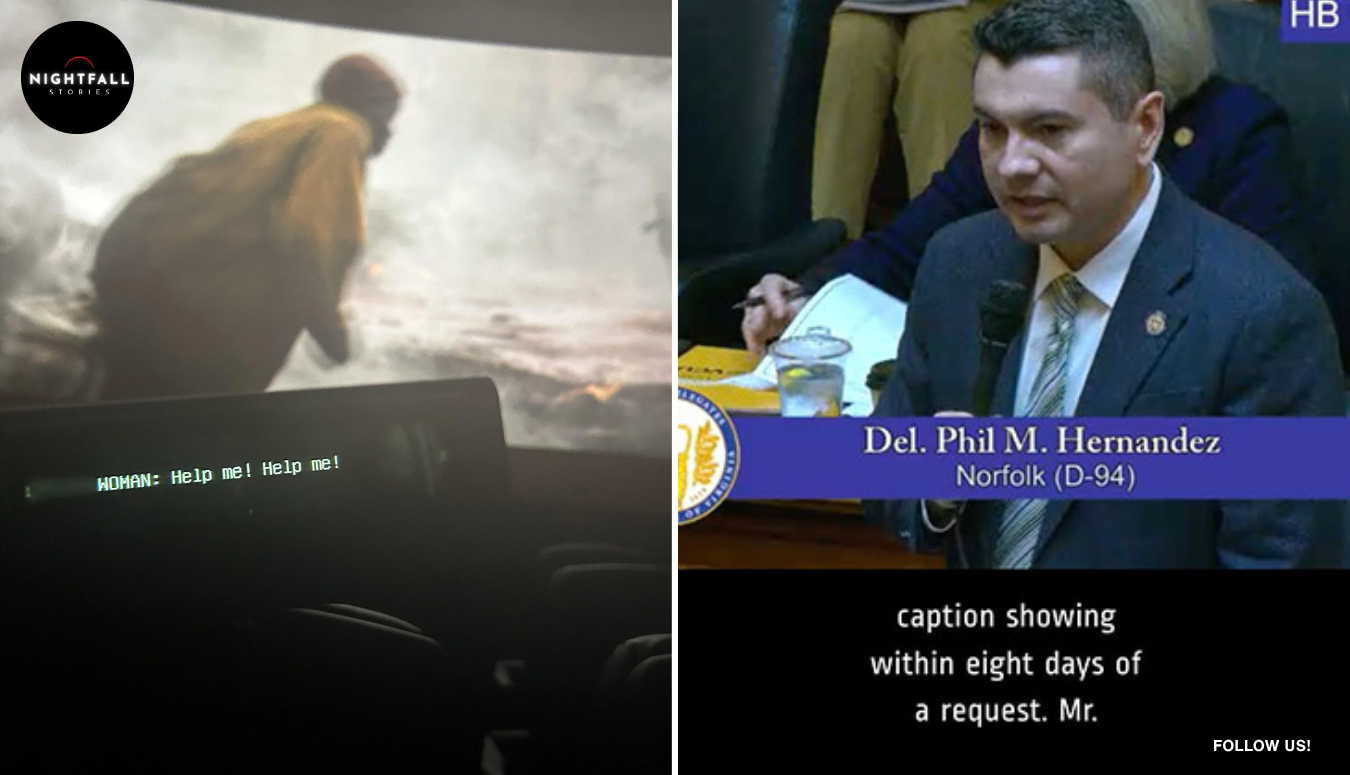
    What changed for him is a Virginia law, House Bill 602, which took effect on the first of July. It does something that sounds almost too small to need a statute. It requires cinema chains to put the words on the screen, visible to everybody in the room, at a set number of ordinary screenings of ordinary new releases.

    That is open captioning, and the distinction between it and the thing cinemas have offered for decades is the entire fight. Closed captioning is private. You collect a device at the counter, a pair of caption glasses or a bendy plastic arm that slots into your cup holder with a small reversed display on the end, and the text appears for you alone. In principle it is elegant. Nobody else’s film is altered. In practice, ask the people who use them.

    ReBecca Bennett, who runs a camp for deaf children and lives in Fredericksburg, has described the experience as simply frustrating: dead batteries, screens that will not sit straight. Jenny Witteborg, from Culpeper, who goes to films with her deaf husband, describes the specific indignity of the thing failing mid film, which means getting up, walking out, finding a manager, asking for a replacement pair, and coming back having missed a chunk of the story you paid for. Jamie Berke, from Fairfax, was among the deaf Virginians who said the same at a public town hall before the bill moved.

    Add it up and the pattern is obvious. The industry’s answer to deaf audiences for thirty years has been a gadget, and a gadget has a battery, a hinge, a stock level at the counter and a member of staff who may or may not know where they are kept. An open caption does not. It is in the file. It either plays or it does not.

    And here is the part that makes this a story rather than a regulation. The idea of putting words on a film for deaf audiences was not a studio’s gift, or a legislature’s, or a technology company’s. It was invented by a deaf actor whom the film industry had just finished throwing away.

    Emerson Irving Romero was born in 1900 and lost his hearing at six, after whooping cough. He became a silent film comedian under the name Tommy Albert, appearing in more than two dozen two reel comedies in the late 1920s, doing his own stunts and his own makeup, working alongside performers including W. C. Fields and Janet Gaynor, and hiring the deaf actress Carmen de Arcos. Silent film was, for a few years, a medium where deafness was not a disadvantage at all. Everybody in the audience was reading. The intertitle was the dialogue.

    Then sound arrived, and the intertitles went, and an entire audience and an entire generation of deaf performers were shut out of the medium in the space of about two years. Romero’s screen career ended around 1929. He went back to New York.

    What he did next, in the 1940s, is the origin of film captioning. He bought prints of films and physically cut them open, splicing in frames carrying the dialogue as text between the picture frames, by hand, and then rented the results out to deaf schools and deaf clubs. It was a brute force solution with real costs. Inserting caption frames into the picture stretched the running time and broke the rhythm of a scene, the copies were poor, and the splicing damaged soundtracks. He had no industry backing and no money, and eventually he stopped.

    But the idea survived him stopping. Edmund Burke Boatner, then superintendent of the American School for the Deaf, picked it up, heard about a film etching process developed by a Belgian company that could put text onto a print without cutting frames into it, and with a colleague founded a non profit called Captioned Films for the Deaf. Between the late 1940s and the late 1950s it captioned and circulated twenty nine educational and Hollywood films. That is the thin thread from which everything else descends.

    Romero did not confine himself to film, either. He went on inventing things deaf people needed and nobody was making: a vibrating alarm clock he called the Vibralarm, doorbells, smoke alarms, baby alarms. He helped found a theatre guild for deaf performers and edited a deaf community journal. He died in 1972, decades before captions became routine on anything.

    Hold those two facts next to each other. A deaf man cut captions into film prints with a razor because the industry would not, and gave up for want of funding. Roughly eighty years later, a state legislature had to pass a law to make cinemas show captions on a file that in most cases already has them.

    Because that is the bit that stings. Modern distribution means the caption data usually ships with the film. The law even allows for the case where it does not: if a film’s digital file genuinely has no captions available, nobody is required to invent them. The requirement is not that cinemas create anything. It is that they turn on something they already have, in a room full of people, at a decent hour, a handful of times.

    The arithmetic is specific, and it is worth knowing exactly how far it goes, because the honest reading of this law is that it is a floor and not a solution. A chain with five or more Virginia locations must provide open captioning for any film showing at least seven times a week over more than one week. Within the first fortnight of such a film’s run it has to schedule at least four open captioned showings, and at least one of those has to fall inside protected prime time: a Friday evening, a weekend daytime or evening, or a weekday evening. In other words, not a Tuesday at eleven in the morning, which is where accessible screenings traditionally went to die. After the third week of a run, a customer can request a captioned showing and the cinema has seventy two hours to put one on, with exceptions where tickets are already sold. Smaller operators, four locations or fewer, have a lighter duty: a captioned screening within eight days of someone asking. Drive ins and outdoor venues are exempt. Chains have to publish a contact point for requests and have to label the screenings so you can find them, which in practice means the letters OC on the listing. Complaints go to the state attorney general’s civil rights office.

    Four screenings out of a fortnight of a big release is not every screening. Nobody involved pretends otherwise. But four is the difference between a deaf couple choosing a film and a deaf couple being assigned one, and that is the difference Anderson is describing when she talks about having choices.

    The legislator who carried it, Phil Hernandez, represents a district around Norfolk, and his interest is not abstract: his sister is deaf. By his own account he took the bill up after an accessibility advocate came to him about it, in the second half of 2025. That advocate is not named anywhere in the public record of the bill, which is a gap worth flagging rather than glossing. The person who walked into a politician’s office and started this is unidentified, while the politician’s name is on the statute. It is a pattern in disability law that recurs so often it has stopped being remarkable, and it should not have.

    What is on the record is a lot of unglamorous chapter level work by people who were not going to be in any headline. Kenneth Reichert, who leads the Virginia Beach chapter of the Hearing Loss Association of America and who spent thirty years in the United States Navy before leaving it with service related hearing loss, spoke publicly for the bill, and made an argument that is easy to miss: this is not only about deaf adults. It is about a grandparent being able to sit through a film with a grandchild. A string of other chapter members wrote to legislators. It passed both chambers comfortably, was signed in the spring, and became law in the summer.

    Within that same association’s account of the campaign there is a second couple whose story rhymes with the Andersons’ almost exactly, and they are a different couple in a different part of the state, which is worth stating clearly because the two are easy to confuse. Claire Fornsel, a chapter vice president near Virginia Beach, has talked about her husband Ken, who has hearing loss, and about the years in which he came along to films he could not hear for no better reason than that he loves her. Two couples, hundreds of miles apart, with the same quiet arrangement. That is not a coincidence or a nice line. It is what the absence of captions actually produces at scale: a hearing partner watching a film and a deaf partner sitting beside them doing something else.

    Then there is the response from the side everybody expected to object. Steve Nerangis, who co owns an Alamo Drafthouse cinema in Winchester, is on the record as entirely relaxed about it, and his reasoning is the single most disarming fact in the whole story. Plenty of people, himself included, watch television at home with the captions switched on so as not to miss any dialogue. Given that, he regards putting them on a cinema screen as a natural next step rather than an imposition.

    He is right about the habit, and the habit is global. Subtitles on by default, in your own language, in your own living room, has quietly become the normal way a very large number of hearing people under forty watch anything at all. Modern sound mixes bury dialogue. Phones and laptops have bad speakers. People watch in shared rooms, on public transport, with a baby asleep next door. Whatever the cause, the result is that the thing the film industry spent decades treating as a specialist accommodation for a minority has become the default setting of a mainstream audience, which rather undermines the long standing argument that visible captions ruin the experience for everybody else.

    There is one more thing the gadget era got wrong, and the law quietly corrects it. A closed caption device singles you out. You queue separately, you sign something, you carry a piece of plastic to your seat, and if it fails you make a scene in a dark room. Several of the deaf Virginians who spoke up for this bill kept returning to that, not to the technology but to the asking. An open caption asks nothing of anybody. You buy a ticket like everyone else and sit down like everyone else, and the difference between those two experiences is not a convenience, it is whether a night out costs you an act of self identification at a counter.

    The practical effect in one mid sized town is modest and real. Local organisations that work with deaf and hard of hearing residents, including an independent living centre in Winchester whose director has credited the local cinema’s willingness to cooperate, now point people towards captioned screenings of the summer’s biggest films rather than apologising for their absence. The venues involved are ordinary ones: a twelve screen multiplex, the Alamo in the same town, a small chain cinema in a nearby town covered by the on request rule. The drive in down the road is exempt and remains so.

    None of this reaches independent single screen cinemas, which are not chains. None of it reaches the other forty nine states, where the gadget in the cup holder is still the answer. And four screenings a fortnight is four screenings a fortnight.

    But something did change, and it changed in the direction the medium originally pointed. For about fifteen years at the start of cinema, every single person in the room read the dialogue off the screen, and a deaf Cuban American could be a working film comedian with his name on the posters. Sound closed that door, and one of the people it locked out went home and spent his own money cutting the words back into the picture by hand, with nobody’s help, and ran out of road.

    The words are back on the screen now, in a few hundred auditoriums, four times a fortnight, labelled with two letters on a listings page. And a man who had spent a lifetime going to the cinema mainly to sit next to his wife in the dark went to see a film about a long journey home, with a neighbour, and followed every word of it.
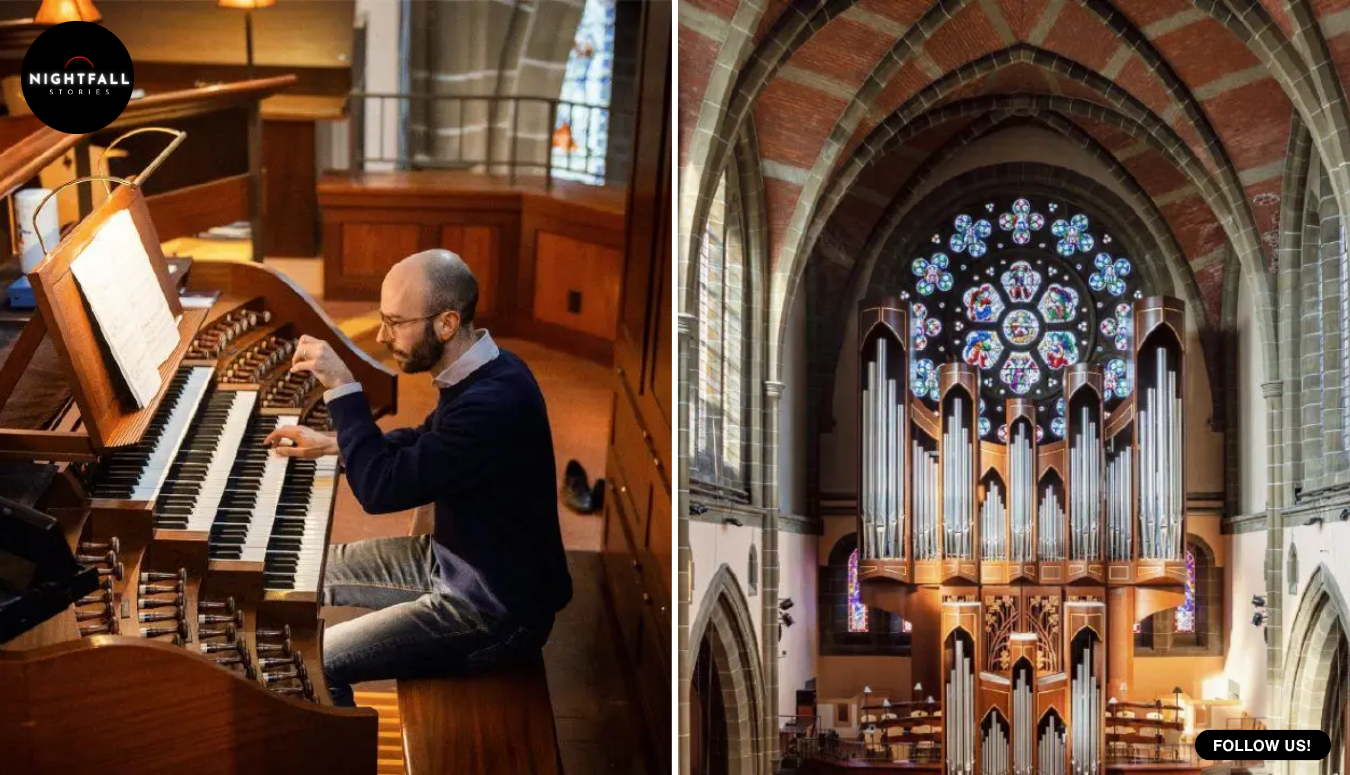
  • It took six years to build and twenty-one years to wear out. The crew who stripped it down this summer had learned their trade in the workshop that made it.

    It took six years to build and twenty-one years to wear out. The crew who stripped it down this summer had learned their trade in the workshop that made it.

    For eleven weeks this summer, the largest mechanical pipe organ in Canada west of the Rocky Mountains was not an instrument at all. It was components. Four thousand pipes, or something close to four thousand three hundred depending on whose count you accept, came out of a free standing mahogany case built around a rose window and were laid out, cleaned one at a time, and put back. Twenty tons of wood, leather, tin and lead, sitting on a reinforced steel frame wedged between two bell towers to keep it still in an earthquake, was opened up and gone through by hand.

    The crew who did it worked for a company in Montreal called Juget-Sinclair. The organ they were taking apart was built by a man called Hellmuth Wolff, in a workshop in Laval, Quebec. And the reason this is a story rather than a maintenance invoice is that the people who dismantled the instrument had learned the trade inside Wolff’s own shop, from Wolff, and came back to his work two decades later to undo and redo it. Wolff himself died in Montreal in 2013. He never saw the overhaul, and he never had to watch anybody else’s hands inside his masterpiece.

    That is the headline fact, and it holds up. Stephen Sinclair, who became an associate of the Montreal firm in 1998, worked in Hellmuth Wolff’s workshop from 1989 until 1998, with spells in France and England along the way. Denis Juget, who founded the firm in 1994 after training as a cabinetmaker and apprenticing in organ building in France before moving to Montreal, also came out of Wolff’s orbit. The Victoria reporting describes Juget-Sinclair plainly as a company made up of Wolff’s former associates, and the firm’s own account of itself confirms the apprenticeships. These were his people.

    The instrument sits in Christ Church Cathedral in Victoria, British Columbia, on Canada’s Pacific coast. It is Wolff’s Opus 47, out of roughly fifty instruments he designed, built and installed across North America between 1968 and 2008, which means it arrived near the end of a working life and is widely treated as one of the best things he ever made. Mark McDonald, the cathedral’s organist and assistant director of music, puts his finger on why: Wolff, he says, was really a musician at heart, and it shows in the way the thing sings rather than merely sounds.

    Wolff’s own route to that workshop is worth a paragraph, because it explains the instrument. He was born in Zurich in 1937. He apprenticed with Metzler and Soehne in Dietikon, worked at Rieger in Austria, then crossed the Atlantic to work with Charles Fisk in Massachusetts before emigrating to Canada in 1963. He spent time as a designer at Casavant Freres in Quebec, worked briefly with Karl Wilhelm, and in 1968 opened his own shop in Laval. He became a Canadian citizen in 1970. He was one of a small number of builders in North America who turned back towards historical practice at exactly the moment the industry was going the other way, which is to say he built tracker organs, where the keys are connected to the pipe valves by a physical linkage of wooden rods rather than by electricity. Press a key on an instrument like that and you are pulling open a valve with your finger. You feel it. That is the whole point, and it is also why such an instrument wears like a machine rather than like a piece of furniture.

    The Victoria organ took six years to come together and cost about 2.2 million Canadian dollars to build, somewhere around 1.8 million US dollars at the exchange rates of the day. More than a quarter million of that went on steel alone, because the engineering problem in a seismic zone is not the music, it is stopping twenty tons of case from moving. Installation began in 2004 and the instrument was inaugurated in the autumn of 2005, with a dedication recital given by the English organist John Scott. The case is mahogany, free standing, deliberately shaped around the rose window in the west wall so that the window still reads as a window. The console is detached from the case with enough room between the two for two rows of singers, which is a small design decision that tells you the builder was thinking about choirs and not about photographs.

    The thing it replaced had been in constant use for well over a century. McDonald’s description of its final decades is the kind of line that sticks: held together, he says, with duct tape and prayers. A former music director, Michael Gormley, started arguing in the 1980s that the cathedral needed something spectacular instead, and spent years pushing the fundraising that eventually produced the Wolff.

    It helps to know what is actually being counted, because the counting is where this story gets slippery. A rank is a single row of pipes, one pipe for every note, all built to the same recipe so they share a family voice. A stop is the control the player pulls to bring a rank, or sometimes several ranks at once, into play. So ranks are hardware and stops are closer to choices, and the moment a builder lets one rank be played from two different keyboards, or borrows a bass rank to serve two purposes, the arithmetic stops being arithmetic and becomes a matter of convention.

    It is also worth knowing how small the shop was. By 1990 Wolff’s firm had completed thirty three instruments in twenty two years, with James Louder joining as an associate in 1986, which is the output of a handful of people working slowly rather than a factory. Opus 47 was not assembled by a workforce. It was made by a few pairs of hands over six years, and almost everybody who ever touched the inside of it knew everybody else who had. That is why sending Wolff’s former apprentices back to it is not a sentimental coincidence. In a trade that small, there was hardly anyone else to send.

    Here is where the numbers go sideways, and rather than quietly split the difference it is more honest to lay the disagreement out. The cathedral’s own description of its instrument says sixty seven stops and four thousand pipes across four manuals and pedal. The standing Quebec organ catalogue that documents the province’s builders lists the same instrument as sixty one stops, eighty six ranks and approximately four thousand three hundred pipes. A third reference gives sixty one stops and eighty five ranks. Local reporting over the summer used both sets at different times, sixty one stops and eighty five ranks in the spring, sixty seven stops in the autumn. Nobody is lying. Stop counts move depending on whether you count borrowed and duplexed registers, couplers and transmissions, and rank and pipe counts move with them. But the spread is real, and the only defensible way to write it is to say that the cathedral calls it sixty seven stops and four thousand pipes, that the catalogue calls it sixty one stops, eighty six ranks and about four thousand three hundred pipes, and that both figures describe the same object.

    What is not in dispute is the workload. In its first twenty one years the instrument was used for more than twenty thousand hours. The cathedral breaks that down as roughly four thousand services, three thousand rehearsals and two hundred concerts, and it is the primary teaching instrument for the University of Victoria’s organ programme and the Victoria Organ Studio on top of all that. Which means students. Which means scales, and the same passage ninety times, and the mechanical action taking every one of those repetitions through a linkage of wood.

    Twenty thousand hours does specific, unromantic things to an organ. Leather dries and hardens and stops sealing, so wind leaks where it should not and pipes speak when they are not asked to. Felt and cloth bushings compress, so the action develops slack and the touch goes vague. Wooden trackers move with two decades of humidity swings and the regulation drifts out, so the keys no longer all feel the same under the hand. Pipe mouths fill with dust and the voicing dulls, a few cents and a shade of brightness at a time, slowly enough that nobody in the congregation ever notices a bad day. Electrical contacts on the stop action corrode. None of it is dramatic. All of it is cumulative, and the sum of it is that the instrument gradually stops being the instrument that was delivered.

    There is something quietly surprising in that for anyone who assumes an organ restoration must involve a nineteenth century relic. This machine was twenty one years old. It had already worn out once. That is not a sign of poor building, it is a measure of how hard a working cathedral instrument is actually driven, and it is a far more interesting fact than the usual heritage rescue story.

    The cathedral decided to deal with it rather than let the drift continue. The target was 150,000 dollars, raised by public donation, and by the time the crew arrived in the middle of June about 120,000 of it was in, leaving the committee chasing the last thirty thousand while the work was already underway. Thomas Chase, who chaired the fundraising, described the instrument as the voice of the cathedral, something that can fill the building with thunder and can also whisper, and the campaign leaned on exactly that: not a building fund, not a roof, but the sound of the place.

    Then the organ went silent, and stayed silent through the entire summer, in a building whose liturgy is organised around it. McDonald’s own formulation is that the organ gives voice to the liturgy. Take it out in the middle of June and give it back in September and you have taken out the thing the congregation sings against for a whole season.

    The work itself was straightforward in description and brutal in scale. Every pipe cleaned and regulated. Mechanical components taken apart, refurbished and reset. Electrical components gone through. A hard deadline at the start of September, because the first booking back was not a quiet Sunday but a concert by the Choir of Merton College, Oxford, on the seventh. There is no version of that date where the instrument is nearly ready.

    It was ready. The organ returned to public service on 7 September, under an Oxford choir, which is about as exposed a re entry as an instrument can be given. Donald Hunt, the cathedral’s director of music, said afterwards that it came back sounding as beautiful as ever, which from a director of music is less a quote than a verdict.

    What happens next is scheduled rather than finished, and it is worth being precise about that. The formal rededication falls on 4 October, at Evensong, and a British composer, David Bednall, has written a new piece for the occasion which is due to receive its world premiere at that service. The weekend around it is built out: Mark McDonald playing a lunchtime recital with the Calgary trumpeter Adam Zinatelli, and Alex Ross of Juget-Sinclair giving a public talk about what the crew actually did, which is an unusually good idea, because the work is invisible once the case is closed. The internationally known organist Jan Liebermann is booked for a concert the same weekend. At the end of October the organist David Briggs is due to accompany the 1925 silent Phantom of the Opera on the restored instrument, which is the single best demonstration of range anyone could have programmed: the same machine that carries an Evensong has to produce a horror film for ninety minutes without a break.

    So the rededication and the premiere are still ahead as this is written. The ending that has actually happened is the one in September, and it is the better ending anyway, because it is the one where the instrument had to work.

    There is a detail in the Bednall commission that rewards a second look. Commissioning a new piece is what you do when an organ is new. Doing it for a rededication means the cathedral is treating a twenty one year old instrument as something with a future rather than something being tidied up, and asking a living composer to write for this particular box of pipes, in this particular stone room, with this particular reverberation.

    And the shape of the whole thing is unusual enough to say out loud. Most restoration stories are about strangers rescuing an object from its own history. This one is about continuity. A man trains two young builders in a workshop in Quebec. They leave and start their own firm. He builds, late in his career, the instrument most people consider his finest, and ships it across the continent to a cathedral on the Pacific. He dies. Twenty one years of use grind the thing out of tune with itself. And the people who come west with the tools are the people he taught, doing to his work exactly what he taught them to do, in a building where nobody in the pews will ever be able to point at a single thing they changed.

    That is the test they were working to, in fact. A restoration of this kind succeeds when it leaves no trace. If a parishioner sits down in October and thinks the organ sounds different, somebody got it wrong. If they sit down and think it sounds the way it always did, better than they remembered, and cannot say why, then eleven weeks and 150,000 dollars did precisely what they were supposed to do. The congregation paid for an absence of change, and got it.

    The instrument is booked solid through the autumn. Lunchtime recitals, a Danish organist in September, the rededication, the silent film at the end of the month. Hellmuth Wolff’s Opus 47 is back to doing the four thousand services and three thousand rehearsals and twenty thousand hours again, which is the only form of immortality a working machine gets, and the only one its builder would have asked for.

  • 15 movies that are basically impossible to forget

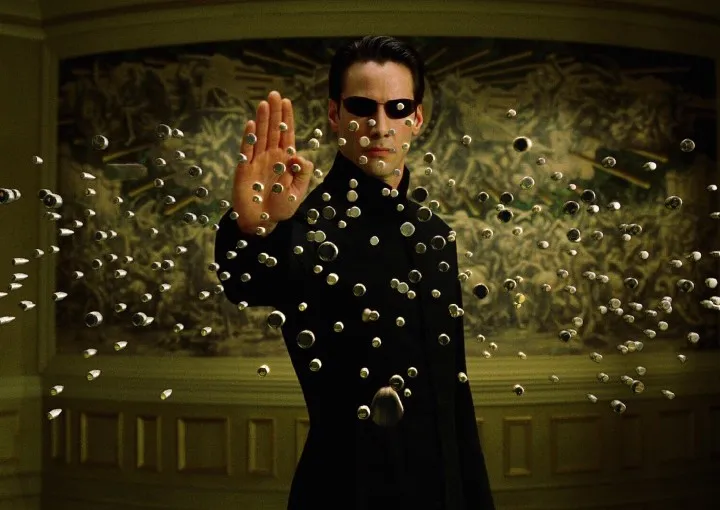
    15 movies that are basically impossible to forget

    Dodging bullets in slow motion completely changed the way action movies looked.
  • He walked out of a Myanmar prison after seven years, and then started a list he has never been able to finish

    He walked out of a Myanmar prison after seven years, and then started a list he has never been able to finish

    Bo Kyi was a student at Rangoon Arts and Sciences University when the demonstrations of 1988 filled the streets of his country, and the years that followed took him out of a lecture hall and into a cell. He served seven years in total, across two separate imprisonments. When he finally got out in the late 1990s, he did not go back to his degree, and he did not try to build the ordinary life that had been interrupted. He went to the Thai border town of Mae Sot with a handful of other men who had been inside, and together they began keeping a written record of everyone who was still being held.

    That was twenty six years ago. The record has not stopped since. It is the single most important thing about him, more than the prison time, and it is the reason the Ramon Magsaysay Award Foundation in Manila named him one of three 2026 awardees. The Foundation’s board wrote that his life’s work has been a steady pursuit of truth, accountability and justice, and that his commitment shows moral courage, personal sacrifice and a belief that democracy and human dignity are always worth defending. Those are the words of a citation, and citations are written in a register that flattens things. What they are describing is a man in a border town with a spreadsheet.

    The organisation he co-founded is called the Assistance Association for Political Prisoners, and its central product really is a list. Names. Where each person was picked up. What they are charged with, if anything. Which prison or interrogation centre they are believed to be in now. Whether they have been sentenced, released, or died in custody. It sounds administrative because it is administrative, and the administrative part is exactly what makes it dangerous and exactly what makes it matter.

    Consider what it takes to build such a list from outside the country it describes. AAPP cannot operate legally inside Myanmar. It was founded in exile and it has stayed in exile, funded from abroad, staffed largely by people who cannot go home. Everything on the list has to be carried out of the country by somebody. A family member who visited a prison and counted the men in the yard. A lawyer who saw a charge sheet. A released prisoner who memorised the names of everybody in his block because he knew he would be asked. Those fragments arrive by phone, by message, by word passed hand to hand, and every one of them has to be checked against the others before it becomes an entry.

    The record is also published, which is the part that turns a database into a form of pressure. For years AAPP has put out monthly chronologies, month after month, each one listing arrests and court outcomes alongside an updated roll of who is currently held. Those documents stretch back well over a decade and they are still coming. Anybody can open the one from years ago and the one from last month and compare them, which means the organisation is holding itself to its own archive as well as holding a government to account. A record that is published can be checked. A record that is published on a schedule can be trusted, because the gaps would show.

    This is why AAPP publishes two numbers instead of one. By its own records, dated to late September of this year, the organisation counts 14,847 people it can verify are still being held in connection with opposition to military rule, and a further 7,856 whose detention it believes in but cannot yet stand up to its own standard. It counts 31,976 people arrested in total since the military seized power in 2021, 9,273 of them since released, and 8,427 people killed. Those figures come from AAPP, not from the award, and they move every week. The organisation keeps the verified and unverified columns separate precisely because the state disputes the whole exercise, and a list that overclaims is a list that can be dismissed.

    That is the discipline at the heart of the thing. A government that denies holding political prisoners at all does not need to refute a careful record. It only needs one wrong entry. So the record has to be more careful than the people denying it, permanently, with far fewer resources, from the wrong side of a border. Twenty six years of that is not a gesture. It is a job, done daily, mostly by people whose names will never appear in a citation.

    Why does a name on a list keep a person alive? Because the alternative is a person who was never officially there. An undocumented detainee can be moved, held past a sentence, or simply not produced, and there is no external record to contradict whatever account is eventually offered. A documented detainee has a paper trail that exists outside the jurisdiction holding him. Families can ask after a specific person rather than a rumour. Lawyers have something to file against. Diplomats have something to raise in a meeting. And when accountability comes, if it comes, investigators have evidence gathered contemporaneously rather than reconstructed years later from memory. AAPP works with the United Nations Independent Investigative Mechanism for Myanmar, which is the body assembling exactly that kind of case file, and the lists feed into it.

    Bo Kyi’s own years inside are part of why he understands the value of information, and he has described the experience in unusually practical terms. He has said that everyone of his generation grew up on state media, censored newspapers and censored television, and that prison was where the actual country became visible to him. Inside, he met men from ethnic minority communities who had been treated in ways that never appeared in any broadcast he had ever seen. He was, in a grim sense, being educated.

    He also got an education of a more literal kind. There was a professor in a nearby cell, and Bo Kyi worked out a system with him. Whenever the guards were out of earshot, he would ask the man for a short sentence in English, and he would keep it. Sentence by sentence, in the gaps between rounds, he learned the language he would later use to talk to foreign journalists, diplomats and United Nations officials about what was happening to people like him. He has said he did it partly to keep his mind working, which is its own quiet detail about what those years were like. He has not made a set piece out of the worse parts, and neither will this piece.

    Release did not end it. Once out, he began meeting people he was not supposed to meet. He held unofficial conversations with the International Committee of the Red Cross. He met journalists in secret and passed on what he knew about conditions and about who was being held. He got information to United Nations special rapporteurs. This is the point where you can see the later organisation forming inside the earlier man, because none of that was activism in the marching sense. It was reporting.

    The military noticed, and made him an offer. They wanted him as an informant. By his account he answered with conditions of his own, that all political prisoners be freed and that the government open a dialogue with Aung San Suu Kyi, and when those were refused he refused too. He went back to prison. That refusal is the hard choice at the centre of his story, and it is worth sitting with for a second, because he had already served years and he knew exactly what he was choosing to go back to. After his eventual release, staying in the country was no longer survivable. He crossed to Mae Sot.

    Mae Sot is a market town on the Thai side of the Moei River, and for decades it has been where Myanmar’s exiled institutions live: clinics, schools, newsrooms, aid groups, all serving a country a few hundred metres away and legally out of reach. It is the obvious place to build something like AAPP and a terrible place to build anything at all. Funding is foreign and therefore precarious. Staff have uncertain status. The border itself has closed, opened and militarised repeatedly. And the organisation’s subject matter is entirely on the other side.

    For its first two decades the list grew steadily and, for a while, in the right direction. Myanmar’s partial political opening in the 2010s brought amnesties, and AAPP expanded from documentation into aftercare, because it turned out that getting people out was not the end of the problem either. Since 2010 it has run counselling, mental health support and human rights training, work that has reached roughly five thousand prisoners and family members. It has built contact with around 33 of the 49 prisons and detention facilities in the country, which tells you both how far the network reaches and how much of the system it still cannot see.

    The aftercare work is less visible than the list and in some ways harder. A political prisoner’s family usually loses its income at the moment of arrest, and then has to spend money it no longer has on travelling to a prison that may be many hours away, because in Myanmar a detainee often depends on relatives bringing food and medicine. AAPP has worked on that gap, funding visits and supporting households that lost an earner, and it has worked on what comes after release, when a person walks out of years of detention into a country that has no place ready for them and no acknowledgement that anything happened. The counselling and training programmes grew out of watching men and women get free and then struggle, which is a problem Bo Kyi knew from the inside before it was ever a programme.

    Then in early 2021 the military took power again, and the work changed character overnight. What had been partly historical became urgent, and then it became enormous. The numbers above are the scale problem in plain form: an organisation built to track hundreds of cases suddenly tracking tens of thousands, still from outside, still with the same border problem and the same funding problem. Journalists were among the first taken. Human rights monitors put the number of reporters currently held at seventeen or eighteen depending on whose count you use, and one press freedom body ranks Myanmar as the world’s second largest jailer of journalists after China. Local researchers have documented more than two hundred journalists arrested since the coup and eleven killed. Only one journalist is recorded as released this year, a documentary filmmaker freed in an amnesty after nearly three years inside.

    Bo Kyi is 61 now. When the award was announced at the end of August, he did not treat it as his. He dedicated it to the people of Myanmar who are pushing against injustice, and specifically to the political prisoners still behind bars, and he used the occasion to repeat the demand he made to his interrogators decades ago in a cell, that political prisoners be released, including Aung San Suu Kyi. He put the figure he is asking about at more than twenty two thousand people.

    He is not the first person from his country to receive this award. The doctor Cynthia Maung, who built a clinic on the same border for the same displaced population, received it in 2000, the year AAPP was founded. The journalist Swe Win received it in 2019. Published accounts differ on exactly how many Myanmar nationals have now been honoured, some say five and some say eight, which is a small illustration of how contested even basic record keeping about this country becomes. He shares the 2026 award with the Singaporean diplomat Tommy Koh and with Runa Khan of Bangladesh.

    The ceremony has not happened yet. It is scheduled for November at the Metropolitan Theater in Manila, at the end of the Foundation’s festival week, and it is one of the few parts of this story with a clean date attached to it. Everything else is ongoing. The list is being updated as you read this. The verified column and the unverified column are both moving. Somewhere a family is coming back from a prison visit with three names they were asked to remember, and somewhere in Mae Sot those three names are being checked against what is already on file before anyone writes them down.

    That is the shape of the recognition. It is not an award for a breakthrough or a victory, because there has not been one. It is an award for showing up to the same clerical task for twenty six years, in exile, against a state that would prefer the task were impossible, on the theory that a name written down accurately is harder to erase than a name that was never written down at all. Bo Kyi went into a cell as a student and came out with a conviction about paperwork. He was right about it, and the proof is that the record still exists, and that people whose detention nobody else recorded are on it.

  • He sat at a console 500 kilometres from his patient, and the thing that nearly stopped the operation was not the distance

    He sat at a console 500 kilometres from his patient, and the thing that nearly stopped the operation was not the distance

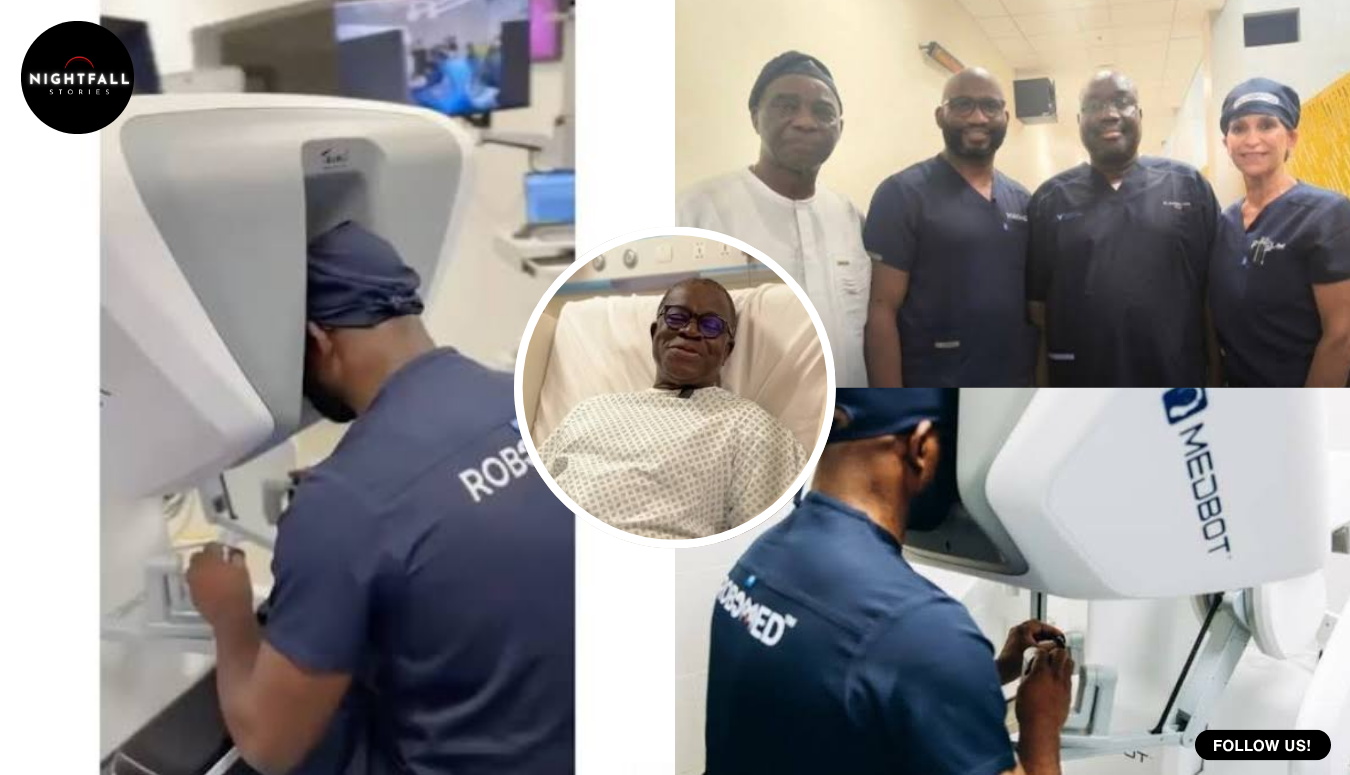
    The patient was asleep in an operating theatre in Abuja. The surgeon was sitting in a room in Mowe, in Ogun State, roughly 500 kilometres away, with his hands inside a console and his eyes on a screen. Between them ran a satellite internet link, a mobile network held in reserve, and a Chinese made surgical robot called Toumai standing over the body with instruments already through the skin. The operation was a right radical nephrectomy, the removal of a cancerous kidney, and it took about three hours.

    And at some point during those three hours, by the account of one of the doctors involved, the network glitched.

    That is the detail worth leading with, because it is the one that tells you what this kind of surgery actually is. Not a demonstration of how clever a robot can be, but a test of what happens when the least glamorous part of the whole arrangement, the connection, does what connections do. Nothing dramatic followed. The surgical team physically present in the Abuja theatre was able to take over. That team was in the room for exactly that reason, and the hospital’s chief executive has been fairly blunt about the logic: machinery can go wrong, connections can cease, so you always keep people on the ground who can do what needs doing.

    Which is a more honest description of remote surgery than most of the coverage managed. The robot is not autonomous. It does not decide anything. It holds instruments and reproduces, at reduced scale and with tremor filtered out, whatever the surgeon’s hands do at the console. Take the surgeon away and it stops. Take the link away and it stops. The word robot does a lot of misleading work here, and the surgeon has made the same point himself, that the system magnifies a human surgeon’s movements rather than replacing them.

    Before going further, a matter of names, because the reporting cannot agree on one. This operation was performed by a Nigerian born, United States based professor of urology and renal transplantation who co-founded a company called RoboMed Global. Some Nigerian outlets have called him Obi Ekwenna-Davis. Others have called him Obi Davies-Ekwenna. The University of Toledo College of Medicine and Life Sciences, where he holds a tenured professorship in Urology and Renal Transplantation, lists him on its own faculty pages simply as Obi Ekwenna, and that is the name under which his published research appears. His own professional profile carries Davies as an unhyphenated middle name. So Ekwenna is the surname, Davies is not part of it with a hyphen, and Ekwenna-Davis appears to be an inversion that entered circulation and stuck. This article calls him Professor Obi Ekwenna, which is what his university calls him.

    That is not pedantry. The name confusion is a symptom of how this story reached the public, and the mechanism matters for how much weight you put on any of it.

    Everything reachable about this operation traces back to two hospitals and one news agency. Redeemer’s Health Village in Mowe, a 300 bed facility founded by the Redeemed Christian Church of God, hosted the console. Nisa Premier Hospital in Abuja, founded and run by Dr Ibrahim Wada, had the patient. The News Agency of Nigeria distributed the announcement. From there it went out through Punch, Vanguard, Leadership, Daily Trust, Pulse, BellaNaija, Pharmanews, The Journal and others, and it went out largely unchanged. Seven or eight bylines, one account. No independent clinical verification exists, no regulator has published a confirmation of the procedure, no operative report has been peer reviewed, and the surgical team’s own description is currently the only description there is. That does not mean it did not happen as described. It means nobody outside the room has checked, and the misspelled name is the visible seam where copying rather than reporting shows through.

    The patient is not named, which is correct and which also removes the person from the centre of the story. What is known is minimal: an adult with cancer in the right kidney, reported in good condition immediately after the operation. On the ending, the hospitals said the patient was expected to be discharged within twenty four hours. Expected is doing load bearing work in that sentence. A forecast is not an outcome, and no discharge has been independently confirmed in any reporting since. One outlet’s write up states the patient was discharged, but it gives no date, no source and no detail, and it is part of the same institutional cluster, so it does not settle the question. The documented ending, at the time of writing, is a completed three hour operation with the patient in good condition afterwards and a stated expectation of a quick discharge. That is where this account stops.

    So what actually happened here, and why should anyone outside Nigeria care?

    Start with the regulatory spine, which is the least exciting and most consequential part. In late December 2025 Nigeria’s National Agency for Food and Drug Administration and Control approved the Toumai robotic surgical platform, made by Shanghai MicroPort MedBot, for clinical use. It was reported at the time as the first approval of a robotic surgical platform anywhere in West Africa. Approvals like that are usually where the story ends for a piece of medical equipment in a lower income health system. A regulator signs off, a machine arrives, a press release goes out, and then the machine sits in a hospital that cannot afford to run it or cannot staff it. The interesting thing about this operation is that it is what the approval was actually for, about nine months later.

    Then the link. The connection ran over Starlink satellite internet with MTN mobile service as backup, and it is worth understanding why that combination rather than fibre. Telesurgery is not bandwidth hungry in the way video streaming is. What it cannot tolerate is latency and jitter, the delay between a hand moving at the console and an instrument moving in the body, and the variation in that delay. A surgeon can adapt to a consistent lag. A lag that changes unpredictably is dangerous, because the hand learns a rhythm the system then breaks. Dedicated fibre between two Nigerian cities 500 kilometres apart, secured and reserved for a medical procedure, is a large infrastructure ask. Low earth orbit satellite gives you reach without laying anything, at the cost of a link you do not own and cannot fully control. Hence the backup, and hence the team standing in the theatre.

    The glitch, when it came, is therefore not an embarrassment to be buried. It is the system’s design assumption being confirmed. A remote operation that had no plan for the link failing would be reckless. One that had a plan, used it, and finished the operation is what a first attempt is supposed to look like.

    Now the claim, because the claim has been oversold. The hospitals described this as the first telesurgery in West Africa, and that narrower statement is defensible. What has circulated more loosely, as a first for Africa or a landmark for the continent, is not. Telesurgery has been done in Africa before. In Morocco in May of last year a telerobotic prostate operation was performed over more than 1,100 kilometres, connecting Casablanca with Laayoune, and it was reported as that country’s first national telesurgery. A month later a surgeon in Central Florida operated on a patient in Luanda, Angola, across roughly 11,000 kilometres, a case written up in a peer reviewed robotic surgery journal as a landmark in expanding surgical access in Africa. Both of those preceded this one by more than a year.

    The distinction is not trivial and it is not about national pride. It is about who gets new medicine, in what order, and on whose terms. The Morocco case was done by a Moroccan private hospital group on its own patients within its own country. The Angola case was a surgeon in the United States operating on an African patient from 11,000 kilometres away, which is a genuine technical achievement and also a particular model of access: the expertise stays where it already is and reaches in. What happened in Nigeria is a third thing again. The surgeon is Nigerian born and works in Ohio, and for this operation he was physically in Ogun State, at a console in a Nigerian hospital, operating on a patient in a Nigerian city. The expertise came home and then travelled domestically.

    That is the part with real consequences, and it connects to a problem that is much larger than one kidney.

    Nigeria has somewhere over 200 million people and a surgical workforce that is thin by any measure, with specialists concentrated heavily in a handful of cities. Whole states have no practising urologist at all. For a patient in one of those states, a kidney tumour has historically meant one of three outcomes: travel hundreds of kilometres to a city, travel abroad if the family can raise the money, or be operated on by a general surgeon doing their best outside their subspecialty. Medical emigration makes it worse every year, as the doctors trained in the country leave for systems that pay them properly. Professor Ekwenna is himself part of that pattern, a Nigerian trained abroad who built a career in the United States, and his published research has focused repeatedly on transplantation and surgical capacity in resource constrained settings, including kidney transplantation in Nigeria specifically.

    A working telesurgery link changes the arithmetic of that problem without solving it. If a specialist console in one city can reach a theatre in another, then the scarce thing is no longer the specialist’s physical location. But the scarce things that remain are still formidable, and it is worth being clear eyed about them. Each remote theatre needs its own robot, which costs in the low millions of dollars. It needs a full surgical and anaesthetic team on site competent to convert to open surgery at any moment. It needs sterile supplies, blood, intensive care beds and reliable power. A satellite link does not deliver any of those. The uncomfortable truth is that telesurgery is most useful in places that already have a well equipped operating theatre and are only missing the subspecialist, and the places with no urologist tend also to be the places with no robot.

    Kidney cancer is a sensible choice for a first attempt, and the choice reveals something about how carefully this was planned. A radical nephrectomy is a removal rather than a reconstruction. There is no delicate suturing of a join that has to hold pressure for the rest of the patient’s life, as there is in a prostatectomy or a transplant. The kidney’s blood supply is anatomically well defined and can be controlled early. The operation is planned rather than emergency, so the team can pick the day, test the link and have everyone in place. And if everything went wrong, the abdomen is accessible to a surgeon standing in the room. You would not choose a bleeding trauma case or a complex reconstruction for the first attempt over a satellite connection.

    It also matters which robot this was, and not for brand reasons. For most of the history of robotic surgery the field has been effectively one manufacturer’s market, and the price of a console plus the annual service contract and the per case consumables has put the technology out of reach of most hospitals outside wealthy systems. Toumai is one of a newer generation of Chinese built platforms competing on cost, and a Chinese system being the one a West African regulator approved first is a reasonable indicator of where that competition is heading. Cheaper consoles are the difference between one robot in a country and a dozen, and a dozen is the point at which a remote surgery network stops being a demonstration.

    There is also the plain physical oddity of the thing, which the coverage skipped entirely. A surgeon at a console is not standing over a patient. He is seated, leaning into a viewer, working hand controls with his fingers and a set of pedals with his feet, watching a magnified three dimensional view of an interior he is not in the same building as. Nobody in his room is sterile. Nobody in his room is holding anything. For three hours the most consequential activity in two cities was a man sitting still in a chair in Ogun State, moving his fingers.

    What remains genuinely unknown is whether any of this becomes routine. One operation, announced by the institutions that performed it, is a proof that it can be done once. It is not evidence of a service. The questions that decide whether this matters in five years are dull ones: whether NAFDAC builds a framework for licensing remote operators across state lines, who is legally liable when a link drops during a procedure, whether any insurer or public health scheme will pay for it, and whether a second robot ever reaches a hospital in a state that currently has no urologist. None of those have answers yet.

    But something did happen, and it is worth stating plainly without the inflation. An adult with a cancerous kidney was operated on by a surgeon who was not in the building, on equipment a national regulator had approved nine months earlier, over a consumer satellite link with a mobile phone network as the fallback. The connection faltered and the people in the room handled it. Three hours later the kidney was out and the patient was reported to be in good condition, and a hospital 500 kilometres from where the surgeon was sitting had been, for those three hours, an extension of his hands.

    Whether that patient walked out the next day, as the hospitals expected, is not yet on the record. What is on the record is that the distance stopped being the hard part.

  • Eight days under a collapsed building, and the sound on the third day that made him start shouting

    Eight days under a collapsed building, and the sound on the third day that made him start shouting

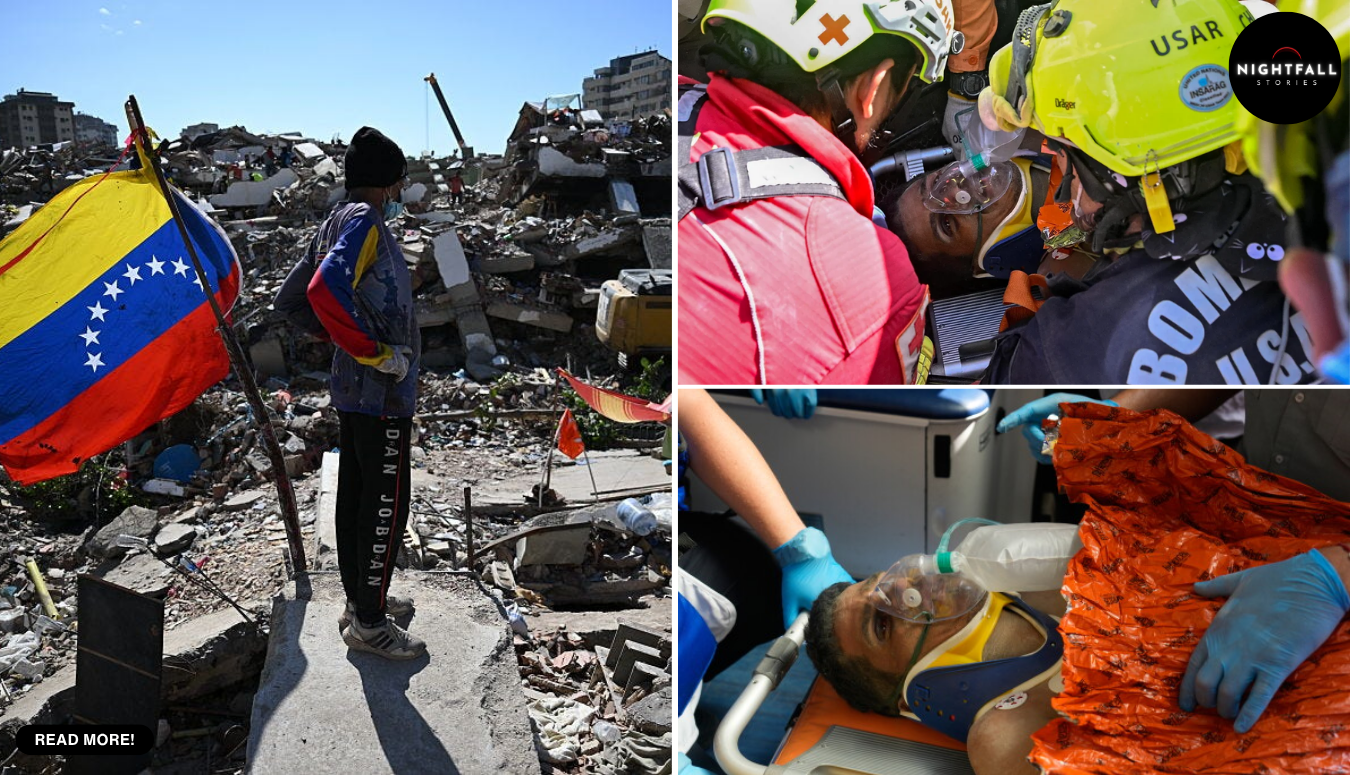
    For the first two days he did not know whether anyone was looking. Hernan Gil, 43, was on shift as a security guard in the basement of a seven storey building in Catia La Mar, on Venezuela’s central coast, when the floor above him stopped being a floor. He remembers the second shock as unbelievably strong. He remembers stones hitting his head and his eye. Then nothing, for a while, and then dark.

    When he came round he was not lying down and he was not standing. He was wedged partly kneeling, in a space with no light in it at all, and breathing was work. Aftershocks kept arriving. He could not tell morning from night, so he lost the count of days almost immediately, which is the detail that tends to get skipped when this kind of story is retold. He was not counting down to a rescue. He had no idea a rescue existed.

    Then, on what he later worked out was the third day, he heard footsteps above him.

    That is the moment the whole thing turns on, and it is worth being precise about what it actually was. Not a shout, not a dog, not a light. Footsteps, somewhere over his head, muffled through concrete. He started calling out. Someone called back. He has described what that did to him as a glimmer of hope, and the word he keeps returning to is hope rather than certainty, because a voice answering you through rubble is not the same thing as being out.

    It took rescuers more than three further days to travel the short distance between that answering voice and Gil’s body. He came out on a stretcher on a morning in early July, eight days after the ground moved, having spent something in the order of 180 hours underneath a collapsed building. He was reportedly pinned beneath around 140 tons of concrete.

    Before going further it is worth saying plainly where this account comes from, because the number of places it was published is misleading. The interview in which Gil described his eight days was given to the news agency AFP from his hospital bed a few days after he was pulled out. Almost everything you can read about what he thought and felt down there traces back to that one conversation. Several large outlets, including CBS, carried the AFP copy essentially unchanged. CNN and Al Jazeera produced their own write ups of the extraction itself, and a Costa Rican outlet interviewed rescuers directly. So there are perhaps three genuinely independent accounts of the rescue, and essentially one of the man’s own story. That does not make it untrue. It does mean nobody has gone back over it a second time, and a reader deserves to know that.

    The earthquakes themselves were unusual enough that seismologists took an interest separate from the human toll. Two strike slip ruptures hit on the same evening near San Felipe, in Yaracuy state, on the San Sebastian fault system. A magnitude 7.2 came first. The magnitude 7.5 mainshock followed 39 seconds later, at a shallower depth of around ten kilometres. Some agencies published figures in a range up to about 7.8, and some treat the whole thing as one complex event rather than two, so the honest way to state it is as a doublet of roughly magnitude 7.2 and 7.5 with the agencies not in full agreement.

    Thirty nine seconds matters more than it sounds. A building hit by a strong quake does not fail all at once. Columns crack, joints loosen, reinforcement stretches, walls lose their connection to the frame. In most earthquakes the structure then gets hours or days before the next serious shaking, which is enough time for people to get out and, sometimes, for engineers to look at it. Here the second and larger rupture arrived before anyone could stand up. Buildings that would have survived the 7.2 alone met the 7.5 already damaged, with their stiffness gone. Nearly 800 buildings were reported collapsed or badly damaged across the affected region, with 189 recorded as total collapses. Basements and ground floors took the worst of it, because that is where the weight of everything above lands when the frame lets go. Gil was in a basement.

    Basements are a particular kind of trap, and also, occasionally, a particular kind of shelter. When a frame fails, the upper floors pancake downward and the lowest level takes the accumulated weight of everything that was above it. That is why casualty rates are worst at the bottom. But a basement also has thick retaining walls, structural columns at close spacing and, crucially, furniture and machinery that can jam under falling slabs and hold them at an angle. Where that happens you get a void, a space a few feet across that did not close. Survival at day eight is almost always a story about a void rather than a story about a person, and rescue teams are trained to read a collapsed structure for where the voids are likely to be before they touch anything.

    The dig for him was slow for reasons that are worth understanding rather than glossing. Once his voice was located, in part with radar equipment pushed into voids, the teams’ first instinct was a tunnel. That plan was abandoned as too likely to bring the remaining structure down on both him and the rescuers, which is the routine arithmetic of collapsed building work and the reason these operations take days rather than hours. Every piece of concrete removed changes how the load travels through what is left. Move the wrong slab and you have killed the person you came for.

    So they worked from above and around, in relays, cutting and lifting and shoring, then stopping to check what the removal had done to everything else. Rescuers from seven countries took turns on that site: Venezuela, Chile, the United States, Portugal, Costa Rica, El Salvador and Mexico. More than 100 specialists cycled through. Among the Americans were members of a Florida task force; a Chilean fire service urban search and rescue unit was on the final push. Across the wider disaster, at least twenty countries sent search and rescue personnel.

    While they dug they kept him alive through the gap they had made. They passed a small camera down so they could see him, and they fed him fluids through a tube and, by several accounts, a syringe, because a syringe delivers a controlled amount to someone lying at an awkward angle who cannot sit up and who must not choke. You do not hand a solid meal to a man who has been crushed and dehydrated for five days. It is also worth noting the medical caution behind it: reintroducing food and fluid too fast to a body that has been compressed and starved carries its own risks, so small and controlled is the point rather than an improvisation.

    The last obstacle was not concrete. It was a chair. Gil’s legs were tangled in it, and he has said that freeing them was the hardest part of the entire eight days, harder than the waiting. Rescuers who were there described the final moments as needing one more effort from him, at the end of nearly four days of their work and eight of his.

    He came out with bruised legs, a bleeding nose and a right eye swollen and reddened where the stones had caught him. Hospital records reported afterwards included a dislocated left collarbone and a scalp haematoma, which is why photographs taken later show his left arm in a sling. He went to hospital by ambulance. A few days after that he was sitting up in a blue hospital gown talking to a reporter, and he said he felt reborn.

    What he says he did down there is not dramatic. He prayed, a great deal. He thought about his wife, Gusbimar Gonzalez, and about his children, and about his father, who is dead. He talked about wanting to be at his son’s birthday and about taking the family to the beach. Gonzalez, for her part, called it the longest eight days of her life, and she meant it literally rather than poetically: she spent them at the site, not knowing.

    That is the position most relatives of the missing were left in, and it is worth sitting with rather than passing over. For the best part of a week she was outside a pile of concrete knowing only that her husband had gone to work there and had not come home.

    There is a temptation in stories like this to turn the burial itself into something meaningful, as though eight days in the dark were a lesson. It was not. It was eight days of thirst, pain, bad air and no information, endured by a man who happened to be in a survivable pocket of a building that killed other people who were not. The pocket is why he lived. The prayer helped him get through the pocket. Those are two different facts and collapsing them into one does a disservice to everyone who prayed just as hard in a space that had no air in it.

    Gil was also not the only person pulled out alive in that window, which is worth saying because a single miraculous survival invites the idea that the rest of the effort was futile. An eleven year old was found alive by a Colombian team several days after the quakes. A small boy was recovered alive at La Guaira two days before Gil came out. Live rescues at day four, day six and day eight are the reason international teams stay on a site long past the point at which the public assumes everyone is dead.

    Which brings the story to its hardest number, and the reason this disaster is still not finished counting. The death toll moved every day for weeks, and any figure printed about it is only true of the moment it was published. Al Jazeera reported the confirmed dead at 1,719 towards the end of June. By the time Gil was pulled out in early July, AFP reported the official count nearing 2,600, with the president of Venezuela’s National Assembly, Jorge Rodriguez, putting it at 2,295. Later reporting in July carried figures above 3,500. Separate tallies listed more than 5,000 injured and, in the same official accounting, more than 46,000 people registered as missing.

    Those are three different categories and they must never be added together or averaged. Injured is a count of people treated. Dead is a count of bodies identified. Missing is a count of names reported to authorities by people who cannot find someone, and it includes the same person reported twice, people who left the area without telling anyone, people already recorded among the dead, and people still under 189 totally collapsed buildings. A missing figure twenty seven times larger than the confirmed dead does not mean 46,000 more bodies. It means a system that cannot yet tell the difference, and tens of thousands of families living in the gap.

    Nor is the register a bureaucratic failure so much as an unavoidable one. In a disaster that damaged nearly 800 buildings across several states, with roads broken and phone networks patchy, the only way to compile a list of the unaccounted for is to let people report names. Nobody can verify those reports at the speed they arrive. A woman reports her brother; his employer reports him too; his neighbour reports the whole family. Three entries, one man, and if he is later identified among the dead there is no guarantee all three entries get closed. Authorities know this, which is why officials kept describing the missing number as a register rather than an estimate of the dead. That distinction was widely lost in the retelling, and it caused real harm, because families reading a figure of 46,000 were being told, in effect, that their odds were far worse than the arithmetic supported.

    That gap is what Gil’s eight days actually illuminate. For 183 hours his wife was one of those families. He was a name on a list, in a category with no information attached to it, and then he stopped being one, because a rescue team walked over the right piece of ground at the right moment and he was conscious enough to hear their feet and shout. Most of the people on that list will not get the footsteps. The arithmetic guarantees it.

    A last honest note, and it matters for how you read the ending. The most recent direct sighting of Hernan Gil in reachable reporting is that hospital interview in early July, left arm in a sling, calling himself reborn. There is no later follow up: no report of his discharge, no report of how his collarbone or his eye healed, and, importantly, no report of his death. What is documented is that he survived the building, survived the extraction, reached hospital, was in good enough shape to talk at length about it within days, and was talking about his son’s birthday rather than about the dark.

    He went down as a man doing a night shift in a basement. He came up as the reason more than a hundred specialists from seven countries stayed on a pile of concrete for four days after most people had stopped expecting anyone to be alive inside it. And the thing that got him out was not equipment or luck in the usual sense. It was that on the third day, when he heard footsteps he had no reason to expect, he decided to shout.

  • Three elements had never been found together in a single mineral. The man who finally found them was not allowed to put his own name on it.

    Three elements had never been found together in a single mineral. The man who finally found them was not allowed to put his own name on it.

    The formula is Tl2[(UO2)2(V2O8)], and if you do not read chemistry, the important part is that it contains three things at once: thallium, uranium and vanadium. Individually, none of them is exotic. Uranium has hundreds of known minerals. Vanadium has plenty. Thallium has a handful. What had never been documented, in the entire catalogue of roughly six thousand approved mineral species, was a naturally occurring crystal that held all three in one structure.

    The crystals themselves are tiny, and by the account of the mineralogist who works on this family they are rather charming under the lens, small and neat and yellow. They came out of the Atlanta mine in Lincoln County, Nevada, an old workings in dry country at around 38 degrees 27 minutes north, 114 degrees 19 minutes west. The man who found them and led the description is Travis Olds, a mineralogist at the Carnegie Museum of Natural History in Pittsburgh. The International Mineralogical Association approved the new species, and the record now carries it as IMA 2025-086, approved in January of this year, with the abbreviation Spt.

    It is called spanoite. Olds’s name is nowhere in it.

    That is not modesty. It is a rule, and it is one of the few genuinely charming pieces of governance in the sciences. Under the conventions enforced by the International Mineralogical Association’s Commission on New Minerals, Nomenclature and Classification, you cannot name a mineral after yourself. You can name it for its composition, which is why so many minerals are called something like calcium-this or hydroxy-that. You can name it for the place it was found. Or you can name it for a person, and if you do, it has to be somebody else. Every single eponymous mineral in the catalogue is therefore a judgment somebody made about somebody else’s work, and it is a judgment a committee of strangers then had to agree with.

    Olds named this one for Tyler Spano, a mineralogist who now works as a senior nuclear security scientist in the National Security Sciences Directorate at Oak Ridge National Laboratory. She did her doctorate on minerals containing both uranium and vanadium, which is exactly the chemical territory spanoite sits in, and by her own account being handed a mineral name was on her list of things she hoped would happen one day. She has described it as among the highest honours a mineralogist can receive, and as an unusually well-fitted one, because she spent years of her working life on precisely these materials. The part she seems most pleased by is not the compliment but the verdict inside it: an international community of specialists looked at the proposal and agreed she was an expert in the thing.

    There is a further turn in this, and it is the reason the naming is more than a nice gesture.

    Spano has been on the other side of it. Some years ago she led the description of another new uranium mineral, finchite, a strontium uranyl vanadate with the formula Sr(UO2)2(V2O8) and five waters, notable at the time for being the first uranium mineral known to contain essential strontium. Its type locality is Sulfur Springs Draw in Martin County, Texas, with a second occurrence in an underground mine in San Juan County, Utah, and the first person to suspect it was something new was a United States Geological Survey scientist working the Texas surface deposits.

    When it came time to name it, the same rule applied to Spano that later applied to Olds. She could not name it for herself. Finchite was named for Warren Finch, who lived from 1924 to 2014, a Geological Survey geologist who spent decades on uranium resources and sandstone-hosted uranium deposits, who set up the survey’s dedicated uranium and thorium programme, and who served as his country’s representative to the International Atomic Energy Agency. He had been dead for years by the time a mineral carried his name.

    Travis Olds was a co-author on the finchite paper. So the chain runs like this: a young researcher and her collaborator put an old man’s name permanently into the mineral catalogue, and some years later that same collaborator put hers there. Nobody in the sequence named anything after themselves. That is the system working exactly as designed, and it is quietly one of the better ideas any scientific body has ever had.

    The chemistry is worth slowing down for, because it is the real reason spanoite exists as a story at all.

    Uranium is, from a mineralogist’s point of view, extraordinarily productive. In its reduced form, locked up underground away from air and water, it sits in a small number of stable minerals and does very little. But where uranium ore comes into contact with oxygen and moving groundwater, which is what happens in a weathering zone or, very commonly, in the walls of an abandoned mine, the uranium oxidises into the uranyl ion, and the uranyl ion is a promiscuous builder. It forms flat sheets and chains, and it is extremely relaxed about what other ions come and slot into the gaps between those sheets. The result is that uranium-bearing secondary minerals are one of the richest seams in modern mineralogy. New species keep coming out of old mine workings, in quantities of a few milligrams, often as crusts you would need a hand lens to notice.

    Vanadium is a frequent partner in that chemistry. The uranyl vanadates are a large and well-studied family, and the best-known of them, carnotite, was mined commercially and is familiar to anyone who has handled uranium ore, a yellow powdery coating that turns up wherever these two elements meet in oxidising conditions. There are dozens of relatives. The structural motif in spanoite, the uranyl vanadate sheet, is a known and understood architecture.

    Thallium is where it gets unusual. Thallium is a heavy, soft, toxic metal that is scarce at the surface and forms relatively few minerals of its own. It also has an awkward personality chemically: in its singly charged state it is a large, floppy ion, closer in size and behaviour to potassium or rubidium than to the metals it sits near on the periodic table. That is precisely what makes it interesting here. The interlayer gaps in a uranyl vanadate sheet structure are usually occupied by calcium, or barium, or strontium, or potassium. Thallium can fit that role. The chemistry never forbade it. Nature simply had not been caught doing it.

    And it had been done in a laboratory. The commission’s record notes that spanoite has a known synthetic analogue, which means chemists had already made this compound, characterised it and published it, before anyone found a crystal of it in the ground. That gap is common in this field and it is one of the quietly satisfying things about mineralogy: the list of compounds humans can make is much longer than the list nature is known to make, and every so often somebody finds a natural specimen of something that had only ever existed in a beaker. Finding it in the Nevada desert does not change the chemistry. It changes the inventory of what the planet does on its own.

    Getting a new mineral accepted is not a matter of announcing it. The commission requires a package, and the package is demanding for something that may weigh less than a grain of rice.

    You need a chemical formula, established by direct analysis of the actual grains rather than inferred. You need a crystal structure, which for spanoite means monoclinic, space group P21/c, with unit cell dimensions measured to four decimal places and a beta angle of 105.364 degrees. You need a powder diffraction pattern, the list of characteristic spacings that lets any other laboratory identify the same substance later. You need a type locality, specified precisely enough that somebody could go back and look, which is why the coordinates for the Atlanta mine are in the record. You need a name, with a justification. And critically, you need to deposit type material in a public collection, permanently, so that the physical evidence outlives everyone involved. Spanoite’s holotype is catalogued at the Carnegie Museum of Natural History as CM34788, with a cotype as CM34789, at the museum on Forbes Avenue in Pittsburgh where Olds works.

    It is also not a one-person job any more, which the record makes plain. The spanoite description carries twelve names. Olds is listed first and is the contact address on the entry, but the other eleven include university researchers, staff at other natural history museums, laboratory specialists and independent mineralogists working across three continents. That spread is not padding. A modern mineral description needs electron microprobe chemistry, single-crystal diffraction, powder diffraction, spectroscopy and often the original collector who knew where to look, and almost no single institution has all of it under one roof. The names on the entry are effectively a list of the instruments involved.

    Only then does it go to the commission, which votes. The approval appears in the commission’s numbered newsletters, which read like a very dry and very permanent ledger: a number, a name, a formula, a symbol, coordinates, a list of authors, and the museum shelf where the proof is kept. Spanoite’s full formal description, with the colour and habit and optical properties written out at length, is still to be published separately. The approval came first.

    It is worth saying plainly why so much of this work happens in abandoned mines rather than in pristine outcrops. A mine does two things that nature is slow to do on its own. It exposes a large volume of ore to the air, and it leaves that exposed surface standing for decades in a fixed, undisturbed position with water trickling over it. That is an accelerated weathering laboratory, and the crusts that grow on those walls are where the new species are. It is also why the material is handled with care. These are uranium compounds, and this one also contains thallium, which is toxic in its own right, so the specimens are small, sealed and worked on under controlled conditions, not passed around. The romance of the field is a few milligrams in a gelatin capsule.

    And the ending sits in the suffix. Nearly every mineral name ends in ite, from the Greek for stone, which is why the catalogue reads the way it does: carnotite, finchite, spanoite. It is a naming tradition so consistent that the shape of the word tells you what kind of thing it is before you know anything else about it, and it means an honoured name gets slightly reshaped on the way in. Spano becomes spanoite. The person becomes a substance.

    That deposited specimen is the part that deserves more attention than it gets, because it is the whole argument for museums in three lines of a catalogue entry. A mineral species is not a photograph or a paper. It is a physical thing that has to remain available for anybody who wants to check, argue with or re-analyse it in fifty or a hundred years, using instruments nobody has invented yet. Spano’s own career is a demonstration of what that policy buys: a Geological Survey scientist noticed something odd in Texas, material moved between institutions, and a mineral that had never been described got described. Collections keep producing science long after they stop looking like news.

    Two people, then, working at opposite ends of the same chemistry. One in a museum in Pittsburgh, going through material from old workings and publishing new species out of a public collection. One at a national laboratory in Tennessee, having moved from describing uranium minerals to nuclear security work, which is a very different job with much of the same underlying chemistry behind it.

    What makes the ending land is the permanence. Almost nothing in a scientific career is fixed. Papers are superseded, models are replaced, institutions restructure, job titles evaporate. Approved mineral names do not. Barring a formal renaming, which the commission does very rarely and only for technical reasons, the name is now part of the standing vocabulary of the subject.

    Spanoite has been told to her, and she has said what anyone would say. But the name no longer needs her, or Olds, or anybody currently alive. From now on, every time somebody writes out Tl2[(UO2)2(V2O8)], in a paper about how uranium moves through groundwater, or in a catalogue entry, or on a label in a drawer in Pittsburgh next to a few milligrams of yellow crystal from a Nevada mine, they are writing her name down without thinking about it. That is what the rule against naming things after yourself is for. It means the honour can only ever arrive from somebody else, and once it arrives, it does not leave.

  • Nobody alive knew how to play the game scratched into this Roman stone. Then someone checked which lines were worn deepest.

    Nobody alive knew how to play the game scratched into this Roman stone. Then someone checked which lines were worn deepest.

    The object is small enough to carry in one hand. It measures 212 by 145 by 71 millimetres, weighs 3.38 kilograms, and is made of white Jurassic limestone quarried at Norroy in what is now northeastern France, which means somebody paid to move it a long way. On its top surface, cut with something harder than the stone, there is a rectangle, four diagonal lines, and one straight line running across. It was dug out of the Dutch town of Heerlen more than a century ago, catalogued as object 04433, and then it sat in a museum collection for decades while nobody worked out what it was.

    In 2020 an archaeologist named Walter Crist asked to look at it. Crist studies ancient board games, which is a real specialism and a small one, and he has spent years learning to read incised grids the way other people read handwriting. He knows the three-in-a-row grids the Romans scratched into paving stones. He knows the merels boards, the race boards, the alignment games. He looked at the pattern on object 04433 and did not recognise it. It matched no game that anyone currently knows how to play.

    That is where most stories like this one stop. A grid of lines on a stone is one of the most frustrating objects in archaeology, because a grid of lines is exactly what you get from a dozen different human activities that have nothing to do with each other. It could be a tally. It could be a mason setting out a cut. It could be a geometric doodle made by somebody waiting for something. It could be a game. The history of games is thin for precisely this reason: play leaves behind almost nothing that is unambiguously play, and so the record we have starts much later than the behaviour did.

    There was also a problem with the object’s paperwork, and it is worth being honest about it, because it limits what anyone can claim. Object 04433 was excavated in Heerlen in the late nineteenth or early twentieth century, at a time when recording standards were not what they are now, and the provenance documentation that survives is minimal. Nobody can point to the exact layer it came out of or the exact year it was lifted. That is why the dating is given as a range of centuries rather than a date, and why the study leans so heavily on the stone itself rather than on its context. When the context is gone, the object has to testify on its own behalf.

    So Crist and a team drawn from Dutch, Belgian and Australian institutions did something unusual. Instead of arguing about what the lines looked like, they asked the stone what had been done to it.

    Under a microscope, the surface of the limestone is mostly rough, the way a broken piece of Norroy limestone is rough. In places, though, the individual grains have been levelled and smoothed flat, which is what happens when something harder is dragged repeatedly across them. Those smoothed patches are not scattered randomly. One continuous smoothed zone runs alongside one of the diagonal incised lines, its inner edge parallel to the line and sitting between 16 and 18 millimetres away from it, which is roughly the width of a hand pushing a small object along a track. The underside and the vertical edges of the stone, by contrast, show no abrasion at all. Something had been moved back and forth along that one diagonal, many times, for a long time.

    The team also did the thing that separates careful use-wear work from wishful use-wear work, which is to set up controls. They photographed the microtopography of a naturally broken, unworked piece of Norroy limestone, so they had a baseline for what this specific stone looks like when nothing has happened to it. They also photographed the deliberately flattened surface of another Norroy limestone object from the same museum, an inscription, so they had a baseline for what the stone looks like when a craftsman has worked it on purpose. The smoothed patches on the game board do not match either baseline. They are not raw rock and they are not tool-dressed. They are what you get from prolonged, gentle, repeated contact.

    To capture this properly, Luk van Goor at the Restaura restoration workshop in Heerlen built a digital model of the stone using photogrammetry combined with a photometric stereo technique, which lets you turn surface topography into measurable depth rather than just a picture of shadows. The resulting depth map showed the surface generally lowered around the incised lines, and showed something more useful still. Some of the lines were a fraction of a millimetre deeper than others. Not decoratively deeper. Worn deeper. The board had favourite routes.

    That is the physical half of the work, and it is the half that usually gets skipped in the coverage. It is also the half that does the real evidential lifting, because it establishes that objects were slid along these lines rather than the lines simply being cut and admired.

    The second half is where the computers come in, and it needs describing carefully, because most of the headlines about this study have described it wrongly.

    The team could not simply read the rules off the stone. To begin with, they could not even agree on the board. The incised lines support six different plausible geometries, depending on which lines you treat as part of the playing surface and which you treat as errors, and treating some lines as errors is not special pleading, because other excavated game boards do carry visible mistakes where somebody misjudged a cut. So they carried all six forward.

    Haretavl is worth a word, because the choice of starting point was not arbitrary. It belongs to the broad family of Northern European hunt games, the same family as the various tafl games, in which the two sides are deliberately unequal: one player has many pieces and a blocking or capturing goal, the other has few and is trying to survive or escape. These games were still being played in living memory in parts of Europe, and their rules are recorded, which is the only reason a simulation seeded with them is anything other than guesswork. The team was not inventing candidate rules out of nothing. It was asking whether any rule set from a documented regional tradition would, if played on this board, produce this pattern of wear.

    Then they used Ludii, a general game system developed at Maastricht University that can encode and play an enormous range of historical board games under formally specified rules. They assembled 130 possible configurations of board and rule set. Of those, 112 were variations on haretavl, a family of Northern European games in which one side has more pieces and the other has fewer, and the many pieces try to pin the few. Artificial agents using alpha-beta search then played each configuration, 1,000 rounds per combination, with one second of thinking time per move.

    Crucially, they were not asking the software to guess the rules. They were asking a narrower and much better question: if people had played this particular rule set on this particular board, thousands of times, which lines would have taken the most traffic? Each simulated game logged which lines its pieces travelled along. The team then compared those traffic patterns against the wear on the real stone, and specifically against that one smoothed diagonal.

    Nine configurations produced a match. All nine were blocking games. The single most likely candidate is straightforward enough to teach a child in about a minute. One player begins with four pieces along one vertical side of the main rectangle. The other begins with two pieces on the opposite side. The player with four pieces is trying to manoeuvre the player with two into a position where they cannot legally move at all. Then the players swap roles, and whoever trapped the other in fewer turns wins. You need the board, six counters of two colours, and somebody to play against. Coins work.

    Dennis Soemers, one of the computer scientists on the team, has been notably careful in public about what this does and does not establish, and his caution deserves to be repeated rather than buried. A system like this will always be able to find some rule set that fits some pattern of lines. Finding rules that are consistent with the wear is not the same as proving those were the rules. Nobody can be sure that the people in Roman Heerlen played the game precisely this way. What the study offers is a plausible reconstruction, constrained by physical evidence, and published openly so that other people can attack it. That is a genuine result. It is not a solved code, and the decode-style headlines that followed the paper oversell it.

    What is left once you strip the overclaiming out is still significant, and it is significant for a reason that has nothing to do with computers. Blocking games of the haretavl type have been documented in Northern Europe from the medieval period onward. There was no accepted evidence for them earlier. Object 04433 has been dated to roughly 1,500 to 1,700 years ago, and if the reconstruction holds even approximately, the genre was being played in this part of Europe centuries before the record allowed. Veronique Dasen, a specialist in ancient play who was not part of the team, has called the approach groundbreaking and pointed out that the same method could be turned on the many other carved stones and tiles sitting in collections around the world whose meaning nobody has been able to establish.

    It is worth putting the object back in its town, because the town explains the stone. Heerlen sits on what was once Coriovallum, a Roman settlement on the empire’s northern edge where two major roads crossed. Coriovallum is best known for its bath complex, and the physical fabric of that complex tells you something about the place. The foundations of its portico are rough blocks of local Kunrader limestone from a nearby quarry, and resting on top of them is a pillar base of imported Norroy limestone, the same stone the game board is made from. Ordinary local material doing the heavy work, expensive imported material where it would be seen.

    Games themselves were entirely ordinary across the Roman world, which is part of why the gap in the record is so odd. Roman soldiers and townspeople played rota, a three-in-a-row game whose circular grid turns up scratched into paving and steps all over the empire. They played alignment games of the sort that later become gomoku. They played race games with dice, and they gambled on them, and they complained about the gambling. What was missing from that picture was any solid evidence of the blocking game, the cold, quiet, dice-free kind where nothing depends on luck and the whole contest is about closing off your opponent’s options. That absence is what object 04433 pushes against.

    The museum collection from the same site also holds glass gaming pieces, a small handful of them, smooth and rounded and exactly the sort of thing that would slide along a shallow incised line and, over a long enough period, polish the grains of a limestone surface flat.

    So the picture is not a mystery so much as an ordinary afternoon. Somebody in a road town on a cold frontier got hold of a rounded lump of good imported limestone, shaped its underside and sides deliberately so it would sit flat, scratched a grid into the top, and then played on it. Repeatedly. Enough that one line took visibly more traffic than the others, which is the most human detail in the entire study, because it means they had a preferred opening. People in garrison towns have always had time to fill, and filling it is not the sort of thing anybody writes down.

    That is also the answer to the question the paper actually sets out to ask, which is not how do you decode a Roman game but how do you recognise play in the archaeological record at all. The answer the team arrives at is that you look for the traces of repetition. Play is defined by doing the same thing over and over for no external reward, and repetition is the one thing that leaves a physical signature. A tally is cut once. A mason’s setting-out line is used once. A game is played until the stone goes smooth.

    Object 04433 is still object 04433. The museum that holds it, Het Romeins Museum in Heerlen, is closed while it is rebuilt, and is not expected to reopen until 2028, so for the moment the stone itself is not something you can go and stand in front of. But the work that was done on it has left, and this is the part that makes the story finish rather than trail off.

    The rule set is published, in an open access paper, alongside the wear data and the depth maps and the reasoning. The game has been given a name, Ludus Coriovalli, the game of Coriovallum, which is a modern invention because nobody knows what its players called it. And all nine surviving rule variants have been implemented in Ludii, which means the game is not a description in a journal. It is playable. You can pick a variant and sit down to it, four pieces against two, and try to pin your opponent in a corner of a rectangle that somebody scratched into a piece of French limestone in a frontier town seventeen centuries ago.

    Nobody can promise you are playing it correctly. What can be said is that you are moving pieces along lines that were worn down by somebody else’s hands doing the same thing, and that the stone kept the record of their moves long after everything else about them was lost.

  • 10 vintage electronics collectors are willing to pay for

    10 vintage electronics collectors are willing to pay for

    Only a small number survive, and working ones have sold for hundreds of thousands of dollars at auction.
  • For a century, only three animals on Earth were known to grow this way. A jar filled in 1914 helped push the count to thirteen, and answered a question nobody could settle.

    For a century, only three animals on Earth were known to grow this way. A jar filled in 1914 helped push the count to thirteen, and answered a question nobody could settle.

    Among the more than twenty thousand species of annelid worms that science has described, exactly three were known to branch. Not segment, which all of them do, but branch: one head at the front, and behind it a body that forks, and forks again, into a tree of dozens or hundreds of separate rear ends, all of them threaded through the internal plumbing of a living sponge. Three species, out of twenty thousand. A team led by Professor Maria Teresa Aguado at the University of Göttingen has now taken that number to thirteen, adding ten new species and erecting a new genus called Cladosyllis alongside the existing Ramisyllis. Some of the material they worked from was collected in 1914 and has been sitting in spirit in Frankfurt ever since.

    The species count is the headline, and it is not the interesting part. The interesting part is what having thirteen of them instead of three lets you finally ask. With three data points you cannot tell whether an extraordinary body plan is a repeated trick that evolution keeps rediscovering, or a single accident that happened once and then diversified. With thirteen, and with DNA from all of them, you can. The answer, the team reports, is that it happened once. Every branching worm known descends from a single common ancestor in which the branching began. The strangest architecture in the animal kingdom was invented exactly one time.

    It helps to understand how weird the animal actually is, because the description sounds like a mistake in the transcription.

    Take a sponge. A sponge is not a solid object; it is a filter, and its body is riddled with canals through which it pumps seawater to feed. Now put a worm inside those canals. The worm’s head sits at one point in the sponge. From there its body runs into a canal, and where the canal divides, the worm divides with it, growing a second body that continues down the branch. That happens again at the next junction, and the next, until a single animal has filled a large part of the sponge’s internal network with its own branching self. The result is one worm with one mouth and, in a big specimen, hundreds of tails. Its gut is continuous through the whole tree. If you dissolved the sponge away you would be left with something that looks like a root system and is a single individual.

    For most of the time this was known, nobody could examine it properly, which is a large part of why the group stayed at three species. The worm is inside another animal. You cannot see it without destroying the sponge, and if the sponge is a museum specimen collected a century ago, destroying it is not an option worth discussing. The practical effect was that branching worms were studied from fragments: bits of worm teased out, drawn, described, and compared to other bits of worm. Which is a bad way to do taxonomy on an animal whose defining character is the shape of a structure you have just broken.

    The nineteenth century got there first anyway. Syllis ramosa was described from the deep sea in the eighteen hundreds, and it was such an odd report that it hung around the literature for a long time as a curiosity rather than a starting point. A second branching species turned up in 2006, when Christopher Glasby found worms living inside sponges in Darwin Harbour in northern Australia; that animal was formally described in 2012 as Ramisyllis multicaudata, and the genus Ramisyllis was created for it. A third, from Japanese waters, followed a decade later. Aguado was involved in that work, and by then she had been on this group for years. Three species, three widely separated parts of the ocean, and no way to say whether they were relatives or coincidences.

    What changed the problem was a scanner. Micro computed tomography does to a sponge roughly what a medical CT scanner does to a person: it takes X-ray images from hundreds of angles and reconstructs the interior in three dimensions. Point it at a sponge with a worm inside, and because worm tissue and sponge tissue absorb X-rays slightly differently, you can pull the worm out of the reconstruction as a complete object and look at the whole branching tree, junction by junction, without touching the specimen. A jar of preserved sponge that was scientifically opaque in 1914, and in 1960, and in 1990, becomes readable.

    That is the part of this story worth being precise about, because there is a lazy version of it in circulation. The lazy version is that specimens sat forgotten in a drawer until somebody finally bothered to look. That is not what happened, and it is unfair to several generations of curators. The specimens were not forgotten. They were catalogued, maintained, topped up with preservative, and available to anyone who asked, at the Senckenberg Research Institute and Natural History Museum in Frankfurt, where Dr Ekin Tilic is among the study’s authors. What they were not was legible. The question the team wanted to ask, about the internal geometry of a branching body and the relationships between animals that share it, could not be asked of those jars with the tools that existed when the jars were filled. The collection was not neglected. It was waiting for instruments that had not been built yet.

    The second instrument was genetic. The team sequenced DNA from both newly collected material and museum specimens, which is harder than it sounds, because old preservatives chop DNA into short fragments and the oldest material tends to yield the least. Getting usable sequence out of historic wet collections is a specialist craft, and it is the reason a jar from 1914 can contribute to a phylogeny at all. With sequence from across the whole set, the team could build a tree of how these animals are related to each other rather than a list of how they look.

    There is a craft problem hiding underneath all of this, and it is the reason the group resisted sorting for so long. To tell two worm species apart, a taxonomist normally works from a short list of reliable characters: the shape of the head appendages, the arrangement of the bristles, the form of the hooks at the tips of the limbs, the proportions of the first few segments. Those characters work because they are stable within a species and different between species. Branching sabotages that. A branching worm’s most striking feature is the one thing you cannot use, because how much a given individual has branched depends on how old it is and on the geometry of the particular sponge it grew up inside. A small worm in a small sponge and a large worm in a large sponge can be the same species and look nothing alike. Worse, the branch points themselves are anatomically unusual, so a fragment that includes one can look like a different animal from a fragment that does not.

    So the team had to do it the hard way: find characters that were not about branching at all, and check them against genetics rather than assuming they were sound. That is why the micro CT mattered beyond simply seeing inside a sponge. It let them examine the same structures across many specimens in identical orientation, at a resolution that made small consistent differences visible, and then ask whether those differences tracked the DNA. Where they did, they had a character. Where they did not, they had an artefact of growth. Aguado is the scientific curator of the Biodiversity Museum at Göttingen, and she has spent a large part of her working life on this one small group of animals, which is the sort of investment that makes a thirteen-way revision possible at all. Nobody arrives at this from a standing start.

    Thirteen distinct forms came out of it, from three known before. The release describes ten of them as newly discovered species. They come from the Indo-Pacific, from the Red Sea, and from New Zealand, and they span an enormous range of depth: some in shallow-water sponges a diver could reach, others inside deep-sea glass sponges more than a thousand metres down. Glass sponges are a different kind of host altogether, built on a skeleton of silica, and the worms living in them appear to be specialists rather than opportunists. The pattern the team describes is of host preference sorting by region and by depth, which is to say these are not one adaptable worm turning up everywhere. They are a radiation.

    And that radiation resolves into two lineages. One is Ramisyllis, the genus that already existed. The other is Cladosyllis, newly erected, which is what taxonomists do when the animals in front of them are clearly related to a named group but clearly not members of it. The name is not a flourish; it is a load-bearing statement that a group of these species shares an ancestor with each other more recently than any of them does with Ramisyllis, and that lumping them together would hide a real division.

    The division shows up in the body. The two lineages do not branch in the same way. They both end up with a tree, but they build it differently, which is the kind of detail that would be easy to skip past and is actually the most informative thing in the paper. Because if branching had been invented twice independently, you would expect two different mechanisms, and you would explain the difference by saying they are not the same trick at all. The genetics rules that out. The two lineages are descendants of one branching ancestor. So the difference in how they branch is not evidence of separate origins; it is evidence that once an animal has the underlying capacity to fork, the developmental details are free to drift. The ancestor supplied the ability. The lineages then went their own ways about how to exercise it.

    That is a real evolutionary finding and it is worth stating in plain terms. A body plan this extreme has been produced once in the history of a phylum containing tens of thousands of species. It did not arise repeatedly under similar pressures, which is what you would guess if living inside a sponge’s canals simply favoured branching. It arose once, in one lineage, and everything that has it inherited it. That makes branching a historical accident rather than a repeated solution, and it makes the animals that have it a single strange family rather than a category.

    There are also things this work does not settle, and Aguado’s group has been open about them for years. Nobody knows what a branching worm eats, or how. One mouth at the front of a body with hundreds of tails is an obvious problem: the head cannot plausibly move around enough to gather food for the whole tree. Examination of the gut has found very little sponge material in it, which weakens the simplest hypothesis, that the worm is quietly eating its host from inside. One alternative under discussion is that the animal absorbs dissolved organic carbon straight through its skin, which some other marine invertebrates do, in which case the enormous branched surface area inside a sponge’s water canals starts to look less like a puzzle and more like the point. That remains unresolved.

    The relationship with the sponge is also unresolved in a more basic way. If the worm is not eating the sponge, is it harming it at all? Is it paying for its accommodation somehow? Nobody has demonstrated either. What is known is that reproduction happens at the ends: some branches develop into stolons, detachable segments packed with eggs or sperm, which break away to spawn. So the tree is not merely a body. It is also a way of producing a great many reproductive units at once from a great many separate tips, from inside a shelter that a predator would have to demolish a sponge to reach.

    The funding argument in all this is unglamorous and it is the honest lesson. Nobody builds a career, or gets a headline, out of maintaining spirit collections. Topping up alcohol in jars, keeping catalogue numbers legible, holding humidity steady in a basement for a hundred years: it is the least fashionable work in science and it has almost no visible output. What it produced here is ten species, a new genus and an answer to an evolutionary question, entirely from material that was already inside the building before any of the people who used it were born. The 1914 collector could not have imagined micro CT or DNA sequencing. The jar was filled anyway, and kept anyway, and it turned out to contain an argument.

    Aguado has made the point directly, and it is worth relaying in her framing rather than sharpening it into a slogan: this work would have been impossible without access to museum specimens, and collections of this kind are not stores of old samples but resources that keep producing new results. That is a claim a curator has to make repeatedly and usually cannot prove. Here it is proved.

    The count now stands at thirteen. Ten new species, published; a new genus, named; and the branching body plan traced to a single origin. Nothing in it awaits further analysis. The remaining questions are about how the animals live, not about who they are, and the next time somebody wants to ask one of those, the jars will still be in Frankfurt.