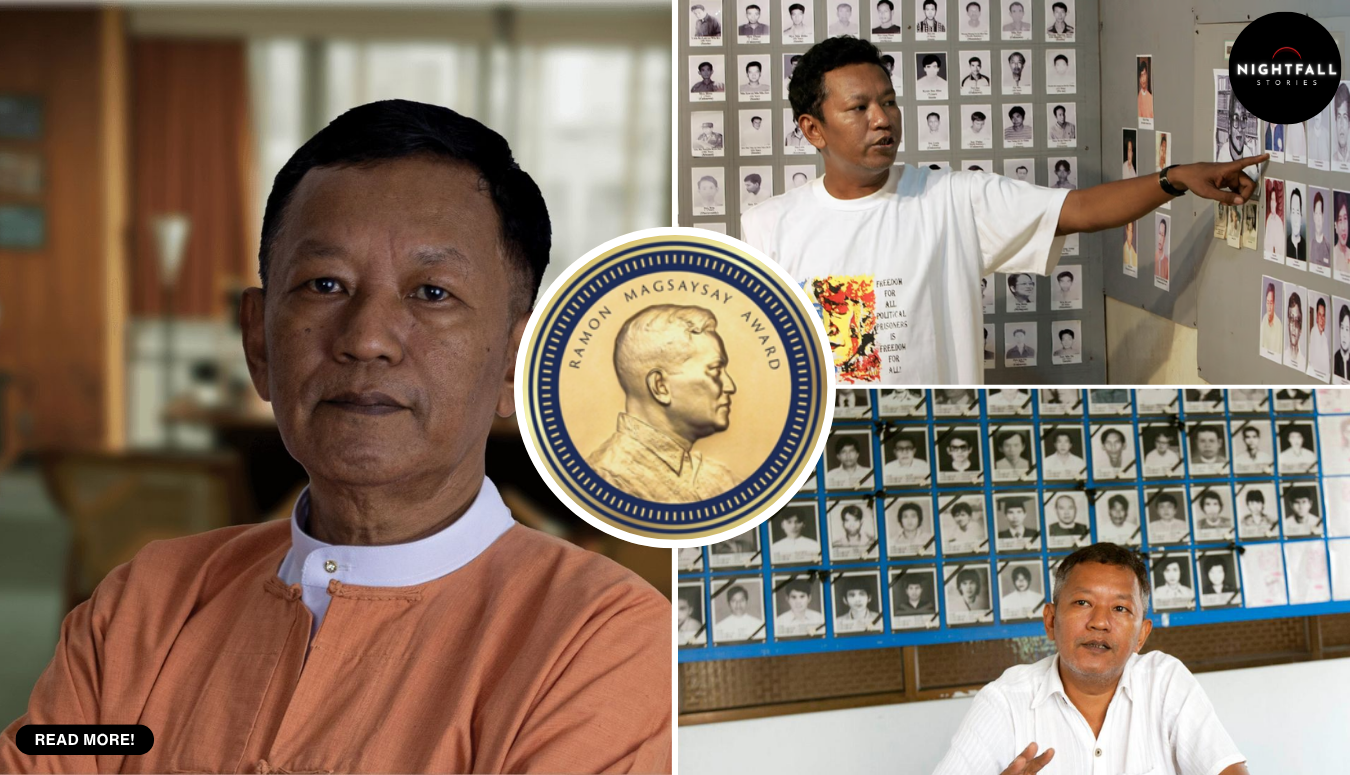
Bo Kyi was a student at Rangoon Arts and Sciences University when the demonstrations of 1988 filled the streets of his country, and the years that followed took him out of a lecture hall and into a cell. He served seven years in total, across two separate imprisonments. When he finally got out in the late 1990s, he did not go back to his degree, and he did not try to build the ordinary life that had been interrupted. He went to the Thai border town of Mae Sot with a handful of other men who had been inside, and together they began keeping a written record of everyone who was still being held.
That was twenty six years ago. The record has not stopped since. It is the single most important thing about him, more than the prison time, and it is the reason the Ramon Magsaysay Award Foundation in Manila named him one of three 2026 awardees. The Foundation’s board wrote that his life’s work has been a steady pursuit of truth, accountability and justice, and that his commitment shows moral courage, personal sacrifice and a belief that democracy and human dignity are always worth defending. Those are the words of a citation, and citations are written in a register that flattens things. What they are describing is a man in a border town with a spreadsheet.
The organisation he co-founded is called the Assistance Association for Political Prisoners, and its central product really is a list. Names. Where each person was picked up. What they are charged with, if anything. Which prison or interrogation centre they are believed to be in now. Whether they have been sentenced, released, or died in custody. It sounds administrative because it is administrative, and the administrative part is exactly what makes it dangerous and exactly what makes it matter.
Consider what it takes to build such a list from outside the country it describes. AAPP cannot operate legally inside Myanmar. It was founded in exile and it has stayed in exile, funded from abroad, staffed largely by people who cannot go home. Everything on the list has to be carried out of the country by somebody. A family member who visited a prison and counted the men in the yard. A lawyer who saw a charge sheet. A released prisoner who memorised the names of everybody in his block because he knew he would be asked. Those fragments arrive by phone, by message, by word passed hand to hand, and every one of them has to be checked against the others before it becomes an entry.
The record is also published, which is the part that turns a database into a form of pressure. For years AAPP has put out monthly chronologies, month after month, each one listing arrests and court outcomes alongside an updated roll of who is currently held. Those documents stretch back well over a decade and they are still coming. Anybody can open the one from years ago and the one from last month and compare them, which means the organisation is holding itself to its own archive as well as holding a government to account. A record that is published can be checked. A record that is published on a schedule can be trusted, because the gaps would show.
This is why AAPP publishes two numbers instead of one. By its own records, dated to late September of this year, the organisation counts 14,847 people it can verify are still being held in connection with opposition to military rule, and a further 7,856 whose detention it believes in but cannot yet stand up to its own standard. It counts 31,976 people arrested in total since the military seized power in 2021, 9,273 of them since released, and 8,427 people killed. Those figures come from AAPP, not from the award, and they move every week. The organisation keeps the verified and unverified columns separate precisely because the state disputes the whole exercise, and a list that overclaims is a list that can be dismissed.
That is the discipline at the heart of the thing. A government that denies holding political prisoners at all does not need to refute a careful record. It only needs one wrong entry. So the record has to be more careful than the people denying it, permanently, with far fewer resources, from the wrong side of a border. Twenty six years of that is not a gesture. It is a job, done daily, mostly by people whose names will never appear in a citation.
Why does a name on a list keep a person alive? Because the alternative is a person who was never officially there. An undocumented detainee can be moved, held past a sentence, or simply not produced, and there is no external record to contradict whatever account is eventually offered. A documented detainee has a paper trail that exists outside the jurisdiction holding him. Families can ask after a specific person rather than a rumour. Lawyers have something to file against. Diplomats have something to raise in a meeting. And when accountability comes, if it comes, investigators have evidence gathered contemporaneously rather than reconstructed years later from memory. AAPP works with the United Nations Independent Investigative Mechanism for Myanmar, which is the body assembling exactly that kind of case file, and the lists feed into it.
Bo Kyi’s own years inside are part of why he understands the value of information, and he has described the experience in unusually practical terms. He has said that everyone of his generation grew up on state media, censored newspapers and censored television, and that prison was where the actual country became visible to him. Inside, he met men from ethnic minority communities who had been treated in ways that never appeared in any broadcast he had ever seen. He was, in a grim sense, being educated.
He also got an education of a more literal kind. There was a professor in a nearby cell, and Bo Kyi worked out a system with him. Whenever the guards were out of earshot, he would ask the man for a short sentence in English, and he would keep it. Sentence by sentence, in the gaps between rounds, he learned the language he would later use to talk to foreign journalists, diplomats and United Nations officials about what was happening to people like him. He has said he did it partly to keep his mind working, which is its own quiet detail about what those years were like. He has not made a set piece out of the worse parts, and neither will this piece.
Release did not end it. Once out, he began meeting people he was not supposed to meet. He held unofficial conversations with the International Committee of the Red Cross. He met journalists in secret and passed on what he knew about conditions and about who was being held. He got information to United Nations special rapporteurs. This is the point where you can see the later organisation forming inside the earlier man, because none of that was activism in the marching sense. It was reporting.
The military noticed, and made him an offer. They wanted him as an informant. By his account he answered with conditions of his own, that all political prisoners be freed and that the government open a dialogue with Aung San Suu Kyi, and when those were refused he refused too. He went back to prison. That refusal is the hard choice at the centre of his story, and it is worth sitting with for a second, because he had already served years and he knew exactly what he was choosing to go back to. After his eventual release, staying in the country was no longer survivable. He crossed to Mae Sot.
Mae Sot is a market town on the Thai side of the Moei River, and for decades it has been where Myanmar’s exiled institutions live: clinics, schools, newsrooms, aid groups, all serving a country a few hundred metres away and legally out of reach. It is the obvious place to build something like AAPP and a terrible place to build anything at all. Funding is foreign and therefore precarious. Staff have uncertain status. The border itself has closed, opened and militarised repeatedly. And the organisation’s subject matter is entirely on the other side.
For its first two decades the list grew steadily and, for a while, in the right direction. Myanmar’s partial political opening in the 2010s brought amnesties, and AAPP expanded from documentation into aftercare, because it turned out that getting people out was not the end of the problem either. Since 2010 it has run counselling, mental health support and human rights training, work that has reached roughly five thousand prisoners and family members. It has built contact with around 33 of the 49 prisons and detention facilities in the country, which tells you both how far the network reaches and how much of the system it still cannot see.
The aftercare work is less visible than the list and in some ways harder. A political prisoner’s family usually loses its income at the moment of arrest, and then has to spend money it no longer has on travelling to a prison that may be many hours away, because in Myanmar a detainee often depends on relatives bringing food and medicine. AAPP has worked on that gap, funding visits and supporting households that lost an earner, and it has worked on what comes after release, when a person walks out of years of detention into a country that has no place ready for them and no acknowledgement that anything happened. The counselling and training programmes grew out of watching men and women get free and then struggle, which is a problem Bo Kyi knew from the inside before it was ever a programme.
Then in early 2021 the military took power again, and the work changed character overnight. What had been partly historical became urgent, and then it became enormous. The numbers above are the scale problem in plain form: an organisation built to track hundreds of cases suddenly tracking tens of thousands, still from outside, still with the same border problem and the same funding problem. Journalists were among the first taken. Human rights monitors put the number of reporters currently held at seventeen or eighteen depending on whose count you use, and one press freedom body ranks Myanmar as the world’s second largest jailer of journalists after China. Local researchers have documented more than two hundred journalists arrested since the coup and eleven killed. Only one journalist is recorded as released this year, a documentary filmmaker freed in an amnesty after nearly three years inside.
Bo Kyi is 61 now. When the award was announced at the end of August, he did not treat it as his. He dedicated it to the people of Myanmar who are pushing against injustice, and specifically to the political prisoners still behind bars, and he used the occasion to repeat the demand he made to his interrogators decades ago in a cell, that political prisoners be released, including Aung San Suu Kyi. He put the figure he is asking about at more than twenty two thousand people.
He is not the first person from his country to receive this award. The doctor Cynthia Maung, who built a clinic on the same border for the same displaced population, received it in 2000, the year AAPP was founded. The journalist Swe Win received it in 2019. Published accounts differ on exactly how many Myanmar nationals have now been honoured, some say five and some say eight, which is a small illustration of how contested even basic record keeping about this country becomes. He shares the 2026 award with the Singaporean diplomat Tommy Koh and with Runa Khan of Bangladesh.
The ceremony has not happened yet. It is scheduled for November at the Metropolitan Theater in Manila, at the end of the Foundation’s festival week, and it is one of the few parts of this story with a clean date attached to it. Everything else is ongoing. The list is being updated as you read this. The verified column and the unverified column are both moving. Somewhere a family is coming back from a prison visit with three names they were asked to remember, and somewhere in Mae Sot those three names are being checked against what is already on file before anyone writes them down.
That is the shape of the recognition. It is not an award for a breakthrough or a victory, because there has not been one. It is an award for showing up to the same clerical task for twenty six years, in exile, against a state that would prefer the task were impossible, on the theory that a name written down accurately is harder to erase than a name that was never written down at all. Bo Kyi went into a cell as a student and came out with a conviction about paperwork. He was right about it, and the proof is that the record still exists, and that people whose detention nobody else recorded are on it.