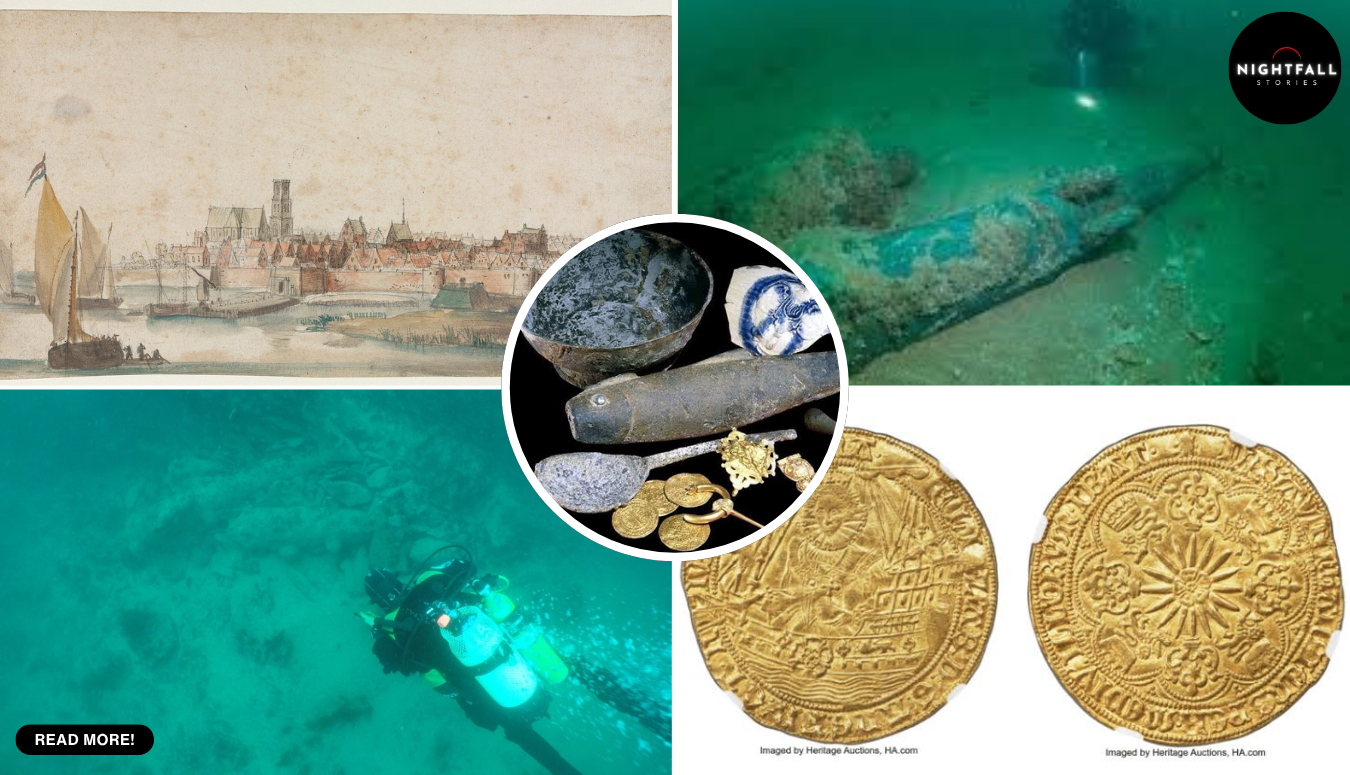
Somewhere off the south coast of Devon, about 18 metres down, there is a scatter of iron and timber roughly 30 metres long. Divers have known about it since 1995. They have brought up cannons and anchors, a pewter bowl, a spoon, gold jewellery, a small ceramic weight carved into the shape of a fish, a merchant’s stamp seal, and more than 400 gold coins struck in Morocco. It is the largest hoard of Moroccan gold ever recovered in Europe.
For thirty one years, nobody could say what the ship was called.
That is a strange thing to sit with. The wreck was never lost. Its position was recorded, it was designated a protected site under law, diving on it was restricted to licence holders, and its finds went into the British Museum. Everything about it was known except the one thing that would turn a pile of objects into a story: a name, a crew, a voyage, a reason for being there.
The answer did not come from the seabed. It came from an independent historian named Ian Friel, sitting in the reading room of the National Archives at Kew, going through the records of the High Court of Admiralty.
The ship was called the Dom van Keulen. It was Dutch. It sailed from the Moroccan port of Safi in the autumn of 1633, bound for Amsterdam, and it never got there.
What Friel found was not a logbook or a captain’s account. It was a lawsuit. After the ship went down, two merchants, recorded as João de Pas and Andrea de Azevedo, brought a salvage claim, and the court took testimony from members of the crew. That is the paper trail. Somebody wanted their property back, and the legal machinery of the seventeenth century obligingly wrote down where the cargo had been, what it consisted of, and how it came to be on the bottom of the English Channel.
The crew described meeting with much tempestuous weather. The ship took a beating in the Channel, sprang a serious leak, put her anchors down off Salcombe, and foundered there.
And here is the part of the story that keeps it from being a tragedy. Every single member of the crew survived.
That detail changes the whole texture of it. Most shipwrecks that leave behind gold also leave behind bodies, and the writing about them tends to lean on the drowning. This one has no drowning in it. What it has is a leaking hull, a crew working the pumps in bad weather, a decision to anchor rather than run for it, and then a slow, undignified loss of the ship while everybody got off. It is closer to an insurance dispute than to a disaster.
Which is exactly why the documents exist, and why Friel could find them.
To understand why a Dutch merchantman was coming north out of Morocco loaded with gold, you have to know something about who was running Morocco at the time. The Sa’dian dynasty held power there from the middle of the sixteenth century until the middle of the seventeenth, and their wealth rested on gold coming up out of West Africa. The coins recovered from the wreck were struck under Sa’dian rulers, and taken together they form the largest known assemblage of Sa’dian gold anywhere. Before this site, that material was scarce enough that numismatists worked from scraps.
The gold moved north and Dutch manufactured goods moved south. That was the trade. But the gold was not travelling alone, and the rest of the manifest is the part of this story that most people skate past, which is a shame, because it is the most interesting thing in it.
Alongside roughly 9,000 Barbary ducats, the Dom van Keulen was carrying 150 bags of gum arabic, 64 bags of saltpetre, and 320 goat skins.
Read that list again and a whole economy opens up. Gum arabic is the hardened sap of acacia trees, and in the seventeenth century it was an industrial material. It bound pigments in ink and paint, it sized and stiffened textiles, it went into medicines and confectionery. Saltpetre is potassium nitrate, and saltpetre is gunpowder. A Dutch republic in the middle of a long war with Spain had an appetite for saltpetre that was effectively bottomless. Goat skins became leather, and leather became boots, bindings, bellows, straps, gloves and armour padding.
So the ship was not a treasure galleon. It was a working freighter carrying money, chemicals, and raw hide on a route that connected North African gold to a northern European war economy. The gold is what makes headlines. The saltpetre is what explains the voyage.
It is also worth being precise about the coins, because two numbers get merged constantly and they are not the same number. Roughly 9,000 ducats appear on the documented manifest. Just over 400 gold coins were actually recovered from the seabed. The gap between those figures is not a mystery, and it is not a hint that thousands of coins are still down there waiting.
It is because the wreck was salvaged almost immediately.
That is what the salvage claim was about. The ship went down in shallow water, close to shore, in a place where local people knew the ground. Most of the cargo appears to have been lifted within a short time of the sinking. What stayed on the bottom was what nobody could find in 1633: coins that had worked their way into the sediment and gravel, where they sat for more than 360 years until the seabed shifted and divers from the South West Maritime Archaeology Group came across them.
So the site is poor in objects and rich in information, and those two things are connected. A wreck that was never salvaged gives you a full cargo. A wreck that was salvaged gives you a court case, and a court case gives you names.
There is one more thing the documents did, and it is easy to miss. They killed a theory.
When hundreds of Moroccan gold coins start coming up off the English coast alongside cannons, the first idea everybody reaches for is piracy. It is the obvious reading. Barbary corsairs operated in these waters in the seventeenth century, they did reach as far north as the Channel and beyond, and a wreck full of North African gold with guns on board fits that picture almost too neatly. That speculation hung around this site for years, and it is reported in the coverage of the new volume as the assumption the research had to clear away.
The manifest is what clears it away. Pirates do not carry 150 bags of gum arabic. Pirates do not carry 320 goat skins. Bulk industrial commodities, itemised, insured, and then sued over in an Admiralty court by named merchants, are the signature of legitimate freight. The gold was not loot. It was payment, moving north on a commercial route, in the hold of a chartered trader alongside everything else the same voyage could profitably carry.
That correction matters more than it looks. A pirate wreck is a curiosity. A merchant wreck is evidence of a trade relationship, and a trade relationship between Sa’dian Morocco and the Dutch republic is a genuinely underexamined piece of economic history that most readers have never had any reason to think about. One ship, properly identified, turns a romantic guess into a documented route.
The coins themselves only surfaced because the seabed moved. The site was first noted as little more than cannons with nothing else visible around them. It took a shift in the sediment in the mid-1990s to expose the rest, and once material began appearing, divers from the South West Maritime Archaeology Group started the slow work of recording it properly rather than simply lifting what shone. That restraint is why there is anything to write about. A site stripped by souvenir hunters produces no manifest to match against a court record.
The identification, it should be said plainly, rests on paper rather than on a nameplate. No hull timber came up with the ship’s name carved into it. The sequence was that analysis of the recovered objects made a Dutch origin look overwhelmingly likely, the coins put the earliest possible date of loss at 1632 because that is the date of the youngest coin in the hoard, and Friel’s archival work then supplied a documented Dutch loss off Salcombe in the autumn of 1633 that matched the cargo on the seabed item for item. The British Museum’s own published description is carefully worded, saying the vessel reportedly sank off Salcombe in 1633.
That hedge is honest and it is worth respecting rather than sanding off. This is a very strong identification built from convergence: the right nationality, the right date window, the right port of origin, the right commodities, the right stretch of coast. It is not a signature on a beam. Archaeology almost never gets a signature on a beam.
What makes it satisfying is that it is falsifiable in a way that speculation is not. Anyone can go and read the documents. They are catalogued, they are in a public archive, and the reasoning is set out in full in a volume that came out this year.
That volume is called From Morocco to the Coast of England: The Story of the Dom van Keulen and its Remarkable Cargo. It is a British Museum research publication, edited by Venetia Porter, formerly the Museum’s senior curator for Islamic and contemporary Middle Eastern art, and Dave Parham, professor of maritime archaeology at Bournemouth University. Friel is one of the contributors, alongside David Gaimster, Caroline R. Cartwright, Gwilym Lewis and Peter Davey. Jeremy D. Hill, the Museum’s head of research, was involved in bringing it out.
You can buy a paper copy through the Museum’s shop. You can also read the whole thing online for nothing, under an open licence, which for a specialist volume on seventeenth century Moroccan numismatics and Channel shipwrecks is not a small thing. The people most likely to want it are volunteer divers, local historians and students, which is to say people without institutional library access.
The smaller finds are where the ship stops being a cargo list and starts being a place where people lived. There is a pewter bowl and a pewter spoon, Dutch made, somebody’s dinner service. There is a sounding weight shaped like a pilchard, which would have been dropped on a line to read the depth, and somebody took the trouble to make a functional lump of ceramic look like a fish. There is a stamp seal, the tool a merchant used to press wax and close a letter. There is a small nugget of gold shaped like a finger.
And there is a red earthenware jar containing pills coated in resin, still recognisable after nearly four centuries underwater. Nobody knows exactly what they were for. The resin coating is what preserved them. Somebody aboard that ship had a supply of medicine, carefully sealed, and it outlasted the ship, the crew, the dynasty that minted the gold and the war the saltpetre was bound for. There were preserved beans in there too.
Those are the objects that do the real work on a reader. A hoard of gold coins is impressive but abstract. A spoon is not abstract. A jar of pills is not abstract. Somebody was ill on that voyage, or expected to be.
The site itself remains protected. It sits inside a designated area managed by Historic England, diving is by licence only, and it is watched from the National Coastwatch Institution’s lookout at Prawle Point, which is the kind of quiet, unglamorous arrangement that actually keeps an archaeological site intact. Not a fence. A volunteer with binoculars and a phone.
It is worth dwelling for a moment on the thirty one years, because the framing of long mysteries usually gets this backwards. Nothing was lost during those three decades. Divers surveyed, finds were conserved, the coins were acquired by the British Museum, specialists published on the numismatics. The delay was not neglect. It was the ordinary speed at which this kind of work moves when it is done by a mix of volunteers, museum staff and academics, mostly around other jobs, and when the crucial evidence is not on the site at all but in a box of legal papers in a different country, filed under a case nobody had connected to a Devon wreck.
That is the genuinely useful lesson in it. Maritime archaeology looks like an underwater discipline, and a great deal of it happens in reading rooms. The divers found the coins. A historian with no diving involved found the ship.
There is a version of this story that never gets to this point, and this operation has seen plenty of them: a wreck comes up, the objects are catalogued, the report concludes that further study will help identify the vessel, and nothing follows. The site becomes a permanent question mark with a good photograph attached. Most identified-but-unnamed wrecks stay that way.
This one did not. The Dom van Keulen sailed from Safi in the autumn of 1633 with gold, gum arabic, saltpetre and goat skins in her hold, took the worst of the Channel weather, sprang a leak, anchored off Salcombe and went down with every one of her crew alive. Two merchants sued for their cargo, a court wrote down what the crew told it, and the paper sat in an archive for very nearly four centuries until somebody went looking for it.
Thirty one years after the first coins came up out of the gravel, the ship has a name, the reasoning behind that name is published, and anyone who doubts it can read the documents and check the work for free.