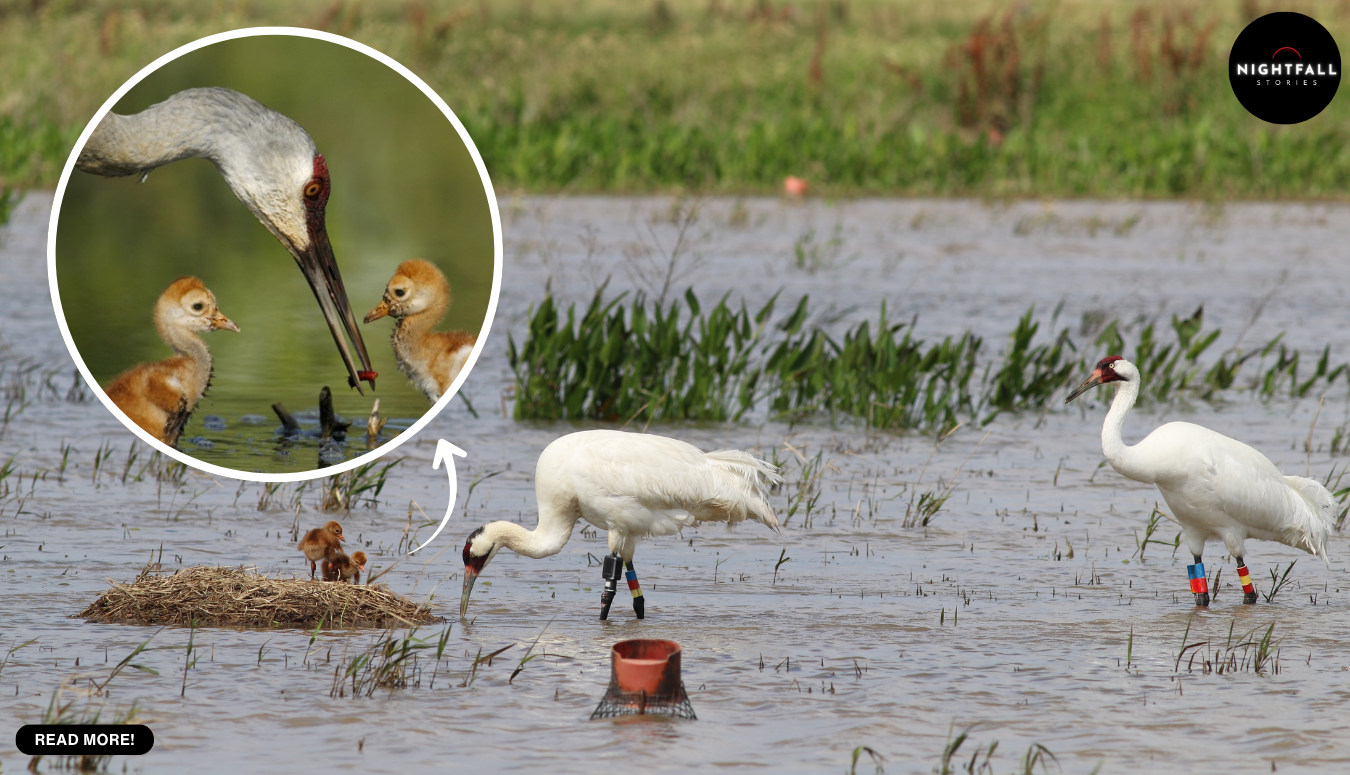
Ten whooping crane chicks in the marshes of southern Louisiana got big enough to fly this year. That is the record. It beats the previous best of eight, set four years earlier, and the state wildlife agency that runs the programme says it is the most ever produced by any whooping crane reintroduction project in the country.
Ten. Not eighteen, and not twenty, even though those are the numbers that ended up in most of the headlines.
Twenty pairs built nests. Eighteen of those pairs hatched chicks. Ten chicks fledged.
Those three figures describe three completely different things, and collapsing them is the single most common error in coverage of this kind of work. A nest is an intention. A hatch is an egg that opened. A fledge is a young bird that survived long enough to leave the nest on its own wings, which in a whooping crane means roughly three months of being large, conspicuous, flightless and edible in a landscape full of alligators, bobcats, coyotes and raccoons.
Eighteen of twenty pairs hatching something is a hatching statistic, and it is a genuinely striking one. Sara Zimorski, the Louisiana Department of Wildlife and Fisheries biologist who has overseen the crane project, says it is the highest proportion the programme has ever recorded. It tells you the adults are finding mates, holding territories, building nests in the right places and incubating successfully. That is a lot to get right.
But eighteen hatches producing ten fledglings also tells you that eight of those families lost their chicks. Nobody writes that number in a headline, and it is the honest other half of a record season.
Fledging is the number that counts because fledging is the only one that adds a bird to the population. An egg that hatches and then disappears in week five has changed nothing about the flock’s size. This is why the distinction is not pedantry. It is the whole measure of whether a reintroduction is working, and it is exactly where optimistic reporting tends to quietly inflate a result.
The Louisiana flock now stands at 84 birds, by the count published at the end of the nesting season. Thirty two of them were hatched in the wild, in Louisiana, by wild parents.
To understand why that second figure is the one the biologists care about, you have to go back to what was there before.
It helps to know what kind of animal is being counted. A whooping crane stands close to five feet tall, which makes it the tallest bird in North America, with a wingspan that opens to well over seven feet. It is white, with black wingtips and a patch of bare red skin on the crown, and it has a call that carries for miles across flat ground. There is nothing else remotely like it in a Louisiana marsh. You cannot mistake one for anything, and you cannot miss one either.
Whooping cranes once nested across a large part of North America, including the coastal prairies and marshes of Louisiana. Then they were shot, and their wetlands were drained, and by 1941 there were twenty one left on the entire planet. Twenty one. The species survived the twentieth century on a margin that thin.
Louisiana lost its resident cranes entirely. For more than seventy five years, no whooping crane hatched naturally anywhere in the state. That gap belongs to Louisiana specifically, not to the species, which continued breeding in Canada throughout. But for the marshes themselves, the bird was simply gone within living memory and then beyond it.
In 2011, the state started putting them back. Ten captive-reared juveniles were released at the White Lake Wetlands Conservation Area in Vermilion Parish, chosen because the coastal habitat there is still extensive and still wet. The plan was unusual in one important respect: this flock was never meant to migrate. Whooping cranes are famous for enormous seasonal journeys, and teaching reintroduced birds to make them has been one of the hardest problems in the field. Louisiana’s historic population did not migrate, so the reintroduction did not ask the new birds to either.
Dropping the migration was a real simplification and it came with a real trade. What it removed was the hardest and most failure-prone part of other whooping crane reintroductions: teaching captive-reared young birds a route they had never flown, and then hoping they survived a wintering ground, a summering ground and two long journeys a year between them. Every one of those is a place something can go wrong, and a migratory reintroduction has to succeed in all of them at once.
What it could not remove was the flip side. A bird that never leaves cannot leave. A migratory flock that loses its breeding grounds still has a wintering ground. A resident flock in a single stretch of coastal marsh has nowhere else, and southern Louisiana is not a place where nothing ever happens to coastal marsh.
Five years later, in 2016, a pair in the wild hatched a chick. It was the first whooping crane to hatch naturally in Louisiana in more than seventy five years.
Going from that to ten fledglings in a single season took another decade, and it did not happen because anything dramatic changed. It happened because the birds got older.
This is the part Zimorski keeps coming back to, and it is one of the least intuitive things about restoring a long-lived species. Whooping cranes are not good at breeding when they are young. A first-time pair is often a bad pair. They pick poor nest sites, they mishandle incubation, they lose chicks to predators they should have avoided, and they frequently fail outright. Then they try again the following year and do slightly better. As a population ages, the proportion of experienced breeders climbs, and the success rate climbs with it. Zimorski’s explanation of this season is essentially that: as the population gets older, more of the breeding pairs are getting it right.
Which means a reintroduction cannot be judged on its early years, and also cannot be declared finished on one good one. Ten fledglings is what fifteen years of patience looks like arriving all at once.
The word fledged is doing quiet work in all of this, and it is worth being clear about what it does and does not promise. A fledged crane is a bird that can fly. It is not yet a bird that has survived a year, or found a territory, or bred. Plenty of fledglings die in their first winter. So ten fledglings is not ten future breeders, and nobody involved is pretending otherwise.
What it is, though, is ten birds that got past the stage where reintroduced populations usually fail. Chick mortality in the first weeks is the bottleneck. Clear it, and the odds improve sharply.
The counting is unusually honest here, and it is worth saying why. In plenty of conservation stories, the encouraging number is a hatch count, or a nest count, or an estimate of animals released, and the figure that would actually matter, how many survived, is left for a future report that sometimes never comes. This is not one of those. The fledging count is the published number. The chicks reached flight age before anyone announced anything. There is no deferred reckoning hiding inside the good news.
That does not make the flock safe. Eighty four birds in one place is a small population in a single location, and Zimorski has been direct about what that means. If every bird you have lives in one population in one area, a single bad event, a hurricane, a disease outbreak, a chemical spill across a coastal marsh, could take out the lot. That is the entire logic behind maintaining separate whooping crane populations in different parts of the continent instead of concentrating them where conditions look best. You are not optimising. You are spreading risk.
There is also the awkward fact of where these birds actually live. The coastal prairie that whooping cranes want in Louisiana is not a wilderness. It is working agricultural country, and cranes forage readily in flooded rice fields and crawfish ponds, which are excellent shallow wetlands from a bird’s point of view and private property from everybody else’s. That is why the crane killed this year was killed at a crawfish pond. It is also why landowner relations are not a soft add-on to this programme but a core part of it. A flock that nests and feeds on farmland survives or does not survive largely at the discretion of farmers, and a reintroduction that has not brought those farmers with it will lose birds faster than it can produce them.
Most of them have come along, which is the quiet reason any of this works. A great many Louisiana landowners now have enormous white birds wandering their fields and simply let them get on with it.
The losses are not all environmental either. Cranes in Louisiana get shot. It keeps happening, year after year, to a bird that stands nearly as tall as a person, is bright white, is federally protected and is entirely unmistakable. One was killed at a privately owned crawfish pond earlier this year. Another died over the summer, bringing the count reported in later coverage slightly below the end-of-season figure. Power lines take birds too; a large crane flying at dusk does not see a thin wire in time.
So every fledgling is expensive. Behind the ten there is a captive breeding operation, with birds raised at facilities including the Freeport-McMoRan Audubon Species Survival Center in New Orleans, where Richard Dunn works as assistant curator. There is tracking, banding, monitoring, nest observation, landowner relations across private farmland and marsh, and law enforcement following up shootings. There are fifteen years of field seasons.
Against the species as a whole, eighty four birds is a modest share. Fewer than a thousand whooping cranes exist across all populations, wild and captive combined. The one genuinely self-sustaining wild population, which breeds in Wood Buffalo National Park in Canada and winters on the Texas coast, numbered around 557 birds in the most recent count. Everything else, including Louisiana, is still assisted.
Which brings us to the thing that actually happened this year, and which is not the number ten.
One of the chicks that fledged in Louisiana was raised by a pair in which both parents had themselves been hatched in the wild, in Louisiana.
Read that slowly, because it is the point of the entire programme. Neither of those adults came out of a captive breeding facility. Neither was reared by people in a pen, fed by handlers in crane costumes, crated, transported and released into a landscape it had never seen. Both of them hatched in a Louisiana marsh, to parents who were raising chicks there, and grew up as wild birds. And then they built a nest of their own, incubated an egg, and got a chick through to flight.
That is a second generation of wild-hatched Louisiana cranes producing a third. It is the specific outcome that the 2011 release was designed to reach, and until it happens, a reintroduction is not a population. It is a maintained collection. Birds are added by people, they breed or they do not, and if the additions stop, the numbers fall.
A pair of wild-hatched parents raising a wild-hatched chick means the loop has closed. The flock is now, at least in part, making itself.
It is a single pair and a single chick, and nobody involved is claiming otherwise. Thirty two of eighty four birds are wild-hatched, which means the majority of the flock still traces directly to captive rearing, and the release programme has not ended. One second-generation success does not make a self-sustaining population any more than one good season makes a recovered species.
But it is a threshold, and thresholds only get crossed once. Fifteen years ago there were no whooping cranes breeding in Louisiana at all, and had not been for three quarters of a century. Ten years ago there was one wild-hatched chick, the first in more than seventy five years. This year there were ten fledglings, the most any whooping crane reintroduction anywhere in the country has produced, according to the agency that produced them.
And in among those ten, in a marsh in southern Louisiana, there is one young crane whose mother and father were both born in that same landscape, wild, to wild parents, with no human hand in it at any point.
That bird is what the programme was built for. It took fifteen years, a captive breeding network, an agency that kept counting honestly, and a biologist who stayed with the same flock long enough to watch the young pairs become good at it. The ten is the record. The one is the proof.