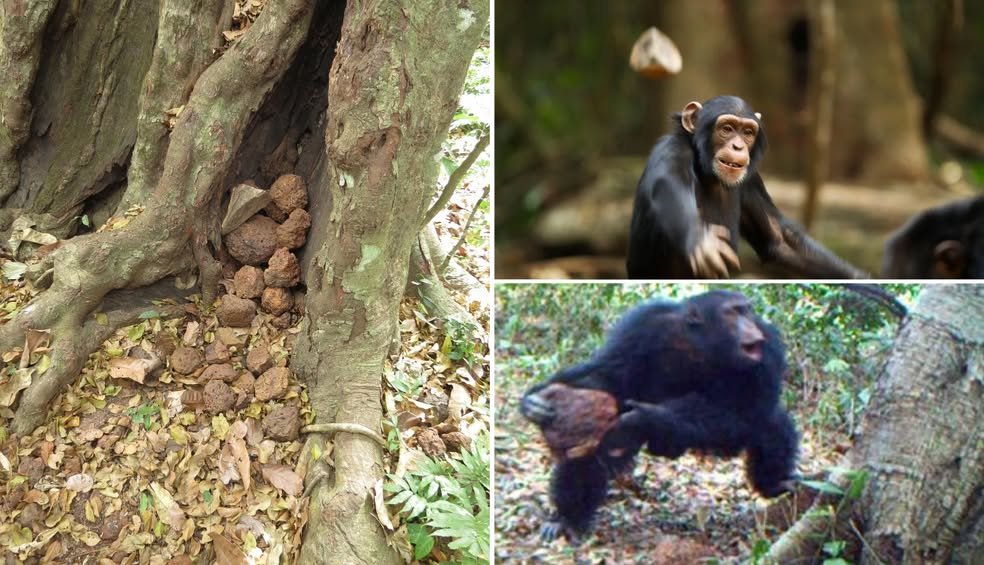
There is a tree in the savanna woodland of Guinea-Bissau with a pile of stones at its base. Not stones that rolled there. Stones that were carried, sometimes for a considerable distance, and thrown hard at the trunk by an adult male chimpanzee who then shouted about it.
The pile has been growing for more than a decade. Nobody knows why.
That last sentence is not a tease. It is the actual state of the science, and two researchers spent a field season in one of the least accessible corners of West Africa trying to change it. Robyn Nakano and Ammie Kalan, who work out of the Great Ape Behaviour Lab in the anthropology department at the University of Victoria in Canada, went to Boé National Park with field assistants Djei Baldé and Balu Séra and a lab colleague, Taylor Tippett, and set up camp twenty-two kilometres out into the bush near a river, well away from the nearest village. They are not there to habituate the chimpanzees or to follow them around. These chimpanzees are not habituated and they do not want company. If a human appears, they leave.
So the entire study is machines. Cameras strapped to trees, microphones left running, batteries swapped, memory cards collected at half past six in the morning, day after day, while the animals go about a behaviour nobody has ever watched with their own eyes at close range.
The behaviour has a clinical name that does very little to convey how strange it is. Accumulative stone throwing. A chimpanzee picks up a rock, approaches a particular tree, and either hurls it at the trunk, bangs it repeatedly against the wood, or tosses it into a hollow in the base. Then it leaves the rock there. Over years, the rocks pile up, wedged between buttress roots or stacked inside the cavity, until the tree has a visible cairn at its foot.
It was first caught on camera in 2011, and even that happened by accident. A wildlife camera in Guinea, set up as part of a huge multi-site survey of chimpanzee behaviour across Africa, recorded a male doing something that made no sense to the people reviewing the footage. When the survey team went looking, they found the behaviour at a handful of other sites and nowhere else. The results were published in 2016 and they were genuinely disorienting, because chimpanzee behaviour is one of the most intensively studied subjects in animal science and this was a completely new one, hiding at four sites in one corner of the continent.
The scale of that search is worth knowing, because it tells you how confident the negative result is. The survey ran across thirty-four sites over roughly four years, with cameras out continuously, and it produced sixty-four recorded stone throwing events. Sixty-four, from a continent-wide effort. The team also sorted the action into three distinct forms: hurling the stone at the trunk with one or both hands, banging it repeatedly against the wood, and tossing it into a hollow cavity. Different chimpanzees, at different sites, doing recognisably the same thing in recognisably different styles.
Boé itself is not a small or marginal population, which makes the exclusivity stranger. Estimates put somewhere between one thousand and fifteen hundred chimpanzees in the sector, living in a landscape that is not dense rainforest but a mosaic of savanna, woodland and gallery forest along the rivers. It is hot, open country, and the chimpanzees there live at the dry edge of what their species can tolerate.
Those four are Boé in Guinea-Bissau, Sangaredi in Guinea, Mount Nimba in Liberia, and a reserve in Côte d’Ivoire. All of them hold western chimpanzees, a subspecies that has lost the large majority of its numbers in a generation and is now listed as critically endangered. Chimpanzees elsewhere in Africa, including populations that have been watched continuously for half a century by some of the most famous field projects in biology, do not do this.
That distribution is the first reason the behaviour matters so much. When a behaviour appears in some populations of a species and not others, and the difference cannot be explained by what is physically available in the environment, you are looking at culture in the technical sense. Something learned from other individuals and passed along, rather than something every chimpanzee would invent on its own given the same rocks and the same trees.
And the availability argument really does fail here. Earlier work in Boé found that out of hundreds of suitable trees in the area, only around thirty-nine are used for stone throwing. There is no shortage of trees and no shortage of stones. The chimpanzees have selected specific trees, and they keep going back to those, and they have kept going back for long enough that a researcher who mapped the sites in 2017 could return nearly a decade later and find them still in use.
Look at the list of tree species involved and the pattern gets more interesting rather than less. Analysis of years of camera footage from Boé lists silk cotton, a kola relative, African rosewood, African breadfruit, red kapok and a smaller savanna tree. That is a mix of very different trees, so the choice is not simply about wood density or hollowness in any obvious way. Something else is deciding which tree becomes a stone tree.
What we know about the act itself comes almost entirely from footage. It is predominantly adult males. They do it in the daytime and, more recently documented, at night. They do it in the rain. They frequently do it while producing a pant hoot, which is the loud rising call chimpanzees use to broadcast over long distances, and they often combine it with buttress drumming, the familiar behaviour of hitting a tree’s flared roots with hands and feet to produce a low boom that carries through the forest.
That combination is the strongest clue anyone has. Drumming is well understood as a signal. It travels, it identifies the drummer to those who know him, and it announces position and probably mood. If stone throwing is happening in the same package as drumming and pant hooting, the obvious hypothesis is that it is also a signal, and that the crack of a rock against a hard trunk is doing something drumming alone cannot do. In open, dry savanna woodland, sound behaves differently than it does under closed rainforest canopy, and a sharper, higher-frequency impact may simply carry better.
The other hypothesis is the one that makes people uncomfortable, and it is the reason this behaviour got so much attention in the first place. Humans have been stacking stones at particular places for a very long time, and often for reasons that are not practical. Cairns mark boundaries and routes, and in many traditions they mark something less tangible than that, accumulating because each person who passes adds one. When the 2016 paper went out, researchers noted carefully that they could not rule out a symbolic or ritual dimension to what the chimpanzees are doing, and that careful wording travelled around the world in a considerably less careful form.
It is worth being clear about what is and is not being claimed. Nobody serious is saying chimpanzees have religion. The point is narrower and more useful. If a behaviour is socially learned, tied to specific places rather than specific resources, repeated across generations, and has no obvious function in getting food or avoiding danger, then it has some of the structural features that human ritual has. Whether it has any of the internal content is not a question a camera trap can answer, and it may not be a question anybody can answer.
Which brings us back to the two people sitting in a bush camp collecting SD cards.
Nakano and Kalan’s approach is to stop guessing and start measuring. Two video cameras at each stone throwing site rather than one, so they can see the tree from more than one angle and identify individual animals. Audio recorders running alongside, because if the sound is the point then the sound needs to be recorded properly rather than captured incidentally by a camera microphone. They measured the trees. They made three-dimensional scans of the thrown rocks, which sounds excessive until you consider that nobody has ever established whether the chimpanzees are selecting stones by size, shape or weight, or grabbing whatever is nearest. They surveyed nests and feeding signs to work out who was in the area and when.
None of it would happen without the people who live there. The two field assistants working with the team, Djei Baldé and Balu Séra, are local, and in a place where the chimpanzees flee from strangers and the terrain does not forgive guesswork, that is not a courtesy hire. Knowing which trees are the stone trees, and how to reach them, and when the rivers are crossable, is knowledge held locally and shared, and the whole project sits on top of it.
What they want out of the footage is a set of fairly basic facts that have never been established. Who throws, by age and sex. Whether the same individuals return to the same trees. What the rest of the community does when it happens, whether others come, respond vocally, or ignore it entirely. Whether the sites cluster near the boundaries of a community’s range, which would support the territorial signalling idea, or sit in the middle of it, which would not.
And there is one observation already on the record that points somewhere specific. Reviewing a decade of camera footage from Boé, researchers noted juveniles at the sites, apparently picking the behaviour up. That is the transmission mechanism made visible. A young chimpanzee watching an adult male throw a rock at a tree and, eventually, throwing one too.
It also explains the timescale. A stone pile that has been growing for over a decade is not the record of one animal’s habit. It is a record of a practice outliving individuals, which is exactly what culture means and exactly what makes the piles worth protecting as objects and not just as data.
That last point is not abstract, and it is where the story stops being a curiosity.
Boé sits on bauxite. Bauxite is the ore that aluminium comes from, and the region is one of the more significant untapped deposits in West Africa. During the field season the researchers reported seeing bore holes, the physical marks of exploration drilling, in the landscape they were working in. Neighbouring Guinea is one of the largest bauxite producers on Earth, and the record there is well documented: bauxite is strip mined, which means the surface comes off, along with the trees standing on it, the soil, the water table and everything living in the way. Dust and sediment do the rest downstream.
If that arrives in Boé, it does not just kill chimpanzees, though it would do that too, to a subspecies that cannot afford it. It erases the specific trees. And because the behaviour is attached to those particular trees rather than to trees in general, and because it is passed on by young animals watching old ones at those places, the tradition would very likely go with them. You would not be losing a population and hoping it recovers elsewhere. You would be losing a cultural practice documented at exactly four sites on the planet, one of which happens to be the one sitting on the ore.
This is a genuinely new problem for conservation, and the people who study animal culture have been pushing on it for years. Protection frameworks are built around species and habitats. They count individuals and hectares. They have almost no language for a behaviour that exists in one population and nowhere else, that is not encoded in any genome, and that cannot be relocated, bred back or reintroduced. Once the chimpanzees who know how to do it are gone from a place, or the place itself is gone, the behaviour does not come back. There is no seed bank for this.
Nakano and Kalan are careful about what they can currently say. There is no new peer-reviewed paper establishing a function, and it would be wrong to suggest otherwise. What exists is a body of published work stretching back a decade, an enormous archive of camera footage, and a fresh field season whose recordings are still being analysed. The researchers describe the project as ongoing and the question as open, which is an unusual thing to say publicly in a field that rewards conclusions.
The honest summary is this. In one specific stretch of West African savanna woodland, male chimpanzees carry stones to about three dozen chosen trees, throw them, shout while doing it, and leave the stones behind. They have been doing it at those same trees for longer than anyone has been watching, and they were doing it for an unknown period before a camera happened to catch one of them in 2011. Young ones are learning it. Nobody can yet say what it is for.
The piles themselves are the part that stays with you. Every stone in them was picked up by an individual animal and thrown at a particular tree for a reason that mattered enough to do it again the next time. Thousands of decisions, stacked up at the foot of a trunk, sitting there in plain view in a forest that may or may not still exist in twenty years.
Somebody is finally sitting in the dark with the recorders running, trying to work out what is being said.