At the twenty week scan, the sonographer stopped moving the probe. Maisie Savage was on the table in a London hospital expecting the ordinary reassurance of a mid pregnancy appointment, the kind where you find out whether you are having a boy, and instead the screen showed her son’s intestines floating outside his body. They had pushed through a small opening in his abdominal wall, just beside where his navel was going to be.
Late last year, in an operating room in Houston, a surgical team went into her uterus through incisions barely wide enough to pass an instrument, drained away the amniotic fluid, filled the space with gas so they could see, moved the loops of bowel back inside the boy, and closed the wall. He was still fourteen weeks away from being born. He had no name yet in public, no birthday, no weight. He had a repaired abdomen.
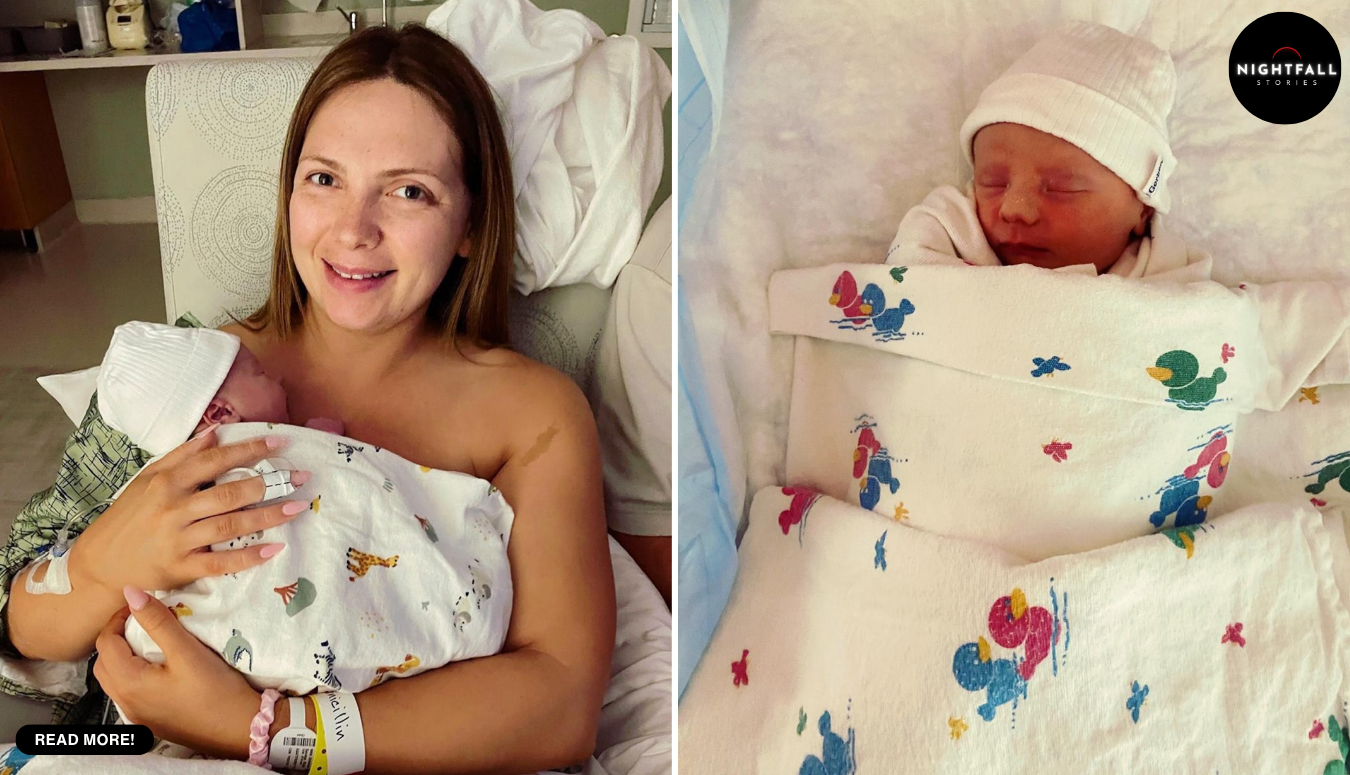
He is Theo French, and the reason anyone outside two families and one hospital knows about him is what happened after the birth rather than before it. He arrived full term at normal weight. He was feeding fully within two days. He went home on the third.
To understand why a day three discharge is the part that made surgeons put down their coffee, you have to know what the condition normally costs a newborn. Gastroschisis is an abdominal wall defect in which the intestines develop outside the body during pregnancy, and it is not rare in the way that word usually implies. Most cases are what surgeons call simple: the bowel is out, but it is otherwise intact. Those babies are delivered, the intestines are returned in one or two operations, and they go home after roughly a month.
Theo’s case was the other kind. Complex gastroschisis means the exposed bowel has also been damaged while it was outside, twisted, narrowed, atretic, part of it sometimes dead. It accounts for a minority of cases, somewhere around one in six in published series, and the difference in what follows is not marginal. In one recent single centre study of seventy seven infants, the babies with simple gastroschisis had a median hospital stay of thirty four days. The babies with complex gastroschisis had a median stay of one hundred and ten. Sixty nine per cent of the complex group needed two or more operations, against eight per cent of the simple group. Sepsis rates were more than double.
Those are the numbers that a specialist in London would have had in mind when Maisie and Josh French, both of them teachers, sat down to hear what the scan meant. Months in intensive care. A staged closure, where the bowel is held in a silo above the body and eased back a little at a time over days or weeks. Feeding through a line into a vein because the gut cannot cope with milk. More operations later for the narrowed sections. And a real chance of a childhood organised around a digestive system that never quite works.
Survival, it should be said plainly, is high. Better than ninety five per cent of babies born with gastroschisis now live. The question was never whether Theo would survive. The question was what kind of first year he would have, and what the damage already happening to his bowel in the amniotic fluid would cost him for the rest of his life.
That is the pressure that makes the fetal argument worth having at all. Amniotic fluid is not neutral to intestine. Over the second and third trimesters, bowel sitting outside the body is bathed in it, and the longer that goes on, the thicker and more inflamed and more matted it becomes. Every week of waiting is another week of injury. So the obvious thought, which people have had for decades, is why wait for the birth at all.
The reason is that opening a pregnant uterus is a serious thing to do. Traditional fetal surgery means a hysterotomy, a large incision in the womb. It carries real risk of preterm labour, membrane rupture, bleeding, and a uterine scar that affects every pregnancy afterwards. For a condition with a ninety five per cent survival rate, trading a manageable neonatal course for a threat to the whole pregnancy and to the mother is not an obvious bargain. It is why in utero repair of gastroschisis stayed theoretical for so long. The maths did not work.
What changed the maths was the keyhole. Doctors at Great Ormond Street Hospital in London, having diagnosed the complex form, told the family about a clinical trial in the United States, at Texas Children’s Hospital in Houston, that was attempting the repair fetoscopically. Not a hysterotomy. Small ports, a camera, instruments on the end of long shafts, the same basic idea that turned gallbladder surgery from a week in hospital into a day case, applied to an operation performed on a patient who has not been born.
So the family did what a small number of families end up doing when the only version of the care they want exists on another continent. They left London and relocated to Texas for the rest of the pregnancy. On the way there was a stop in Belgium, at the hospital in Leuven, where Theo was given an injection of botulinum toxin to relax the muscle of his abdominal wall and make the opening easier to work through and to close. Two continents, three countries, one unborn patient, before the actual operation had even started.
There is an uncomfortable thing sitting underneath that itinerary, and it is worth naming rather than stepping around. The reason the family had to move is that the trial exists in one place. Fetal surgery of this kind is concentrated in a handful of centres worldwide, because it needs a fetal surgeon, a maternal fetal medicine specialist, a neonatal team and an anaesthetic team who have all done it together enough times to be calm. That concentration is the right way to build a difficult operation safely, and it also means that access to it is decided partly by whether a family can pick up their life and relocate for a trimester. The London referral was the system working. The plane ticket was the part the system does not cover.
The decision itself is the part that is easy to skate past. Read it quickly and it sounds like an obvious yes. It was not. They were being offered a place in a trial, which by definition means the outcome was not known. Theo was the third candidate enrolled. The alternative on the table was a difficult but well understood path: have the baby, hand him to a good neonatal unit, and accept months of intensive care. Instead they were being asked to accept an experimental operation on a fetus at twenty six weeks, performed through the wall of a uterus that was carrying him, with the risk that the pregnancy would end that week and there would be no baby at all.
There is no calculator for that. Maisie has described the period as an anxious and frightening one, and she has not dressed it up. They were not brave in the film version of the word. They were two teachers in an unfamiliar city, a long way from their own families, agreeing to something nobody could promise them.
They also had to hold two ideas at once for about six weeks, which is the part parents in trials rarely get credit for. One was hope, because that is what gets you on the plane. The other was that the honest answer to what will happen to my son was that nobody knew, and that pretending otherwise would have been a kindness nobody was offering them.
The operation went ahead late last year, at twenty six weeks. The team was led by Dr Michael Belfort, the obstetrician and gynaecologist in chief at Texas Children’s Pavilion for Women, who has spent his career on fetal intervention, alongside Dr Sundeep Keswani, the hospital’s associate surgeon in chief and the principal investigator on the trial, and colleagues including Dr Luc Joyeux and Dr Magdalena Sanz Cortes. It is a formal, FDA authorised clinical trial with a registration number, not a one off act of improvisation, and that distinction matters more than it sounds. A single dramatic case can be luck. A trial is an attempt to find out.
The technique, described plainly, is strange to sit with. The uterus is partially exposed so the team can position it and position the baby inside it. The amniotic fluid is drained out and replaced with carbon dioxide gas, which opens up a working space and lets the camera see. Then the intestines are eased back through the defect and the abdominal wall is closed, on a patient the size of a large aubergine whose heart has been beating for about five months. Afterwards the fluid goes back and the pregnancy continues as if nothing had happened, which for the next fourteen weeks is more or less what it did.
By the accounts published since, there were no complications during the fetal surgery and none afterwards. Theo went to term. He was born at a normal weight. His intestines were inside him, his abdominal wall was closed, and the months of injury that the fluid would otherwise have done had been stopped in the second trimester rather than the third.
He started breastfeeding straight away. He was on full feeds by day two. On day three his parents carried him out of the hospital, which is a sentence that would be unremarkable for almost any other newborn and is close to unbelievable for a baby with complex gastroschisis. Set it against that median of one hundred and ten days and you can see why the surgeons involved have been careful with their language and still cannot quite keep the astonishment out of it.
The hospital and the family said nothing publicly for months, and that gap is worth explaining rather than treating as secrecy. In a trial, a single early result is fragile. A baby can do beautifully for six weeks and then develop a stricture, a feeding problem, an obstruction that needs the very operation the whole exercise was meant to avoid. Announcing a triumph at week two and correcting it at week twelve is how public trust in surgical innovation gets spent. So they waited, and watched, and let the child accumulate the only evidence that actually counts, which is uneventful time.
When the family did speak, last month, Theo was five months old. His father’s summary was that he is doing everything a normal baby should be doing. Keswani’s was that the boy is behaving like any other healthy baby. Neither man reached for anything grander than that, and neither needed to. The case has since been written up in the Journal of the American College of Surgeons, described as the first procedure of its kind reported in the United States.
That phrasing is deliberately narrow, and it should stay narrow. This is not the first time anyone has operated on a fetus, or the first time a surgeon has claimed a womb based first. What is defensible is the specific thing: the first fetoscopic, keyhole repair of complex gastroschisis reported in the United States, done inside a registered trial, with a documented outcome. Everything beyond that is marketing.
It is also, so far, one baby. That is the honest limit of the story. One successful case does not establish that in utero repair is better than good neonatal care for complex gastroschisis, and the people running the trial would be the first to say so. The next patients will tell you whether Theo was the beginning of a standard or an extraordinarily good day. There will be cases that do not go like this, and a trial that reports only its best outcome is not a trial.
What the case does establish is narrower and still enormous. It shows that the operation is technically possible without opening the uterus, which is the barrier that kept the idea on paper for thirty years. Once you can do it through ports, the risk side of the ledger changes, and a bargain that made no sense for a condition with high survival starts to make some. That is the door this has opened, and it is the reason a case report about a single infant ended up in a surgical journal rather than a hospital newsletter.
For the people at the centre of it there is no ledger. There is a boy who is now a good deal older than five months, in a family that went to another hemisphere to have him and came back with an ordinary baby. He will grow up with a small scar and a story that he will get very tired of hearing. He will not remember Houston, or Leuven, or the gas that replaced the water he was floating in while three surgeons worked in the space it left.
His parents will remember all of it. They also had to decide, on incomplete information, in a country not their own, whether to let someone reach into a pregnancy and touch their son before anybody had held him. They said yes, and nobody could tell them it would work.
It worked. The trial goes on, which is the sentence that matters most, because the point of what happened to Theo French is not that one baby got lucky. It is that the next one might not have to be.