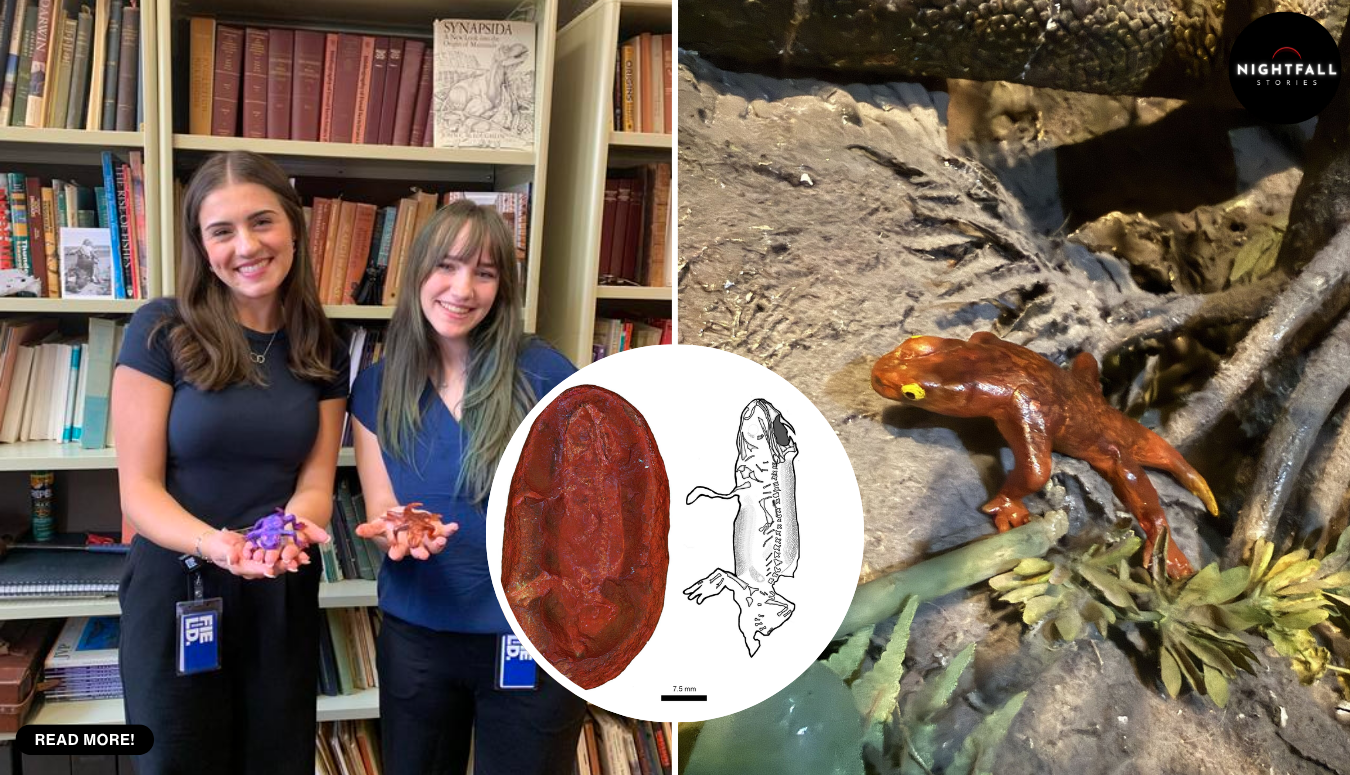
The fossil had been sitting in a drawer at the Field Museum in Chicago under the wrong name, and nobody had looked at it closely enough to notice. It had been collected years earlier at Mazon Creek in Illinois by an amateur fossil hunter, given to the museum, filed as a specimen of a species called Amphibamus grandiceps, and left there. Two undergraduate interns pulled it out, spent a summer working on it, and established that it was not Amphibamus grandiceps at all but an animal science had never described. Which meant they got to name it. Which meant a problem, because there were two of them and only one name.
They solved it the way you would hope. Allison Sefcovic and Payton Kohlberg both went to their mothers for the honour, and it turned out both of their mothers are called Jean. The animal is now Jeanerpeton mazonensis, which reads roughly as Jean’s crawler from Mazon Creek, and the name went into the permanent scientific record when their paper appeared in the Journal of Vertebrate Paleontology. Two mothers with the same name are attached to a 309 million year old proto-amphibian for as long as the name stands, which under the rules of zoological naming means indefinitely.
That is a lovely piece of luck and it is also the smallest interesting thing about this story. The bigger one is how the fossil got into that drawer in the first place, because it did not arrive through a funded expedition or a professional dig. It arrived because somebody who does this for love walked a spoil pile in northern Illinois, picked up a lump of ironstone, cracked it open, found something inside, and eventually handed it to a museum instead of a shelf in a spare room. That is not an accident of this one specimen. That is how the entire Mazon Creek record exists.
Mazon Creek is not a single site. It is a scatter of more than 250 fossil localities across northern Illinois, roughly between the towns of Morris and Essex, about sixty miles southwest of Chicago. Around 309 million years ago, in the Carboniferous, this was a swampy river delta grading into a shallow inland sea, thick with tree ferns and horsetails and the enormous insects that period is famous for. When plants and animals died there, they were buried fast in fine sediment, and iron carbonate cemented around them into hard nodules called concretions. The nodule sealed the body off. What happened next is the reason paleontologists care so much: the soft parts did not simply rot away and leave bone. They left impressions.
That is unusual to the point of being freakish. Most of the fossil record is bone, shell and tooth, the hard parts, and everything that made the animal an animal is gone. Mazon Creek gives up outlines of bodies, the texture of skin, the shape of an eye. Nearly 800 species have come out of those concretions, including the Tully monster, a creature so strange that arguments about what it even was have run for decades and are not settled. It is found nowhere else on Earth.
The study of the place began in the middle of the 1800s, and it began with locals. Natural exposures along the creek and its banks started producing fossils near Braidwood around 1855 and near Coal City a few years later, and the first collectors were farmers and townspeople. Some of their names survive in the literature, Joseph Even, S. S. Strong, J. C. Carr, men who were not scientists and who fed material to the scientists who were. Leo Lesquereux had described 71 species of fossil plants from Mazon Creek by 1866 and 180 by 1870. Amos Worthen and Fielding Meek published a run of papers over the following decades. None of that happens without the people who were actually out there in the mud.
Then came the mine, and the mine changed everything. The Peabody Coal Company ran a strip mine known as Pit 11 near Essex from 1945 to 1974, and stripping coal meant stripping off the fossil-bearing shale above it and dumping it in spoil piles. Peabody let collectors onto those piles. You applied at the mine office on a weekday or found the foreman at the machine shop on a Sunday, and then you walked the heaps looking for nodules of the right shape and colour. This was, for about twenty years, the most productive amateur fossil collecting ground in the world, and the Tully monster came out of it.
The technique those collectors developed is beautifully low technology. You do not smash a concretion, because smashing it tends to destroy whatever is inside. You take it home, soak it, and put it through freeze and thaw cycles, letting water work into the natural seam until the nodule splits itself along the plane of the fossil. Some collectors have buckets going through that cycle for a year. And the odds are not good. Early accounts of Pit 11 talk about a great number of duds, nodules that open on nothing at all. Others produced shapes so indistinct that collectors just called them blobs, and the blobs were only later worked out to be jellyfish.
When the mining stopped, Peabody sold Pit 11 to a utility company that built a nuclear generating station there, and land around the cooling pond was leased to the state as a conservation area where collecting is allowed on a seasonal, permitted basis. The community kept going. The Earth Science Club of Northern Illinois has been the institutional home of that community for generations, and the Field Museum now works with its volunteers directly rather than around them.
That relationship has history behind it. Eugene Stanley Richardson Jr, a Field Museum paleontologist through the Pit 11 decades, made a habit of taking amateur finds seriously, publishing them, and sometimes naming the new species after the person who found it. And the collections themselves came in by the truckload. One collector, Jerry Herdina, left the museum more than 14,000 specimens, nearly all of them from Mazon Creek. A museum drawer holding an undescribed animal is not a sign of neglect so much as a sign of scale. There is far more material in those cabinets than there are people to study it.
Which brings us back to a misfiled fossil and two students with a summer to spend. Sefcovic, who studies at the University of Michigan, and Kohlberg, at the University of Illinois, came in through the museum’s Women in Science internship programme, in the 2025 cohort. The programme takes high school and undergraduate students from the region around the museum, and it is not a shadowing exercise. Interns work in person, full time, Monday to Friday, on a real project with a real output. Past cohorts have georeferenced insect collections, digitised specimens, and trained machine learning to sort beetles. This one described a new species.
Their fossil had been swallowed by what paleontologists call a waste bin taxon. When you have a pile of specimens that all look vaguely similar and nobody has the time to sort out which is which, they get lumped under one existing name, and the pile becomes a kind of holding pen. Amphibamus grandiceps was that pen here. Anything squat and salamander-shaped from Mazon Creek could end up inside it. The label is a placeholder pretending to be an identification, and it can sit unchallenged for a century.
Getting something out of a waste bin taxon is unglamorous work. You prepare the specimen, you photograph it under different lighting to bring out impressions the eye misses, you measure everything, you compare it feature by feature against the animals it has been lumped with and against everything else in the group, and you build the case in the form of a character matrix, a table of anatomical traits that lets you argue formally about where the animal sits. Then you write it up in a form a journal’s reviewers will accept. The postdoctoral researcher Cam So worked with them on that, and the museum’s assistant curator of fossil fishes and early tetrapods, Arjan Mann, ran the lab the work was done in. This was a supervised museum project, not two students alone in a basement, and it is a better story for it.
What they found was worth the summer. In the Jeanerpeton fossil you can see scales along its back, the small belly ribs called gastralia, and impressions where its eyes were. Sefcovic has said that what is really remarkable about Mazon Creek is that it preserves details you almost never get, things like toe pads and the outline of a body. So explained that the team found enough evidence of an anatomically distinct animal to pull Jeanerpeton out of the waste bin and stand it up on its own.
The animal itself was small, squat, somewhere between a frog and a salamander in overall build, living in a hot coastal swamp where the American Midwest is now. It is not an amphibian in the modern sense. It belongs to the broad early group that modern amphibians came out of, which is why the museum has been calling it a proto-amphibian, and the point of describing it properly is that it pushes features we think of as amphibian characteristics back to about 309 million years ago. Soft tissue, not bone, is what made that case possible. Bone alone would have left it in the bin.
Naming is also more procedural than it sounds, and the procedure is what makes it permanent. A new animal name is only valid if it is published in a form the international rules recognise, with a description that distinguishes the animal from its relatives, and with one physical specimen designated as the anchor for the name. That specimen becomes the reference point forever. If anyone in two hundred years wants to argue about what Jeanerpeton mazonensis actually is, the argument has to be settled against that one nodule in a Chicago drawer. This is why getting a specimen out of a waste bin taxon matters beyond tidiness. Until somebody does the work, the animal has no anchor and effectively does not exist as a unit that science can reason about.
It also helps to know what the world around this animal looked like, because it explains why so much of it survived. The Carboniferous is the period that laid down most of the coal humanity has burned, and it did that by growing enormous quantities of plant matter in wet lowlands and then burying it before it could fully decay. Low oxygen in waterlogged sediment is what stopped the rot, and the same conditions that made coal seams made the concretions above them. The mine and the museum are looking at two products of the same process. The coal company was after the seam. What it shovelled aside to reach the seam was the fossil record, and the only reason any of it was saved is that people with no professional stake showed up to carry it away by hand.
There is a wider run of work behind this. Mann and the research associate Jason Pardo published in Science earlier this year on juvenile fossils of embolomeres, crocodile-shaped early tetrapods, from the same deposits, and the finding was that these animals had no tadpole stage and nothing like amphibian metamorphosis. That contradicts an assumption that had stood for a long time about how vertebrates made the move onto land. The specimens were centimetres long. And they came from collectors: Mann named Paul Demkovich, Ben Riegler, Rich Rock and Tom Testa, and said plainly that the discovery would not have been possible without citizen science.
He has also said something that ought to unsettle anyone who assumes the site is worked out, which is that he believes more concretions are still sitting in those spoil piles than have ever been collected. Nearly two centuries in, the best guess is that most of Mazon Creek has not been opened yet.
So there is a chain here, and it is worth naming in full. An amateur collector walked a pile of mine waste and found a nodule. They cracked it, kept it, and gave it away to an institution rather than keeping it as an ornament. A museum accessioned it and filed it, wrongly, and it waited. Two undergraduates were handed a summer and the drawer, and with a postdoc and a curator behind them they worked out that the label was wrong. A journal agreed. And the name that now sits in the permanent record belongs to two women called Jean who did not dig anything up, who as far as the public record shows had nothing to do with paleontology, and whose daughters decided that this was the thing they wanted to do with a once in a lifetime privilege.
The collector’s name is not in any of the public accounts of this species, and that is worth sitting with. The person whose find made the whole thing possible is described only as an amateur collector who donated the specimen. It is entirely possible they are still alive, still in northern Illinois, still cracking nodules, and have no idea that the lump they pulled out of a spoil heap has a name now, and two mothers behind the name.
That is the part that will stay with you. A formal species name is one of the very few things a person can put into the world that does not expire. Papers get superseded. Museums reorganise. Exhibits come down. But once a name is validly published, it is in the nomenclatural record, and the only way it moves is if later researchers decide the animal belongs somewhere else, in which case the species half of the name usually travels with it. Two students had that in their hands for one summer, and they gave it to their mothers.