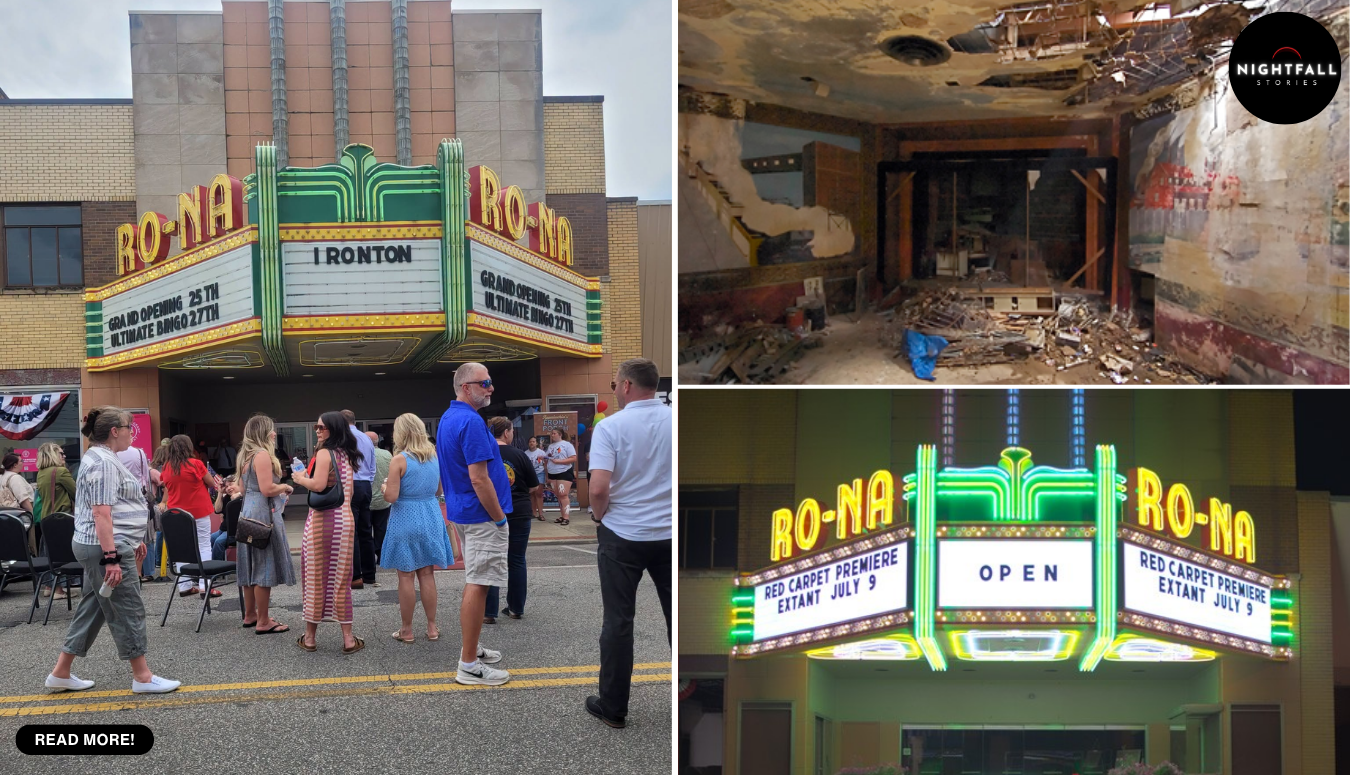
In a river town in southern Ohio there is a long art deco building with glass block columns down its front, and for most of the last half century the only thing happening inside it was decay. The Ro-Na Theatre in Ironton opened in the summer of 1949 with about a thousand seats and a reputation as one of the best rooms of its kind in the state. It closed in 1973. The film on the screen at the end, according to the man who has led the effort to bring the place back, was The Godfather.
Then nothing, for thirty five years. No projector, no audience, a roof that gave up, a building on the main street of a town that had been losing its industry and could not afford a ruin.
The next film to play in that auditorium ran late last September. It was We Are Marshall, it was free, and about eight hundred and fifty people could get in on a first come basis. Between those two screenings sits a story that has almost nothing to do with cinema and everything to do with a small group of people who kept turning up for nearly two decades to work on a building that did not belong to them at the start and did not pay them at any point.
Jeff Mowery, one of the people who has driven it, puts the figure at nineteen years, and says they have spent a lot of time and a lot of blood, sweat and tears in that building. The paperwork is slightly kinder to the calendar than he is. The Hampton family, who owned the Ro-Na, said in the first weeks of 2008 that they wanted to give it away, and the deed passed to the City of Ironton a month later, which makes the formal clock closer to eighteen and a half years, and one report has put it at eighteen. Mowery has been at it long enough that the difference is not worth arguing about. Nearly two decades is the honest description.
What is genuinely unusual about this restoration is how well documented the slow part is, because most stories of this kind skip straight from ruin to ribbon and leave out the years that actually take the years. The Ro-Na’s own timeline is unsparing. The family offered the building in January. The deed transferred in February. In May the city council set a goal of getting a roof on it, which tells you what state the roof was in. Volunteers started clearing the inside out that July. And then the roof, the thing everyone had agreed was urgent, was not removed and rebuilt until July of the following year.
That is the actual rhythm of a volunteer restoration. A year to get to the first structural job, because the money has to be found before the work can start and there is no budget line anywhere for a closed cinema. Then another five years before the next visible milestone, which came in the spring of 2014, when the Ro-Na’s marquee was put back up and lit for the first time since the early 1970s.
Think about what that means as a piece of strategy rather than sentiment. Six years in, with no seats to sell and no film to show, the volunteers spent their money on the one part of the building the whole town could see from the street. It worked, in the way such things work. A lit marquee on a dark block is an argument that something is happening, and you need that argument when you are going back to the same donors and the same council for the eleventh year running.
The building they were arguing for was worth it. Ironton sits on the Ohio River, and when the Ro-Na opened it was a serious room in a working town, streamline moderne with neon and those glass block columns, a single screen with a thousand seats, the kind of house that showed The Ten Commandments and King Kong to a population that had nowhere else to go on a Friday night. When it shut in 1973 nobody demolished it, which is the only reason any of the rest of this was possible. A great many American towns of that size lost the same building in the same decade and have a car park where it was.
There is a thing worth saying about the donation itself, because a gift like that is not straightforwardly a gift. When a family hands over a closed cinema they are handing over a liability: a large uninsurable structure with a failing roof, a tax bill, a facade over a public pavement and no income. The Hamptons gave the town something valuable and something expensive in the same envelope, and the city took it on knowing which of the two it would feel like first. Everything that followed, the council setting a roof goal within months and the volunteers spending that summer carrying rubbish out by hand, is the sound of a town working out what it has just accepted.
Money for that stage does not come in one piece. It comes from raffles, memberships, small foundation grants, sponsored seats, donated labour from local trades and the sort of fundraising where somebody’s uncle has a lift and does not charge for a weekend. It arrives slowly and it is spent immediately, and it produces years in which nothing visible changes. The hardest part of a nineteen year project is not the first year or the last; it is year eleven, when the novelty is gone, the original committee has aged and the building is still not open.
The turn came when the state money arrived. Ohio ran a programme aimed at its Appalachian counties, and the City of Ironton was awarded about 5.28 million dollars under it for a riverfront and downtown scheme, of which roughly 2.7 million dollars was assigned to the Ro-Na itself. That is a different order of magnitude from what volunteers can raise at a fish fry, and it is what turned a saved shell into a usable theatre. The list of what it bought is the least glamorous list imaginable and the most important one: walls, ceilings, a levelled floor, heating and cooling, lighting, lavatories, the balcony, the facade. There was also a 50,000 dollar grant from a telecoms company’s community fund, and that one went to the parts a cinema needs to be a cinema, the screen itself and the digital projection and sound.
Work began in the summer of 2025, with a local firm, Collier Construction, doing the building and an architect, Jake Henderson, who summed up the job in a line worth repeating: the building needed to come up to where the community is now, not the other way around. The plan was to extend the stage, level the floors, add seating and redo the walls, and to be finished inside a year.
The finish line, when it came, came in two parts, and it matters that they are kept separate. In late June of this year the Ro-Na held its ribbon cutting. Rick Jansen of Friends of Ironton, the nonprofit that has held and run the building since 2008, cut the ribbon. Brad Bear ran the event and said the lights were back on, the doors were open and the Ro-Na was once again ready to serve Ironton. The mayor, Sam Cramblit, called the building a symbol of hope and resilience. A state representative, Jason Stephens, said the crowd was watching the old made new again. John Carey, from the state’s Appalachian office, made the point that none of the money would have mattered without the community behind it. School students let off confetti poppers. There were classic cars parked outside and children playing games in the lobby, and at one point Casablanca went up on the new screen.
That was the building being declared open. It was not a film screening, and the distinction is the sort of thing that gets flattened in the retelling. A clip on a screen at a party in June is not a public showing. The first of those came three months later.
The choice of what to show was not left to nostalgia, and it was not left to the volunteers alone. The state’s committee for the national 250th anniversary asked for something with local meaning, and Jansen has said the first thing that came to mind was We Are Marshall. It is not a film about Ironton. It is a film about Marshall University, an hour or so down the same river, and about what happened after 14 November 1970, when a chartered flight bringing the football team home came down near Kenova in West Virginia and seventy five people were killed, among them most of the players, the coaching staff, medical staff and supporters travelling with them. The film is about the years afterwards, and the decision to field a team again.
That is a heavy piece of programming for a reopening, and it was chosen deliberately. In this part of the river valley the crash is not history that happened to somebody else; it is inside living memory and inside a lot of families. Screening that film in a town an hour away, for free, with the doors open at six, is a specific kind of gesture and the organisers were clear about the reason. Jansen said plainly that they wanted younger people in the room who did not know the story, and local football teams were invited for exactly that purpose. Before the film there was a panel, with Mark Snyder, a former head coach at Marshall, and half a dozen of the actors who appeared in the picture. Snyder, who was there, talked about what the restoration meant and about the building’s job of teaching people something.
So on a Thursday evening in late September, more than fifty years after the last time, a film ran on the Ro-Na’s screen. Suzie Hamlin of Friends of Ironton was reported to have been overcome when she saw the room as it now is, which after that long is not surprising. The auditorium seats about eight hundred and fifty now rather than the original thousand, which is what happens when a 1949 house is brought up to modern requirements for access, sightlines and comfort. Fewer seats, better ones.
It is worth being careful about one detail in this story, because it is doing a lot of work and it rests on less than it seems. The Godfather as the last film shown before the doors closed comes from the volunteers’ own account of the building’s history. The Ro-Na’s records confirm that the film played there. That it was the final one is what the people who saved the place have always said, and it is how the local broadcaster reported it. It has the ring of a fact a town keeps rather than a fact a town checks, and it should be read that way: the story Ironton tells about the night the lights went out, entirely plausible, sourced to the people who were there and not to a surviving ticket stub.
The larger question the Ro-Na now has to answer is the one that faces every restored single screen in a small town, and it is not a question about films at all. Nobody drives to a thousand seat house to watch a new release; that battle was lost to the multiplex and then lost again to streaming. What a room like this can do is be the only large indoor space in a small town that is not a church or a school gymnasium. The renovation was designed for that from the start, which is why the money went into a levelled floor and an extended stage and a flexible ground level rather than into rows of fixed seating. Bear described the aim as a cultural arts centre that is also a multi purpose space, and the programme since the reopening has run to concerts and classic films rather than first runs.
That is a more modest ambition than saving a cinema, and a more useful one. The Ro-Na is not going to make money showing movies. It can host a graduation, a touring band, a Christmas show, a free screening for eight hundred and fifty people who did not pay anything to get in, and it can do all of that on a downtown street that badly needs a reason for people to be on it after six in the evening.
What the volunteers actually did, across nineteen years by Mowery’s count, was keep a large building standing through the period when it was worth nothing at all, so that it would still be there when public money finally turned up. That is the whole trick, and it is almost never recognised as a skill. A roof in 2009. A marquee in 2014. Decades of meetings, small grants, clean up days, and the steady work of being the people who did not let it be knocked down.
Then the state wrote a cheque, a phone company paid for the screen, and last September a film about a town rebuilding after the worst thing that ever happened to it played in a room that had been dark since 1973. Nobody planned that echo when the grant applications were being written. It is just what fit, chosen by a committee looking for something local, in the only building in Ironton big enough to hold everyone who wanted to see it.