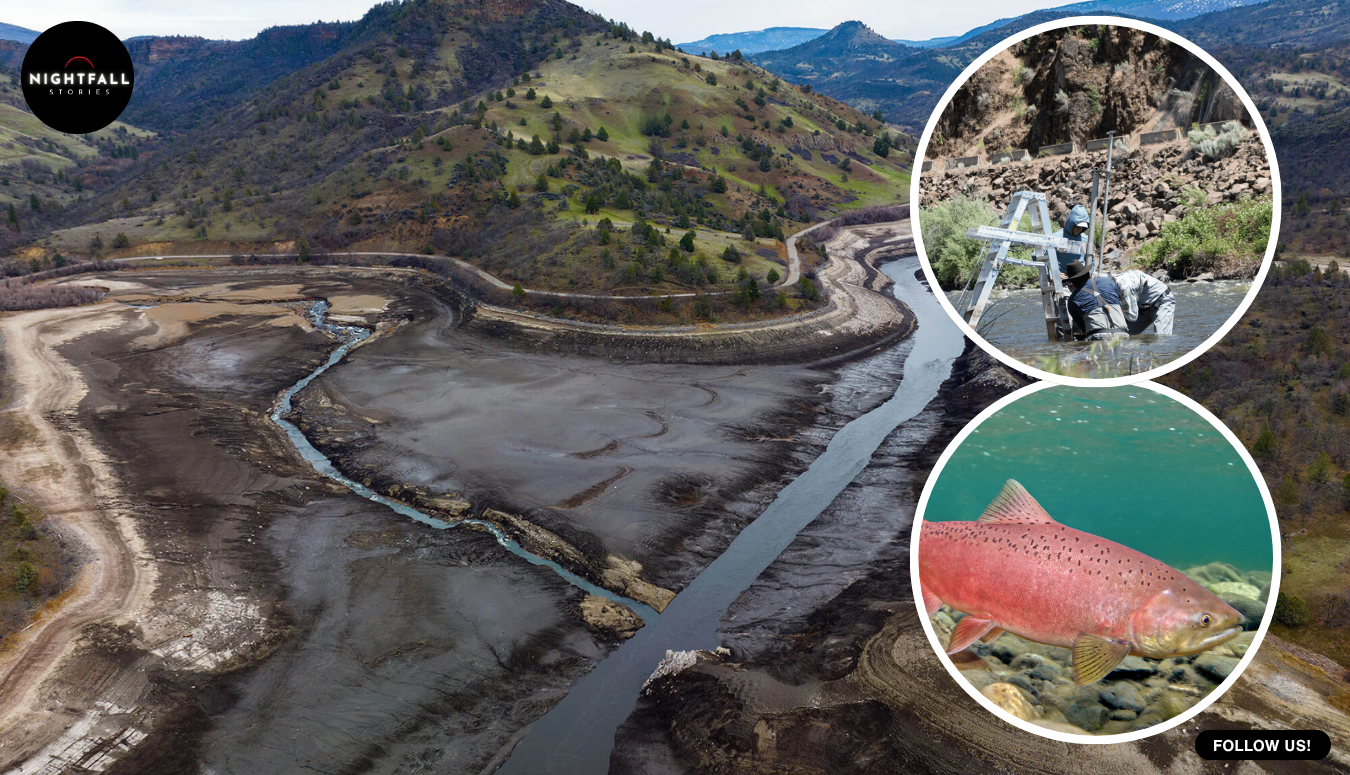
About a hundred metres downstream of where Iron Gate Dam used to stand, a sonar camera sat in the Klamath River through the autumn of 2024 and watched. It did not take pictures in any ordinary sense. A multi beam sonar unit throws high frequency sound into the water and reads what comes back, which means it works in sediment so thick that a camera would see nothing at all, and it can tell you which way a fish is swimming, how long it is, how fast it is going and how far from the bank it passed.
Between the first of October and Christmas Eve that year it counted 7,742 Chinook salmon moving upstream past a place where, for more than a century, no salmon could go. The following autumn the same stretch of river gave up 13,310. Add the two and you get 21,052 fish in two migration seasons, which is where the round figure of twenty thousand that circulated in news coverage actually comes from.
Some of them went a very long way. Fish were documented at Beatty Gap on the Sprague River, at an elevation of about 1,250 metres and more than 580 kilometres from the Pacific, which is the farthest from the ocean that a salmon has ever been recorded in that basin. That is more than 360 river miles inland, uphill, through a fishway, into country where the last salmon anyone saw was seen before the First World War.
And then there is the figure that got the headlines, which is 88 per cent, and it is worth being very careful about what it means, because almost everything written about it has been looser than the paper that produced it.
Damon Goodman, the Shasta Cascade regional director at California Trout, is lead author on the study, published late last year in Scientific Reports. The 88 per cent is a measure of river length, not of fish. The authors took the historically documented extent of Chinook distribution in the upper basin, measured from the furthest upstream historical observation on record downstream to the Iron Gate site, worked out how much of that length is now occupied, and divided one by the other. The answer came to 88 per cent, across roughly 345 kilometres of the Klamath mainstem, the Link River and eleven tributaries combined.
So it is not 88 per cent of the salmon that used to be there. It is not 88 per cent of the whole Klamath basin. It is not a population restored to 88 per cent of anything. It is a statement about geography: of the river length where we have hard evidence salmon once went above the dam sites, almost nine tenths of it now has salmon in it again.
The authors are blunter still about the word they use for it. Recolonisation, in their definition, means movement into and use of habitat following reconnection. It does not mean the establishment of permanent, self sustaining populations. They say so in the paper. They also say what would be needed before anyone could claim that, which is evidence of sustained performance over time, successful reproduction in particular, and a broader ecosystem response. Two years of data is two years of data.
Two seasons is also exactly two seasons, and that matters because the story has a tendency to inflate in the retelling. The dams came out and the fish came back in the two autumn runs that followed. That is remarkable on its own and needs no help. Those two runs represented about 18 per cent and about 19 per cent of the basin wide return in their respective years, which tells you that the upper basin is not yet carrying the bulk of the run, and nobody involved claims it is.
Here is the part of this story that gets told wrong most often, and it is the part that actually explains why there is a river to count fish in.
The four dams, J.C. Boyle, Copco 1, Copco 2 and Iron Gate, did not come out because a conservation nonprofit asked nicely. They came out because tribes in the Klamath basin spent decades fighting for it, in hearings, in courtrooms, in shareholder meetings, in the press and on the river itself. The Yurok, the Karuk, the Hoopa Valley and the Klamath Tribes pushed through administrative processes that outlasted careers. Amy Cordalis, an attorney who represented the Yurok Tribe and now runs the Indigenous conservation group Ridges to Riffles, is one of the names attached to that long effort. The turning point in public opinion came in 2002, when roughly 33,000 adult Chinook died in the lower river in warm, low, crowded water, and tribal members hauled the bodies out by hand in front of cameras. Klamath salmon runs had already fallen by something close to 90 per cent.
The mechanics of actually getting four dams out were their own long grind. The structures belonged to a power utility, and the decisive lever was not a conservation campaign but a relicensing process, because a dam that needs a new federal licence has to prove it can meet modern fish passage requirements, and these four could not do so at anything like a defensible cost. Agreements were signed, collapsed, renegotiated and signed again across more than a decade. A purpose built nonprofit, the Klamath River Renewal Corporation, was created to take ownership of the dams and demolish them, which is a strange and quite modern solution to the problem of who carries the liability for knocking down somebody else’s infrastructure. Its chief executive, Mark Bransom, spent years as the public face of a project that had no precedent at this scale anywhere in the world. Federal regulators gave the final approval, the reservoirs were drawn down, and the last of the concrete came out in the course of 2024. The bill came to around 500 million dollars, carried by utility customers in two states and by the states themselves, with a further 162 million dollars pledged by the federal interior department for restoration work and tens of millions more awarded since.
For the Klamath Tribes in the upper basin, the absence was older and more total. Salmon stopped reaching them around 1909. Their chairman, William Ray Jr, marked the recent return by reaching back to testimony recorded in 1911, in which an elder named Berthe Lotches said that the salmon taken each year from the Sprague River had supplied more than half the food of the people living along it. The Klamath word for those fish is c’yaals, and the tribes do not describe them as a resource. They describe them as relatives.
Which brings us to the author list, because this is where the story stops being a nonprofit press release and becomes something more accurate. The study carries twelve authors, and four of them are tribal scientists, named, as authors and not as acknowledgements. Toz Soto, a fisheries biologist and senior research and policy adviser for the Karuk Tribe, and Alex Corum, also of the Karuk Tribe. Jordan Ortega, who is the anadromous fish specialist with the Klamath Tribes’ Ambodat department. And Oshun O’Rourke of the Yurok Tribe.
They are not passengers on the paper. Ortega is the person who confirmed a radio tagged Chinook in the upper basin in the autumn of 2025, the fish that let the Klamath Tribes say out loud that salmon were back above the dam sites. Ambodat’s monitoring programme runs radio telemetry and passive integrated transponder tagging, visual surveys and the grim, essential work of collecting biological samples from salmon carcasses after they spawn, because a carcass tells you whether a fish actually bred or merely arrived. Barry McCovey Jr, who directs the Yurok Tribe’s fisheries department, has been running crews on this river for years. The Karuk Tribe’s own water quality sampling is the source of one of the most striking numbers in the whole affair: before the dams came out, 58 per cent of samples exceeded public health limits for toxic algae, and after they came out, none did.
That is not background. That is the data.
It is also worth killing one misunderstanding before it spreads, because the paper’s own title uses the word rewilding, and rewilding in most people’s ears means somebody released animals somewhere. Nothing of the kind happened here. No fish were put into the upper Klamath to produce these counts. The dams came out, the river reconnected, and salmon that were already in the system swam up it of their own accord, through a 4.6 metre high fishway at Keno Dam and a stretch of hydraulically awkward water that nobody was confident they would manage. There are hatchery programmes in the basin, including fry releases from Fall Creek, and Soto has publicly criticised the timing of one of those releases as unfavourable, but the fish counted on the sonar were volunteers.
Goodman’s own assessment is that the biological response has been much faster than he, and most of the people working on it, expected. That is a scientist admitting his own forecast was wrong in the pleasant direction, which is rarer than it should be.
Now the harder half, because this is a river, not a fable.
George Pess, a co author who spent years as a federal fisheries scientist and is now science director at the Conservation Angler, has put it about as plainly as it can be put: this is not a magic bullet, and the Klamath still has plenty of problems. In the summer after the second count, an outbreak of the parasite Ceratonova shasta killed hundreds of juvenile Chinook. Snowpack was low that year and water deliveries were cut to below normal spring levels. Spring run Chinook, the ecotype that vanished from the upper river by the 1970s and the one that matters most to the tribes, has not come back, although reconnection at least makes its return conceivable.
Passage above the old dam sites is still imperfect. At Keno Dam, no fall run Chinook were confirmed passing in 2024 at all. The following year a motion sensor camera, which only works in daylight, caught 2,497. At Link River, the figure for that year was 210. Keno Dam does not meet federal or state fish passage standards. Upstream, the endangered suckers of Upper Klamath Lake are still in decline, and the long argument over water for a project that irrigates well over 240,000 acres of farmland has not gone anywhere. Coho, steelhead and Pacific lamprey all appeared in the reconnected river within the first year, and what happens to them next is genuinely unknown.
There are also people in this basin for whom the river is an irrigation supply rather than a fishery, and pretending otherwise would be dishonest. The Klamath Project delivers water to well over 240,000 acres of farmland, and in a low snowpack year every acre foot sent downstream for fish is an acre foot not sent to a field. The Klamath Water Users Association and districts such as the Klamath Drainage District have their own executives making their own arguments, and those arguments did not end when the dams did. Low water in the refuges has its own body count: botulism in Tule Lake National Wildlife Refuge killed well over thirteen thousand birds in a single recent year. Taking the dams out removed one fight from the basin and left the older, harder one exactly where it was.
None of that cancels the 88 per cent. It explains it. Because the most useful thing this study says to every other river with a dam on it is not that salmon are resilient, which everyone already believed and nobody could prove on this scale. It is that for the upper Klamath, the binding constraint turned out to be access. Water quality was bad, disease pressure was real, the climate was against them and the runs were a fraction of what they had been, and still, the moment the concrete was gone, the fish went most of the way back up in two years. The information that told them where to go had survived a hundred years of being unable to act on it.
That is an argument you can take to a licensing hearing. It is also the answer to the question that hangs over every dam removal proposal, which is whether it is worth doing when the river is already in such poor shape. The Klamath was in poor shape. The fish came anyway.
What remains is the counting, and the counting is the point. Somebody has to sit with the sonar footage, frame by frame, and decide what is a Chinook and what is a coho and what is a stick. The team built Bayesian models that classify fish by length and by the timing of their passage, and brought in machine learning help that reached 98.4 per cent accuracy near the bank and about 75 per cent across the full width of the river, roughly doubling the speed of review. The machine learning side came from an unlikely direction. The team leaned on a project called Fisheye, built by researchers out of Caltech, MIT and the University of Massachusetts Amherst as part of the same Visipedia effort that produced iNaturalist and the Merlin bird identification app, which is to say the computer vision lineage behind this salmon count is the same one behind the app that birdwatchers use to identify a song in a hedge. It still needs people. It still needs crews walking tributaries in the cold looking for carcasses, and technicians reading tag detections, and someone from Ambodat standing on the Sprague in October confirming that the signal in the receiver is a fish that started in the ocean.
Those crews were there before the dams came out, counting fish that were not arriving, in a river that had been argued over for a generation. They are the reason there is a baseline to compare any of this to. The headline number belongs to them as much as to anyone, and the honest version of it is narrower and better than the one that travelled: nearly nine tenths of the river they fought to reopen now has salmon moving through it, for the first time in over a century, and the question of whether those salmon stay is one only the next ten autumns can answer.