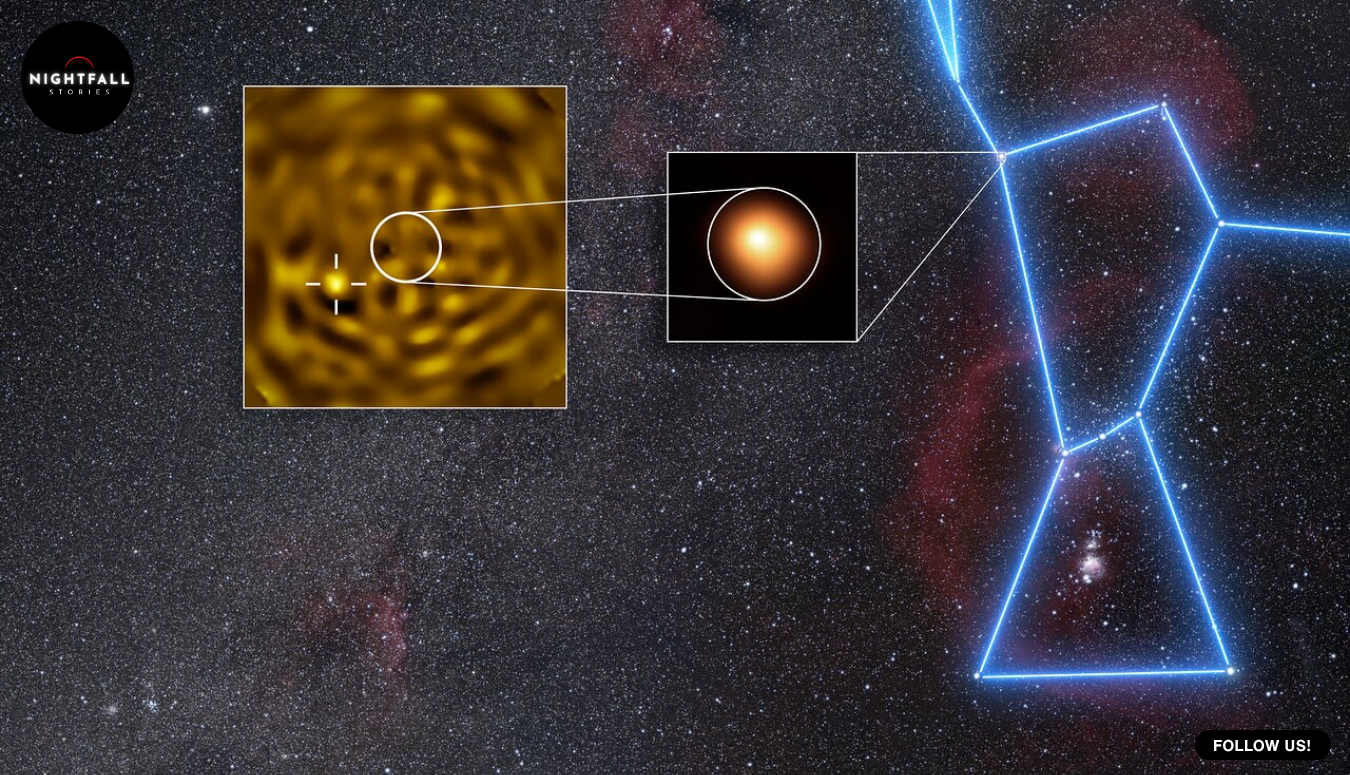
The paper that came out of this is titled, in full, VLT/SPHERE images of the candidate companion of Betelgeuse. Read that word in the middle again. Candidate. It is still there in the title of the paper that supposedly ended a hundred years of argument, and the thirteen authors put it there on purpose.
What they have is genuinely remarkable. Miguel Montargès of LIRA at the Observatoire de Paris led a team that pointed the SPHERE instrument on the European Southern Observatory’s Very Large Telescope at Betelgeuse on two nights, and pulled out of the glare a faint point of light sitting about 52 milliarcseconds from the star, at a brightness ratio of roughly one to twelve hundred. In their own measurement the separation is 52.32 milliarcseconds with an uncertainty of 0.18, and the position angle is 117.12 degrees give or take 0.6. Those are not vague numbers. That is a thing, in a place, measured.
What they do not have, and say they do not have, is proof that the thing is orbiting Betelgeuse rather than sitting behind it. For that you need to see it move. The paper states the condition plainly: formal confirmation that this is a gravitationally bound companion awaits a second observing epoch, and the object should turn up on the opposite side of the primary after half an orbit. Given a minimum orbital period of around six years, that means waiting about three. Until then, candidate.
It is worth understanding how hard even this much was, because the picture is not a picture in the way people usually mean. Betelgeuse is one of the brightest stars in the night sky, visibly orange, sitting on Orion’s shoulder, and it is enormous. The companion is twelve hundred times fainter and sits so close in the sky that from here the gap is about the width of a human hair seen from a kilometre away. Imaging it is the optical equivalent of photographing a candle held next to a floodlight, where the candle is close enough to the floodlight that both land on the same few pixels.
The way around that is to remove the floodlight mathematically. The team used SPHERE’s ZIMPOL camera through two narrow filters, one on a slice of continuum near the hydrogen alpha line and one on the line itself, then ran the data through processing originally built for hunting planets around other stars, subtracting a model of the bright primary and looking at what refused to subtract away. The leftover signal came out at 6.1 standard deviations with one method and 5.1 with another. In this field that is a detection, not a hint, and it is the reason the team is confident about the object even while being careful about the word companion.
The history behind this is the actual story, and it is longer and messier than any announcement captures. The suspicion that Betelgeuse is not alone goes back generations. It appeared in binary star catalogues in the early 1980s and again in the 2000s. In 1986 a group led by Margarita Karovska reported the star as a binary. None of those claims, as this paper notes drily, ever got independent confirmation, and the field moved on without settling anything.
What kept the question alive was a rhythm in the star’s brightness. Betelgeuse varies on a cycle of roughly four hundred days, which is the star pulsating, and that part is uncontroversial. Sitting underneath it is a second, slower variation with a period of around 2,200 days, about six years, and that one has no good explanation in terms of the star itself. Red giants and supergiants commonly show these long secondary periods and nobody has ever properly accounted for them. In 2024 two separate groups, one led by Jared Goldberg and one led by Morgan MacLeod, argued that for Betelgeuse specifically the long period is an orbit, and that if it is, a companion ought to be at its widest apparent separation from the star at a particular moment in late 2024.
That is a prediction with a date on it, which is the kind of thing astronomers find impossible to ignore. Several teams went looking. Several came back empty. Goldberg’s group reported a non-detection in the ultraviolet with the Hubble Space Telescope, and a group led by Anna O’Grady reported a non-detection in X-rays with Chandra. Then a team led by Steve Howell at NASA, using the ‘Alopeke speckle imager on the Gemini North telescope, got something, but only barely: a tentative detection at 1.5 standard deviations, which is weak enough that a careful person would not bet a career on it. Howell’s group published it, called the object Alpha Ori B, nicknamed it Betelbuddy, and estimated it at around one and a half times the mass of the Sun, likely a hot young blue-white star orbiting inside Betelgeuse’s own extended outer atmosphere.
Here is the coincidence that makes this sequence genuinely odd. Howell’s team observed on the ninth of December 2024. Montargès and colleagues observed on the third and the sixth of the same month, three to six days earlier, and did not know what the other group had. Two instruments, two methods, two teams, one week.
That ordering matters more than it sounds, and it is the thing most coverage of this got backwards. The SPHERE images are not a later, second epoch confirming an earlier detection. They are an earlier epoch, taken first, processed and published afterwards. The red circle you see drawn on the published figures marks where Howell’s team found their object, and the SPHERE signal lands inside it. What that gives you is two independent instruments seeing the same thing in the same place in the same week, which is strong. What it does not give you is the one thing a second epoch would give you, which is motion.
Then there is the mass, which is where the numbers need handling carefully. The paper derives a range of 2.6 to 3.1 times the mass of the Sun. The European Southern Observatory’s own announcement rounded that to roughly two to three solar masses, and much of the reporting repeated the line that the companion is heavier than predicted. Both of those statements are defensible and neither is quite the full picture.
More massive than what, is the question. It is heavier than Howell’s estimate of around one and a half solar masses, which is a real and interesting discrepancy between two detections of the same object. It is heavier than the older assumption that any companion would be a modest, roughly solar-mass star, which is the comparison the observatory’s announcement was making. But Goldberg’s 2024 analysis had already predicted something in the two to three solar mass band, and this result sits at the top of that prediction rather than outside it. So the honest version is that one earlier estimate was undershot and another earlier prediction was confirmed at its upper end, which is messier than a surprise but more useful.
And the mass is not a measurement. It is an inference, and the paper is explicit about the chain. The team took the companion’s brightness in their continuum filter, compared it against PHOENIX model atmospheres, assumed the two stars formed together, assumed Betelgeuse itself is somewhere between eight and ten and a half million years old, and read a mass range off pre-main-sequence evolutionary tracks at that age. Change any assumption in that chain and the number moves. Call it a young star of two to three solar masses and you are on solid ground. Call it a measured mass and you are not.
The weakest link in the chain is one astronomers have been complaining about for decades, and the paper says so in almost those words: nobody knows exactly how far away Betelgeuse is. This sounds absurd for one of the most studied stars in the sky, and the reason is the star itself. Distance is normally pinned by parallax, the tiny annual wobble of a star’s apparent position as the Earth moves around the Sun, and that technique assumes your target is a point with a fixed centre. Betelgeuse is not. Its surface is a boiling, blotchy thing with convective cells the size of planetary orbits brightening and fading, which shifts where the centre of light appears to be and corrupts the measurement. The paper works with a distance of about 168 parsecs derived from the star’s own oscillations, with an uncertainty of plus 27 and minus 15, and notes that this distance produces orbital periods consistent with the 2,200 day signal. Which is a satisfying consistency and still an uncertainty of nearly 20 per cent, and distance feeds straight into brightness, and brightness feeds straight into mass.
A separate loose end: the companion’s position angle does not line up with where Betelgeuse’s known rotation axis says it should be, by more than twenty degrees. The authors are relaxed about it, offering two straightforward fixes. The rotation axis may be tilted out of the plane of the sky, or the companion may simply not have reached its widest separation yet on an orbit with a modest tilt. Either resolves it, but nothing in the data picks between them.
One thing this result does help with is the mystery it grew out of. If the six year brightness rhythm were just the companion stirring up dust and periodically blocking light, the numbers do not work; the authors conclude that dust sublimation alone cannot produce the brightness swings actually seen. What is left is dynamics, the companion physically disturbing the supergiant’s vast distended envelope as it goes round. That is a real contribution to a problem that stretches well beyond this one star, since long secondary periods turn up in red giants all over the sky.
Now the part search engines will insist on, so it is worth saying flatly. None of this means Betelgeuse is about to explode. It is a massive star late in its life and it will end as a supernova, and on the timescales astronomers use for stellar evolution that is soon, which in human terms means it could be tens of thousands of years from now. The episode a few years ago that convinced a lot of people otherwise, when the star faded dramatically and the speculation ran well ahead of the evidence, had an entirely undramatic explanation.
There is also a reason to care beyond Betelgeuse itself. Howell’s team noted that if this object is where they think it is, it is the first close-in stellar companion ever detected around a supergiant, orbiting inside the primary’s own bloated outer atmosphere rather than at a comfortable distance from it. That is an unusual place for a star to be. A supergiant’s envelope is enormous and tenuous, more like a very hot atmosphere than a surface, and a second star ploughing through it for millions of years is a situation nobody has had a real example of before. It would make Betelgeuse a laboratory for what happens when a small star is slowly swallowed by a large one, which is a process astronomers believe is common and have very few places to watch.
Montargès imaged that dimming as well, which is the quiet shape of this whole story. The person who photographed the star going dark is the person who then found what may be orbiting it.
That is also, incidentally, the reason the Great Dimming mattered so much at the time. When Betelgeuse faded by more than half its usual brightness a few years ago, enough that the shape of Orion looked wrong to anyone who knew it, the serious question underneath the public excitement was whether the star’s surface was doing something nobody had modelled. The answer turned out to be dust, a huge cloud of it flung off the star and drifting across the line of sight, and the imaging that showed the star’s blotchy, lopsided face while it happened came from the same instrument and the same lead author as the companion images.
His own framing of the result, in the observatory’s announcement, is that it concludes a century-long quest, and that he jumped out of his chair when he saw the processed images. He also said something more revealing, which is that he had honestly not thought they had the sensitivity to see the thing at all, and that they can see it precisely because it is heavier than anyone expected. The detection happened because a prediction was wrong in a helpful direction.
So what is actually settled, and what is not. There is an object, measured in position and brightness, by two instruments within one week, exactly where a model said something should be. It is consistent with a young star of two to three solar masses. That is a lot. Whether it is bound to Betelgeuse or merely in front of it is not settled, by the authors’ own statement, and will not be until somebody looks again and finds it on the other side.
Which means the century of argument has not ended. It has been handed forward, with a far better set of coordinates than anyone had before, to whoever points a telescope at Orion’s shoulder in about three years and checks whether the faint thing has moved.