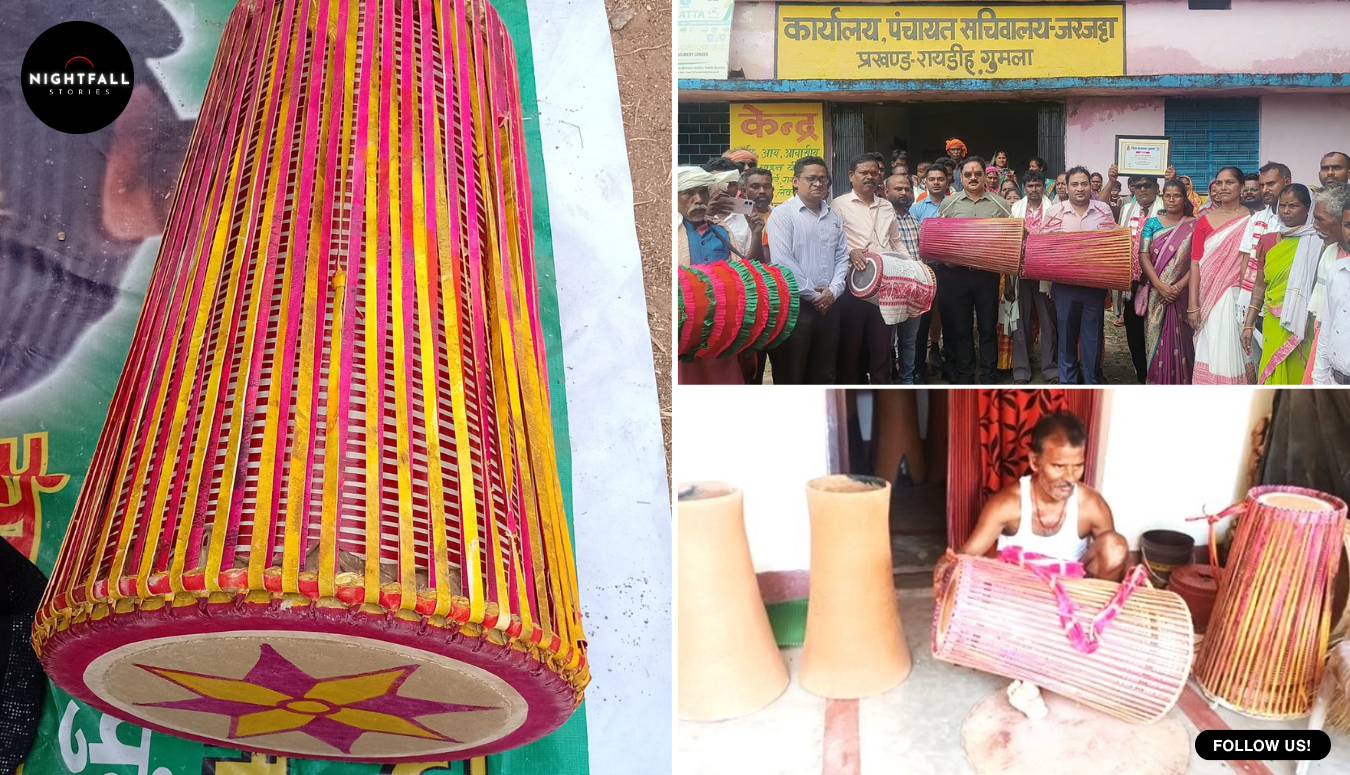
A few days ago, in a government office in Chennai more than a thousand miles from the village in question, a registrar signed off on a name. The name is Mandar of Jharkhand. What it protects is a drum with a body made of fired clay, headed with leather at both ends, built in a village called Jarjatta in Raidih block of Gumla district, where by the district administration’s own count about 25 families have been making them for four generations.
Getting that signature took five years. It took a documentation file assembled by Dr Satydeep Singh, a visiting faculty member at the National University of Study and Research in Law in Ranchi, who began the work around 2020 and lodged the application in 2021 through the Chief Minister’s Small and Cottage Industries Development Board. It took three successive Deputy Commissioners of Gumla, Sushant Gaurav, then Karn Satyarthi, then Dileshwar Mahto, each inheriting a file from a predecessor who had been posted elsewhere. It took anthropology written down nearly a century ago by scholars who were studying something else entirely.
And here is the thing worth sitting with. Read every report of the registration, in every outlet that carried it, and you will find the number 25, the word generations, and the names of the officials. You will not find the name of one person who makes a mandar. The makers are a figure in a document. That absence is not a small detail at the edge of this story. It is close to the centre of it.
Start with what the instrument actually is, because the sound is the reason any of this happened. A mandar is not a drum with a wooden shell. The shell is clay, thrown and shaped and then fired until it is hard enough to hold tension, and it is specifically local clay, the sticky reddish nagda earth that the region’s potters have always worked. Leather goes over both ends and is pulled tight. Both heads are played. And the two heads are not the same, which is the part that makes the instrument interesting rather than merely traditional.
For how that difference is produced, the best reporting available anywhere is not from Jarjatta and is not from the registration period. It is a piece the Hindi daily Ranchi Express published in July 2024, two years before the registry acted, and it is set in Tapkara village, in Torpa block of Khunti district, which is a different district altogether. It should be read as a description of how mandars are made in that part of the region, by the maker that reporter happened to find, and not as a description of Jarjatta or of anything happening this year. With that said plainly, it is the only place the craft is reported properly.
What that report describes is a paste called kharan, red stone ground to powder and mixed with clay, laid onto the leather heads. It goes on thicker on one head than the other. That is the whole trick. The heavier loading drops the pitch and shortens the ring on one end, the lighter loading leaves the other end brighter and more open, and a single player working both hands gets two voices out of one body. The two heads are also not the same size. The report gives roughly 30 inches across on the heavy side and roughly 12 on the light side, which tells you the instrument is less a drum than a pair of them joined at the waist.
The same report sets out three sizes with three names. The muchi mandar runs around two feet. The thongi runs around three. The jaspuria, at around three and a half feet, is the one that travels furthest, turning up not only across Jharkhand but in Chhattisgarh, Odisha and Madhya Pradesh. A single drum takes two to three days of work. None of that is in any of the registration coverage, which is exactly why it is worth going and finding it.
The loading is not a quirk of one village. Weighting a drumhead with a paste to tune it is one of the oldest ideas in the region’s percussion, and it works for a reason that has nothing to do with tradition. Added mass on a membrane pulls its pitch down and damps the higher overtones faster than the low ones, so a heavily loaded head produces a short, dark, definite thud, while a bare or lightly loaded head of smaller diameter rings higher and longer. Put one of each on the same resonating body and you have a drum that can hold down a pulse with one hand and answer itself with the other.
Why clay, rather than wood, is harder to answer with any confidence, and makers tend to answer it the way craftspeople everywhere do, which is that the local earth is the right earth. Fired clay is rigid and it is brittle, so a clay shell does not flex and absorb energy the way a carved wooden one does, and the makers’ claim that the nagda earth gives the instrument a sound no other material gives it is exactly the claim the registration has now written into law. It is also, usefully, the one part of the case that can be checked by ear.
Two people speak in that 2024 piece, and what they say is not triumphant. Samman Ram, who makes drums in Tapkara, said the market had thinned badly. He remembered selling well at the Rath Yatra fairs and said demand had fallen considerably since. Lakshmikant Narayan Badai, a school principal in Torpa who also plays nagpuri music, put the instrument at the foundation of the region’s entire musical life and said no cultural occasion feels finished without it. He also said that the village evenings where people gathered and played, forty or fifty years ago, have simply stopped happening.
So the drum was already in trouble before anybody started filing paperwork about it. That is the condition a geographical indication is supposed to address, and it is worth being precise about what one is, because the phrase gets thrown around as though it were a prize.
It is not a prize. It is a statutory register. A geographical indication is a legal recognition that a particular product’s qualities or reputation are tied to a particular place, and that only producers in that place may sell under the name. It is not owned by a company the way a trademark is. It is a collective right, held on behalf of everyone who makes the thing in the place where the thing is made. Which sounds generous until you consider what it costs to obtain, because the register does not take anybody’s word for it. You have to prove the link. In writing. With evidence a registry examiner will accept.
That is straightforward for a product with an industry behind it and records going back decades. It is very hard for an object made in a village by families who never kept a single document about it, because the tradition’s own memory lives in hands and in festivals, and a registry cannot read either. So the proof has to be assembled out of whatever other people happened to write down.
Which is where the anthropology comes in. The documentation drew on the work of Sarat Chandra Roy and Tarak Chandra Das, researchers who studied music and dance in the Chotanagpur region generations ago and whose descriptions, written for entirely different purposes, became the evidentiary spine of a 21st century legal application. Nobody writing those pages was trying to protect anyone’s livelihood. They were describing what they saw. A century later that description is what let a lawyer argue that the drum had been there long enough to count.
The administrative side of it is almost comically mundane and genuinely admirable. A file sits in a district office. The officer who understood it gets transferred. A new officer arrives, is handed a folder about a drum, and does not drop it. That happens three times. There is no moment of drama anywhere in the sequence, and the whole thing worked because of it.
Where the drum is actually used explains why the state cared at all. The mandar is the instrument of Sarhul, the spring festival that marks the flowering of the sal trees; of Karma, which falls in the monsoon months; and of Sohrai, the harvest and cattle festival. It is what the dances are danced to. Take the mandar out and you do not have a quieter festival, you have no festival, because the dance steps are built on the pattern the two heads make between them. That is the sense in which Badai’s remark about nothing feeling complete is a technical statement rather than a sentimental one.
What the registration will change is a more sober question than the coverage suggests. The real protections are narrow and specific. The name is now reserved, which means drums that look identical but are made elsewhere, from other clay or from other materials entirely, cannot be sold as the Jharkhand article. Buyers who want the real thing have a way of knowing they have it. The district has talked about organising the makers into a producer company, which would let them sell as a group rather than individually at fairs, and about market links beyond the local circuit. All of that is worth having.
But a geographical indication does not create demand. It is a fence, not a field. Plenty of registered products in India have the certificate and still have the same thin market they had before, because nobody built the thing that was supposed to come after. The tag is the beginning of a commercial project, and whether the project happens depends on district officials who will themselves be transferred, and on 25 families deciding it is worth their children’s time to learn a trade that currently pays badly. The register cannot settle that.
There is also the question of who would ever enforce it. A registered geographical indication is a right somebody has to assert, which means noticing that drums are being sold under the name from outside the area, and then doing something about it. In practice that work falls to whoever is organised enough to do it, which is why the producer company idea matters more than the certificate does. Twenty five families with a legal right and no body to exercise it are in much the same position as twenty five families with no legal right at all.
Which brings it back to the names. Across every account of this registration, the makers of the mandar appear as a count. Twenty five families. Four generations. No one is quoted. No one’s hands are described. The only people with names are the ones who handled the paper.
That is partly just how news works when the news is an administrative act, and partly something stranger and more structural. The legal case for a geographical indication is a case about a place. You prove that a village makes a thing, that the village has made it a long time, that the clay from that ground gives the thing a quality no other clay gives it. The argument is deliberately impersonal, because a right held by one named person would be a trademark, and the whole point of this instrument is that it is held by everybody there. The anonymity in the file is not an oversight. It is the shape of the protection.
It still leaves a gap in the public record that nobody has filled, and it is a gap worth filling for an entirely practical reason, not a sentimental one. If the producer company happens, somebody will have to run it. If the market links happen, buyers will want to know whose drum they bought. A craft sells on names. The register has given Jarjatta a protected name for a sound, which is real and took five years and three Deputy Commissioners and a century of borrowed anthropology to achieve.
The thing it has not given anyone yet is a name for the person who lays the paste on thicker on one side than the other, so that one drum can say two things at once. That is the next piece of documentation this story needs, and unlike the first one it would not take five years. It would take an afternoon in the village with a notebook.