The first images came up on a screen on a boat off the coast of Benin, and the man watching them had spent years of his working life imagining this exact view without ever expecting to see it. Coffi Gerard Franck Zinzindohoue, a researcher at the Institut de Recherches Halieutiques et Oceanologiques du Benin in Cotonou, was looking at a seafloor about 54 metres down that his country’s scientific record described, on the only authority available, as dead. It was not dead. It was a garden. Soft corals stood thick enough to hide the rock they were anchored to, and fish moved between them in the low light, the kind of fish that only bother with a reef if the reef is working.
He has described the feeling since as a mixture of excitement and disbelief, which is an unusually honest thing for a scientist to admit about his own data. The disbelief is the part worth sitting with, because it tells you something about how this reef came to be written off in the first place, and about who has been able to go and look at the West African seabed over the last sixty years, and who has not.
The story starts in the early 1960s with a set of surveys that were never really about corals at all. French researchers working the Gulf of Guinea shelf, led in this stretch by Alain Crosnier, were doing the kind of work that governments paid for at the time: finding out where the fish were, and where a trawl could and could not be dragged. Somewhere off Benin and Togo their instruments kept hitting something hard at depths of roughly 52 to 56 metres, running in a line that looked like a barrier. The historical reports suggested the structure might extend something like 40 kilometres parallel to the coast. They recorded it as a coral reef barrier, noted it, and moved on with the assumption that it was dead.
That assumption was not lazy, exactly. It was the product of what the survey was for. A fisheries survey wants to know whether a given patch of seabed is hard or soft, snagging or clear. It has no particular reason to establish whether the hard thing down there is living tissue or the skeleton of something that died a long time ago, and in the early 1960s, at that depth, there was almost no practical way to find out. Nobody was going to put a diver down to 54 metres on a routine fisheries cruise. There were no drones. There were no cameras that could be lowered with any confidence of coming back with a usable picture. So the reef went into the file as probably dead, and the file sat there.
Then, for about sixty years, nobody went back.
Not nobody in a dramatic sense. Benin has a marine research institute, and that institute has been doing work on its waters throughout. But no coral research targeted the Benin continental shelf after those investigations of 1963 and 1964, which meant that the composition and distribution of whatever was living out there stayed undocumented. A line in an old report hardened into a fact. The country’s only known reef structure became a thing everyone had heard about and nobody had seen.
Part of why has to do with depth, and this is the piece that most people miss. The reef sits in what marine scientists call the mesophotic zone, the band below the bright shallows where light is present but thin. Zinzindohoue describes it as living deeper than the familiar shallow reefs, in a place where light is much more limited, and he makes a point that changes how you should picture it: a mesophotic system does not necessarily form one continuous wall of coral. It can be patchy, scattered, a run of separate communities spread across the seabed rather than a single structure you could swim along.
Fifty metres plus is an awkward depth for science. It is too deep for the easy recreational and research diving that has mapped shallow reefs around the world in exhaustive detail, where a team can be in the water within minutes of anchoring and back up with samples before lunch. Working safely at that depth means technical diving, specialised gas mixtures, decompression planning, a support team and a budget. At the same time it is far too shallow to interest the deep-sea expeditions that bring crewed submersibles and remotely operated vehicles with robotic arms to the continental slope and the abyssal plain. The mesophotic band falls between the two funding worlds, globally, and in a region where marine research money is thin to begin with, falling between two funding worlds means falling out of the schedule entirely.
What finally changed was not the question. The question had been sitting there in plain sight since 1964. What changed was the instrument.
Zinzindohoue’s team ran modern side-scan sonar over the suspect ground, covering a cumulative 11.5 kilometres of transects, which is a small amount of seabed and he says so himself. Sonar at this stage is a filter rather than an answer. It tells you where the hard, structured, reef-shaped things are, and it narrowed the search to two spatially separate zones that carried the right acoustic signature. He has said that the campaign up to this point was not easy, a run of long days at sea, technical problems and a great deal of uncertainty, and that the moment the sonar started throwing up shapes that could plausibly be reef was the moment the thing started to feel possible.
There is a wider reason people have started caring about this depth band in the last decade or so. Shallow reefs are the ones in trouble, bleaching in warm water years and taking the brunt of coastal pollution and physical damage, and researchers have spent a long time asking whether the communities sitting just below them are buffered enough by depth to act as some kind of reserve. The evidence on that is mixed and contested, and nobody serious treats mesophotic reefs as a guaranteed backup copy of the shallows. But it does mean that every one of these systems that gets found and described adds a data point to an argument that matters, and that a stretch of West African shelf with no description at all was a hole in the picture rather than a curiosity.
Then they put eyes down. An underwater drone went in first, followed by the Deep Sea Camera System built by the National Geographic Society’s Exploration Technology Lab, a lowered rig designed to be dropped onto a target and left to film. Suddenly, as he puts it, they could actually see the seafloor.
The camera system is worth a word, because it is the sort of kit that quietly decides which questions get answered. A lowered deep-sea camera rig is cheap compared with a crewed submersible, needs no pilot, and can be worked from a boat that is not a dedicated research vessel. It is the difference between a survey that needs an international expedition and one that a national institute can actually run.
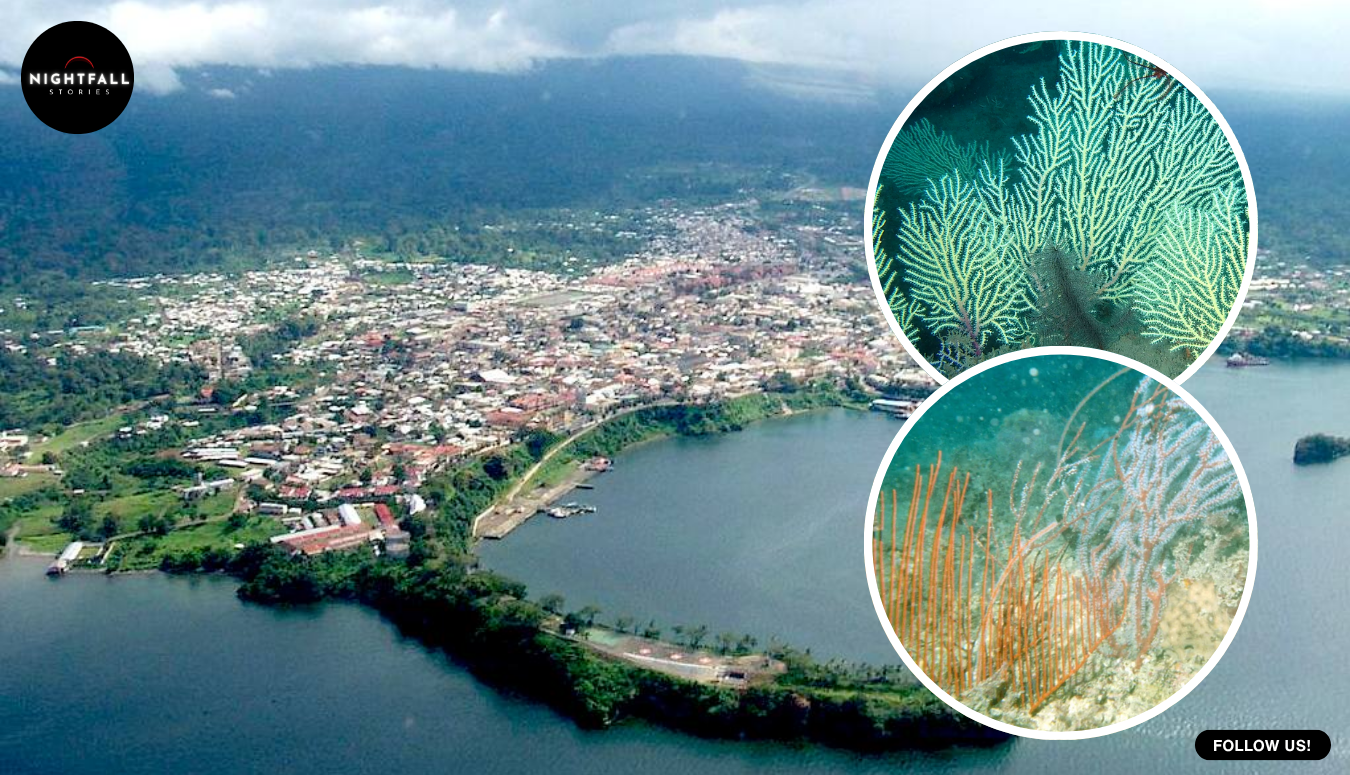
What came back was a dense coral garden dominated by octocorals, the soft corals that bend in the current rather than building the stony architecture people picture when they hear the word reef. The team documented at least six octocoral morphotypes along with two black coral taxa, plus an associated crinoid, a feathery relative of the starfish that perches on high ground and filters the water going past. The corals were growing on sub-angular blocks of rock, consolidated hard substrate that gives a soft coral something to hold onto, which is exactly the kind of snagging, trawl-wrecking surface a fisheries survey would have flagged sixty years earlier without ever asking what was living on it.
And there were fish. Eight species, photographed on the reef and named in the paper: the robust butterflyfish Chaetodon robustus, the Monrovia doctorfish Acanthurus monroviae, the golden African snapper Lutjanus fulgens, the Guinean angelfish Holacanthus africanus, the blackbar soldierfish Myripristis jacobus, the West African goatfish Pseudupeneus prayensis, and two damselfish, Chromis limbata and Chromis cadenati. Several of them were clustered at the base of one of those rocky blocks in a mixed-species group, which is what fish do on a reef that has food and shelter on it.
That is the finding, published earlier this year in Frontiers in Marine Science after review, and the team states it as the first confirmed record of a living mesophotic coral ecosystem on the continental shelf of the Gulf of Guinea.
Now the part that a lot of coverage has skipped, and that Zinzindohoue and his colleagues put in writing themselves.
This is not a reef that came back from the dead. It cannot be, because nobody ever established that it was dead. The paper is explicit that whether the present observations reflect coral communities that have simply persisted down there all along, or changes in conditions since the 1960s, cannot be determined from the data available. Both readings are open. Either the corals were alive in 1964 and were recorded as dead by a survey that had no way of checking, or something died and something else grew. The honest version of this story is narrower than a resurrection and, read properly, more uncomfortable: a reef was written off without being looked at, and then sixty years later somebody looked.
Nor is the reef uniformly thriving. One of the published photographs shows a dead octocoral colony with hydroids and tube-building serpulid worms colonising it after death, which is an ordinary thing to find on any reef but is worth saying out loud in a story that is otherwise about abundance. Things die down there too.
The species names also come with a caveat the team flags clearly: because no physical samples were collected, the identifications remain provisional. Everything was done by camera. Visual identification of octocorals in particular is genuinely hard, and in a region this poorly surveyed there is a real chance that something on those rocks does not yet have a name in the literature at all. The paper is equally careful about the apparent scarcity of some groups, noting that whether that reflects a real ecological pattern or simply the limits of how they sampled remains an open question.
So what you have is not a tidy headline. You have a confirmed living mesophotic coral ecosystem where the record said there was nothing, described from images, with the taxonomy unfinished and the history unresolved. For a first look at a place nobody had looked at in six decades, that is about as much as anyone could expect, and the willingness to say it plainly is part of why the result is credible.
It is worth looking at the author list, because it explains how this got done. Zinzindohoue is the lead author and the survey lead, and he worked with three colleagues from his own institute in Cotonou: Houangninan Midinoudewa, Bola-Nle Christelle Akonde and Zacharie Sohou. Beyond that the names come from the Alfred Wegener Institute in Bremerhaven, GEOMAR in Kiel, the Faculty of Engineering at the University of Porto, and the National Geographic Society in Washington. That is a Beninese-led survey of Beninese waters, running on instruments and expertise assembled from four countries.
The argument underneath that is the one the paper gestures at and Zinzindohoue makes directly. He thinks what they found is probably not an exception. He thinks it is a reflection of how little is still known about coastal waters in West Africa and in plenty of other places, and he puts the question bluntly: if a reef could be found again after sixty years, how many others are sitting undocumented or simply forgotten? He is careful not to oversell it. He does not assume reefs are everywhere, and he says each one has to be confirmed, because without going back into the field everyone is just guessing.
That is the uncomfortable thought in all this. The reason this reef spent sixty years as a probably-dead line in an old report was not that the science was impossible or the question uninteresting. It was that the equipment needed to answer it, and the funding to put that equipment on a boat, were not available to the people whose coastline it was. The gap was never curiosity. It was access.
What Zinzindohoue says he wants next is not a press cycle. It is a proper scientific diving and sampling programme, back at the same site, with divers in the water and physical coral samples coming up, because that is the only way the provisional names become real ones. He notes that the historical reports pointed to a possible barrier running around 40 kilometres along the coast, and his team surveyed a small section of it with a limited number of visual transects. Almost all of it is still unexamined.
The part of this he seems most interested in is not the species count at all. It is the reef’s history, and what a structure like that can tell you about how the ocean in that region has changed over time, the way a stand of old coral holds a record of the water it grew in. He has compared it to opening an archive that had been sitting there for a very long time and reading the first page.
Which is roughly where the matter stands. One researcher, a borrowed camera system, 11.5 kilometres of sonar, and a country that can now say something true about its own reef instead of repeating somebody else’s guess.