Category: News

  • Five men vanished with their trawler in 1980, and the reason nobody found them was hiding in a buoy number

    Five men vanished with their trawler in 1980, and the reason nobody found them was hiding in a buoy number

    The paperwork was right the whole time. That is the part of this story that takes a moment to sit with. When a Belgian fishing boat called the Z.592 Hosanna disappeared in the Dover Strait in the winter of 1980 with five men aboard, the people who searched for her wrote down where they looked and what they looked near, and what they wrote down was accurate. It stayed accurate. It is still accurate now. And for forty six years it sent everybody who read it to the wrong patch of sea, because two years after the boat was lost, somebody changed the labels on the water.

    The boat was found this year. She had actually been sitting on the seabed off Dover for decades, on charts, known to divers as an unidentified wreck, which is a category the English Channel has a great many of. What had been lost was not her position. It was her name. A Dutch maritime researcher and a British wreck researcher worked out why the two had come apart, divers went down twice over the summer and into the autumn, and the Hosanna now has her name back. Nobody is going to be brought up from her. That was decided early and it is not going to change.

    Start with the boat, because she was an ordinary working vessel and that matters. The Hosanna was built in Zeebrugge in 1965, twenty five metres of steel, a motor cutter of the sort that spent its life dragging gear across the southern North Sea. By the end of the 1970s she had been sold to a British company, Minerva Fisheries, and in the winter of 1980 she left Plymouth bound for the Netherlands with five people on board. She never arrived. No distress call was ever transmitted. Nothing was heard from her at all.

    Two days or so after she sailed, a liferaft marked Z.592 was recovered. Accounts of where differ, which is itself a small illustration of how thin the record is: British reporting places it near the Goodwin Sands off the Kent coast, while a Belgian regional broadcaster places it off the French coast near Cap Gris Nez. Either way it was the only hard thing anybody had. A search followed. It found nothing else. No wreckage came ashore, no bodies were recovered, and the file stayed open in two countries.

    The five men were skipper Germain Ackx, his son Piet Ackx, Hector Snauwaert, Pieter Guijt, and Pieter Albertus Guijt, who was Pieter Guijt’s nephew and who was fourteen. Three of the crew came from Knokke-Heist in Belgium and two from Scheveningen in the Netherlands, according to Flemish public broadcasting, though the English language reporting gives the five names without assigning nationalities to them, so the obvious pairing is better left unstated than printed as fact. Pieter Guijt was thirty three. Those are the facts about the crew that are in the record, and they are where the record stops.

    What filled the gap instead was rumour, and the rumours were unusually persistent. Over the years there were unconfirmed reports that the Hosanna had been seen off Morocco, off Spain, off Greece. The boat had a history that fed that sort of talk. She had reportedly been linked to smuggling and to running supplies out to the offshore ship of the pirate radio station Radio Mi Amigo, which broadcast illegally from the North Sea, and British marine police had taken an interest in her before she was lost. Once a vessel has that reputation, a disappearance without wreckage invites the theory that there was no disappearance at all, only a boat that went somewhere else under another name. Families who have no answer get offered a great many answers of that kind, and none of them is any use.

    Now the buoy, which is the actual heart of this.

    The Dover Strait is the narrowest point of the Channel and one of the busiest stretches of water anywhere on the planet. Something like four hundred commercial movements a day pass through it, crossing ferries cutting across the grain of the through traffic. To stop that turning into a permanent collision risk, the strait is run as a traffic separation scheme, which is essentially a motorway laid out on the sea: lanes going one way, lanes going the other, and a separation zone down the middle that nobody is supposed to be in. Because water takes no paint, the lanes are marked by buoys, and the buoys in the middle of that strait carry names in a series beginning with the letters CS, for Channel Separation.

    In 1980 the people searching for the Hosanna did what anybody would do and described their search area in relation to the nearest fixed thing they could name. Their records refer repeatedly to the buoy CS2. That was a perfectly sensible way to write it down. A buoy is a known object in a known place, which makes it a better reference than a string of coordinates that can be mistyped.

    Then, in 1982, the Dover Strait routing was reorganised. New traffic separation arrangements came in, the lanes shifted, and the marks that defined them were repositioned and renumbered. The buoy that is called CS2 today is not in the place where the buoy called CS2 sat in 1980. Same name, different water.

    Follow what that does to the search. A record that says the search concentrated near CS2 remains a true record of what happened. But anybody who picks it up afterwards and plots it, naturally and correctly, against a modern chart will put a mark in the place where CS2 now is. They will then look there, find nothing, and conclude that the record is unreliable or that the boat is somewhere else entirely. The error is not in the document and it is not in the reader. It sits in the gap between them, created by a change neither of them made.

    Think of a house number on a street that was later renumbered. A letter addressed to number twelve in 1979 was correctly addressed. Deliver it in 1985, after the council has run the numbers the other way, and it goes to the wrong door, and the person who finds it there has no reason to suspect the address was ever right. Nobody is wrong. The letter still ends up in the wrong hands. That is the whole mechanism, and it is why a search can be conducted by competent people with accurate paperwork and still fail for nearly half a century.

    There is a second reason the mistake was so durable. A buoy number feels like a permanent fact. Coordinates look provisional, something you check and re-check, but a named mark on a chart reads as a landmark, and landmarks are the things you trust in order to doubt everything else. So when the plotted position produced nothing, the reasonable conclusion was that the 1980 search had been loose or that the liferaft had drifted much further than anyone thought, and the search widened outwards from a point that was never the right point to begin with. Every expansion of the area made the real site relatively less likely to be covered. The further you look from the wrong centre, the more sea you have to rule out.

    It also helps to remember what sort of record this was. These were not scientific survey logs. They were the working notes of a 1980 search for a small fishing boat, written quickly by people who expected to be read within days, not in forty six years. Nobody writing them had any reason to imagine the reference frame itself would be rebuilt around them. There is no annotation to catch, no footnote saying that CS2 means the old CS2. The only way to find the problem is to already suspect that a label can move, and then to go and check the history of the labels, which is archive work rather than search work and belongs to a completely different trade.

    Mark Lewis, the British wreck researcher who worked through the historical material, has described the task in almost exactly those terms. The job, as he put it, was to take records written in 1980, work out what they actually meant geographically, and then compare that against what could be seen underwater. Once the historic changes to the Dover Strait buoy system were understood, he said, the geography of the case started to make a great deal more sense. On the Dutch side the research ran through Cees Meeldijk, a maritime researcher working with Stichting Onderzoek Maritieme Vermissen, a foundation that does nothing except investigate people lost at sea and whose name appears in some reporting with a slight spelling variation. The foundation went back through the archive material, reinterpreted it, and concluded that the search area had to be off Dover after all.

    Which brought everybody to a wreck that was already on the chart and had been for years, sitting there with no name attached, because the one thing that would have settled it was gone. The Hosanna lies upright. Her working deck is at roughly forty seven metres and the seabed beneath her runs towards fifty two, though one Dutch account puts the depth at nearer fifty five. Her wheelhouse is no longer standing. On a fishing boat the wheelhouse is where the obvious identifying features live, which is precisely why identifying her needed archive research rather than a diver with a torch reading a name off a plate.

    Forty seven metres is not recreational diving. It is technical diving, with mixed gas, planned decompression and a hard limit on how long anyone can usefully stay. Doing it in the middle of the world’s busiest shipping lane is a separate problem again, and a regulatory one. Permission to dive the site had previously been refused, according to the Belgian federal police missing persons unit, Cel Vermiste Personen, whose Gerry Van Loock has spoken publicly about the case. An exemption was eventually granted, which is the only reason any of this happened.

    And the lane itself is the reason permission is not casually given. Suspending a diving operation in the middle of the Dover Strait means putting a boat with divers in the water in a corridor that large ships cannot swerve in, cannot stop in and are legally required to keep moving through. A dive boat on station is a hazard to navigation and a hazard to itself. That is why the refusal makes sense and why the exemption was the hinge the whole thing turned on: no exemption, no dive, no identification, regardless of how good the archive work had been.

    The first dive went in during August, from a charter boat called the Maverick operated by Mutiny Diving, a technical diving outfit based in Dover. The team filmed the structure. The second went in late September from a vessel called the Renegade, and this time members of the Guijt family were aboard on the surface while the divers worked below, along with a Dutch television crew. Afterwards the family put flowers on the water above the wreck.

    What actually clinched the identification was the winch. Fishing boats are individual in their gear, and the winch on the wreck was compared against old photographs of the Hosanna until, as Meeldijk put it, it was clear that it really was her. A handful of items were brought up as well, including a radio with Oostende written on it, the Belgian port the boat worked out of in her early life.

    There is an honest caveat to put plainly rather than bury. The full underwater imagery, the video and the specific identifying features have deliberately not been published. A documentary is in production with the Dutch public broadcaster EO, reportedly produced by Mary Kragtwijk and expected to air in 2027, and the material is being held back until it is finished. That means the central claim here rests on the assertion of the divers and the researchers rather than on evidence anyone else can examine, and it is being withheld for a commercial reason. The families have been told, and a national police unit is treating the identification as real, which is not nothing. But it has not been shown.

    The cause of the sinking is the other place to be careful. In the English language reporting it is simply undetermined, and the investigators say they hope further examination of the wreck and the archives may yet answer it. The Dutch side has gone further in public. Radar at the time of the disappearance is said to have shown the echoes of two vessels, and from that it has long been assumed the Hosanna was run down. Meeldijk has said the underwater images make it clear the boat suffered a collision while she was crossing the strait, and that she was probably struck in dense fog by a large cargo ship, with a substantial dent and tear visible in one side of the hull. That is an attributed assessment from the researcher who has seen the footage, not a finding by any investigating authority, and it should be read that way. Nobody has named another ship and nobody is likely to.

    What will not happen is any recovery. The hull is filled with silt and sand, which makes going inside it too dangerous for divers, and so no remains will be brought up and no identification by DNA is possible. The site is being treated as what it is, a sailor’s grave, and the boat stays where she is. Relatives in the Netherlands had been kept informed by the foundation for years. In Belgium the federal missing persons unit has gone back to the families in Knokke-Heist with the news.

    So this ends somewhere strange. Five families now know where. They are not going to be told why by any official process, they are not getting anyone back, and nothing is going to be raised from the seabed off Dover. The answer they have is a position and a name, after forty six years of neither.

    And the thing worth carrying away from it is smaller and stranger than a shipwreck. Every search that failed was conducted properly. The 1980 searchers wrote down the truth. Everyone who came after read it faithfully. The failure was not in the record and not in the reading but in the two years between them, when a shipping lane was tidied up and a buoy quietly took its name to a different piece of water. The document never stopped being right. The world underneath it moved.
  • Five divers had twelve days before the pipeline came, and what they found on the Baltic seabed made the pipe move

    Five divers had twelve days before the pipeline came, and what they found on the Baltic seabed made the pipe move

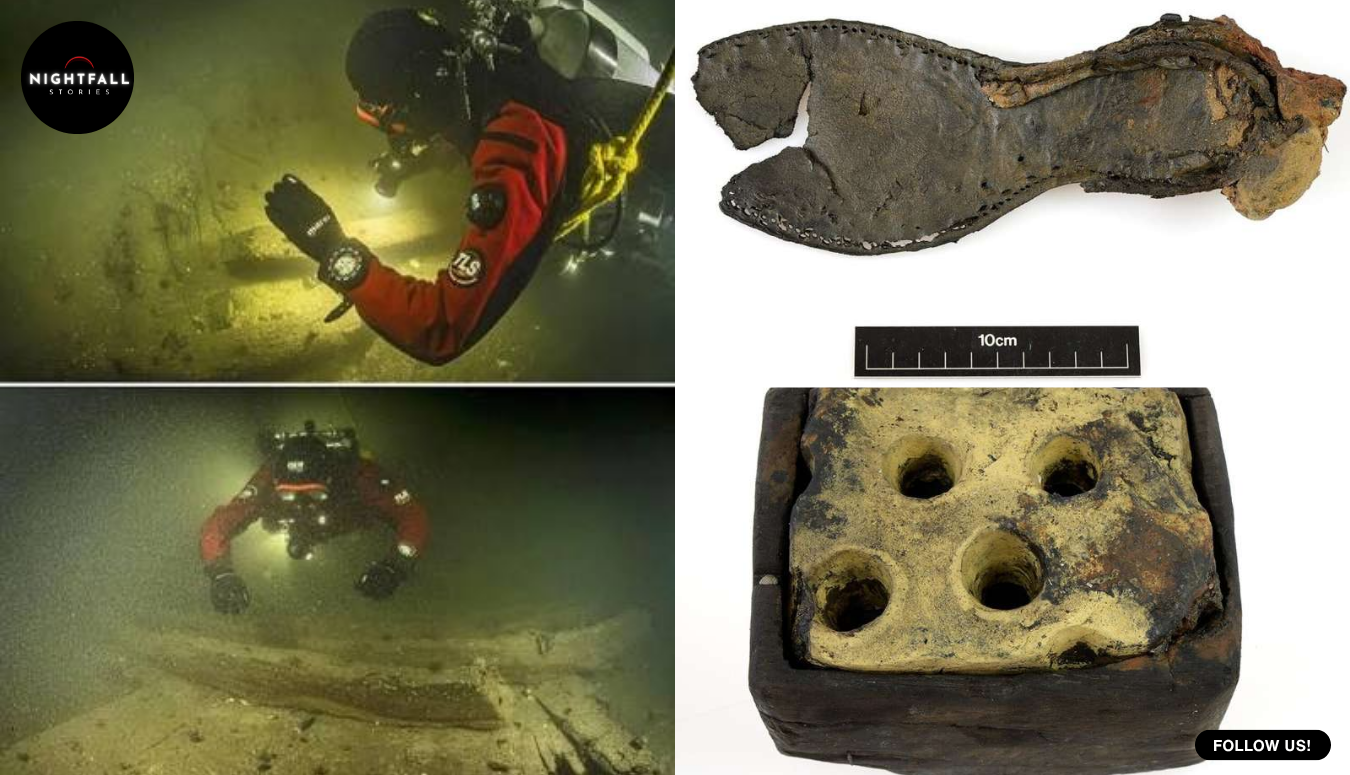
    The object was about seven and a half metres under the surface of the Bay of Greifswald, in the shallow, silty, half-fresh water off Germany’s Baltic coast, and nobody surveying the seabed that year could say what it was. It showed up where it was least convenient: directly on the planned route of a subsea gas pipeline that was about to be laid across the bay.

    That is how most underwater archaeology actually begins. Not with a legend or a treasure map, but with an engineering survey finding a shape it cannot explain and somebody having to go and look before the machines arrive.

    The somebody, in this case, was Michal Grabowski, an underwater archaeologist at the University of Warsaw, and the first thing worth knowing about what he did is the arithmetic of it. Five divers. Twenty-two dives. Twelve days. That is not a research season. That is a rescue, run against a construction schedule that was not going to wait, in water where you often cannot see your own hands.

    What came up was not gold. It was two shoe soles. A strip of leather with stitching still in it. Wooden blocks from a ship’s rigging tackle. Two anchors, one of them badly corroded. Rope. Barrel staves. A hollowed-out oak log that the team thinks was probably a bilge pump. The handle of a carpenter’s hand drill. Bones from a pig, and from a sheep or a goat. Loose timbers and ribs scattered out of the hull. And one object nobody has a good parallel for: a clay tile with holes punched through it, set into a block of wood, which the archaeologists suggest may have been somebody’s improvised rig for sharpening drill bits or chisels.

    More than sixty objects in all, out of twelve days of work. Tree-ring dating put the felling of the ship’s timber somewhere between 1626 and 1639. Some of the wood is charred, and nobody will say why.

    And after all of it, the ship has no name. It is not in a register. Nobody has matched it to a loss, an owner, a cargo or a port. The one thing twenty-two dives did not buy was an identification.

    Then the pipeline route was changed to go around it.

    That last fact is the reason this is a story and not a catalogue. A gas pipeline, part of the infrastructure built at speed when Europe was scrambling to replace Russian pipeline gas, got bent around a four-hundred-year-old wooden boat that nobody can identify, because twelve days of diving produced an argument that the thing on the seabed mattered more than a straight line did. The wreck was then covered over with sandbags and left where it lies.

    Here is what is genuinely missing from that ending, and it is worth saying out loud rather than papering over: nobody is named as the person who made that call. Not in the published report’s press cycle, not in the English coverage, not in the German coverage. Every account says some version of the same passive sentence, that the route of the pipeline was adapted to protect the wreck. Who signed it, on what date, against what objection, at what cost, is not in the public record. The decision is real and the decision is unattributed.

    There are only two places that answer lives. The first is the state heritage office for the region, the Landesamt fur Kultur und Denkmalpflege Mecklenburg-Vorpommern, which is the authority for archaeological finds on that seabed, is co-credited on the survey mapping, and is the body whose assessment would have carried legal weight with a construction consent. The second is the pipeline’s operator, the gas network company Gascade, which laid the line and would hold the engineering change order, the one document that would actually show the reroute as a decision with a date and a signature on it. Anyone who wants to finish this story properly asks those two.

    The pipeline itself is identifiable, and it helps to know what it was for, because it sets the clock. It runs roughly fifty kilometres from a liquefied natural gas import terminal at Mukran, on the island of Rugen, across the water to the established gas hub at Lubmin on the mainland. The gas arrives by ship as a liquid, is turned back into gas, and goes into that pipe and then into the European grid. Subsea laying across the bay began in the autumn of the year the wreck was found, and the two halves of the line were welded together and set down on the seabed early the following year. The project was contentious for reasons that had nothing to do with archaeology: the Bay of Greifswald is a nursery where Baltic herring spawn, and environmental groups fought the route hard.

    So the window the divers had was not a bureaucratic formality. The pipe was coming that same season. Twelve days was what the calendar allowed, and twenty-two dives in twelve days is what you do when the alternative is that nobody ever knows what was down there.

    Grabowski’s own explanation of why he took it on is almost comically unscientific, and better for it. He had no idea what the thing was, and he wanted to solve the mystery. That is the whole motive. There was no reason to expect anything remarkable. Shallow Baltic water near a working coastline is full of unremarkable debris, and the probability on any given survey anomaly is that it turns out to be rubble, a sunken barge or a lost fishing net. He went anyway.

    What he found instead was a vessel built in a way that should not quite have existed when its timber was cut. The hull is clinker-built, which means the planks overlap each other like the boards of a fence rather than meeting edge to edge. It is the construction of Viking ships and medieval northern European boats. By the 1620s and 1630s, serious shipbuilding across much of Europe had moved to carvel construction, with planks butted flush over an internal frame, because it scales up better and takes gunports and heavy rigging more happily. A clinker hull in that date window is late. It points either to a conservative local builder working in an older tradition because that is what the region’s shipwrights knew, or to a smaller working craft of a type that simply never needed the newer method. The planks here are fastened with iron nails and the seams are sealed with a mixture of tar and animal hair, which is a very old recipe and a very effective one.

    The surviving section of hull is only about seven and a half metres long, which is not the length of the ship. It is the length of what is left.

    Then there is the date range, 1626 to 1639, and the temptation that comes with it. Those years sit inside the Thirty Years War, and the coast around Greifswald was directly in it. Imperial forces held the town, Swedish forces took it, the region was occupied and fought over and taxed into the ground, and Baltic sea traffic was carrying troops and supplies for one side or another throughout. A ship built in that window and lost in that water, with charred timbers, practically writes its own dramatic caption.

    The archaeologists have refused to write it, and that refusal is the most professional thing in the whole report. Charring tells you that wood met fire at some point. It does not tell you when, or whether the fire had anything to do with the ship going down. Timbers can burn in a galley accident that the crew puts out. They can burn in a fire years before the loss and be reused. They can burn in a vessel that is already a wreck. Nobody involved has said the ship burned and sank, and the honest summary is the one they give: some of the timbers are charred and the reason is not established. The war is the context the dating puts it in. It is not a cause.

    The reason any of this survived at all is a quirk of the Baltic that explains why northern European marine archaeology looks the way it does. The Baltic is barely salty, a brackish pool fed by rivers and connected to the North Sea through narrow straits. The marine borer that destroys submerged wood in saltier seas does not thrive there. In the Mediterranean, a wooden hull is reduced to a scatter of cargo and metal fittings within decades. In the Baltic, hulls stand. Rope survives. Leather survives. Barrel staves survive. That is why a stitched leather strap and two shoe soles could be lifted off a seabed four centuries after someone wore them, and it is why a bay like this one can be full of intact history that nobody has catalogued.

    Which is also the part of this story that should bother you slightly. The only reason anyone looked here was that a pipeline was coming. Had the route run two hundred metres to one side, the survey would have found nothing, the ship would still be there, and no one would know. The wreck was not discovered by archaeology. It was discovered by industry, and then archaeology got twelve days.

    The small objects are where it stops being a technical exercise. Two shoe soles mean feet. A sewn leather strap means somebody made it and somebody mended it. Pig bones and sheep or goat bones mean meals, and a food supply carried on board, and a diet. A carpenter’s drill handle means a person whose job was keeping a wooden ship from leaking, with his tools where he could reach them. And the clay tile with holes in a wooden block, if the archaeologists’ reading of it is right, means somebody on that ship got tired of blunt drill bits and built himself a solution out of a broken roof tile and a piece of wood.

    That is not a ship. That is a workplace. The crew list is unrecoverable and the names are gone, but the shape of the working day is right there in the find register: tools, repairs, boots, dinner, improvisation.

    What happened to all of it afterwards is the quiet, unglamorous standard of modern heritage practice, and it looks like nothing. The site was covered with sandbags. The pipeline was moved. That is it. No lifting of the hull, no museum gallery, no conservation tanks for the timbers. The recovered objects came up because they were loose and at risk, and the structure stayed down because the best thing you can do for a waterlogged wooden hull that has been stable in silt for four hundred years is leave it in the silt and stop anything from disturbing it. Raising a hull is enormously expensive, commits a museum to decades of chemical conservation, and often damages the thing it rescues. Burying it under sandbags on the seabed costs almost nothing and preserves the one condition it needs.

    It also means the ship is still available. The twelve days were a rescue, not an excavation. What was documented was the part that could be documented in the time available, and the published report is explicit that this was a first investigation. Somebody with a proper season, better conditions and no pipe coming could go back, map the whole hull, take more dendrochronological samples, run the timber’s growth signature against regional reference curves and possibly work out not just when the wood was cut but where it grew. A matched origin would narrow the shipbuilding tradition, and that in turn narrows the search for who the ship belonged to.

    So the mystery is not closed. It has been secured.

    That is an unusual outcome to be able to report, and it is worth being clear about what it does and does not prove. It does not prove that heritage protection reliably beats infrastructure. The pipeline was already being laid at speed under political pressure, through a herring nursery, over environmental objections. This was not a project in a mood to be generous. The reroute happened because the archaeology was done fast enough and documented well enough that there was a defensible case on the table by the time the decision had to be made. If those twelve days had produced a vague report, the pipe would almost certainly have gone straight through, and the loss would have been invisible, because you cannot miss what was never recorded.

    Which puts the weight of the whole thing back on five people making twenty-two dives in silty, dark, shallow water on a deadline, and on the unnamed official who read what they produced and agreed that a four-hundred-year-old wooden boat with no name attached to it was worth bending a national energy project around.

    Somewhere in a filing system in northern Germany, that person has a name, a job title and a date. Someone should go and get it. Until then, the honest version of the ending is this: a ship nobody can identify sits under sandbags on the floor of a Baltic bay, with a gas pipeline curving politely around it, because five divers spent twelve days proving it was there.

  • Thirty years of digging at the world’s oldest temple turned up no graves. Then two appeared under a floor

    Thirty years of digging at the world’s oldest temple turned up no graves. Then two appeared under a floor

    Somebody cut a kidney-shaped pit through a plastered floor and put three people in it. Not laid out, not arranged as you would arrange a body you had just lost. By the time the pit was closed, the skulls had been collected into one corner, the long bones had been stacked along a wall, and everything in between had been pushed toward the middle. In a second trench, a short distance away and immediately beside one of the great circular stone buildings the site is famous for, a young woman lies on her left side with her knees drawn up to her chest, facing east, more or less exactly as she was put there.

    Those are the first two burials ever found at Gobeklitepe, and they have arrived after roughly thirty years of excavation at a place whose entire popular reputation rests on the fact that it did not have any.

    The paper reporting them was published in PLOS ONE under the title First burials give insights into mortuary rites at Gobeklitepe, Early Neolithic Turkiye, and it has only two authors, which is itself slightly startling for a site of this fame. Julia Gresky is the first of them, an anthropologist attached both to the Faculty of Biology and Psychology at Georg-August University in Gottingen and to the Division of Natural Sciences at the German Archaeological Institute in Berlin. Her co-author is Lee Clare of the institute’s Istanbul department, who runs the Gobeklitepe research project’s prehistoric archaeology and research data side. Gresky is also the credited photographer on most of the paper’s figures, which is a small detail that tells you something useful: she was not handed a box of bones in Berlin. She was in the trench.

    To understand why two graves are worth a paper, you have to understand the specific shape of the absence they fill.

    Gobeklitepe, in southeastern Turkiye, is the site most people have heard of as the world’s oldest temple. Huge T-shaped limestone pillars, some of them carved with foxes and boars and scorpions and vultures, arranged into circular enclosures and then deliberately buried. It predates pottery, predates writing by thousands of years, and in the first two decades after excavation began it was interpreted as a ritual centre rather than a place to live. Hunter-gatherers, the argument ran, converged on it from across the region, did whatever it was they came to do, and went home again. A sanctuary without a congregation in residence.

    Human bone had been turning up there for years. It just never turned up in graves. Fragments kept coming out of the fill of the monumental buildings, loose, broken, unassociated with any skeleton or any pit. Gresky and Clare note that these fragments come from males and females across every age category, which means it was not a selected population. It was everybody. And the distribution of them, as the paper puts it, remained enigmatic. They were not buried. They were just in the dirt.

    That absence is what fed decades of speculation, including the most widely circulated idea about the place, which is that it was a site of some kind of skull cult. Fragmented human remains with no graves to account for them is an invitation to imagine a practice, and plenty of practices were imagined.

    The two burials date to the Pre-Pottery Neolithic B, which the authors place between roughly 8,700 and 8,000 BCE. The collective one, in a trench labelled DR1, is the kidney-shaped pit, cut into the plaster floor of a rectangular building. There are at least three people in it. Individual 1 is a female of at least thirty-five. Individual 2 is a male between twenty and thirty. Individual 3 is a girl of eleven to fourteen. The single burial, in trench L09-65, is a woman of twenty to thirty, found in a small space just west of the structure the project calls Special Building A.

    Then comes the part that turns this from a discovery report into something more interesting, which is what the bones themselves had been through.

    Gresky read them one at a time, and the detail is specific enough to be checkable. On the collective burial, the ends of the long bones, the epiphyses, are broken off and missing across both adults, leaving only the shafts, and those survive as large fragments rather than whole. The left ulna and right radius of individual 1 carry horizontal fractures. The left humerus of individual 2 has a horizontal fracture with smooth margins. Most of the fractures across the assemblage have serrated edges, which is the signature of bone breaking long after death under slow pressure from the soil above it. But some of them are smooth, and several are helical, spiralling breaks of the kind that only happen while there is still collagen in the bone. That is a timing clue. Some of this damage happened while the bone was still relatively fresh, and some happened centuries later.

    There are gnaw marks, mostly on individual 2, including at a ridge on the right humerus, and also on the outer surface of the ribs of individual 3. Rodents, almost certainly. And over most of it, a crust: calcareous deposits cover the surfaces of 61.4 per cent of the fragments, and where they occur they cover between 70 and 100 per cent of the surface area. The single burial in L09-65 is in better condition overall but tells the same story. Every epiphysis broken and gone. Shafts snapped mainly into three large pieces. Helical breaks in both tibiae. Possible rodent gnawing on the right ulna and the left tibia, and on that tibia one gnawed patch is partly covered by the calcareous crust and one is completely covered by it, which puts the gnawing before the crust and gives you a sequence rather than a list.

    What is just as important is what Gresky did not find. No cut marks. No heat alteration. No ochre. Nothing on these bones indicates that anyone defleshed them, burned them, painted them, or handled them ritually at all. The damage is the damage of time, water, soil and animals.

    And that is the actual argument of the paper, and it is a quieter and better one than a grave discovery.

    The taphonomic signature of the two burials, the high fragmentation, the heavy calcareous crusting and the rodent gnawing, closely matches the signature of all those loose human bone fragments that have been coming out of the fill of the monumental buildings for years. Which supports a fairly undramatic explanation for them. The mound at Gobeklitepe is a mound. Material on the higher parts of it moves downhill. If there were subfloor burials in buildings further up the slope, and the deposits containing them slid down into the lower-lying monumental buildings, then the scattered fragments are not the residue of a mysterious practice. They are graves that came apart and travelled.

    The authors are careful not to overclaim it. They say explicitly that this explanation does not rule out additional mortuary practices, and they frame their results as underscoring how varied burial ritual was across Neolithic Anatolia rather than as settling anything.

    Now the part a reader who knows Gobeklitepe as the world’s oldest temple needs stated precisely, because it is easy to inflate and the paper does not inflate it.

    Burying your dead under the floor of a building is a thing done by people who live in that building. Across the Pre-Pottery Neolithic, as the German Archaeological Institute noted when it announced the publication, the dead were generally buried within settlements rather than in separate cemeteries. Subfloor graves are a domestic signature. So two subfloor burials at a site long read as a place nobody lived push in one direction.

    But here is the honest version of what is being challenged, and by what. The authors do not present these burials as the evidence that overturns the sanctuary reading. They present them as one more item on a pile that already existed. Their own wording is that during the first two decades of research the site was interpreted as a ritual centre lacking significant permanent occupation, and that recent years have already seen that view reassessed, with increasing evidence for dwellings and domestic activities across the whole of the site’s sequence. The burials, they write, provide yet another indication of the additional domestic function of the site.

    Yet another indication. Not the proof, and not the first of its kind. The reassessment of Gobeklitepe from pure sanctuary to inhabited settlement has been underway among specialists for some years, driven by architecture and domestic debris rather than by graves. What has lagged behind is the public picture, which is still largely the one from the early years of excavation. If you have been carrying around the idea of a temple that people visited and left, the thing to update is not that two graves have demolished it, but that it was already being dismantled and you were not told, and these graves are the newest brick taken out of the wall.

    It also needs saying that two burials is a very small number to carry an argument about how a site was used across seven centuries, and the authors clearly know it. Nothing in the paper claims that these two graves establish permanent year-round occupation of Gobeklitepe. The claim is narrower: the site had a domestic function in addition to its monumental one, which was already being argued, and these burials are consistent with that, and separately they offer a mechanism that plausibly accounts for the scattered bone that nobody could previously explain. Anyone reporting this as the discovery that proved people lived at the world’s oldest temple is going further than Gresky and Clare do.

    There is one more word worth pausing on, because it is being used in two different senses. The paper’s own abstract calls these the first two intact burials, and the word intact has gone into the coverage as though it described the bones. It does not. It describes the context. An intact burial, in this usage, is one that was still a burial when it was found, still in its pit, still identifiable as a deliberate interment, as opposed to a handful of fragments in a fill layer. The bones inside those intact burials are extensively broken, crusted and chewed. That is, in fact, the whole reason the paper exists. Reading intact as meaning well preserved inverts the finding.

    And the paper leaves its loose ends visibly loose, which is the most quietly impressive thing about it.

    In the collective burial, one of the three crania looks too mature to belong to the eleven to fourteen year old girl. Two metatarsal bones have unusually round shafts that do not match anything belonging to the three individuals identified. So the figure caption marks that cranium in pale blue and says, in print, that it probably belongs to individual 3 but could belong to a fourth, older person. There may be four people in that pit. The authors do not know, and they say so rather than rounding it off.

    The single burial has a stranger problem again, and it is a problem the excavation created for itself. That trench was first opened in 2012. The burial was found, there was not enough time left in the season to deal with it properly, so it was sealed back up and left. It was finally excavated ten years later, in 2022. Which means the skeleton now exists in two colours on the diagram: the bones lifted in 2022, and the bones lifted in 2012. And the authors cannot be certain they belong to the same human being. Some of the material from the first season could belong to another individual, possibly male. On the published figure, those bones are marked in red and the rest in violet and blue, a decade of excavation history rendered as a colour key on a skeleton.

    So the final state of the evidence is this. A site that was understood for a generation as somewhere people travelled to, did something extraordinary, and departed, has produced two graves cut under floors, which is what people do where they live. The scattered bones that fed thirty years of speculation about what was being done to the dead at Gobeklitepe now have an unglamorous and probably correct explanation involving a slope, water and gravity. And at the centre of it, in a pit under a plaster floor laid nearly ten thousand years ago, there is a skull that either belongs to a teenage girl or belongs to an older person nobody has yet counted, and a leg bone found in one decade that has still not been proved to come from the same body as the skull found in another.

  • The police told the court his complaint did not exist. He had filed it himself

    The police told the court his complaint did not exist. He had filed it himself

    Somewhere in a filing system in Antalya there was a single sheet of paper with Ozgur Firat’s name on it, recording that he had walked into a police station and reported being robbed online. A court in another city wrote and asked whether that paper existed. The answer that came back was no. On the strength of that no, a physical education teacher was sentenced to three years and four months for a fraud he had been the victim of, and he served fourteen months of it. Years later he and his lawyer went to the police station themselves and found the paper sitting exactly where it had always been.

    That is the whole shape of it, and it is worth sitting with for a second, because the thing that put him in a cell was not a conspiracy, not a bribe, not a vendetta. It was an administrative answer. Somebody checked somewhere, did not find it, and said no. A court accepted that as evidence of a negative. Nobody in the chain had to be malicious for a man to lose a decade.

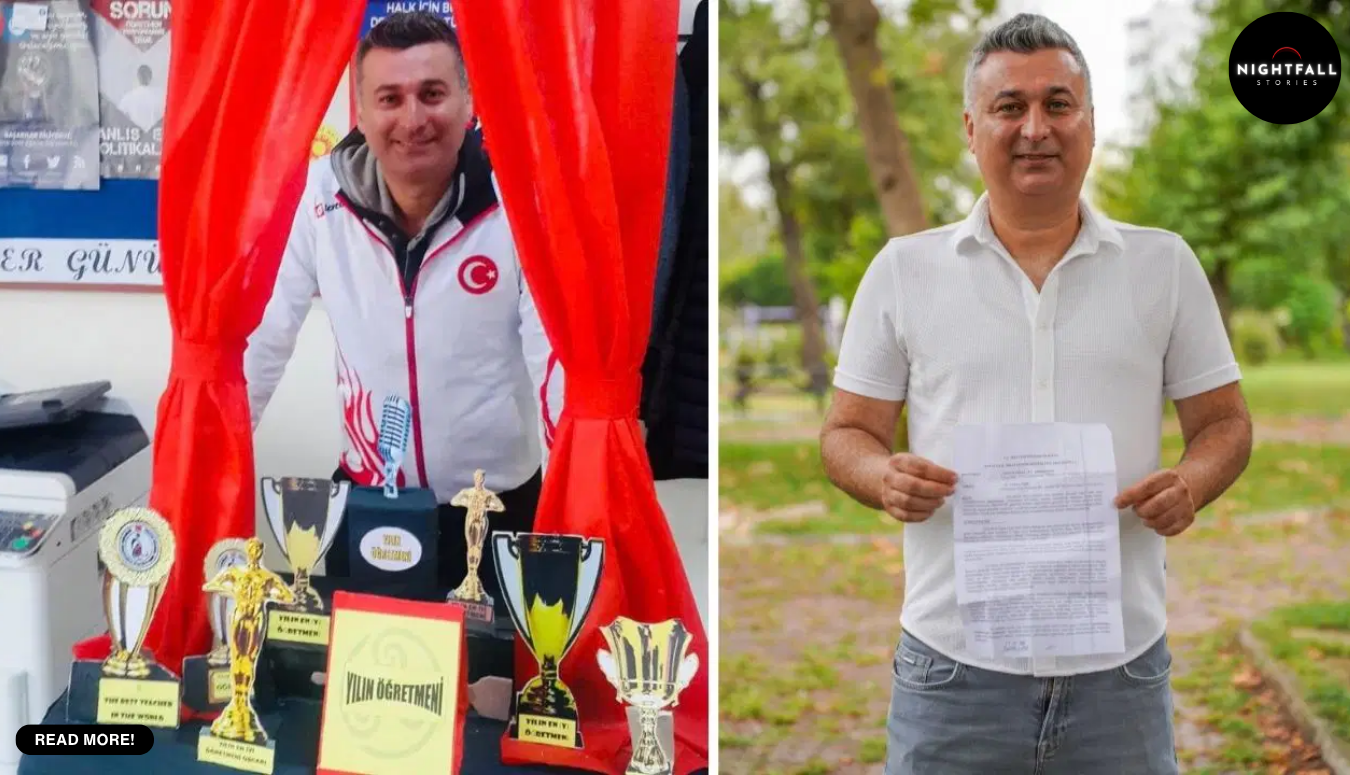
    Firat is forty five now. He was appointed to a state school in Antalya in 2010 and taught there, by his own account happily, with three certificates of achievement in his file. In 2016 he wanted to change his car, and he started an application for a loan online, the way millions of people do. That was the opening.

    People contacted him presenting themselves as bank staff. The story they told him is the standard one and it works because it sounds helpful rather than threatening: his account needed some movement through it to improve how his credit looked, nothing unusual, nothing he had to pay. They talked him through it. Verification messages arrived on his phone and he passed the codes along, because the people asking were from the bank, and a bank asking you to confirm a code feels like the system working rather than failing.

    What those codes bought them was his account. Money moved into it that was not his, taken from somebody else, and then straight out again through a cash machine. The total was about two thousand two hundred and fifty lira, which at the exchange rates of that year was roughly seven hundred and fifty dollars. Keep that number in mind. Everything that follows was built on top of less than a thousand dollars.

    Firat did the thing you are supposed to do. He went to the police and reported it as a victim. He gave a statement in that capacity, it was written down, and he went back to teaching, presumably assuming that was the end of a bad week.

    The problem with being used as a channel for stolen money is that the channel has your name on it. The person whose money had actually gone missing lived in Eskisehir, hundreds of miles away, and when that person went to the police, the account the money had passed through belonged to Ozgur Firat. A case was opened in Eskisehir against him, in the third heavy penal court there, on a charge of fraud committed by using banks or credit institutions as an instrument. On paper, with no other context, it was not an unreasonable case to open. He was the account holder. The money had gone through him.

    The context that would have dismantled it existed in two places. The first was his own complaint, the statement he had given in Antalya as a victim of the same scheme, which would have shown the court immediately that he was not the operator of the fraud but another person caught by it. The second was the record of his contact with his bank on the day it happened, which would have shown him doing what a victim does, calling repeatedly, trying to stop it.

    The court looked for both. It wrote to the police directorate in Antalya asking whether Firat had given a statement as a complainant in connection with the incident, and it wrote to the bank asking whether he had been in contact with them. Two institutions were asked a direct question about their own records, and two institutions answered in the negative. No statement had been taken from him. There had been no contact with the bank.

    Both answers were wrong. The statement existed. The calls had happened. But a court is not an archive, and when it asks the body that holds the records and the body that holds the records says no, there is very little left to work with. He was convicted and sentenced to three years and four months.

    He did not know the conviction had become final. This is the part that sounds impossible until you consider how notification works in practice, how often addresses in a file are out of date, and how a case tried in a city you have never lived in proceeds at a distance from the person it is about. In May 2019 he was driving to school when he was stopped at a routine police check. There was a warrant out for him. He was taken into custody from the roadside and sent to prison, and he was released in June of the following year, having served fourteen months.

    It is tempting to write what those fourteen months were like, and it should not be written, because he has not described them in any detail and inventing the interior of someone else’s imprisonment is not reporting. What can be said is what it cost on the outside, and that is documented plainly in his own account. He lost the teaching job he had held since 2010. His marriage ended during the proceedings. His family sold their house to keep paying for lawyers. When he came out, with a fraud conviction on his record and no profession to return to, he started driving a taxi, and he is still driving it.

    None of that makes him an inspiring figure and he should not be dressed up as one. A man who has been imprisoned for something he did not do has not grown through an experience. He has been subtracted from. The taxi is not a redemption arc, it is what you do when the thing you trained for and were good at has been taken away and the rent is still due.

    What he did have was a lawyer who would not let the file stay shut, and a second accident of the same kind that cracked it open.

    Because the fraud had touched more than one person, Firat was eventually named in a second case, this time in Kocaeli, brought by somebody else over the same scheme. By then he was already out of prison and already driving. A second prosecution for the same ruinous thing must have felt like the floor giving way again. It turned out to be the opposite.

    The Kocaeli file was a fresh look at the same facts, and a fresh look was all it took. The third heavy penal court there examined it and acquitted him. In the course of that case, the gaps in the first one became visible: what the Eskisehir court had been told did not match what was actually there. This is the moment the story turns, and it turns on nothing more dramatic than two courts being asked the same question and only one of them getting a straight answer.

    His lawyer, Luiza Ersu, has described where they started, and it is a bleak starting line. They began with a closed file, a conviction that had already become final, in which two things were simply missing: the record of her client’s statement as a complainant, and the phone data showing his calls to the bank. So they went and got them. They went to the police themselves and found the document that the police had told the court was not there. Faced with the paper, the police wrote to the court again, and this time confirmed that the document was genuine and that Ozgur Firat had indeed given a statement as a complainant.

    Then came the piece that did the real work. Turkish courts can obtain what are known as HTS records, the logs of calls made and received held by the telephone operators. They are not transcripts and they do not reveal what anybody said. They show that a number called another number, and when, and how often, and they are extremely hard to argue with because they are not anybody’s recollection or anybody’s written reply to a letter. They are metadata generated automatically by the network at the time.

    The bank had told the court there had been no contact. The HTS records showed eleven calls between Firat and the bank on the day the money moved.

    Eleven. Not one call that could be dismissed as a misdial, not two that might have been about something else. Eleven calls in a single day, which is the phone log of a man watching money he does not recognise pass through his own account and trying to get somebody to stop it. The written answer from an institution said one thing. The network’s own record of its own traffic said another. One of them could be checked independently, and that is why the case collapsed.

    Getting a court to look at any of it was its own grind. Ersu has said that every request they made in the ordinary way was refused. The fourth heavy penal court in Eskisehir rejected the application to reopen the trial. So they took the longer route, a reversal in the interest of law, in which the request goes through the Chief Public Prosecutor’s Office at the Court of Cassation rather than through the trial court that has already said no. The request was accepted. The Court of Cassation’s eleventh criminal division quashed the refusal to reopen, and the door that had been bolted swung open.

    He was retried, and in June of this year he was acquitted. The decision became final. In his own words, after eight years, the ruling was overturned in the interest of law and the acquittal was settled on retrial.

    That is where the story genuinely ends, and it is important to be honest about the fact that it ends there rather than somewhere more satisfying. There is a version of this piece that puts him back in a gymnasium with a whistle and a class of teenagers, and that version would be fiction. In September he and his lawyer filed a petition to be reinstated to teaching. As of now that application has not been decided. The file is with the ministry. He says, with the particular carefulness of someone who has learned what an unanswered administrative question can do, that he hopes it comes through soon and that he will pick up where he left off. He is not back. He is waiting, in a taxi, for a directorate.

    The compensation is further away still. Ersu has said they will claim for eight years of losses and that they will bring damages actions against both the bank and the police directorate. Will, not have. Those cases are a stated intention, not a filing, and anybody reading this in a year will know more about how they went than anybody can know today.

    A note on the arithmetic, because two different clocks get mixed together whenever this story is retold. The fraud was in 2016, which is where the eight and nine and ten year counts in various headlines come from, depending on what each one is measuring. The imprisonment was a narrower window, from the roadside stop in May 2019 to his release the following June. Both are real and they are not the same number. He lost fourteen months of liberty and the better part of a decade of everything else.

    It is also worth saying where this account comes from, because the volume of coverage is misleading. This story appeared across a great many outlets in Turkey, the national papers and the education trade press and the local sites in Antalya and Kocaeli and Eskisehir, and it reads like a story that has been independently reported many times over. It has not. Almost all of it traces to a single piece of agency reporting by Demiroren Haber Ajansi, filed from Antalya and then carried, rewritten and retitled by everyone else. The quotes are the same quotes. The sequence is the same sequence. Where the versions differ, they differ because of rewriting rather than because anybody went back and checked, which is why some of them blur which court did what. The documents that would settle every remaining detail are the Eskisehir case file, the Kocaeli acquittal and the Court of Cassation decision, and those are not public.

    So treat the fine grain with appropriate caution and the spine of it as solid, because the spine is the part every version agrees on and the part his lawyer has put her name to on the record: an institution was asked whether a document existed, said it did not, and was wrong. A second institution was asked whether a conversation had happened, said it had not, and was wrong. A man went to prison on the back of those two answers, and what eventually beat them was not a confession or a whistleblower but a telephone company’s record of eleven calls, kept automatically, by a system with no interest in the outcome.

    That is the useful thing to take away, and it is uncomfortable. The safeguard that worked was not a human being being careful. It was a machine that had logged something and could not be persuaded to say otherwise.

  • He went back for something he had forgotten. That is why he was in the courtyard when the boy fell

    He went back for something he had forgotten. That is why he was in the courtyard when the boy fell

    Khayrullo Ibadullayev had finished in the courtyard and walked away. Then he realised he had left something behind and turned round, which is the only reason he was standing on Petrozavodskaya Street in St Petersburg, shovel in hand, when a seven year old came off a seventh floor windowsill above him.

    The boy caught himself for a moment on a cornice. Ibadullayev saw him up there and shouted. Then the boy lost his grip and Ibadullayev got himself underneath, took the impact with his own body and went down into the snow with the child on top of him. By one account the boy was within centimetres of the ground before he reached him. The boy went to hospital in a critical condition and survived. Ibadullayev went on sick leave with an injured arm.

    He had been in the city about four months. He is a street sweeper, a dvornik in the Russian term, which in a Petersburg February means being outside before most of the building is awake, clearing the paths and the ice and the snow that falls on what you cleared an hour ago. His employer described him afterwards as sociable and willing to help, the sort of character reference a building manager gives about somebody they have barely had time to notice. He was working part time and told one reporter his pay came to roughly 25,000 roubles a month, which at the exchange rates of that month was something in the region of 330 dollars.

    He is from the Kashkadarya region of Uzbekistan, and the money was not for him. His wife, Gullola Safarova, is at home with their four daughters, the youngest four years old and the eldest in her eighth year of school. His father is unwell and needs paid treatment, and by one account has had three strokes. Ibadullayev is the only person earning in that arrangement, which is why a man with four children of his own was three thousand kilometres away pushing snow around a courtyard in a city he had only just met.

    All of which is background. What happened next is the part worth following, because it happened four separate times and none of it was in his gift.

    Within a day, the president of Uzbekistan had signed a decree awarding him the state medal Jasorat, which translates as courage. The presidential press service announced it on 23 February 2026, the day after the fall. The citation, as published by the Uzbek state information service, recognises him for courage and heroism, saying that in an emergency situation he risked his own life to save a child and prevent his fall from the upper floors of a residential building. No decree number has been published that I can see, so I am not giving you one.

    The medal is worth a paragraph on its own, because the choice of it was not arbitrary. Jasorat was established by Uzbek law in 1994 and is, in the main, a decoration for soldiers and security officers who show bravery on duty. But the statute has a second clause, and the second clause is the one that applied here. It allows the medal to go to citizens of Uzbekistan or to people who are not citizens at all, for heroic acts in protecting public safety, saving lives or saving property during natural disasters, fires and other emergencies. A law written thirty years ago had already imagined a civilian in a foreign courtyard, and left the door open.

    The decree itself, as reported in Uzbekistan, said his actions showed courage and the humanity that is characteristic of his people. That is the register of language a state reaches for on these occasions, and it is also, read plainly, a government telling its own citizens abroad that someone noticed.

    Two days later he was in Smolny, the seat of the St Petersburg city government, where governor Alexander Beglov presented him with a distinction called For Valour in Rescue, along with a commemorative watch. Beglov told him he had not thought of himself, that he had been hurt and had saved a seven year old’s life, and thanked him for it. That is roughly what a governor says on such an occasion, and it was also true.

    The municipal machinery had started moving before that. A deputy governor had publicly promised the city would recognise him within a couple of days of the fall, and then the governor did it himself. Nothing about the sequence was slow, which is unusual for anything involving two bureaucracies and a work permit.

    Then came the medal itself. Decrees are announcements. The Jasorat was physically conferred on 26 February at the Consulate General of Uzbekistan in St Petersburg, by Botirjon Asadov, Uzbekistan’s ambassador to Russia, in front of consulate staff, members of the Uzbek community in the city and a press pack. So this is not one of those stories where a prize is announced in a burst of attention and never actually handed over.

    The fourth thing was money. Margarita Simonyan, who runs Russia’s state international broadcaster, announced a prize of one million roubles in the name of her late husband, the director Tigran Keosayan. That is about 13,000 dollars at the exchange rate of that month, and it is roughly forty times what Ibadullayev was earning in a month at the time. He said he had not expected a reward and had only done what he should have done. Then he sent the money to Uzbekistan for his father’s treatment. He had reportedly been saving towards a car and a flat in Tashkent. The car and the flat went.

    The prize, it turns out, was not a one off gesture. Over the following months the same award went to a man in North Ossetia who pulled a family out of a mountain river, to a resident of Makhachkala who saved a girl in a flood, and to a schoolboy in Chechnya who saved a child. Ibadullayev was one of the first people it found. Later in the year he picked up a further award in an Ordinary Heroes category from a large national public organisation, which by that point was less a surprise than a formality.

    His own account of it never got any more elaborate, which is either modesty or simply the truth about how such a thing happens. Months later, collecting another award, he said much the same as he had said on the first day: that he could not have done anything else, that it was a child, and that surely anyone standing where he was standing would have done the same. He may be wrong about that. People do freeze. But it is not a line he has been talked into, because it is the line he started with before anyone was handing out medals.

    It is worth sitting with how unusual that cascade is, and what it is unusual against. There are millions of Uzbek citizens working in Russian cities, a very large number of them in exactly the kind of job Ibadullayev had, which is the sort of work that gets described in the aggregate and almost never attached to a name. A street sweeper is a function. For about a fortnight, this one was a person with a biography, a region, a wife’s name, four daughters and a sick father, written up in two countries at once. His own head of state decorated him for something he did in somebody else’s.

    The honest thing to say about that is that it cuts two ways, and the second way is not cynical. A man did something that took about three seconds and no deliberation, and two state systems that are usually indifferent to people in his position moved very fast to be seen alongside him. That is how recognition works almost everywhere. It does not make the medal less earned. It does mean the medal is not really the end of the story, because medals do not change the arithmetic that sent him north in the first place.

    There is one more thing the record shows, and it shows it by omission. The coverage in both countries runs hard for about a week, through the decree and the governor and the consulate and the money, and then it stops almost completely. The next time anyone writes about him is the middle of the year, when two reporters go looking and find him in a different city. In between, nothing. Whatever he was for that week, he was not it for very long, and he does not appear to have expected to be.

    The arithmetic did not change. He went home. Then, by the middle of the year, he was back, this time in Moscow, renting a flat and doing the same work, because his father’s treatment still had to be paid for. He told a reporter that there is work in Uzbekistan but the wages are not enough, and that his wife had not wanted to let him go this time. He said he had no other options. In Moscow he was earning around 75,000 roubles a month, close to a thousand dollars, and sending nearly all of it home.

    That is the shape of the whole thing. One million roubles arrived and went straight into a hospital bill. A medal arrived and sits in Kashkadarya. The man himself is in another city with a broom, doing what he was doing before, for three times the pay and on the same terms.

    His injuries are one of the few parts of the record that accounts disagree on, and the disagreement is worth reporting rather than resolving. The city broadcaster said he had hurt a hand. A Russian daily reported two days after the fall that he had been treated for bruising, then had gone back to a clinic because his arm was still hurting, and had been signed off work. A later report put it at broken ribs and fractures in his fingers. One wire account mentioned no injury at all. What is consistent is that he was hurt enough to stop working for a while, and that he does not appear to have made much of it.

    Of the boy there is very little to say here, by design. He was seven. He survived, he was in intensive care for a fortnight or so and was then moved to an ordinary ward, and he is not the subject of this story and does not need to be identified in it. His mother was inside the flat when it happened, on the phone. She said nothing publicly until her son was out of intensive care. According to one report, she never contacted the man who caught him.

    That detail has been passed around with a certain amount of indignation attached, and it is better left without any. A parent whose child has fallen seven floors is not obliged to perform gratitude on a schedule, and whatever happened between those two households is not a matter of public record. It is simply noted, and then left alone.

    One Russian state outlet reported that Ibadullayev’s family had taken the boy on as a fifth child. It is a beautiful detail and no other outlet in either country carries it, so it is not in this story. If it is true, somebody will document it, and it will be worth reading when they do.

    What the record does support is smaller and stands up better. A man who had been in a city for four months, who was outside at the coldest hour of a northern winter for about 330 dollars a month, who was supporting six people on it, walked back into a courtyard for something he had forgotten. He looked up. He had perhaps two seconds to decide whether to stand where he was standing, and he did not need them. He put his hands up and let a falling child land on him.

    Then four institutions in two countries wrote his name down correctly, which for a man in his line of work is rarer than the catch.

  • They drummed through the streets before dawn for fifty years. Then a man gave it a name

    They drummed through the streets before dawn for fifty years. Then a man gave it a name

    Abdul Hannan Tahir has been arranging the same kind of music since 1984, and in the last weeks of 1999 he settled on a word for it. The word was daul. It was not a translation of anything and it was not a committee’s choice. It was one man deciding that the thing he and his neighbours had been doing for years was a thing, and deserved a name that fitted in a sentence.

    In early September this year, Indonesia’s Ministry of Culture entered that word on a national register. Daul music of Pamekasan, on the island of Madura in East Java, is now officially listed as Indonesian Intangible Cultural Heritage, designated on 4 September 2026 after a file that went up through the provincial culture authorities and came back approved. The regency’s own announcement records Hannan receiving the news with emotion and gratitude, which is a careful official way of saying that a man watched a word he invented become a line in a government document.

    The music itself is loud, mobile and almost entirely made of things that were something else first. A daul ensemble is built around percussion: slit drums of hollowed wood, the kentongan and tong-tong family that rural Madura used for centuries as a night alarm, alongside discarded oil barrels, rebana frame drums, klenang, gendang and whatever else in the neighbourhood held a note. Later groups added trumpets and the saronen, the reed instrument that gives Madurese processional music its nasal, carrying cry. Purists complain that the trumpets cost the form some of its character. The crowds do not seem to mind.

    The whole thing moves. Early groups pushed their instruments on hand carts. From roughly the 2000s the carts gave way to car chassis, stripped down and rebuilt in tiers, decorated and repainted, so that an ensemble now arrives looking less like a band than a float with a band inside it. One account of the mid 2000s describes the standard decoration as yellow palm leaf and black cloth. The players themselves wear the red and white striped shirt, the loose black trousers called gombor and the odheng headcloth, and they are very often teenagers and children.

    Why any of this exists comes down to a meal. Through Ramadan, somebody has to wake the street for the pre dawn meal before the day’s fast begins. In Madura that job belonged for generations to whoever was willing to walk the lanes after the night prayers hitting a piece of hollow wood, which is the same instrument and almost the same gesture as the old village watch. Reports of the tradition from well over a decade ago describe exactly that: a few wooden knockers, a cart, water containers and scrap drums, and a group of young people making enough noise to get a whole neighbourhood out of bed. The music has an alarm clock at its origin, and you can still hear it.

    The lineage behind the wood goes back a very long way, and it was never originally about music at all. The slit drum has gone by a string of names across the region, kulkul and titir and gulgul among them, and one account of its history in Madura traces it to Sumenep’s Batuputih and Ambuten districts, where the big drums were struck as an alarm. In the Hindu period they were sounded during a lunar eclipse, which was read as a sign of coming misfortune. Under colonial rule the same instrument organised the night watch. Only after that did somebody work out that a row of them, hit in time, was a band. The name itself is just the noise, tong and then tong again, which is as plain an origin as an instrument ever gets.

    What the groups play on top of all that is less traditional than you might expect. The repertoire runs through regional songs, Malay popular music and kasidah, the devotional form, and ensembles move between pentatonic and diatonic scales depending on what the tune needs. Dancers get added. Carts get repainted. In Sumenep the cousin tradition has had its own festival since 2013, which pulls in small traders and visitors and has turned a Ramadan chore into something with a measurable local economy attached. The Madurese percussion sound now also gets booked far from Madura, and turned up at a night carnival in Tegal, on the Javanese mainland, earlier this year.

    Where it turned from a chore into an art form is genuinely contested, and the contest is worth laying out rather than smoothing over. The regency and Hannan himself trace the roots to the 1970s sahur tradition, with Hannan beginning to arrange it in 1984 and naming it at the end of 1999. The national broadcaster’s account puts the turning point in the 1980s, when a Pamekasan body started running competitions and gave the groups something to be judged against, and quotes the head of the local arts council comparing it to the patrol music of Jember on the mainland. A separate cultural write up credits a long power cut in 1999, three months without electricity, which pushed people into the streets to make their own entertainment. These are not really rival claims so much as layers. A tradition acquires a function, then a contest, then a name, and each stage leaves people who remember that stage as the beginning.

    What is not in dispute is the scale it reached. Pamekasan regency has 178 villages across 11 subdistricts, and by the local education and culture office’s own count, every one of them has at least one daul group. That is the number that makes the rest of the story make sense. This is not a heritage form kept alive by three elderly specialists and a grant. It is closer to a village football league, with the same mixture of local pride, borrowed equipment and arguments about judging.

    A full set is not cheap, which is the part of this story almost nobody writes down. A report on the neighbouring Sumenep version from 2008 put the cost of equipping a single complete ensemble at a minimum of 30 million rupiah, roughly three thousand dollars at the exchange rates of that period, with performance fees of about a million rupiah locally and half again for a booking out of town. The same report described a group of ten players plus one instructor. Later accounts say contemporary ensembles need more than ten and sometimes over twenty people once you count the ones pushing the cart. Set those figures beside village incomes and you get a sense of what a community is actually committing when it decides to field a band.

    And here is the honest gap in the record. For a form whose entire identity rests on its instruments, there is very little published anywhere about who builds them. No reachable report names a single maker of Pamekasan daul instruments, or describes a workshop, or follows a set from raw material to first performance. The closest documentation covers the cousin tradition in Sumenep, where the method is described in some detail: bamboo, or jackfruit and coconut wood for the better pieces, or a scrapped oil drum for the cheaper route. The outside is cleaned, the inside smoothed so the resonance carries. One end stays open to act as the resonator and the other is partly closed. A membrane of goat hide, rubber or thin wood is pulled tight and held with rattan cord, wire or nails. Then somebody hits it, over and over, adjusting, until it makes the sound the whole thing is named after. Finally it gets painted, red or yellow or black, often with Madurese motifs. That is a craft with a tradition behind it, and it is sitting in the archive essentially unrecorded on the Pamekasan side.

    The designation file itself was lodged last year and went through the Cultural Preservation Centre for Region XI in East Java. Akhmad Basri Yulianto, who heads the Pamekasan education and culture office, has been clear in several accounts that nothing about it was sudden. The submission had to establish that daul had developed in Pamekasan for more than fifty years, that its instruments and arrangements were distinctive rather than a local variant of something already listed, that its practitioners had kept at it continuously, and that local government support had been real rather than rhetorical. The province assessed it, then the ministry assessed it, and then it was in.

    It is also worth keeping the scale of the honour in proportion, because nobody in Pamekasan is pretending otherwise. The national register takes in a batch of entries every year from across Indonesia, and the same 2026 round that admitted daul also admitted twenty one items from Central Java alone. A listing is not a prize awarded to one winner. It is an administrative acknowledgement, and the people who filed for it wanted it precisely because it is administrative.

    It is fair to ask what that actually buys. A register entry does not fund anything by itself, it does not pay a drummer and it does not stop a form being thinned out by whatever the next decade’s entertainment turns out to be. What it does is settle an argument about ownership. Pamekasan’s culture department had already registered daul for intellectual property protection as traditional heritage some years back, which tells you the anxiety was there long before the national listing arrived. Madura’s percussion traditions travel well, they get booked for carnivals far from the island, and a form with no paperwork is a form that can quietly be described as belonging to somewhere else.

    The plan now, according to the officials involved, is to push daul communities into schools and universities, on the reasoning that an art form with a register entry and no twenty year olds is a museum piece. Deputy regent Sukriyanto has framed the designation as motivation for artists and young people to hold on to daul as part of what Pamekasan is. That is the standard thing for a deputy regent to say. It also happens to be the only strategy available.

    Hannan’s own group, Semut Ireng, came out of Parteker in Pamekasan town and is the name that appears whenever anyone outside Madura writes about daul at all. It has played the Bromo festivals and has performed at the presidential palace, by one account three separate times, and has had enough foreign visitors turn up wanting to learn the technique to be worth mentioning. It has also survived periodic rumours of its own breakup. Hannan is now described in the regency’s announcement as the group’s advisor rather than its conductor, which is the sort of quiet retitling that happens when a founder has been doing something for forty years and the people doing the actual carrying are younger.

    What daul is for has shifted too, and not entirely downwards. It still plays through Ramadan. But it also plays school year end celebrations, which is where a great many Pamekasan children first stand in front of a tiered cart of barrels and realise they could be on it, and it plays civic processions, weddings and welcomes for visiting dignitaries. A tradition that began as a way of waking people up now mostly performs for people who are already awake, and that is a real change in what the music means, even if the instruments have not changed much at all.

    There is a version of this story where the ministry is the hero and the paperwork is the climax, and that version is dull because the paperwork is dull. The better version is the one about the word. For fifty odd years, people in Pamekasan did something at four in the morning for which there was no settled term, and because there was no term it could not be written on a form, which meant it could not be counted, funded, taught, claimed or defended. One man, who had spent fifteen years arranging the stuff, chose four letters. Everything institutional that has happened since, the competitions, the intellectual property filing, the provincial assessment, the entry on the national register, ran through that word.

    For four decades the only real measure of a good daul night was whether the street came out. There is now a second measure, held in a ministry file in Jakarta, with the word spelled the way Hannan spelled it. Most of the people in those 178 villages will never see it. They will carry on judging by the street, which is the harder test, and the only one that was ever going to keep the music alive.

  • He was convicted on five counts and sentenced to 18 years. The count that produced the number had nothing to do with birds

    He was convicted on five counts and sentenced to 18 years. The count that produced the number had nothing to do with birds

    The sentence handed down in a court in the Brazilian state of Bahia came to 18 years and 25 days of closed custody, plus a further year, two months and 11 days of the lighter detention regime. The man who received it, Weber Sena Oliveira, known everywhere in the case file as Paulista, was convicted on five counts: running a criminal organisation, trafficking in wild animals, animal cruelty resulting in death, money laundering, and receiving stolen goods in its aggravated form. Seven other people were convicted alongside him.

    Read that list and the obvious assumption is that the wildlife counts carried the weight. They did not. Under Brazilian law as it stands, the wildlife trafficking offence that sits at the centre of this case is worth six months to a year of detention and a fine. Not six years. Six months to a year. It is, in sentencing terms, closer to a traffic matter than to the thirty-year commercial enterprise the prosecutors say they were dismantling.

    The 18 years came from the money.

    This is the part of the case that is genuinely worth understanding, and it is not a technicality. It is the whole reason the prosecution existed in the shape it did. Brazil’s organised crime statute, the law that allows prosecutors to charge a network rather than a series of individuals, defines a criminal organisation as four or more people in a structurally ordered association with a division of tasks, pursuing advantage through the commission of offences whose maximum penalties exceed four years. That threshold is the gate. Read it against the wildlife offence and the problem is immediate: a crime with a maximum of one year cannot get a group through a door marked more than four. On the bird offence alone, there is no criminal organisation in law, no matter how organised the thing on the ground plainly is.

    Money laundering clears the gate easily. Concealing or disguising the origin, movement or ownership of assets derived from criminal activity carries three to ten years and a fine, and the statute adds a further increase of between one third and two thirds where the laundering is habitual or carried out through a criminal organisation. Aggravated receiving adds another substantial range on top. Stack those, apply the increase, and 18 years is not an outlier. It is the arithmetic.

    So the decision that produced this sentence was made long before any judge saw it. It was made by two prosecutors who looked at a bird trafficking case and chose to build a financial one.

    Kleber Valadares coordinates the environmental defence unit at the public prosecutor’s office in Alagoas. Aline Salvador works in the regional environmental prosecution service in Bahia. Operacao Fauna Protegida was run jointly by their two offices, with the justice promotion office in the Bahian city of Itabuna and, crucially, with Gaeco, the special task force that exists in Brazilian state prosecution services specifically to handle organised crime. An environmental prosecutor alone would have produced an environmental case. Bringing in the organised crime unit is what changed the available ceiling, and it meant the investigation had to be conducted to a different standard. Instead of proving that birds were taken and sold, which is comparatively easy and comparatively worthless, they had to prove an enterprise: who reported to whom, who handled cash, where the cash came from and where it went.

    What they produced reads like a corporate organogram. Across five separate indictments, 24 people were charged in all, one leader and 23 others, and the prosecutors broke the structure down by function: 14 suppliers, ten of them based in Bahia; five receivers; three transporters; and one financial operator. That single financial operator is the pivot of the entire case.

    She is Ivonice Silva e Silva, Oliveira’s companion. According to the prosecutors, close to 500,000 reais, in the region of 100,000 dollars at the exchange rates of the time, passed through her accounts in a six-month window across the first three quarters of 2023. The deposits did not arrive as transfers from identifiable buyers. They arrived through cash machines in Mage, a municipality in the state of Rio de Janeiro, which the prosecution links to a co-defendant known as Juninho de Mage, charged in relation to the laundering. Silva e Silva was convicted and received a little over six years in closed custody with a further year of detention.

    That is what a laundering case looks like when it works. Nobody has to catch anyone holding a bird. Bank records, by their nature, are dated, itemised and continuous, and six months of them establish three things that a seizure on a roadside cannot: that the activity was commercial rather than incidental, that it was continuous rather than opportunistic, and that it involved a division of labour, because someone was moving money who was not catching anything. Those are precisely the elements the organised crime statute requires, and they are also what triggers the habituality increase in the laundering law. The bank statements did not merely add a charge. They supplied the proof for every other charge in the indictment.

    The case that became this one started on a road. In early January last year, officers stopped a vehicle on the BR-101 highway near Itabuna and found 135 birds being transported illegally. By the prosecutors’ own account, Oliveira had been pursued for more than twenty years before that stop, and the releases from the Alagoas office describe the network as having operated for over thirty. Those two figures are not quite the same claim, and the article does not try to reconcile them: the official statements from the two prosecution services say over thirty years of activity, while coverage at the time of the arrest said more than two decades. Either way the number describes a working life, not an episode.

    The highway stop led to a preventive detention order in the Bahian municipality of Mascote toward the end of the same year, and from there to the indictments and, in the first weeks of this year, to the verdict. Oliveira has therefore been held since before he was charged, which answers the question that often undoes a story like this one. The prosecutors’ announcement does not say the conviction is final, and there is no public record of it having passed beyond appeal; Brazilian criminal procedure gives convicted defendants real room to challenge a first-instance judgment. But the preventive detention came first, so the practical answer to whether the man is in custody does not depend on the appeal.

    The description of Oliveira as the country’s largest wild bird trafficker needs attributing rather than repeating. It is the prosecutors’ own characterisation, and it appears in their releases as the framing of their own case. It may well be right. It is not a finding anybody independent has tested, and an enforcement agency describing the target of its biggest operation as the biggest offender is a claim with an interest attached.

    The species involved explain why the whole thing is structured the way it is, and they are not what an outside reader expects. This was not a parrot network and it was not an export network. The birds named across the prosecutors’ material are songbirds: canaries, the papa-capim and the trinca-ferro, the azulao, the pássaro preto, the chorao, the estevao. Small, brown and grey and blue, unremarkable to look at, and valuable entirely for sound. Brazil has a long domestic culture of keeping and competing songbirds, and the demand that sustains a network of this size is internal. The money was moving from Rio de Janeiro toward Bahia, not toward an airport. One recorded sale in the case file reached 80,000 reais, somewhere around 15,000 dollars at the rates of the period, for a bird.

    That price is the exception and it is also the engine. A single exceptional specimen funds a great deal of ordinary volume, and volume is what the business model requires. The prosecutors put the capture scale at up to 500 birds in a day using nets twenty metres long, and single consignments at more than a thousand birds. They also cite a transport mortality figure of around 90 per cent, drawn from data compiled by Renctas, a Brazilian non-governmental organisation that has tracked the wildlife trade for years. That figure stays attributed here, because it is an estimate produced by a campaigning organisation and not a measurement taken from this network’s shipments. What it means, if it is even approximately right, is that the arithmetic of the trade runs the wrong way round from any legitimate business: the supply chain is designed around the assumption that almost all of the stock is lost, which is why the numbers taken at the top of it are so large. Ten birds reaching a buyer requires a hundred leaving a net.

    The choice to run it this way carried a real cost, which is why it counts as a hard decision rather than an obvious one. An environmental charge against a man caught transporting birds on a highway is close to self-proving: the birds are in the vehicle. A financial case against a network is months of account analysis, cooperation between prosecution services in two states that are more than a thousand kilometres apart, and the involvement of a task force whose caseload is normally drug and weapons organisations. It also raises the burden of proof enormously, and a laundering count that fails takes the organised crime count down with it, since the one depends on the other clearing the four-year bar. Valadares and Salvador chose the version of the case that could fail outright over the version that was almost certain to succeed and almost certain to be worthless. That is the decision at the centre of this story, and it was made before anyone knew what the bank records would show.

    Eight convictions also means 16 of the 24 charged have not been resolved here. The charges were brought as five separate indictments rather than one, which spreads the network across more than one proceeding and means this verdict is a part of the case rather than the end of it. The suppliers in particular, 14 of them in the prosecutors’ breakdown, are the layer that regenerates fastest if only the top of a network is removed, because the nets and the knowledge of where the birds are do not go anywhere.

    The routes were not guesswork either. The prosecutors drew on a mapping project called Libertas, run by the Brazilian association of environmental prosecution service members, which identified 31 concentration points in the trade and traced recurring corridors running from southeastern Bahia and northeastern Minas Gerais toward Rio de Janeiro. That is the sort of tool that turns a series of local seizures into a case theory. It tells a prosecutor where to expect a network before they have found one, and it is a reasonable guess that it is also what allowed two state offices in different parts of the country to recognise that they were looking at the same organisation.

    There are two things this verdict does not resolve, and it is worth saying both.

    The first is what happens to confiscated birds. The releases record 135 birds taken in the highway stop and say nothing about where they went, and that silence is not negligence, it is the shape of a genuinely hard problem. A bird taken from an unknown location cannot simply be let go somewhere convenient, and the people who seize them are usually enforcement officers rather than wildlife biologists. The judicial end of a trafficking case and the biological end are two different problems, and only one of them gets a sentence attached.

    The second is the law itself. Toward the end of 2025, Brazil’s Chamber of Deputies approved a bill raising the penalty for wildlife trafficking from the current six months to a year up to a range of two to five years, with three to eight years where aggravating circumstances apply, including offences involving threatened species, the involvement of public officials, or the death of the animals. The vote was 427 in favour to one against, which is about as close to unanimity as a legislature gets. The bill then went to the Senate, where at the time of writing it has not become law.

    Hold the two facts next to each other and the significance of this particular conviction becomes clear. If that bill passes, the wildlife offence crosses the four-year threshold on its own. Prosecutors would no longer need to find a financial operator and six months of cash machine deposits in order to charge a bird network as what it visibly is. The organised crime statute would simply be available.

    Until then, the lesson of Operacao Fauna Protegida is narrower and more useful than a headline about a record sentence. Thirty years of taking birds out of nets, by the prosecutors’ own account, was worth almost nothing in a courtroom. Six months of one woman’s bank statements was worth 18 years. Valadares and Salvador did not win this case by proving what everyone already knew about the birds. They won it by treating a wildlife network as a business and auditing it.

  • He expected the fabric to cost him his strawberries. The plants underneath produced more than three times the fruit

    He expected the fabric to cost him his strawberries. The plants underneath produced more than three times the fruit

    Gabriel Bamidele Olawuyi went into the strawberry trial expecting to lose fruit. That was the whole point of running it. He is a graduate research assistant in entomology and plant pathology at North Carolina State University, and the thing he was testing was a knitted textile designed to keep insects off a plant without anybody spraying it. The fabric looks almost opaque. Plants need light to make fruit. His own stated expectation, before any berries were counted, was that the cover would push the plants into producing leaves instead of strawberries.

    Across a seven-week harvest, the covered plants produced 3.56 times as many harvestable fruits as the uncovered ones. The berries were also bigger: an average of 12.18 grams against 6.63 grams, which is roughly a 1.84-fold increase in the weight of a single fruit. Per plant, the covered beds gave up 10.8 fruits on average. The uncovered beds gave 2.83. In the first week of harvest, the uncovered plants gave nothing at all.

    None of that was the experiment. The experiment was about aphids.

    The material is called Plant Armor Generation 2, and it did not begin life as agriculture. R. Michael Roe, the William Neal Reynolds Distinguished Professor who corresponds on the paper, has described the origin plainly: the research line started with an attempt to build a cloth that could sit on a soldier’s chest and make body armour more comfortable to wear. A fabric that blocks things while still breathing is a textile problem before it is ever a pest problem. Somewhere along the way the people working on it noticed that a structure engineered to let air and moisture through while refusing to let anything solid pass is also a description of the ideal insect barrier, and the work turned sideways into a field.

    That turn is visible in the author list, which is the most informative thing about the paper if you know how to read one. The study ran in Agriculture, published toward the end of September, and it carries nine names. Olawuyi is first. Andre J. West, from the Wilson College of Textiles, sits sixth, the only textile engineer in a line of entomologists. Roe is ninth and corresponding. In the conventions of experimental science, that arrangement is not a hierarchy of importance so much as a map of labour. First position goes to the person who did the work. Last position, with the correspondence asterisk, goes to the person whose lab it is.

    The paper spells it out rather than leaving it to convention. The idea was conceived by West and Roe. The funding was secured by Roe and by Clyde E. Sorenson. Supervision belonged to Roe and to Loganathan Ponnusamy. Everything in between belonged mostly to Olawuyi: the methodology, the validation, the investigation, the formal analysis, the data curation, the figures. And the original draft of the manuscript was written by one person, listed alone in that line, which was him. Eight senior and co-equal colleagues then reviewed and edited it. The graduate research assistant designed the measurements, ran them, did the statistics, drew the charts and wrote the sentences. The distinguished professor had the idea and paid for it.

    There is a second line in the paper that sharpens this. The fabric was patented by North Carolina State University in early 2023, with West and Roe among the named inventors, and the university has licensed it for commercial development. The conflicts of interest statement separates the nine authors accordingly: the inventors declare an interest, and Olawuyi and six others declare that they have no competing financial interest in the result at all. The person who produced the data has no stake in what the data is worth. That is a fairly ordinary arrangement in university research and it is worth saying out loud anyway, because the cheerful version of this story is about a miracle fabric and the accurate version is about who stands where around it.

    Now the aphids, because that is the part of the paper that actually proves something clean.

    The insect work was a penetration assay, and the design is almost crude in its directness. Take a strawberry leaf. Put a barrier over it. Put aphids on the barrier. Wait, and count how many get through to the leaf. The leaf was set into a water source so it stayed hydrated and worth reaching. A one centimetre square of filter paper was laid on the barrier so the insects had a surface they would willingly crawl onto rather than hesitating at the material. The aphids were nymphs, the small soft juvenile stage, collected from the infested foliage in the team’s own plots and identified as Rhodobium porosum, a rose and strawberry aphid. The run lasted 180 minutes at 27 degrees Celsius and about 50 per cent humidity, and it was conducted during the scotophase, the dark part of the cycle, when the insects are moving.

    The positive control was standard fly screen. This is the detail that makes the result interesting rather than obvious. Fly screen is the mesh in a kitchen window. Its openings in the paper are given as about 1.5 millimetres by 1.2 millimetres, which sounds tight and is tight by the standards of a housefly. Aphid nymphs crossed it. The paper reports penetration of the fly screen rising over the course of the assay, following a curve the authors fitted statistically. Through the Plant Armor fabric, across every single time point of the three hours, the figure was zero.

    The reason is geometry, not hole size, and this is where the word knitted earns its place. A woven screen is a flat grid. Every opening in it is a straight tunnel from one side to the other, and a soft-bodied insect that can deform itself a little only has to find an opening slightly smaller than it is and push. A three-dimensional knit is not a grid. It is a thick structure with layers and loops set at angles to each other, so there is no straight path from the outside to the inside. An insect pressing into it does not find a shorter tunnel, it finds another wall. Air and water, which do not need a straight line, go through perfectly well. That is why the fabric can be porous and impassable at the same time, and it is why measuring the mesh count of a pest barrier tells you less than people assume.

    That matters because of what the alternatives are. The standing answer to sap-feeding insects on a fruit crop is chemical, and the reason growers reach for it is not laziness but arithmetic: the physical option, exclusion netting, has a hole in it, and the hole is exactly the size of the insects that do the most damage to a soft fruit. A barrier that an aphid nymph can walk through in under three hours is not a barrier, it is a fence for larger animals. So the choice a grower has actually been offered is spray or accept the loss, and the title the authors gave their paper puts prevention of insect feeding in it precisely because that is the problem the material was built against. The strawberry yield is the second half of the title and was not the reason the trial existed.

    Which brings the story back to the strawberries, and to an honest account of why there were so many more of them.

    The expectation Olawuyi started with has a name in plant biology: shade avoidance. A plant that senses it is being shaded tends to invest in reaching for light, which means stems and leaves rather than flowers and fruit. If the cover had triggered that, the covered beds would have been leafier and poorer. The paper measured exactly this and found it did not happen. There was no statistically significant difference in either wet or dry plant weight between the covered and uncovered plants. If anything the covered plants were slightly lighter on both measures, with the uncovered beds averaging 92.1 grams wet against 78.8 grams, and 23 grams dry against 18.1 grams, differences well inside the noise. The plants under the fabric did not grow bigger. They just fruited more.

    The mechanism the paper points to is heat. Weekly environmental readings taken under and outside the covers over the winter and spring of the trial found the mean temperature under the fabric was higher by 1.93 degrees Celsius, a small and statistically solid difference, while relative humidity showed no significant change at all. Olawuyi’s own explanation runs through growing degree days, the standard way of accounting for the fact that plants develop on accumulated warmth rather than on calendar time. A plant needs a certain quantity of heat to move from one developmental stage to the next. Give it slightly more heat every day across a whole winter and it arrives at fruiting earlier and spends more of the season doing it. That is consistent with the single most vivid number in the harvest data, which is that in the first week of picking the uncovered plants produced no fruit whatsoever. They had not got there yet.

    So the fabric was not feeding the plants. It was giving them a slightly longer and slightly warmer season while also keeping the aphids off. Two modest advantages, compounding over months, landed as a tripling at the end.

    Here is where the piece has to be careful, because a 3.56-fold yield increase is the kind of figure that escapes into headlines and stops carrying its conditions with it.

    This was a tunnel trial, not a farm. The plots were raised beds three metres long by 1.2 metres wide. Three beds were used, each split in half so that one half was covered with the fabric over a hoop frame of PVC pipe and the other half was left open, which gives six experimental units in total. The cultivar was Sweet Charlie, one commercial strawberry variety among many. It was one site, in one climate, across one season, with harvest running from early April to the middle of May. The authors do not oversell it. Their own conclusion is that on-farm testing is now needed to examine how the textile performs on a range of crops in different places, which is the correct thing to say and not what a press release usually says.

    It is worth being concrete about what on-farm testing would have to settle, because the gap between a split raised bed and a working field is not just one of scale. A three-metre bed under a hoop has edges, and edges change the temperature inside a covered space; a hectare of the same cover would not necessarily sit 1.93 degrees warmer. The heat advantage was measured through a winter and into spring in a temperate climate, where extra warmth is a gift. In a hot season or a hot region the same property turns into a liability, and nothing in this trial speaks to that. Then there is the cost of the material itself, the labour of installing and removing it over hoops, and how long a knitted textile survives weather, handling and ultraviolet light before it has to be replaced. A 3.56-fold yield increase is only interesting to a farm if the fabric is cheaper than the extra fruit, and that calculation does not appear in a single-season plot trial and should not be expected to.

    There is also one question the paper simply does not answer, and a reader will reach it within seconds of understanding the result. If the cover is impassable to insects, what happens to the insects you want? Strawberry flowers are capable of pollinating themselves, but visits from bees are widely understood to improve the size and shape of the fruit, and a barrier that stops an aphid nymph is not going to admit a bee. Pollination is not addressed anywhere in the study. The nearest thing to an answer is indirect and does come from the data: these covered plants, with whatever pollination they managed under a sealed hoop, still produced more fruit and heavier fruit than the open beds beside them. That is suggestive. It is not the same as having measured it, and anyone proposing to put this material over an orchard rather than a strawberry bed would want it measured.

    What the trial does establish is narrow and real. A knitted three-dimensional textile stopped a soft-bodied insect that ordinary netting does not stop, without pesticide, and on a small plot it also warmed the root zone enough to shift the fruiting calendar in the plants’ favour. Those are two separate findings that happened to arrive in the same experiment, and the second one was nobody’s hypothesis.

    The person who will carry it forward into the on-farm work is the one who wrote the draft. Olawuyi set out to show that a pest barrier costs you yield, measured the thing he expected to see, and found the opposite sitting in his own harvest tallies. That is a better outcome than being right. Being right confirms what somebody already thought. Being wrong in that particular direction is how a textile designed for a soldier’s chest ends up over a strawberry bed, with a graduate student explaining to eight senior colleagues why the plants did something none of them predicted.

  • He was picking a campsite in northern Quebec when he noticed the lake was the wrong shape

    He was picking a campsite in northern Quebec when he noticed the lake was the wrong shape

    Joel Lapointe was not looking for a crater. He was looking for somewhere to put a tent. He is an amateur astronomer in Quebec, and he was doing what anyone planning a trip into roadless country does, which is scrolling satellite imagery of the Cote-Nord region to find a lake worth paddling and a shore worth sleeping on. What stopped him was a ring. Lake Marsal sat inside a circular feature about 25 kilometres across, and the circle did not look like the work of ice or rivers. It looked like a hole.

    So he did the thing most people do not do. He wrote to strangers. He contacted specialists in Europe and in North America and told them what he thought he was seeing, with no professional standing and no reason to expect an answer.

    Two years later, a team of geologists hauled their equipment through fifty metres of open water because a floatplane could not get them to the shoreline, pushed through swamp and insects and vegetation that one of them described as deep, twisty and gnarly, and came back with pieces of rock shaped like cones. Those cones are why the structure now has a name. It is called Uhackatik, it is roughly 390 million years old, and it is the largest impact structure found anywhere on Earth since the 31 kilometre Hiawatha structure turned up under Greenland’s ice in 2018.

    The part worth slowing down for is not the discovery. It is the gap between a circle on a screen and a confirmed crater, because that gap is where almost every amateur find in this field dies.

    Round lakes are common. Craters are not. There are only around two hundred confirmed impact structures on the entire surface of the planet, and the list grows by a handful per decade. Meanwhile the northern half of Canada is covered in circular water. Glaciers gouged basins and left them to fill. Blocks of buried ice melted out and dropped the ground into neat bowls. Ancient magma pushed up through the crust in ring shaped intrusions that weather into rings at the surface. Folded basement rock, worn down over hundreds of millions of years, can leave a circular outcrop pattern that looks from orbit exactly like the rim of something that fell. If you go looking for circles on satellite maps you will find hundreds, and essentially all of them will be ordinary geology.

    Which is why the professional response to an email about a circular lake is usually polite scepticism, and why Gordon Osinski’s first reaction was no different. Osinski is a planetary geologist at Western University in Canada and he directs the Impact Earth database, which means he is one of the people the world sends its round lakes to. He was not immediately convinced. What he eventually did, though, was organise a trip, which is a bigger commitment than a reply.

    The geography of the region is also the reason the claim was worth taking seriously at all. Quebec sits on the Canadian Shield, a vast slab of very old continental crust that has been geologically quiet for an extremely long time. There are no young mountain belts folding it, no thick blanket of new sediment burying it, and successive ice sheets have scraped the surface clean rather than piling material on top. Anything that hit the Shield is still, in some form, there to be found. That is why the province is unusually rich in these things. Uhackatik brings the count of confirmed impact structures in Quebec to eleven.

    Quebec’s existing craters give you the scale of what the province has been collecting. Manicouagan, in the same broad region, is about 100 kilometres across and roughly 214 million years old, and its flooded ring is so large and so regular that it is one of the most recognisable features on Earth from orbit. Charlevoix, closer to the St Lawrence, is around 54 kilometres and far older still. Those have been known for decades. Uhackatik is smaller than either, and it was missed, which tells you something about how much of the north has never been walked over by anybody carrying a hammer.

    The expedition went in during the autumn, and the logistics tell you why nobody had checked before. There is no road. The only way in is by air to water, and the water would not cooperate, so the team waded. Osinski has done fieldwork on six continents and has called this among the hardest of it. Nothing about the site is dramatic in the way a crater is dramatic in a film. After 390 million years of erosion and eleven ice ages there is no bowl, no raised rim you can stand on and admire, no obvious hole in the ground. There is a lake, some low relief, and a lot of forest and bog. The evidence had to be found in the rock, not in the landscape.

    What they found, at multiple outcrops in the Grenvillian basement at the centre of the structure, were shatter cones, some of them tens of centimetres across. This is the piece of the story that rewards a reader’s patience, because shatter cones are one of the few places where geology hands you something close to proof.

    When a large object hits the Earth at tens of kilometres per second, the pressure that passes through the target rock is far beyond anything normal planetary processes can produce. Volcanoes cannot do it. Earthquakes cannot do it. Tectonic compression cannot do it. Under that shock, rock fractures in a very particular way, splitting into nested, branching, cone shaped surfaces with fine lines radiating from the tip, like the grain inside a horsetail. The cones tend to point back toward the source of the shock. Once you know what you are looking at, you can hold one in your hand and know that something travelling absurdly fast arrived here. Osinski has described shatter cones as the only unequivocal evidence of an impact event that you can actually see in the field with the naked eye.

    Everything else in the case is laboratory work, and it is the laboratory work that produced the age. The team took oriented cores of impact melt rock, which is rock that was briefly liquid because of the collision and then froze again, locking in the direction of the Earth’s magnetic field at that moment. Because the magnetic field’s behaviour through geological time is partly known, that frozen direction can be read as a rough clock. It put the event somewhere between about 370 and 400 million years ago. Preliminary lead isotope measurements on zircon crystals, done by laser, came back broadly compatible, in the range of 350 to 400 million years. Two independent methods landing in the same window is what allows the round figure of about 390 million years.

    Try to picture what was there to witness it. That date puts the impact in the Devonian. There were no dinosaurs, and would not be for another 150 million years or so. There were no flowering plants. Fish were the most impressive animals alive, and the first true forests were only then beginning to spread across the continents, with the earliest tall trees working out how to stand up. The land the object hit would not have looked like Quebec. It would barely have looked like anywhere.

    A 25 kilometre structure is not a minor event either. Craters of that scale form from objects on the order of a kilometre or more across, and the energy involved is continental in its effects, not local. Structures that large collapse as they form, so the floor rebounds upward into a central peak or uplift rather than staying as a simple bowl, which is part of why the deeply eroded centre is where the shocked basement rock ends up exposed.
    It is also worth being clear about what does and does not count as evidence here, because the bar is higher than most people assume. A circular shape is not evidence. Neither is a gravity anomaly, or an unusual magnetic signature, or a ring of hills, or a lake that local tradition says is bottomless. All of those are suggestive and all of them have ordinary explanations more often than not. What the field accepts is physical proof that rock at the site experienced shock pressures nothing else on this planet generates: shatter cones in outcrop, microscopic deformation features inside quartz grains, high pressure mineral forms, or rock that was genuinely melted by the collision rather than by volcanism. That is a short list, and it is short on purpose, because the history of this discipline includes a long tail of claimed craters that were not craters.

    The reason that matters for a story like this one is that the amateur contribution and the scientific confirmation are two completely different jobs, and conflating them does a disservice to both. Lapointe did not confirm a crater. He noticed something anomalous and passed it to people with the training and the equipment to test it, which is precisely the right division of labour and precisely what almost never happens, because most people who spot a suspicious circle either keep it to themselves or announce it as a discovery on the internet.

    Now the honest part, which the coverage of this find has generally skipped.

    Uhackatik is not yet formally recognised. The work has been published as an abstract presented at the annual meeting of the Meteoritical Society, with Jerome Gattacceca of CEREGE in France as first author and a long list of co authors from France, Canada and the United States, Osinski among them. A conference abstract is a real scientific document and it is how new impact structures are conventionally announced in this field, but it is not a peer reviewed journal paper, and it should not be read as one. The committee that keeps the formal record is reported as expected to take the site up at its next meeting. Until then, the structure is not in the Earth Impact Database.

    So what exists is a confirmation rather than a declaration. The team considers the impact origin essentially settled, and the reason they can say that is the shatter cones plus the melt rock plus the magnetism, not a vote. The paperwork is a separate process from the evidence, and it has not caught up. That distinction is worth keeping, because the difference between a structure that scientists are confident about and a structure that is officially on the list is exactly the kind of nuance that gets flattened in a headline.
    The scientific work on the site is also not finished, which is a different statement from the recognition being incomplete. A newly identified structure of this size raises immediate questions that one autumn of sampling cannot settle. How deep is the melt sheet. Whether any ejecta, the material thrown clear of the impact, can be traced in sedimentary rocks elsewhere, which is how an impact gets tied to events recorded in the wider geological record. How tightly the age can eventually be pinned, since a window of 370 to 400 million years is useful but not precise, and narrowing it is the difference between a date and a correlation. Each of those takes more field seasons, in a place that is extraordinarily difficult to reach.

    There is one more detail in the published abstract that deserves more attention than it has had, and it is the name.

    The structure sits in Innu territory on Quebec’s north shore, and the name Uhackatik was not invented in a French laboratory or a Canadian university office. The abstract states plainly that the name was chosen following discussions with the Ekuanitshit Innu council. NASA’s Earth Observatory, which published the satellite view of the site, described the same thing, noting that the team is calling the crater Uhackatik after consulting the Innu Council of Ekuanitshit.

    That is a small sentence carrying a real amount of weight. Naming is the part of discovery where outsiders have historically helped themselves, and a brand new label stuck onto a landform in somebody else’s homeland is not a neutral act of bookkeeping. Here the researchers went and asked, and the name they are using came out of that conversation rather than around it. Whatever else happens to this structure in the formal literature, that is the version of the process that will look best in fifty years.

    As for Lapointe, he got his answer, roughly two years after sending an email that he had every reason to expect would be ignored. He has said he was over the Moon when the confirmation came through, which is a forgivable thing to say in the circumstances. The line of his that is actually useful, though, is the other one. He has encouraged people not to ignore an intuition or an observation just because it falls outside their own field.

    That is not a platitude in this case, because the structure of the find makes it literally true. The crater had been sitting there for 390 million years. The satellite imagery had been publicly available for years and anybody could open it. The geologists had the expertise, the funding, the floatplane and the laboratories. The one thing nobody had supplied was a person looking at a lake in the course of planning a holiday, noticing that the shape was wrong, and being willing to say so out loud to someone who knew more than he did.

    The rock did the rest.

  • Twenty English coins turned up in a rubbish pit next to the Vatican, and fourteen of them had fused into lumps. The coins are not the find

    Twenty English coins turned up in a rubbish pit next to the Vatican, and fourteen of them had fused into lumps. The coins are not the find

    Dig a rubbish pit out of a building site in Rome and you expect pottery, bone, charcoal, the ordinary wreckage of people living. What came out of the ground beside St Peter’s, in a dig that ran from 2020 to 2023 at the Palazzo della Rovere, was twenty English silver coins. Nineteen pennies and one halfpenny, struck across roughly half a century under three kings, and fourteen of them lying in two tight clusters of six to eight, corroded so thoroughly that the coins had bonded to each other into solid groups.

    The headline that writes itself is treasure near the Vatican. The actual story is a permission, and it is better.

    First, a correction to the clock, because this will be presented elsewhere as a fresh dig and it is not one. The excavation finished three years ago. The findings were presented at an international conference at Roma Tre university in Rome, Rome and the Others, in the middle of December 2025, in a session on research in the area of the schola Saxonum. They appear as a chapter in the resulting Italian-language volume, Rome and the Others (300 to 1000): Foreigners in the city between conflicts and integration. What is actually new is the English-language account, which arrived in autumn 2026 through a University of Cambridge feature and the coverage that followed it. Nothing was unearthed this month. The spade work and the coin work are both finished; what changed is who can read about it.

    Second, a correction to the superlative, and this one is the difference between a good story and a sloppy one. The find is being described as the first material evidence of the Schola Saxonum, the English quarter in early medieval Rome. That phrasing is fine as long as you hear the word material. The Schola Saxonum was never lost. It is attested in written sources, it has been known to historians for centuries, and its name is still legible on the modern Roman street map: the Lungotevere in Sassia runs along the Tiber there, and the Santo Spirito in Sassia church and hospital carry the same root. Sassia is Saxon, worn down by a thousand years of Italian mouths. Nobody discovered a neighbourhood. What nobody had before was a physical object you could pick up and date and say, this was theirs, and it was here.

    That is a smaller claim than discovery and a more interesting one, because text and dirt fail in different ways. Written sources tell you that a thing existed and almost never tell you what ordinary life inside it looked like. Twenty coins in a bin tell you almost nothing about why the quarter was founded and quite a lot about what people were doing in it on a Tuesday.

    So: the permission.

    In early medieval Rome, you generally could not spend foreign money. This was normal and not remotely unique to Rome. A coin was not a universal token, it was an issue of a particular authority, and crossing into somebody else’s jurisdiction meant converting at whatever rate and whatever cut the local system imposed. Pilgrims arriving in Rome from anywhere in Europe expected to change money, be charged for the privilege, and spend what the papal system recognised. Franks changed money. Lombards changed money.

    The reading advanced by Rory Naismith and Francesca Tinti is that the English did not have to. Naismith is Professor of Early Medieval English History at Cambridge and a Fellow of Corpus Christi College, and the numismatic work is his. Tinti is Professor of Medieval History at the University of the Basque Country and was a visiting research fellow at Clare Hall, Cambridge, in 2025 and 2026. They co-led the study, and the chapter carries the names of Marzia Di Mento, who coordinated the fieldwork for MDM Archeologia, along with Valentina Pica and Filippo Salamone. The excavation itself was directed and scientifically supervised through the Soprintendenza Speciale di Roma, with Renato Sebastiani and Alessio De Cristofaro, and the preliminary coin analysis and photography were done by Cecilia de Leone. That is a lot of names for one chapter, and they are all the reason the thing is credible.

    The documentary half of the privilege argument runs through a source historians have had all along. Asser, who wrote a life of Alfred the Great, records that Pope Marinus I freed the Schola Saxonum from every tribute and toll, in 883, at Alfred’s request. That line has been read for a long time as a tax exemption, which is how it sounds. The coins give it a second dimension. If English pennies were circulating inside the quarter and being lost there in ordinary numbers by ordinary people, then English money was functionally usable in that corner of Rome rather than something you surrendered at the gate. A tribute and toll exemption plus a usable home currency is not a minor administrative courtesy. It is a standing diplomatic arrangement, renewed and respected, that other foreign communities in the same city did not have.

    It helps to picture what that is worth. Every exchange is a loss. Remove the exchange and a pilgrim who has walked across a continent arrives with purchasing power intact, in a quarter where the people selling things will take what is in his purse. Multiply that by decades of traffic and you are looking at one of the reasons the English quarter in Rome was as substantial as the sources imply, probably hundreds of permanent residents at its height, a church, a hostel, workshops, and the pilgrim flow that paid for all of it.

    Which brings us to why a rubbish pit beats a hoard.

    A hoard is somebody’s savings. It is deliberate, it is selected, and it is almost always a crisis: coin buried because of a raid or a war or a death, by a person who expected to come back. Hoards are enormously useful for dating and nearly useless for ordinary economics, because nobody buries their walking-around money. A rubbish pit is the opposite. It is the residue of a normal week, unselected and unintended, and anything that ends up in one got there by accident or indifference.

    Fourteen coins in two clusters in rubbish pits is a strong signal of exactly that. The researchers’ reading is that the coins were lost rather than stored, probably by craftspeople and shoppers, and that they were never destined to be melted down into local currency. That last point is a real observation and not a rhetorical one: there is no sign of the coins having been processed as bullion. Silver that is being converted gets clipped, cut, weighed, melted. These were coins when they went into the ground and coins when they came out.

    The fusing is worth understanding physically, because it is easy to misread as something dramatic. Fused does not mean melted. Silver pennies of this period are not pure silver, and in a damp, chemically active environment such as an organic rubbish pit, the alloy corrodes. Corrosion products grow outward from each coin’s surface, and where coins are touching, those products bridge the gap and mineralise into a shared crust. Over a thousand years, a small stack of coins in contact becomes a single lump. It is the same process that welds nails into clumps and cements grave goods to each other.

    What that tells the archaeologists is specific and useful. Coins only fuse if they are in contact and then stay in contact, which means these were deposited together, as groups, and were not subsequently disturbed, scattered or sifted through. So this is not twenty coins drifting in one by one over fifty years. It is at least two discrete events in which a handful of coins went into a pit at once and nobody went back for them. Whether that means a dropped purse, a sweeping-out of a workshop floor, or coin discarded with the rubbish because it had been written off is not something the fusing can settle. But it narrows the field, and it rules out the tidy picture of casual single losses.

    The fusing has a cost too. Coins locked in a corroded mass cannot simply be read; they have to be conserved, sometimes separated, sometimes identified from whatever face is exposed. That is slow work, and it is part of why there is a gap of several years between the last season of digging and a chapter in a conference volume.

    The dates are the other half of the argument. The coins were struck under Edward the Elder, who reigned from 899 to 924, Aethelstan, 924 to 939, and Eadred, 946 to 955. That is a span of roughly fifty years of minting, and the mints behind them are scattered across England: East Anglia, Kent, London, the West Midlands. Alongside the English material the dig produced about ten further coins, Roman-period pieces and tenth-century Italian issues.

    Read that spread carefully, because it is what carries the whole case. Twenty coins from one mint in one short reign would be a single purse, a single traveller, a single accident. Twenty coins from four regions of England across three reigns and five decades is a flow. It describes a quarter supplied continuously from home, by successive waves of people arriving with current coin in their pockets, and it means the privilege, whatever its precise legal shape, was not a one-off favour granted to one embassy and then forgotten.

    And then there is the debris around the coins, which is the detail most of the coverage will skip. The same deposits produced evidence of leather working, bone working and metal working. That changes the character of the place. A pilgrim quarter can be imagined as a hostel and a chapel, somewhere you sleep before going home. Workshop waste says the English in Rome were making and mending and selling, that there were trades there, and that the people losing pennies in the rubbish were as likely to be artisans as travellers. A community with craft production is a community with a local economy, and a local economy is precisely the thing a usable currency serves.

    It also makes the shape of the neighbourhood legible. The quarter grew up in the second half of the eighth century between the Tiber and the Vatican, on the pilgrim route to St Peter’s, in the area the sources call the Burgus, from the same Germanic root that gave Rome its Borgo district. Tradition credits its foundation to Ine of Wessex, who abdicated and went to Rome in the early eighth century, though the attribution is traditional rather than documented. It burned down repeatedly, which is what crowded timber settlement next to a river did. Its church and institutions eventually evolved into Santo Spirito in Sassia, and the hospital complex on that site is one of the oldest in Europe. Canute visited in 1027. The name survived everything.

    The honest last word is about scale. Twenty coins is not very many. If this story is told as a treasure find it falls apart on inspection, because by weight and by value this is small change: the sort of money you would lose and shrug at. The case rests entirely on the three things that are not bulk. The dates, which show continuity across three reigns. The mints, which show geographic spread back home. And the context, which puts the coins in domestic rubbish next to workshop waste rather than in a buried box.

    That is a careful argument built on thin evidence, and it should be reported as one. The chapter is in Italian, in a conference volume, and no outside numismatic response to it had appeared in English at the time of writing. The privilege reading is the authors’ interpretation of a thin archaeological signal placed alongside a line in Asser, and it is persuasive rather than proved.

    But the thing it is arguing is worth the effort, because it is about belonging rather than about silver. A foreigner who has to change money at every border is a visitor by definition, counted and charged at each one. A foreigner who can spend what is in his own pocket, in a quarter with his own church and his own craftsmen, is something closer to a resident. Somewhere beside the Vatican, roughly eleven hundred years ago, somebody with an English penny in his hand did not have to explain himself. He bought something, dropped the change, and it sat in a bin until it turned to stone.