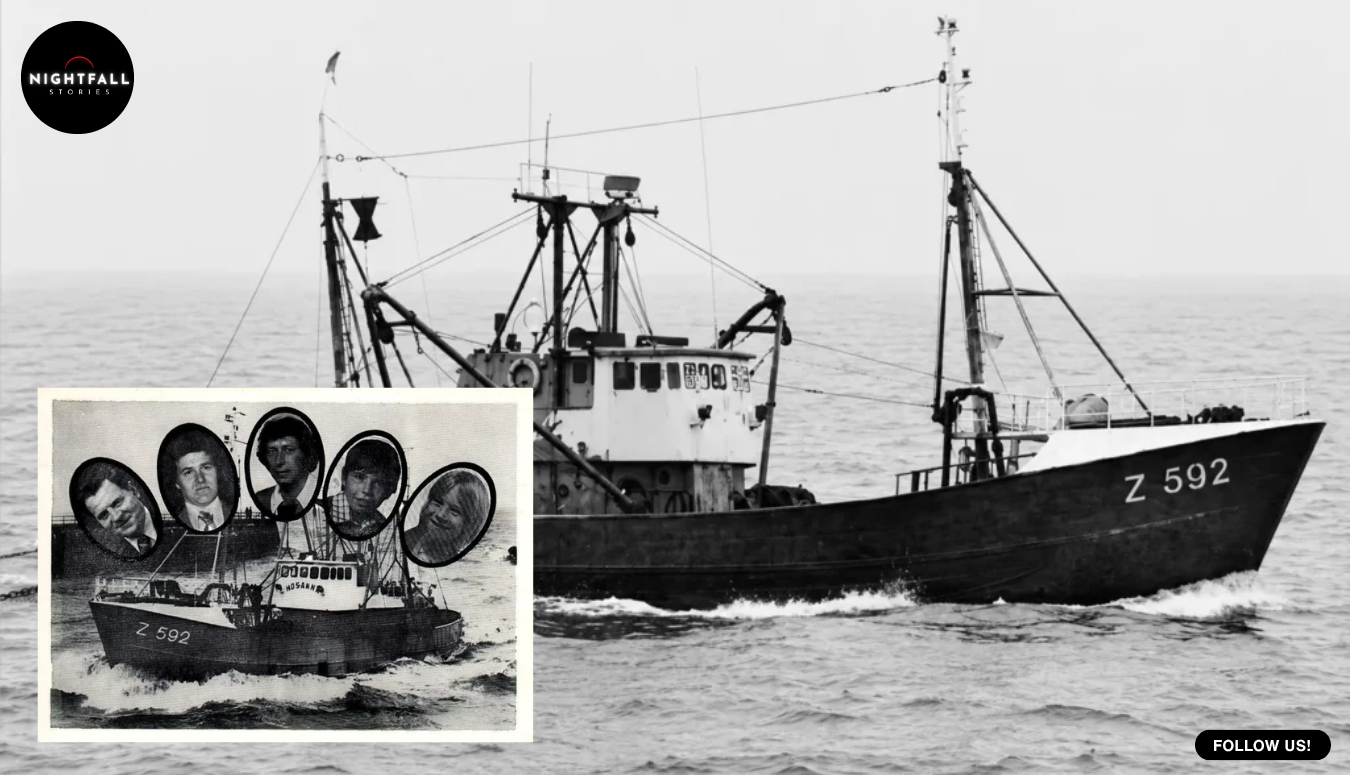
The paperwork was right the whole time. That is the part of this story that takes a moment to sit with. When a Belgian fishing boat called the Z.592 Hosanna disappeared in the Dover Strait in the winter of 1980 with five men aboard, the people who searched for her wrote down where they looked and what they looked near, and what they wrote down was accurate. It stayed accurate. It is still accurate now. And for forty six years it sent everybody who read it to the wrong patch of sea, because two years after the boat was lost, somebody changed the labels on the water.
The boat was found this year. She had actually been sitting on the seabed off Dover for decades, on charts, known to divers as an unidentified wreck, which is a category the English Channel has a great many of. What had been lost was not her position. It was her name. A Dutch maritime researcher and a British wreck researcher worked out why the two had come apart, divers went down twice over the summer and into the autumn, and the Hosanna now has her name back. Nobody is going to be brought up from her. That was decided early and it is not going to change.
Start with the boat, because she was an ordinary working vessel and that matters. The Hosanna was built in Zeebrugge in 1965, twenty five metres of steel, a motor cutter of the sort that spent its life dragging gear across the southern North Sea. By the end of the 1970s she had been sold to a British company, Minerva Fisheries, and in the winter of 1980 she left Plymouth bound for the Netherlands with five people on board. She never arrived. No distress call was ever transmitted. Nothing was heard from her at all.
Two days or so after she sailed, a liferaft marked Z.592 was recovered. Accounts of where differ, which is itself a small illustration of how thin the record is: British reporting places it near the Goodwin Sands off the Kent coast, while a Belgian regional broadcaster places it off the French coast near Cap Gris Nez. Either way it was the only hard thing anybody had. A search followed. It found nothing else. No wreckage came ashore, no bodies were recovered, and the file stayed open in two countries.
The five men were skipper Germain Ackx, his son Piet Ackx, Hector Snauwaert, Pieter Guijt, and Pieter Albertus Guijt, who was Pieter Guijt’s nephew and who was fourteen. Three of the crew came from Knokke-Heist in Belgium and two from Scheveningen in the Netherlands, according to Flemish public broadcasting, though the English language reporting gives the five names without assigning nationalities to them, so the obvious pairing is better left unstated than printed as fact. Pieter Guijt was thirty three. Those are the facts about the crew that are in the record, and they are where the record stops.
What filled the gap instead was rumour, and the rumours were unusually persistent. Over the years there were unconfirmed reports that the Hosanna had been seen off Morocco, off Spain, off Greece. The boat had a history that fed that sort of talk. She had reportedly been linked to smuggling and to running supplies out to the offshore ship of the pirate radio station Radio Mi Amigo, which broadcast illegally from the North Sea, and British marine police had taken an interest in her before she was lost. Once a vessel has that reputation, a disappearance without wreckage invites the theory that there was no disappearance at all, only a boat that went somewhere else under another name. Families who have no answer get offered a great many answers of that kind, and none of them is any use.
Now the buoy, which is the actual heart of this.
The Dover Strait is the narrowest point of the Channel and one of the busiest stretches of water anywhere on the planet. Something like four hundred commercial movements a day pass through it, crossing ferries cutting across the grain of the through traffic. To stop that turning into a permanent collision risk, the strait is run as a traffic separation scheme, which is essentially a motorway laid out on the sea: lanes going one way, lanes going the other, and a separation zone down the middle that nobody is supposed to be in. Because water takes no paint, the lanes are marked by buoys, and the buoys in the middle of that strait carry names in a series beginning with the letters CS, for Channel Separation.
In 1980 the people searching for the Hosanna did what anybody would do and described their search area in relation to the nearest fixed thing they could name. Their records refer repeatedly to the buoy CS2. That was a perfectly sensible way to write it down. A buoy is a known object in a known place, which makes it a better reference than a string of coordinates that can be mistyped.
Then, in 1982, the Dover Strait routing was reorganised. New traffic separation arrangements came in, the lanes shifted, and the marks that defined them were repositioned and renumbered. The buoy that is called CS2 today is not in the place where the buoy called CS2 sat in 1980. Same name, different water.
Follow what that does to the search. A record that says the search concentrated near CS2 remains a true record of what happened. But anybody who picks it up afterwards and plots it, naturally and correctly, against a modern chart will put a mark in the place where CS2 now is. They will then look there, find nothing, and conclude that the record is unreliable or that the boat is somewhere else entirely. The error is not in the document and it is not in the reader. It sits in the gap between them, created by a change neither of them made.
Think of a house number on a street that was later renumbered. A letter addressed to number twelve in 1979 was correctly addressed. Deliver it in 1985, after the council has run the numbers the other way, and it goes to the wrong door, and the person who finds it there has no reason to suspect the address was ever right. Nobody is wrong. The letter still ends up in the wrong hands. That is the whole mechanism, and it is why a search can be conducted by competent people with accurate paperwork and still fail for nearly half a century.
There is a second reason the mistake was so durable. A buoy number feels like a permanent fact. Coordinates look provisional, something you check and re-check, but a named mark on a chart reads as a landmark, and landmarks are the things you trust in order to doubt everything else. So when the plotted position produced nothing, the reasonable conclusion was that the 1980 search had been loose or that the liferaft had drifted much further than anyone thought, and the search widened outwards from a point that was never the right point to begin with. Every expansion of the area made the real site relatively less likely to be covered. The further you look from the wrong centre, the more sea you have to rule out.
It also helps to remember what sort of record this was. These were not scientific survey logs. They were the working notes of a 1980 search for a small fishing boat, written quickly by people who expected to be read within days, not in forty six years. Nobody writing them had any reason to imagine the reference frame itself would be rebuilt around them. There is no annotation to catch, no footnote saying that CS2 means the old CS2. The only way to find the problem is to already suspect that a label can move, and then to go and check the history of the labels, which is archive work rather than search work and belongs to a completely different trade.
Mark Lewis, the British wreck researcher who worked through the historical material, has described the task in almost exactly those terms. The job, as he put it, was to take records written in 1980, work out what they actually meant geographically, and then compare that against what could be seen underwater. Once the historic changes to the Dover Strait buoy system were understood, he said, the geography of the case started to make a great deal more sense. On the Dutch side the research ran through Cees Meeldijk, a maritime researcher working with Stichting Onderzoek Maritieme Vermissen, a foundation that does nothing except investigate people lost at sea and whose name appears in some reporting with a slight spelling variation. The foundation went back through the archive material, reinterpreted it, and concluded that the search area had to be off Dover after all.
Which brought everybody to a wreck that was already on the chart and had been for years, sitting there with no name attached, because the one thing that would have settled it was gone. The Hosanna lies upright. Her working deck is at roughly forty seven metres and the seabed beneath her runs towards fifty two, though one Dutch account puts the depth at nearer fifty five. Her wheelhouse is no longer standing. On a fishing boat the wheelhouse is where the obvious identifying features live, which is precisely why identifying her needed archive research rather than a diver with a torch reading a name off a plate.
Forty seven metres is not recreational diving. It is technical diving, with mixed gas, planned decompression and a hard limit on how long anyone can usefully stay. Doing it in the middle of the world’s busiest shipping lane is a separate problem again, and a regulatory one. Permission to dive the site had previously been refused, according to the Belgian federal police missing persons unit, Cel Vermiste Personen, whose Gerry Van Loock has spoken publicly about the case. An exemption was eventually granted, which is the only reason any of this happened.
And the lane itself is the reason permission is not casually given. Suspending a diving operation in the middle of the Dover Strait means putting a boat with divers in the water in a corridor that large ships cannot swerve in, cannot stop in and are legally required to keep moving through. A dive boat on station is a hazard to navigation and a hazard to itself. That is why the refusal makes sense and why the exemption was the hinge the whole thing turned on: no exemption, no dive, no identification, regardless of how good the archive work had been.
The first dive went in during August, from a charter boat called the Maverick operated by Mutiny Diving, a technical diving outfit based in Dover. The team filmed the structure. The second went in late September from a vessel called the Renegade, and this time members of the Guijt family were aboard on the surface while the divers worked below, along with a Dutch television crew. Afterwards the family put flowers on the water above the wreck.
What actually clinched the identification was the winch. Fishing boats are individual in their gear, and the winch on the wreck was compared against old photographs of the Hosanna until, as Meeldijk put it, it was clear that it really was her. A handful of items were brought up as well, including a radio with Oostende written on it, the Belgian port the boat worked out of in her early life.
There is an honest caveat to put plainly rather than bury. The full underwater imagery, the video and the specific identifying features have deliberately not been published. A documentary is in production with the Dutch public broadcaster EO, reportedly produced by Mary Kragtwijk and expected to air in 2027, and the material is being held back until it is finished. That means the central claim here rests on the assertion of the divers and the researchers rather than on evidence anyone else can examine, and it is being withheld for a commercial reason. The families have been told, and a national police unit is treating the identification as real, which is not nothing. But it has not been shown.
The cause of the sinking is the other place to be careful. In the English language reporting it is simply undetermined, and the investigators say they hope further examination of the wreck and the archives may yet answer it. The Dutch side has gone further in public. Radar at the time of the disappearance is said to have shown the echoes of two vessels, and from that it has long been assumed the Hosanna was run down. Meeldijk has said the underwater images make it clear the boat suffered a collision while she was crossing the strait, and that she was probably struck in dense fog by a large cargo ship, with a substantial dent and tear visible in one side of the hull. That is an attributed assessment from the researcher who has seen the footage, not a finding by any investigating authority, and it should be read that way. Nobody has named another ship and nobody is likely to.
What will not happen is any recovery. The hull is filled with silt and sand, which makes going inside it too dangerous for divers, and so no remains will be brought up and no identification by DNA is possible. The site is being treated as what it is, a sailor’s grave, and the boat stays where she is. Relatives in the Netherlands had been kept informed by the foundation for years. In Belgium the federal missing persons unit has gone back to the families in Knokke-Heist with the news.
So this ends somewhere strange. Five families now know where. They are not going to be told why by any official process, they are not getting anyone back, and nothing is going to be raised from the seabed off Dover. The answer they have is a position and a name, after forty six years of neither.
And the thing worth carrying away from it is smaller and stranger than a shipwreck. Every search that failed was conducted properly. The 1980 searchers wrote down the truth. Everyone who came after read it faithfully. The failure was not in the record and not in the reading but in the two years between them, when a shipping lane was tidied up and a buoy quietly took its name to a different piece of water. The document never stopped being right. The world underneath it moved.