Category: News

  • He planted 130 trees on a hillside carved apart by floods. His barley nearly doubled, and researchers say that almost never happens

    He planted 130 trees on a hillside carved apart by floods. His barley nearly doubled, and researchers say that almost never happens

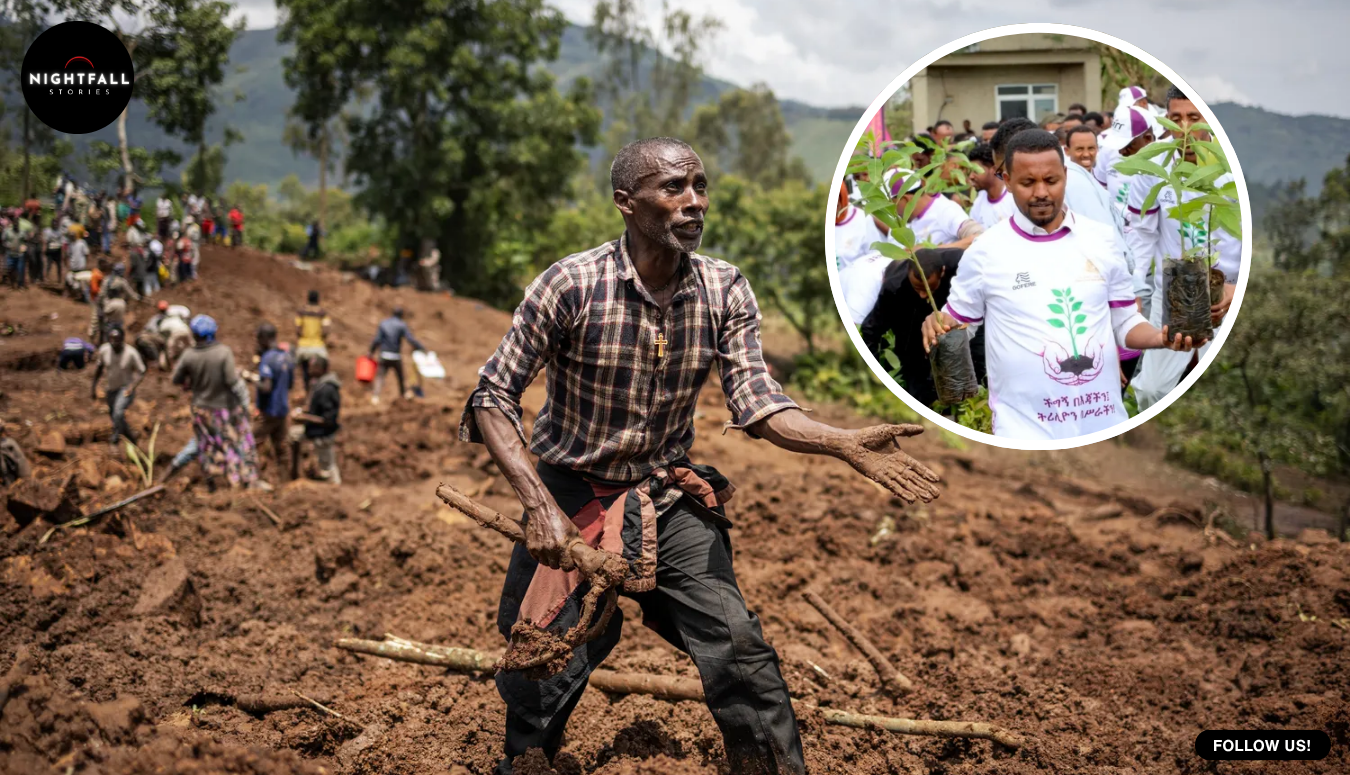
    Niku Argane’s farm sits on a steep hillside in the Gurage Zone of central Ethiopia, in a semi-mountainous stretch of country where years of flooding have cut deep gullies straight through the land. He is 32. He has a wife and four children, and the soil on that hillside used to grow enough barley and potatoes to feed all of them and leave a surplus to sell at market.

    Then it stopped doing that. The soil eroded, washing downhill every rainy season through the gullies the water had opened. Drought made what was left harder to work. As he put it to a reporter who came to the farm, they never stopped farming, but production fell because the land was degrading underneath them.

    What he did about it is unremarkable on paper. Since 2019 he has planted eighty tree seedlings on his own farmland and another fifty in a communal area nearby. Along the edges of his fields he has put in grass, fodder plants, fenugreek and fruit trees, which hold the soil in place and also feed the four cows, six goats and three sheep he keeps for milk and meat. Nothing in that list is clever. Any agricultural extension officer anywhere would recommend it.

    His barley harvest has gone from about 1,800 pounds an acre to roughly 3,200.

    That number is his own account rather than an independently measured yield, and it belongs to the whole package rather than to the trees alone: seven years of grass and fodder and fenugreek and edge trees, all working together to stop water running off a slope and taking the topsoil with it. But it is close to a doubling, on a hillside that was being written off, and that is the part worth understanding, because according to the researchers who work on this, what happened on Argane’s land is close to a statistical freak.

    Aad Kessler is a researcher at Wageningen University in the Netherlands who studies land restoration for a living, and he is broadly supportive of what Ethiopia has been attempting. Here is how he describes the thing he supports: “Reforestation is one of the most difficult things you can imagine. It almost always fails.”

    It is rare to get a sentence like that from someone on the inside. Scientists who back a programme usually defend it. Kessler’s position is that the effort is worth making precisely because it is enormous, and that at this scale even a thirty percent survival rate would still represent a vast amount of new tree cover. That is arithmetic rather than optimism, and it quietly concedes that most of what gets planted is expected to die.

    Why does tree planting fail? Not for the reasons most people assume. It is not usually about the wrong species, or bad soil, or even drought, though all of those contribute. The mechanism is simpler and more human than that.

    Emiru Birhane Hizikias, a restoration ecologist at Nord University in Norway, puts it in a single image: you cannot expect a baby to grow if you do not care for it, and that, he says, is how plantation in Ethiopia is being done. A seedling is not a finished tree. It is a fragile thing six inches tall that needs water in its first dry season, protection from grazing livestock in its first two or three years, and somebody to notice when it is failing and replace it. Planting is the easy, visible, photographable part, and it takes an afternoon. Tending is years of unglamorous attention that nobody films.

    This is where the scale comes in, and it is the only place in this article where it will. According to the Ethiopian programme’s own accounting, published by its Ministry of Agriculture and reported by Yale Environment 360, tens of millions of Ethiopians have planted more than 47 billion seedlings in the last seven years, against a stated target of 50 billion by 2030. That figure is the government’s own self-reported total for its own programme and should be read as such. It has never been independently audited at national scale, and nothing in this article depends on it being right.

    What can be checked, and has been, is what happened to the seedlings.

    A study published last year in the journal Discover Environment did the work properly on one district. Setiye Abebaw Tefera and Vijaya Lakshmi Thatiparthi, at the Centre for Environment at JNTU in Hyderabad, took satellite imagery from Landsat and Sentinel over the Gubalafto district in north-eastern Ethiopia, about a thousand square kilometres, and tracked land cover from 2013 to 2024 using machine classification and vegetation indices.

    Some of what they found is genuinely encouraging. High-density vegetation in that district went from under one percent of the land area to more than nine percent over the eleven years, a roughly tenfold increase. Woodland expanded by around forty square kilometres, mostly converted from farmland.

    And some of what they found is the uncomfortable part. Actual forest cover in the same district fell over the same period, from a little over sixteen percent to under fifteen percent. Tree planting and forest loss were happening simultaneously in the same place. More importantly, the authors put district-level seedling survival at just under forty percent on average, with a range running from under eight percent in the worst areas to around seventy-six percent in the best. They also note that armed conflict in the region after 2020 disrupted restoration work, which is a reminder that none of this happens in a vacuum.

    Just under forty percent survival, with some places losing nineteen seedlings in every twenty. Kessler’s illustrative thirty percent, which he offered as a deliberately pessimistic floor, turns out to have been close to the real figure.

    The gap between what is claimed and what survives has been pressed before. Reporting a couple of years ago found that while officials had put survival at eighty-five percent for one year’s planting, sources inside the country’s own environmental commission suggested the true rate might not pass fifty percent. The same reporting carried a far more sobering comparison from Wubalem Tadesse of the Ethiopian Environment and Forest Research Institute, who pointed out that data indicated more than ninety-two thousand hectares of forest were being destroyed every year while the country was planting roughly twenty thousand. That is a national programme of extraordinary ambition running at roughly a fifth of the speed of the damage.

    There are other structural problems, and they are the sort that explain a thirty-nine percent survival rate better than any amount of talk about rainfall. The programme has been described as lacking a dedicated budget and a single coordinating office, with responsibility split across three government ministries, which is a reliable recipe for nobody being accountable for what happens to a seedling in year two. The official species target was around thirty percent fast-growing trees, thirty percent indigenous species and forty percent fruit-bearing and ornamental, but farmers have strong economic reasons to favour fast-growing eucalyptus, which earns money and is hard on the water table and on whatever is growing near it.

    None of which is an argument that the planting days are theatre. They are not, and the people who turn up to them are not fools.

    On one day each August, millions of people across the country go out and plant. One of them, Yeshihareg Teferi, travelled at sunrise from her home in Addis Ababa out to Tulu Dimtu so that she could crouch in the rain and dig holes in the mud. It was her fifth consecutive year doing it. In previous years she had put in indigenous species, African wild olive and African fern pine among them. This time she chose juniper. Her reasoning, as she gave it, was about obligation rather than enthusiasm: that there is a responsibility to make sure the next generations inherit green and fertile ground rather than bare land.

    That is the right instinct and it is also, on its own, not enough, and the uncomfortable truth in the survival figures is that her juniper has somewhere around a two in five chance.

    It is worth holding on to how hard the underlying problem is, because nothing about this is a story of lazy farmers. Belayneh Mamo is 65 and farms in the Amhara region in the country’s north, which is drought-prone. He depends on the July rains for his teff, sorghum, maize and the wheat he turns into bulgur. He also receives seeds from the government, coffee and neem and gesho. In one recent season the rains simply did not arrive until August, and he could not plant anything until they did. By his account, in earlier years the crops would have been well along by September and food would already have been coming in; the delay hit the seedlings, the crops and the animal feed all at once.

    That is one farm in one season and it is weather, not proof that a national programme has failed. But it is a precise illustration of the ground truth. A man who has farmed for decades, who wants the trees, who was given the seed, still lost a season to rain that came a month late. Multiply that across a country and you can see where the missing sixty percent goes.

    So what actually works?

    Endalkachew Wolde-Meskel, a soil scientist with the Center for International Forestry Research, states the reframe in one line: the objective is not really to plant trees, it is to restore the functioning of an entire landscape. Those are different projects that happen to involve some of the same equipment.

    The practical version of that distinction looks like earthworks rather than saplings. Half-moon ditches, which are shallow crescent-shaped trenches dug across a slope, catch water that would otherwise sheet straight downhill and hold it long enough to soak in and feed whatever is planted inside the curve. Check dams are low barriers built across an existing gully, which slow the water travelling down it, so the gully stops cutting deeper and starts filling with the silt the water drops. Neither is a tree. Both are the reason a tree can live on a slope where it otherwise could not.

    This is exactly what Argane has been doing, in effect, with living material. Grass and fodder and fenugreek along his field edges are a soil-holding structure that happens to be edible. His trees and grasses have reduced the erosion on his land and slowed the movement of water across it during heavy rain, which is why his barley came back. The crop did not improve because he added trees. It improved because he stopped losing his soil, and the trees were part of how he stopped.

    Not everything in the national picture stands up to the same scrutiny. Kumera Wakjira, who is director-general of the Ethiopian Wildlife Conservation Authority, has spoken about wildlife returning to Abijata-Shalla National Park as restoration has progressed there. That may well be true, and it would be good news, but it is the head of a government agency describing an improvement in his own agency’s park, with no independent survey attached, and it should be read with that in mind.

    There is a temptation, writing about a programme this big, to score it. Either tens of billions of trees are a triumph or they are a state vanity project and a photo opportunity. Neither reading survives the detail.

    What survives the detail is this. The national total is a number produced by the organisation being measured. The one hard, independently measured figure available says that in one district, somewhat under two seedlings in five lived. The researcher most sympathetic to the whole effort says reforestation almost always fails and he means it literally. The ecologist says the reason is that nobody looks after the seedlings once they are in the ground, and he is describing his own country’s programme when he says it.

    And on a hillside in the Gurage Zone, a 32-year-old man with four children put a hundred and thirty trees into the ground, plus grass and fodder and fenugreek and fruit along every edge of every field, and then he stayed. He kept at it for seven years. He watched where the water went when it rained and he put something in its way. By his own reckoning the barley coming off that land has nearly doubled.

    His seedlings lived for the least mysterious reason there is, and it is the one thing no national target can deliver and no planting day can substitute for. Somebody was there the following year, and the year after that, to look after them.

    The planting was never the hard part.
  • He walked away from cinema and taught himself botany. Then a laboratory in Bologna spent eighteen months on the film he left behind

    He walked away from cinema and taught himself botany. Then a laboratory in Bologna spent eighteen months on the film he left behind

    For about a year and a half, a man in his mid seventies divided his attention between a film laboratory in the north of Italy and a slope of bare volcanic rock below a fort in the Indian desert.

    In Bologna, technicians were working through a 16mm negative he had shot in 1989. The inspection report on it read like a list of everything that can go wrong with film: perforation damage, tears, scratches, shrinkage, mould, halos. Colour had drained out of whole sections. The sound carried significant electrical noise, distortion, gaps and a great many drops. On the rock in Jodhpur, he was looking after a park that had not existed when he stopped making films, because he had built it, species by species, out of a hillside nobody had wanted.

    The man is Pradip Krishen. He made three feature films and then he stopped, and the second thing he did with his life turned out to be the thing he is now known for. That is the part of this story worth sitting with. Plenty of people quit something they were good at. Very few of them go on to write the standard reference work in an unrelated field.

    He was born in New Delhi in 1949 and educated at Mayo College, then St Stephen’s College in Delhi, then Balliol College at Oxford. In 1972 he took a temporary lectureship in history at Ramjas College in Delhi University, and then an MPhil at Jawaharlal Nehru University, where by his own later account the academic history on offer failed to hold him. He drifted toward film instead, which in the Delhi of that period was not an industry so much as a small circle of people who knew each other.

    His first feature, Massey Sahib, came out in 1985. His third, Electric Moon, in 1991. The one in between is the one that would not go away.

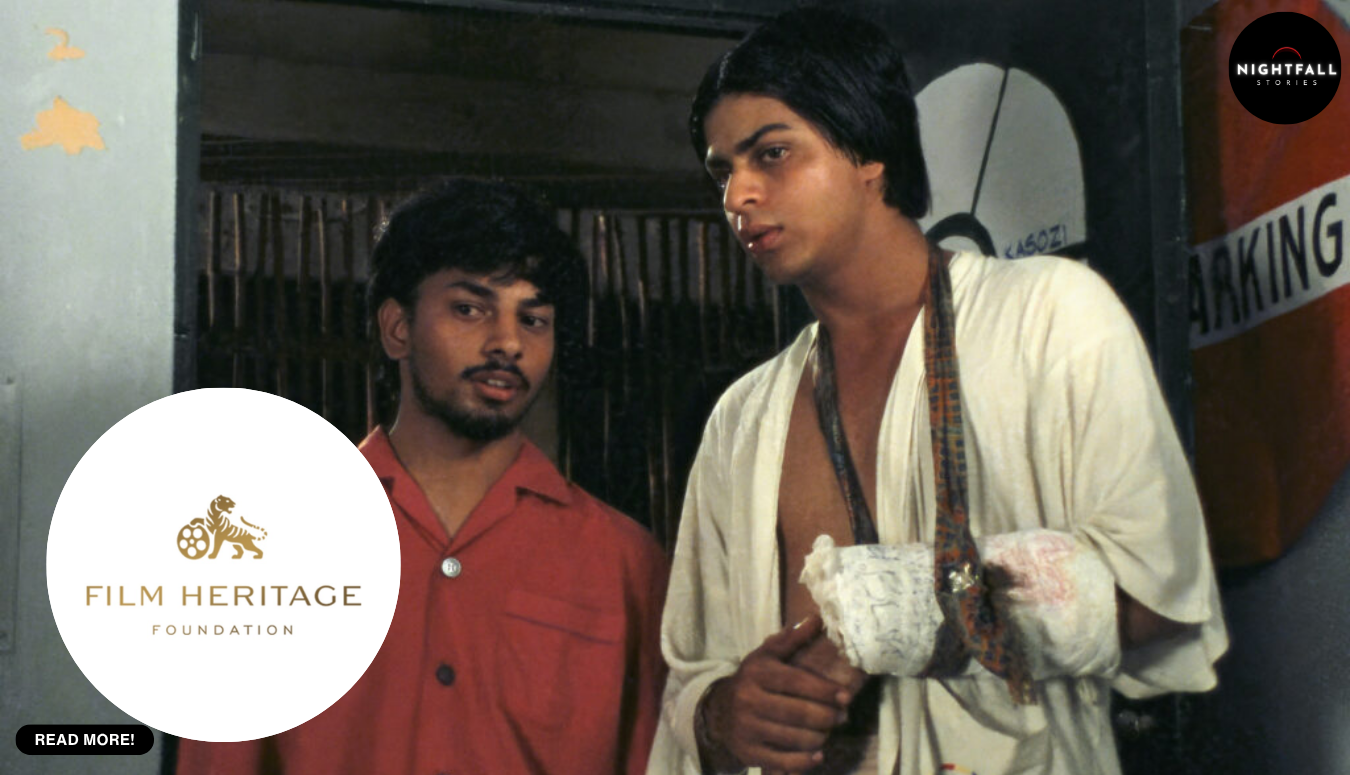
    In Which Annie Gives It Those Ones was made for Doordarshan, the Indian state broadcaster, and it is set in the 1970s inside a fictional architecture college in Delhi called the National Institute of Architecture, modelled closely on the real School of Planning and Architecture. It follows a group of final-year students: hostel life, unfinished thesis projects, the small cruelties of academic authority, and the specific way a certain kind of student talks when he is nineteen and convinced he can fix the country. The title comes from the main character’s habit of giving it those ones, which is the film’s phrase for his unworkable schemes to put architecture to some grand social use.

    Annie himself, whose real name in the film is Anand Grover, was played by Arjun Raina. Roshan Seth played the college principal. The cast also holds some very early screen appearances by actors who later became enormously famous in India, including Shah Rukh Khan in a small part as a senior student, which is the kind of detail that makes a lost film into a rumour.

    The screenplay was by Arundhati Roy, who was 28 at the time and had herself studied at the School of Planning and Architecture. She was not then a writer anyone had heard of. She also appears in the film as Radha, an independent and nonconformist friend of Annie’s, and she is credited with the production design on top of that. She was married to Krishen when the film was made, which is the straightforward reason a first-time screenwriter was writing for this particular director, and it is the only thing about either of their private lives that belongs in this story. Years afterwards she published a novel that made her internationally known, which is why most people now come to this film through her name rather than his.

    At the National Film Awards, the state film prizes, the film took Best Feature Film in English for Krishen and Best Screenplay for Roy. The year attached to it reads differently in different records, because the Indian awards for one year’s films are handed out in the following one. Either way, it was honoured by the national jury.

    And then it went away. Doordarshan broadcast it once, late at night, and that was essentially the end of it. There was no theatrical release. The original print was lost. What survived in public was videocassette recordings taped off that single broadcast, copied and recopied and eventually digitised and put on the internet, and for close to four decades that degraded tape was the only way anyone saw it. Krishen himself has described it as a film that virtually went underground. Its reputation grew roughly in proportion to how hard it was to see, which is what reputations do.

    He stopped making films in the first half of the nineties. The exact year is recorded inconsistently, somewhere around 1994 or 1995, and the reason he has given himself is not the one you might expect. He did not describe it as failure or as a quarrel with anybody. He said he wanted to do something internal and meditative and small, something that was not about projecting anything to anyone. Film-making had become, in his telling, simultaneously too crowded, full of collaborators who took something away rather than adding to it, and extremely lonely. One summary of his life attributes the departure to corruption in the industry, but that framing does not appear in his own extended account of it, and his own account is the one to trust.

    What he did instead was learn plants, from nothing, with no botanical training of any kind. A colleague who worked with him later put the starting point memorably: at the beginning, Pradip knew exactly one tree, and it was mango.

    His method was stubborn and unglamorous. He worked from Dietrich Brandis’s The Forest Flora of North-West and Central India, a reference book published in 1874, and he annotated his copy relentlessly, inventing his own system of symbols for leaf characteristics so he could find his way back through it. He has said the work requires a certain obsessiveness, and a willingness to keep pushing when a fog of incomprehension is sitting in front of you and nothing is resolving into sense yet. That is a precise description of self-teaching, and it is the opposite of a hobby.

    In 1993 he bought land with friends in Bariaam village near Pachmarhi, in the forested hills of central India, among them an architect named Golak Khandual, who had done the make-up on Annie four years earlier. He got involved in local heritage protection through a conservation trust, which pulled him into bureaucratic obstruction and then into litigation that was not resolved until 2012. The jungles around Pachmarhi became his classroom.

    Thirteen years after he stopped directing, the field guide appeared. Trees of Delhi was published in 2006, and it did something field guides do not do, which is sell. Close to twenty thousand copies went out. If you want to identify a tree in Delhi, that is still the book you reach for. Jungle Trees of Central India followed in 2014, and it took him four years and thirty-seven trips into central India to finish, with two thousand copies ordered before it was even printed.

    Somewhere in there, the Mehrangarh Museum Trust in Jodhpur asked him to do something about the ground around their fort, and this is the project that is hardest to picture from the outside and most worth picturing.

    Mehrangarh is a fifteenth-century fort that sits on a great rise of rock above the city of Jodhpur, at the eastern edge of the Thar desert. The rock itself is volcanic, hard, fractured, and almost entirely without soil. Around seventy hectares of it below the walls had been quarried and dumped on for generations, and the whole slope had been colonised by Prosopis juliflora, a thorny mesquite shrub originally from Central America, known locally as baavlia, which grows in dense impenetrable thickets and chokes out everything native.

    Krishen’s team did not clear it with machines, because machines on that ground would have destroyed the rock and the seed bank with it. They hired khandwaliyas, local rock chisellers whose traditional work is cutting stone, and had them take the mesquite out of the fissures in the volcanic rock by hand, root by root, so that the cracks survived. Then they put desert plants back into the same cracks: over eighty native species propagated in a nursery on site, raised in polybags under shade, planted out around the monsoon when there was a chance of rain. It took about seven years. The Rao Jodha Desert Rock Park opened to the public in 2011, and it now holds something in the region of two hundred and fifty native plant species. It is described as India’s first outdoor museum of desert plants.

    It is important not to imagine a garden in the ordinary sense. There is no lawn. There are no rows. What is there is a hillside of stone that has been persuaded back into being a desert, with the plants growing out of the same cracks they would have grown out of before anyone interfered, and paths that let you walk through it and look.

    Krishen is blunt about the distinction, and it is the single most useful thing he says. People think restoration means planting trees, he has said, largely because planting trees is what governments do. What restoration actually means is trying to return a landscape to something like what it was before it was damaged, which requires knowing what was there, what soil and shade and water each species needs, and what will simply die. At Jodhpur his team spent three years recording species, soil conditions and survival rates, and that record is what let them push survival above the sixty to sixty-five percent that counts as normal. He has also built or advised on gardens at Nagaur Fort, at the Calico Museum in Ahmedabad, on sand dunes near Jaipur, and at Sunder Nursery in Delhi, which is now one of the busiest public green spaces in the city.

    That was the life the film came back into.

    The Film Heritage Foundation, a Mumbai-based archive and restoration outfit run by Shivendra Singh Dungarpur, went looking for whatever survived. In January 2024 they acquired the director’s own materials, and in March 2024 those materials were moved to Mumbai. The 16mm original camera negative and the 16mm sound negative were preserved at the National Film Archive of India, under the NFDC. A 35mm release print was in the foundation’s own vaults. There were digital audiotapes of the whole film, and, remarkably, the surviving shooting script and dialogue script.

    The foundation’s own account of the work reads like a condition report, and it is worth taking seriously as a piece of craft documentation rather than a press release. Everything listed at the top of this article came off that inspection. The negative went to L’Immagine Ritrovata in Bologna, one of the handful of laboratories in the world that does this properly, and the repair was largely manual: physically mending the film, then digital restoration, then colour grading, because the colour had to be judged rather than calculated. Krishen worked alongside the restorers throughout, which matters, because with a film this obscure there is nobody else alive who knows what it was supposed to look like. It took about a year and a half. The result is a 4K restoration of a film shot on 16mm for television.

    It had its world premiere in the Berlinale Classics section of the Berlin International Film Festival, on a bill it would never have reached when it was new, and Krishen’s reaction was reported as straightforward delight that a film which had gone underground was being shown to the world on that kind of platform. He also made a point about why it had mattered at the time: nobody then was making films about people like them, about an English-speaking student subculture whose characters spoke their own patois. Dungarpur, for his part, has called it arguably the first English Indian film, irreverent and idiosyncratic. It went on to the New York Film Festival in the Revivals section, and it was reported as going out theatrically in India across fourteen cities and nineteen cinemas, which is more distribution than it ever had.

    Here is the part that is almost too neat to be true, and is on the record anyway.

    The daydreams that give the film its title, the ones Annie keeps giving it, are schemes for using architecture to improve the world. One of them, as the film has been described, is planting trees along the railway lines.

    The student in that film was a joke about idealism, the sort of young man everyone has met who has a plan for the country and cannot finish his own thesis. The man who directed him walked out of cinema a few years later and spent the following three decades doing a rigorous, documented, unromantic version of exactly that fantasy: learning what grows where, and putting it back.

    He did not need the film to return. He had the books and the park and a body of work that had nothing to do with anything he filmed. But it came back anyway, in better condition than he left it, and when the screenings in Berlin and New York were over he went back to the rock below the fort, where the plants are still in the cracks the khandwaliyas opened for them, and where the only thing that ever mattered was whether they lived.

  • Her floating hospital has treated more than 800,000 people. It has no address, because the islands it serves will not stay in one place

    Her floating hospital has treated more than 800,000 people. It has no address, because the islands it serves will not stay in one place

    The thing to understand first is the ground.

    In the north of Bangladesh, where the Brahmaputra comes down wide and heavy out of the mountains, the river carries so much silt that it builds land out of it. Shallow banks rise inside the water, dry out, firm up, and become islands. People move onto them, because the soil is good and because nobody else wants it and because they have nowhere else to go. They plant, they build, they have children there. And then the river takes the island back. Sometimes over years. Sometimes in a single flood season. The land that was there in the spring is water by the autumn, and a new island has appeared four kilometres downstream.

    These are the chars, and by the Ramon Magsaysay Award Foundation’s reckoning at least one in twenty Bangladeshis live on them.

    Now try to put a clinic on one.

    You cannot. That is not a figure of speech or a funding problem. You cannot build a hospital on land that has a known expiry date and no fixed coordinates, which means that for most of modern Bangladeshi history the people living on the chars were outside the health system entirely, not because anyone had decided to exclude them but because the system is made of buildings and the chars are not made of anything permanent. A peer-reviewed evaluation published last year found that only about 35 percent of char residents were reaching public health services at all, and that roughly 80 percent of them counted as ultra poor. People with no permanent address also tend to end up with no documents, which cascades into no school enrolment, no land title and no entitlement to anything that requires you to prove where you live.

    That cascade is worth spelling out, because it is the quiet half of the problem and it is not medical at all. A birth that happens on a char with no registrar nearby is a birth that may never be recorded. A child who is never recorded cannot easily be enrolled in a school, cannot sit a national exam under their own name, and later cannot open an account, claim a benefit, inherit land or prove they are a citizen of the country they have lived in their whole life. Erosion does the same thing to adults: when the island goes, so does the address on every piece of paper attached to it. In the survey that researchers ran across these communities, 43 percent of respondents had no formal education at all. That figure is not really a statement about schools. It is a statement about paperwork.

    So in 2002 a Bangladeshi woman named Runa Khan did the obvious thing, which nobody had done. If the patients cannot come to the hospital and the hospital cannot stand still, put the hospital on the water.

    She converted a barge. It had been brought over from France, and it became the Lifebuoy Friendship Hospital, and it went up the Brahmaputra to the islands. In the years since, according to figures published by the corporate partner that has funded it since the beginning rather than by Runa Khan’s own organisation, that single vessel has treated more than 816,000 patients, delivered around 1.35 million separate health services, run 489 surgical camps and performed more than 19,000 operations. In one recent year alone it saw 48,784 patients, of whom about 4,400 needed a specialist and 987 needed surgery.

    Last year the Magsaysay Foundation named her one of its awardees, with a citation that turns on a single idea: that in her hands, privilege became not an entitlement but a responsibility, not a family legacy to protect but a gift to be shared. She is due to receive it in Manila later this year.

    That is the sentence doing the real work, and it needs the biography to make sense of it.

    Runa Khan was born in 1958 into one of the most comfortable families in the country. By the Foundation’s own description she started out exempt from almost everything that made life hard for most Bangladeshis. And for the first two decades of her working life she did nothing that would predict any of this.

    She studied geography, taking a degree at a college in Calcutta and a second one in Dhaka. In 1979 she was teaching kindergarten and junior school children in Chittagong, and what preoccupied her then was not poverty or medicine but pedagogy. She had noticed that her students were being trained to memorise and reproduce rather than to understand, and she set about fixing it, writing textbooks built around getting children to interpret information instead of storing it, and developing her own teaching methods for motivating them conceptually. She also ran a clothing boutique that employed around forty women.

    That is a complete and respectable life. Teacher, textbook author, small business owner. Most people who have built that by their late thirties spend the next thirty years maintaining it.

    In 1997 she went to visit a char.

    What happened on that visit is not something she has elaborated at length, and it would be dishonest to embroider it. What is on the record is that she saw how people were living on an island in the Brahmaputra and did not go back to her previous life. Five years later, at an age when the overwhelming majority of people have stopped starting things, she founded Friendship with 24 field staff and four people in an office, and a boat.

    It is worth sitting with the gap between those two facts. She was about 39 when she saw the chars and about 44 when the hospital ship started work. She was not a doctor. She was not a development professional. She had no institutional platform in health, no technical training in it, and no obvious reason to think she could build anything in it. What she had was an unusual willingness to accept that the problem was a geography problem rather than a charity problem, and that the answer therefore had to be a vessel.

    A boat is not a sentimental choice here and it is important not to read it as one. It is the correct engineering answer to a specific physical constraint. A hospital ship can reach a community that has no road, no jetty and no stable shoreline, because it does not need any of those things. It can relocate when the island relocates. It can carry an operating theatre, diagnostic equipment and a specialist team to a population of a few thousand people, stay as long as the caseload justifies, and then move to the next population a few hours upriver, which no building can do and no ambulance can do because there is nothing for an ambulance to drive on. When the river rearranges itself, the hospital rearranges itself too. That is the entire insight, and almost everything else Friendship built came out of following it honestly.

    A second ship, the Emirates Friendship Hospital, later joined the first on the same river, and between them, over roughly a decade and a half, the two vessels were documented in that independent evaluation as having served something in the order of 1.2 million individual people. Friendship itself now says it operates seven hospital ships along with two land hospitals, around 550 mobile clinics, roughly 700 trained community medic aides and 137 economic development hubs, and that it reaches about 7.5 million people a year. Those are the organisation’s own figures and they should be read as such. The two hospital ships named above are the ones an outside research team has actually audited, and Friendship’s own health pages describe two floating hospitals on the Brahmaputra specifically, so the higher vessel count presumably includes coastal and other craft doing different jobs. The reach figures have not been independently checked by anybody we could find, and a charity’s account of its own scale is not the same category of fact as a surgical log.

    What has been independently checked is more interesting than the headline numbers anyway, and it points somewhere the publicity material does not.

    A research team evaluating the model surveyed 760 people in the char communities it serves. Most of the respondents were women. Forty three percent had no formal education. Two thirds were living on less than about 1,620 dollars a year. And when the researchers asked which part of the service people had actually used in the previous six months, the answer was not the ship. Just under 13 percent had gone to a hospital ship for a common illness. More than 90 percent had used something else: a satellite clinic, or a community medic aide.

    The medic aides are the part of this that deserves the attention, and they are the reason the model did not stay a charity.

    They are women recruited from the chars themselves. They live on the islands they serve, they are trained by Friendship in primary care, health education and counselling, and they are the first point of contact for their own neighbours. Some go on to further training as community skilled birth assistants, which means prenatal and postnatal care and attending deliveries, on an island, where the alternative is a boat journey to a town. Some carry mobile phones so they can consult a doctor remotely. Above them sit the satellite clinics, led by paramedics, which come round on a weekly, fortnightly or monthly rotation. The ship is the top tier, and it is for the things the other two tiers cannot do: the cataract, the cleft lip, the club foot, the operation.

    The model also travelled, which is the test of whether something is a system or a one-off. The same three tiers were put to work on the coast, where the hazard is salt and cyclones rather than erosion, with static clinics built for communities too far from anything else and a land hospital in the coastal belt, and they were extended to serve refugee populations sheltering in the south of the country. None of that needed a new idea. It needed the same one applied to different water.

    Which means the thing at the centre of this story is not actually the vessel. The vessel is the piece that makes the headlines and the photographs, and it does work no clinic could. But the system only functions because the overwhelming majority of care is delivered by women who already lived there, which is also why it keeps functioning when the ship is two hundred kilometres away. An organisation that employed 28 people at the start now employs more than 7,500, and by its own account most of them come from the communities it serves. The cost side bears this out in a way that is almost comically small: the independent evaluation found char residents were charged somewhere between five and nine cents at a satellite clinic, against a registration fee of around 2.79 dollars at the nearest private alternative. Across every service the researchers costed, from antenatal care to treating a child’s diarrhoea, the per-patient cost came out below the private option.

    Eighty three percent of the people surveyed said they were satisfied with the service overall. Fewer, about 43 percent, were fully satisfied with what they were charged, which is the kind of unflattering detail that tends to get left out of award citations and is worth keeping in, because five cents is still five cents when your annual income is under two thousand dollars.

    The work spread outward from medicine, as it generally does once you are the only organisation that turns up. Friendship says it has brought more than 30,000 children into prefabricated schools that can be taken down and moved when the island goes, that it has trained over 10,000 people in rescue and relief for flood seasons, that it has planted mangroves on the coast, and that it has helped char residents get the birth registrations and citizenship papers that unlock everything else. Its health teams say they immunise over 6,500 char children a year and screen more than 18,000 women annually for cervical cancer, treating around 150 of them for pre-cancerous changes.

    There is an obvious way to write the ending of this, and it would be wrong. The obvious ending is the prize: Manila, the Metropolitan Theater, a woman from a comfortable Dhaka family receiving one of Asia’s more serious honours for having spent the second half of her life on a river. It is a good scene and she has unquestionably earned it, and the Foundation’s board explicitly credited her empathy for the poorest and her courage, vision and tenacity.

    But an award is a thing that happens to a person once, and the point of what she built is that it does not depend on her.

    The truer ending is on an island that may not exist in twenty years, where a woman who grew up on that island, or on one very like it, has been trained to take blood pressure and deliver a baby and recognise the illness that needs a boat. She is not waiting for anyone. She is the nearest thing to a hospital her neighbours have, and when the river finally eats the ground she is standing on, she will move with everyone else and go on doing it from wherever they land next.

    That is what the boat was for. Not to bring medicine to the chars, which would have been a gesture, but to buy enough time and reach to train the people who were already there. Runa Khan was 44 when she started, which is late, and she was not a doctor, which is a bigger gap than it sounds. What she worked out, and what most people with her advantages never have to work out, is that the people on those islands were not short of resilience. They were short of a hospital that could follow them.

    So she built one that floats.

  • Six years after she stopped singing, she walked onstage in Paris and wept. Then came the setlist

    Six years after she stopped singing, she walked onstage in Paris and wept. Then came the setlist

    The last full concert Celine Dion gave before everything stopped was in Newark, New Jersey, on a Sunday night in the first week of March 2020. It was a stop on a tour called Courage. She closed it with Imagine. Nobody in the building, including her, had any idea it was the end of anything.

    Six and a half years later she walked out in front of a sold out arena west of Paris and could not get a word out. The crowd was on its feet before she had sung a note. She stood in it, wiping her face, and when she did speak the first thing she said was that she had promised herself she would not cry. Then she worked through two and a half hours and twenty five songs, which is a full concert by any measure, and the first one she had given since that night in Newark.

    What happened in between is a long, undramatic story of a career being taken apart in pieces. The Courage tour did not get cancelled in one announcement. It got postponed, then rescheduled, then thinned. Eight shows were cancelled outright and twenty three were moved two years into the future. A planned restart of around fifty concerts was abandoned. Eventually the entire European leg went too. Anyone following it from outside would have watched a calendar quietly emptying without being told why.

    The reason came in the last month of 2022, in a video she posted herself, in English and in French, visibly upset. She said she had been diagnosed with stiff person syndrome. And then she described, in her own words, what it was doing to her: the spasms affected every aspect of her daily life, sometimes making it difficult to walk, and they would not let her use her vocal cords to sing the way she was used to. She said that singing was all she knew, that it was what she had done all her life and what she loved most. She said she was working with a sports medicine therapist every day to build back her strength and her ability to perform, and then she admitted, without decorating it, that it had been a struggle.

    Those are her sentences about her own body, and they are the only ones anybody outside her household is entitled to use.

    For what the condition actually is, the useful source is a medical one. The National Institute of Neurological Disorders and Stroke, part of the United States National Institutes of Health, describes stiff person syndrome as a rare neurological disorder. Its characteristic features are stiff muscles in the torso, arms and legs, and a heightened sensitivity to noise, touch and emotional distress, any of which can set off a muscle spasm. The institute states plainly that the condition is progressive, meaning it gets worse over time, and it does not offer a cure. What it offers is management: with the right treatment, it says, symptoms may be kept under control. The drugs it lists are the ones used for muscle spasm and for autoimmune conditions generally, including benzodiazepines such as diazepam, and intravenous immunoglobulin, which it describes as effective in reducing stiffness. It also notes the condition is roughly twice as common in women as in men and usually appears between the ages of twenty and sixty.

    Nothing about Dion’s own treatment is public, and nothing about how her condition will behave is knowable by anyone writing about her. No doctor has spoken about her case, and the appropriate thing to do with that silence is leave it alone.

    But set two documented facts next to each other and the shape of what she did becomes clear without anybody having to embroider it. A medical institute lists emotional distress among the things that can trigger a spasm in this condition. The event she chose for her return was a standing ovation from tens of thousands of people in a room the size of a stadium, which is about as much emotional distress as a human being can arrange on purpose.

    There had been one glimpse in between, and it needs to be stated exactly because a lot of people remember it and would otherwise think the six year figure is wrong. In the summer of 2024 she sang at the opening ceremony of the Olympic Games in Paris, standing on a platform on the Eiffel Tower, performing Hymne à l’amour. It was extraordinary, it was watched by an audience in the hundreds of millions, and it was one song. A single song in the rain is not a concert, and she clearly knew the difference, because she did not go back on stage for another two years.

    She was not absent from public view in those years, she was simply not singing. In 2024 she released a documentary about herself, directed by Irene Taylor, which went out on Prime Video and became the most watched documentary that service had ever carried. It was made with her cooperation and with real access, and in Variety’s interview with Taylor the director recounted that when it came to the hardest footage in the film, Dion told her she did not want that scene cut out. Strip the sentiment out of that and what is left is a decision: a performer whose whole public life had been built on polish choosing to be seen on a bad day by an audience of millions, two years before she tried to sing a concert again.

    The return was at Paris La Défense Arena, in Nanterre, just west of the city, the biggest indoor venue in Europe. The house was sold out. Attendance was reported at thirty thousand by one wire account and at around thirty five thousand by the promoters and by a reviewer in the room, so the honest figure is somewhere in that band and large enough that the difference is academic.

    She opened with On ne change pas, a French song whose title translates roughly to we do not change, which is either a very pointed choice or an accident, and she leaned French for most of the night. Destin came second. Because You Loved Me third. The set ran in four acts with films between them, and she put My Heart Will Go On at the top of the second act rather than saving it for the end, which is the move of someone who did not want the whole evening organised around one song from 1997.

    The ordering is worth paying attention to because it is the closest thing to evidence of what she could and could not do. There is a disco medley in the middle, stitching I Feel Love into I’m Alive and That’s the Way It Is and Sweet Dreams, which is a lot of sustained singing in a row. There is The Prayer and there is Love Can Move Mountains. And there is Courage, the song that gave the abandoned tour its name, performed in the middle of the room she had to build instead of finishing that tour.

    Then she closed the main set with Ebben? Ne andrò lontana, an aria from an Italian opera. Putting an aria at the end of a two and a half hour night, after twenty one songs, is the most exposed possible thing to do. There is nowhere to hide in it. She did it first.

    The encore began with All by Myself, which has the kind of final note people buy tickets for, and ended with Des milliers de baisers, and then it was over, and she had done the thing.

    What was the voice actually like? This is the question that matters and it is also the one most coverage of the night dodged in both directions, either declaring a miracle or inspecting her appearance. The most useful account came from Alma Rota, writing for Rolling Stone France, who was in the room and said something more interesting than either. Rota’s reading was that the voice was not always predictable. It wavered in places. At other moments it produced sustained notes and high reaches that were still entirely under her command, and her vocal runs could still make the human voice sound closer to a wind instrument than to a person. That is not a triumph and it is not a decline. It is a description of an instrument that works, with an uncertain ceiling, operated by somebody who knows exactly where the uncertainty is.

    This is one of the rare entertainment stories where you can actually trust the reporting, and the reason is worth a sentence. A concert is not a press release. Every critic who wrote about this night was physically present and writing their own copy from their own notes, which means four or five accounts of the same evening are four or five genuinely independent sources rather than four rewrites of one handout. The usual problem with coverage of a famous person, that a dozen outlets are all paraphrasing the same single origination, does not apply here. The reviews agree on the facts and disagree on the readings, which is what independent sources look like.

    They also agree on the staging, which turns out to be part of the story rather than decoration. The show was built by the creative director Willo Perron around huge grey monoliths, brutalist arches and slate surfaces, in a palette that stayed close to black and white, with films by Thibaut Grevet running between the acts on themes of movement and transformation. Scott Price was the musical director. The effect described by people who saw it is of a set that holds still: no runways, no costume sprints, no choreography built on the assumption that the singer will be in constant motion. Twenty years ago her shows were engineered around a woman who could cover a stage. This one is engineered around a woman standing in one place, and it is engineered beautifully enough that the constraint reads as a design decision instead of a concession.

    That is the part of this story that is actually new, and it is not the fact that she sang. It is the shape of what she agreed to.

    And it is a shape she knows better than almost anybody alive, because she had a large hand in inventing it. Between 2003 and 2019 Dion played the Colosseum at Caesars Palace in Las Vegas across two residencies, A New Day and then Celine, totalling 1,141 performances in a single room for more than four and a half million people. The executives who ran it say without much hedging that it rewrote how entertainment in that city works, and they are not really overstating the case: the modern business of a famous singer parking in one purpose built theatre for years rather than hauling a production around the planet substantially starts there.

    The second of those runs ended in the middle of 2019. Within months she had launched Courage, an ordinary world tour, which is to say she deliberately walked away from the format she had helped build in order to go back out on the road. Eight months into it she was standing in Newark singing Imagine. Then it stopped, and seven years later she is back in a fixed room with her name on the dates, which is either a circle closing or a lesson being applied, and probably both.

    She is not touring. There is no world tour, no fifty city run, no logistics of the kind that collapsed in 2020 and 2023. There is one building. Twenty six nights have been announced in it across two years, and even that number arrived in instalments: ten were put on sale, then the 2026 block grew to sixteen, then ten more were added for the following spring after demand outran supply. The nights are spaced, three or four days apart, never two in a row. A fixed address, a known room, a predictable schedule, long gaps.

    Read it as a business decision and it is a residency. Read it as what it is and it is a performer and a production team designing a career around a condition that a medical institute describes as progressive, and doing it without saying so out loud.

    Which is why the register of the night, as reported, was so carefully controlled. The thing she said from the stage that stuck was not inspirational. It was three words. She told the audience she was going to tell them three words, and the three words were that she was well. She said she had made a promise to come back and that they had made it. She described the path as rocky and the journey as longer than she had expected, and said she had kept hold of a faint light in the distance because she believed in it. And she said she wanted to sing for them, for herself, and for life. That is roughly four sentences in two and a half hours, and then she got on with the songs, which is the correct ratio.

    Nothing has been cured. The institute’s own language on this condition is that it gets worse over time and that treatment manages it. Whatever is happening in her body is still happening, and the twenty six nights and the four day gaps and the set that does not require her to move are all the evidence anybody needs that everyone involved knows it.

    So the thing she did is not that she got better. It is that she stopped waiting to be the performer she used to be, worked out what was still available to her, and then built a room around that instead. The old career is not coming back. This one is smaller, slower, fixed in one place, and she can do it.

    On the night it started she cried before she sang, which she had told herself she would not. Four days later she had to walk out and do it again.

  • He broke the law every time he signed a pot, and 170 years later a museum worked out who it actually owed

    He broke the law every time he signed a pot, and 170 years later a museum worked out who it actually owed

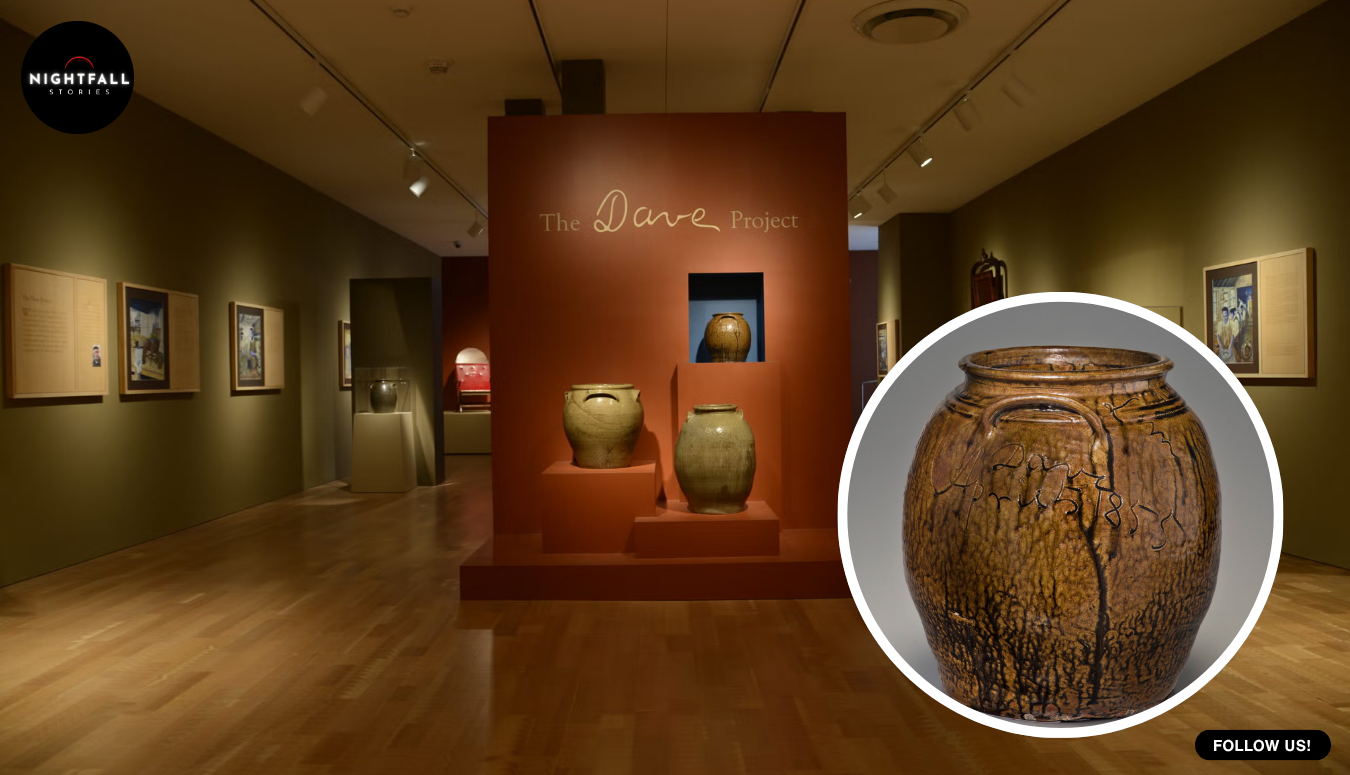
    In a gallery in Milwaukee there are two large stoneware jars behind glass. One of them has a name cut into the wet clay near the rim, in a careful, unhurried hand: Dave. Beside it, a date. The man who wrote it was enslaved in South Carolina, and under the law of that state at the time, the act of forming those letters was a crime.

    Last month the jars stopped belonging to the museum. They did not move. They are in the same room, on the same plinths, under the same lights, available to anyone who walks in. What changed is the paperwork, and the paperwork is the whole story: title to both vessels now sits with the living descendants of the man who made them.

    The potter is catalogued in most museums as Dave, later recorded as David Drake. He was born into slavery around 1800 or 1801, with sources differing, and he spent his working life in and around Edgefield, a district of South Carolina sitting on exceptionally good clay. The potteries there turned out alkaline glazed stoneware for the regional market, and Drake worked in them as a thrower, which is the person who actually raises the vessel on the wheel.

    He was astonishingly good at it. The scale of what he made is hard to credit even standing in front of it. One of his surviving jars, now in New York, is nearly two feet tall, more than two feet across, six feet around at the belly, and weighs eighty two pounds empty. It holds roughly twenty five gallons. Some of his pots ran to forty. These were not display objects. They were working vessels for storing pork, beef and grain on farms, and a thrower who could centre and raise that much clay without the wall collapsing was a specialist.

    But that is not why anyone knows his name, and he is almost the only enslaved American craftsman whose name we do know. We know it because he wrote it down, on the pots, over and over, for decades.

    In 1834 South Carolina passed legislation making it illegal to teach an enslaved person to read or write. Drake’s earliest known signed and inscribed jar is dated to that same year. He had learned anyway, apparently in the orbit of the Edgefield potteries and their connection to a local newspaper, and he kept going. Around forty of his surviving vessels carry not just his name and a date but verse, composed by him and incised into the clay before firing, which means the words became permanent at the moment the kiln closed and could not be removed afterwards.

    The couplets are worth reading closely, because they are almost the only first person account of his inner life that exists, and they are funnier and sharper than people expect. One from 1840 names his situation and the kiln in the same breath: Dave belongs to Mr Miles, wher the oven bakes and the pot biles. One from 1859 is a warning, with his own spelling preserved as it was cut: I made this out of number, and cross, if you do not lisen at the bible you’ll be lost. One from the summer of 1857 is a flat refusal to pretend the work was anything but work: I made this Jar for Cash, though its called lucre trash.

    Several are jokes about what the jar is for. A very large jar which has four handles, pack it full of fresh meats then light candles. Another, on the twenty five gallon jar in New York, dated in the spring of 1858, is a dedication to a bartender in a nearby town, followed by a line about a man named Scot turning up for a piece when the jar is filled with pork or beef.

    And one, cut in the summer of 1857, is not a joke at all. I wonder where is all my relation, friendship to all and every nation.

    That couplet is now the most quoted thing he wrote, for a reason that took more than a century and a half to arrive. Enslaved families were routinely broken up by sale, and Drake appears to have lost track of his own. He put the question on the side of a jar because a jar outlasts a person, and then the jar went into a farmhouse, and then into a collection, and then into a museum case, and nobody could answer him.

    The answer came from a genealogist named April Hynes, whose name has also appeared in print as Alice Hines. She is from South Carolina, and she came to the subject sideways: her grandfather had turned up an old alkaline glazed face jug during a school construction job, which sent her reading about how such things were made and by whom. That reading led her to Drake, and from Drake to a much harder question, which was whether anyone alive was related to him.

    This is the part of the story that deserves more attention than it usually gets, because tracing descent from an enslaved person is not ordinary genealogy with extra steps. It is research against records that were built not to record people as people. In the United States, the federal census before 1870 did not list enslaved individuals by name. They appear as tallies, counted by age bracket and sex in the column belonging to the person who claimed them. There is no name to follow, no household to reconstruct, no marriage certificate, often no birth record. For millions of African American families, conventional paper research hits a wall at 1870, the first census after emancipation in which formerly enslaved people were written down as individuals with names, and everything earlier has to be inferred from estate inventories, bills of sale, wills, probate papers and plantation ledgers, where a human being may be listed between the livestock and the furniture.

    Hynes worked that material, cross referenced it against published research on Drake, and in 2016 she picked up the telephone and called a woman in Maryland named Daisy Whitner to tell her who her ancestor had been. Whitner was in her eighties. She and her three siblings had understood their family history to begin in Aiken, South Carolina. They had no idea there were relatives in Edgefield, and they had never heard of David Drake.

    Around thirty members of the family travelled down to Edgefield later that year, for the first of what became an annual commemoration and for Drake’s induction into the state’s hall of fame. Standing in front of his pots was, by one account, like receiving a message he had sent out in the only medium available to him and getting it back generations later.

    What happened next is where this becomes a legal story as well as a family one. If the descendants of an artist are identifiable, then the ordinary logic that governs art ownership starts to apply, and it starts to apply to objects that were made by a person who was himself held as property and who was never paid for any of it.

    Yaba Baker, Daisy Whitner’s nephew and a descendant several generations down from Drake, became the family’s public voice. Accounts differ on the exact degree, with some describing him as a fourth great grandson and others as a fifth generation descendant, which is the kind of imprecision that follows from reconstructing a line through the gaps. In late 2024 the heirs set up the Dave the Potter Legacy Trust, a limited liability company created to hold claims collectively on behalf of the whole family, including relatives who have not yet been identified. Then they began writing to the institutions that held his work.

    The first museum to say yes was the Museum of Fine Arts in Boston, which announced its resolution last year and which is, as far as anyone has established, the first American museum to resolve an ownership claim over an object made under slavery. It held two vessels Drake had thrown at the Stony Bluff Manufactory within a month of each other in the late summer of 1857, one carrying a poem and one carrying only his signature and the date.

    The structure Boston used is the thing to understand, because Milwaukee then copied it, and it is not what most people picture when they hear that a museum returned something. It has two steps. First the museum restored ownership of both objects to the family, unconditionally. Then, as the new owners, the family chose what to do with them, and what they chose was to sell one back to the museum and lend the museum the other on a long term loan. Both pots stayed in the building. The museum’s provenance specialist put the reasoning plainly: an institution that has spent decades handling claims over art taken from Jewish families in Europe cannot reasonably decline to ask the same questions about property taken under slavery.

    Milwaukee’s version added a wrinkle, because the two jars there were not actually owned by the museum. They belonged to the Chipstone Foundation, a decorative arts foundation that had put them on display at the Milwaukee Art Museum in 2015 and had kept them there ever since. Chipstone’s involvement with Drake goes back further, to a 2010 exhibition it staged pairing his work with the contemporary sculptor Theaster Gates, which is widely credited with starting his modern recognition and which also launched a long running education programme in the city built around him.

    The family’s letter went to Chipstone in 2025. The foundation’s director has said there was no established legal route for what was being asked, and that a charitable foundation disposing of collection assets has its own compliance obligations to satisfy, so the solution was to work through the museum. Chipstone donated both vessels to the Milwaukee Art Museum. The museum then transferred ownership of both to the Legacy Trust. The museum then bought one of them back from the Trust, the signed and dated 1855 jar, using money from an anonymous donor, and took the second and larger pot, which is unsigned, on long term loan from the family.

    Three transfers, in sequence, to arrive at a position where two objects sit in exactly the same vitrines they occupied before, and the difference is who has the right to decide anything about them.

    That difference is not cosmetic. The family now holds title. It can set the terms and the length of the loan and can end it. It can say where a pot travels and on what conditions. When a museum wants to keep one permanently, the family is the seller and the money comes to the family, which matters more than it might sound given that Drake’s inscribed vessels have reached around a million dollars at auction, with unsigned or uninscribed work selling for far less. And when the heirs approach the next institution, they do so as owners of comparable objects with two completed precedents behind them rather than as petitioners with a story.

    They have been busy. By the late summer of this year the family had recovered six pieces, through museums including one in Georgia and through private owners, and Baker has said the aim is to reach all the surviving work within a couple of years. Around 270 of Drake’s pots are known to survive, out of thousands he must have made.

    It is worth being clear about what has no bearing on any of this, which is the law. There is no statute that governs restitution to the descendants of enslaved craftspeople. Native American human remains and cultural items have a federal framework. Objects looted across borders in wartime have international conventions and decades of case law. Work made by enslaved artisans in the United States has nothing comparable, which means every one of these agreements is negotiated from a blank page by people who could equally have declined, and that a museum that wants to say no can simply say no and face no legal consequence whatever. Reporting on the Boston deal noted at the time that no heirs of enslaved artists had previously received anything like it and that there was no obvious legal mechanism for it.

    So this is not a precedent in the binding sense. It is a precedent in the weaker and more interesting sense that it demonstrates a workable structure, and that the next conversation can start from a template instead of from first principles.

    It is also not closure for anything larger, and nobody involved has claimed it is. Two pots changed hands. One family, which had to be found by a researcher working against deliberately incomplete records, now owns two objects out of the two hundred and seventy that survive. The institutions that agreed to it were under no obligation and deserve no particular medal for arriving at the obvious answer late. And the family’s stated goal was never possession for its own sake. Baker has been consistent that the point is to keep the work where the public can see it, because Drake’s story is of use to people who feel unheard, and a pot in a private vault is of no use to anyone.

    What makes all of it possible, every piece of it, is a habit. Drake signed and dated his work. He did not have to. No other enslaved potter in Edgefield did, and the overwhelming majority of surviving southern stoneware from that period is anonymous, made by people whose names were never written anywhere and cannot now be recovered. He wrote his name on the side of a jar, and a date, and sometimes two lines of verse, knowing exactly what the statute said about it. His family’s view is simply that he knew what he was doing and did it anyway.

    Because he did, there was a name to research. Because there was a name, there was a line to trace. Because the line could be traced, there were people with a claim. And because there were people with a claim, the jar in Milwaukee with Dave cut into the shoulder belongs to Dave’s family.

    He asked, in clay, in 1857, where all his relations were. It took until now, and it took a genealogist with an old jug and a lot of patience, but somebody answered him.

  • His only truck was gone by one in the morning, and it took nearly six months to learn who had taken it

    His only truck was gone by one in the morning, and it took nearly six months to learn who had taken it

    At around one o’clock in the morning, four men nobody could identify walked into a storage yard in Ayodhya, in northern India, broke the steering lock on a small Tata truck and drove it out. There were cameras on the yard. The truck belonged to Hari Dutta Sharma, who drove it himself and earned his living with it, and it was the only vehicle he had. He went to the police the same day and filed a theft report, because as far as he knew, his truck had been stolen.

    It had not been stolen. It had been repossessed by the finance company that had lent him the money to buy it, and the company had not told him it was coming. He would not find that out for nearly six months. By the time a legal notice reached him and explained what had happened, the truck had already been sold to someone else, a month earlier, and the notice was asking him for the balance.

    That sequence is the whole case, and it took him three and a half years and two courts to get an answer about it. Last month the Supreme Court of India, the highest court in the country and the end of the road for any Indian appeal, held that what was done to him that night broke the constitution. It closed his loan accounts, ordered the sale money refunded with interest, awarded him compensation for the loss of his livelihood, and then did something larger. It turned to the country’s central bank and said, in effect, that the rules written to stop exactly this had been sitting on paper for more than twenty years without being enforced, and that it was time they were.

    Start with the loan, because the loan matters and because the honest version of this story is not one in which Sharma owed nothing. In early 2019 he borrowed to buy the truck, a Tata SFC 407, a light commercial vehicle of the kind that moves goods between towns across most of Asia. The sanctioned amount came to a little over a million rupees, which was somewhere around fifteen thousand dollars at the rates of the time, with roughly thirteen and a half thousand dollars actually paid out. He agreed to repay it across seventy five monthly instalments, spread over more than six years. A further small top up followed about two years later.

    The security for all of this was the truck itself, under an arrangement Indian lending calls hypothecation. In plain terms, Sharma owned the vehicle and used it, while the lender held a registered charge over it, and if he stopped paying, the lender had the right to take it and sell it to recover what it was owed. Almost every financed car, motorcycle, taxi and truck in the country sits under some version of that structure, and so do most financed vehicles anywhere in the world. The right to take the asset back is not the controversial part. The controversial part is how.

    Sharma did fall behind. The judgment records it without softening: he failed to keep up the instalments, and the lender, Cholamandalam Investment and Finance Company, sent him a recall notice at the start of 2022 demanding the whole balance. He paid something, about twelve hundred dollars worth, and then fell behind again. Two more notices followed across that year. The truck had already been taken once before and released back to him after he paid. By the time of the night in question, the company’s books showed arrears of a little under seven thousand dollars. None of that was in dispute, and the Court did not pretend otherwise.

    What was in dispute was the one o’clock seizure, and the document that governed it was the loan agreement he had signed. Article 11 of that agreement said the company had to give him seven days’ written notice at his registered address before it repossessed anything, and that the notice would count as delivered a day after it was posted. Seven days is not a lot. It is enough, though, to empty a vehicle of your tools, to tell the people whose goods you are carrying, to find the money if the money is findable, or to turn up with a lawyer.

    He got no notice at all. The Court found that nothing was served before the seizure, that no possession memo carried his signature, and that the company’s claim to have handed pre seizure intimation, an inventory and a pre sale notice to both him and the police did not hold up on the record. It also noticed something odd that nobody below had looked at: traffic penalties were still being issued against the vehicle well after the date the company said it had sold it.

    Then the judges read Article 11 properly, and this is the part of the ruling that will travel. The clause did give him seven days. It also said his rights under the agreement ended automatically on default, with no notice required. It authorised the company’s agents to enter any place at all to find the truck. It left the actual procedure for seizing and selling the vehicle entirely undefined. And it allowed the company to skip the seven days whenever it decided, on its own judgement, that the asset was at risk.

    A protection that the protected party cannot rely on is not a protection. The Court described a notice promise that the lender could waive at will as an illusory one, defeasible at the pleasure of the very party it was supposed to guard the borrower against. That reasoning applies to a great deal of consumer credit paperwork in a great many countries, and anyone who has signed a vehicle loan without reading past the interest rate might want to find their copy.

    Getting to that finding took Sharma years, and the route tells you something about how hard this is for a person without resources. His criminal complaint went nowhere. He had reported a theft, and there was no theft to investigate, because the people who took the truck had a contractual right to the truck even if they exercised it unlawfully. He then went to the Allahabad High Court, the senior court for his state, with a writ petition, which in Indian law is a direct application to a constitutional court alleging a violation of fundamental rights rather than an ordinary civil suit for damages.

    The High Court threw it out without looking at the substance. Its reason was delay. The truck had already been sold in August 2023, the judges noted, and Sharma had come to court late. The petition was dismissed in the spring of last year on that basis alone.

    The Supreme Court did not agree, and said so in terms that amount to a correction. Sharma had filed a police report on the very day the truck disappeared, and then a further complaint, because he believed it had been stolen and had no way of knowing otherwise. The delay the High Court held against him was in large part a period during which he was being kept ignorant of who had his property. The higher court held that the High Court’s conclusion had been reached without reference to what was actually on the record, and that a petition of this kind should not be dismissed on timing alone without any examination of its merits.

    On the merits, two judges, Pamidighantam Sri Narasimha and Alok Aradhe, found a violation of Articles 14 and 21 of the Indian constitution. Article 14 guarantees equality before the law and has been read for decades as a bar on arbitrary state action. Article 21 guarantees that no person shall be deprived of life or personal liberty except by procedure established by law, and Indian courts have long read the right to life as including the right to a livelihood, on the straightforward logic that a life you cannot feed is not much of a right.

    Sharma was a man of modest means who depended on that single vehicle for his income, the Court said, and he had been deprived of his livelihood in a manner that was arbitrary and unfair. It leaned on a judgment from nearly twenty years earlier in which the same court had told lenders that India is governed by the rule of law, that loans can be recovered only by lawful means, and that banks cannot send strongmen to take possession of things by force.

    There is a technical point hidden in that framing which matters more than it looks. Constitutional rights ordinarily run against the state, not against a private company, and a borrower with a contractual complaint is usually told to sue in a civil court and wait several years. By treating a forcible night time seizure as a constitutional wrong rather than merely a breach of contract, the Court kept the door to the writ jurisdiction open against a private lender. That is a faster, cheaper and far more public remedy than a damages suit, and it is now available to the next person this happens to.

    The relief was itemised. Both of Sharma’s loan accounts were ordered closed. The company was told to refund the full sale price of the truck, about fifty four hundred dollars at the exchange rate of the month it was sold, with six per cent annual interest running from the date of the sale until it is actually paid. He was awarded ten lakh rupees, around ten and a half thousand dollars, as compensation for mental agony and for the loss of his livelihood over a considerable period. He was given fifty thousand rupees more, a little over five hundred dollars, towards his costs.

    What the Court did not do was undo the sale. The truck was gone, bought by a third party who had done nothing wrong, and no order was going to bring it back into his yard. He was compensated for it rather than restored to it, which is the usual shape of justice arriving late.

    And then the judgment widened out, and this is why it is worth reading from anywhere.

    India’s central bank, the Reserve Bank of India, is also the regulator of banks and of non banking finance companies, which are lenders that extend credit without holding a banking licence and which do an enormous share of the country’s vehicle and small business lending. Since 2003 it has issued what it calls a Fair Practices Code, and then successive versions and master circulars running through the following decade. Those documents are not vague. They tell lenders not to harass borrowers, not to bother them at odd hours, and in wording the Court quoted, not to use muscle power to recover money. They require that loan agreements contain a repossession clause, that notice periods be respected, that recovery agents be properly trained and supervised, and that borrowers have somewhere to complain.

    Put the one o’clock seizure next to that text and the gap is not subtle. Odd hours, force, no notice, no identification, and a man filing a theft report about his own truck.

    The Court’s conclusion was blunt. The guidelines, it said, have existed only on paper. It directed the Reserve Bank to take effective steps to secure genuine compliance by non banking lenders and scheduled commercial banks alike with the codes and circulars it had been issuing for more than two decades, so that incidents of this kind, where a citizen is dispossessed of his livelihood in the dead of night without notice and without recourse, do not happen again. It instructed its own registry to send the bank a copy of the judgment, which is a quiet way of making sure the regulator cannot say it was unaware.

    That finding is the part a reader in any country should sit with for a moment. Rules governing repossession exist almost everywhere, and almost everywhere they follow the same logic. They do not exist to let people keep things they have not paid for. They exist because the alternative is a system in which a creditor can decide privately that you are in default, send people to take your property at an hour when nobody official is watching, and leave you with no way to test whether the decision was right before the thing is gone and sold. Notice is what converts a private grab into a reviewable act. It gives the borrower a window in which the lender’s arithmetic can be checked, the debt disputed, the asset emptied, the money found.

    When a court says a rule like that has been on paper only, it is saying the window was never really open. Not that the guidance was badly drafted, but that nobody was being made to follow it, for twenty three years, in a market with tens of millions of financed vehicles. The ruling does not change the words of the code. It changes who is now on the hook for whether the words mean anything.

    One more thing should be said plainly, because it is unusual in a story this specific. Hari Dutta Sharma has not spoken publicly. No reporter appears to have interviewed him in any language, before or after the ruling, and everything above comes from the judgment, from the regulator’s own published code, and from independent legal reporting of the decision. There is no account from him of what the five and a half months of not knowing were like, and nothing here invents one. What exists in the record is the shape of it: the yard, the broken lock, the theft report, the silence, the notice that arrived after the sale, the High Court door closed on grounds of lateness, and then a bench in New Delhi reading his loan agreement line by line.

    He had a real debt and he had missed real payments, and none of that was the point. The point was that there is a lawful way to take a man’s truck and that this was not it. He is the only person in the whole sequence who insisted on that distinction, through a police station that could not help him, a criminal complaint that failed and a High Court that would not look.

    Because he kept insisting, the compensation is his, and the rest is everybody’s. Every financed scooter, taxi, tractor and truck in India now sits behind a protection that a court has ordered its regulator to make real, rather than one that was merely written down. That is a larger result than one man could reasonably have expected from a night when he stood in a storage yard looking at the place where his truck used to be, and assumed he had been robbed.

  • The US government released beetles to bring its rivers back. Now it warns of six-figure penalties for moving them

    The US government released beetles to bring its rivers back. Now it warns of six-figure penalties for moving them

    Last summer, on the bank of the White River in western Colorado, a man named John Leary spent his working days carrying water up a slope in a five-gallon bucket. The river was right there. The seedlings he was watering, a few dozen young cottonwoods, buffaloberry, sumac and woods’ rose, were a short climb above it. There was no pump, no tank, no irrigation line. There was a bucket, a bank, and however many trips a person can make before the light goes.

    Leary manages restoration and geographic information systems for RiversEdge West, a Colorado nonprofit that has spent decades trying to put native vegetation back along rivers across the American Southwest. He is, in other words, a professional with a mapping brief and two decades of institutional science behind him, and the most useful thing he could do with his summer was haul water by hand. That image is the end point of one of the largest deliberate releases of a foreign insect in the history of North American land management, and understanding how the two connect means going back about 25 years, to a number almost everybody believed and almost nobody had measured.

    The plant at the centre of it is tamarisk, also called salt cedar, a feathery shrub native to Eurasia and Africa that was planted across the American West from the nineteenth century onwards to hold soil in place and break the wind. It did that, and then it did a great deal more. Tamarisk tolerates salt, tolerates drought, resprouts from the base when you cut it and seeds prolifically, and along rivers whose natural flooding cycles had been flattened by dams it outcompeted the native cottonwoods and willows almost everywhere it arrived. By the late twentieth century it dominated hundreds of thousands of acres of riverbank, and the question had stopped being whether to remove it and become how.

    The answer everyone reached for was water. The figure that circulated in agency documents, newspaper stories and funding applications was that a single tamarisk drank around 757 litres a day, roughly 200 gallons, which made the plant sound less like a weed and more like a thief in a region where water is the only currency that matters. Kill the tamarisk, the reasoning ran, and the rivers would come back. It is easy, now, to be sniffy about that logic. At the time it was the consensus, and it had the enormous political advantage of turning an ecological problem into an arithmetic one.

    So the research went ahead. The US Department of Agriculture’s Agricultural Research Service had been working on a leaf beetle from Central Asia that eats tamarisk and, as far as the host testing could establish, essentially nothing else. The regulator inside the department, the Animal and Plant Health Inspection Service, issued an environmental assessment in early 1999, found no significant impact that July, and permitted releases into sealed field cages the same month. Two years of cage monitoring followed at ten sites. Then, in 2001, the agency issued permits to let the beetles out of the cages.

    They went out that spring across six states. The published release figures are precise and surprisingly small: around 27,000 adults and larvae at Lovell in Wyoming, 15,000 at Delta in Utah, 6,900 plus larvae near Pueblo in Colorado, 3,500 at Schurz and 1,400 at Lovelock in Nevada, several thousand at Bishop in California, and fewer than 500 adults near Seymour in Texas. The insects had been collected from around the forty-fourth parallel at Fukang in China and Chilik in Kazakhstan, chosen because beetles from that latitude would read a northern winter correctly and not try to breed into the frost. The two Agricultural Research Service scientists most publicly associated with the work were C. Jack DeLoach in Texas and Raymond Carruthers in California, and the departmental announcement at the time was straightforwardly hopeful.

    What happened next is the part everyone involved agrees on. The beetles worked. They worked better than their own advocates had expected. From about five hectares, a dozen acres, by the end of the following year, the defoliated area ran to hundreds of hectares the year after that and several thousand the year after that, and kept going. Researchers who had spent years on the host-specificity work have since said plainly that they had not thought of these as insects that would take off. The beetle now shows up from Chihuahua in northern Mexico to California, Oregon, Idaho, Wyoming and Kansas. By the measure written into the original proposal, which was whether a released insect would establish itself and eat tamarisk, the programme is one of the more emphatic successes in the field.

    Almost none of the benefits followed.

    Start with the number. In 2007, two rangeland scientists, Keith Owens, then at Oklahoma State University, and Georgianne Moore at Texas A&M, published a short paper in the journal Rangeland Ecology and Management with the title Saltcedar Water Use: Realistic and Unrealistic Expectations. Their conclusion was that the figure everyone had been using was far too high. A realistic number, they found, was something closer to 122 litres a day, about 32 gallons, which is roughly what a cottonwood or a willow of comparable size uses. The plant the whole programme was built to remove was not, it turned out, drinking meaningfully more than the plants the programme wanted to replace it with. The water saving at the heart of the case was largely arithmetic that had never been checked.

    That single correction does a lot of damage on its own, but there is a deeper problem underneath it, and it is the thing worth understanding properly. The rivers of the American Southwest are not dry because of a shrub. They are dry because they are dammed, diverted, drawn down for farms and cities, allocated on paper in quantities that exceed what falls from the sky, and running through a region in prolonged drought. A river that has been promised to more people than it can supply does not refill when you kill the vegetation on its banks. Removing tamarisk cannot return water that was never going to be in the channel. The intervention was aimed at the last thing in the chain rather than the first, which is an extremely human way to approach a problem that has powerful people at one end and a defenceless plant at the other.

    The die-off figures did not hold up either, though in a more interesting way. The expectation written into the programme was that up to 85 percent of tamarisk would die. Dan Bean, who runs the Colorado Department of Agriculture’s insectary at Palisade and has monitored the beetles since the beginning, has found something considerably less dramatic. What the beetles tend to do, on his account, is cut the tamarisk in a river’s canopy by about half, leaving some trees dead and many alive but ringed with dead branches, a condition the people who work on it describe as haloed. And here is the honest part, which Bean himself concedes: nobody has produced an accurate measurement of the overall die-off, because the invasion covers too much ground to survey properly. The headline finding, a quarter of a century in, is that the scale of the effect is unknown. That is less satisfying than a number and considerably more truthful.

    Then there is the bird. The southwestern willow flycatcher is a small, drab, federally endangered songbird that nests in dense riverside thickets. Where the native thickets were gone, which was most places, it nested in tamarisk. At Mormon Mesa in Nevada, one of the sites in the beetle’s early path, the ecologist Sean Mahoney, now at the University of North Carolina Wilmington, documented songbird communities in the tamarisk stands and found diversity roughly equivalent to what the cottonwood and willow stands supported. The beetles reached the site in 2006. When environmental consultants went in looking for flycatchers in 2013, and again the following year, they found none at all. The birds were simply not there any more.

    It is important to be careful here, and the people who study it are careful. The flycatchers vanished after the beetles arrived. That sequence is documented. It is not the same as proof that the beetles caused it, and nobody has established causation at Mormon Mesa to the standard a scientist would want. Drought, river management, fire and the ordinary volatility of a tiny population are all in the frame. What can be said is that a federal agency licensed an insect to destroy the nesting material of a species another federal agency had listed as endangered, and that at the one site where somebody had bothered to count the birds beforehand, the birds subsequently went.

    The regulator did not ignore this. In mid-2010, the Animal and Plant Health Inspection Service terminated the saltcedar biological control programme outright. A memorandum signed by the director of its invertebrate and biological control programmes ended the work in 13 states, cancelled every active permit for interstate movement and environmental release, stopped issuing new ones, and prohibited further releases from cages or field sites. The stated reason was concern about effects on the critical habitat of the endangered flycatcher. The same memo warned that moving the beetles without authorisation could violate both the Endangered Species Act and the Plant Protection Act, with penalties reaching $250,000 per violation. Nine years after the government set the insect loose, it made moving the insect a potential federal offence.

    That was not the end of it. In late 2013 the Center for Biological Diversity sued the Department of Agriculture, the Department of the Interior and the Fish and Wildlife Service in federal court in Nevada. The suit’s complaint is pointed in a way that is easy to miss: the challenge was not simply that the agency had released the beetle, but that it had shut the programme down without taking remedial action for the habitat the beetle had already stripped. Walking away, the argument went, was its own failure. In May 2016 the court granted one of the group’s five claims, finding that the inspection service had not complied with the section of the Endangered Species Act that requires federal agencies to use their programmes to conserve listed species. A further opinion on what the agency actually had to do followed the next year. The judge’s direction was for more monitoring and more restoration.

    Today the department’s public guidance is brief and slightly extraordinary to read. Permits for moving tamarisk leaf beetles across state lines have been discontinued, so moving one may violate the Plant Protection Act. Releasing the beetle, the page says, may harm habitat critical to the flycatcher and other native wildlife. Below that sits the statutory penalty schedule: a maximum of $1,100 for a first non-commercial violation by an individual, $60,000 for subsequent violations or for any violation involving financial gain, and $300,000 per violation for a company. The page was last revised partway through last year. It is worth being exact about what this is and is not. These are the maximum civil penalties available under the statute, published as a warning. There is no public record of anybody being fined $60,000 for moving a tamarisk beetle. But the government that imported the insect, bred it, permitted it and released it now lists the price of handling it.

    The record-keeping has wound down too. For nearly 20 years, RiversEdge West maintained a tamarisk beetle distribution map, assembled with more than 70 partner organisations and built in large part on the fieldwork of Levi Jamison, a biologist who spent 13 years, from 2006 to 2019, surveying the Colorado, Dolores and San Juan rivers from a boat. He stopped every 1.6 kilometres, a mile, on journeys that ran as far as 724 kilometres, counting eggs and adult beetles and estimating how much of the canopy had been stripped. That data became the reference every agency and nonprofit in the region used. The final map, released last year, holds more than 16,000 presence and absence records stretching from northern Mexico to the Pacific Northwest and the Great Plains.

    There will not be another one. The reporting that brought this story to light says the department halted the funding for it. The organisation’s own public notice says something different and worth quoting fairly: it is pausing future map releases because the beetle is now thoroughly established and the map’s original purpose has been served. Both things can be true at once, and it is not obvious which is the more deflating. Either the money stopped, or the point of tracking an invasion stopped being the arrival of the insect, because the insect is everywhere.

    What is left is people. Melissa Neubaum coordinates restoration for the same nonprofit and runs the field monitoring on the Dolores. Amanda Stahlke teaches biology at Colorado Mesa University and advises the organisation on the science. Tom Dudley at the University of California, Santa Barbara, has worked on these beetles for close to two decades. Anna Sher at the University of Denver has spent her career on riverside restoration. Dan Bean, who monitored the introduction from the start, is also the person whose own research undercut the forecast the programme was sold on, and that deserves saying plainly rather than as a gotcha. He did not have to publish findings that made the project he ran look less impressive. He did it anyway, and the field is better calibrated because of it. That is what the inside of a correction looks like when it goes right.

    None of these people are villains, and the story reads badly if you try to cast one. Nobody falsified anything. The host testing was rigorous and the beetle has behaved as predicted towards other plants. The regulator responded to the flycatcher problem by stopping the programme, which is what a regulator is supposed to do. The conservation group sued because stopping was not the same as fixing. The court agreed. Every individual step is defensible, and the aggregate is still a river with less tamarisk on it, no more water in it, and one fewer endangered bird at the site where anybody was counting.

    The useful lesson is narrower and harder than the one that usually gets drawn from stories like this. It is not that biological control is reckless. It is that an intervention can succeed completely at its literal task and fail entirely at its purpose, if the link between the task and the purpose was assumed rather than measured. The beetles were asked to eat tamarisk and they ate tamarisk. They were never actually capable of delivering water, because the water was being taken somewhere else by people with lawyers.

    Which brings it back to the bucket. Researchers in other countries dealing with their own tamarisk invasions are now testing mealybugs, moths and midges as possible control agents, and when that comes up with Leary his reaction is not the scepticism you might expect from a man who has watched one insect solution play out over 25 years. He is interested. He would take the help. He has a riverbank to plant and not enough hands.

    The beetles did their job. They were never a replacement for the work, which still gets done by hand, one bucket at a time, by somebody who has read all the studies and goes down to the water anyway.

  • Tim Finn found a tape in his garage with Chrissy Amphlett’s voice on it. Playing it meant baking it in an oven

    Tim Finn found a tape in his garage with Chrissy Amphlett’s voice on it. Playing it meant baking it in an oven

    In 2023, Tim Finn went into the garage of his Melbourne home for what he has described as a deep rummage. Stacked in a cupboard among the two-inch reels he had accumulated over a long career was one with handwriting on the box that read, according to the ABC, Chrissy Amphlett and Tim Finn, 30/11/1998. Three songs were on it. Nobody outside that room had ever heard them. The woman singing on them had died ten years earlier.

    That tape has now been released as an EP called Some Times, with three tracks: He’s In Love, Crash, and Sometimes. It came out digitally late last week, with a limited CD and a twelve-inch pressing following, roughly 28 years after the session and 13 years after Amphlett died. The record is the part of this story that is easiest to describe and the least interesting. What is interesting is the gap. A box sat on a shelf for a quarter of a century while the person whose voice was inside it ran out of time, and the only reason any of it exists in public now is that nobody ever decided the box was rubbish.

    To understand why Finn picked up the phone in the first place, you have to understand how strange the pairing was. Chrissy Amphlett was the singer of the Divinyls, a Sydney band she formed in 1980 with the guitarist Mark McEntee and the bassist Jeremy Paul, and by the late nineties she was one of the most recognisable rock performers Australia had produced. The band’s reach was not local. I Touch Myself, released in 1990, went to number one at home, reached the top five in the United States and the top ten in Britain, and is still the song most people in most countries would name if you asked them about her. Her reputation was built on volume and confrontation. She was a hard, wiry, unsentimental presence on a stage, and for most of her working life that was the only version of her that got written about.

    Then, in 1998, she took a role in the original Australian production of The Boy From Oz, the musical built around the life of the songwriter Peter Allen. Amphlett played Judy Garland. It is worth sitting with how odd a casting decision that was at the time, and how much it required of her: a rock singer whose entire register was aggression, standing in a theatre every night doing somebody else’s standards, in a role that demands fragility rather than force.

    The role also tells you something about where she was in her life. She was approaching 40, nearly two decades into a band she had co-founded, and she had spent that time writing as well as fronting, mostly with McEntee. Taking a theatre job in somebody else’s story, singing material written long before she was born, is not what a rock singer does when she is coasting. It is what someone does when she wants to find out what else the voice can do.

    Finn was in the audience. He had his own long history, having fronted Split Enz through the seventies and eighties before a solo career, and he knew Amphlett’s records the way everyone did. What he saw on stage was not what he expected. By his account to one Australian music publication, the performance was a complete departure from the Divinyls, and it made him want to work with her in a register nobody had used her in.

    So he asked, and she said yes, and what followed was not a studio booking in the ordinary sense. Finn had recently bought an old Bechstein upright piano. In a room in Surry Hills, in inner Sydney, over a few days, the two of them wrote and recorded three songs around that piano, with Charley Drayton on drums. Drayton was an American drummer with a substantial session history who had played on Divinyls records; he and Amphlett were a couple by then and would marry the following year. The ABC describes the recording as happening in Finn’s studio and the interview places it in the Surry Hills room with the piano, which are probably the same thing described two ways, though neither account spells that out.

    Finn’s description of the music is the detail that makes the whole thing worth chasing. He has said that it felt as though Amphlett was looking for a new creative direction, and that she loved singing with a piano. What came out was quiet, intimate and piano-led, nothing like the Divinyls and nothing much like his own records either. Her voice on the tape, as the ABC heard it played back in Finn’s office, is gentle and husky with a hint of jazz phrasing. That is not the instrument the public knew. It was there the whole time and almost nobody got to hear it use itself that way.

    Then ordinary life did what ordinary life does. Finn’s son had just been born. The sessions had been a few days squeezed into two very busy careers, and there was no label waiting for the results, no deadline, no plan beyond seeing what happened. The tape went into a box. The box went into a cupboard. Both of them went on working. Amphlett reprised the Garland role when the production came back to Australia as an arena show after its Broadway run, then kept touring and recording. Finn kept making albums. The three songs stayed exactly where they had been put.

    Amphlett was ill for the last years of her life. She disclosed a diagnosis of multiple sclerosis publicly in 2007 and a breast cancer diagnosis in 2010, and she died in Manhattan in 2013 at the age of 53. Her memoir, Pleasure and Pain, was published shortly afterwards. There is no version of this story in which the delay was anybody’s fault, and there is no version in which the delay was worth it. The songs simply stopped being something that could be finished with her in the room, and that is the plain fact at the centre of this.

    What happened next is the part almost no coverage explains properly, and it is the reason the recordings could easily have been lost even after they were found. Drayton, by several accounts, kept asking Finn whether the multitracks still existed. Finn looked once without success and found the reel on a second, more thorough search. But finding a two-inch master from 1998 is not the same as being able to hear it. Analogue tape of that era is a sandwich: a plastic backing, a layer of magnetic oxide particles, and a polyurethane binder whose only job is to glue the oxide to the plastic. In a great many tape stocks manufactured from the mid-seventies through the nineties, including widely used professional reels from Ampex and Scotch, that binder is hygroscopic. It absorbs water out of the air, slowly, for decades, and the chemical reaction that follows breaks it down.

    The result is known in studios as sticky shed. The binder softens and migrates to the surface, and when you try to play the tape it drags against the heads and guides, squealing, shedding a brown residue, losing the high frequencies and sometimes stalling the machine outright. Push it and you scrape the recording off the backing. A great deal of twentieth-century music is sitting in archives in exactly this condition.

    The fix is not elegant and has never pretended to be. You put the reel in a low oven, typically at somewhere between 54 and 60 degrees Celsius, roughly 130 to 140 degrees Fahrenheit, and leave it there for anything from an hour to eight hours. Wider tape needs longer, and a two-inch reel is about as wide as music tape gets. The heat drives the absorbed water back out of the binder. The binder temporarily firms up. And for a window of a few weeks to a few months the tape plays more or less as it did when it was new, after which it begins taking moisture back in and the problem returns. Baking is repeatable, but it is not a repair, and every pass through a machine takes a little more oxide off for good. In practice you get one honest shot at transferring the music to something permanent.

    There is a second reason the format matters, and it is the reason this release is a record rather than a curiosity. What Drayton kept asking about was not a finished mix. It was the multitracks. A two-inch reel of that era typically carries 16 or 24 separate tracks running side by side, which means the piano, the drums and the vocal all exist as independent recordings rather than as one blended stereo file. Had the only surviving object been a mixdown, there would have been almost nothing to do with it except clean it up and put it out. Because the multitracks survived, somebody in 2026 could sit at a desk and make genuine choices about balance, space and which take of the vocal to favour, 25 years after the performance. The width of the tape is the whole reason there was any work left to do.

    It is also worth knowing how routine this near-miss is. The music industry spent roughly four decades committing its masters to a plastic ribbon coated in a glue that was quietly failing from the moment it left the factory, and nobody knew that at the time. Archives, labels and private studios are full of reels in the same condition as this one, and the people who look after them talk about transfer the way doctors talk about triage: there are more tapes than there are hours, the clock is running on all of them, and the ones nobody is asking about tend to lose. A reel in a domestic garage, with no catalogue number, no label chasing it and no paperwork saying it existed, is about as low as a recording can sit on that list. The only thing that saved these three songs was one person who would not stop asking.

    That is what was done. Finn’s description of it is almost comically mundane: they put them in these little ovens and bake them to get the moisture and residue off the tape. Then the reel was played once, carefully, and digitised, which is the only moment in this entire story where the songs actually crossed from one era into another. From that point they existed as files rather than as a chemical coating on plastic, and they could not be lost to humidity again.

    Drayton took it from there. The digitised multitracks went to New York, where he mixed them, which means that the last creative decisions made on his wife’s vocal performance were made by him, 25 years after he had sat behind the drums while she sang it. He is credited on the session as the drummer and on the release as the person who finished it. There is no way to make that neutral and there is no need to dress it up. A man who spent years asking whether the tapes still existed ended up being the one who had to decide how loud her voice sat in the mix.

    Some of the fine print around the release is still thin. No record label has been named in any of the reporting, and the three songs are listed slightly differently in different places, with the third track given as Sometimes while the EP itself is Some Times, two words. One music trade outlet credits the mix and master to the engineer Pat Thrall with Peter Contini engineering, while Finn’s own interview and other coverage credit the New York mix to Drayton, which may simply mean more than one pair of hands was involved at different stages. These are the kinds of details that get settled on a credits sheet rather than in a news story.

    What is not in doubt is the shape of the thing. The ABC has built a two-part Australian Story special around Amphlett, and the release has arrived alongside it, which means the songs have landed in the middle of a broader reconsideration of who she actually was. That reconsideration has been going on for a while and it tends to run in one direction: away from the snarling stage persona that dominated three decades of writing about her, and towards the person who wrote the lyrics. The tape is useful evidence for that, not because quiet music is more serious than loud music, but because it shows she had somewhere else she could go and was curious about going there.

    It is also worth being honest about what the recordings are not. Three songs cut over a few days around a piano, with no label and no release plan, are a sketch. Finn has not claimed otherwise. The appeal, by his account and by the account of people who have heard them, is precisely the lack of polish: two experienced writers in a room with an instrument and a drummer, working fast, with nobody in the building who needed the result to sound like anything in particular. Records made under commercial pressure almost never sound like that, which is why unfinished tapes are so often more interesting than finished ones.

    There is a version of this story that gets told as a triumph, and it is not quite right. Nothing was rescued in time. The one person who could have said whether these were worth releasing, or whether she wanted a fourth verse on the second song, or whether the whole thing should stay in a cupboard, was not there to ask. What actually happened is smaller and more ordinary than a triumph: a man kept asking a question, another man went and looked twice, somebody with a low oven and a steady hand got a fragile object to play one more time, and a husband sat down in a studio in New York and finished something his wife had started.

    The three songs are public now, under a title she never knew would be a title, and the only reason any of that was possible is that for 25 years nobody cleaned out the garage.

  • He was paroled after 42 years. The conviction stayed with him for nine more.

    He was paroled after 42 years. The conviction stayed with him for nine more.

    In 1974, a young woman in Alabama was shown a row of photographs and pointed at one of them. The man in the picture was Ervin Harris, 19 years old, from the Birmingham area. According to the court record, she explained her choice by saying that the eyes in the other photographs were not big enough. Police told her they were going to go and get him. They did, that same day.

    That identification was the case. Not part of it. Essentially all of it. There was no fingerprint, no DNA testing anywhere in American courtrooms yet, and nothing physical that pointed at Harris. A jury in Bessemer convicted him in late 1975 and the sentence was 99 years. He served 42 of them.

    Then comes the part of this story that almost nobody writes about, and it is the part worth sitting with. Harris was released on parole in 2017. He did not walk out exonerated. He walked out a convicted man, with the conviction fully intact and every consequence of it still attached, and he lived that way for another nine years. He was 71 when a judge finally set the conviction aside, and 71 when the case against him was formally dropped a few weeks after that.

    Most wrongful conviction stories are shaped like a door opening. Someone is in a cell, the evidence collapses, and they come out into a car park with their family and a crowd of cameras. Harris did not get that shape. His prison sentence and his wrongful conviction ended nine years apart, and in the gap between them he was a free man in the narrow sense and a convicted one in every sense that touches a life.

    Start with what the trial actually was. The offence was in November 1974. The woman who was attacked was 21. Nothing about what happened to her belongs in this piece, and the one thing that should be said plainly is that nothing in the eventual ruling suggests she was anything other than a genuine victim telling the truth as she remembered it. She has since died. She is not the villain of this story and never was.

    What the record shows is that her memory and the man she picked did not match. The person she described to police differed from Harris in age, in height and in facial hair. She told police the man who attacked her spoke very clearly. Harris had, and still has, a severe stutter. His sister testified at the original trial that he could not talk for long without stuttering, and another witness said the same. The attacker drove her around in her own car before the assault. Harris could not drive, and a witness said she had never once seen him manage it. He also had a severe and contagious sexually transmitted infection at the time, which she did not contract.

    He gave police an alibi immediately: he was with family and friends, playing cards and shooting pool. A string of relatives and friends testified to it. Prosecutors were never able to shake any of them. The jury convicted him anyway on 6 November 1975, and that is not as strange as it sounds, because juries then and now tend to find a confident witness pointing across a courtroom more persuasive than a row of people saying somebody was at home.

    Semen and blood were found on the victim’s clothing. Nobody tested the blood type, which was possible in 1975 and would have narrowed the field considerably. Tests on Harris’s own clothing came back negative. The Alabama Court of Criminal Appeals upheld the conviction in 1976. He filed a petition in 1978 arguing his lawyer should have made more of the medical evidence, and the courts turned him down. After that, the legal system had said its piece, and he had 39 more years to serve.

    Judge David Carpenter, reviewing the case decades later, noted something about the circumstances that is in the record and should be stated once, without ornament: Harris was a Black man with two prior burglary convictions, accused of raping a young white woman in Alabama in 1974. The judge raised it as context for how a case this thin reached a conviction. It is not the engine of this story and it does not need to be dressed up. It is simply part of why nobody looked harder at the time.

    Now the nine years. In 2017, after more than 41 years inside, Harris was released on parole and required to register as a sex offender.

    That sentence passes quickly in every account of this case, and it should not. Alabama has one of the most demanding registration regimes in the country, and for an adult convicted of a sex offence it runs for life. The statute requires a registrant to appear in person to verify his information during his birth month and then every three months after that, in every county where he lives, for the rest of his life. Over nine years, that is somewhere around 36 separate appearances in front of law enforcement, each one a re-registration of a thing he said he had not done.

    The restrictions are not only administrative. Alabama law forbids a registrant from establishing or keeping a residence within 2,000 feet of certain properties, including schools and childcare facilities. In a built-up city, that rules out a great deal of the available housing, and it does not care whether the person has anywhere else to go. There are employment bars on top of that, including work at schools and childcare facilities and on mobile vending businesses. If a registrant wants to leave his county for three or more days, he has to give notice first. His name and address sit on a public database that anybody can search, including employers, landlords and neighbours.

    Put those pieces together and you get the real texture of those nine years. A man in his sixties, out of prison for the first time since the Ford administration, trying to find somewhere to live inside a map full of exclusion zones, trying to find work with a record that answers every question before he opens his mouth, and reporting to a counter four times a year to confirm that he is still who the state says he is. Parole is not an apology. It is a licence with conditions, and the conviction underneath it was still standing.

    There is a further wrinkle that is easy to miss. Registration in Alabama is not a sentence a judge hands down and a person completes. It attaches to the conviction itself and runs for life, which means that for nine years Harris was being supervised, restricted and published on the basis of a verdict that the same court system would eventually decide could not be trusted. Every quarterly appearance was an act of compliance with a finding that was wrong. And because the obligations are lifelong, nothing in the arrangement contained any prospect of improvement. There was no date in the future on which it was going to get easier. The only thing that could ever end it was the one thing that had already failed twice in the 1970s, which was a court agreeing to look again.

    It is also worth being clear about what the restrictions cost in ordinary terms rather than legal ones. Housing, work, where you can sleep, how far you can travel and who gets to know your business before they meet you are not peripheral things. They are most of a life.

    It needs saying honestly that Harris himself has not publicly described those years in any detail. The court filings, the registry record and the news coverage all move straight from his release to his hearing, and none of them stop to ask what the decade in between was like. That gap is itself worth noticing. The years a person spends in prison get counted carefully, because they are easy to count. The years afterwards, carrying a conviction that has not yet been undone, do not get counted at all, and there is no line in any statute that compensates for them.

    He did not stop trying. The Innocence Project took up his case in 2018, the year after he came out. There was not much to work with. He wanted DNA testing on clothing collected in 1974 by the Fairfield police, which would have settled the thing outright. The court ordered an exhaustive search for it. The evidence could not be found. Half a century of storage had swallowed the one item that could have given him a clean answer.

    So the case was rebuilt on the only thing left, which was the identification itself, and on what the last fifty years of research has established about how identifications go wrong.

    The structural problem with a single eyewitness is not that witnesses are careless. It is that there is nothing to check them against. In most criminal cases, a piece of evidence is only as good as the other evidence that agrees with it, and a jury weighing a dozen strands can notice when one of them does not fit. When the entire case is one person’s recollection, there is no second strand, and the only test available to the jury is whether the witness seems sure. That test does not work, which is the part the science has settled.

    This is where the story stops being about one man’s bad luck. In 2014 the National Research Council, part of the US National Academies, published a report called Identifying the Culprit, which remains the standard scientific assessment of eyewitness evidence. Its conclusions are not comforting for anyone who assumes memory works like a recording. Memories are forgotten, reconstructed, updated and distorted. A witness’s memory can be contaminated by all sorts of influences, including ordinary interaction with police, and the contamination does not feel like contamination from the inside. It feels like remembering.

    The report’s most uncomfortable finding concerns confidence. A witness’s confidence tends to grow between the identification and the trial, as she learns more about the case, goes through trial preparation and sits in the pressure of the witness box. By the time she points at the defendant in front of a jury, she may be completely certain, and her certainty tells the jury nothing reliable about whether she is right. That is why the report recommends recording a witness’s confidence verbatim at the very first identification, before anything can inflate it.

    The report also recommends that photo arrays and lineups be administered blind, meaning the officer running the procedure does not know which photograph is the suspect, so that nothing in his face or tone can steer the witness. It recommends that witnesses be told clearly that the perpetrator may or may not be among the pictures. It recommends that the whole procedure be video recorded as standard. None of that existed in 1974. What existed instead was a procedure in which a witness looked at photographs and the officers already knew which one they wanted, and then told her they were going to go and get him.

    At Harris’s hearing, an eyewitness identification expert named Nancy Franklin testified that the identifications in his case were highly unreliable, and that they were very likely the product of suggestive influences after the event rather than of memory. She made the point that the person the witness described and the person she identified were two different people. An investigator with the district attorney’s Conviction Integrity Unit, which was only set up in 2021, said Harris’s account of that night was the most consistent statement he had ever taken. Nothing in it had moved in fifty years.

    It matters to be exact about what happened next, because the distinctions are real and they are routinely blurred. On 19 June 2026, Judge Carpenter vacated the conviction and the 99-year sentence. The legal basis was that modern eyewitness research amounted to newly discovered evidence, and that if Harris had been able to put that science in front of his jury, the verdict would likely have been different. The judge also ordered him removed from the state sex offender registry. The district attorney’s office did not object to any of it. That is unusual and it is worth stating, flatly, without applause.

    What the judge did not do was declare Ervin Harris innocent. No court has. A vacated conviction means the verdict cannot stand, that the trial was not a reliable test of guilt, that the state’s case does not hold. It is not the same as a finding that the man did not do it, and the order does not contain one. Then, a few weeks later, on 12 July 2026, the prosecution asked for the case to be dismissed and the court granted it. That is as close to over as the system gets. Harris is no longer a convicted man and will not be tried again. The National Registry of Exonerations lists him among its exonerees, with mistaken witness identification as the cause.

    Which brings the story to arithmetic, because arithmetic is the only part of this that resolves cleanly. Alabama does have a compensation scheme for the wrongly imprisoned, set up in 2001 and run by a legislative committee with the state’s risk management division checking applications. The base figure is a minimum of 50,000 dollars for each year of incarceration. Harris served 42 years. At the statutory base, that is about 2.1 million dollars.

    He has not been paid any of it, and there is no public record of a claim. There are two obstacles in the way. The scheme is built around people who were imprisoned for felonies of which they were innocent, and the order in his favour does not make a finding of innocence, which is a problem an applicant has to solve rather than a box he can tick. And any amount the committee recommends beyond the base still has to be appropriated by the state legislature, which means a payment is a political act as well as a legal one.

    So the honest close is not a cheque and not a scene of vindication. The National Registry of Exonerations has recorded more than 3,800 exonerations in the United States since 1989, adding up to more than 36,000 years of lost life, and Harris’s 42 are now part of that total. But the number that stays with you is the smaller one. He finished the punishment before anyone undid the verdict. The state had already taken everything a 99-year sentence takes, and then nine more years on top of it from a man who was out of prison and still not free, and the correction arrived when he was 71, with nothing left for it to give back.

  • He could have walked out of a Myanmar prison by naming names. He chose to go back inside, and then spent 26 years building a list.

    He could have walked out of a Myanmar prison by naming names. He chose to go back inside, and then spent 26 years building a list.

    The offer was simple, and it was the kind of offer that works. Bo Kyi had already served one stretch in a Myanmar prison for taking part in the pro-democracy uprising of 1988, when he was a student at Rangoon Arts and Sciences University. He was out. Military officials came to him with a proposition: work for us, tell us who the activists are, and your life gets easier. He said no. By one account of the exchange he answered their offer with conditions of his own, that they release all political prisoners and open a dialogue with Aung San Suu Kyi, which was not a counter-offer so much as a way of declining without pretending to be polite about it. He was arrested again.

    That is the whole story in one paragraph, and everything Bo Kyi has done in the thirty-odd years since follows from it. He had a door in front of him and the price of walking through it was other people’s freedom, and he shut it and went back to a cell. Nobody filmed it. There was no crowd. It is the kind of decision that leaves no record at all unless the person who made it survives long enough to be asked about it, and even then it sounds small when described, because the alternative version of his life, the one where he said yes, would have looked from the outside like an ordinary life.

    Earlier this autumn he was named a Ramon Magsaysay Award laureate, the recognition often described as Asia’s Nobel Prize. The award body’s citation talks about extraordinary moral courage, personal sacrifice, and an unwavering belief that democracy and human dignity are always worth defending. Which is accurate and also tells you nothing about what he has actually been doing for the last twenty-six years, because the honest answer to that is clerical. He has been keeping a list.

    Go back to the prison first, because there is one detail from those years that explains the rest of him better than any account of his treatment would. Bo Kyi taught himself English inside the cell. He did it by writing on the concrete floor with a piece of broken brick, which is what was available, and by taking lessons from a professor held in the next cell along. The professor would speak a sentence or two in English when the guard was out of earshot, and Bo Kyi would take it and work on it. He hid whatever study material he had accumulated every time a warden came past.

    Think about what that requires. Not courage exactly. Patience of an almost inhuman order, and a particular kind of faith: that there would one day be a reason to have English, in a cell where the evidence pointed the other way. A man scratching letters into a floor with a brick fragment, learning a language one whispered sentence at a time, is not resisting in any way that inconveniences his jailers. He is making a bet on a future he has no reason to expect. The language is why he can now sit in front of foreign journalists, diplomats and award committees and give them numbers in their own vocabulary. The brick did that.

    Accounts of the imprisonment itself differ in their detail, which is normal for Myanmar in that period and worth stating plainly rather than smoothing over. The award body’s own biography has him first arrested after the 1988 demonstrations, imprisoned twice, accumulating seven years in detention, released once in 1993 and again in 1998. An earlier profile by an international rights organisation dates an arrest to 1990 and gives a single sentence of seven years and three months. The totals are close enough that the shape is not in dispute. He went in as a student in his early twenties and came out, finally, in his late twenties, having spent most of the decade inside. He has never offered the physical particulars as his story, and they are not the point here either.

    What he did on getting out the second time was leave. He crossed to Mae Sot, the Thai town on the Myanmar border that has absorbed exiles, refugees, clinics and opposition organisations for decades, and in March 2000 he and other former political prisoners founded the Assistance Association for Political Prisoners. Its founding principle has been quoted ever since: as long as political prisoners exist inside Burma, Burma will not be free. The organisation still gives its base as Mae Sot and Rangoon.

    One thing about that founding is worth pausing on, because it is not incidental. AAPP was set up by former political prisoners, not by lawyers or academics or sympathetic outsiders. The people who built the register had all been on it. That is why the organisation knows what questions to ask a man who has just come out, and which answers are likely to be wrong, and how long to wait before asking anything at all. It is also why the work has a built-in expiry problem that nobody talks about, because the founding generation came out of the prisons of the 1990s and the people filling the cells now were not born when the brick was scratching the floor.

    Mae Sot matters too. It is a border town, and border towns are where this kind of organisation can exist at all: close enough that information still arrives, far enough that the people handling it are not immediately reachable. An outfit documenting Myanmar’s prisons cannot be inside Myanmar. The entire structure of the work is a consequence of that single geographic fact, and so is the exile of everyone doing it.

    Now, the list. This is the part that deserves the length, because it is the part that gets skipped.

    The work of AAPP is to know, by name, who is being held for political reasons inside Myanmar, and to keep knowing it as the number changes. That sentence hides an enormous amount of labour. A political prisoner is not an entry in a public register. Arrests are frequently unacknowledged. Families are not told where someone has been taken, or whether they have been charged, or with what. Sentences are handed down in closed hearings. People are moved between facilities without notice. Someone released may be rearrested within weeks, which means the list is never finished, only current.

    So the record has to be built from the outside in, which is slow and relies almost entirely on trust. Former prisoners are interviewed when they come out. Families come forward, or they do not. Lawyers, local networks and other organisations pass on what they have. Every name that arrives has to be checked, because an unverified report that goes into a public tally and turns out to be wrong damages the credibility of the whole record, and the credibility of the record is the only asset the organisation has. So AAPP does something unusual and quietly brave for an advocacy group: it publishes its uncertainty. Its running figures separate the detainees it has verified from the detainees it has not yet been able to verify. The second number is large. Keeping it visible rather than folding it into the headline total is a decision that makes the organisation look less impressive and the data much more useful.

    By AAPP’s own tallies, published and updated continuously, something over thirty-two thousand people have been arrested for political reasons since the military coup of February 2021. Close to fifteen thousand are recorded as verified in detention, with another seven or eight thousand reported but not yet verified, which is where the roughly twenty-two thousand figure that circulates in reporting comes from. Over nine thousand people have been released. AAPP also maintains a count of those killed by the military since the coup, which stands in the thousands. All of these are the organisation’s own estimates, compiled in the way described above, and they should be read as such rather than as official statistics, because no official statistics exist.

    The coup of 2021 changed the scale of the job rather than its nature. Before it, the counting was a matter of hundreds and then thousands; an international profile of Bo Kyi from the late 2000s put the number of political prisoners then held at around nineteen hundred. Then in a matter of months the arrests ran into five figures and the organisation had to move from periodic reporting to a daily briefing, because a monthly figure is useless when the number moves that fast. An outfit built by a handful of ex-prisoners in a border town absorbed that, and is still absorbing it.

    Bo Kyi has also given a plainer measure of the limits of the work. By his account there are around forty-nine prisons and detention centres in the country. AAPP is able to reach into about thirty-three of them, and through those it supports somewhere in the region of five thousand prisoners and family members. Sixteen facilities, then, that it cannot get near. He does not present the gap as a failure. He presents it as the size of the job.

    That reach is not only paperwork. The organisation’s work includes getting money and medical help to people inside and to the families left outside, monitoring conditions as far as it can, and running rehabilitation and assistance programmes for activists after release, which matters more than it sounds, because a person who has lost years and a career and sometimes a family comes out into a country that has no place for them. Since the coup AAPP has produced a daily briefing and a monthly data dashboard, which is the public face of the counting.

    The cost of keeping a list like this is not abstract. Everyone who feeds information into it takes a risk by doing so, and so the methods have to stay out of view, which means the organisation can never fully show its work, which means it is permanently open to the accusation that it is making the numbers up. It has to be scrupulous precisely because it cannot be transparent. The people who do this work also cannot go home. Bo Kyi has been in exile since the late 1990s and operates from Thailand, and there is no public indication that he has been able to return to Myanmar in all that time. The country he keeps the register of is one he knows now mostly through other people’s testimony.

    And the register is used. Governments, United Nations bodies, courts assembling evidence, bar associations, foreign ministries drafting sanctions, journalists and advocacy campaigns all need to be able to say how many and who, and when they do, the figure very often comes from this organisation. One of the stranger facts about international human rights machinery is how much of it rests on small outfits of exiles with a database. When a minister somewhere cites a number of political prisoners in Myanmar, a chain of custody runs backwards from that podium through a briefing paper, through a monthly dashboard, to an interview conducted with somebody who just got out, and before that to a family member who decided to risk telling someone.

    Which is what makes the Magsaysay a slightly odd fit, and also the right one. The award has gone to three people this year, including a Singaporean diplomat and a Bangladeshi social entrepreneur, both of whom have built things you can point at. Bo Kyi’s body of work is a spreadsheet that nobody wants to exist. The citation reaches for the language of moral courage, which is fair for the man who refused the informer’s job in the 1990s, but the twenty-six years since have called for something much less dramatic and much harder to sustain, which is the willingness to do the same careful, unrewarding, unfinishable task every month while the thing you are counting gets worse.

    Because it has got worse. That is the uncomfortable arithmetic sitting underneath the prize. The organisation was founded by men who had been political prisoners in the 1990s, at a point when the number inside was in the low thousands. A quarter of a century later, after a brief democratic opening and then the coup that closed it, the number is several times that. Bo Kyi has spent his adult life on this and the list is longer now than when he started.

    It would be easy to turn that into despair, and he does not. Nothing in the record suggests he treats Myanmar’s situation as hopeless or as fated, and the work itself is an argument against both readings, because you do not maintain a careful register of the imprisoned unless you believe somebody will one day need it. A list is a bet on accountability. It assumes a future in which names matter: release negotiations, legal proceedings, a transition, a family finally told where someone is. If the future never arrives, the list was still the right thing to have kept. If it does arrive, the list is the only reason anyone will know who to look for.

    The award ceremony falls later in the year, and a man who cannot go home will collect a prize in a country that is not his for keeping the count of a country that is. There is no neat ending available here, and inventing one would be a disservice.

    So here is the real one. In the 1990s Bo Kyi was offered a way out of a cell in exchange for names, and he refused to give them, and went back inside. Everything since has been the same decision pointed the other way. For twenty-six years he has been collecting names, as carefully and as verifiably as it can be done from outside a border, so that the people inside are not simply absent. He would not give up a single name to the people who were holding him. He has given tens of thousands of them to the rest of the world, which is the only form of protection available to someone in his position, and he will be adding to the list next month.