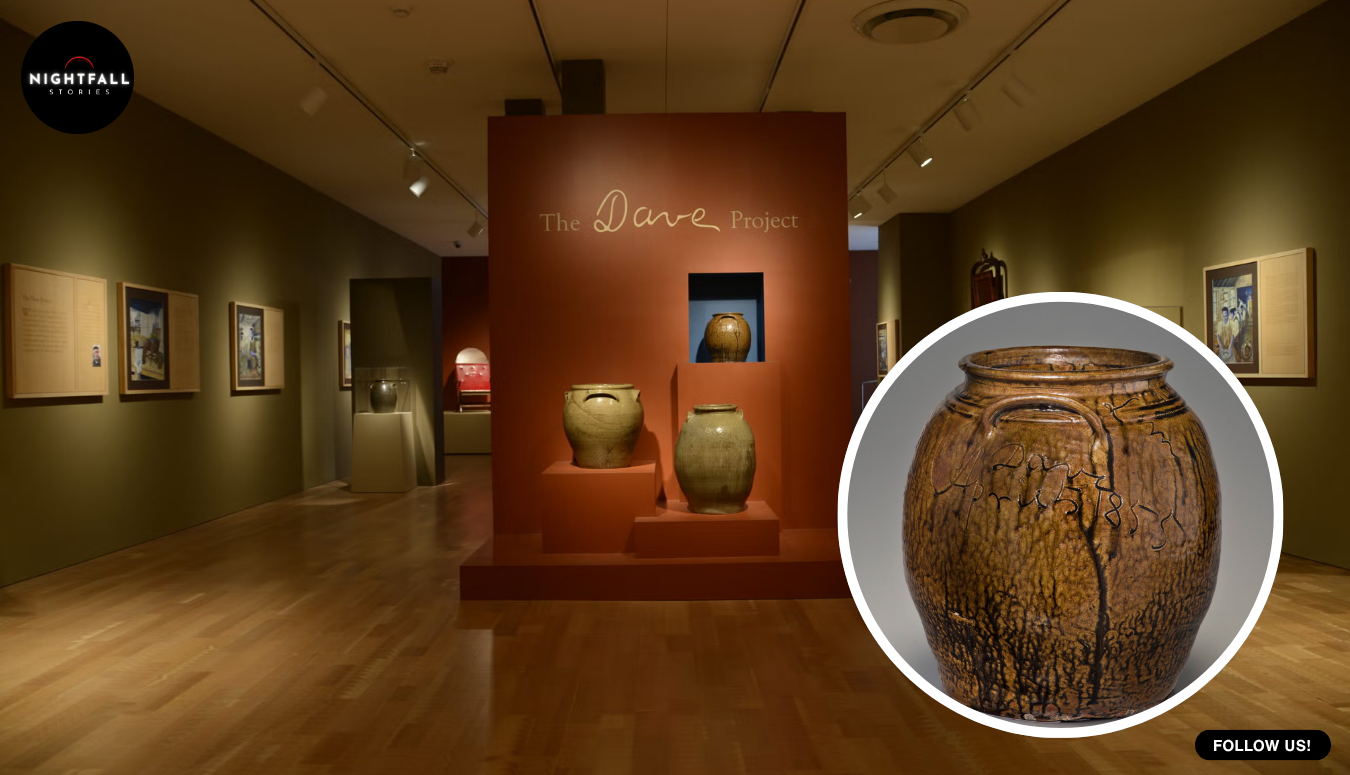
In a gallery in Milwaukee there are two large stoneware jars behind glass. One of them has a name cut into the wet clay near the rim, in a careful, unhurried hand: Dave. Beside it, a date. The man who wrote it was enslaved in South Carolina, and under the law of that state at the time, the act of forming those letters was a crime.
Last month the jars stopped belonging to the museum. They did not move. They are in the same room, on the same plinths, under the same lights, available to anyone who walks in. What changed is the paperwork, and the paperwork is the whole story: title to both vessels now sits with the living descendants of the man who made them.
The potter is catalogued in most museums as Dave, later recorded as David Drake. He was born into slavery around 1800 or 1801, with sources differing, and he spent his working life in and around Edgefield, a district of South Carolina sitting on exceptionally good clay. The potteries there turned out alkaline glazed stoneware for the regional market, and Drake worked in them as a thrower, which is the person who actually raises the vessel on the wheel.
He was astonishingly good at it. The scale of what he made is hard to credit even standing in front of it. One of his surviving jars, now in New York, is nearly two feet tall, more than two feet across, six feet around at the belly, and weighs eighty two pounds empty. It holds roughly twenty five gallons. Some of his pots ran to forty. These were not display objects. They were working vessels for storing pork, beef and grain on farms, and a thrower who could centre and raise that much clay without the wall collapsing was a specialist.
But that is not why anyone knows his name, and he is almost the only enslaved American craftsman whose name we do know. We know it because he wrote it down, on the pots, over and over, for decades.
In 1834 South Carolina passed legislation making it illegal to teach an enslaved person to read or write. Drake’s earliest known signed and inscribed jar is dated to that same year. He had learned anyway, apparently in the orbit of the Edgefield potteries and their connection to a local newspaper, and he kept going. Around forty of his surviving vessels carry not just his name and a date but verse, composed by him and incised into the clay before firing, which means the words became permanent at the moment the kiln closed and could not be removed afterwards.
The couplets are worth reading closely, because they are almost the only first person account of his inner life that exists, and they are funnier and sharper than people expect. One from 1840 names his situation and the kiln in the same breath: Dave belongs to Mr Miles, wher the oven bakes and the pot biles. One from 1859 is a warning, with his own spelling preserved as it was cut: I made this out of number, and cross, if you do not lisen at the bible you’ll be lost. One from the summer of 1857 is a flat refusal to pretend the work was anything but work: I made this Jar for Cash, though its called lucre trash.
Several are jokes about what the jar is for. A very large jar which has four handles, pack it full of fresh meats then light candles. Another, on the twenty five gallon jar in New York, dated in the spring of 1858, is a dedication to a bartender in a nearby town, followed by a line about a man named Scot turning up for a piece when the jar is filled with pork or beef.
And one, cut in the summer of 1857, is not a joke at all. I wonder where is all my relation, friendship to all and every nation.
That couplet is now the most quoted thing he wrote, for a reason that took more than a century and a half to arrive. Enslaved families were routinely broken up by sale, and Drake appears to have lost track of his own. He put the question on the side of a jar because a jar outlasts a person, and then the jar went into a farmhouse, and then into a collection, and then into a museum case, and nobody could answer him.
The answer came from a genealogist named April Hynes, whose name has also appeared in print as Alice Hines. She is from South Carolina, and she came to the subject sideways: her grandfather had turned up an old alkaline glazed face jug during a school construction job, which sent her reading about how such things were made and by whom. That reading led her to Drake, and from Drake to a much harder question, which was whether anyone alive was related to him.
This is the part of the story that deserves more attention than it usually gets, because tracing descent from an enslaved person is not ordinary genealogy with extra steps. It is research against records that were built not to record people as people. In the United States, the federal census before 1870 did not list enslaved individuals by name. They appear as tallies, counted by age bracket and sex in the column belonging to the person who claimed them. There is no name to follow, no household to reconstruct, no marriage certificate, often no birth record. For millions of African American families, conventional paper research hits a wall at 1870, the first census after emancipation in which formerly enslaved people were written down as individuals with names, and everything earlier has to be inferred from estate inventories, bills of sale, wills, probate papers and plantation ledgers, where a human being may be listed between the livestock and the furniture.
Hynes worked that material, cross referenced it against published research on Drake, and in 2016 she picked up the telephone and called a woman in Maryland named Daisy Whitner to tell her who her ancestor had been. Whitner was in her eighties. She and her three siblings had understood their family history to begin in Aiken, South Carolina. They had no idea there were relatives in Edgefield, and they had never heard of David Drake.
Around thirty members of the family travelled down to Edgefield later that year, for the first of what became an annual commemoration and for Drake’s induction into the state’s hall of fame. Standing in front of his pots was, by one account, like receiving a message he had sent out in the only medium available to him and getting it back generations later.
What happened next is where this becomes a legal story as well as a family one. If the descendants of an artist are identifiable, then the ordinary logic that governs art ownership starts to apply, and it starts to apply to objects that were made by a person who was himself held as property and who was never paid for any of it.
Yaba Baker, Daisy Whitner’s nephew and a descendant several generations down from Drake, became the family’s public voice. Accounts differ on the exact degree, with some describing him as a fourth great grandson and others as a fifth generation descendant, which is the kind of imprecision that follows from reconstructing a line through the gaps. In late 2024 the heirs set up the Dave the Potter Legacy Trust, a limited liability company created to hold claims collectively on behalf of the whole family, including relatives who have not yet been identified. Then they began writing to the institutions that held his work.
The first museum to say yes was the Museum of Fine Arts in Boston, which announced its resolution last year and which is, as far as anyone has established, the first American museum to resolve an ownership claim over an object made under slavery. It held two vessels Drake had thrown at the Stony Bluff Manufactory within a month of each other in the late summer of 1857, one carrying a poem and one carrying only his signature and the date.
The structure Boston used is the thing to understand, because Milwaukee then copied it, and it is not what most people picture when they hear that a museum returned something. It has two steps. First the museum restored ownership of both objects to the family, unconditionally. Then, as the new owners, the family chose what to do with them, and what they chose was to sell one back to the museum and lend the museum the other on a long term loan. Both pots stayed in the building. The museum’s provenance specialist put the reasoning plainly: an institution that has spent decades handling claims over art taken from Jewish families in Europe cannot reasonably decline to ask the same questions about property taken under slavery.
Milwaukee’s version added a wrinkle, because the two jars there were not actually owned by the museum. They belonged to the Chipstone Foundation, a decorative arts foundation that had put them on display at the Milwaukee Art Museum in 2015 and had kept them there ever since. Chipstone’s involvement with Drake goes back further, to a 2010 exhibition it staged pairing his work with the contemporary sculptor Theaster Gates, which is widely credited with starting his modern recognition and which also launched a long running education programme in the city built around him.
The family’s letter went to Chipstone in 2025. The foundation’s director has said there was no established legal route for what was being asked, and that a charitable foundation disposing of collection assets has its own compliance obligations to satisfy, so the solution was to work through the museum. Chipstone donated both vessels to the Milwaukee Art Museum. The museum then transferred ownership of both to the Legacy Trust. The museum then bought one of them back from the Trust, the signed and dated 1855 jar, using money from an anonymous donor, and took the second and larger pot, which is unsigned, on long term loan from the family.
Three transfers, in sequence, to arrive at a position where two objects sit in exactly the same vitrines they occupied before, and the difference is who has the right to decide anything about them.
That difference is not cosmetic. The family now holds title. It can set the terms and the length of the loan and can end it. It can say where a pot travels and on what conditions. When a museum wants to keep one permanently, the family is the seller and the money comes to the family, which matters more than it might sound given that Drake’s inscribed vessels have reached around a million dollars at auction, with unsigned or uninscribed work selling for far less. And when the heirs approach the next institution, they do so as owners of comparable objects with two completed precedents behind them rather than as petitioners with a story.
They have been busy. By the late summer of this year the family had recovered six pieces, through museums including one in Georgia and through private owners, and Baker has said the aim is to reach all the surviving work within a couple of years. Around 270 of Drake’s pots are known to survive, out of thousands he must have made.
It is worth being clear about what has no bearing on any of this, which is the law. There is no statute that governs restitution to the descendants of enslaved craftspeople. Native American human remains and cultural items have a federal framework. Objects looted across borders in wartime have international conventions and decades of case law. Work made by enslaved artisans in the United States has nothing comparable, which means every one of these agreements is negotiated from a blank page by people who could equally have declined, and that a museum that wants to say no can simply say no and face no legal consequence whatever. Reporting on the Boston deal noted at the time that no heirs of enslaved artists had previously received anything like it and that there was no obvious legal mechanism for it.
So this is not a precedent in the binding sense. It is a precedent in the weaker and more interesting sense that it demonstrates a workable structure, and that the next conversation can start from a template instead of from first principles.
It is also not closure for anything larger, and nobody involved has claimed it is. Two pots changed hands. One family, which had to be found by a researcher working against deliberately incomplete records, now owns two objects out of the two hundred and seventy that survive. The institutions that agreed to it were under no obligation and deserve no particular medal for arriving at the obvious answer late. And the family’s stated goal was never possession for its own sake. Baker has been consistent that the point is to keep the work where the public can see it, because Drake’s story is of use to people who feel unheard, and a pot in a private vault is of no use to anyone.
What makes all of it possible, every piece of it, is a habit. Drake signed and dated his work. He did not have to. No other enslaved potter in Edgefield did, and the overwhelming majority of surviving southern stoneware from that period is anonymous, made by people whose names were never written anywhere and cannot now be recovered. He wrote his name on the side of a jar, and a date, and sometimes two lines of verse, knowing exactly what the statute said about it. His family’s view is simply that he knew what he was doing and did it anyway.
Because he did, there was a name to research. Because there was a name, there was a line to trace. Because the line could be traced, there were people with a claim. And because there were people with a claim, the jar in Milwaukee with Dave cut into the shoulder belongs to Dave’s family.
He asked, in clay, in 1857, where all his relations were. It took until now, and it took a genealogist with an old jug and a lot of patience, but somebody answered him.