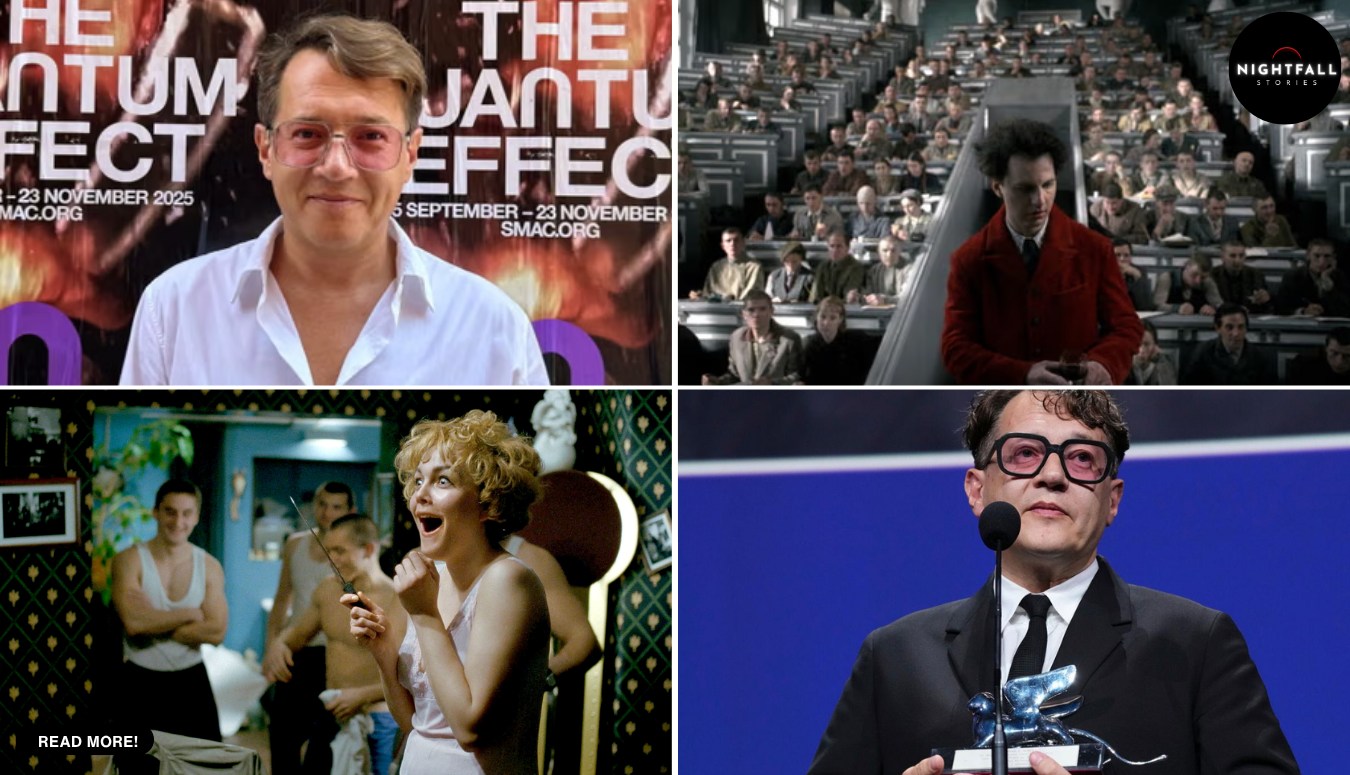
A little over a month ago, two ministries of a country at war sat down and wrote a public letter asking the oldest film festival in the world to take a film out of competition. The festival said no. Three weeks later, the jury handed that same film’s director one of the biggest prizes on the Lido, and the director, standing there with it, said the thing almost nobody expected him to say. He said he wished the government that had tried to get him removed every success in saving its country and winning its war.
That is the whole shape of it, and almost nothing about it is simple.
The film is called DAU, and it arrived at the 83rd Venice International Film Festival carrying about seventeen years of argument on its back. Its director is Ilya Khrzhanovsky, born in Moscow in the mid 1970s, resident outside Russia since 2007, and, since Russia’s justice ministry designated him a foreign agent, no longer a Russian citizen at all. He renounced it. He now holds British, German and Israeli citizenship and lives in Berlin. His passport, or rather the absence of the one everybody assumed he had, sits underneath every part of this story.
Before the festival even opened, Ukraine’s foreign and culture ministries issued a joint statement objecting to DAU’s place in the main competition. Their case was not that the film was bad, and it was not, on its face, that the director was Russian. It was about money, networks and what a stage like Venice confers. At a time when Russia was continuing a war of aggression against Ukraine and systematically destroying its cities, its cultural heritage and its national identity, the ministries argued, handing one of the most prestigious cultural platforms in the world to a project linked to the Russian state and its networks of influence sent an extremely troubling signal. They said Russia treats culture as an instrument of state policy and hybrid warfare, and that accepting Kremlin adjacent projects lets Moscow test how far international institutions are willing to tolerate its crimes.
They were specific about why they thought DAU qualified. The project’s early financing came from Sergei Adoniev, a Russian businessman later placed under sanctions. Khrzhanovsky had gone on to run a major cultural institution funded by oligarch money. And the film’s lead performer, the conductor Teodor Currentzis, had been granted Russian citizenship by presidential decree and has declined, repeatedly, to criticise Vladimir Putin. Currentzis’s orchestras have received Russian institutional funding. Ukraine’s embassy in Italy raised the same objection through diplomatic channels. Put together, the ministries’ argument was that you cannot separate a work from the pipes the money ran through, and that a festival which pretends you can is doing the propaganda work for free.
That is a serious argument, made by a state whose cultural institutions have been bombed, and it deserves to be stated at full strength rather than waved at.
The festival’s answer was unusually blunt. Alberto Barbera, Venice’s artistic director, refused to pull the film and said the campaign against it was a manipulation of reality. He said DAU is not pro Putin propaganda. He said it is not a Russian film at all, and that what it actually does is denounce totalitarian regimes. He called the effort to have it removed a petty and unacceptable act. Festival directors under pressure from a government usually reach for something diplomatic about artistic freedom and leave it there. Barbera did not.
His position, stated at its strongest, is this. If the content of a film condemns authoritarian power, and if its director has renounced the citizenship of the state accused of backing him, then removing it because of where money came from nearly two decades ago is not resistance to propaganda. It is a test the festival would be failing in the other direction, by letting any government decide which artists are acceptable. And if the standard is association rather than content, it is a standard almost no international co production could survive.
Both of those cases are coherent. Neither of them is silly. And the reason this row travelled so far beyond film people is that most of the arguments in the world right now have exactly this shape, where the question is not whether a thing is good but whether the people behind it have earned a hearing.
To understand why DAU in particular is such a strange object to be arguing about, you have to know what it is, and almost nobody outside a fairly small circle does.
Around 2008, Khrzhanovsky set out to make a biographical film about the Soviet physicist Lev Landau, known to colleagues as Dau. What he built instead, in Kharkiv, in Ukraine, was a twelve thousand square metre reconstruction of a Soviet research institute, and then he moved people into it. Roughly four hundred participants, most of them not professional actors, lived inside that reconstruction under period rules, in period clothing, with no modern objects permitted, for stretches at a time. The unscripted shoot ran from late 2009 to late 2011. It generated around seven hundred hours of 35mm film, which was eventually cut into fourteen features and three series plus installation work. The film that competed at Venice runs three hours and fifteen minutes and follows Currentzis as a physicist moving through Soviet life across four decades.
It is not, by any measure, a normal movie, and it has never been treated as one.
The project has been controversial on its own terms since long before any of this, and it would be dishonest to write about the Venice row without saying so. When an earlier DAU film screened at a major festival years ago, a group of Russian journalists published an open letter attacking its selection. There have been sustained allegations about the conditions inside the institute and about how far the line between performance and real experience was allowed to blur, including a claim that an intimate scene was filmed without the performers’ knowledge, which the lead actress herself denied. Khrzhanovsky has addressed the accusations publicly rather than ignoring them, and has argued that the emotional register of the work is meant to be hard to sit through. Nobody has ever been able to settle the argument to everyone’s satisfaction, partly because the project’s whole method was to make the boundary between the thing and the depiction of the thing impossible to locate. Anyone who tells you the ethics of DAU are a solved question is selling something.
There is one more layer, and it is the one that makes Ukraine’s objection more complicated rather than less.
For several years, Khrzhanovsky was artistic director of the Babyn Yar Holocaust Memorial Center in Kyiv. Babyn Yar is the ravine where tens of thousands of Jewish civilians were murdered during the German occupation, and the plan to build a major memorial there became, under his tenure, one of the loudest cultural fights in the country. Critics, including Ukrainian historians and cultural figures, objected fiercely to his proposed immersive approach to memory, and objected too to the memorial’s funding sources. Others argued that the institution was doing serious historical work that had been neglected for decades. He left the role a few years ago, saying that the war had changed a great deal about how a culture of memory can be built in Ukraine.
So the man Ukraine’s ministries wanted removed from Venice is also a man who spent years working in Ukraine, whose defining project was built in a Ukrainian city that has since been shelled repeatedly, and who has publicly opposed the invasion since it began, including signing letters against it and helping arrange access for independent journalists to interview Ukraine’s president. His critics would say none of that cancels the money trail or the casting of Currentzis. His defenders would say it is precisely the record that the ministries’ statement leaves out. Both of those are positions people hold sincerely, and this piece is not going to pretend one of them has quietly won.
When reporters put Ukraine’s accusations to him in Venice, Khrzhanovsky did not do what most people do under that kind of attack, which is to counterattack. On the financing, he said plainly that Adoniev was the first financier of the project, from 2008 to 2019, before sanctions existed, and that in the seven years since then the project has had a completely different life and different money. On Currentzis refusing to condemn Putin, he declined to denounce him. He said some people make choices he does not like, and that everyone is responsible for their own choices, which is either an evasion or an unusually restrained refusal to throw a colleague under a bus, depending on where you are standing.
And then he said the line that made the story travel. Asked what he wanted, he said the only thing he could wish for was peace, and success for the Ukrainian government, that it succeed in the best possible way, that it save the country, and that it win this war.
That is a director, under public attack from two ministries of a state, wishing that state victory.
You can read it a few ways, and people did. The generous reading is that he refused to let a cultural row be converted into a reason to be lukewarm about a war he has been clear about for years, and that he separated a government’s decision about him from a country’s survival. The sceptical reading is that it was the single most disarming sentence available to him and he knew it. The honest position is that nobody outside his own head can settle which, and the sentence is on the record either way.
The festival ran its eleven days. At the closing ceremony, a jury chaired by Maggie Gyllenhaal, a jury widely read going in as one likely to be attentive to ethical questions about how films get made, gave Khrzhanovsky the Silver Lion, reported as the award for best director. Of all the outcomes available, it was the one guaranteed to keep the argument alive. A quiet exit from competition would have ended the story. A prize did the opposite.
One detail that has circulated since deserves flagging rather than repeating. Some coverage has reported that Khrzhanovsky dedicated the award to Ukraine from the stage. That claim traces back to secondary outlets and could not be confirmed against the ceremony record, so it is left where it belongs, unverified. What is solidly documented is the earlier answer, given to reporters at the festival, about wishing the Ukrainian government success in saving the country and winning the war. The reason the two keep getting fused in retellings is obvious, because the second makes a neater story, and neat is usually the first sign that something has been smoothed.
There is a detail in all this that keeps getting lost, and it is the one that would matter most to anyone who ever walked through the set. The institute was built in Kharkiv. Kharkiv is a city that has been under bombardment on and off since the invasion began, close enough to the border that air raid warnings there have at times been measured in seconds rather than minutes. Whatever anyone thinks of the project’s methods, the place where four hundred people spent two years living inside a reconstructed Soviet institute is now a front line city, and the country that hosted the strangest film production in modern European history is the same country whose ministries asked for its result to be pulled from competition. That is not an argument for either side. It is just the fact that sits underneath both of them.
The other thing that keeps this from being a one off is the precedent question, and everybody involved knows it. Since the invasion, every major festival, orchestra, opera house and museum in Europe has had to decide, case by case and usually without a written rule, what to do with Russian born artists, with work funded years ago by people who are now sanctioned, and with performers who will not say publicly what they think of the government at home. Some institutions drew the line at the state, some at the individual, some at the money, and a few drew no line at all and took the criticism. Venice’s decision on DAU is now one of the loudest data points in that record, and whichever way you think it should have gone, the next institution facing the same call will be looking at it.
So where does it actually settle.
Ukraine’s ministries did not get the film removed and have not withdrawn their objection. Their argument about cultural platforms as instruments of legitimacy is one that other institutions are going to face again, because the underlying question of whether a work can be assessed separately from its financing has no agreed answer anywhere in the arts. Barbera did not apologise and the festival’s position has not moved. The film went out into the world with a major prize attached and an asterisk that will follow it into every review. Khrzhanovsky went back to Berlin with a Lion, no Russian passport, a body of work that is still genuinely contested on its ethics, and a sentence about somebody else’s war that will probably outlast the prize.
What is worth holding onto is how rare it is to see any of these parties behave the way they did. A state at war spent diplomatic effort on a film rather than ignoring it, because it believes culture is a front. A festival refused a sympathetic government’s request in public and gave its reasons. And a director who had every incentive to be aggrieved used his moment to wish the people who came after him well. None of that resolves anything. All of it is on the record, which, in an argument this loud, is the most anyone is likely to get.