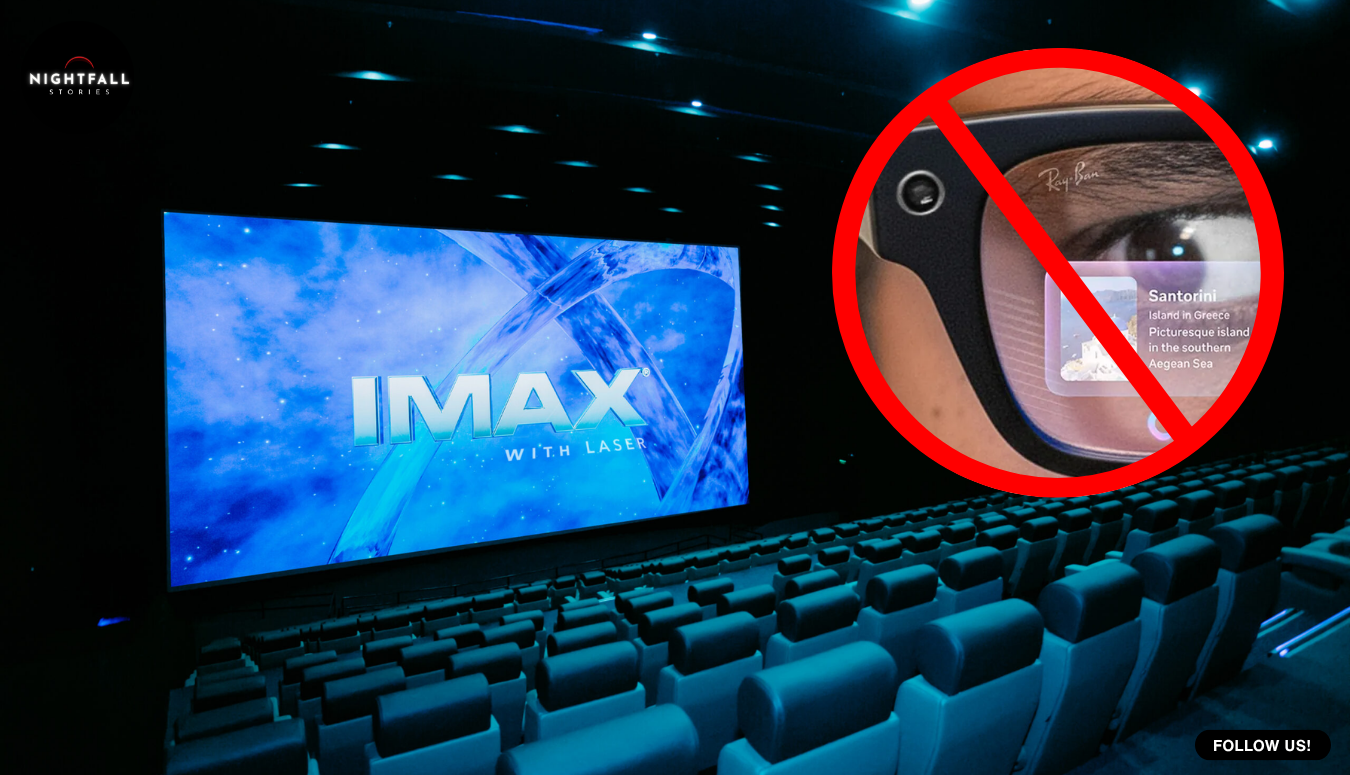
Somewhere in a British cinema this week, an usher is going to have to make a decision about a pair of spectacles, and there is no honest way for that usher to get it right.
The glasses on the person’s face might be ordinary prescription lenses. They might be a camera capable of recording the entire film in high definition without anybody in the row noticing. They might be an assistive device that is the only reason that customer can follow the dialogue at all. In a darkened auditorium, standing at the end of an aisle, looking at a stranger who has paid for a ticket, the usher cannot tell the difference. Nobody can.
That is the problem the UK Cinema Association has just admitted it does not know how to solve. The association represents the operators behind the overwhelming majority of cinema screens in Britain, and in guidance to its members it acknowledged that many of them are now introducing policies to prohibit or restrict the wearing of camera-enabled smart glasses in their venues. In the same breath it conceded that operators recognise these devices can genuinely help customers with access requirements, and that the whole question is, in its own careful phrasing, clearly a developing area. Having said that much, the association said it would make no further comment for now.
Read that carefully and you can see an industry working out loud. Cinemas have two commitments here and the technology has put them directly into conflict. One commitment is to the studios, which insist that the auditorium is the last secure room in the film business, where recording is not merely against the house rules but a criminal matter. The other commitment is to the several million customers who cannot fully use a cinema without help, and who have spent decades asking the industry to take their access seriously. A blanket ban on smart eyewear honours the first commitment by breaking the second.
What makes this worth paying attention to is that Britain already tried this once, and the man who announced it then is the same man in charge now. Back in 2014, when Google Glass launched in the UK, the trade body then known as the Cinema Exhibitors Association asked customers not to wear wearable recording technology in auditoriums, with staff empowered to ask anyone who did to take them off or leave. Its chief executive, Phil Clapp, explained the reasoning at the time in language that has aged almost too well. Phones can be put away when the film starts. With something you wear, he said, it is generally harder to know when it is recording and when it is not.
Britain was not even first. An American cinema chain known for its strict rules about talking and texting had banned the devices a few weeks earlier on the same reasoning, and casinos, bars and restaurants across the United States were doing the same. For a brief period the wearable camera looked like a settled social question that had been answered no.
That policy went precisely nowhere, for the simple reason that Google Glass went precisely nowhere. Nobody had to enforce a rule against a product that almost nobody bought and that anyone wearing in public was instantly, conspicuously identifiable as wearing. The device announced itself. It sat above the eyeline on a titanium band with a visible prism hanging in front of one eye, and people who wore them acquired a nickname that ended their social viability faster than any cinema policy could.
What has changed in the intervening years is not the rule and not the anxiety. It is the industrial design. The current generation of camera glasses do not look like technology. They look like Wayfarers, because a very large number of them are Wayfarers, built in partnership between Meta and the eyewear conglomerate that owns Ray-Ban. The second-generation Ray-Ban Meta glasses carry a twelve megapixel camera, on-board microphones, live streaming, and a voice assistant, inside a frame that is visually indistinguishable at two metres from a pair of sunglasses somebody has owned since university. Last year Meta went further and announced a version with an actual display built into the lens, controlled by a wristband that reads the small electrical signals in your forearm, so the wearer can operate the thing without moving a hand that anyone would notice. It went on sale at around eight hundred dollars.
The scale is the part that makes this different from the last time. The eyewear group that manufactures the frames reported selling around seven million smart glasses in a single recent year across its Ray-Ban and Oakley lines, after reaching only two million cumulative units in the first year or so on sale. It has talked about pushing annual production capacity toward ten million, and there have been reports of discussions about going considerably higher than that. Google Glass never sold in numbers anyone bothered to publish. These are mass-market sunglasses that happen to contain a camera, bought overwhelmingly by people with no interest whatsoever in recording a film, and that is exactly why a cinema cannot treat their presence as suspicious.
There is a safeguard, and it is the thin thread the entire consent argument hangs from. A small white LED on the frame lights up when the camera is running. In a bright room, at conversational distance, from the correct angle, it works. Privacy researchers have pointed out for years that it is far less reliable in low light, which is a polite way of describing the exact conditions inside a cinema, and there has been a small aftermarket in modifications that disable the light altogether for a few dollars. A safeguard that costs sixty dollars to remove is not really a safeguard. It is a courtesy extended by people who were never the problem.
The privacy half of this story arrived before the piracy half did. The glasses picked up an ugly nickname online after reports of men using them to film women without consent and post the footage, in some cases attached to enough personal detail that the women involved were then harassed. That is not a cinema problem specifically. It is a public space problem, and cinemas simply happen to be a dark public space where people sit still for two hours next to strangers. The industry did not ask to become the test case, but it is a reasonable place for the argument to land, because a cinema is one of the last places where an audience genuinely cannot see what is happening around them.
The piracy half is where the money is, and where the numbers get slippery. The film industry has argued for a very long time that the great majority of pirated copies in circulation originate from somebody recording a screen inside a theatre, a claim that has been repeated so often it is now treated as settled fact and that independent researchers have never been able to verify at the stated level. What is not in dispute is that camcorded copies are the first copies. A film that leaks on its opening weekend leaks from a room with a screen in it, and everything downstream flows from that single recording. British cinemas have run anti-camcording training for staff for years, with reward schemes for employees who spot a recording in progress, and every one of those programmes assumes an object the staff member can see. A phone held up. A camera bag on a lap. A red standby light in the back row.
The economics behind all of it are brutally simple. A film earns most of what it will ever earn from cinemas in its first two or three weekends, and the value of that window collapses the moment a watchable copy is available for nothing. It does not need to be a good copy. A shaky recording with heads in the bottom of the frame and muffled sound is enough to satisfy a meaningful number of people who were never going to pay, and enough to satisfy some who would have. Every additional week a distributor can keep a clean copy off the internet is money, which is why the studios treat the auditorium the way a bank treats a vault.
None of that training survives a pair of glasses. The whole apparatus of cinema anti-piracy enforcement depends on a recording device looking like a recording device, and that assumption has now quietly stopped being true.
Which brings us back to the person in row F, and to the part of this story that most of the coverage skipped. Cinemas have spent the better part of two decades putting glasses on people’s faces on purpose. When the industry finally took accessibility seriously, one of the answers it reached for was eyewear. Captioning glasses, developed by Sony and rolled out across thousands of screens, display subtitles that float in the wearer’s field of view while the screen itself stays clean, so a deaf or hard of hearing customer can go to any showing at any time rather than the one subtitled screening at eleven in the morning on a Tuesday that nobody else wants to attend. That was a genuine advance, and it was achieved with a pair of glasses with a display in them.
The modern devices do the same job better and do other jobs besides. Meta has argued publicly that its glasses are critical technology for blind and low vision users, and that restricting them would be a significant step backwards. It would be easy to dismiss that as a company defending its product, and partly it is, but the underlying point is not wrong. An AI assistant that can describe your surroundings out loud, read text to you, and answer a whispered question is a meaningful improvement in independence for someone who has spent their life asking other people to read things to them. Somebody who relies on that does not switch it off at the cinema door because it is inconvenient for the studios.
So the door staff are being asked to do something genuinely impossible. They must distinguish, in low light, at speed, without embarrassing anybody, between a device that threatens a distributor’s release window and a device that is the reason a customer can attend at all, when the two devices are frequently the same device being used for different purposes. The obvious answers all fail. Banning everything punishes disabled customers for the behaviour of pirates. Allowing everything leaves a hole in the one security perimeter the film industry has left. Asking people to declare their disability at a ticket desk in order to keep their glasses on is the kind of policy that sounds reasonable in a meeting and humiliating in practice, and access campaigners have spent years explaining why.
There is no national rule in Britain, and that is a deliberate choice rather than an oversight. The association has not mandated anything. Individual operators are writing their own policies, which means the answer to whether you can wear your glasses depends entirely on which company’s building you walk into, and in some cases on which member of staff is on the door. Cinemas are not alone in this. Courts in England and Wales have restricted the devices, as have courts in New York state, and Germany’s data protection authority has suggested there are legal grounds for banning them in certain settings. In the United States, the major theatre chains were asked directly what their policies were and had not answered publicly, which is its own kind of answer.
The most likely outcome is not a ban at all. It is the same thing that happened with phones, which is to say the industry will eventually stop trying to keep the device out of the room and start trying to make the recording useless once it leaves. Cinemas already run forensic watermarking on digital prints, invisible markers baked into the projected image that let a distributor trace a leaked copy back to a specific screen and a specific showing. That technology does not care what recorded it. Glasses, phone, professional camera, the watermark survives all of them, and it turns a detection problem the staff cannot win into an evidence problem the studios can.
In the meantime, the honest position is the one the trade body took, which is to admit the thing is unresolved rather than pretend otherwise. That is unusual and worth noting. It would have been much easier to issue a firm-sounding ban, generate a day of supportive headlines about protecting films, and quietly leave the enforcement problem with the lowest-paid person in the building. Instead the industry said out loud that it has two duties here, that they point in opposite directions, and that it has not worked out the answer yet.
Twelve years ago the same organisation, under a different name and the same chief executive, wrote a rule about glasses and never had to enforce it, because the glasses failed. This time the glasses are selling, and they look like glasses, and the rule will have to mean something. Somebody is going to have to decide what happens in row F, and for once the people responsible have admitted they do not yet know.