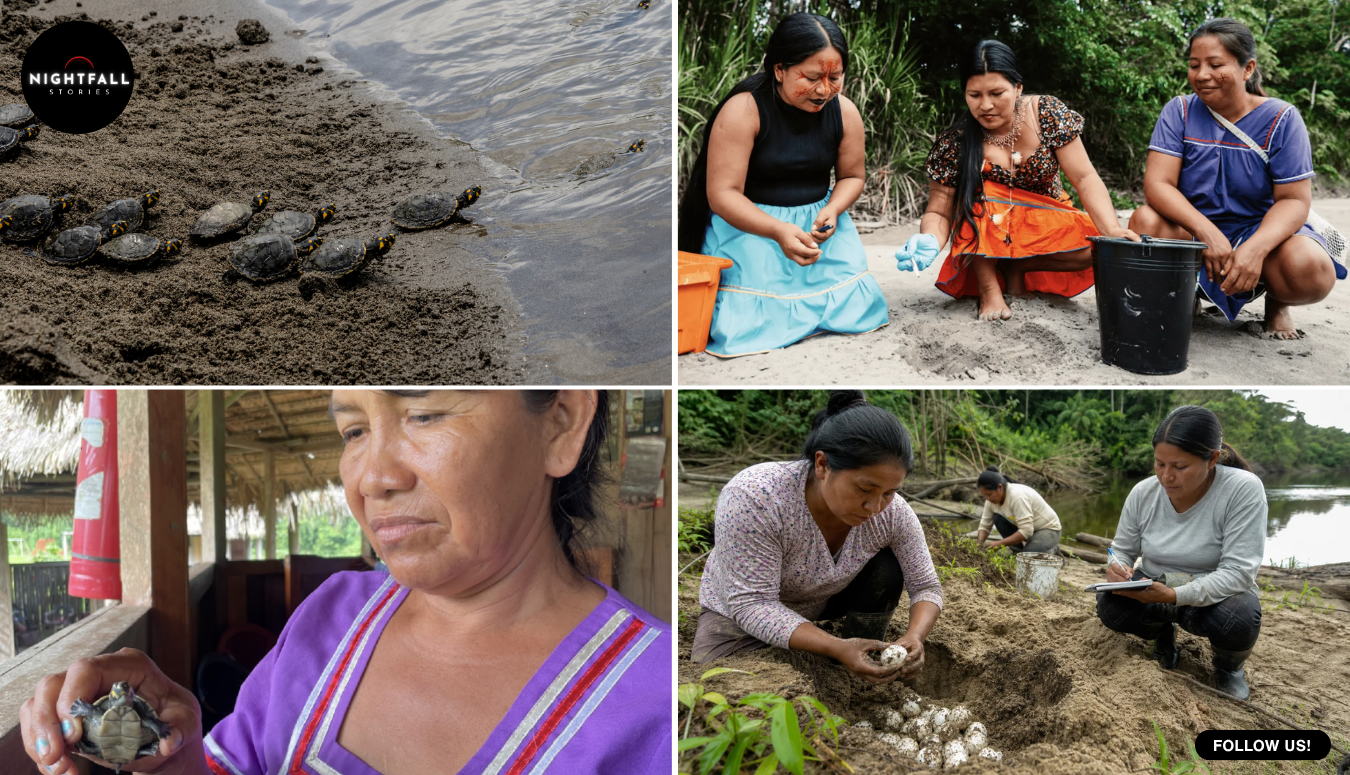
Two hundred and eight baby turtles went into the Aguarico River this year, and the only reason anybody knows that is because seven women decided to write it down.
That is the whole thing, really. Not a rescue mission mounted from outside. Not a government programme. Seven women from the Siekopai nation, in the Ecuadorian Amazon, who looked at a river they have known their entire lives, noticed that something in it was quietly going missing, and took on the job of finding out how bad it had got.
They call themselves Tari Nomiowa’i. In English, the turtle women.
The species they are working for is the charapa, known in English as the yellow spotted river turtle and to scientists as Podocnemis unifilis, and it is listed as vulnerable on the international conservation red list. If you have never heard of it, that is a large part of the point. It is not a tiger. It is not a whale. It is a mid sized freshwater turtle with pale markings on its head that spends its life in slow brown water and comes ashore to lay eggs on sandbanks, and its decline has happened almost entirely out of sight.
Turtles like this are extraordinarily vulnerable for a reason that sounds almost too simple. Everything about their survival strategy assumes time. They take years to reach breeding age, they can live for decades, and they compensate for losing a great many eggs and hatchlings by breeding over and over across a long life. That works beautifully in a stable river. It falls apart fast when the adults start disappearing, because an animal that slow cannot replace itself quickly enough to catch up.
The charapa is not a small animal, either. A mature female can reach a shell length approaching half a metre, which makes her a substantial and entirely defenceless target the one time each year she has to leave the water. She is also, for that stretch of hours, stationary and predictable, on an open bank, at a known time of year, in a known kind of place. Almost every threat the species faces converges on that single night.
And the pressures on the charapa arrive from every direction at once.
The eggs are taken, because they always have been, and because a nest of turtle eggs on an open sandbank is one of the easiest sources of food or income in the forest. The adults are hunted. Boat traffic on the rivers has increased, and the wake from passing engines erodes exactly the soft banks the turtles need. Pollution comes down the water in the form of plastic and fuel. And the rivers themselves have become harder to predict, with rising and falling water levels flooding nests that would have been safely above the line in an ordinary year.
Janeth Piaguaje, the Siekopai community leader behind the project, has described what the river now carries past her in the plainest possible terms. Plastic. Rubbish bags. Dead animals drifting downstream.
None of that is dramatic enough to make international news on its own. It is just steady, and steady is how species go.
What makes this story worth your time is not the threat, though. It is the answer, which is strange and modern and old at the same time.
The core skill here is knowing where the nests are, and that is not a skill you can download. A female charapa comes ashore at night, digs, lays, covers the nest and leaves, and what she leaves behind on a wide sandbank is a slight disturbance in the sand that will be gone with the next rain or the next wind. Reading that is a trained eye developed over a lifetime on a specific river, and among the Siekopai it is knowledge that has largely been carried by women, passed down within families.
Only one of the seven has been named in the coverage, which is Piaguaje herself, and the reporting describes the group as around seven women rather than fixing the figure precisely. That is worth flagging rather than glossing over, because the anonymity of the other six is quietly typical of how this kind of work gets reported. A named leader, a collective of unnamed hands, and a result that belonged to all of them.
Piaguaje learned to find and handle eggs from her father. That is the entire technology transfer at the heart of this project, and it happened decades before anyone wrote a grant application.
What is new is what they have bolted onto it.
The women patrol the banks during the nesting window, locate the nests, and then, instead of simply remembering, they record. They use a field data app called Epicollect5, logging the date, the time, the location and the number of eggs in each clutch. Then they lift the eggs, carefully, and move them to a protected incubation site away from the flooding, the erosion and the collectors.
Moving a clutch is not a trivial act, and it is worth knowing that it is a real technique with real care behind it rather than simply scooping eggs into a bucket. Turtle eggs cannot be rotated once development has begun without killing the embryo, so a relocated clutch has to be lifted in the orientation it was laid and reburied the same way up, at a comparable depth. Incubation temperature matters enormously too, because in many freshwater turtles the sex of the hatchlings is determined by how warm the nest is rather than by chromosomes. Get the shade and the sand depth wrong and you do not lose the clutch, you skew it, and produce a generation that is almost entirely one sex. This is the kind of detail that separates a project that works from one that merely looks caring.
When the hatchlings emerge, they are not immediately dropped in the river. They are kept for about a month and fed on cassava, sweet potato and taro leaves, which gives them a size advantage against the long list of things in an Amazonian river that will happily eat a turtle the size of a coin. Then they go into the water.
This season, the numbers were 235 eggs collected and 208 hatchlings released.
Read that again, because the second number is the story. That is a hatch and survival rate that most wild nests on an open sandbank, exposed to flooding, predators and people, would not come close to. Twenty seven eggs did not make it, which is honest and normal, and nobody has dressed the figures up.
The releases were done in front of the community, with schoolchildren taking part alongside workshops, which matters more than it might sound. A child who has personally carried a hatchling to the water is a different kind of adult later on. The knowledge that used to move quietly between a father and a daughter is now moving in public, in a village, with a spreadsheet behind it.
The reason the count itself is the achievement, rather than a footnote to it, takes a moment to explain.
Conservation runs on numbers. A species with good data gets monitoring, funding, legal protection and a line in policy documents. A species without data is invisible, and invisible animals do not get saved, because you cannot argue for a trend you cannot demonstrate. For a great many freshwater species in the Amazon, and for the charapa on this particular stretch of the Aguarico, nobody outside the region was systematically counting anything. The decline was known locally, in the way you know a road used to be quieter, and it existed nowhere on paper.
By logging every nest they find, seven women have started turning local knowledge into the one form the wider world reliably responds to. A dataset. Next season’s figures can now be compared to this season’s. In five years there will be a trend line. Someone in a ministry or a funding body can eventually be shown a graph, and the graph will have come from women walking a riverbank at night with a phone.
The app itself is worth a sentence, because it is not a bespoke piece of conservation software costing a fortune. Epicollect5 is a free, general purpose field data collection tool that any project can set up on an ordinary phone, and it has quietly become part of the infrastructure of community led monitoring around the world, used by people recording everything from water quality to bird counts. The barrier to this kind of work was never really the technology. It was whether anyone thought the people who already held the knowledge should be the ones holding the data.
The project runs alongside Conservation International’s Ecuador programme, which supplies the technical side. The knowing where to look, and the deciding that it was worth doing, came from the community.
For the Siekopai, the turtle is not only an animal that needs saving. In their own telling, the charapa sits within a relationship rather than on an inventory. Piaguaje has spoken about Koouwajëo, described as the guardian of the turtles, and has framed the work as something done to honour the spirits of the river and to strengthen the culture, saying she wants Koouwajëo to be proud. That is her framing and the community’s, offered publicly, and it is not for anyone outside to interpret, decorate or explain.
What it does tell you is why the work is worth doing on nights when it is raining and nobody is watching.
It also helps to know how much the Siekopai have already had to fight for the right to be on that water at all, because it puts a patrol along a riverbank in a rather different light.
The Siekopai are a small nation, and the twentieth century went hard on them. During the border war between Ecuador and Peru in the nineteen forties, their territory became a militarised frontier zone and their freedom to move through it collapsed. Families were separated across a line drawn by two states. Later, after the conflicts ended, Ecuador claimed a large area of their ancestral land, known to them as Pë’këya and on maps as Lagartococha, as state property and folded it into a national wildlife reserve without their consent. They were kept out of it for decades. Their own land was legally protected from them.
That only changed a few years ago. A provincial court ordered the environment ministry to grant the Siekopai legal title to roughly 42,360 hectares of Pë’këya, and to issue a public apology for violating their collective territorial rights. It was the first time an Indigenous community in the country had been granted title inside a nationally protected area, and it was understood at the time as a precedent that other peoples could use. One of their leaders, Justino Piaguaje, put it in exactly those terms, saying the titling mattered not only for the Siekopai but for others still waiting.
So this is a nation that spent most of a century being told it did not belong on its own rivers, and that won, in court, comparatively recently.
And what a group of its women chose to do with that hard won presence was to go out at night and count turtle eggs.
There is something clarifying about that. The grand version of environmental action is a summit, a pledge, a signature, a headline number with a lot of zeroes. The version that actually moves a population of vulnerable animals is far less impressive to look at. It is seven people, a stretch of sandbank, a phone with a data form on it, a shaded box of sand, a month of chopping cassava and taro leaves for animals the size of a bottle cap, and then a morning where you put them in the water and most of them swim.
Nobody gets famous for this. There is no ribbon.
It is also worth saying clearly what this project is not. Two hundred and eight hatchlings will not, by themselves, restore a species. Most of them will not survive to adulthood, because most young turtles never do, and the ones that make it will not breed for years yet. The threats have not gone anywhere. The boats still pass, the water still rises and falls unpredictably, and the rubbish still comes downstream.
The honest description is that this is a beginning with a number attached to it, which is more than the charapa on this river had before.
What happens next is fairly clear, and pleasingly unglamorous. The women intend to keep going, season after season, because the value of what they are building compounds. One year of data is an anecdote. Five years of data is evidence. The hatchlings released this year will be in the river as the count continues, and the children who carried them down to the bank will be old enough to run patrols themselves by the time the first of those turtles is ready to nest.
That is the timescale this work actually runs on, and it is one of the reasons it so rarely gets done. It requires people who intend to still be there in twenty years.
Seven women on the Aguarico apparently do.
They found the nests the way they were taught, they wrote down what they found, and two hundred and eight small turtles went into a river that had been quietly losing them. Somebody is finally keeping the count. That is how something stops disappearing.