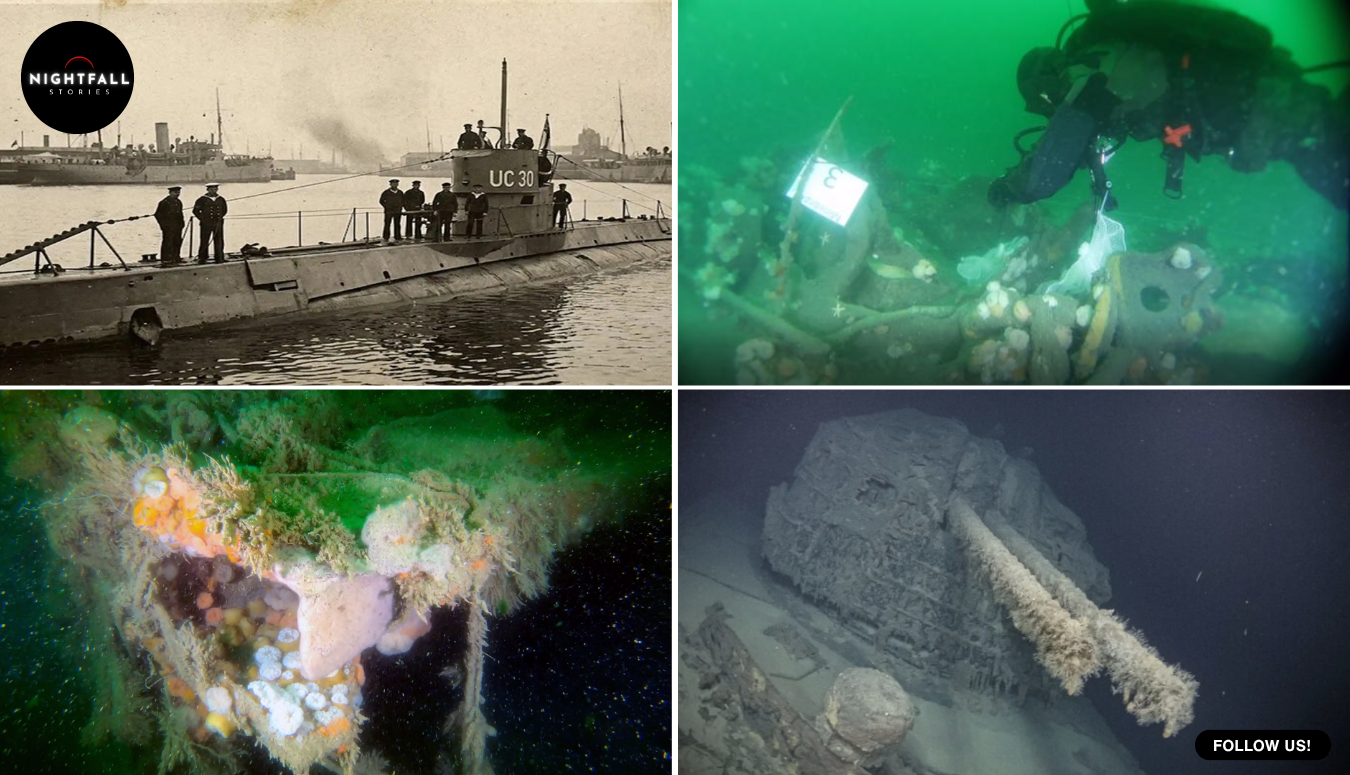
The submarine was going home when it died. It had given up on its mission, turned back towards Germany, and was crossing a stretch of shallow water off the Danish coast when it ran into a British mine. Twenty-six or twenty-seven men went down with it, depending on which record you read. So did eighteen sea mines and six torpedoes that had never been used.
For ninety-nine years, nobody knew exactly where it was. Then a Danish diver found it, sitting on the seabed in water shallow enough that you can reach it and cold enough that it has not rotted away. And a team of scientists went out to it with steel cages full of mussels, because they wanted to answer a question that nobody had thought to ask for most of a century.
The question was simple. The explosives are still in there. Where are they going?
The answer, published in a marine pollution journal by researchers from Aarhus University working with colleagues in Germany, is that they are going into the water, into the seabed, and into the animals living on the hull. Not in dramatic quantities. Not in a way that would hurt anyone swimming past. But measurably, continuously, and in a way that is going to get worse rather than better, because the thing holding it all in is a steel shell that has been dissolving since the year it sank.
The wreck is UC-30, a German minelaying submarine of a type built in a hurry during the First World War. It was a small boat by any standard, under fifty metres long, with a crew of around twenty-six and a job that was mostly invisible. Minelayers did not hunt ships in the way the famous U-boats did. They crept into shipping lanes, dropped mines through vertical tubes in the bow, and left. Whatever happened afterwards happened to somebody else, days or weeks later, with no submarine anywhere near.
UC-30 was commissioned in the summer of 1916 and lasted less than a year. Over four patrols it sank five vessels, three merchant ships and two requisitioned trawlers. Its commander, a man in his early thirties named Heinrich Stenzler, went down with the boat. His body came ashore in Denmark and was eventually identified and taken home to Germany for burial, which makes him one of the very few of that crew to have a grave anywhere at all. The rest are still where they were.
That matters for what happens next, and it is worth saying early. This is a war grave. It is not a dumping ground that somebody can simply lift and take away, and any conversation about cleaning it up has to sit alongside the fact that the men who loaded those mines are still inside the hull.
The wreck was rediscovered in 2016, off the Danish coast near the island of Romo, by Gert Normann Andersen, a diver who has spent a working lifetime locating lost ships in these waters. It lies in an area of the North Sea that is busy with fishing, shipping and, increasingly, offshore construction, and it was catalogued as a historical find rather than an environmental one.
The study that changed that was led by Kathrine Juul Andresen, a geoscientist at Aarhus University, with collaborators including a toxicologist at the University Medical Center Schleswig-Holstein and researchers connected to Germany’s Alfred Wegener Institute. The fieldwork was not straightforward. Civilian diving on the wreck is not permitted, for reasons that become obvious when you remember what is stacked inside it, so the sampling was carried out by divers from the Royal Danish Navy.
They took water. They took sediment. They took starfish and common mussels off the hull. And then they did something cleverer, which is the part of this study that makes it more than a spot check.
They took healthy blue mussels, the ordinary edible kind, put them in steel cages, and had the divers fix those cages to three different wrecks. Alongside UC-30 there was SMS Mainz, a German light cruiser from the same war, and a Second World War transport ship. The mussels stayed down for around eleven weeks, filtering seawater the way mussels do, which is to say constantly and indiscriminately. A mussel is a very good instrument. It cannot be told where to look, it does not need power, and whatever is in the water ends up in its tissue.
When the cages came up, the mussels from UC-30 had accumulated the highest concentrations of TNT of the three sites.
That is the finding, and the way Andresen has put it publicly is about as plain as science gets: they found traces of TNT in the wildlife, in the seabed and in the water column, and pollution is definitely happening. In the seawater around the wreck the measured TNT was roughly 72.6 nanograms per litre, which is a number worth translating. A nanogram per litre is a part per trillion. This is not a spill. It is a seep, at a concentration you would need very sensitive equipment to notice at all.
But the team also found the compounds TNT turns into once it is out in the world, the ones labelled 2-ADNT and 4-ADNT, which are what you get when bacteria or seawater start breaking the original molecule apart. Finding the breakdown products alongside the parent compound is how you know this is an ongoing process rather than a one-off release. Something is leaking now.
And the mussels were not merely carrying the stuff. The researchers reported significant differences in the activity of the enzymes those animals use to process foreign chemicals, the biological equivalent of a liver working harder than it should. That is a sign of stress, and it is the difference between saying a pollutant is present and saying it is doing something.
There is a quiet irony in using a mussel for this. The animals were not placed there as victims of an experiment so much as recruited as instruments, and the reason they work is the same reason they colonised the wreck in the first place. A submarine hull on a sandy seabed is a rare hard surface in an otherwise featureless place, and marine life takes any hard surface it can get. Within a few decades a wreck like this becomes one of the richest patches of habitat for miles, crusted with mussels and patrolled by starfish and fish that have nowhere else to shelter. The thing that makes it a good home is the same thing that makes it a slow leak.
None of this means the North Sea is poisoned, and the researchers have been careful not to say that. The contamination appears to be local, clustered around the wreck itself rather than spread across the region, and Andresen has said openly that more work is needed to establish how far from a wreck the effect actually reaches. Nobody has suggested that seafood from these waters is unsafe.
What makes the study unsettling is not the concentration. It is the direction of travel.
Steel in seawater corrodes. It has been corroding since the day the boat went down, and every year there is a little less of it between the explosive filling in those mines and the open sea. The mines are inside vertical tubes in the hull, which is both a blessing and a problem: they are contained, for now, by two layers of metal that are both running out. Andresen’s own warning is that this will worsen as the wreck continues to deteriorate and exposes more of the material inside. The clock does not tick down. It ticks up.
And UC-30 is one wreck.
A survey commissioned by Denmark’s environmental authority a couple of years ago counted 10,127 wrecks in Danish waters alone. Around fifteen per cent of them date from the two world wars. Not all of those were carrying explosives, and some are buried deep enough in sediment that they are probably sealed off from the water. But the proportion that are both war-era and armed is not small, and Denmark is one country with one coastline.
Widen the frame and the figure becomes genuinely hard to absorb. Experts estimate that around 1.6 million tonnes of conventional munitions are lying in German waters of the North Sea and the Baltic. A large part of that was not lost in combat at all. It was deliberately dumped after the wars ended, when the fastest way to make a defeated country’s ammunition disappear was to load it onto barges and tip it over the side into shallow water. Nobody at the time was thinking about what the steel casings would be doing eighty years later, because nobody expected anyone to still be thinking about it.
It is worth understanding why so much of it ended up in the sea in the first place, because it was not carelessness so much as a decision that looked reasonable at the time. At the end of both wars there were mountains of shells, bombs and mine casings that somebody had to make safe in a hurry, in countries with wrecked infrastructure and no appetite for storing high explosive near towns. The sea was deep, it was close, and it was assumed to be effectively infinite. Barges went out, cargo went over the side, and the paperwork, where there was any, was often vague about exactly where. That is part of why mapping is now the first job: a great deal of this material is not where the records say it is, if the records exist at all.
So there is now an entire slow-moving problem sitting on the floor of some of the busiest seas in the world, and almost nothing about it is easy to solve.
The obvious answer, blowing the munitions up where they lie, is the one that has historically been used and the one the researchers are most wary of. Detonating old explosives underwater does not make the chemistry go away. Depending on currents and the nature of the seabed, it can take material that was concentrated in one place and distribute it over a much wider area, while also killing anything nearby with the pressure wave. Recovering the munitions instead is safer for the environment and far more dangerous for the people doing it, and it is expensive on a scale that has kept most governments from starting.
Germany has begun to spend real money on recovery, and there is European funding behind work on robotic systems that could map where munitions are and eventually lift them without putting a diver next to a hundred-year-old detonator. That is the direction the field is moving: find everything first, prioritise what is actually leaking, and leave alone the wrecks that sediment has already sealed. Some of these sites are genuinely less of a risk left undisturbed than dug up, and knowing which is which is most of the work.
There is also an argument for a kind of humility here. One of the toxicologists involved in this research has made the point that with a carcinogen, there is no threshold at which you can declare a dose harmless in principle, only doses too small to measure a harm from. That is a scientist’s framing rather than a public health warning, and it should be read as the former. The practical risk to a person eating mussels from the North Sea today is not what this study is about. It is about whether we should be comfortable with a curve that only goes one way.
What lifts this above an environmental audit, though, is what the wreck actually is.
UC-30 was a machine for killing people at a distance, and it failed at that more often than it succeeded, and then it killed its own crew on the way home. Those eighteen mines were built to destroy ships full of men who would never have seen the thing that got them. The submarine sank before it could use them, which at the time would have been counted as a small mercy.
A hundred and nine years later, the mines are doing the only thing left available to them. They are leaking, slowly, into a patch of seabed covered in mussels and starfish, and into the tissue of animals that have made a home out of the hull. The submarine has become a reef. It is also still, chemically, a weapon that has not finished going off.
The team at Aarhus is not calling for the wreck to be raised or the site to be closed. What they are asking for is that these thousands of sites stop being filed as maritime history and start being treated as infrastructure that needs monitoring, because that is what they now are. Andresen’s own summary of the task ahead is modest and a little bleak: they are looking for the gentlest solutions available, because there is unfortunately no easy way to clean any of it up.
That is probably the honest ending. Nobody is going to fix this in one go. The best realistic outcome is that the wrecks that are leaking get found, the worst of them get carefully emptied, and the rest get watched.
The men inside UC-30 have been dead for more than a century, and the war they fought in ended before their grandchildren were born. The cargo they were carrying is still out there in the dark, still doing its job in the only way it has left, one molecule at a time, into the mussels.