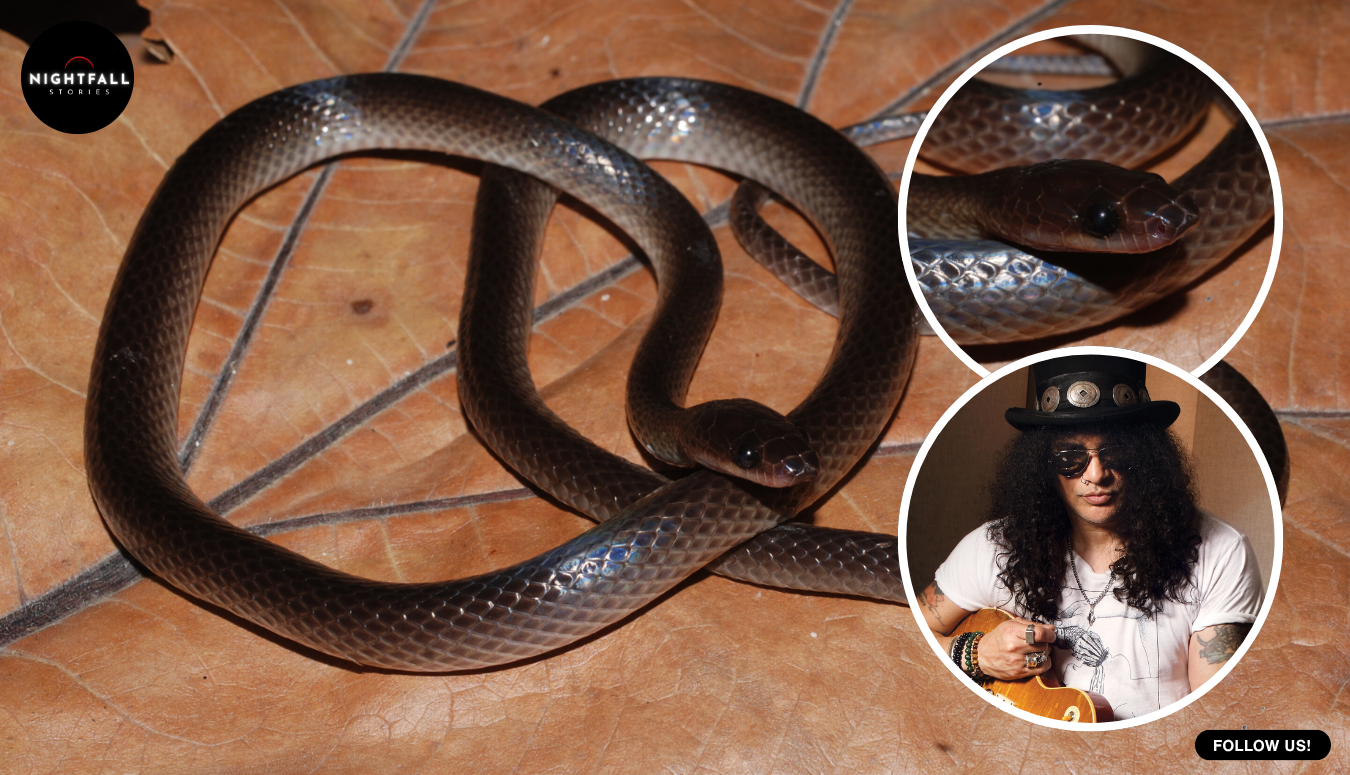
Somewhere in the collections of a natural history museum in Chicago there is a snake in a jar, about the length of your forearm and then some, reddish-brown all over, with no stripes or bands or blotches to make it interesting. It is not venomous. It is not enormous. It is the sort of animal that a person could step over in the dark without ever knowing it was there. And for twenty years, nobody knew what it was.
It has a name now. The name is Lielaphis slashi, and it belongs to the top-hatted guitarist from Guns N’ Roses, who has kept snakes since he was eleven years old and who turned up at the museum in person to meet the animal that now carries his name.
That is the short version, and it is a good story on its own. The longer version is better, because it is about what actually happens to a small brown snake between the moment somebody picks it up in a forest at night and the moment it gets a name, and about why that gap was two decades long, and about a scientist who kept a magazine from her childhood on a shelf for thirty years without ever imagining what it would eventually be good for.
Start with the forest. In 2006, a herpetologist named Chris Austin was doing night fieldwork in Sandaun Province, in the northwestern lowlands of Papua New Guinea. Austin is a curator at the Louisiana State University Museum of Natural Science, and looking for snakes after dark in New Guinea is a very specific kind of work. Groundsnakes there tend to sit at the base of big trees once the sun goes down, which means you walk with a torch, slowly, checking tree roots, in a country that also happens to hold some of the most seriously venomous snakes on the planet. Austin has said the nocturnal ones are especially hard to find, which is a mild way of describing a job where the animal you want is small, brown and hidden and the animal you do not want is also out there.
There is a detail in the fieldwork photographs that makes the whole enterprise feel less abstract. Austin is standing in the field with colleagues from the Papua New Guinea National Museum and Art Gallery, in ordinary clothes, in ordinary bush, in a place that does not look remotely like a laboratory. This is what the front end of taxonomy actually is. Somebody walks around at night for weeks, finds a few dozen animals, and ships them home with catalogue numbers attached, and then the interesting part happens years later in a building thousands of miles away.
He found this one in secondary forest. It looked like a groundsnake. It went into a jar, into a collection, into a catalogue, filed under a species that had already been described. That is not carelessness. It is the correct thing to do when an animal looks exactly like something already known, and this one did.
Here is the problem with New Guinea groundsnakes, and it is the reason the story has a twenty-year hole in the middle of it. They all look the same. The genus is full of medium-sized terrestrial snakes that are nocturnal, secretive, poorly recorded and almost uniform in appearance. They also have what the researchers politely call a complex taxonomic history, meaning that for more than a century scientists have been shuffling them between genera, lumping them together, splitting them apart, and generally disagreeing. The genus these snakes now sit in, Lielaphis, was itself only recently brought back into use after years out of circulation. When the animals in front of you are effectively indistinguishable by eye, you cannot count on your eye.
What eventually cracked it was genetics. Tianqi Huang, the first author on the study, is a researcher who has worked across the Field Museum and Rutgers University, and the team ran a stack of modern genetic analyses on the group. The snake from Sandaun Province came back genetically distinct from everything else in the genus. Not slightly unusual. Distinct.
Once the DNA said look again, the physical differences started to show up. The scale counts are not the same. This species runs somewhere in the range of a hundred and sixty-five to a hundred and eighty-one ventral scales along the belly, with eighty-three to a hundred and seven divided scales under the tail, seventeen rows of scales around the middle of the body, and a cream-coloured underside that may darken very slightly toward the tail. Those numbers are not exciting to read. They are how snake identification actually works, and they are the difference between an animal that exists on paper and an animal that does not.
The team also ran ecological modelling and found that this snake prefers different conditions from its closest relatives, which is another argument for it being its own thing rather than a regional variation on something known. The description was published in the taxonomic journal Zootaxa. With it, the genus Lielaphis went from nineteen species to twenty.
None of that, by itself, would have travelled beyond people who read taxonomy journals for a living. What made it travel was the second word in the name.
Sara Ruane is the associate curator of herpetology at the Field Museum and the senior author on the paper. She has been obsessed with reptiles since she was a child, which is the standard origin story for herpetologists and is also, in her case, the load-bearing detail. Back in the mid-1990s, a copy of Reptiles Magazine came out with Slash on the cover, holding a python. She was a kid. She read it. She kept it.
Thirty years later, with a species that needed a name, she went back and reread that old interview. What struck her was not the celebrity of it. It was that he talked about loving museums and zoos and natural history, which is precisely the set of things she has spent her career inside. A scientific name is permanent in a way almost nothing else is, and naming one after somebody is a real statement about what you think is worth honouring. She and her co-authors chose him for his long public advocacy for snakes, zoos and museums, which is stated plainly in the paper’s etymology section under his legal name, Saul Hudson.
The advocacy is not decorative. At his peak he kept something like eighty snakes, mostly boas and pythons, including Burmese pythons, reticulated pythons, red-tailed boas, Dumeril’s boas, anacondas and kingsnakes, in enclosures he treated as part of the furniture. He had been keeping them since childhood. He eventually gave the collection up, and his reason for doing so is one of the most relatable things a rock star has ever said about a hobby: feeding all of them by himself had turned into a job, and he missed when it was simpler.
He described himself, in response to the naming, as a long-time herpephile, and said he was honoured and humbled. Then he came to Chicago. There is a photograph from that visit of Ruane standing beside him in the museum holding up her copy of the magazine, the one with his face on it, the face now standing next to her. Behind them is the kind of room most visitors never see, shelves of jars, a collection built across more than a century.
It is worth sitting with what that room is, because it is the actual engine of this story. Museum collections look like storage and function like a time machine. An animal collected in 2006 can be reexamined in 2026 with technology that did not exist when it was picked up, by scientists who were not yet working when it went into the jar. The specimen does not degrade into uselessness. It waits. There are drawers in institutions all over the world full of animals that are quietly new to science and are simply waiting for somebody to run the right test on them, and the researchers on this paper have said outright that they expect more undescribed species in this same group.
That is a cheerful thought and also an uncomfortable one, because the waiting is not free. The forests in that part of New Guinea are under pressure from agriculture, including coffee farming, and from mining. Ruane has been direct about it: the habitat this snake comes from is being eaten into. An animal can be lost before it is ever described, which means it can be lost without anyone being able to say what was lost, because there is no name to put on the loss. Conservation runs on lists, and lists run on names. A species that has not been described does not appear in an impact assessment, does not appear in a protected-species schedule, does not appear anywhere at all.
New Guinea is the largest tropical island on Earth and one of the most biologically rich places anywhere, with an enormous share of its plants and animals found nowhere else. It is also one of the least thoroughly surveyed. Those two facts together are why a snake can sit unrecognised for twenty years in a well-run museum: not because anyone was asleep, but because the backlog of undescribed life from that island is genuinely vast and the number of people qualified to work through it is genuinely small. Every described species is one item cleared from a queue that nobody has ever seen the end of.
The habit of naming species after people is older than most of the institutions that do it, and it has always been a bit of a mixed bag. Plenty of patronyms honour funders and collectors and colonial officials, and a fair number honour people who would not survive a modern background check. In recent years scientists have argued publicly about whether the practice should continue at all. What tends to get lost in that argument is that a patronym is one of the very few chances a working scientist gets to point at something in the wider world and say publicly that it mattered to them. Ruane pointed at a guitarist who spent his whole life telling people that snakes were worth caring about, which is, on the evidence, a defensible use of the privilege.
That is the honest argument for why taxonomy matters, and it is not a romantic one. Ruane has made the point that every species needs to be recognised before anyone can understand how an ecosystem actually works. You cannot model a food web out of blanks.
The paper itself is also a reminder that this kind of work is not done by lone heroes. Seven people are on it. Alongside Huang, Austin and Ruane there is Justin Bernstein, who has worked at Slippery Rock University and the American Museum of Natural History, Jackson Roberts of the Virginia Museum of Natural History, Jeffrey Frederick of the University of Kentucky, and Bulisa Iova of the Papua New Guinea National Museum and Art Gallery. That last name matters more than it might look. Research on New Guinea’s wildlife has a long history of specimens leaving the country and the science happening elsewhere, and having the national museum on the author line is a small correction to that pattern. Austin’s own fieldwork photographs from Sandaun Province show him working alongside colleagues from that same institution.
As for the snake, it lives a life nobody has watched properly. It comes out at night. It has enlarged teeth at the back of its mouth rather than fangs at the front, which is the standard toolkit for an animal that eats small lizards and reptile eggs rather than anything that needs subduing. It does not constrict. It poses no danger to a human being whatsoever, which is the detail most worth repeating, because the first instinct a lot of people have about a snake story is fear and this is an animal about the length of a violin that hunts geckos in the dark.
Almost everything else about it is a blank. Nobody has documented its breeding, its lifespan, how many there are, or how widely it ranges. The scientists who named it are open about that. Describing a species is not the end of the work. It is the point at which the work becomes possible, because now there is something to ask questions about.
There is a neat symmetry in how this ended up. A child reads a magazine because a guitarist she thinks is cool is holding a python, and the coolness is the hook but the python is the point, and she grows up to run a herpetology collection. Decades later she is holding a jar containing an animal that has been nameless since before she had the job, and the name she reaches for is the one from the cover. The guitarist, meanwhile, had been a kid who liked snakes long before he was famous, and stayed one through eighty enclosures and a touring career and giving the whole collection up again.
Neither of them planned any of it. That is usually how this goes. Scientific names are a strange kind of permanence, more durable than records or awards or buildings, because as long as the species is recognised the name travels with it through every paper and field guide and database that will ever mention it. It does not expire. It does not go out of fashion.
Somewhere in the northwestern lowlands of New Guinea, in forest that is being pressed in on from several directions at once, there are more of these snakes moving around the roots of big trees after dark, doing exactly what they were doing twenty years ago when a man with a torch happened to walk past one of them. They have no idea any of this happened. They have a name now anyway, and because of that, somebody can finally start arguing for them.