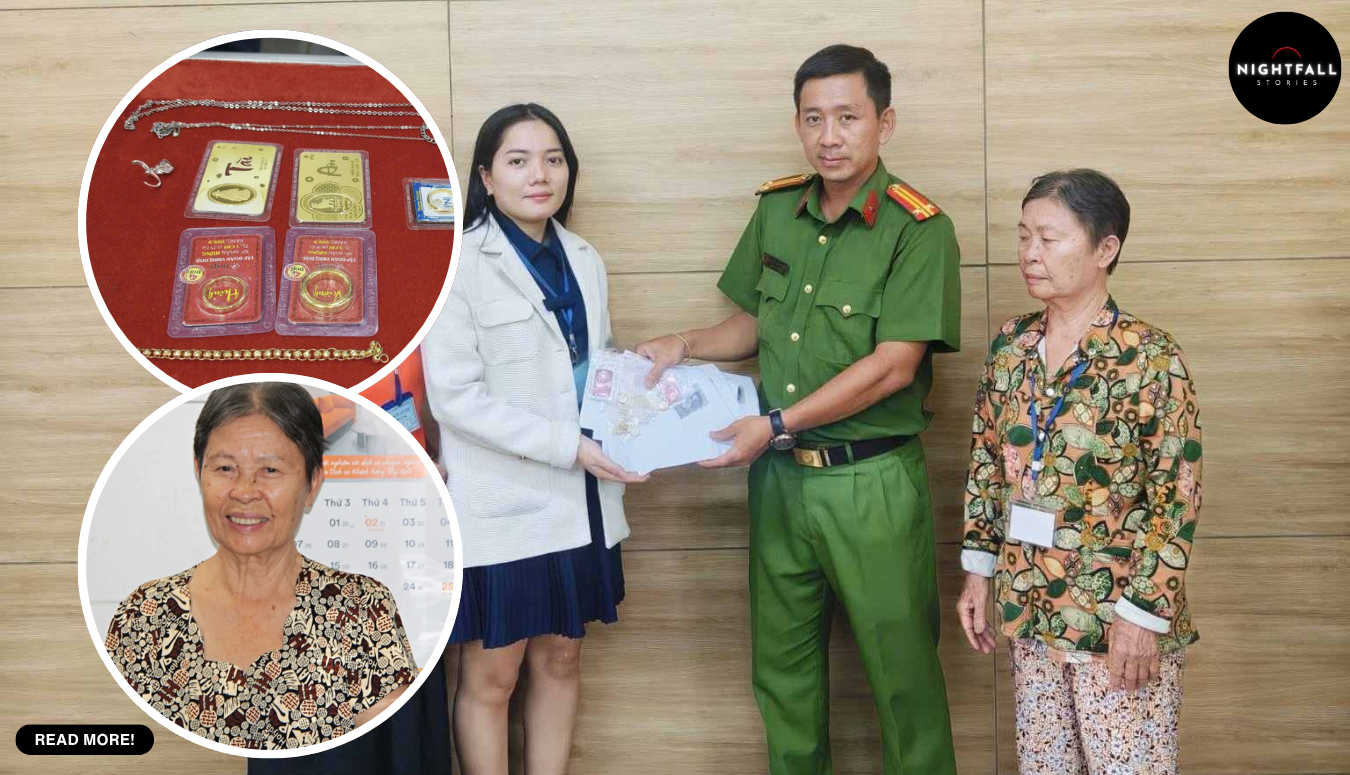
The bag was paper, the kind a shop hands over a counter, and it had been thrown out with the rest of somebody’s rubbish. Nguyen Thi Mui is 78 years old and she collects scrap for a living, so a paper bag in a pile of household waste is exactly the sort of thing she is supposed to look at. She opened it at about half past nine in the morning. Inside were jewellery boxes, and inside the boxes were nineteen pieces of gold: fifteen rings, two necklaces, a bracelet and a pendant.
She did not take it home. She did not weigh it, sell it, or sleep on it. According to the account police gave local media, she carried the bag straight to the ward police station that same morning and handed the whole thing over.
What happened next is the part that turns a small local item into something people all over the world have been passing around. She was thanked with the equivalent of roughly 380 US dollars and ten kilograms of rice. For a woman whose working day is measured in loose change, that is a real amount of money. Set against nineteen pieces of gold, it is also a number that says a great deal about how the world is arranged, and the honest thing to do is put it on the page and let readers sit with it rather than lecture anybody about it.
Start with the work itself, because most people outside Vietnam have no clear picture of it. In Ho Chi Minh City, as in Hanoi and most large cities in the region, a significant share of everything that gets recycled is recovered by people who are not employed by anyone. They buy or gather scrap paper, plastic bottles, cardboard, metal and glass, sort it, and sell it on to small depots that sell it on again. Research by labour organisations working in Vietnam has consistently found that women make up the majority of this workforce, that it is largely invisible in official statistics, and that most of the people doing it are outside the social insurance system, which means no sick pay, no accident cover and no pension waiting at the end.
The pay tracks commodity prices, and commodity prices have not been kind. One study of the trade noted that a kilogram of plastic bottles that once fetched a decent price now sells for a half or a third of what it did. The work is physical, it happens in traffic, and the hazards are ordinary and constant. People carry loads they should not carry. They handle other people’s broken glass. Nobody is covering the doctor’s bill.
The scale of it is bigger than most people assume. The UN Development Programme has estimated that roughly 30 percent of Vietnam’s waste is recovered by individual scrap pickers rather than by any formal system, and that around nine in ten of those pickers are women. One specialist quoted in Vietnamese media put the daily haul in Hanoi alone at more than 3,000 tonnes. These are the people who get into the narrow alleys a rubbish truck cannot enter. Without them, a large share of the country’s recyclable material would simply be buried.
The days are long in a way that is hard to convey in a sentence. Collectors interviewed for one Vietnamese report described ten and twelve hour shifts, routes beginning around six or seven in the morning and sometimes not ending until nine at night when the load is heavy, in whatever weather the day produces. Some hold a second job before the route even starts. The material gets hauled to a dealer, weighed, and paid out at a price that can move sharply from one week to the next. One collector described plastic dropping by nearly a third in the space of a few days, which is the difference between a decent week and a thin one, decided by nobody she will ever meet.
Typical earnings reported in that same coverage run to about five or six million Vietnamese dong a month, somewhere in the region of 200 US dollars, with close to half of it going straight back out on rent and basic living costs. Spread across a long working day, that is a few dollars for hours of physical labour. It is also, for the purposes of this story, the number to hold in your head when you picture a paper bag of gold sitting open in a woman’s hands.
Mui is 78 and she is still doing it. That single fact frames everything else about the morning she found the bag. Police described her as being in difficult financial circumstances, which is an official way of saying she needed the money. She was holding an amount of gold that would have changed her material life, in a form that is easy to sell, in a country where gold jewellery is bought and sold in small shops constantly. There was no camera pointed at her. There was nothing stopping her.
She walked it into a police station instead.
The story of how the gold got into the rubbish is almost as good, and it is the detail that keeps the whole thing from being a parable. The owner had not been robbed. She had thrown it out herself. Tran Thi Thuy Van, 34, lived in the same neighbourhood, and she had been cleaning her home. Somewhere in the sorting and the shifting of things, a paper bag containing most of her gold went out with the discards. She did not notice. By the time police found her, she had no idea it was missing.
If you have ever thrown away a receipt you needed, or binned a charger that turned out to be the only one in the house, you have made a smaller version of the same mistake. This one just happened to contain a life’s savings.
That phrase is not a flourish. In Vietnam, gold jewellery is not only decoration. It has long functioned as a household store of value, particularly for people who came up in decades when inflation and currency instability made saving in cash a bad idea. Gold gets given at weddings. It gets bought a ring at a time as money allows. It sits in a drawer rather than a bank, which is precisely why fifteen rings can be in one paper bag in one flat, and precisely why that bag can go out with the cleaning.
The police work that followed deserves its own paragraph, because it is the part everybody skips past and it is genuinely clever. The officers had a bag of jewellery and no name attached to it. What they did have was a receipt, tucked inside one of the boxes, carrying the name of whoever had bought that piece. They ran that name against the national population database, which returned more people than they could visit. So they narrowed the list to residents of the immediate neighbourhood, on the sensible theory that a bag in the local rubbish came from a local home, and then they went door to door until somebody opened one and said yes, that is mine, and then almost certainly sat down.
The jewellery went back to Van the same day. Not a week later, not after a claims process. The same day.
The thank you came from several directions at once. Police, local representatives and Van herself presented Mui with the money and the rice. Ten million Vietnamese dong is a real sum in the context of her income, the sort of amount that covers months of small necessities. The rice is not a token either. In a household running close to the line, ten kilograms of rice is weeks of meals you no longer have to worry about.
And still. Nineteen pieces of gold, and a sack of rice.
It is worth being careful here, because there is a version of this story that turns into a finger-wagging piece about a stingy reward, and that version would be unfair to everyone involved, including Van. Nobody outside that transaction knows her circumstances. A 34-year-old woman with a drawer of family gold is not necessarily wealthy; that gold may be exactly the savings she and her family have instead of a pension, which would make giving a large share of it away a genuine sacrifice rather than a gesture. The reporting does not say what she earns or what the gold represents to her, and inventing it would be dishonest. What can be said plainly is that the gap between what was handed in and what was handed back is large, and that Mui went back to work the next morning either way.
There is also a legal frame around all this that most readers will not know. Vietnamese civil law sets out what happens when someone finds property that is not theirs. The finder is expected to hand it in rather than keep it, the authorities hold and publicise it, and if an owner comes forward within the prescribed period the property goes back to them. The finder’s entitlement is not nothing, but it is conditional and it generally only becomes substantial when no owner is ever found. Here, the owner was found in a matter of hours. Mui did the thing the law asks and the law’s own reward mechanism, the one that might have turned some of that gold into hers, never had a chance to engage, because the system worked exactly as designed and returned the property to the woman who had lost it.
So the outcome is correct. It is also, from where Mui is standing, a morning in which she held a fortune and then did not have it.
What makes the story travel is not the gold. It is the size of the temptation measured against the size of the person’s means. Honesty costs almost nothing when you are comfortable. Handing back a wallet with 40 dollars in it when you have 400 in the bank is a nice thing to do, not a hard one. The reason this particular item has been shared in a dozen countries is that everyone reading it can do the arithmetic and knows, somewhere behind the polite response, that they are not certain what they would have done at 78 with aching hands and no pension.
Mui did not appear to find it a close call. The officer who spoke about the case afterwards made the point that her situation was difficult and that she was not tempted, which is the kind of line that gets said about people and is usually a summary rather than a transcript. Mui herself has not been widely quoted, and that is probably how it should be. She handed in a bag. She was thanked. She went back to her route.
Stories like this surface in Vietnamese media fairly often, which is worth saying because it protects the story from being told as though one extraordinary saint has been discovered in a slum. Scrap collectors return things regularly. Motorbike drivers chase down people who dropped envelopes of cash. It is a recognisable civic reflex rather than a miracle, and treating it as a miracle quietly insults the thousands of people who would have done the same.
What is unusual here is the scale of what was in the bag, and the fact that the police documented the whole chain in public, including how they traced the owner. That is why we have this level of detail at all. Nearly everything known about the morning comes from a single police account relayed through Vietnamese news outlets, including VnExpress and Dan Tri’s English service, and the value of the jewellery has never been independently established. Anyone telling you what nineteen pieces of gold are worth in dollars is guessing, and that guess would be the least interesting number in the story anyway.
There is one more thing worth holding onto, and it is not the moral. It is the ordinariness of every person in this chain. A woman cleaning her flat made a domestic mistake that anybody could make. Another woman doing a hard job noticed something in the rubbish, which is literally her job, and then made a decision that took about ten seconds and cost her more than most people are ever asked to give up. A group of officers did unglamorous administrative work with a receipt and a database until a name matched a door. Nobody in this story is a hero in the way the internet usually means it. They are people who each did the next correct thing.
The gold is back in its drawer, presumably in a different place this time, and probably not in a paper bag. Van got a fright and her savings back in the same afternoon. The neighbourhood got a story it will still be telling in five years. And Nguyen Thi Mui got 380 dollars, ten kilograms of rice, and a week of strangers wanting to talk to her, which at 78 is its own kind of exhausting.
Then she picked up her sacks and went out again, because the rent does not care what you found yesterday. That is the real ending, and it is not a sad one. It is just true. The woman who handed back a fortune is still working, still pushing a load through morning traffic, still opening other people’s discarded bags to see what is inside. She would almost certainly do the same thing tomorrow.