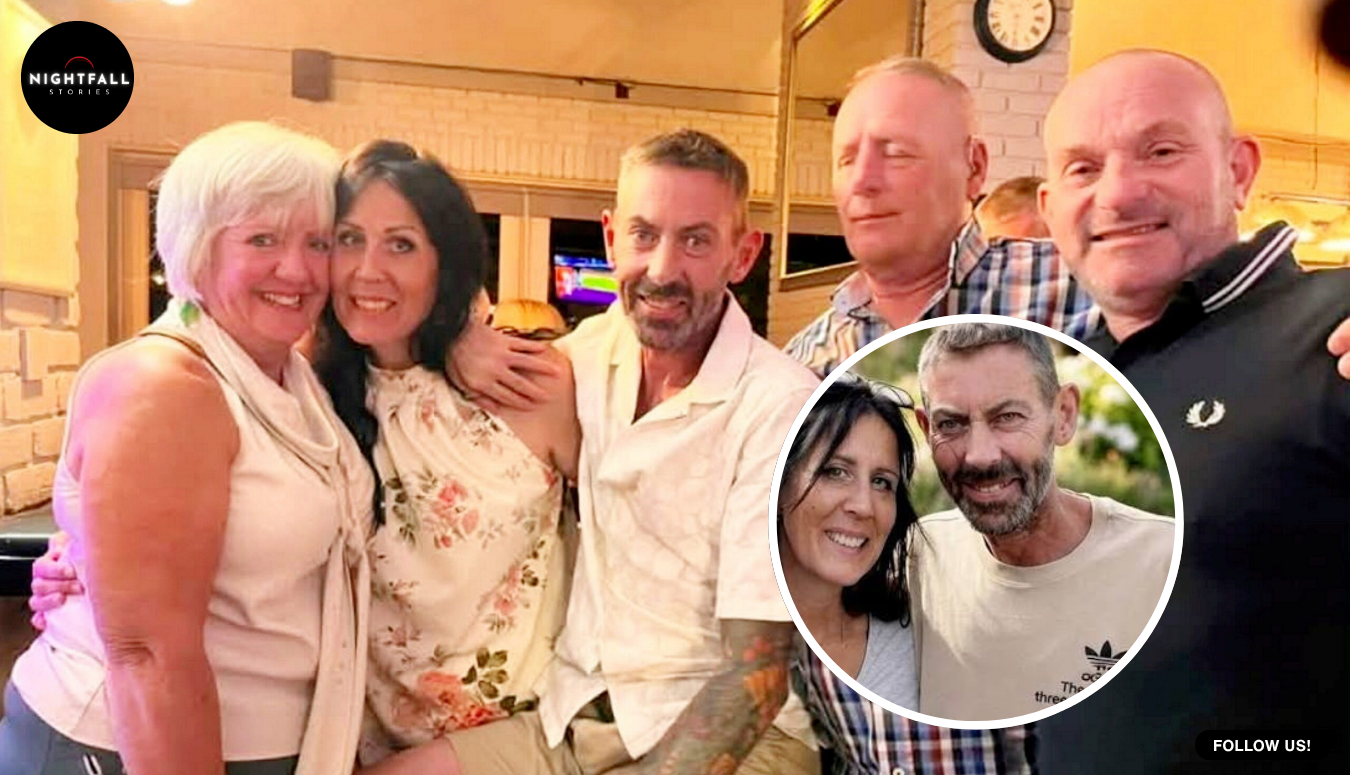
The pub opened its doors at half past two in the afternoon and the last people left around midnight. More than 200 of them came through: family, the friends you make at work and keep, and at least one person Austen Cole had not laid eyes on since primary school. It looked like any good party in any town on any Saturday, apart from one thing. It was Austen’s wake, and Austen was there.
He is 55, he was a self-employed tiler in a town in the English Midlands, and earlier this year he was told he had less than a year to live. Rather than leave the send-off to everyone else, he booked the pub himself. He refuses to call it a wake, by the way. He calls it his leaving do, which tells you more or less everything about how he has decided to handle this.
The idea is not as strange as it first sounds, and once you have heard it you will probably find it hard to argue with. A funeral is a room full of people saying true and generous things about someone who is not in a position to hear any of it. Austen’s view, put plainly when he was asked about it, was that he could not see why he would want to miss his own. So he did not.
What is worth understanding first is how he got here, because that part is not gentle and he has been direct about it. His symptoms were put down to irritable bowel syndrome for more than six months. Six months of a diagnosis that was not the diagnosis. When the real one arrived, the cancer was in his pancreas and had already reached his liver and his lymph nodes, and there was no version of the conversation that ended with a cure. Doctors put the number at under twelve months.
He has talked about the misdiagnosis without turning it into an accusation, and that is worth matching rather than improving on. He has not claimed anyone acted badly. The reason it matters, and the reason he keeps mentioning it, is that it is an extremely common story.
The organisation Pancreatic Cancer UK publishes the numbers, and they are grim in a very specific way. Around four in five people with pancreatic cancer are diagnosed at stage three or four, by which point surgery that could cure it is off the table. Only about one in five are caught early. Roughly half of all cases are discovered through an emergency, which usually means somebody arrives at a hospital acutely unwell and finds out that way. Seven in ten people receive no active treatment for it at all. Five-year survival across all cases sits below seven percent, and the charity notes the UK ranks near the bottom of thirty-three countries it is measured against.
The reason so many are found late is unglamorous. The early symptoms are indigestion, back pain, tiredness, changes in the bathroom, weight coming off, and every one of those things is also the symptom of something ordinary. They are the symptoms of stress, of a bad diet, of getting older, and yes, of irritable bowel syndrome. A doctor seeing a middle-aged man with a rumbling gut is looking at the most common explanation, and the most common explanation is usually correct. The tragedy of this particular cancer is that the small number of times it is not, the clock has already been running a while.
It is also worth being fair to the doctors in this, because the shape of the problem is bigger than any one appointment. A general practitioner sees enormous numbers of people with exactly these complaints, the overwhelming majority of whom do not have cancer, and there is no simple routine test that reliably picks the pancreas out of that crowd. The organ sits deep in the body and gives very little away early. That is a structural gap in how this disease gets caught rather than a verdict on any individual, and it is the reason charities in this field spend so much of their effort on earlier detection rather than on new treatment alone.
Once the news landed, Austen made a decision that a lot of people find harder to accept than the party. He turned down chemotherapy.
He has explained the reasoning without dressing it up. What was on offer was not a cure. It was the possibility of a couple of extra months, bought at the cost of feeling considerably worse during the months he already had. He weighed a longer bad ending against a shorter one he could actually live in, and he chose the second. He has said he is not going to let the illness run whatever life is left, and that he can still be happy, and both of those sentences are easier to type than to mean.
That is a choice, not a tragedy, and it is his to make. It is also not a recommendation. Plenty of people take the treatment and get years rather than months, and this piece is not an argument about what anyone else should do with their own diagnosis. It is one man’s arithmetic about one man’s situation, and he did the sum with his eyes open.
The phrase he chose for it is doing quiet work, and it is worth unpacking for anyone outside the country. A leaving do is what British workplaces throw when somebody moves on. Somebody books a room, a card goes around the office, people who have never spoken outside a corridor end up talking properly for the first time, and the person at the centre of it gets an evening of being told they will be missed. It is affectionate, slightly awkward, and entirely unceremonial. Nobody makes a speech about the meaning of life at a leaving do.
By calling it that, Austen set the terms of the whole evening before a single person arrived. Not a vigil. Not a memorial with the subject wheeled in. A leaving do, because he is leaving. It gave two hundred people permission to behave normally, which is the single hardest thing to do around someone who is dying and the thing most of them would have wanted most.
Then he started planning the party.
The venue was a pub in his home town, the sort that is a functioning part of a community rather than a destination. The guest list ran past two hundred. He wanted the people he actually liked in one room while he could still enjoy the sight of them, and he got it. His partner, Tracey Nash, was there throughout. So were his two grown children, a daughter in her late twenties and a son in his early thirties, who backed the whole idea.
By his account it was not solemn and it was not brave. It was a good day. There was a lot of laughing. People came from across the country. He saw faces he had genuinely forgotten existed, which is the specific pleasure of a big gathering and something most people only get at weddings and funerals, one of which you are too busy to enjoy and the other of which you miss.
He has said he loved every minute of it, and that there was more laughter and warmth in it than he expected. He also said something that stops the story from tipping into anything comfortable. For most of the day it did not feel like a wake at all. It only started to feel like one right at the end, as people were putting coats on and working out who was driving, when the goodbyes stopped being ordinary goodbyes. That was when some of the crying started.
Sit with that for a second, because it is the true centre of the whole thing. Two hundred people spent nine hours having a lovely time, and then each of them had to walk up to a man they love and say goodbye in the full knowledge of what the word meant. Not one of them got to hide inside the usual formulas. There was no see you soon. That is the price of doing it this way, and he and everyone in that room paid it in the car park at midnight.
He and Tracey stayed until the end.
What he has been doing since is the detail that undoes people, and it has nothing to do with bucket lists. He has been working on the house. Since the diagnosis he has built an extension, put up fencing, redecorated the living room and painted the hallway. He has done this while on morphine and in pain, a tiler by trade using the last good months of his working hands.
He is not doing it for himself. He is doing it so that Tracey does not have to. Every job he finishes is a job she will not be standing in front of alone in a year’s time, trying to find someone reliable while grieving. It is the least sentimental form love takes and it is by far the most convincing. Anyone can say the words. Very few people spend their remaining strength making sure the fence is sound.
There is a version of this article that would call all of that beautiful, and it is not. It is a man in pain doing maintenance because he is running out of time to do it. What makes it land is that he has refused, publicly and consistently, to present any of this as inspiring. He got dealt a card he did not want. He is playing it the way he wants to play it. That is the whole of his position and he has not embroidered it.
The living wake is not something he invented, though almost nobody in his town would have been to one. Versions of it have existed for decades. In Japan there is a recognised practice, sometimes translated as a living funeral, in which a person holds a ceremony in their own honour while they are still well enough to attend, partly to thank people and partly to spare their family the burden of arranging it later. Hospice and palliative care workers in a number of countries have quietly encouraged the idea for years, because they see the same thing repeatedly: people die having never heard the things that get said about them the following week.
The argument for it is simple and hard to rebut. The compliments are wasted on the dead. The gathering is a comfort to everyone at it, and the person it is about is the only one who never gets any of that comfort. Flip the order and the same room, the same people and the same pub do considerably more good.
The argument against it is real too, and honesty requires saying it. It asks an enormous amount of the guests. A funeral lets people cry in a socially agreed space and then go home and begin to move forward. A living wake asks them to do that and then keep going, to text him on Tuesday and see him at the shops in October and hold the farewell they already made. Some people cannot do it. Some of the two hundred in that pub will have found the drive home the worst part of their year.
He knew that, and he did it anyway, and the people who came did it anyway, and that is a fairly good description of what love in middle age actually looks like.
There has been no public word suggesting Austen’s circumstances have changed since the account he gave of that night, and whatever has happened in the weeks since belongs to him and his family rather than to anybody reading this. When he spoke about it he was making plans, none of them grand: a theme park, and a trip to Jersey. Not a helicopter over a volcano. A rollercoaster and a small island, with the people he already has.
What he has actually done, whether he intended it or not, is offer a fairly serious idea to a very large number of strangers. Most people handle death by not handling it. We postpone the visit. We do not make the call because we would not know what to say. We save the sentence we mean until the eulogy, where it is safe, because the person cannot hear it and cannot respond and cannot make it awkward.
Austen Cole booked a pub and removed that option from two hundred people at once. Every one of them had to look at him and say it to his face. He got to hear it, all of it, which is more than almost anyone gets.
He did not do it to be an example. He did it because he wanted a good day with his friends, and he was not willing to wait for one he would not be attending. If anything of his is worth borrowing, it is not the venue or the guest list. It is the timing. Whoever you were planning to say something to eventually, he has made a reasonably strong case that eventually is not a real date in anybody’s diary.
The last of them left at midnight. He was still there, which was the entire point.