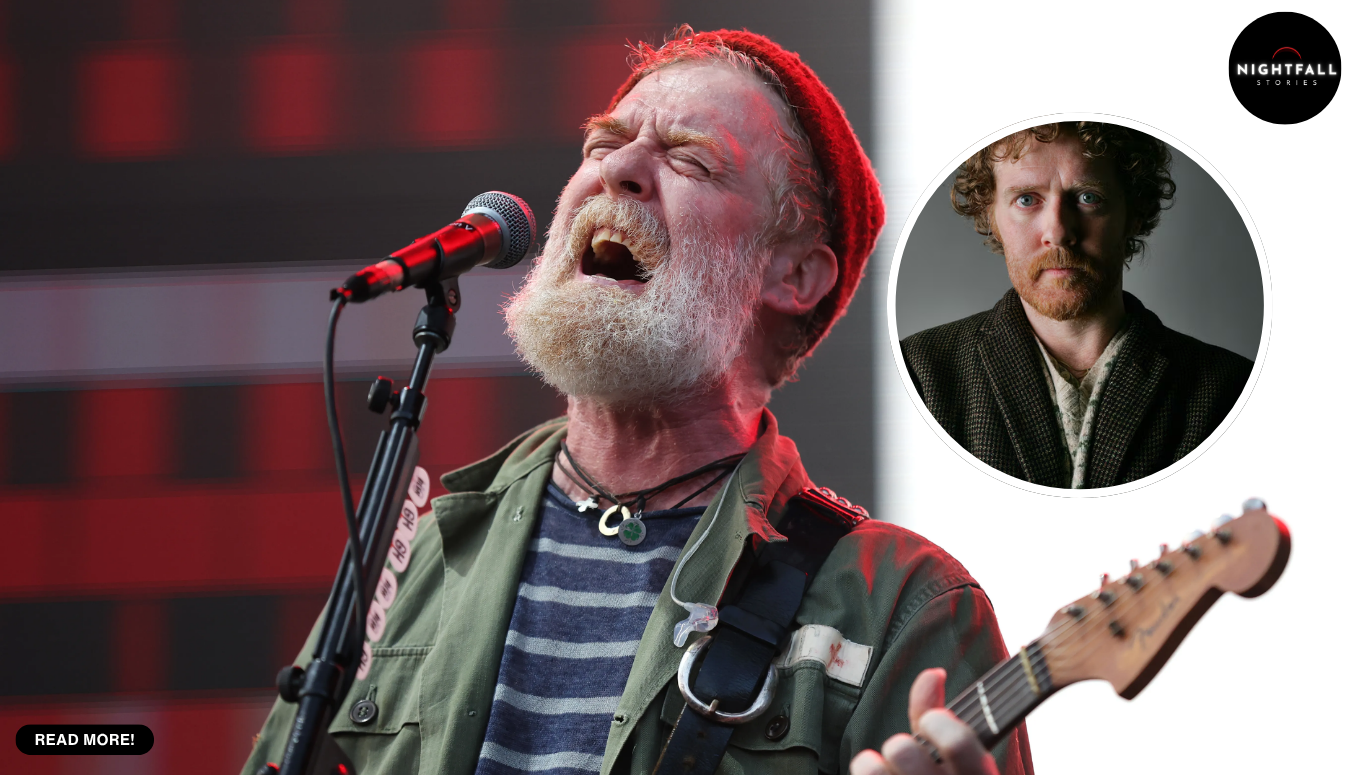
The song that won Glen Hansard an Academy Award was written in one sitting, at a piano in the Czech Republic, with a seventeen-year-old whose family he had known for years. He had the guitar figure and the first line. She sat down at the keys, and by the end of the evening the thing was finished. It would go into a film shot in seventeen days on a budget of roughly 150,000 dollars, by a director who was paying the two leads out of his own fee because there was no other money. Neither of them expected anyone outside Ireland to see it.
Three years later he was standing on a stage in Los Angeles holding an Oscar, having spent most of his adult life playing for coins outside a department store on a Dublin shopping street. And the part that made people love him was what he did next, which was to go home and keep playing for coins.
Hansard died on 29 July 2026, aged 56, in a single-vehicle motorcycle crash on the Lower Road at Strawberry Beds, in west Dublin, in the early hours of the morning. He had been at a traditional music session at a pub on the same road and left after closing. Irish police said the motorcyclist, a man in his fifties, was treated at the scene and pronounced dead a short time later. His management confirmed the death that morning. No other vehicle was involved.
He was born in Ballymun, on the northern edge of Dublin, in 1970, and he left school at thirteen. The story he told about it for the rest of his life was that his headmaster was the one who suggested it. The boy was already playing on the street, already bringing home more in an afternoon than the school could plausibly promise him by the end of a leaving certificate, and the headmaster seems to have looked at the situation and told him that he could probably make a living doing that. Whether it was good advice or a polite way of losing a difficult student, it turned out to be correct.
Grafton Street is a pedestrianised stretch in the middle of Dublin, and for decades it has functioned as an unofficial audition room for Irish musicians. You set up outside a shop, you open a case, you play, and you find out very quickly whether strangers will stop. Hansard was there through his teens and his twenties, and the education was brutal in a way a conservatory cannot replicate. Nobody on a shopping street owes you their attention. You either take it or you do not eat.
In 1990 he started a band called The Frames, which became one of the most beloved live acts in Ireland and almost entirely unknown outside it. That gap between domestic devotion and international obscurity would define the next fifteen years of his life. The band toured relentlessly, built a following that treated their gigs as something closer to a congregation than a concert, and never quite broke through anywhere else. He was, for a long time, a musician whose fame stopped at the water.
There was one earlier brush with something bigger. In 1991 he played the guitarist Outspan Foster in The Commitments, a film about a group of young Dubliners forming a soul band, and for a moment he was a recognisable face in a hit. He later said the sudden attention did a number on him, and he retreated back into the band and the street. It is worth noting because it means that when the second, larger wave of fame arrived, he already knew what it did to people, and he had a plan for it.
The second wave began with a friend. John Carney had been the bass player in The Frames before he moved into filmmaking, and he wanted to make a small musical about a busker and an immigrant woman who meet on a Dublin street and write songs together over the course of a week. He originally wanted Cillian Murphy for the lead, but Murphy withdrew, partly out of doubts about his own singing and partly because his co-star was going to be seventeen years old.
So Carney asked Hansard, who was not an actor in any serious sense, to play a busker, which he was. The seventeen-year-old was Markéta Irglová, a Czech pianist and singer whose family Hansard had known for years. Almost three quarters of the financing came from the Irish Film Board. The total budget came to about 150,000 dollars. Carney gave his own salary to his two leads and put his own money into the production. The crew was skeletal. They shot for seventeen days, used natural light, borrowed friends’ houses for interiors, and filmed the street scenes without permits, using long lenses from far enough away that passers-by did not realise a film was happening. That last decision was practical rather than artistic, but it had an effect nobody planned: two non-actors relaxed, because nobody was watching them.
The film was called Once, and the song was called Falling Slowly. It had been written during recording sessions at a studio near Prague in late 2005, and finished in a single evening at Irglová’s family home. Years later she said the collaboration had been so fluid that she could no longer remember which of them had written what. It is a duet about two people holding each other up, and it works because the two voices sound like they need each other rather than like they are performing togetherness.
Once opened in limited release and behaved in a way small films almost never do. It topped the independent box office charts, posted extraordinary per-screen averages, and went on to take nearly 9.5 million dollars in North America and more than 20 million worldwide. For a film made for the price of a modest apartment, that is not a success, it is an anomaly.
At the 2008 Academy Awards, Falling Slowly won Best Original Song. Its eligibility had been questioned, because earlier versions had appeared on albums before the film came out, and the Academy had to determine that it had genuinely been written for the picture before clearing it. Hansard accepted first, visibly stunned, and made a short speech about how the film had been made for almost nothing and how that should encourage anyone at home with an idea and no budget. Then the orchestra started, as it always does, and Irglová was played off the stage before she had said a word.
What happened next is the reason people who were not even watching that year know the story. During the commercial break, the host Jon Stewart had her brought back out. He told the audience that she deserved to speak, and she did, thanking everyone who had backed a film nobody had expected anything from. It remains one of the few genuinely kind things that has ever happened on that stage, and it happened to two people who had walked in expecting to lose.
Then came the part that Hansard did not handle well, and which he was unusually honest about afterwards. He went dark. He drank too much. Winning had removed the thing that had organised his entire adult life, which was the struggle to be noticed, and he did not know what to put in its place. By his own account it was Bruce Springsteen who talked him through it, essentially telling him to stop treating success as a betrayal of who he had been and to go and use it.
What he used it for is the reason he was mourned the way he was.
In 2010 he was asked to join a group of fundraisers singing on Grafton Street for the Dublin Simon Community, a homelessness charity, and he said no. He went home, felt terrible about it, and decided he would come into town the following day and busk on his own. That day was Christmas Eve. He stood on the street he had grown up on, played, and collected money for people who had nowhere to sleep.
He did it again the next year. And the next. Other musicians started turning up. Damien Dempsey came. Imelda May came. Over the fifteen years the Christmas Eve busk ran, the list of people who joined him at various points included Bono, Hozier, Damien Rice, Shane MacGowan, Sinéad O’Connor and The Script, which on paper is an absurd concentration of talent for a street corner. But he kept the shape of the thing deliberately unpolished, and every year the line-up also included musicians nobody had heard of and people who had themselves been supported by the charity. It was never curated into a gala. It stayed a busk.
By the end of its run, Dublin Simon Community reported that the tradition had raised more than two million euros, comfortably over two million dollars, for its work across Dublin and the surrounding counties. When the pandemic made a crowd on Grafton Street impossible, they filmed it instead. One year it became a television special that brought in roughly 1.7 million dollars. The next it was staged inside St Patrick’s Cathedral and raised about 1.4 million dollars in twelve days, and was later released on vinyl as The Busk Record.
He went further than fundraising. In 2016 he was part of the occupation of Apollo House, an empty office block in Dublin taken over by activists and turned into emergency accommodation during a housing crisis. It was a confrontational thing to do, legally precarious, and not the sort of gesture that helps a career. People who organised alongside him said his real skill was not the singing but the recruiting. He could explain a situation to somebody with a large platform in a way that made them turn up.
Meanwhile the music kept coming, and it kept being unhurried. He released solo records that did well without being designed to do well. One of them earned a Grammy nomination. He toured with The Swell Season, the duo he had formed with Irglová, and then separately, and The Frames continued to exist in the way Irish institutions do, reconvening when it suited them. Once itself outgrew everybody: it became a stage musical that opened in New York and won eight Tony Awards, including Best Musical. The busker and the immigrant girl ended up on Broadway.
Through all of it he stayed in Dublin. He kept playing on the street, not as a stunt or an anniversary gesture but as something he actually did, turning up unannounced with a guitar in the city where people had watched him grow up. He married a Finnish poet a few years before he died, and they had a son.
The reaction to his death made the shape of his life visible in a way that his record sales never had. More than eleven thousand people queued for a public wake at the Royal Hospital Kilmainham. The funeral was held at St Patrick’s Cathedral, and more than forty thousand people watched it online while crowds filled the park outside and lined the route as the cortege left. Bono read. Eddie Vedder sang. Irglová was there, and sang. Damien Dempsey and Imelda May performed. His brothers Gary and Richard spoke, and one of them described how everything their brother had done had started at kitchen tables in north Dublin and spread outward from there. A poet delivered a tribute in Irish and said he was a person the likes of whom would not come again. The dean of the cathedral talked about his generosity before his talent.
The service ended with everyone on the stage singing a Bob Dylan song as his wicker coffin was carried out, and the cathedral stood and applauded. A private cremation followed. The Irish prime minister called him a musician and actor who had made a significant contribution to the country’s cultural life, which is the sort of sentence politicians produce on these occasions. The homelessness charity he had spent fifteen Christmas Eves standing in the cold for said something more useful, which was simply what the money had done.
There is an easy version of this story where a busker wins an Oscar and it changes everything. That is not what happened. He won the Oscar and then spent eighteen years proving that it did not have to change anything, that you could hold the most recognisable trophy in entertainment and still consider your actual job to be standing on a pedestrianised street in the rain, playing to people who had not planned on stopping.
The song took an evening. The rest of it took a lifetime, and he was still doing it, in the same city, on the same streets, right up until the morning he did not come home.