The job was routine. Somebody wanted to sell a small Picasso privately, Christie’s took it in, and a researcher did what researchers at auction houses do, which is check where a painting has been. It is usually dull. You chase a name through old catalogues, you find a gallery invoice, you match a photograph, you move on to the next lot.
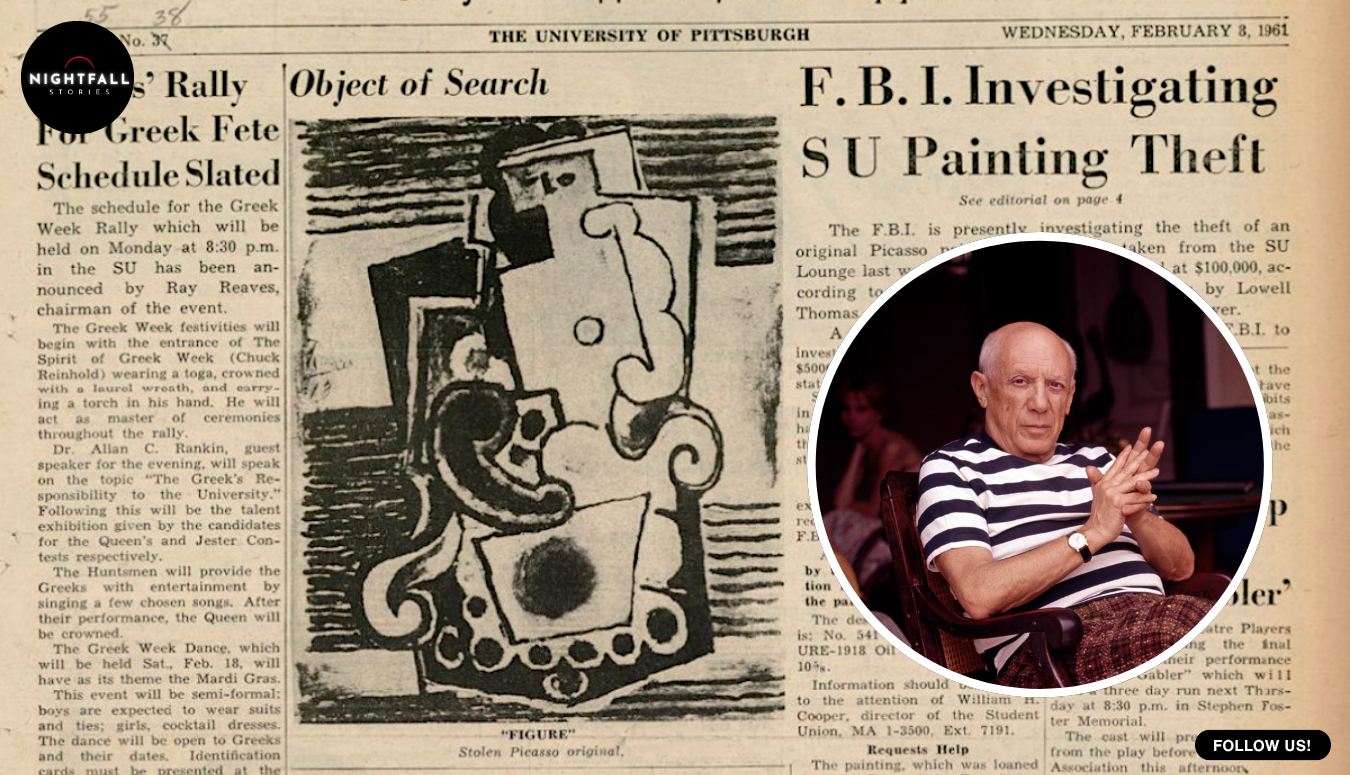
This one did not move on. The painting in front of her was a Cubist oil of a woman in a chair, barely larger than a sheet of letter paper, and when she traced it back through the records she arrived at a specific afternoon more than sixty years earlier when it had been hanging on a wall in a student building in Pittsburgh, and then had not been.
The painting is Femme dans un fauteuil, made in 1918, from the period when Picasso was working in flat interlocking planes and hard edges. It measures roughly 13.5 by 10.5 inches. Solomon R. Guggenheim himself acquired it in 1936, which puts it among the early bones of the collection that eventually became the museum on Fifth Avenue with the white spiral inside.
It is also, on paper, a modest thing. Picasso made a very large number of works, and a small Synthetic Cubist oil from 1918 is not one of the monuments. That is part of why it could go missing without the art world screaming. The paintings that cannot be stolen successfully are the famous ones, because they are unsellable the moment they are gone. The ones that disappear for decades are precisely the works like this: real, valuable, catalogued somewhere, but not so instantly recognisable that a dealer would flinch at the sight of them.
In the early 1960s it was not in a vault. It was out on loan, the way museums have always lent work, and it had travelled to the University of Pittsburgh for an exhibition. It hung in the Students Union building, which is exactly what it sounds like, a building full of young people coming and going at all hours with no particular reason to look twice at a small framed picture on a wall.
On a February morning in 1961, someone doing their rounds noticed the space where it had been. Reporting from the time and from the museum’s later filing describes the discovery being made by a dormitory aide, which is a detail that tells you everything about the security situation. Nobody heard an alarm, because there was nothing to hear.
What followed was the full standard response of the era. Local police investigated. The FBI came in. Newspapers carried the story, a reward was offered, and for a while there was the usual flurry of leads that go nowhere. Then the case did what nearly all stolen art cases do. It stalled, then it went quiet, then it stopped being a case at all and became a line in an old file. A Picasso does not vanish in the sense of ceasing to exist. It vanishes in the sense that nobody with any reason to look for it knows where to look, and the people who do know have every reason to say nothing.
It is worth understanding what that researcher was actually doing, because provenance work has changed beyond recognition since 1961 and that change is the only reason this story exists. A modern auction house does not simply take a consignor’s word. Before a significant work goes to sale, someone builds its history backwards owner by owner, exhibition by exhibition, and runs it against the registers of missing and stolen art that now exist: commercial loss databases, law enforcement listings of stolen cultural property, and the catalogues raisonnes that record where a given artist’s works were last seen. Small twentieth-century paintings are exactly the category where this matters most, because they are portable, they are valuable, and they are numerous enough that memory alone cannot keep track of them.
None of that infrastructure existed when the painting disappeared. There was no searchable list to check in 1999 that would reliably have flagged a 1961 campus theft, and the habit of checking was far from universal even where lists did exist. A gallery with a good name and a plausible story was, in practice, the due diligence. That is not an excuse for anyone in the chain, but it does explain how a well-documented theft could stay invisible through at least one open sale in a major art capital.
Sixty-two years is a long time for a small painting to stay off the record. Somewhere in that gap it moved, more than once, and the museum’s account of the chain is incomplete in the way these accounts almost always are. What is not in dispute is where it surfaced. In 1999, a couple from Massachusetts, Lawrence Jay Handler and Wendy Cohen Handler, bought the work from Beadleston Fine Art, an established gallery in Manhattan. By any ordinary standard that is how you are supposed to buy a painting. You go to a real dealer with a real address and a reputation, you pay, you take it home.
They had it for around a quarter of a century. Then they decided to sell, and the painting went to Christie’s, and the researcher opened the file, and the whole arrangement came apart.
The Guggenheim says it learned the work had resurfaced in the summer of 2023. It sent a formal demand for the painting’s return not long after. That demand was refused, and the painting stayed put, physically held at Christie’s while the two sides did not agree. Last month the Solomon R. Guggenheim Foundation went to the New York State Supreme Court and sued.
The museum’s case, as filed, is straightforward in shape. It says the painting was stolen from its custody, that title never passed to anybody down the line because a thief cannot pass good title, and that the current possessors are unlawfully withholding property that belongs to the foundation. It asks the court to declare that the museum owns the painting, to order it handed back, and to award damages. The figure most widely reported from the complaint is 3.5 million dollars, though at least one account of the filing describes the museum’s damages claim as falling somewhere between 3.5 and 5 million. Either way, that is the museum’s demand, not an appraisal of the painting, and nobody should read it as what the work would fetch. For scale, contemporary estimates around the time of the theft put its value somewhere in the range of tens of thousands of dollars, which is a reminder of how completely the market has been rebuilt underneath these objects in the intervening decades.
All of that is the museum’s version, and it is important to keep it labelled as such. The Handlers have not filed a public answer. Nothing they have said publicly characterises their position beyond the fact that they refused to give the painting back, and it would be unfair to them to invent a defence they have not yet made. What can be said is what the documented facts allow. They bought from a named commercial gallery. They bought in 1999, thirty-eight years after the theft, with no obvious reason on the face of the transaction to suspect anything. They kept the work for about twenty-five years without hiding it, and it was their own decision to sell openly through a major auction house that exposed the history. People running a knowing fraud do not usually walk their evidence into Christie’s and ask for a provenance check.
That is the genuine difficulty at the centre of the case, and it is not a trick or a technicality. Two parties can both be blameless and only one of them gets the painting. A museum that lent a work in good faith and had it taken, and a couple who paid a real price to a real dealer and hung it in their home for a quarter of a century. Somebody has to lose, and the law has to pick.
New York, as it happens, has a very clear opinion about how to pick, and the museum bringing this claim is the same institution that established it.
In the late 1960s a mailroom employee stole a Chagall gouache from the Guggenheim. It was sold on, and in 1967 a couple named Lubell bought it from a respectable Madison Avenue gallery for 17,000 dollars and hung it in their apartment for more than twenty years. The museum located it in 1986, demanded it back, and was refused. The parallels to the present case are almost uncomfortably exact.
That dispute went to the New York Court of Appeals, and in 1991 the court set out the rule that still governs. Under New York law, the clock on a claim to recover stolen property does not start running at the moment of the theft. It starts when the true owner demands the property back and the person holding it says no. The court went further and declined to impose a duty of reasonable diligence on the victim, meaning a museum does not forfeit its claim simply because it failed to mount an energetic search for decades. Putting that burden on owners, the reasoning went, would reward whoever was best at keeping a stolen object out of sight.
For the Guggenheim, that is close to ideal ground. Its demand was made in 2023 and refused in 2023, so on the New York rule the claim is nowhere near stale, no matter that the theft happened in 1961.
But the same ruling left a door open, and it is the door any defence in this case would be expected to walk through. The court held that while the statute of limitations would not save the possessor, the equitable defence of laches remained available and had to be tested at trial. Laches asks whether the claimant sat on its rights in a way that unfairly prejudiced the other side. The conduct of both parties becomes relevant, including whether the owner searched with reasonable diligence, whether the theft was properly reported and circulated, and whether the delay has destroyed evidence or witnesses the possessor would otherwise have had.
Sixty-two years destroys a great deal. The dealers who handled the painting between 1961 and 1999 are largely beyond reach. Whatever paperwork accompanied it has had decades to go missing. Anyone who could explain how a stolen Picasso arrived on a Manhattan gallery’s books is likely to be dead or unfindable. That cuts against both sides, but it cuts hardest against whoever needs to prove the innocence of a transaction that nobody alive can describe.
The Chagall case, for what it is worth, never produced a final judgment on the merits. It settled in 1993. That is what usually happens, and it is the most likely outcome here too. These disputes are expensive, slow and reputationally awkward for everyone, and a negotiated split, a payment, a shared credit line, a sale with divided proceeds, is a far more common ending than a courtroom verdict.
There is one more layer that rarely gets mentioned, and it explains a great deal about how the mid-century art world operated. Museums lending serious work to universities was completely normal, and so was hanging it in ordinary rooms where ordinary people were. The idea that a major collection’s holdings should only be displayed behind sensors and guards is largely a product of the losses that followed. Institutions learned the hard way, one theft at a time, and the loan agreements, condition reports, courier requirements and insurance schedules that now surround a travelling painting are essentially scar tissue. A student union in 1961 was not being reckless by the standards of 1961. It simply had no framework telling it to be anything else.
What the whole episode exposes is how much of the art market still rests on paperwork that was never properly built. For most of the twentieth century there was no serious central register of stolen art, no habit of running a purchase against a database, no expectation that a buyer would do more than trust the gallery. The infrastructure that caught this painting, searchable loss records, institutional provenance departments, auction houses employing people whose entire job is to check, is a recent invention, and it is now being pointed backwards at decades of transactions that were made without it. Every time it catches something, the same situation arises. A work with a criminal origin sits in the hands of someone who did nothing criminal.
That is likely to keep happening, and it is arguably a sign of the system working rather than failing. The painting only reappeared because the current owners chose the transparent route. Had they sold it quietly, privately, to someone who did not ask, it would still be off the record and the researcher would have had nothing to find.
For now the work is not on anyone’s wall. It sits in storage at Christie’s, a small 1918 canvas that spent six decades unaccounted for, waiting for a court or a settlement to decide who has the better claim to a woman in an armchair that two sets of people are certain belongs to them.