Category: News

  • The archive said the camp closed in 1956. The shoes in the ground said otherwise.

    The archive said the camp closed in 1956. The shoes in the ground said otherwise.

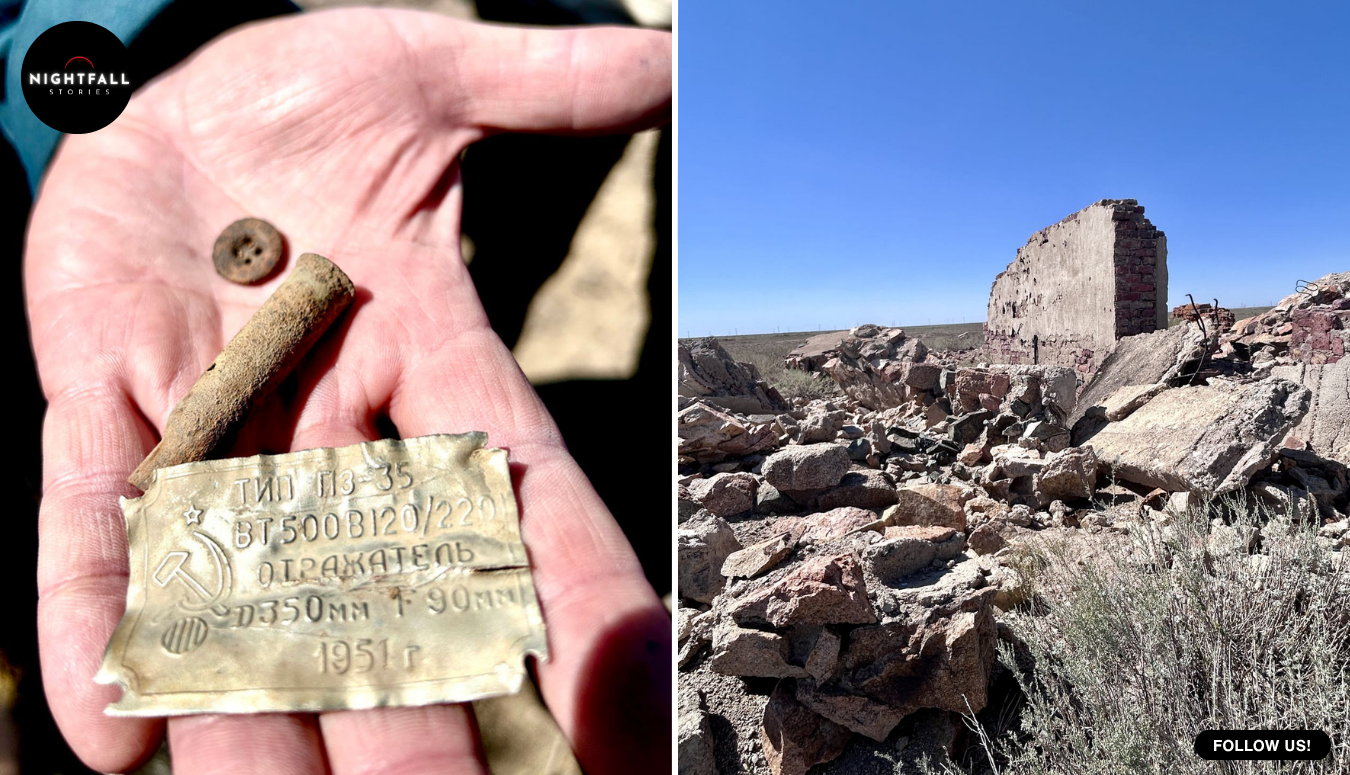
    On a stretch of Kazakh steppe where there is almost nothing to look at, a team of archaeologists picked up the sole of a woman’s shoe, a scatter of broken bottles with 1959 and 1960 pressed into the glass, and a small metal label from a lamp stamped 1951. The lamp label made sense. The bottles did not. According to every official Soviet document historians have worked from for decades, the camp those objects came from had already been shut down.

    That gap between the paperwork and the ground is the whole story. The Soviet state was one of the most obsessive record keepers in history, and its records are the main reason we know as much as we do about the Gulag. Millions of index cards, transfer orders, quotas, closure notices. Historians have spent a generation working through them. What the Czech team on the steppe has done is something different and, in its way, harder. They went and looked.

    The site is Steplag, the Steppe Camp, near Zhezkazgan in central Kazakhstan. It was one of the special camps set up after the Second World War for political prisoners, run under what the system called an intensified regime, which in practice meant numbered uniforms, barred windows and longer hours. More than 20,000 people were held there. They came from well over forty nationalities. Lithuanians, Latvians, Ukrainians, Poles, Russians, Germans and a smaller number of Czechs and Slovaks worked the copper, manganese and coal that the region was valuable for. Estimates of the Czechoslovak citizens specifically held at Steplag run to a few dozen, with hundreds more scattered across the wider network of Kazakh camps, and almost none of their individual stories were ever written down.

    The excavation is run by archaeologists from the Faculty of Arts at the University of West Bohemia, led by Pavel Vařeka, working with Gulag.cz, a Czech organisation that has spent about fifteen years documenting Soviet forced labour camps wherever they can still be reached. Štěpán Černoušek, who chairs Gulag.cz, has been going back to these landscapes for years with cameras, drones and 3D scanners. What makes this round different is a piece of paper. The team says this is the first officially licensed archaeological excavation of a Gulag site anywhere in the former Soviet Union. Not a documentation trip, not a photographic survey. A permit to put a trowel in the ground.

    That distinction matters more than it sounds. Gulag sites sit in an awkward legal and political space across the former USSR. Many are on land nobody wants, in regions nobody visits, and for a long time the practical answer to what should happen to them was nothing at all. A licence turns a ruin into a site, and a site into evidence. It also means the finds are recorded properly, with their positions logged, rather than being picked up loose and losing everything that made them useful.

    Gulag.cz did not arrive at Steplag cold either. The organisation has been running expeditions into the former Soviet camp landscape for years, including a substantial trip through Kazakhstan several years ago that covered Alzhir, the camp outside the capital that held the wives and female relatives of men the state had already condemned, and Karlag, the sprawling agricultural complex in the Karaganda region that was one of the largest camps in the entire system. That work produced a documentary film and a public online archive of the Kazakh sites, with 3D models of standing structures, panoramic photography, survivor biographies and the same declassified Western reconnaissance images the archaeologists now use as survey data. The point of putting all of it online was that most people will never stand on that steppe, and the buildings that are still standing are not going to be standing indefinitely.

    The team did not walk in blind. Before anyone dug, they worked over the landscape with drone photography and with declassified American military reconnaissance imagery from the 1950s and 1960s, the satellite photographs taken when the West was trying to work out what was going on inside the Soviet interior. Those images are now one of the most useful tools in the archaeology of the recent past, because they show what a place looked like while it was still being used. Combined with ground survey, that gave the team a map of things to go and check.

    They ended up identifying six camps in the Karaganda and Zhezkazgan regions. Three were already known. Three were not. One of the new ones, out on the open steppe, turned out to be remarkably intact, still with its working zone laid out beside the compound where the prisoners were held. There was also a cemetery that nobody had marked or maintained, where the graves are indicated by wooden posts and broken crosses, and where the count runs to somewhere near twenty visible burials. One of those carries a Lithuanian cross that was put up in 1990, by people who came back to find where somebody had been left.

    Across the sites, some things repeated. Three lines of barbed wire around every perimeter. Guard towers at every one. Isolation cells at most of them. Černoušek has said that what actually surprised the team was how much variation there was underneath that shared skeleton, in the materials the camps were built from and in how they were organised internally. The system was standardised on paper and improvised in practice, which is true of a great deal of Soviet administration and is exactly the sort of thing documents tend to hide.

    Then there are the objects. Fragments of plates and bottles. An aluminium mug. Pieces of clothing and footwear. Uniform buttons. Spent cartridge casings, concentrated near where the guard towers stood. The lamp label from 1951, from the lighting rigged along the fenced perimeter. None of it is spectacular. That is rather the point. This is the material of ordinary days in a place built to consume people, and it survives because nobody ever thought it was worth removing.

    The bottles are the part that has made this news beyond archaeology. Glass from that era was routinely dated at manufacture, which makes it an unusually honest little clock. The team recovered bottle glass marked 1959 and 1960 at a location that the archives place as closed by 1956. Alongside it, they found the remains of women’s shoes.

    Černoušek’s reading is that there had been a camp there, a women’s camp, after the date the records give, and that its existence was simply not carried into the documents historians have been using. He is careful about how he puts it, and so should anyone repeating it be. This is an interpretation drawn from a small body of material, not a settled fact. Bottles move. Sites get reused. A date on glass tells you when the bottle was made, not when it was dropped, and in a place where scrap was valuable and nothing was thrown away lightly, that gap can be years. The honest version is that the archaeology is inconsistent with the archival closure date and that the team thinks the most likely explanation is continued use.

    What raises the confidence is that the objects are not the only source. There is a man.

    Mizambai Bralin lives locally and was a child when the camp was operating. When the team brought him back to the site, he was able to walk them through it and say what each building had been for, which structure did what, where the guards were, how the place functioned. Černoušek has said he remembered it all with remarkable precision. His account and the material in the ground point the same way, and neither was derived from the other. In historical work that kind of independent agreement is worth a great deal more than either piece on its own.

    It is also, in the plainest terms, a closing window. Anyone with a first hand memory of a camp that was running in the late 1950s is now in their late seventies at the youngest. There is a reason archaeologists of the twentieth century tend to work fast and take testimony while they still can. In twenty years this excavation would have been a purely material exercise, and the ground alone would never have been able to tell them what each building was used for.

    The wider context around Steplag is well documented and does not depend on any of this. In 1954, in the months after Stalin’s death, prisoners at Steplag took control of the camp in what became known as the Kengir uprising. For about forty days they ran the place themselves, organised food and order, set up their own administration and negotiated with the authorities. It ended when the army came in with tanks. The number of people killed has been disputed ever since, with official figures far lower than the accounts of survivors, and it remains one of the episodes where the archive is least trusted even by people who work in it every day. That history is one reason the site matters, and it also explains something about why a discrepancy in a closure date does not surprise the people working there.

    The Kazakhstan fieldwork is part of a larger research project the Czech team calls Wild Land, which looks at how people held in twentieth century camps found ways to endure them. It deliberately sets the Kazakh camps against a set much closer to home, the uranium mining camps around Jáchymov in the Czech Ore Mountains, where the Czechoslovak state ran its own prison labour system in the 1950s. Putting the two side by side is a way of making a point that is easy to lose: this was not a distant thing that happened to other people somewhere cold. The same architecture of wire, tower and quota was built inside Europe, by a government, within living memory.

    It is worth being clear about why a women’s camp at Steplag is plausible rather than startling. Women were held throughout the Soviet camp system, in separate compounds and in whole separate camps, on the same political articles as men and often for nothing more than a family connection to someone already arrested. Kazakhstan in particular had a significant share of them. So the archaeologists are not proposing something the system did not do. They are proposing that one instance of something the system did routinely was either never written into the surviving paperwork or was written into files that have not been found, declassified or connected to this location. Given how the closure and reorganisation of the special camps was handled in the years after Stalin’s death, when units were merged, renumbered and transferred at speed, a site slipping out of the ledger while people were still inside it is not an extraordinary suggestion.

    There is one thing the team has been explicit about not doing. The cemetery will not be excavated. The plan is a non invasive geophysical survey, which can map what is below the surface and give a sense of how many burials there are without disturbing any of them. Nobody is going to be dug up to produce a number. That decision is worth stating plainly, because it is the kind of restraint that rarely makes headlines and is the difference between research and intrusion. The graves are the resting place of people whose families, in many cases, were never told where they were.

    What all this adds up to is a quiet argument about how we know what we know. The Gulag has been studied for decades almost entirely through paper, partly because the paper survived in enormous quantity and partly because for a long time the sites themselves were unreachable. Paper is generated by an institution, for the institution’s purposes, and it records what the institution wanted recorded. A camp that was closed on schedule looks tidy in a ledger. A camp that quietly kept operating for another three or four years with a few hundred women in it does not, and there was nobody in that chain of command with a reason to write it down.

    The ground has no such motive. It keeps a bottle because a bottle was dropped. It keeps the sole of a shoe because leather and rubber outlast almost everything in dry steppe soil. It is an indifferent witness, which in this case makes it a useful one.

    None of this rewrites the history of the Gulag, and the archaeologists have not claimed it does. The system’s scale, its purpose and its cost were established long ago by historians working with exactly the documents this find complicates. What the excavation does is smaller and more specific. It demonstrates that the archive has holes, it gives a method for finding them, and it shows that those holes can be filled by a combination of what is buried and what an elderly man still remembers about the place where he grew up.

    The team intends to go back. There is more of the steppe to survey, and the satellite imagery has flagged locations nobody has walked yet. The finds from this season are being catalogued and studied, and the results will go through the normal process of publication and challenge, where the 1959 interpretation will be tested by people whose job is to be sceptical of it. That is how it should work.

    Meanwhile the objects themselves sit in trays: buttons, casings, a label from a perimeter lamp, a piece of glass with a year on it, the sole of a shoe that belonged to a woman whose name is not in any file anyone has found. She was, according to the documents, not there. She was there.
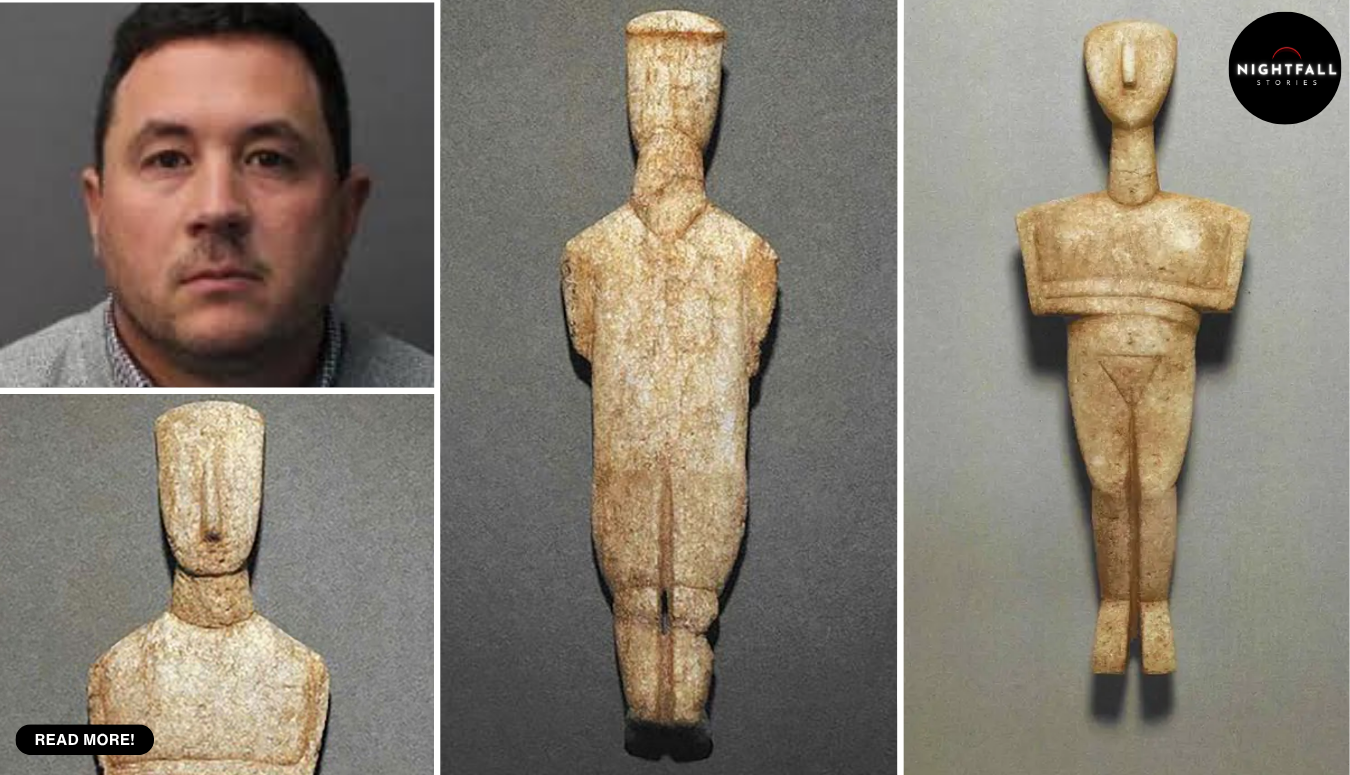

  • The paperwork was perfect except for two things nobody was supposed to notice

    The paperwork was perfect except for two things nobody was supposed to notice

    The three little marble figures were the easy part. They were about thirty centimetres tall, a kilogram each, pale and flat-faced and folded-armed in the way that has made Cycladic sculpture one of the most recognisable shapes in the ancient world. Anybody who has walked through a museum has seen something like them. They are the objects that look four thousand years old and somehow also look like they were carved last week by a very good modernist, which is exactly why people pay enormous sums for them.

    What sank the whole thing was a folder of invoices.

    A man had approached Sotheby’s in London saying he had inherited the pieces from his late grandfather, who had bought them back in 1976, and he had the paperwork to prove it. In the antiquities trade that paperwork is not a formality. It is the entire transaction. An unprovenanced ancient object is close to unsellable at a major house, because nobody can rule out that it came out of the ground illegally. A documented purchase history going back decades is what turns a stone figure into a lot number. Which is why, when people set out to defraud this market, they have learned to spend most of their effort on the documents rather than the objects.

    There is a specific reason the date on those invoices was chosen. The market’s working convention treats 1970 as the line in the sand, the year of the international convention on the illicit trade in cultural property, and objects that can be shown to have been out of their country of origin and in private hands before that point are far easier to sell than objects that cannot. A purchase documented in the mid-1970s from an established dealer is close to the ideal story. It is recent enough for records to plausibly survive and old enough to sit on the comfortable side of everyone’s compliance policy.

    He had spent a lot of effort. The invoices named a real dealer, a genuine London firm, with an embossed company logo at the top. They were dated to a year that sat comfortably on the right side of the market’s ethical cut-off. They named an address in central London. They carried the name of a grandfather.

    The researchers at the auction house read them anyway, and two things did not survive the reading. The letters had been printed by a machine, not typed, and the printing technology involved did not exist in the mid-1970s. And the typeface, the actual shape of the letters on the page, had not been designed until 2001, twenty-five years after the documents were supposedly written.

    Then there was a third detail, and it is the one that stays with you. The embossed logo of the dealership, the raised mark that is meant to say this is a real company with a real stamp, had not been embossed at all. Somebody had drawn it by hand.

    The man was Andrew Crowley, in his mid-forties, from Longwell Green, near Bristol in the west of England. He had contacted the auction house in 2022. By October of that year the house’s own due diligence team had flagged inconsistencies in both the sculptures and the documentation, and rather than take the commission and let the problem become somebody else’s, they called the police.

    It is worth sitting with that decision for a moment, because it runs against the lazy assumption people hold about auction houses. A specialist department is measured on what it brings in. Three Cycladic figures with clean-looking 1970s paperwork is a good week. Turning it away and calling the police is a worse week, and the house did it anyway, and that choice is the reason the rest of this story exists.

    What followed was the kind of investigation that almost never gets written about, because it involves no chase and no dramatic raid. The Metropolitan Police’s Art and Antiques Unit, a small specialist team, worked the paperwork. Detective Constable Ray Swan led the case. The forensic question, essentially, was when could this piece of paper have been made, and answering it meant going after the font and the printing method. Officers worked with the FBI in New York on the typeface analysis. The answer came back unambiguous.

    The Art and Antiques Unit is a genuinely unusual outfit. It is tiny, it has been repeatedly reported to be under resource pressure over the years, and its caseload covers everything from stolen paintings to looted archaeological material passing through one of the largest art markets on earth. Most of what it does is paperwork and relationships, and most of its wins look like this one: not a recovery, but an interception.

    Researchers also went looking for the grandfather. The invoices gave a London address from which the purchase had supposedly been made, and the records showed no John Crowley registered there in the relevant period. The man on the paperwork, the one whose collection was supposed to explain how three Bronze Age figures came to be sitting in a house in the English west country, could not be placed at the address where his own documents said he had been.

    The dealership named on the invoices was K.J. Hewett Limited, and this is where the scheme reveals a certain amount of homework. Kenneth John Hewett was not invented. He was a real and well-connected London dealer who started out as a bookseller, bought a small shop in Richmond after the war, and later moved to Sydney Street off the King’s Road. He dealt in antiquities and ethnographic art, and he moved in the highest circles of the trade, doing business with Sotheby’s own chairman Peter Wilson and with the dealer John Hunt, and counting the collectors Robert and Lisa Sainsbury among his friends. Objects that passed through his hands sit in serious collections today.

    Using his name was clever for the obvious reason. Hewett is exactly the sort of figure whose 1970s paperwork ought to exist, whose stock ought to have included pieces like this, and who is no longer alive to be asked. It is also, from the point of view of everyone who works in this field, a fairly ugly thing to do to a dead man’s reputation.

    A stargazer, for anyone who has not met the term, is a small carved marble figure from Anatolia with a tilted head and an upturned face, hence the name. Like the Cycladic figures they are ancient, abstract, instantly legible to a modern eye, and fiercely contested in ownership terms. It is a very short list of object types that combine that much desirability with that much documentary murk, and this case involved two of them at once.

    Crowley was arrested on the street outside Sotheby’s premises on New Bond Street in Mayfair in the summer of 2023, having come back to the building. He pleaded guilty to fraud by false representation early in 2026, and he was sentenced at Southwark Crown Court in London a few months later.

    Here is where the story needs to be told precisely, because it has been reported loosely. He was not jailed. The sentence was two years’ imprisonment suspended for two years, together with two hundred hours of unpaid work and an order to pay costs of roughly two thousand dollars. A suspended sentence means the prison term hangs over him and activates if he offends again during that period. He walked out of the building.

    The value figures deserve the same care, because the court did not accept the number the prosecution opened with. Prosecutors put the potential value of what he was trying to sell at up to around 650,000 dollars. The judge worked from a lower figure, closer to 450,000 dollars. The auction house disputed the higher valuation and has indicated that it did not originate with them. Nothing was ever sold and no buyer ever lost money, which is a large part of why the sentence landed where it did.

    There is one further wrinkle worth flagging rather than smoothing over. The police account of the case describes three Cycladic figures. Reporting on the court proceedings also refers to an Anatolian stargazer statuette, a different and similarly coveted type of small carved figure, offered alongside them with the same forged provenance. The two accounts are not in conflict so much as differently scoped, and the safest description is three Cycladic figures at the core of the case, with a fourth object mentioned in the court reporting.

    What the court did not establish, and what nobody has claimed in public, is who actually made the figures, or who physically produced the documents. Crowley admitted representing them falsely. That is the offence he pleaded to and the only thing the record supports. Whether he carved them, commissioned them, bought them believing something else, or acquired the paperwork from somewhere upstream is not something the case determined, and it would be wrong to write it as though it had.

    It also bears saying that the sentence sits within a pattern that frustrates a lot of people who work in this field. Art and antiquities fraud is expensive to investigate, slow to prosecute, and tends to produce sentences at the lighter end, partly because the loss is often prevented rather than realised, and partly because courts weigh it against violent offending. Three and a half years passed between the arrest and the sentencing.

    The reason this matters beyond one man in one courtroom is that it is a small, unusually clear picture of how the antiquities market actually protects itself, which is not the way most people assume.

    Cycladic figurines come from the islands of the Aegean, and the classic folded-arm type belongs to roughly the third millennium BCE. They were carved from marble, most of them modest in scale, though a handful approach life size. They turn up overwhelmingly in burial contexts, and some of them show signs of having been repaired while they were still in use, which tells you they mattered to somebody while that somebody was alive. They are also, by the honest admission of the field itself, a catastrophe of documentation. The great majority of the ones in circulation were taken out of the ground without any record of where they came from, which means scholars are largely studying objects stripped of the one piece of information that would tell them the most.

    That combination, enormous desirability and almost no reliable archaeological context, is precisely the gap a forger works in. If nobody can say where a real one came from, the story attached to a fake one is harder to disprove. The only defence left is the paper.

    So the people who catch this are not detectives in the conventional sense. They are provenance researchers, and the work is dull in the way that genuinely skilled work often is. You read a document and you ask whether every single element of it could have existed on the date it claims. You check whether the named person lived at the named address. You compare the letterhead against known examples. You find out when a font was released.

    Angelina Giovani-Agha, a provenance specialist who commented on the case, made the point that the market cannot lean on the police to clean up afterwards, and that the value of provenance research lies in stopping fraudulent material before it enters circulation at all. That is not a small distinction. Once a forgery is sold at a major house, it acquires exactly the thing it was missing, which is a real, verifiable, documented sale history. It becomes legitimate by having been sold. Every later owner inherits the lie in good faith, and unwinding it can take decades, if it happens at all.

    In this instance the material never got in. The figures were never catalogued, never estimated in a printed sale, never bid on. The chain stopped at the front desk because somebody whose job is to be sceptical about paperwork did that job properly, at the cost of the commission the house would have earned had they simply believed him.

    The Met’s own assessment of the case emphasised the cross-border cooperation involved and the harm prevented to the London art market, which is exactly the right frame. Nobody recovered a stolen masterpiece. Nobody was rescued. What happened is that a fraud that had clearly taken months of preparation was stopped at the moment it tried to convert into money, and the person who tried it now has a criminal conviction and a suspended sentence attached to his name in a trade with a very long memory.

    There is a quiet lesson buried in the forensics, and it is not the one about ancient art. It is about how documents fail now. A forger in 1976 forging a document from 1946 had to worry about paper and ink and typewriter keys, and a careful one could get very close. A forger today forging a document from 1976 is fighting a much harder battle, because the file they typed it in carries a typeface with a release date, and their printer leaves a signature, and both of those facts are knowable by anybody who thinks to ask. The objects can be aged. The paperwork cannot lie about the technology that made it.

    The three figures sat at the centre of a story about a grandfather who bought beautiful things half a century ago, and the story was warm and plausible and entirely defeated by the shape of the letter A.

  • He scored all five. The song that went to number one wasn’t his.

    He scored all five. The song that went to number one wasn’t his.

    There is a moment near the end of the Toy Story 5 premiere that people who were in the room keep describing in the same slightly stunned way. An 82-year-old man sat down at a piano on the stage of the Dolby Theatre in Los Angeles, and the biggest pop star in the world walked out and sang with him. The song they sang was not the new one. It was not the track that had just gone to number one on the charts in a dozen countries. It was a soft, shuffling, faintly goofy thing he had written thirty-one years earlier for a movie about a cowboy doll, and half the audience had known it since before they could read.

    The man at the piano was Randy Newman, and the reason that duet landed the way it did has almost nothing to do with the star standing next to him. It has to do with the fact that Newman has now written the music for every single Toy Story film, from the first one in 1995 to the fifth, and that for this one, for the first time, the song everybody walked out humming was written by somebody else.

    That is the story, and it is a gentler one than the internet made it sound. Newman did not get pushed out. He scored the picture, all of it, his tenth feature for Pixar. What changed is that the emotional showpiece song, the one that plays over the closing credits and gets clipped and reposted and cried over, came from a different desk. Newman gave it his blessing, sat down at the premiere, and played his own old song instead. For a composer whose entire career has been about the distance between what a thing looks like and what it actually feels like, it is hard to imagine a more Randy Newman ending.

    To understand why that matters, you have to know how unusual his run has been. Film scoring is a business of turnover. Franchises change composers the way they change directors. Newman has held the Toy Story chair for three decades, which means the music that a five-year-old heard in 1995 is by the same person as the music their own five-year-old hears now. Almost nothing in popular culture works that way.

    Consider what that continuity actually covers. The first film arrived when computer animation was an unproven gamble and a lot of people in the business quietly expected it to look like a novelty within five years. Newman scored that one, then A Bug’s Life, then Toy Story 2, then Monsters, Inc., then Cars, then Toy Story 3, then Monsters University, then Cars 3, then Toy Story 4. Nine features for the same studio before this one, and at least one Academy Award nomination out of seven of them. The fifth Toy Story makes ten.

    He did not come to it from nowhere, either. Newman grew up inside the family business in the most literal sense. Three of his uncles, Alfred, Lionel and Emil Newman, were Hollywood film composers, and Alfred in particular was one of the towering figures of the studio era. Several of his cousins went into scoring too. Randy was the one who went sideways first, into songwriting, into records full of unreliable narrators and sly, uncomfortable characters, songs that a lot of listeners misread on first pass because he refused to tell them who to root for.

    That is the man Pixar hired in the mid-1990s to write a song for a toy. And what he handed back was “You’ve Got a Friend in Me,” which is so simple that people assume it must have been easy. It is not a clever song. It has no twist in it. It is a lazy, warm, slightly rickety promise from one friend to another, and it has outlived nearly everything else on the radio that year.

    There is a version of that story where the studio wanted something inoffensive and got it. The truer version is that a songwriter known for irony was handed a job that gave him no room for irony at all, and he simply did the sincere thing properly. It is much harder than it looks. Sincerity without sugar is the rarest register in film music, and it is why the song still works in a cinema full of adults.

    Newman’s relationship with the Academy Awards became a long-running joke because of how exactly it went wrong. He was nominated over and over and lost every time, and at one point he held the record for the most Oscar nominations without a win. Fifteen. He finally won for “If I Didn’t Have You” from Monsters, Inc., and then again for “We Belong Together” from Toy Story 3. He has been nominated twenty-two times in total. That is a career where the industry kept telling him he was among the best in the room and kept handing the trophy to somebody else, and he kept showing up anyway.

    He has also, and this is the part that gets forgotten, handed songs to other singers before. The most devastating piece of music in the entire franchise is “When She Loved Me,” the Toy Story 2 song about a cowgirl doll being outgrown. Newman wrote it. Sarah McLachlan sang it. He did not need to be the voice on it, and anybody who has watched that sequence knows the choice was correct. So when the same thing happened in a different shape on the fifth film, it was less a break with tradition than most of the coverage suggested.

    The fifth film itself is a stranger proposition than the previous four. Directed by Andrew Stanton, it picks up two years after Toy Story 4 and puts Woody, Buzz and Jessie up against something no villain toy ever managed, which is a tablet. The new arrival is a device called Lilypad, voiced by Greta Lee, and it becomes the child’s favourite thing in the house. Stanton has described the premise as an existential problem rather than a plot one, the problem being that nobody is really playing with toys anymore. Tom Hanks, Tim Allen and Joan Cusack came back. Conan O’Brien turned up as a pair of trousers. The film opened in more than four thousand cinemas and went on to take in the region of 589 million dollars worldwide, with a global opening weekend of about 310 million, the biggest the studio has ever had.

    Underneath all of that is Newman’s score, and it is not a nostalgia exercise. He wrote around twenty-five new cues for the film alongside the returning themes, and he built the toys-versus-technology conflict into the orchestration itself. One cue, written for a sequence where the toys make their move, leans on brass and percussion for something close to a military feel, with a male choir layered underneath that he compared to marine voices. The child in the film gets her own theme in the strings. Jessie gets up-tempo cowboy music, which is exactly what she has always deserved. The new device character gets a soundscape stitched together with gadget noises from the sound design team, so the machine literally does not get an orchestra of its own.

    He has talked about the mechanics of this work before in the flattest possible terms, as a craft problem rather than an act of inspiration. A cue has to start somewhere, land somewhere, and get out of the way of the dialogue. A theme has to be recognisable after four notes and still bearable after four films. The thing nobody outside the trade appreciates is that a composer on a picture like this is writing to a moving target, because animation keeps changing under the music right up until it cannot change anymore.

    That is thirty-one years of consistency delivered by a man in his eighties, recorded on a scoring stage in Culver City across two years of work, and it is the kind of labour that nobody claps for because it is doing its job when you do not notice it.

    The other song arrived late, and it arrived fast. According to the account that has been given publicly, Taylor Swift was not initially interested in the project at all. What changed her mind was reportedly a letter from one of the film’s producers, Jessica Choi, arguing that her voice mattered in an industry still weighted heavily toward men. Swift went to an early screening. By her own telling she conceived the song more or less on the spot, went home, and had it finished within about eight hours. She wrote and produced it with Jack Antonoff, who played the majority of the instruments on the recording himself.

    It is worth being precise about what that means, because the speed of it got reported as a stunt and it was not one. Sitting through a finished film and coming out with a complete song by the end of the same day is not a magic trick, it is what happens when a writer has been carrying a character around in their head for twenty years and finally gets asked the right question. Swift has spoken about how much one particular lyric about the cowgirl doll’s heartbreak affected her, which is a fairly good indication that the song came from being a fan of these films long before she was a contributor to one.

    The song is called “I Knew It, I Knew You,” and it is built around Jessie, the cowgirl doll whose entire arc across the franchise has been about being loved and then left. It was released as a single ahead of the film and went straight to number one on the Billboard Hot 100, Swift’s fifteenth chart-topper, and it went to the top in several other countries as well. It was the first song from a Pixar film ever to do that, and it topped the Billboard Global 200, another first for a Disney or Pixar film song. It plays over the closing credits and sits first on the soundtrack album, ahead of Newman’s twenty-five cues.

    The soundtrack album came out on the day the film opened in cinemas, running to twenty-seven tracks and around seventy-six minutes, and it puts the two pieces of work side by side in a way that is quietly revealing. One artist’s contribution is a single track written in a day. The other’s is most of the record, built over two years, including revisited versions of “You’ve Got a Friend in Me” and “When She Loved Me” that reach back across the entire franchise.

    Newman, for his part, has been publicly warm about the whole thing. Asked about Swift he described her as remarkably grounded and genuinely nice, which from a man whose stock in trade is withering character studies is a real compliment. He has not made any claim to have been involved in writing it, and the honest description is that the song was a late addition that was never woven into the score’s thematic architecture. It sits alongside the score rather than inside it. Swift has said that having his blessing to step into that world took the pressure off, and she has talked about his music with the specificity of somebody who has actually studied it, praising the syncopations that are unmistakably his and the chords that nobody else would reach for, and the way he writes lyrics that are intricate underneath and plain on the surface.

    That last observation is the whole thing in one sentence, and it explains why the premiere played out the way it did.

    Because when the two of them finally performed together at the Dolby Theatre, they did not do the new song. They did “You’ve Got a Friend in Me.” Newman played. Swift sang with him. A room full of people who work in this industry for a living watched a thirty-one-year-old piece of writing do what it has always done, which is disarm everybody instantly, and then they all went and watched the film.

    There is something quietly instructive in that choice. The obvious move would have been to perform the number one record in front of the people who made the film it came from. Instead the evening handed the stage to the older song, and to the man who wrote it, and let the newer artist be the one standing slightly to the side. Nobody announced it as a tribute. It just was one.

    None of this is breaking news, and it would be dishonest to present it that way. The premiere happened early in the summer, the film went out into cinemas the following week, and the chart run and the box office have long since settled. What has not settled is the odd, quiet significance of what the fifth film represents in one person’s working life.

    Newman is 82. He has been writing music for these characters since the year the first film came out, when the technology used to make it was so new that nobody was sure audiences would accept it. He has watched the franchise change directors, change its own rules about what a happy ending looks like, and arrive at a fifth instalment whose central question is whether children still want toys at all. He is still the person writing the music for it. He wrote the score while the biggest song attached to the picture belonged to somebody born decades after he started.

    A lot of long careers end with a person clinging to the part of the job that makes them visible. Newman appears to have done close to the opposite. He kept the part that is actually hard, the two years of cues and orchestration and getting a brass section to sound like a toy army, and he let the part that generates headlines go to a writer who came in with something the film needed and produced it overnight.

    The work is still there either way. It is playing under every scene in that film, and it has been playing under these characters since 1995, mostly without anybody knowing whose it is. That is the deal composers make. You get thirty-one years inside people’s memories and almost none of the credit, and if you are very lucky, one night near the end of it, a full house stands up for a song you wrote about a toy.

  • Nine years of filming, and the hardest scene was him getting on a plane

    Nine years of filming, and the hardest scene was him getting on a plane

    A film crew followed Travis Barker for the better part of a decade, and when they finally sat down to work out how the story should end, they came back to him with an idea that seemed small. Walk onto a plane. Or, if that was too much, just stand at the airport and look at one.

    He was furious. By his own account he told them the documentary could come out after he was dead, because as far as he was concerned it was already dead to him. Part of him, he said later, wanted to tell them exactly where they could put that ending.

    You have to know what they were asking for. On a September afternoon in 2008, a chartered Learjet 60 tried to take off from Columbia Metropolitan Airport in South Carolina with six people aboard. It never got into the air. Multiple underinflated tyres came apart during the takeoff roll, the hydraulics went with them, and the captain tried to abort at a speed the aircraft was never going to stop from. The jet ran off the end of the runway, crossed a road and caught fire.

    Four of the six died. The two pilots survived the impact and were lost to the fire. Two passengers, Barker’s assistant Chris Baker and his security guard Charles Still, were killed outright. Barker and his friend Adam Goldstein, the DJ known as DJ AM, got out. Both were badly burned.

    Barker had burns across roughly sixty five percent of his body. He spent about eleven weeks in hospital and came through something in the order of sixteen operations. Goldstein survived too, and then died of an accidental overdose less than a year later, which is the kind of second blow that does not get its own headline but sits inside a person for the rest of their life.

    The four deaths were the whole point of the investigation that followed, and its findings are worth knowing, because they explain why the crash was never a freak act of nature that nobody could have seen coming. Investigators concluded that the tyres had been running badly underinflated, that they failed during the takeoff roll, and that the resulting damage took out the hydraulics and the braking. Inadequate tyre pressure checks were cited. So was the captain’s limited experience on that particular type. So was a design issue in the thrust reverser system. The abort was attempted at about 144 knots when the speed beyond which the aircraft was committed to fly was 136. Eight knots, and a set of tyres nobody had checked properly.

    Eighteen years on, that is still the shape of it. Not fate. Maintenance.

    Goldstein’s story deserves more than a clause, because the two of them came out of that fire together and only one of them is here. He went back to work, he talked publicly about being clean, and he was reportedly prescribed painkillers and anxiety medication in the aftermath like anyone with those injuries would be. He developed his own fear of flying. Less than a year after the crash he was found dead of an accidental overdose in his apartment. Barker has spoken about carrying the weight of having lived when four people did not and then losing the one person who knew exactly what that fire looked like from the inside.

    So when a documentary crew suggested that the natural final image was Travis Barker walking up an aircraft stair, they were not asking for a shot. They were asking a man to walk back into the single worst thing that had ever happened to him, on camera, for the benefit of a film.

    That film is out now. It is called Travis Barker: Louder Than Fear, directed by Justin Krook and Michael Dwyer, and it went up on Hulu in August and on Disney+ for viewers outside the United States. Nine years of filming went into it. Questlove turns up, and Stewart Copeland, and Lars Ulrich, the sort of line-up that tells you how seriously drummers take this particular drummer. And the thing everyone comes out of it talking about is not the drumming.

    What makes the story land is how ordinary the obstacle is. Plenty of people are frightened of flying. It is one of the most common fears there is, and most people who have it manage by gritting their teeth for four hours a couple of times a year. Barker’s problem was that his entire working life is built on aircraft. A touring musician who cannot fly is a touring musician who cannot work the way everyone else works, and for thirteen years he simply refused to try.

    What he did instead sounds made up until you hear his bandmate confirm it. He took a tour bus from Los Angeles to New York, six days on the road. Then he got on the Queen Mary and crossed the Atlantic, eleven days at sea. Then another bus at the other end. Seventeen days, give or take, to reach a place an eleven hour flight would have delivered him to before lunch. He did that, more than once, rather than sit in a seat with a tray table.

    And when the distances got too big even for that, he stayed home. Blink-182 toured Australia in 2013 without him, and he said plainly at the time that he had not got past what happened the last time he flew.

    It is worth pausing on what that actually meant for his working life, because “he did not fly” undersells it. A drummer at his level is not doing twenty shows a year. He is doing festivals on three continents in the same summer, session work in one city and a tour rehearsal in another, award shows, one-off appearances, the constant low-level shuttling that a career at that altitude demands. Every one of those became a logistics problem or a no. He kept building anyway, producing across hip hop and pop and everything that is not punk, running a record label and a clothing line, doing the parts of the job that can be done from the ground.

    The fear did not start with the crash, and the film is honest about that. Barker has said publicly that he was afraid of flying long before 2008, and that the way he handled it was chemical. He was taking painkillers in serious quantity, by his own account twenty to thirty pills a day at the worst of it, partly to get himself onto aircraft and partly for everything else. He has described having someone on the payroll whose actual job was to sit and watch him sleep, because nobody was confident he would wake up.

    Then came the crash, and the fear that had already been there acquired a set of memories to attach itself to. He has said since that the accident was what finally got him off the pills. Not a programme, not a clinic. The crash. He has been sober since, and the film treats that as the spine of the whole thing rather than a footnote to the drumming.

    None of that is presented as a method. It is worth saying clearly, because stories like this one get flattened into advice very quickly, and what happened to Barker is not a plan anybody should copy. He survived something catastrophic and came out the other side of a dependency at the same time, and those two facts sitting next to each other in a sentence do not make one the treatment for the other. He is describing his own life, not writing a prescription.

    To understand why the flying mattered so much, it helps to know where the drumming came from, and the film spends real time there. Barker was born in Fontana, in southern California, in the mid seventies. He has said the first thing that switched him on to drums was Animal from the Muppets, which is about as pure a four year old’s reason as you could ask for. His parents bought him a Muppets drum kit. His mother went further than encouragement and learned to read music alongside him so she could actually help.

    She had Sjogren’s syndrome, and she died the day before he started high school. Before that she told him to keep going with the music. A boy losing his mother on the eve of the most exposed week of his childhood is not a detail you dress up, and the documentary does not try to.

    What he did with the rest of his teens is the sort of decision that looks either reckless or clear-eyed depending on how it turns out. He covered his neck and hands in tattoos, on purpose, so that no ordinary employer would take him. He has explained it as removing his own plan B. If he could not get hired anywhere else, he had to make the music work.

    For a while it did not. After school he worked as a bin man in Laguna Beach, riding the truck in the mornings and playing in local punk bands at night. In the mid nineties he joined the ska-punk group The Aquabats, initially as a temporary fill-in, sleeping on a friend’s sofa. He stayed.

    The break, when it came, was almost absurd. Blink-182 lost their drummer just before a show and needed someone who could play their set that night. Barker was given the songs and a dressing room with no kit in it, and he learned the whole thing by drumming on his own knees. Accounts differ slightly on the numbers, somewhere around twenty songs in under an hour, and he played it clean. He has been their drummer since 1998, and Enema of the State the following year turned a punk band into a stadium act.

    That is the career the plane crash interrupted, and the reason the fear cost so much. He was not somebody who could quietly stop travelling.

    The film includes something from the morning of the flight that is difficult to sit with. Barker has said his daughter Alabama, who was very young, became distressed before he left and said something about a roof on fire coming off. He has said he had his own misgivings, took a photograph of the aircraft and messaged his father about not wanting to get on. People carry those moments for decades, and the documentary lets it sit rather than turning it into something mystical.

    He flew again in 2021, thirteen years after the crash. His wife was with him, and the film gives that its place without turning the whole story into a relationship one. What comes across most in the reviews is that the flight is not staged as a triumph. Nobody punches the air. He is a man with white knuckles doing a thing he does not want to do, and the honesty of that is exactly why it works as an ending.

    It is also worth being precise about what the filmmakers actually did and did not do. They did not talk him onto a plane for the cameras in one afternoon. The request landed years into a project he had already given them enormous access to, and he was the one who turned it over, got angry about it, and then decided to treat it as a challenge rather than an insult. He has compared the shift to the way he used to think about being straight edge as a younger man, a refusal to let a thing have that much power over him and over his family. The crew asked. The decision was his, and it took a long time.

    That distinction matters, because the version of this story where a documentary cures somebody is a lie, and it would be an unkind lie to anyone watching who has a fear of their own that has not moved in years. The film is not claiming that. What it shows is a very long stretch of unremarkable, unglamorous work, mostly off camera, in which nothing photogenic happens at all.

    The film itself is not shy about how it handles the crash. The sequence is cut against a drum solo, which sounds tasteless described in a sentence and works on screen, because the noise is the only language the film has for what that was. There is footage from the years he spent at sea, ocean crossings on a liner while the rest of the band flew. Reviewers have flagged that some of the injury and recovery imagery is hard to watch, and one gave it four stars while saying, fairly, that it is not a reinvention of the form. It does not need to be. It has the one thing most music documentaries cannot buy, which is time.

    What the nine years give the film is proportion. You cannot fake a decade. You can see him age across it, see the band come apart and come back together, see Mark Hoppus get a cancer diagnosis in 2021 and watch what that does to three men who had stopped speaking properly. Grief keeps arriving in this story from different directions, and Barker keeps going back to the same room and hitting things in time for a living.

    He is still doing it. Blink-182 have been touring, he has kept producing across genres that have nothing to do with punk, and the travel arrangements are now the same boring ones everybody else has. The seventeen day Atlantic crossing is a story he tells rather than a schedule he keeps.

    The documentary went up in August and has done the thing good documentaries do, which is send people back to the music with different ears. Drummers have been talking about the technique. Everyone else has been talking about the last five minutes.

    And those last five minutes are just a man at an airport. No score swelling into something enormous, no big speech. Somebody who was told by a film crew that this would make a good ending, told them where to go, thought about it for a long time, and then walked up the stairs anyway.

    Nine years of cameras, and that turned out to be the shot.

  • The audio description was not added later. It was there before the first shot.

    The audio description was not added later. It was there before the first shot.

    In most films, the voice that tells you what is happening on screen is a stranger who arrives after everyone else has gone home.

    The picture is locked. The score is finished. The sound mix is signed off. Then somebody is hired to watch the whole thing and write short lines of description that can be squeezed into the gaps, and a narrator records them, and the result is filed away as a separate audio track that a blind or low-vision viewer has to know exists, find in a menu, and switch on. If it is a cinema release, it might mean a special screening at an inconvenient hour on a weekday, in a room with headsets, apart from everyone else.

    Possibilities did it the other way round. The description was part of the film from the beginning, written alongside the edit and the music rather than fitted into the leftovers, and it plays for everybody, all the time, with no menu and no headset. If you watch it, you hear it. That is the whole design.

    The film is a feature documentary about Helen Keller’s legacy and about the lives of blind, low-vision and deafblind people now. It runs 99 minutes. It was made by BeachGlass Films with the American Foundation for the Blind, directed by Bill Sarine alongside Max Lewkowicz, and it went out to the world from a stage where Keller herself once spoke.

    That premiere was held in Zankel Hall at Carnegie Hall on what would have been Keller’s 146th birthday, and the same day the film became available on streaming platforms worldwide. Keller had a genuine connection to that building and to the Carnegie family, so the venue was not a decorative choice. It was the room where a particular argument had been made before.

    But the thing worth pulling apart here is not the premiere. It is the production decision underneath it, because once you take it seriously it changes almost everything about how a film gets made.

    Start with what audio description actually is. It is a spoken account of the visual information a soundtrack does not carry. Who just walked into the room. What the expression on a face is doing. Where we are. What the text on screen says. Done conventionally, it is a retrofit, and retrofits have to work around whatever is already there. The describer gets the pauses that happen to exist between lines of dialogue. If a filmmaker built a long, wordless, musically saturated sequence, the describer is stuck, because there is nowhere to put the words without talking over the score. So the description gets compressed, or rushed, or it simply drops information. Blind audiences know this experience intimately. You can tell when a description is fighting for room.

    Now invert it. If the description is going to be in the film itself, audible to every single viewer, then it is not a track. It is a voice in the mix, and a voice in the mix is a creative element with the same status as the score or the sound design. It has to be written. It has to be performed. It has to be placed. And critically, the rest of the film has to make space for it on purpose.

    That means the edit changes. A shot that would have been held for three seconds might need five. A cut that would have landed on a musical accent has to move, or the accent does. The composer cannot write wall-to-wall. The sound designer has to leave air where air is needed. Every one of those is a craft decision, and every one of them is the kind of decision that can only be made early, by people in the room while the film is being shaped.

    Which is why the collaboration structure matters more than the accessibility label. According to the production’s own account, blind and low-vision contributors worked on the film in creative roles rather than as consultants brought in at the end: in accessibility design, in editorial, in scoring, in sound, and in decisions about how the story itself was told. Film Threat’s review describes blind creatives being involved from the writers’ room through to the final music mix, which is a useful way to picture the span. Not a review pass. The whole pipeline.

    That is a different job description from the one the industry usually offers. The standard arrangement invites disabled people to audit a finished product and flag problems, which puts them in the position of complaining about work that is already too expensive to change. Putting them in the room while it is being built puts them in the position of making it, which is both more useful and, frankly, more interesting work.

    The film’s makers have claimed it is the first widely released feature to fully integrate open audio description into the storytelling itself. That claim comes from the production and from the American Foundation for the Blind rather than from an independent registry, and it is worth attributing rather than asserting. Open description has existed in other contexts, and firsts in accessibility are notoriously hard to adjudicate. What is not in dispute is how unusual the approach still is at feature length with a wide commercial release behind it.

    The people on screen are the other half of the argument, and they are not there to be inspiring. They are there because they are good at things. The film features the technologist Chancey Fleet, the author Leona Godin, the computer scientist Chieko Asakawa, the broadcaster Blake Lindsay, the advocates Melody Goodspeed and Kathy Martinez, Chris Allen, Krystle Allen, Rebecca Alexander, Paulette Eberly, and Tony Stephens, who also produced the film and works as a senior communications figure at the foundation. Alongside them are the historians Kim Nielsen and David Serlin, who deal with the Keller half of the story.

    That mix is deliberate. Artists, educators, entrepreneurs, engineers and organisers, people whose working lives involve building systems, writing books, running institutions and solving technical problems. The reviewer Richard Propes, writing for The Independent Critic, landed on the reason this works: the film is hopeful without being sentimental, and it refuses the easy emotional shortcuts that usually get taken with this subject. Bradley Gibson at Film Threat gave it full marks and called it joyful. Neither review reads like a courtesy.

    The Keller material does something similar with the history. Most people’s image of Helen Keller stops in childhood, at the hand under the water pump, the miracle-worker version that has been taught to schoolchildren for a century and which conveniently ends before she became an adult with opinions. The film is much more interested in the six decades afterwards, when she travelled to more than fifty countries arguing for education, employment and access, and functioned as one of the most effective organisers of her era. Rebuilding her as a working adult rather than a frozen symbol is itself an act of respect, and it rhymes with what the film does for everyone else in it.

    There is a practical history here too, and it deserves to be said plainly rather than tidied up. Possibilities was not made overnight for its Carnegie Hall night. The film was completed a couple of years earlier and spent that time on the festival circuit, collecting around fourteen festival laurels from events including the New York Lift-Off Film Festival, the Garden State Film Festival, the Impact Doc Awards and others, and screening at foundation events. What happened at Carnegie Hall was the wide public launch, the moment it stopped being a film that specialist audiences knew about and became one anybody could stream at home. According to the foundation, that included Apple TV, Prime Video, Tubi, Kanopy and Biblio+, though the exact platform list varies slightly between the release announcement and the foundation’s own page, so it is worth treating as approximate.

    The same-day worldwide availability is not incidental either. A film about access that could only be seen by people able to get to a specific building on a specific night would have had an obvious problem. Launching everywhere at once, with the description already in the mix, meant a blind viewer anywhere with a streaming subscription had exactly the same access on day one as the audience sitting in Zankel Hall. No waiting for the described version. No separate release.

    Anyone who has tried to use the conventional system knows why the separate-track model breaks down in practice. A described screening has to be scheduled, staffed and advertised, which means it usually gets one slot, often a quiet one, and often not the evening show that everybody else is going to. Headsets have to work, and be charged, and be handed out by staff who know the film has description at all. At home the failure points are different but no less familiar: the track exists but the platform buries it, or a regional version ships without it, or an app resets the setting between episodes. The technology has been solved for years. The logistics have not.

    And there is the social cost, which is the part that rarely makes it into policy documents. The described screening is, by construction, the separate one. You go at a different time, to a different room, with a different group, to watch the same film everybody else watched on Friday night. A film that carries its description in the mix quietly deletes that entire arrangement. There is one version. Everyone goes to the same show. Nobody has to ask staff for anything at the door.

    It is worth sitting with what open description does to a sighted audience as well, because that is the part people find surprising. The expectation is that a voice describing the visuals would be intrusive, a running commentary over a film you can already see. In practice, reviewers who watched it did not experience it that way. Propes described the description as working cinematically, as something that adds to the film rather than sitting on top of it. When a describing voice is written as part of the text rather than pasted over it, it behaves more like narration in a novel: another layer of authorship, with its own rhythm and its own choices about what to notice.

    That is the genuinely radical implication, and it is an aesthetic one rather than a moral one. Audio description has always been treated as a compliance cost, a thing you add because a regulation or a distributor requires it, performed flatly so as not to intrude. If you instead treat it as a voice with a point of view, it becomes a tool. Someone has to decide what matters in a frame. Someone has to decide whether to say a character looks away or that she looks at the door. Those are writing decisions. They were being made all along, usually by underpaid describers working at speed with no contact with the filmmakers, and nobody thought to call it craft.

    None of this means the retrofit model disappears. Most films will keep adding description at the end, because most films are finished before anyone thinks about it, and a separate selectable track remains vastly better than nothing. But Possibilities demonstrates something that is easy to assert and hard to prove: that building it in from the start is achievable at feature length, on a real budget, with a real release, and that the result is not a compromised film. It is a film with one more instrument in it.

    The other quiet demonstration is about staffing. The reason the integration worked is that the people who understand what a description needs to do were present when the decisions were being made. That is not a charitable arrangement. It is the ordinary logic of hiring: you want the person who knows the problem inside the process, not reviewing it afterwards. Every industry rediscovers this eventually, usually late.

    Since its launch the film has continued screening, and the foundation has kept adding dates for organisations, schools and festivals that want to run it with a discussion afterwards. The most likely legacy is not the film’s own audience figures, though. It is the next production meeting somewhere else, where a director raises the possibility of building the description in early and somebody in the room is able to say that it has already been done, at length, and that it worked.

    That is a small shift, and small shifts in what counts as normal are how this sort of thing actually changes. For a long time the assumption was that accessibility and craft pulled in opposite directions, that making a film usable by more people meant making it less of a film. Possibilities is a reasonably strong argument that the opposite is true, and that the constraint produced something a conventional edit would not have found.

    Helen Keller spent most of her adult life making a version of that same argument, from stages including the one her film eventually premiered on. It took the industry a while to catch up to the production logic. It is here now, in a 99-minute documentary where the voice telling you what is on screen was written before anything was shot, and where nobody in the room had to be told what they were missing.

  • Five reels, fifty pounds each, and six seconds where nothing can go wrong

    Five reels, fifty pounds each, and six seconds where nothing can go wrong

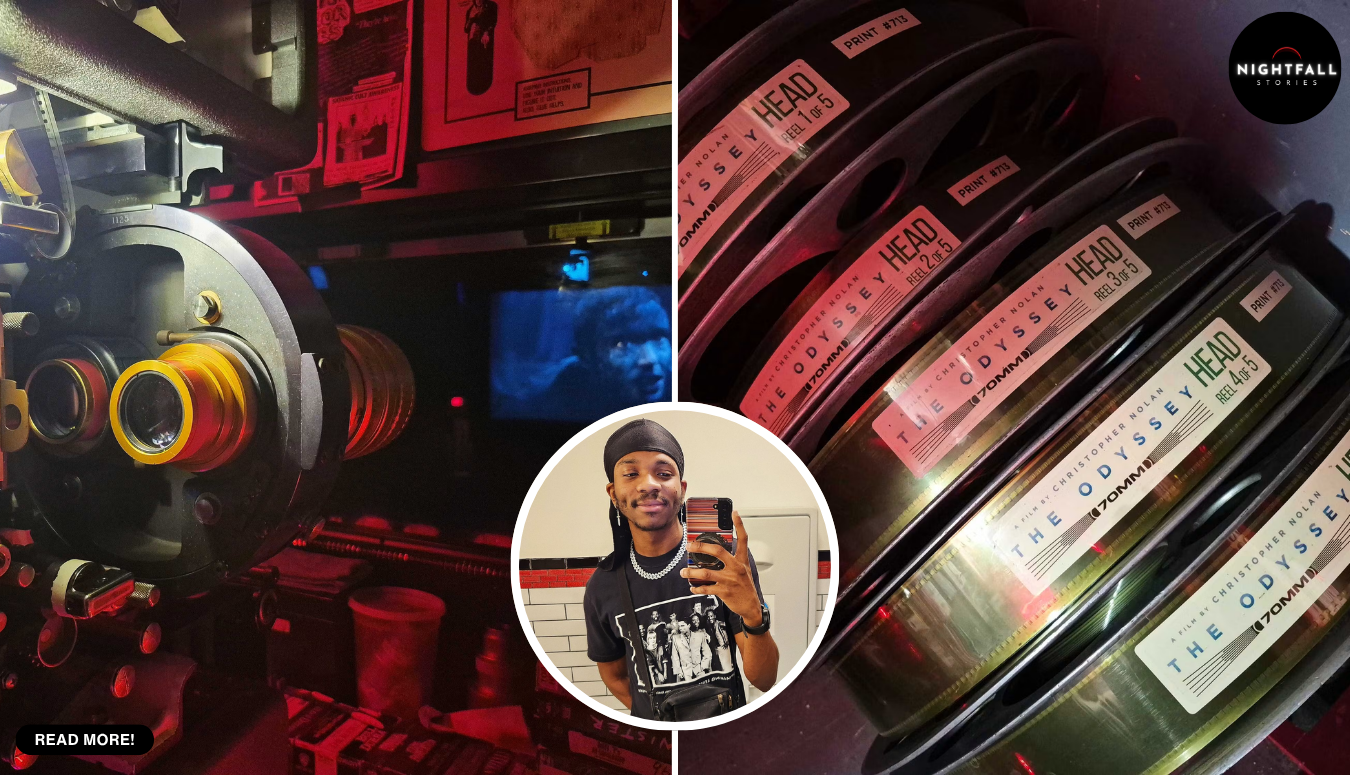
    The room held 324 people and every seat was sold. Upstairs, behind a small window most of them never thought about, Chrishaun Baker was watching a corner of the screen for a mark that would flash for a fraction of a second and then be gone.

    When it came, he had six seconds. Six seconds to start the second projector, swing the light and the sound across, and put the next reel in front of an audience that had paid to see the most technically ambitious film of the year the way it was actually made. If he missed, several hundred people in Atlanta would watch the story of Odysseus fall into darkness.

    He did not miss. He has now done it five times at the same venue.

    Baker is a projectionist at the Plaza Theatre in Atlanta, and he threaded a 70mm film print of Christopher Nolan’s The Odyssey on its opening weekend last summer. He wrote about the experience afterwards in a first-person piece for Inverse, and the thing that makes it worth reading twice is not the film. It is the quiet revelation that a job most audiences assume was automated out of existence around twenty years ago is still being done by hand, by people, in real time, with an audience already seated.

    Here is what that actually involves. The Plaza runs Century JJ dual-gauge projectors, machines that can be set up for either 35mm or 70mm. The print of The Odyssey arrived as five reels. Four of them weigh upwards of fifty pounds each and hold somewhere between thirty-five and forty minutes of film. You do not load a film like that and walk away. You build it, you inspect it, you thread it through a path of sprockets and rollers and loops that has to be exactly right, and then you stand there.

    As a reel nears its end, a cue appears in the upper corner of the frame. Thirty seconds left. Then a second cue, and from that moment the window is six seconds wide. Two projectors, one running out and one waiting, and a human being deciding when to hand the film from one to the other. Done well, nobody in the audience notices anything at all. That is the entire point. The craft is invisible by design, which is exactly why almost nobody knows it survived.

    What makes the Nolan film a genuinely hard case is how it was shot. The Odyssey was photographed entirely on IMAX film cameras, reportedly the first feature ever made that way, burning through more than two million feet of 15-perforation 65mm negative. That is an enormous amount of physical material for one story, and it creates a problem at the other end of the pipeline that no amount of marketing can solve. A film shot that way can only be shown in its full form in rooms that can physically run it.

    And there are very few of those rooms. How few depends on who is counting and when. Wikipedia’s entry for the film lists 41 screens worldwide capable of true IMAX 70mm projection, broken down as 25 in the United States, nine in Canada, three in the United Kingdom, and one each in Australia, Belgium, France and the Czech Republic. Axios reported that only around 25 or 26 US theatres could manage it, with the headline and the body of the piece giving slightly different figures. One trade write-up put the global number at about thirty. The counts moved as venues were brought back online during the run, so the honest version is this: the number was small enough to fit on a single page, and for most of the planet the nearest one was a flight away.

    The reason is not demand. It is manufacturing. IMAX film projection is essentially 1960s engineering, and nobody has built a new IMAX film projector in roughly half a century. The company’s chief executive, Richard Gelfond, has said as much publicly. Theatres that want to run film are not buying machines, they are rebuilding survivors, hunting parts, and relying on technicians who learned the system from people who learned it from people.

    The machines themselves are absurd objects by modern standards. A 70mm IMAX projector weighs around two tons. It stands more than five and a half feet tall and runs over six and a half feet long. It needs a xenon lamp with a dedicated pump and a water cooling system, because the amount of light required to fill a screen that size generates the kind of heat you do not want near plastic. The film does not travel vertically through it the way it does in a conventional projector. It moves horizontally, on a rolling loop, because the frames are laid out sideways across a strip of film wider than your hand.

    The print for a film of this length is close to ten miles of material. Assembled onto a platter it weighs somewhere around 550 pounds, and it reportedly costs in the region of $36,000 to strike a single one. That is one copy, for one venue, for one run.

    In Melbourne, at the only venue in the southern hemisphere equipped for the format, technical manager Dan Drobik described the job in terms that anyone who has ever moved a piano up a staircase would recognise. Before you get to the artistry, he said in essence, there is the sheer logistics of getting the thing into the building, building it up, putting it on the platter and running it. His booth involves pivot rollers, some of them deliberately tacky so they catch dust before it can reach the gate, and a speed-control system keeping ten miles of film moving at a steady rate. And once it starts, he stays. You do not leave the room. You listen and you watch for anything that sounds or looks slightly wrong, because by the time an audience notices, it is already too late. That venue had presold around 30,000 tickets before the film even opened, making it one of the biggest titles in the cinema’s history.

    The Plaza, it is worth being precise about, was not one of those true IMAX rooms. Nolan’s film played in a whole hierarchy of formats, each with its own shape on the screen. The tallest, most immersive version at 1.43:1 existed only on IMAX 70mm prints. IMAX digital screens showed a 1.90:1 image. Conventional 70mm film prints, the kind Baker was handling, ran at 2.20:1. Regular 35mm prints came in at 2.39:1. Baker is straightforward about this in his own account. His theatre could not give audiences the native IMAX ratio. What it could give them was a real film print, running through a real machine, with all the detail and colour depth that comes with a 70mm frame roughly three and a half times larger in area than a 35mm or digital one.

    That distinction matters, and it gets flattened constantly in coverage. Running a 70mm film print is not the same as running IMAX 70mm. But it is still a thing only a small, stubborn population of venues on earth can do at all, and it still requires someone who knows how to build a print, thread a gate and make a changeover without the audience feeling a bump.

    The Plaza is exactly the kind of place where that knowledge survived. It opened in 1939, an Art Deco house designed by the architect George Harwell Bond, and it calls itself Atlanta’s longest continuously operating independent cinema. Its first feature was The Women. It has had a long, bumpy life since: a balcony converted into a second auditorium in the 1980s, a stretch as the city’s home for arthouse and international cinema, the usual near-death experiences that independent theatres collect. It went digital in 2013, like almost everyone else.

    Then Christopher Escobar, who also runs the Atlanta Film Society, took the place on. Under his ownership the theatre was upgraded with 4K digital and, crucially, with 35mm and 70mm film capability restored. That decision looked, at the time, like sentiment. A decade later it is the reason several hundred people in Atlanta got to see the biggest film of the year on film, and the reason a projectionist in that city has a skill the industry spent twenty years deciding it no longer needed.

    The Plaza had been building toward this. The year before The Odyssey, the theatre landed one of the rare 70mm prints of The Brutalist in the run-up to awards season, which is not the kind of booking that lands in a city by accident. It lands where somebody has the machines, the trained hands and a track record of returning a print in the condition it arrived in. Studios impose strict handling rules on prints, and a venue that damages one does not get offered the next.

    That is the part of the job nobody sees at all. Before a single frame reaches a screen, a print has to be inspected, reel by reel, for damaged perforations, bad splices and anything that could tear at speed. It has to be built and set up for a specific pair of machines. Focus and framing get adjusted during the show, by eye, because film breathes slightly as it runs and a lens that was perfect at the start of a reel may not be perfect twenty minutes in. Every one of those decisions is made by a person standing in a hot room listening to an audience through a wall.

    The demand was real, too, which is the detail that undercuts the assumption that any of this is a hobbyist concern. Tickets for the large-format screenings of The Odyssey reportedly went on sale roughly a year ahead of release. Shows sold out weeks in advance. The 70mm IMAX run was extended well past its original window because the handful of rooms that could host it could not meet the demand. People travelled hundreds of miles, in some cases across borders, to sit in a specific auditorium. In a decade of constant argument about whether anyone still wants to go out to the cinema, several thousand people answered by buying a plane ticket.

    There is a version of this story that is about nostalgia, and it is the boring version. Baker’s argument is not that old technology is better because it is old. His argument is about what happens in a room. He wrote about the electricity in the crowd as it left the auditorium, the feeling of several hundred strangers having gone somewhere together and come back. That is not a format. That is what the format is for.

    The numbers around the film make the whole thing slightly surreal when you line them up. The Odyssey cost a reported $250 million and has taken around $1.66 billion worldwide, the second-biggest release of the year and, by most tallies, the highest-grossing film of its rating ever made. An enormous industrial machine, hundreds of millions of dollars, two million feet of negative. And at the very end of that chain, on the night, the whole thing came down to individual people in small rooms above the audience, lifting fifty-pound reels and counting to six.

    There is something genuinely moving about that, and it has nothing to do with romanticising the past. The most expensive, most computerised, most globally distributed art form on the planet still has a handful of points where it cannot be done without a person who has done it before. Nobody has written software that can build a print. Nobody can remotely operate a changeover.

    It is also, quietly, a labour story. The skills involved in film projection were shed at scale when cinemas converted to digital, and the people who kept them did so mostly because they loved it, often in independent venues running on tight margins. When a studio decides to release a film on film, it is drawing on a reserve of expertise that no institution deliberately maintained. It survived in places like the Plaza, in repertory houses, in festival booths, in the hands of people who were considered slightly eccentric for holding on.

    That reserve is finite. Every venue that keeps a working film projector is keeping alive a chain of instruction that only passes person to person. You cannot learn a six-second changeover from a manual. You learn it standing next to someone who has done a thousand of them, and then you do it badly a few times where it does not matter, and then one night you do it in front of 324 people who have no idea you are there.

    The print eventually went back. The film moved to digital release a few months after its run, which is what happens to every film now, and most of the people who eventually watch The Odyssey will watch it on a screen they can carry. That is fine. Nobody in the projection booth is arguing otherwise.

    But for a stretch of last summer, in a small number of rooms scattered unevenly across the world, the biggest film of the year existed as a physical object that had to be carried, built, threaded and handed from one machine to another by a human being paying close attention. In one of those rooms, in a 1939 theatre on a busy avenue in Atlanta, Chrishaun Baker did it five times and nobody in the audience noticed a thing.

    Which, if you ask anyone who has ever stood in a booth waiting for a cue mark to flash, is the highest compliment the job allows.

  • He could have made it the fast way. He spent seven years doing it by hand instead.

    He could have made it the fast way. He spent seven years doing it by hand instead.

    Somewhere in a warehouse outside Portland, Oregon, a person sat down with a pair of tweezers and began putting feathers onto a bird.

    The bird is a puppet, an eagle called the General, and it takes roughly nine thousand feathers, installed one at a time by hand. There is more than one version of that puppet, because puppets get damaged and a production cannot stop while one is repaired. So somebody did it, and then somebody did it again.

    That eagle is a single character in a film with two hundred and thirty-one practical puppets and one hundred and thirty-six built sets, many of them large enough for a crew member to walk into. The film is called Wildwood, it opens in cinemas next month, and its director has spent the past few years cheerfully describing stop-motion animation as the hardest and worst way to make a movie, immediately before explaining that he intends to keep making them this way for the rest of his life.

    His name is Travis Knight, he runs the studio that made it, and the timing of what he is doing is not subtle. He has committed close to a decade and an enormous amount of money to building a fantasy epic out of silicone, wire, fabric and light, in the exact stretch of years when the industry around him has been loudly working out how to conjure images without touching anything at all.

    Knight has called choosing stop-motion now a quiet act of rebellion. Coming from most people that would be a marketing line. Coming from him it is closer to a description of how he has spent his adult life.

    The studio is Laika, and its story is odd enough to be worth telling properly. Knight is the son of Phil Knight, who co-founded Nike, which means Travis Knight grew up with the kind of resources that let a person do almost anything. What he actually did in his twenties was put out a rap album under the name Chilly Tee, recorded partly in a studio at his father’s house, with production help from serious people. He has said since that it did not sell and that he did not enjoy performing, which is an unusually honest summary of a youthful misfire.

    Then he went into animation, starting as an intern at a Portland studio his father had invested in, and here is where the story stops being a rich kid’s detour. He did not stay near the top. He became an animator, which in stop-motion is an artisanal job measured in seconds of finished film per week. He animated on Coraline. He animated on ParaNorman. He animated on The Boxtrolls, and became a lead animator on Laika’s productions before he ever directed one. He knows what it takes to move a puppet because he spent years moving them.

    He eventually became Laika’s chief executive and directed Kubo and the Two Strings, which was nominated for an Academy Award, and then made the live-action Bumblebee, and more recently a live-action Masters of the Universe that came out earlier this year. So he can work the fast way. He has worked the fast way. He has a Golden Globe and three Oscar nominations and a studio to run and no obligation whatsoever to sit in Oregon watching people glue feathers onto a bird.

    Wildwood is an adaptation of a novel published fifteen years ago by Colin Meloy, the singer of the band The Decemberists, illustrated by Carson Ellis. Laika optioned it within weeks of publication. It has been circling the studio in one form or another for the better part of sixteen years, and Knight has said as much: he spent roughly that long getting it to the screen.

    The story is about a teenager called Prue McKeel whose baby brother is carried off by crows into a stretch of forest on the edge of Portland that nobody goes into, and her decision to go in after him with a classmate called Curtis. Inside, there are factions at war with each other, talking animals, a bandit king, an eagle general and a great many things that want them to fail. It is a proper fantasy, with a map’s worth of geography and a body count of ideas.

    There is a neat symmetry in the choice of book, because Meloy set it in Portland, and Laika is in Hillsboro, just outside Portland. After five features set in England, in small New England towns and in feudal Japan, the studio has finally made a film about the place it actually lives. The forest on screen is a version of the one at the edge of its own city. People who have worked on the film have called it a love letter to Portland, and for once that does not sound like a press line, because the crew is from there.

    The screenplay is by Chris Butler, who wrote and co-directed ParaNorman and directed Missing Link, so the studio kept it in the family. The score is by Dario Marianelli, his third for Laika. The voice cast is startling for an animated film with no franchise behind it: Peyton Elizabeth Lee as Prue, Jacob Tremblay as Curtis, Carey Mulligan, Mahershala Ali, Angela Bassett as the General, Awkwafina, Amandla Stenberg, Jake Johnson, Charlie Day, Jemaine Clement, Maya Erskine, Tantoo Cardinal, Richard E. Grant, and Tom Waits as a villain the studio has described as deliberately hard to look at.

    Making that in stop-motion is an act of scale that is difficult to describe without sounding like exaggeration, so here are the numbers instead. Laika has added close to two hundred thousand square feet of floor space since it made Kubo a decade ago. The film runs a hundred and forty minutes, which as far as anyone can establish makes it the longest stop-motion feature ever released. Fifty-four of the puppets are what the studio calls hero characters, each one engineered and costumed to the standard of a bespoke object rather than a prop.

    And a stop-motion animator produces, on a good week, a few seconds of usable film. That is the whole equation. Every second of those hundred and forty minutes was assembled twenty-four still photographs at a time, and between every one of those photographs a human being reached in and moved something by a fraction of a millimetre.

    Think about what that means as a job rather than as a statistic. An animator arrives in the morning, climbs partway into a set the size of a small room, and works on a shot that may take a fortnight to finish and will appear on screen for less time than it takes to read this sentence. They cannot take the day off in the middle of it, because nobody else can match the rhythm of a performance already half committed to film. They cannot easily undo anything. A sneeze at the wrong moment can cost a week. It is closer to glassblowing than to filmmaking: a continuous physical act that has to be carried to the end in one piece.

    None of which means Laika is doing it the way it was done in the 1930s. This is the part people get wrong about the studio, and Knight gets visibly impatient about it. Laika won a scientific and technical Academy Award ten years ago for its work on three-dimensional printing, and it uses that technology relentlessly. Puppet skeletons and facial components are printed. Musculature is printed. Water, which is a nightmare in any physical medium, gets simulated with printed parts. Visual effects clean up rigging and extend what the sets cannot hold. Producer Sam Wilson has said the printing lets the puppets carry performances that read as more human than anything the studio could manage before.

    So the argument Knight is making is not that technology is bad. He is running one of the most technically inventive animation houses on earth. The argument is narrower and more interesting: that something survives in an image when a real object sat under a real light and a real person decided where to put it, and that the survival of that something is worth the cost in years.

    He put that belief into practice in a way that made the industry look twice. For a film made entirely of puppets on miniature sets, he hired Caleb Deschanel to shoot it.

    Deschanel is a live-action cinematographer of the first rank, six times nominated for an Academy Award, the man who shot The Black Stallion and The Right Stuff and The Passion of the Christ and The Patriot. He photographs actors, landscapes, horses, weather. Hiring him to light a forest eighteen inches tall is either a joke or a thesis statement, and Knight clearly meant it as the second.

    The logic holds once you sit with it. The single most common complaint about animation at scale is that the lighting looks like nothing, because nothing about it is constrained. A live-action cinematographer spends a career fighting real light in real space, where the sun moves and a lamp gets hot and a shadow falls where physics puts it. Stop-motion sets are physical. The light is real light. Bringing in somebody whose instincts were trained on the actual world, and pointing him at a world built at a twelfth of the size, is a way of making an invented forest behave like a place.

    Knight has been out talking about this a good deal lately. He was reported to have appeared at Telluride earlier this month alongside Deschanel to discuss the film, and he described Wildwood as by far the most challenging thing the studio has taken on, drawing on close to two decades of accumulated advances in puppetry and miniature work since Coraline. The line he keeps returning to is the one about stop-motion being the hardest and worst way to make a movie, always followed immediately by the fact that he loves it.

    There is an obvious question hanging over all of this, and it is commercial rather than artistic. Laika’s films are admired, decorated and, with the arguable exception of Coraline, not enormous hits. Kubo is regarded as one of the finest animated features of its decade and it did not make back what it should have. Missing Link won a Golden Globe and lost a great deal of money. Wildwood is the studio’s first animated feature since that one, seven years ago, and the gap is not an accident. Knight himself has framed the seven years as the span between the two films.

    Which means the bet is real and the price is visible. A hundred and forty minutes, two hundred and thirty-one puppets, sixteen years from option to screen, and the studio is releasing it into a market where an entire animated sequence can be summoned from a text prompt by somebody who has never held a pencil.

    The release plan suggests confidence rather than nerves. Wildwood premieres at the London Film Festival before opening as the opening-night film at a major American festival, and it goes into cinemas on the twenty-third of October in the United States, distributed by Fathom Entertainment, with FilmNation handling the rest of the world. It will play in premium formats, including large-format and motion-seat presentations, which is a slightly funny thing to say about a film made of dolls and is also exactly right: everything on that screen was a physical object, so there is genuine detail down there to be projected.

    It carries a PG-13 rating, the studio’s first, which tells you something about the kind of fantasy it is. Laika has never made films that treat children as fragile. Coraline frightened a generation of eight-year-olds on purpose and they have been grateful ever since.

    Early signs are encouraging in the only way anyone can measure before a release. The trailers have been watched something in the order of a hundred and seventy-eight million times, which the studio says is the largest trailer launch a fully stop-motion film has ever had. Awards writers have started listing it among the year’s likely animated contenders before most of them have seen a frame beyond the marketing.

    But the number that stays with me is the nine thousand feathers, because of what it implies about everyone in that building who is not Travis Knight.

    A director can make a grand statement about craft. A studio head can commit the budget. Somebody else has to sit at a bench with tweezers and do the nine thousand. Then the puppet goes onto a set for a shot that lasts four seconds, and an animator moves it ninety-six times, and it gets photographed ninety-six times, and if a feather shifts wrong on take seventy the whole thing starts again. Multiply that by two hundred and thirty-one puppets and a hundred and thirty-six sets and seven years.

    That is what Knight is defending when he calls it a quiet act of rebellion. Not a look, and not a technique, but several hundred people’s working lives spent making something slowly on purpose, in a business that has never once been rewarded for slowness.

    Whether audiences turn up in October will decide whether Laika gets to keep doing it, and Knight knows that better than anybody, because he signs the cheques. He has given no sign of hedging. He came up through the trade, he ran the studio, he went away and made live-action films with real actors and real budgets and real speed, and he came back to the tweezers.

    Ask him why and he gives the same answer he has given for years. It is the hardest, worst way to make a film. He loves it. He is not stopping.

  • Six operations, four silent years, and then an airline made her an offer

    Six operations, four silent years, and then an airline made her an offer

    There is a particular kind of problem that prize money does not solve, and Hyun Jae Lim ran into it the moment she started winning again.

    She is 28, she studies at the Curtis Institute of Music in Philadelphia with Midori, and at the start of this year she walked away from a competition in Florida with first prize, thirty thousand dollars, a new violin, a bow, and more than thirty guaranteed concert engagements spread across three continents over the next three years. Which sounds like the happy ending. Except that Lim has a spinal cord injury, she performs seated, and the thing standing between her and those thirty concerts was never the Sibelius concerto. It was airports. It was the logistics of getting a human being and a violin and a wheelchair from one continent to another, over and over, for three years.

    Then a carrier stepped in and offered to fly her, free, whenever she travels with them on official business. And the reason that matters is the whole story underneath it.

    Before any of it, there was an ordinary and very early beginning. She started at the piano at four and moved to the violin at seven, and she has described music slipping into her days so young that it never really registered as a decision. That is the standard origin story for a conservatory violinist and it is worth stating only because of what it means practically: by the time she was twenty, she had been holding the instrument one specific way, standing, for thirteen years. Everything her body knew about the violin, it knew from that position. She had already soloed with major orchestras. She had already been accepted at Curtis, which takes a handful of violinists at a time and is free to everyone who gets in, so the competition to be there is close to absurd.

    Lim’s life was interrupted in May 2020. She had just finished her bachelor’s degree at Curtis, and by several accounts the accident happened on or around her graduation day, which is the sort of detail that sounds invented until you check it and find it in more than one place. She was in a car crash in Korea. She spent two weeks in intensive care. She spent two years in hospital. She has described going through six surgeries and procedures, and then rehabilitation on top of that, and the plain fact of a spinal cord injury that means she cannot move her legs.

    She has talked about that first stretch without any softening. For roughly six months she was in a state critical enough that recovery was the only thing her mind had room for. Nothing else got in. And because the world had shut its doors that same year, her family could not come and sit with her. She was doing the worst part of it largely on her own.

    What people usually get wrong about this kind of story is where they think the hard part is. They assume it is the hospital. It is not, or at least it is not only. Lim has been clear that leaving hospital did not mean the difficulty was over. The two years that followed were spent relearning how to live, adjusting to a body that worked differently, moving between medical appointments and home and not much else. Four years, in total, with no music in them.

    Not “no performing.” No music. She did not pick the violin up. She was not maintaining her chops quietly in a back room waiting for her moment. She genuinely believed the performing career she had spent her life building was finished, and she went looking for something else to be.

    She tried things. Crafts. LEGO. Three-dimensional rendering, which is a real and serious skill and one she seems to have been decent at. She has mentioned looking at online video as a possible direction. These were not idle hobbies to pass the time in a hospital bed. This was a young woman methodically auditioning replacement lives, because the old one appeared to be closed, and she is evidently not the sort of person who sits still.

    None of them took. She has said simply that those other things were not for her.

    What eventually brought the violin back was not a moment of inspiration or a dramatic decision. It was a job. Around the middle of 2024, four years on from the crash, she started teaching a few young children. And teaching a child to play the violin means picking up a violin, because you have to show them. You demonstrate a bow stroke. You play the phrase the way it should sound. You cannot do it from a chair with your hands folded.

    So she played a little. Then a little more. She has said she loved teaching, and that it made the musical part of her grow back. The children had no idea what they were doing.

    From there she rebuilt the whole thing from the ground, and the rebuild was not a return so much as a reconstruction. Everything she knew about playing the violin had been learned standing up, and she was now seated permanently. She has described the mechanical problem with real specificity: her knees got in the way of her bow arm. That is not a metaphor. The geometry of the instrument against a seated body is different, and the path her bow had travelled for twenty years no longer existed.

    She had to go back to fundamentals and rethink what music even was, starting from the bottom. She also quietly reorganised the surface details of a performing life that nobody thinks about until they have to. Concert dresses went. They did not work. She dresses for the way she plays now.

    Her daily routine changed shape entirely, and this is the part that flattens the easy narrative. Lim spends more time on physical therapy than on the violin. She aims for two hours of standing exercises a day, and she has been blunt that these are not a wellness routine running alongside her career. They are load-bearing for the playing itself. She cannot skip them. The violin gets what is left.

    For a musician trained in a culture that treats practice hours as a measure of worth, that ought to be a demotion. She says the opposite happened. Having a hard ceiling on her practice time forced her to think before she played rather than grinding through repetitions, and she believes her musicianship got better for it. She still calls herself a perfectionist. She just no longer thinks time at the instrument is the whole of it.

    She wrote to Midori when she decided to come back, and asked for help. Midori, the violinist whose own career began absurdly early and who has spent decades teaching, took her on. Lim has said flatly that without her none of it would have been possible. She returned to Curtis in the autumn of 2025 for a master’s degree.

    It is worth pausing on what returning to that particular world actually involves, because the romance of a comeback tends to skip it. The international violin competition circuit is not a series of concerts. It is a gauntlet, run against people in their early twenties who have never stopped for a week, let alone four years, and who arrive with a decade of accumulated competition experience and repertoire held permanently at performance readiness. You play rounds across two weeks. You are judged in a hall by people taking notes. You need concertos, sonatas, solo works and whatever new piece the organisers have commissioned, all at once, all at the level.

    Lim went back into that, from a standing start, with a technique she was still rebuilding.

    Then the results started arriving, and they arrived fast enough to be slightly indecent.

    In December 2025, about eighteen months after she had started practising again, Lim won first prize at the twentieth Seoul International Music Competition, a win that came with a purse reported at around fifty thousand dollars. She had already reached the semifinals of two other international competitions the year before, which is not nothing for someone who had been away for four years.

    Then, in January, she went to Boca Raton in Florida for the Elmar Oliveira International Violin Competition, which runs every three years for violinists aged eighteen to thirty and is named for the American violinist who won the Tchaikovsky Competition in 1978. Preliminaries ran on the tenth. Semifinals on the fourteenth. The final was on the eighteenth, in the Wold Performing Arts Center at Lynn University, four finalists playing concertos with the Lynn Philharmonia.

    Lim played the Sibelius. It is a brutal choice, a piece that sits in the small handful of concertos violinists use to prove they can do absolutely everything, and it is not a work anyone picks to be safe.

    She won.

    She also took the prize for best performance of the competition’s commissioned piece, a new work called Wood-Sprite by the composer Melinda Wagner, and the prize for best performance of a solo sonata by Ysaye, which are two very different tests. The commissioned work rewards a player who can make sense of music nobody has ever heard before, with no recordings to lean on and no tradition to hide inside. The Ysaye sonatas reward a player who can hold an audience entirely alone, with no orchestra and no pianist and nowhere at all to put a mistake.

    Three prizes in one night. The first prize package came to thirty thousand dollars from the David and Amy Fulton Foundation, a new violin by the maker Phillip Injeian, a bow by Vladimir Radosavljevic, a carbon fibre case, management support, and those thirty-plus engagements across Europe, Asia and North America.

    It is worth saying plainly what her fellow competitors and audience members said afterwards, because the alternative reading hangs in the air whether anyone voices it or not. People who were in the hall reported that it was not close. She won because she was the best violinist there that week. The wheelchair was in the room, and it had nothing to do with the result.

    Which brings us back to the airports.

    Thirty concerts across three continents is a wonderful problem to have and a genuinely expensive one. Long-haul air travel as a wheelchair user is not simply air travel with an extra form to fill in. It is a sequence of negotiations that has to go right every single time, and a career built on showing up in a different city every week multiplies that by however many weeks you can stand.

    Last month, Korean Air announced it would cover her airfare when she flies with the carrier for official engagements, competitions and concerts included. The agreement was signed at the airline’s headquarters in Seoul, with the company’s vice chairman, Woo Ki-hong, and Lim holding a ceremonial model ticket for the photographers. The airline framed it as part of its social responsibility programme and pointed to an earlier arrangement it had made with a Korean pianist a few years back, so this is a thing the company does rather than a one-off gesture. Some coverage described the deal as unlimited flights. The airline’s own announcement is narrower and more specific: free tickets, on its own services, for work.

    It is easy to underestimate how much that is worth, because most of us only encounter the cost of air travel as a number on a booking page. For a soloist at the start of a career, flights are frequently the single largest running expense and the one that most often decides whether an engagement is worth taking at all. Fees for a young prizewinner playing with a regional orchestra do not always survive contact with an intercontinental ticket. Take the tickets out of the equation and a diary that looked financially impossible becomes a diary she can actually work.

    Narrower is still the right kind of help. It is the unglamorous, infrastructural sort of support that actually removes an obstacle, as opposed to the kind that produces a nice photograph and changes nothing. Somebody at that company worked out what the real barrier was and paid for that instead of something easier.

    What Lim herself says about all of this is strikingly unbothered by the drama of it. She has said she is happy these days, and that the happiness is not coming from winning competitions. It is coming from the music she is playing, and she thinks she is at her happiest while practising. She has described her life and her music as tied together so tightly that neither one works without the other, so joy in one flows into the other in both directions. She has also said, about the four years, that even experiences you would never choose end up shaping you.

    That last one is the kind of line that gets embroidered onto things, and it would be easy to reach for it as the moral. But it is not really the point of her, and she does not seem to want to be anyone’s lesson. She is a violinist with a master’s degree in progress, a very full diary, and a technique she rebuilt from scratch because the old one no longer fit the body she has.

    The diary is the best part of the ending. She made her Milwaukee Symphony debut this week. There is a Seoul Philharmonic debut under Jaap van Zweden on the books, a tour of Korea with an Italian chamber orchestra, and a Brandenburg concerto tour in December alongside the violist Richard O’Neill and the violinist Stefan Jackiw. Recitals in New York, in Boston, in Cremona, the Italian town where the instruments come from.

    She will get to all of them. The flights are handled.

  • He started asking about it in 2008, and the keys were only handed over this month

    He started asking about it in 2008, and the keys were only handed over this month

    Here is a fact about foster care that most people never hear until it happens to a family they know. When children are removed from a home, they are very often removed from each other at the same time. Not out of malice, and not usually because anyone thinks it is a good idea. It happens because a sibling group of three or four needs a foster home with three or four free beds, and on the night the call comes, that home frequently does not exist. So the children get split. One goes here, one goes there, the youngest goes somewhere else entirely, and the last familiar face any of them had is now a scheduled visit on somebody’s calendar.

    That is the problem a new village in the high desert north of Los Angeles was built to solve. Twelve homes on a four and a half acre site, each one with room for a sibling group of up to six children, each one with trained foster parents living in it full time rather than rotating through on shifts. There are two studio apartments set aside for birth parents who are working toward getting their children back, and two more for young people ageing out of the system who would otherwise be walking into adulthood with nothing behind them. In the middle there is a community building with a kitchen, a learning lab and a multi purpose room, plus a citrus grove, gardens, play areas graded for different ages and murals painted across the walls.

    It opened this month. The first families are due to move in shortly. And the idea behind it is roughly eighteen years old.

    The actor Christian Bale co-founded the organisation behind it, Together California, with his wife Sibi and the physician Dr Eric Esrailian, and the celebrity involvement is the part that made the story travel. It is also the least interesting thing about it. The genuinely striking detail is the gap between the date somebody first started asking questions and the date anybody got a key, and what that gap says about how hard it is to build something obvious.

    The origin story, as Bale has told it, is unglamorous. Around 2008, when his daughter was a toddler, he and his wife read about the state of the foster system in California and started looking into it. That is it. No dramatic encounter, no personal history with the system. Two parents of a small child reading something and deciding not to put it down. What they found, reportedly, was that the sibling separation issue kept surfacing in everything they read, and that the model they eventually wanted to copy already existed and had done for decades. It came out of Austria after the Second World War, where the original children’s village concept was developed for children orphaned by the war: a cluster of family homes with permanent house parents, held together by a wider community on the same site, rather than an institution with dormitories and a rota.

    Adapting that to Los Angeles County took sixteen years before a single shovel went into the ground.

    Some of that was money. The project has been reported at a cost in the region of $22 million, raised through donations, and the fundraising is a story in itself. An Austrian American organisation, drawn to the project precisely because the model originated in Austria, is reported to have raised close to $9 million of it. Public money came in too, with the city and the county contributing millions between them across several approvals. But money was not the only obstacle, and probably not the slowest one.

    Building housing for children in the care of the state means clearing every layer at once. Land has to be found and zoned. A county has to agree that the model is one it will place children into, which means licensing, inspections, and reassurance that a site with twelve homes on it does not legally or practically amount to the kind of congregate group facility that child welfare policy in the United States has spent twenty years trying to move away from. Foster parents have to be recruited to a model that asks them to make it their full time job and to live on a campus. Architects have to design something that does not look like an institution, because children who have already been through the worst week of their lives should not arrive somewhere that feels like a processing centre. Every one of those steps involves an agency, and agencies do not move at the speed of good intentions.

    Meanwhile, children kept coming into care. That is the uncomfortable arithmetic sitting underneath the ribbon cutting photographs. California has tens of thousands of children in foster care at any given time, and Los Angeles County has more than any other county in the country. Reporting around the opening put the county figure at more than 30,000. Every year those eighteen years ran, a fresh cohort went into the system and a fresh cohort came out the other end at eighteen, and none of them were helped by a building that did not exist yet. The village opening now is good news. It is also a measure of how long the delay was.

    The scale is worth being honest about as well. Twelve homes is twelve homes. Even at full capacity, with up to six children in each, this is a site that serves a number of children you could fit into two school classrooms, in a county with tens of thousands in care. The organisation says the village will serve hundreds of children over time, counting the turnover of placements and the reach of the community programmes, but nobody involved is pretending this fixes Los Angeles County. It is a demonstration. The unstated argument is that if this one works, and if it can be shown to work, the model gets built again somewhere else, and that is where the numbers would eventually start to matter.

    The site sits in Palmdale, in the Antelope Valley, about an hour north of central Los Angeles and over a mountain range from it. That location was not incidental. Land there is affordable in a way land closer to the city has not been for decades, and a project that needed several acres in one piece could realistically buy it. The trade off is distance, and it is a real one, since a child placed there may be a long drive from the school, the neighbourhood and the birth family they were taken from. The campus design leans hard into making the place feel like somewhere rather than a facility: solar panels on the roofs, drought tolerant planting suited to a desert climate, shaded outdoor gathering areas, and the murals, which were commissioned on themes of hope, unity and resilience rather than left as blank stucco.

    Even the community building was argued over. Reporting and the architects’ own project description differ on its size, with some accounts putting it at around 7,000 square feet and others at about 11,000, which likely reflects a design that grew between the groundbreaking and the finished structure. What it contains is consistent across sources: a large multi purpose room, a learning lab for tutoring and homework, a kitchen, and offices for case managers and administrators, so that the people supervising placements are on site rather than visiting.

    Does it work? That question deserves a careful answer rather than an enthusiastic one, because the village has not housed anyone yet.

    What can be said is that the underlying principle, keeping brothers and sisters together, has a substantial body of research behind it. Work collected by child welfare researchers associates joint sibling placement with fewer disrupted placements, higher rates of children reaching a permanent home, fewer emotional and behavioural difficulties, better school performance and stronger family connections into adulthood. Those are associations drawn from studies of children in ordinary foster placements, not proof that any particular building produces those outcomes, and researchers are careful to note that children placed together may differ in other ways from children placed apart. Still, the direction of the evidence is consistent enough that federal and state policy in the United States already requires agencies to make reasonable efforts to place siblings together. The gap is not in the policy. The gap is in the beds.

    How wide that gap is can be seen in the placement data. One study of a large state system found that children in care with siblings spent under half of their time in care placed with all of their brothers and sisters. For a child with a single sibling the figure was better, around three fifths of the time. For a child with several siblings it dropped sharply, to roughly a third. The more brothers and sisters a child has, the less likely the system is to be able to keep them together, which is the exact inverse of what anyone would want, and it is a capacity problem rather than a policy failure. A home with two spare beds cannot take four children no matter how strongly the law prefers it.

    That is the specific hole this campus was designed to fill. Every home on the site was built with a sibling group in mind rather than a single placement, which is why the homes have three bedrooms and are described as able to take up to six children. The full time professional foster parent model is designed to address the other half of the problem, which is that recruiting and keeping foster carers who can handle a large sibling group is extremely difficult when fostering is something a person does on top of a job.

    The studio apartments for birth parents are the part that surprises people. The stated intention is reunification: the organisation’s model includes supporting the parents children were removed from, on the basis that for many families the goal is to get the children home safely rather than to place them permanently elsewhere. Whether that works in practice is, again, something that can only be judged years from now, and it is fair to be sceptical of any programme that has not yet been tested. But it is a notably different design brief from the one most people imagine when they hear the words foster facility.

    The two studios for young people ageing out deserve a mention of their own, because that is the part of the system with the worst numbers attached to it. In most of the United States, support ends somewhere between eighteen and twenty one, and a young person who has spent years in care is expected to find housing, work and stability with no family safety net and often no savings. The outcomes that follow are well documented and grim: high rates of homelessness, interrupted education, and unemployment far above their peers. Two studio apartments will not change any of that at a population level. For two people at a time, it is the difference between leaving care with an address and leaving care without one.

    There will be no photographs here of the children who move in, and there should not be anywhere else either. Children in care did not choose to become a story, their circumstances are usually the worst thing that has ever happened to them, and their privacy is not ours to spend. The organisation has been clear that it is protecting that, and coverage that respects it is doing the bare minimum rather than something admirable.

    What is fair to report is the thing the adults involved have said. Bale, at the opening, described the job of everyone connected to the place as turning the heartbreak and pain children arrive with into love, hope and some sense of a future. The executive director talked about wanting somewhere that keeps families together and builds a community around them. Those are statements of intent. They are not results, and it would be dishonest to present them as results before a single child has slept there.

    It is also worth noting that this story had already gone around the internet more than once before it was true. Viral posts circulated for years claiming the village was open, built, and full of children, at points when it was a set of drawings, then a construction site, then a half finished campus. Fact checkers had to address it repeatedly. That is its own small lesson about how the internet treats a good idea, which is to declare it finished the moment it is announced and then lose interest during the years when the actual work happens.

    The actual work, in this case, was eighteen years of meetings. Zoning hearings. Fundraising dinners. Licensing paperwork. Architectural revisions. County budget votes. Nobody makes a film about that part, and it is the part that determined whether any of this happened at all.

    There is one more thing in here worth sitting with. The reason a place like this has to exist is not that anyone designed a system to separate siblings. It is that a system built out of individual households, each with their own spare room and their own limits, will always struggle with the arithmetic of a family of four arriving at once. Solving it means building capacity on purpose, in advance, before the night the call comes. That is expensive, slow, unglamorous and almost impossible to fundraise for, because it means paying for empty beds that exist only so they are there when they are needed.

    Twelve homes now sit in the high desert with nobody in them, waiting for exactly that. In a few weeks, brothers and sisters will come through the doors together, and stay together, and that will be the first time anyone finds out whether eighteen years of paperwork produced what it was supposed to.

  • The mountain that stopped his heart, and the morning he went back up it

    The mountain that stopped his heart, and the morning he went back up it

    Four years ago, a 26 year old was found face down in the snow on a Lake District ridge with no pulse, no breathing, and a core body temperature of 18C, which is roughly half of what a living person is supposed to run at. Rescuers shocked his heart three times on the fellside and got nothing back. He was flown off the mountain and put on a machine that did the work of his heart and lungs for him, and doctors later estimated he had been clinically dead for somewhere between two hours and fourteen minutes and three hours and twenty minutes.

    His name is Tommy Price. This month he went back to the same set of hills and finished the thing he had been out there training for when it all went wrong.

    That last sentence is the part people struggle with, so it is worth slowing down on. The challenge is called the Bob Graham Round, and it is one of those events that sounds like an exaggeration until you check the numbers. Forty two peaks. Around 66 miles. Somewhere near 27,000 feet of climbing, which is roughly the height of Everest measured from sea level, except you do it by going up and down repeatedly on rough ground. There is no prize, no entry fee, no race number and no official organiser in the usual sense. There is only a tradition, dating back to a Keswick hotel owner who linked the peaks together on his birthday in the 1930s, that says you should get round in under 24 hours, and that if you do, other people who have done it will vouch for you.

    Price did it in 23 hours and 35 minutes.

    The route itself is worth picturing properly, because it explains why the thing takes a full day. It starts and ends at the Moot Hall in Keswick, and it loops out over the northern fells, then south across Helvellyn and its neighbours, then over the Scafell massif, the highest ground in England, then west and back north over the Newlands fells before dropping into town. Much of it is not path. Some of it is bog, some is loose rock, and a good deal of it is the sort of terrain where you are picking a line between tussocks in the dark and hoping your feet land where your headtorch suggested they would. People who attempt it typically try in the summer, when there are more hours of daylight and the ground is drier, and even then most attempts fail.

    Winter attempts, and winter training on the route, are a different proposition entirely. The northern fells in January are exposed, largely featureless in poor visibility, and capable of turning from cold to genuinely dangerous in the time it takes to stop moving. That is the setting for what happened to Price.

    To understand why that time made grown volunteers cry at a finish line in a small market town, you have to go back to the winter morning that nearly took him off the map entirely. He was out on the first section of the route, the stretch that climbs Skiddaw and Great Calva and then hauls up the narrow spine of Hall’s Fell onto Blencathra. Accounts differ slightly on whether that day was a full attempt or a reconnaissance run over the ground, which is how most people learn the route before they try it properly. What is not in dispute is the weather. Snow, sub zero temperatures, wind hard enough to strip heat out of a moving body faster than the body can make it.

    Hypothermia does not announce itself with a dramatic collapse. It arrives as clumsiness, then as confusion, then as a strange lack of concern about being clumsy and confused. By the time Price could not get himself down safely, he had already passed the point where he could reliably judge how much trouble he was in. The person he was out with got him into an emergency shelter bag and went for help, which is the single decision that gave the story anywhere left to go.

    When Keswick Mountain Rescue Team reached him, he was in cardiac arrest. Cold had done it. Below a certain temperature the heart’s electrical rhythm simply falls apart, and no amount of willpower has any say in it. Volunteers began chest compressions and kept going, working on a body on frozen ground in the dark, and they tried three times with a defibrillator to bring a rhythm back. Three times, nothing. A coastguard helicopter lifted him to the Royal Victoria Infirmary in Newcastle, where he was put on an ECMO machine, which takes blood out of the body, warms and oxygenates it, and puts it back. Only then, once he had been slowly brought back up to a survivable temperature, did his heart start again.

    There is a grim irony sitting inside all of this, and one of his rescuers explained it to the BBC at the time. The cold that stopped his heart is also what protected him while it was stopped. A chilled brain and chilled organs need far less oxygen than warm ones, which is why people pulled out of freezing water have occasionally walked away from periods without a heartbeat that would leave anyone else with catastrophic damage. Emergency clinicians have a blunt saying about this kind of case, that nobody is dead until they are warm and dead, and it is not a figure of speech. It is a treatment protocol. It is the reason the team on the fell kept working long past the point where a bystander would have assumed there was nothing to work with.

    He spent five days in an induced coma. When he woke, the first job was not running. It was his hands and feet, which had lost sensation, and it took months to get that feeling back. He has spoken about the recovery in plain terms rather than heroic ones. He was told his chances had been extremely slim, and he has said, more than once and without much decoration, that he is very lucky to be alive and even luckier to still be able to run.

    Which is what makes what he did next interesting, because he did not immediately go back to the fells. He went and ran the London Marathon, on flat roads, in 3 hours and 10 minutes, and used it to raise about $13,000, roughly ten thousand pounds, for Keswick Mountain Rescue Team. If you want a measure of how ordinary that organisation’s funding situation is, consider that it is a charity staffed entirely by volunteers who carry stretchers up mountains at three in the morning for free, and that it depends on exactly this sort of money to keep radios working and ropes replaced. The people who kept his heart moving for hours in the snow were not paid to be there. They had jobs to go to the next morning.

    It is also worth saying plainly what a mountain rescue callout of this kind actually involves, because the phrase makes it sound tidier than it is. A team is paged. People leave work, or beds, or dinner. They drive to a car park, load packs, and walk uphill in the dark into the exact conditions that have just put someone in trouble. Casualty care happens on a slope, in wind, with a head torch, on ground where kneeling is awkward and where the rescuers are themselves losing heat the whole time. Chest compressions are physically brutal to sustain for minutes, let alone for the extended period a hypothermic arrest demands, so teams rotate, and the rotation has to keep going while other members set up a landing site, manage the radios, and work out how to get a stretcher down if the helicopter cannot fly.

    Every one of those people is a volunteer. In the United Kingdom, mountain rescue is not a state emergency service with a budget line. It is a network of charities, and the teams buy their own vehicles, their own stretchers, their own radios and their own drugs bags out of donations, raffles and the occasional grateful survivor running a marathon.

    For a long time after that, the Round itself sat unfinished. There is no rule anywhere that says a person has to go back. Plenty of people who have had a serious mountain accident never return to the specific place it happened, and that is a perfectly reasonable way to live. Price decided he wanted the thing he had gone up there for in the first place, and he trained for years to be in a state to get it.

    The attempt this month went out and came back in under a day, which on that route means running through an entire night. The Bob Graham is divided into five legs, and almost everyone doing it relies on friends and clubmates to pace them, carry food, and navigate the featureless sections when the mind has stopped working properly. On the first leg, the one that crosses Blencathra, Price was accompanied by Jonny Hulme, a Keswick Mountain Rescue volunteer who had been part of the team that came for him four years earlier.

    Think about what that means in practice. Two men going back over the exact ground where one of them had knelt in the snow doing chest compressions on the other. Past the point where the helicopter came in. In daylight, on a good day, with the ridge behind them and thirty nine peaks still to come.

    At the end, in Keswick, Price touched the door of the Moot Hall, the old building in the town square that serves as the traditional start and finish. Waiting there was Dr John Ferris, who had been involved in coordinating his emergency care. The photographs from that morning show a man who has been awake for more than a day, surrounded by people who are visibly not composed.

    Price’s own account of it was not about pride in the time. He talked about the strangeness of the symmetry, that four years earlier these were the people saving his life, and four years later they were standing at the finish of the challenge he had been out on when it happened. He has been consistent that without the volunteers and the doctors, he would not be here. He has also said, simply, that he was given a second chance and that he made the most of it.

    It is tempting to turn this into a lesson, and it is worth resisting that, because Price’s case is his own. His survival came out of a specific and unusual combination of circumstances: a companion who sheltered him and went for help instead of staying, a rescue team willing to continue resuscitation for a very long time, a helicopter available in bad weather, a hospital with ECMO capability and the willingness to use it, and a cold injury of exactly the type where extreme cooling can protect the brain rather than destroy it. Change any one of those and the story ends differently. Nothing about his recovery says anything about anyone else’s, and his ability to run again is not a template.

    What his case does illustrate, and what the rescue team has been keen to push, is far less dramatic. The difference between a bad day and a fatal one on a winter mountain is very often a spare warm layer and a survival bag weighing almost nothing in the bottom of a pack. Price’s companion had a bivvy bag. That bag bought the time the rescue needed. Mountain rescue volunteers repeat this endlessly because they see the other version of the story more often than anyone wants to think about, and because the people they carry down are usually fit, experienced and perfectly competent, right up until the weather changes faster than they do.

    There is something else in here that is easy to miss, and it is about the shape of a long recovery. Price did not come back in a year. He came back in four, and the road went through months of not being able to feel his own hands, then a road marathon, then years of training on hills at times of day when nobody is watching. The finish line photographs are the part that travels around the world. The unglamorous middle is where the actual work happened, and almost none of it was visible to anyone.

    The Bob Graham Round has been completed by a few thousand people since the 1930s, which in the scale of world sport is nobody at all. Those who have done it tend to be quietly obsessive types who like hills and do not much care whether anyone is impressed. Price is now on that list, with a time comfortably inside the 24 hours that the tradition asks for, and with a footnote that no other name on it carries.

    He is still running. He still lives with the knowledge of what those hills did to him, and he went back anyway, not to prove a point about mortality but because he had unfinished business with a route. The team that carried him off the fell has a little more money in the bank because of him. One of the men who tried to restart his heart has now run beside him over the same ridge on a good morning.

    That is where it has settled. Not a miracle, not a comeback story with a neat moral attached, just a man who was extraordinarily lucky, who knows it, who put in four years of work, and who went back up the mountain and came down the other way.