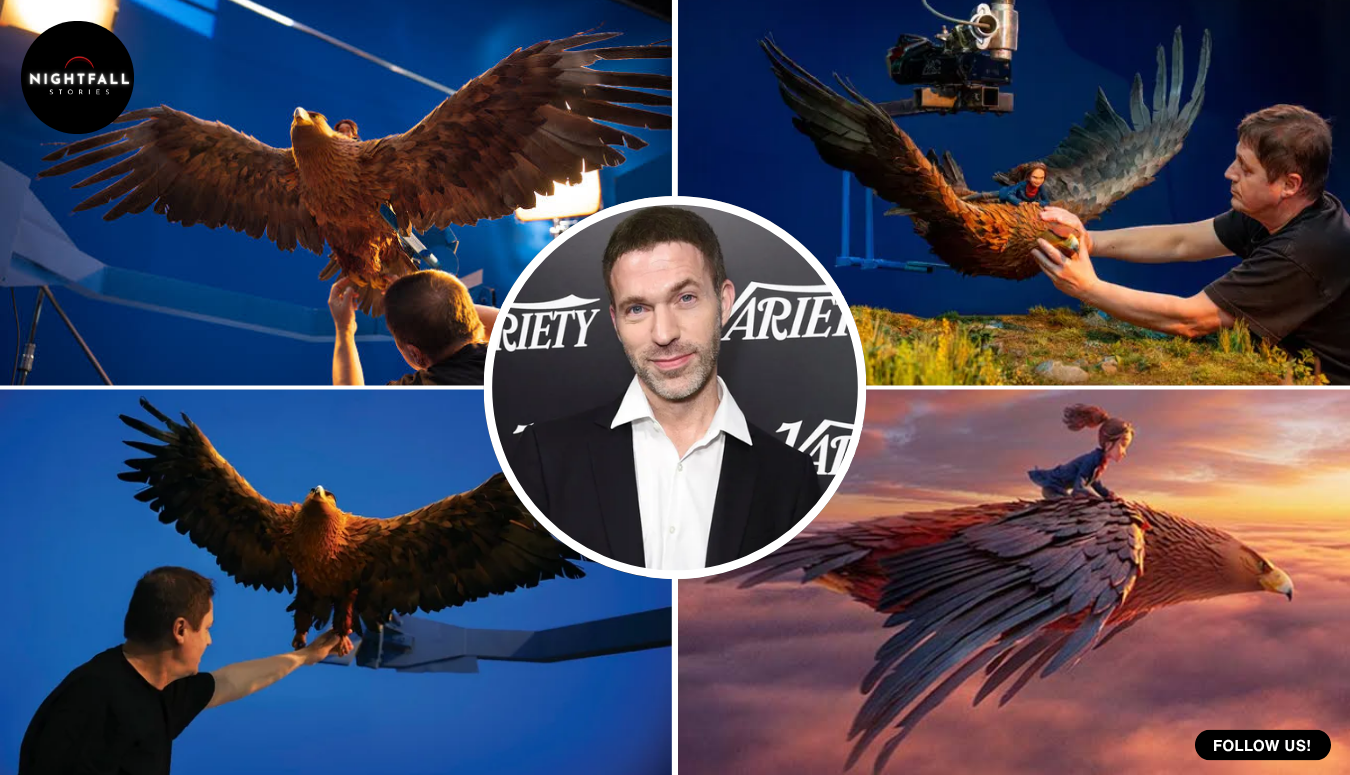
Somewhere in a warehouse outside Portland, Oregon, a person sat down with a pair of tweezers and began putting feathers onto a bird.
The bird is a puppet, an eagle called the General, and it takes roughly nine thousand feathers, installed one at a time by hand. There is more than one version of that puppet, because puppets get damaged and a production cannot stop while one is repaired. So somebody did it, and then somebody did it again.
That eagle is a single character in a film with two hundred and thirty-one practical puppets and one hundred and thirty-six built sets, many of them large enough for a crew member to walk into. The film is called Wildwood, it opens in cinemas next month, and its director has spent the past few years cheerfully describing stop-motion animation as the hardest and worst way to make a movie, immediately before explaining that he intends to keep making them this way for the rest of his life.
His name is Travis Knight, he runs the studio that made it, and the timing of what he is doing is not subtle. He has committed close to a decade and an enormous amount of money to building a fantasy epic out of silicone, wire, fabric and light, in the exact stretch of years when the industry around him has been loudly working out how to conjure images without touching anything at all.
Knight has called choosing stop-motion now a quiet act of rebellion. Coming from most people that would be a marketing line. Coming from him it is closer to a description of how he has spent his adult life.
The studio is Laika, and its story is odd enough to be worth telling properly. Knight is the son of Phil Knight, who co-founded Nike, which means Travis Knight grew up with the kind of resources that let a person do almost anything. What he actually did in his twenties was put out a rap album under the name Chilly Tee, recorded partly in a studio at his father’s house, with production help from serious people. He has said since that it did not sell and that he did not enjoy performing, which is an unusually honest summary of a youthful misfire.
Then he went into animation, starting as an intern at a Portland studio his father had invested in, and here is where the story stops being a rich kid’s detour. He did not stay near the top. He became an animator, which in stop-motion is an artisanal job measured in seconds of finished film per week. He animated on Coraline. He animated on ParaNorman. He animated on The Boxtrolls, and became a lead animator on Laika’s productions before he ever directed one. He knows what it takes to move a puppet because he spent years moving them.
He eventually became Laika’s chief executive and directed Kubo and the Two Strings, which was nominated for an Academy Award, and then made the live-action Bumblebee, and more recently a live-action Masters of the Universe that came out earlier this year. So he can work the fast way. He has worked the fast way. He has a Golden Globe and three Oscar nominations and a studio to run and no obligation whatsoever to sit in Oregon watching people glue feathers onto a bird.
Wildwood is an adaptation of a novel published fifteen years ago by Colin Meloy, the singer of the band The Decemberists, illustrated by Carson Ellis. Laika optioned it within weeks of publication. It has been circling the studio in one form or another for the better part of sixteen years, and Knight has said as much: he spent roughly that long getting it to the screen.
The story is about a teenager called Prue McKeel whose baby brother is carried off by crows into a stretch of forest on the edge of Portland that nobody goes into, and her decision to go in after him with a classmate called Curtis. Inside, there are factions at war with each other, talking animals, a bandit king, an eagle general and a great many things that want them to fail. It is a proper fantasy, with a map’s worth of geography and a body count of ideas.
There is a neat symmetry in the choice of book, because Meloy set it in Portland, and Laika is in Hillsboro, just outside Portland. After five features set in England, in small New England towns and in feudal Japan, the studio has finally made a film about the place it actually lives. The forest on screen is a version of the one at the edge of its own city. People who have worked on the film have called it a love letter to Portland, and for once that does not sound like a press line, because the crew is from there.
The screenplay is by Chris Butler, who wrote and co-directed ParaNorman and directed Missing Link, so the studio kept it in the family. The score is by Dario Marianelli, his third for Laika. The voice cast is startling for an animated film with no franchise behind it: Peyton Elizabeth Lee as Prue, Jacob Tremblay as Curtis, Carey Mulligan, Mahershala Ali, Angela Bassett as the General, Awkwafina, Amandla Stenberg, Jake Johnson, Charlie Day, Jemaine Clement, Maya Erskine, Tantoo Cardinal, Richard E. Grant, and Tom Waits as a villain the studio has described as deliberately hard to look at.
Making that in stop-motion is an act of scale that is difficult to describe without sounding like exaggeration, so here are the numbers instead. Laika has added close to two hundred thousand square feet of floor space since it made Kubo a decade ago. The film runs a hundred and forty minutes, which as far as anyone can establish makes it the longest stop-motion feature ever released. Fifty-four of the puppets are what the studio calls hero characters, each one engineered and costumed to the standard of a bespoke object rather than a prop.
And a stop-motion animator produces, on a good week, a few seconds of usable film. That is the whole equation. Every second of those hundred and forty minutes was assembled twenty-four still photographs at a time, and between every one of those photographs a human being reached in and moved something by a fraction of a millimetre.
Think about what that means as a job rather than as a statistic. An animator arrives in the morning, climbs partway into a set the size of a small room, and works on a shot that may take a fortnight to finish and will appear on screen for less time than it takes to read this sentence. They cannot take the day off in the middle of it, because nobody else can match the rhythm of a performance already half committed to film. They cannot easily undo anything. A sneeze at the wrong moment can cost a week. It is closer to glassblowing than to filmmaking: a continuous physical act that has to be carried to the end in one piece.
None of which means Laika is doing it the way it was done in the 1930s. This is the part people get wrong about the studio, and Knight gets visibly impatient about it. Laika won a scientific and technical Academy Award ten years ago for its work on three-dimensional printing, and it uses that technology relentlessly. Puppet skeletons and facial components are printed. Musculature is printed. Water, which is a nightmare in any physical medium, gets simulated with printed parts. Visual effects clean up rigging and extend what the sets cannot hold. Producer Sam Wilson has said the printing lets the puppets carry performances that read as more human than anything the studio could manage before.
So the argument Knight is making is not that technology is bad. He is running one of the most technically inventive animation houses on earth. The argument is narrower and more interesting: that something survives in an image when a real object sat under a real light and a real person decided where to put it, and that the survival of that something is worth the cost in years.
He put that belief into practice in a way that made the industry look twice. For a film made entirely of puppets on miniature sets, he hired Caleb Deschanel to shoot it.
Deschanel is a live-action cinematographer of the first rank, six times nominated for an Academy Award, the man who shot The Black Stallion and The Right Stuff and The Passion of the Christ and The Patriot. He photographs actors, landscapes, horses, weather. Hiring him to light a forest eighteen inches tall is either a joke or a thesis statement, and Knight clearly meant it as the second.
The logic holds once you sit with it. The single most common complaint about animation at scale is that the lighting looks like nothing, because nothing about it is constrained. A live-action cinematographer spends a career fighting real light in real space, where the sun moves and a lamp gets hot and a shadow falls where physics puts it. Stop-motion sets are physical. The light is real light. Bringing in somebody whose instincts were trained on the actual world, and pointing him at a world built at a twelfth of the size, is a way of making an invented forest behave like a place.
Knight has been out talking about this a good deal lately. He was reported to have appeared at Telluride earlier this month alongside Deschanel to discuss the film, and he described Wildwood as by far the most challenging thing the studio has taken on, drawing on close to two decades of accumulated advances in puppetry and miniature work since Coraline. The line he keeps returning to is the one about stop-motion being the hardest and worst way to make a movie, always followed immediately by the fact that he loves it.
There is an obvious question hanging over all of this, and it is commercial rather than artistic. Laika’s films are admired, decorated and, with the arguable exception of Coraline, not enormous hits. Kubo is regarded as one of the finest animated features of its decade and it did not make back what it should have. Missing Link won a Golden Globe and lost a great deal of money. Wildwood is the studio’s first animated feature since that one, seven years ago, and the gap is not an accident. Knight himself has framed the seven years as the span between the two films.
Which means the bet is real and the price is visible. A hundred and forty minutes, two hundred and thirty-one puppets, sixteen years from option to screen, and the studio is releasing it into a market where an entire animated sequence can be summoned from a text prompt by somebody who has never held a pencil.
The release plan suggests confidence rather than nerves. Wildwood premieres at the London Film Festival before opening as the opening-night film at a major American festival, and it goes into cinemas on the twenty-third of October in the United States, distributed by Fathom Entertainment, with FilmNation handling the rest of the world. It will play in premium formats, including large-format and motion-seat presentations, which is a slightly funny thing to say about a film made of dolls and is also exactly right: everything on that screen was a physical object, so there is genuine detail down there to be projected.
It carries a PG-13 rating, the studio’s first, which tells you something about the kind of fantasy it is. Laika has never made films that treat children as fragile. Coraline frightened a generation of eight-year-olds on purpose and they have been grateful ever since.
Early signs are encouraging in the only way anyone can measure before a release. The trailers have been watched something in the order of a hundred and seventy-eight million times, which the studio says is the largest trailer launch a fully stop-motion film has ever had. Awards writers have started listing it among the year’s likely animated contenders before most of them have seen a frame beyond the marketing.
But the number that stays with me is the nine thousand feathers, because of what it implies about everyone in that building who is not Travis Knight.
A director can make a grand statement about craft. A studio head can commit the budget. Somebody else has to sit at a bench with tweezers and do the nine thousand. Then the puppet goes onto a set for a shot that lasts four seconds, and an animator moves it ninety-six times, and it gets photographed ninety-six times, and if a feather shifts wrong on take seventy the whole thing starts again. Multiply that by two hundred and thirty-one puppets and a hundred and thirty-six sets and seven years.
That is what Knight is defending when he calls it a quiet act of rebellion. Not a look, and not a technique, but several hundred people’s working lives spent making something slowly on purpose, in a business that has never once been rewarded for slowness.
Whether audiences turn up in October will decide whether Laika gets to keep doing it, and Knight knows that better than anybody, because he signs the cheques. He has given no sign of hedging. He came up through the trade, he ran the studio, he went away and made live-action films with real actors and real budgets and real speed, and he came back to the tweezers.
Ask him why and he gives the same answer he has given for years. It is the hardest, worst way to make a film. He loves it. He is not stopping.