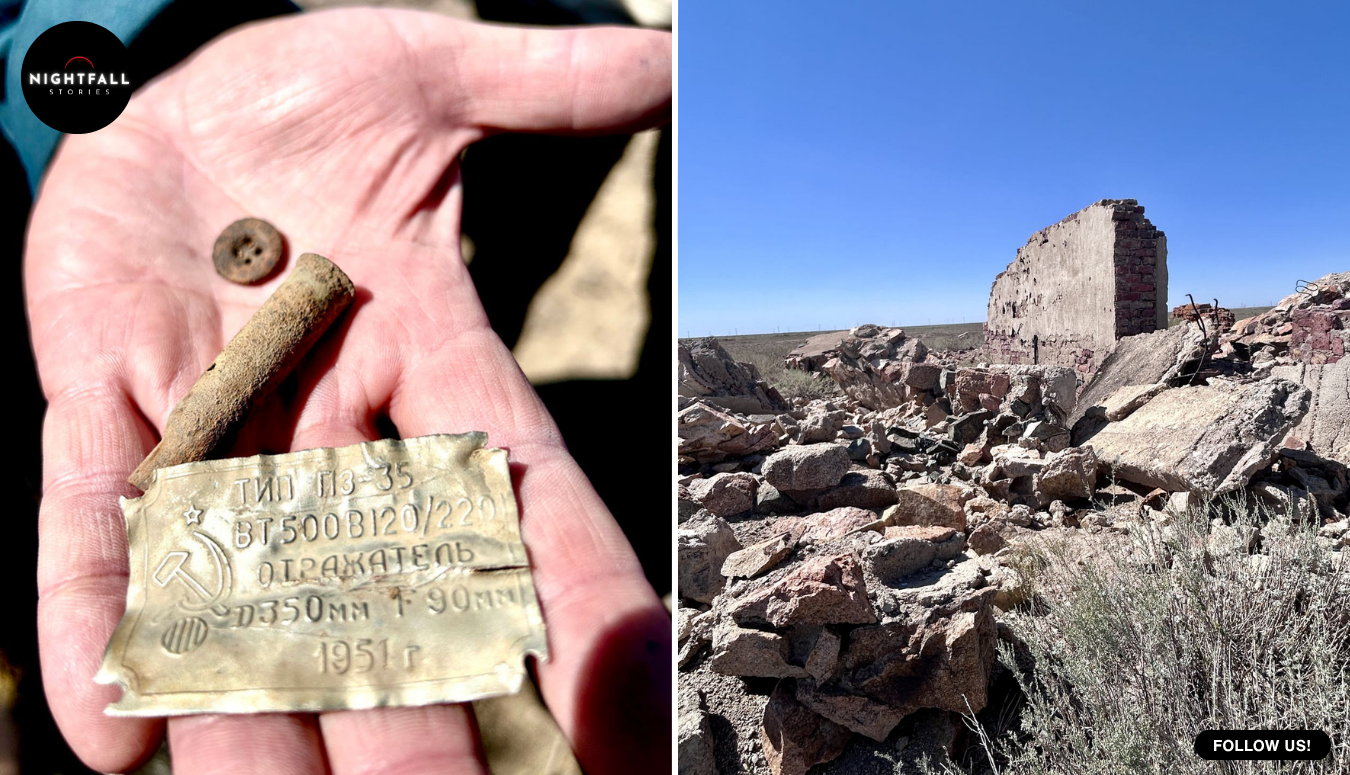
On a stretch of Kazakh steppe where there is almost nothing to look at, a team of archaeologists picked up the sole of a woman’s shoe, a scatter of broken bottles with 1959 and 1960 pressed into the glass, and a small metal label from a lamp stamped 1951. The lamp label made sense. The bottles did not. According to every official Soviet document historians have worked from for decades, the camp those objects came from had already been shut down.
That gap between the paperwork and the ground is the whole story. The Soviet state was one of the most obsessive record keepers in history, and its records are the main reason we know as much as we do about the Gulag. Millions of index cards, transfer orders, quotas, closure notices. Historians have spent a generation working through them. What the Czech team on the steppe has done is something different and, in its way, harder. They went and looked.
The site is Steplag, the Steppe Camp, near Zhezkazgan in central Kazakhstan. It was one of the special camps set up after the Second World War for political prisoners, run under what the system called an intensified regime, which in practice meant numbered uniforms, barred windows and longer hours. More than 20,000 people were held there. They came from well over forty nationalities. Lithuanians, Latvians, Ukrainians, Poles, Russians, Germans and a smaller number of Czechs and Slovaks worked the copper, manganese and coal that the region was valuable for. Estimates of the Czechoslovak citizens specifically held at Steplag run to a few dozen, with hundreds more scattered across the wider network of Kazakh camps, and almost none of their individual stories were ever written down.
The excavation is run by archaeologists from the Faculty of Arts at the University of West Bohemia, led by Pavel Vařeka, working with Gulag.cz, a Czech organisation that has spent about fifteen years documenting Soviet forced labour camps wherever they can still be reached. Štěpán Černoušek, who chairs Gulag.cz, has been going back to these landscapes for years with cameras, drones and 3D scanners. What makes this round different is a piece of paper. The team says this is the first officially licensed archaeological excavation of a Gulag site anywhere in the former Soviet Union. Not a documentation trip, not a photographic survey. A permit to put a trowel in the ground.
That distinction matters more than it sounds. Gulag sites sit in an awkward legal and political space across the former USSR. Many are on land nobody wants, in regions nobody visits, and for a long time the practical answer to what should happen to them was nothing at all. A licence turns a ruin into a site, and a site into evidence. It also means the finds are recorded properly, with their positions logged, rather than being picked up loose and losing everything that made them useful.
Gulag.cz did not arrive at Steplag cold either. The organisation has been running expeditions into the former Soviet camp landscape for years, including a substantial trip through Kazakhstan several years ago that covered Alzhir, the camp outside the capital that held the wives and female relatives of men the state had already condemned, and Karlag, the sprawling agricultural complex in the Karaganda region that was one of the largest camps in the entire system. That work produced a documentary film and a public online archive of the Kazakh sites, with 3D models of standing structures, panoramic photography, survivor biographies and the same declassified Western reconnaissance images the archaeologists now use as survey data. The point of putting all of it online was that most people will never stand on that steppe, and the buildings that are still standing are not going to be standing indefinitely.
The team did not walk in blind. Before anyone dug, they worked over the landscape with drone photography and with declassified American military reconnaissance imagery from the 1950s and 1960s, the satellite photographs taken when the West was trying to work out what was going on inside the Soviet interior. Those images are now one of the most useful tools in the archaeology of the recent past, because they show what a place looked like while it was still being used. Combined with ground survey, that gave the team a map of things to go and check.
They ended up identifying six camps in the Karaganda and Zhezkazgan regions. Three were already known. Three were not. One of the new ones, out on the open steppe, turned out to be remarkably intact, still with its working zone laid out beside the compound where the prisoners were held. There was also a cemetery that nobody had marked or maintained, where the graves are indicated by wooden posts and broken crosses, and where the count runs to somewhere near twenty visible burials. One of those carries a Lithuanian cross that was put up in 1990, by people who came back to find where somebody had been left.
Across the sites, some things repeated. Three lines of barbed wire around every perimeter. Guard towers at every one. Isolation cells at most of them. Černoušek has said that what actually surprised the team was how much variation there was underneath that shared skeleton, in the materials the camps were built from and in how they were organised internally. The system was standardised on paper and improvised in practice, which is true of a great deal of Soviet administration and is exactly the sort of thing documents tend to hide.
Then there are the objects. Fragments of plates and bottles. An aluminium mug. Pieces of clothing and footwear. Uniform buttons. Spent cartridge casings, concentrated near where the guard towers stood. The lamp label from 1951, from the lighting rigged along the fenced perimeter. None of it is spectacular. That is rather the point. This is the material of ordinary days in a place built to consume people, and it survives because nobody ever thought it was worth removing.
The bottles are the part that has made this news beyond archaeology. Glass from that era was routinely dated at manufacture, which makes it an unusually honest little clock. The team recovered bottle glass marked 1959 and 1960 at a location that the archives place as closed by 1956. Alongside it, they found the remains of women’s shoes.
Černoušek’s reading is that there had been a camp there, a women’s camp, after the date the records give, and that its existence was simply not carried into the documents historians have been using. He is careful about how he puts it, and so should anyone repeating it be. This is an interpretation drawn from a small body of material, not a settled fact. Bottles move. Sites get reused. A date on glass tells you when the bottle was made, not when it was dropped, and in a place where scrap was valuable and nothing was thrown away lightly, that gap can be years. The honest version is that the archaeology is inconsistent with the archival closure date and that the team thinks the most likely explanation is continued use.
What raises the confidence is that the objects are not the only source. There is a man.
Mizambai Bralin lives locally and was a child when the camp was operating. When the team brought him back to the site, he was able to walk them through it and say what each building had been for, which structure did what, where the guards were, how the place functioned. Černoušek has said he remembered it all with remarkable precision. His account and the material in the ground point the same way, and neither was derived from the other. In historical work that kind of independent agreement is worth a great deal more than either piece on its own.
It is also, in the plainest terms, a closing window. Anyone with a first hand memory of a camp that was running in the late 1950s is now in their late seventies at the youngest. There is a reason archaeologists of the twentieth century tend to work fast and take testimony while they still can. In twenty years this excavation would have been a purely material exercise, and the ground alone would never have been able to tell them what each building was used for.
The wider context around Steplag is well documented and does not depend on any of this. In 1954, in the months after Stalin’s death, prisoners at Steplag took control of the camp in what became known as the Kengir uprising. For about forty days they ran the place themselves, organised food and order, set up their own administration and negotiated with the authorities. It ended when the army came in with tanks. The number of people killed has been disputed ever since, with official figures far lower than the accounts of survivors, and it remains one of the episodes where the archive is least trusted even by people who work in it every day. That history is one reason the site matters, and it also explains something about why a discrepancy in a closure date does not surprise the people working there.
The Kazakhstan fieldwork is part of a larger research project the Czech team calls Wild Land, which looks at how people held in twentieth century camps found ways to endure them. It deliberately sets the Kazakh camps against a set much closer to home, the uranium mining camps around Jáchymov in the Czech Ore Mountains, where the Czechoslovak state ran its own prison labour system in the 1950s. Putting the two side by side is a way of making a point that is easy to lose: this was not a distant thing that happened to other people somewhere cold. The same architecture of wire, tower and quota was built inside Europe, by a government, within living memory.
It is worth being clear about why a women’s camp at Steplag is plausible rather than startling. Women were held throughout the Soviet camp system, in separate compounds and in whole separate camps, on the same political articles as men and often for nothing more than a family connection to someone already arrested. Kazakhstan in particular had a significant share of them. So the archaeologists are not proposing something the system did not do. They are proposing that one instance of something the system did routinely was either never written into the surviving paperwork or was written into files that have not been found, declassified or connected to this location. Given how the closure and reorganisation of the special camps was handled in the years after Stalin’s death, when units were merged, renumbered and transferred at speed, a site slipping out of the ledger while people were still inside it is not an extraordinary suggestion.
There is one thing the team has been explicit about not doing. The cemetery will not be excavated. The plan is a non invasive geophysical survey, which can map what is below the surface and give a sense of how many burials there are without disturbing any of them. Nobody is going to be dug up to produce a number. That decision is worth stating plainly, because it is the kind of restraint that rarely makes headlines and is the difference between research and intrusion. The graves are the resting place of people whose families, in many cases, were never told where they were.
What all this adds up to is a quiet argument about how we know what we know. The Gulag has been studied for decades almost entirely through paper, partly because the paper survived in enormous quantity and partly because for a long time the sites themselves were unreachable. Paper is generated by an institution, for the institution’s purposes, and it records what the institution wanted recorded. A camp that was closed on schedule looks tidy in a ledger. A camp that quietly kept operating for another three or four years with a few hundred women in it does not, and there was nobody in that chain of command with a reason to write it down.
The ground has no such motive. It keeps a bottle because a bottle was dropped. It keeps the sole of a shoe because leather and rubber outlast almost everything in dry steppe soil. It is an indifferent witness, which in this case makes it a useful one.
None of this rewrites the history of the Gulag, and the archaeologists have not claimed it does. The system’s scale, its purpose and its cost were established long ago by historians working with exactly the documents this find complicates. What the excavation does is smaller and more specific. It demonstrates that the archive has holes, it gives a method for finding them, and it shows that those holes can be filled by a combination of what is buried and what an elderly man still remembers about the place where he grew up.
The team intends to go back. There is more of the steppe to survey, and the satellite imagery has flagged locations nobody has walked yet. The finds from this season are being catalogued and studied, and the results will go through the normal process of publication and challenge, where the 1959 interpretation will be tested by people whose job is to be sceptical of it. That is how it should work.
Meanwhile the objects themselves sit in trays: buttons, casings, a label from a perimeter lamp, a piece of glass with a year on it, the sole of a shoe that belonged to a woman whose name is not in any file anyone has found. She was, according to the documents, not there. She was there.