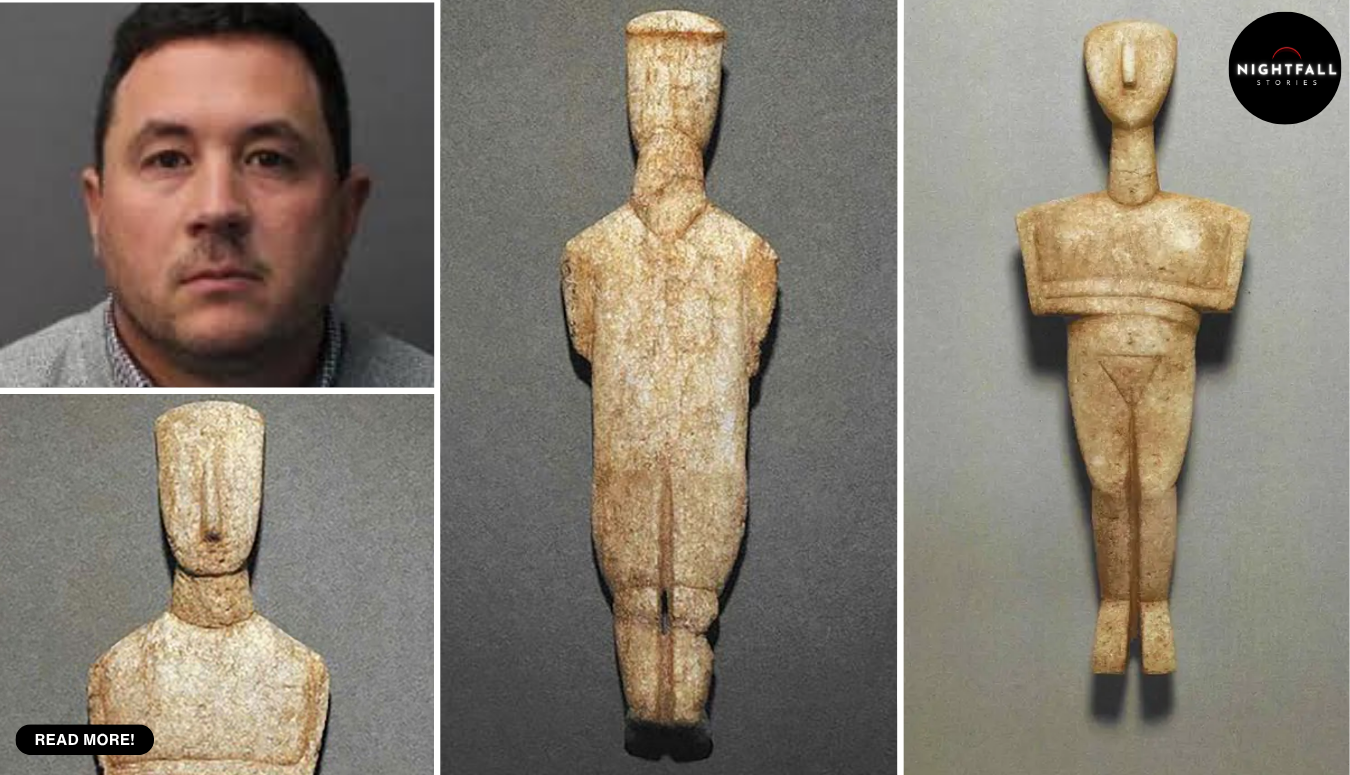
The three little marble figures were the easy part. They were about thirty centimetres tall, a kilogram each, pale and flat-faced and folded-armed in the way that has made Cycladic sculpture one of the most recognisable shapes in the ancient world. Anybody who has walked through a museum has seen something like them. They are the objects that look four thousand years old and somehow also look like they were carved last week by a very good modernist, which is exactly why people pay enormous sums for them.
What sank the whole thing was a folder of invoices.
A man had approached Sotheby’s in London saying he had inherited the pieces from his late grandfather, who had bought them back in 1976, and he had the paperwork to prove it. In the antiquities trade that paperwork is not a formality. It is the entire transaction. An unprovenanced ancient object is close to unsellable at a major house, because nobody can rule out that it came out of the ground illegally. A documented purchase history going back decades is what turns a stone figure into a lot number. Which is why, when people set out to defraud this market, they have learned to spend most of their effort on the documents rather than the objects.
There is a specific reason the date on those invoices was chosen. The market’s working convention treats 1970 as the line in the sand, the year of the international convention on the illicit trade in cultural property, and objects that can be shown to have been out of their country of origin and in private hands before that point are far easier to sell than objects that cannot. A purchase documented in the mid-1970s from an established dealer is close to the ideal story. It is recent enough for records to plausibly survive and old enough to sit on the comfortable side of everyone’s compliance policy.
He had spent a lot of effort. The invoices named a real dealer, a genuine London firm, with an embossed company logo at the top. They were dated to a year that sat comfortably on the right side of the market’s ethical cut-off. They named an address in central London. They carried the name of a grandfather.
The researchers at the auction house read them anyway, and two things did not survive the reading. The letters had been printed by a machine, not typed, and the printing technology involved did not exist in the mid-1970s. And the typeface, the actual shape of the letters on the page, had not been designed until 2001, twenty-five years after the documents were supposedly written.
Then there was a third detail, and it is the one that stays with you. The embossed logo of the dealership, the raised mark that is meant to say this is a real company with a real stamp, had not been embossed at all. Somebody had drawn it by hand.
The man was Andrew Crowley, in his mid-forties, from Longwell Green, near Bristol in the west of England. He had contacted the auction house in 2022. By October of that year the house’s own due diligence team had flagged inconsistencies in both the sculptures and the documentation, and rather than take the commission and let the problem become somebody else’s, they called the police.
It is worth sitting with that decision for a moment, because it runs against the lazy assumption people hold about auction houses. A specialist department is measured on what it brings in. Three Cycladic figures with clean-looking 1970s paperwork is a good week. Turning it away and calling the police is a worse week, and the house did it anyway, and that choice is the reason the rest of this story exists.
What followed was the kind of investigation that almost never gets written about, because it involves no chase and no dramatic raid. The Metropolitan Police’s Art and Antiques Unit, a small specialist team, worked the paperwork. Detective Constable Ray Swan led the case. The forensic question, essentially, was when could this piece of paper have been made, and answering it meant going after the font and the printing method. Officers worked with the FBI in New York on the typeface analysis. The answer came back unambiguous.
The Art and Antiques Unit is a genuinely unusual outfit. It is tiny, it has been repeatedly reported to be under resource pressure over the years, and its caseload covers everything from stolen paintings to looted archaeological material passing through one of the largest art markets on earth. Most of what it does is paperwork and relationships, and most of its wins look like this one: not a recovery, but an interception.
Researchers also went looking for the grandfather. The invoices gave a London address from which the purchase had supposedly been made, and the records showed no John Crowley registered there in the relevant period. The man on the paperwork, the one whose collection was supposed to explain how three Bronze Age figures came to be sitting in a house in the English west country, could not be placed at the address where his own documents said he had been.
The dealership named on the invoices was K.J. Hewett Limited, and this is where the scheme reveals a certain amount of homework. Kenneth John Hewett was not invented. He was a real and well-connected London dealer who started out as a bookseller, bought a small shop in Richmond after the war, and later moved to Sydney Street off the King’s Road. He dealt in antiquities and ethnographic art, and he moved in the highest circles of the trade, doing business with Sotheby’s own chairman Peter Wilson and with the dealer John Hunt, and counting the collectors Robert and Lisa Sainsbury among his friends. Objects that passed through his hands sit in serious collections today.
Using his name was clever for the obvious reason. Hewett is exactly the sort of figure whose 1970s paperwork ought to exist, whose stock ought to have included pieces like this, and who is no longer alive to be asked. It is also, from the point of view of everyone who works in this field, a fairly ugly thing to do to a dead man’s reputation.
A stargazer, for anyone who has not met the term, is a small carved marble figure from Anatolia with a tilted head and an upturned face, hence the name. Like the Cycladic figures they are ancient, abstract, instantly legible to a modern eye, and fiercely contested in ownership terms. It is a very short list of object types that combine that much desirability with that much documentary murk, and this case involved two of them at once.
Crowley was arrested on the street outside Sotheby’s premises on New Bond Street in Mayfair in the summer of 2023, having come back to the building. He pleaded guilty to fraud by false representation early in 2026, and he was sentenced at Southwark Crown Court in London a few months later.
Here is where the story needs to be told precisely, because it has been reported loosely. He was not jailed. The sentence was two years’ imprisonment suspended for two years, together with two hundred hours of unpaid work and an order to pay costs of roughly two thousand dollars. A suspended sentence means the prison term hangs over him and activates if he offends again during that period. He walked out of the building.
The value figures deserve the same care, because the court did not accept the number the prosecution opened with. Prosecutors put the potential value of what he was trying to sell at up to around 650,000 dollars. The judge worked from a lower figure, closer to 450,000 dollars. The auction house disputed the higher valuation and has indicated that it did not originate with them. Nothing was ever sold and no buyer ever lost money, which is a large part of why the sentence landed where it did.
There is one further wrinkle worth flagging rather than smoothing over. The police account of the case describes three Cycladic figures. Reporting on the court proceedings also refers to an Anatolian stargazer statuette, a different and similarly coveted type of small carved figure, offered alongside them with the same forged provenance. The two accounts are not in conflict so much as differently scoped, and the safest description is three Cycladic figures at the core of the case, with a fourth object mentioned in the court reporting.
What the court did not establish, and what nobody has claimed in public, is who actually made the figures, or who physically produced the documents. Crowley admitted representing them falsely. That is the offence he pleaded to and the only thing the record supports. Whether he carved them, commissioned them, bought them believing something else, or acquired the paperwork from somewhere upstream is not something the case determined, and it would be wrong to write it as though it had.
It also bears saying that the sentence sits within a pattern that frustrates a lot of people who work in this field. Art and antiquities fraud is expensive to investigate, slow to prosecute, and tends to produce sentences at the lighter end, partly because the loss is often prevented rather than realised, and partly because courts weigh it against violent offending. Three and a half years passed between the arrest and the sentencing.
The reason this matters beyond one man in one courtroom is that it is a small, unusually clear picture of how the antiquities market actually protects itself, which is not the way most people assume.
Cycladic figurines come from the islands of the Aegean, and the classic folded-arm type belongs to roughly the third millennium BCE. They were carved from marble, most of them modest in scale, though a handful approach life size. They turn up overwhelmingly in burial contexts, and some of them show signs of having been repaired while they were still in use, which tells you they mattered to somebody while that somebody was alive. They are also, by the honest admission of the field itself, a catastrophe of documentation. The great majority of the ones in circulation were taken out of the ground without any record of where they came from, which means scholars are largely studying objects stripped of the one piece of information that would tell them the most.
That combination, enormous desirability and almost no reliable archaeological context, is precisely the gap a forger works in. If nobody can say where a real one came from, the story attached to a fake one is harder to disprove. The only defence left is the paper.
So the people who catch this are not detectives in the conventional sense. They are provenance researchers, and the work is dull in the way that genuinely skilled work often is. You read a document and you ask whether every single element of it could have existed on the date it claims. You check whether the named person lived at the named address. You compare the letterhead against known examples. You find out when a font was released.
Angelina Giovani-Agha, a provenance specialist who commented on the case, made the point that the market cannot lean on the police to clean up afterwards, and that the value of provenance research lies in stopping fraudulent material before it enters circulation at all. That is not a small distinction. Once a forgery is sold at a major house, it acquires exactly the thing it was missing, which is a real, verifiable, documented sale history. It becomes legitimate by having been sold. Every later owner inherits the lie in good faith, and unwinding it can take decades, if it happens at all.
In this instance the material never got in. The figures were never catalogued, never estimated in a printed sale, never bid on. The chain stopped at the front desk because somebody whose job is to be sceptical about paperwork did that job properly, at the cost of the commission the house would have earned had they simply believed him.
The Met’s own assessment of the case emphasised the cross-border cooperation involved and the harm prevented to the London art market, which is exactly the right frame. Nobody recovered a stolen masterpiece. Nobody was rescued. What happened is that a fraud that had clearly taken months of preparation was stopped at the moment it tried to convert into money, and the person who tried it now has a criminal conviction and a suspended sentence attached to his name in a trade with a very long memory.
There is a quiet lesson buried in the forensics, and it is not the one about ancient art. It is about how documents fail now. A forger in 1976 forging a document from 1946 had to worry about paper and ink and typewriter keys, and a careful one could get very close. A forger today forging a document from 1976 is fighting a much harder battle, because the file they typed it in carries a typeface with a release date, and their printer leaves a signature, and both of those facts are knowable by anybody who thinks to ask. The objects can be aged. The paperwork cannot lie about the technology that made it.
The three figures sat at the centre of a story about a grandfather who bought beautiful things half a century ago, and the story was warm and plausible and entirely defeated by the shape of the letter A.