For about a year and a half, a man in his mid seventies divided his attention between a film laboratory in the north of Italy and a slope of bare volcanic rock below a fort in the Indian desert.
In Bologna, technicians were working through a 16mm negative he had shot in 1989. The inspection report on it read like a list of everything that can go wrong with film: perforation damage, tears, scratches, shrinkage, mould, halos. Colour had drained out of whole sections. The sound carried significant electrical noise, distortion, gaps and a great many drops. On the rock in Jodhpur, he was looking after a park that had not existed when he stopped making films, because he had built it, species by species, out of a hillside nobody had wanted.
The man is Pradip Krishen. He made three feature films and then he stopped, and the second thing he did with his life turned out to be the thing he is now known for. That is the part of this story worth sitting with. Plenty of people quit something they were good at. Very few of them go on to write the standard reference work in an unrelated field.
He was born in New Delhi in 1949 and educated at Mayo College, then St Stephen’s College in Delhi, then Balliol College at Oxford. In 1972 he took a temporary lectureship in history at Ramjas College in Delhi University, and then an MPhil at Jawaharlal Nehru University, where by his own later account the academic history on offer failed to hold him. He drifted toward film instead, which in the Delhi of that period was not an industry so much as a small circle of people who knew each other.
His first feature, Massey Sahib, came out in 1985. His third, Electric Moon, in 1991. The one in between is the one that would not go away.
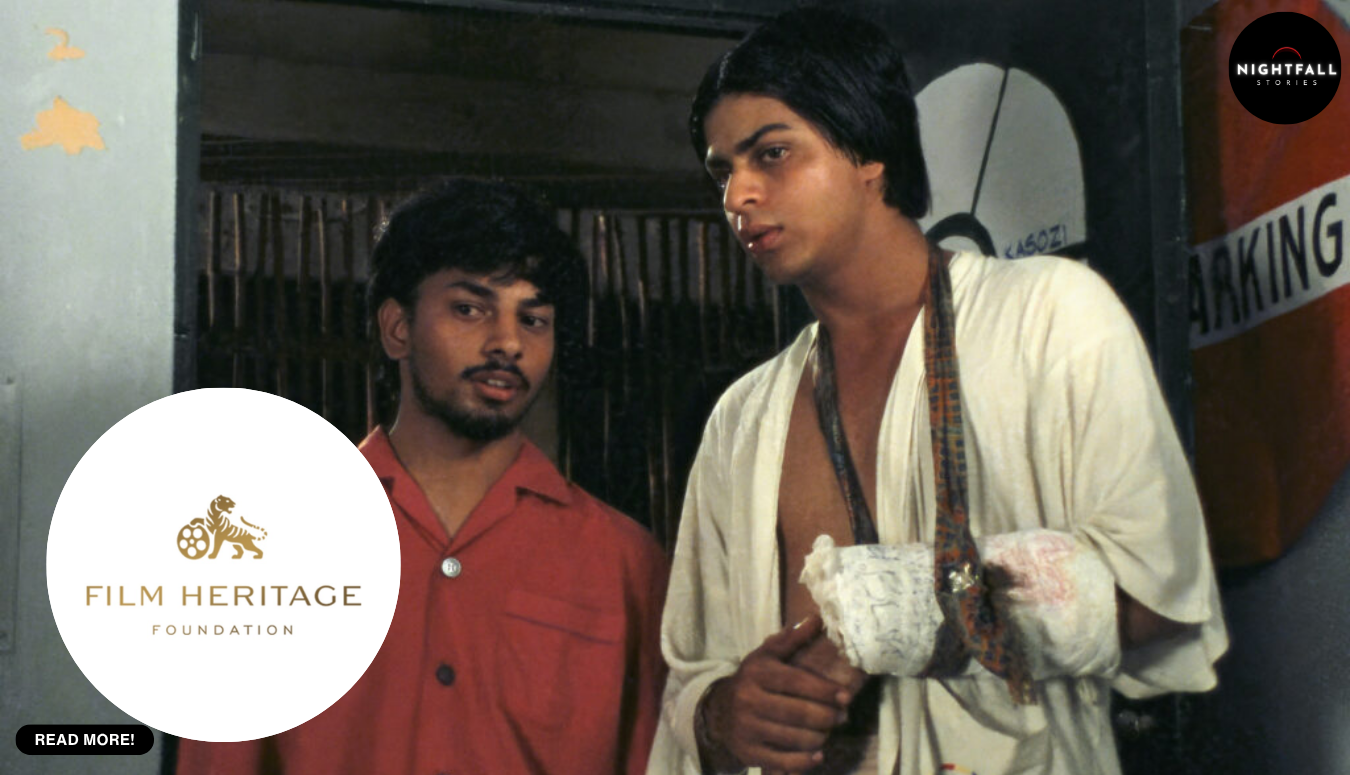
In Which Annie Gives It Those Ones was made for Doordarshan, the Indian state broadcaster, and it is set in the 1970s inside a fictional architecture college in Delhi called the National Institute of Architecture, modelled closely on the real School of Planning and Architecture. It follows a group of final-year students: hostel life, unfinished thesis projects, the small cruelties of academic authority, and the specific way a certain kind of student talks when he is nineteen and convinced he can fix the country. The title comes from the main character’s habit of giving it those ones, which is the film’s phrase for his unworkable schemes to put architecture to some grand social use.
Annie himself, whose real name in the film is Anand Grover, was played by Arjun Raina. Roshan Seth played the college principal. The cast also holds some very early screen appearances by actors who later became enormously famous in India, including Shah Rukh Khan in a small part as a senior student, which is the kind of detail that makes a lost film into a rumour.
The screenplay was by Arundhati Roy, who was 28 at the time and had herself studied at the School of Planning and Architecture. She was not then a writer anyone had heard of. She also appears in the film as Radha, an independent and nonconformist friend of Annie’s, and she is credited with the production design on top of that. She was married to Krishen when the film was made, which is the straightforward reason a first-time screenwriter was writing for this particular director, and it is the only thing about either of their private lives that belongs in this story. Years afterwards she published a novel that made her internationally known, which is why most people now come to this film through her name rather than his.
At the National Film Awards, the state film prizes, the film took Best Feature Film in English for Krishen and Best Screenplay for Roy. The year attached to it reads differently in different records, because the Indian awards for one year’s films are handed out in the following one. Either way, it was honoured by the national jury.
And then it went away. Doordarshan broadcast it once, late at night, and that was essentially the end of it. There was no theatrical release. The original print was lost. What survived in public was videocassette recordings taped off that single broadcast, copied and recopied and eventually digitised and put on the internet, and for close to four decades that degraded tape was the only way anyone saw it. Krishen himself has described it as a film that virtually went underground. Its reputation grew roughly in proportion to how hard it was to see, which is what reputations do.
He stopped making films in the first half of the nineties. The exact year is recorded inconsistently, somewhere around 1994 or 1995, and the reason he has given himself is not the one you might expect. He did not describe it as failure or as a quarrel with anybody. He said he wanted to do something internal and meditative and small, something that was not about projecting anything to anyone. Film-making had become, in his telling, simultaneously too crowded, full of collaborators who took something away rather than adding to it, and extremely lonely. One summary of his life attributes the departure to corruption in the industry, but that framing does not appear in his own extended account of it, and his own account is the one to trust.
What he did instead was learn plants, from nothing, with no botanical training of any kind. A colleague who worked with him later put the starting point memorably: at the beginning, Pradip knew exactly one tree, and it was mango.
His method was stubborn and unglamorous. He worked from Dietrich Brandis’s The Forest Flora of North-West and Central India, a reference book published in 1874, and he annotated his copy relentlessly, inventing his own system of symbols for leaf characteristics so he could find his way back through it. He has said the work requires a certain obsessiveness, and a willingness to keep pushing when a fog of incomprehension is sitting in front of you and nothing is resolving into sense yet. That is a precise description of self-teaching, and it is the opposite of a hobby.
In 1993 he bought land with friends in Bariaam village near Pachmarhi, in the forested hills of central India, among them an architect named Golak Khandual, who had done the make-up on Annie four years earlier. He got involved in local heritage protection through a conservation trust, which pulled him into bureaucratic obstruction and then into litigation that was not resolved until 2012. The jungles around Pachmarhi became his classroom.
Thirteen years after he stopped directing, the field guide appeared. Trees of Delhi was published in 2006, and it did something field guides do not do, which is sell. Close to twenty thousand copies went out. If you want to identify a tree in Delhi, that is still the book you reach for. Jungle Trees of Central India followed in 2014, and it took him four years and thirty-seven trips into central India to finish, with two thousand copies ordered before it was even printed.
Somewhere in there, the Mehrangarh Museum Trust in Jodhpur asked him to do something about the ground around their fort, and this is the project that is hardest to picture from the outside and most worth picturing.
Mehrangarh is a fifteenth-century fort that sits on a great rise of rock above the city of Jodhpur, at the eastern edge of the Thar desert. The rock itself is volcanic, hard, fractured, and almost entirely without soil. Around seventy hectares of it below the walls had been quarried and dumped on for generations, and the whole slope had been colonised by Prosopis juliflora, a thorny mesquite shrub originally from Central America, known locally as baavlia, which grows in dense impenetrable thickets and chokes out everything native.
Krishen’s team did not clear it with machines, because machines on that ground would have destroyed the rock and the seed bank with it. They hired khandwaliyas, local rock chisellers whose traditional work is cutting stone, and had them take the mesquite out of the fissures in the volcanic rock by hand, root by root, so that the cracks survived. Then they put desert plants back into the same cracks: over eighty native species propagated in a nursery on site, raised in polybags under shade, planted out around the monsoon when there was a chance of rain. It took about seven years. The Rao Jodha Desert Rock Park opened to the public in 2011, and it now holds something in the region of two hundred and fifty native plant species. It is described as India’s first outdoor museum of desert plants.
It is important not to imagine a garden in the ordinary sense. There is no lawn. There are no rows. What is there is a hillside of stone that has been persuaded back into being a desert, with the plants growing out of the same cracks they would have grown out of before anyone interfered, and paths that let you walk through it and look.
Krishen is blunt about the distinction, and it is the single most useful thing he says. People think restoration means planting trees, he has said, largely because planting trees is what governments do. What restoration actually means is trying to return a landscape to something like what it was before it was damaged, which requires knowing what was there, what soil and shade and water each species needs, and what will simply die. At Jodhpur his team spent three years recording species, soil conditions and survival rates, and that record is what let them push survival above the sixty to sixty-five percent that counts as normal. He has also built or advised on gardens at Nagaur Fort, at the Calico Museum in Ahmedabad, on sand dunes near Jaipur, and at Sunder Nursery in Delhi, which is now one of the busiest public green spaces in the city.
That was the life the film came back into.
The Film Heritage Foundation, a Mumbai-based archive and restoration outfit run by Shivendra Singh Dungarpur, went looking for whatever survived. In January 2024 they acquired the director’s own materials, and in March 2024 those materials were moved to Mumbai. The 16mm original camera negative and the 16mm sound negative were preserved at the National Film Archive of India, under the NFDC. A 35mm release print was in the foundation’s own vaults. There were digital audiotapes of the whole film, and, remarkably, the surviving shooting script and dialogue script.
The foundation’s own account of the work reads like a condition report, and it is worth taking seriously as a piece of craft documentation rather than a press release. Everything listed at the top of this article came off that inspection. The negative went to L’Immagine Ritrovata in Bologna, one of the handful of laboratories in the world that does this properly, and the repair was largely manual: physically mending the film, then digital restoration, then colour grading, because the colour had to be judged rather than calculated. Krishen worked alongside the restorers throughout, which matters, because with a film this obscure there is nobody else alive who knows what it was supposed to look like. It took about a year and a half. The result is a 4K restoration of a film shot on 16mm for television.
It had its world premiere in the Berlinale Classics section of the Berlin International Film Festival, on a bill it would never have reached when it was new, and Krishen’s reaction was reported as straightforward delight that a film which had gone underground was being shown to the world on that kind of platform. He also made a point about why it had mattered at the time: nobody then was making films about people like them, about an English-speaking student subculture whose characters spoke their own patois. Dungarpur, for his part, has called it arguably the first English Indian film, irreverent and idiosyncratic. It went on to the New York Film Festival in the Revivals section, and it was reported as going out theatrically in India across fourteen cities and nineteen cinemas, which is more distribution than it ever had.
Here is the part that is almost too neat to be true, and is on the record anyway.
The daydreams that give the film its title, the ones Annie keeps giving it, are schemes for using architecture to improve the world. One of them, as the film has been described, is planting trees along the railway lines.
The student in that film was a joke about idealism, the sort of young man everyone has met who has a plan for the country and cannot finish his own thesis. The man who directed him walked out of cinema a few years later and spent the following three decades doing a rigorous, documented, unromantic version of exactly that fantasy: learning what grows where, and putting it back.
He did not need the film to return. He had the books and the park and a body of work that had nothing to do with anything he filmed. But it came back anyway, in better condition than he left it, and when the screenings in Berlin and New York were over he went back to the rock below the fort, where the plants are still in the cracks the khandwaliyas opened for them, and where the only thing that ever mattered was whether they lived.