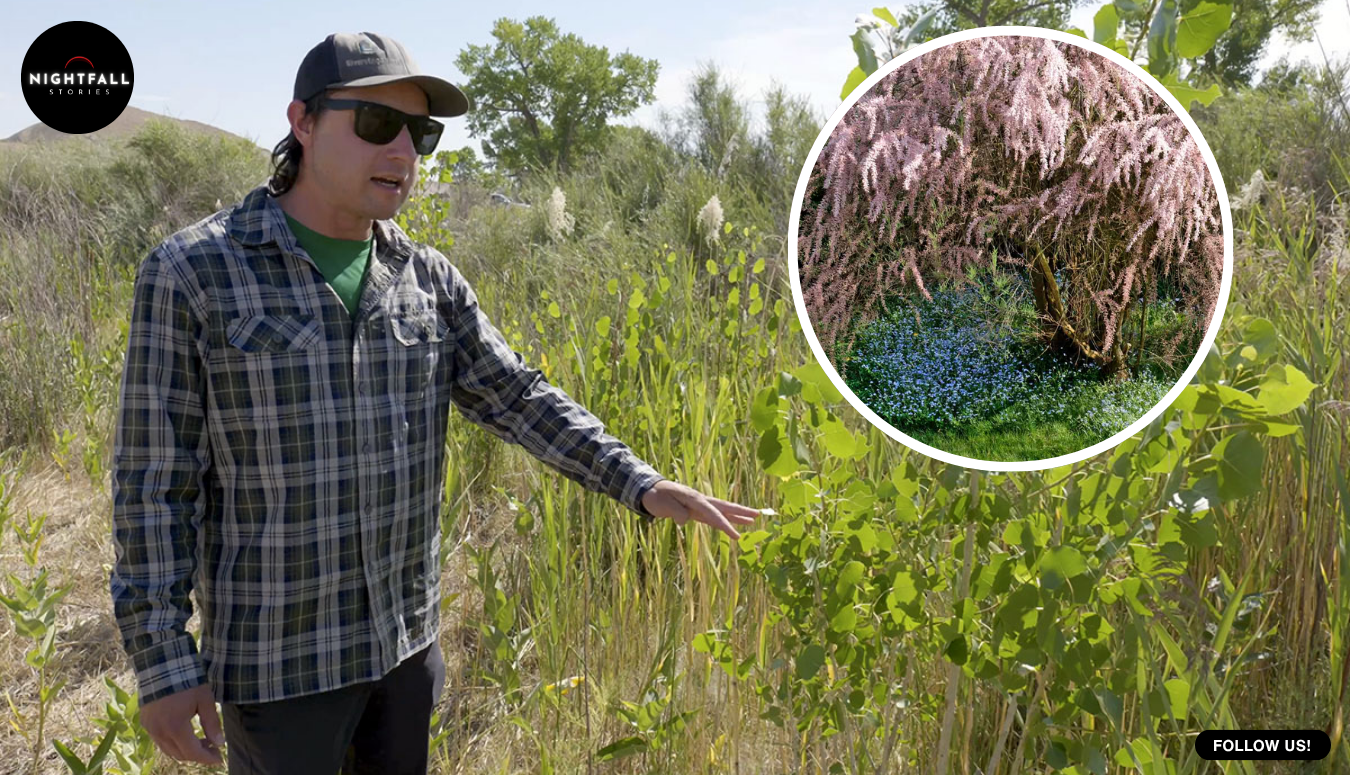
Last summer, on the bank of the White River in western Colorado, a man named John Leary spent his working days carrying water up a slope in a five-gallon bucket. The river was right there. The seedlings he was watering, a few dozen young cottonwoods, buffaloberry, sumac and woods’ rose, were a short climb above it. There was no pump, no tank, no irrigation line. There was a bucket, a bank, and however many trips a person can make before the light goes.
Leary manages restoration and geographic information systems for RiversEdge West, a Colorado nonprofit that has spent decades trying to put native vegetation back along rivers across the American Southwest. He is, in other words, a professional with a mapping brief and two decades of institutional science behind him, and the most useful thing he could do with his summer was haul water by hand. That image is the end point of one of the largest deliberate releases of a foreign insect in the history of North American land management, and understanding how the two connect means going back about 25 years, to a number almost everybody believed and almost nobody had measured.
The plant at the centre of it is tamarisk, also called salt cedar, a feathery shrub native to Eurasia and Africa that was planted across the American West from the nineteenth century onwards to hold soil in place and break the wind. It did that, and then it did a great deal more. Tamarisk tolerates salt, tolerates drought, resprouts from the base when you cut it and seeds prolifically, and along rivers whose natural flooding cycles had been flattened by dams it outcompeted the native cottonwoods and willows almost everywhere it arrived. By the late twentieth century it dominated hundreds of thousands of acres of riverbank, and the question had stopped being whether to remove it and become how.
The answer everyone reached for was water. The figure that circulated in agency documents, newspaper stories and funding applications was that a single tamarisk drank around 757 litres a day, roughly 200 gallons, which made the plant sound less like a weed and more like a thief in a region where water is the only currency that matters. Kill the tamarisk, the reasoning ran, and the rivers would come back. It is easy, now, to be sniffy about that logic. At the time it was the consensus, and it had the enormous political advantage of turning an ecological problem into an arithmetic one.
So the research went ahead. The US Department of Agriculture’s Agricultural Research Service had been working on a leaf beetle from Central Asia that eats tamarisk and, as far as the host testing could establish, essentially nothing else. The regulator inside the department, the Animal and Plant Health Inspection Service, issued an environmental assessment in early 1999, found no significant impact that July, and permitted releases into sealed field cages the same month. Two years of cage monitoring followed at ten sites. Then, in 2001, the agency issued permits to let the beetles out of the cages.
They went out that spring across six states. The published release figures are precise and surprisingly small: around 27,000 adults and larvae at Lovell in Wyoming, 15,000 at Delta in Utah, 6,900 plus larvae near Pueblo in Colorado, 3,500 at Schurz and 1,400 at Lovelock in Nevada, several thousand at Bishop in California, and fewer than 500 adults near Seymour in Texas. The insects had been collected from around the forty-fourth parallel at Fukang in China and Chilik in Kazakhstan, chosen because beetles from that latitude would read a northern winter correctly and not try to breed into the frost. The two Agricultural Research Service scientists most publicly associated with the work were C. Jack DeLoach in Texas and Raymond Carruthers in California, and the departmental announcement at the time was straightforwardly hopeful.
What happened next is the part everyone involved agrees on. The beetles worked. They worked better than their own advocates had expected. From about five hectares, a dozen acres, by the end of the following year, the defoliated area ran to hundreds of hectares the year after that and several thousand the year after that, and kept going. Researchers who had spent years on the host-specificity work have since said plainly that they had not thought of these as insects that would take off. The beetle now shows up from Chihuahua in northern Mexico to California, Oregon, Idaho, Wyoming and Kansas. By the measure written into the original proposal, which was whether a released insect would establish itself and eat tamarisk, the programme is one of the more emphatic successes in the field.
Almost none of the benefits followed.
Start with the number. In 2007, two rangeland scientists, Keith Owens, then at Oklahoma State University, and Georgianne Moore at Texas A&M, published a short paper in the journal Rangeland Ecology and Management with the title Saltcedar Water Use: Realistic and Unrealistic Expectations. Their conclusion was that the figure everyone had been using was far too high. A realistic number, they found, was something closer to 122 litres a day, about 32 gallons, which is roughly what a cottonwood or a willow of comparable size uses. The plant the whole programme was built to remove was not, it turned out, drinking meaningfully more than the plants the programme wanted to replace it with. The water saving at the heart of the case was largely arithmetic that had never been checked.
That single correction does a lot of damage on its own, but there is a deeper problem underneath it, and it is the thing worth understanding properly. The rivers of the American Southwest are not dry because of a shrub. They are dry because they are dammed, diverted, drawn down for farms and cities, allocated on paper in quantities that exceed what falls from the sky, and running through a region in prolonged drought. A river that has been promised to more people than it can supply does not refill when you kill the vegetation on its banks. Removing tamarisk cannot return water that was never going to be in the channel. The intervention was aimed at the last thing in the chain rather than the first, which is an extremely human way to approach a problem that has powerful people at one end and a defenceless plant at the other.
The die-off figures did not hold up either, though in a more interesting way. The expectation written into the programme was that up to 85 percent of tamarisk would die. Dan Bean, who runs the Colorado Department of Agriculture’s insectary at Palisade and has monitored the beetles since the beginning, has found something considerably less dramatic. What the beetles tend to do, on his account, is cut the tamarisk in a river’s canopy by about half, leaving some trees dead and many alive but ringed with dead branches, a condition the people who work on it describe as haloed. And here is the honest part, which Bean himself concedes: nobody has produced an accurate measurement of the overall die-off, because the invasion covers too much ground to survey properly. The headline finding, a quarter of a century in, is that the scale of the effect is unknown. That is less satisfying than a number and considerably more truthful.
Then there is the bird. The southwestern willow flycatcher is a small, drab, federally endangered songbird that nests in dense riverside thickets. Where the native thickets were gone, which was most places, it nested in tamarisk. At Mormon Mesa in Nevada, one of the sites in the beetle’s early path, the ecologist Sean Mahoney, now at the University of North Carolina Wilmington, documented songbird communities in the tamarisk stands and found diversity roughly equivalent to what the cottonwood and willow stands supported. The beetles reached the site in 2006. When environmental consultants went in looking for flycatchers in 2013, and again the following year, they found none at all. The birds were simply not there any more.
It is important to be careful here, and the people who study it are careful. The flycatchers vanished after the beetles arrived. That sequence is documented. It is not the same as proof that the beetles caused it, and nobody has established causation at Mormon Mesa to the standard a scientist would want. Drought, river management, fire and the ordinary volatility of a tiny population are all in the frame. What can be said is that a federal agency licensed an insect to destroy the nesting material of a species another federal agency had listed as endangered, and that at the one site where somebody had bothered to count the birds beforehand, the birds subsequently went.
The regulator did not ignore this. In mid-2010, the Animal and Plant Health Inspection Service terminated the saltcedar biological control programme outright. A memorandum signed by the director of its invertebrate and biological control programmes ended the work in 13 states, cancelled every active permit for interstate movement and environmental release, stopped issuing new ones, and prohibited further releases from cages or field sites. The stated reason was concern about effects on the critical habitat of the endangered flycatcher. The same memo warned that moving the beetles without authorisation could violate both the Endangered Species Act and the Plant Protection Act, with penalties reaching $250,000 per violation. Nine years after the government set the insect loose, it made moving the insect a potential federal offence.
That was not the end of it. In late 2013 the Center for Biological Diversity sued the Department of Agriculture, the Department of the Interior and the Fish and Wildlife Service in federal court in Nevada. The suit’s complaint is pointed in a way that is easy to miss: the challenge was not simply that the agency had released the beetle, but that it had shut the programme down without taking remedial action for the habitat the beetle had already stripped. Walking away, the argument went, was its own failure. In May 2016 the court granted one of the group’s five claims, finding that the inspection service had not complied with the section of the Endangered Species Act that requires federal agencies to use their programmes to conserve listed species. A further opinion on what the agency actually had to do followed the next year. The judge’s direction was for more monitoring and more restoration.
Today the department’s public guidance is brief and slightly extraordinary to read. Permits for moving tamarisk leaf beetles across state lines have been discontinued, so moving one may violate the Plant Protection Act. Releasing the beetle, the page says, may harm habitat critical to the flycatcher and other native wildlife. Below that sits the statutory penalty schedule: a maximum of $1,100 for a first non-commercial violation by an individual, $60,000 for subsequent violations or for any violation involving financial gain, and $300,000 per violation for a company. The page was last revised partway through last year. It is worth being exact about what this is and is not. These are the maximum civil penalties available under the statute, published as a warning. There is no public record of anybody being fined $60,000 for moving a tamarisk beetle. But the government that imported the insect, bred it, permitted it and released it now lists the price of handling it.
The record-keeping has wound down too. For nearly 20 years, RiversEdge West maintained a tamarisk beetle distribution map, assembled with more than 70 partner organisations and built in large part on the fieldwork of Levi Jamison, a biologist who spent 13 years, from 2006 to 2019, surveying the Colorado, Dolores and San Juan rivers from a boat. He stopped every 1.6 kilometres, a mile, on journeys that ran as far as 724 kilometres, counting eggs and adult beetles and estimating how much of the canopy had been stripped. That data became the reference every agency and nonprofit in the region used. The final map, released last year, holds more than 16,000 presence and absence records stretching from northern Mexico to the Pacific Northwest and the Great Plains.
There will not be another one. The reporting that brought this story to light says the department halted the funding for it. The organisation’s own public notice says something different and worth quoting fairly: it is pausing future map releases because the beetle is now thoroughly established and the map’s original purpose has been served. Both things can be true at once, and it is not obvious which is the more deflating. Either the money stopped, or the point of tracking an invasion stopped being the arrival of the insect, because the insect is everywhere.
What is left is people. Melissa Neubaum coordinates restoration for the same nonprofit and runs the field monitoring on the Dolores. Amanda Stahlke teaches biology at Colorado Mesa University and advises the organisation on the science. Tom Dudley at the University of California, Santa Barbara, has worked on these beetles for close to two decades. Anna Sher at the University of Denver has spent her career on riverside restoration. Dan Bean, who monitored the introduction from the start, is also the person whose own research undercut the forecast the programme was sold on, and that deserves saying plainly rather than as a gotcha. He did not have to publish findings that made the project he ran look less impressive. He did it anyway, and the field is better calibrated because of it. That is what the inside of a correction looks like when it goes right.
None of these people are villains, and the story reads badly if you try to cast one. Nobody falsified anything. The host testing was rigorous and the beetle has behaved as predicted towards other plants. The regulator responded to the flycatcher problem by stopping the programme, which is what a regulator is supposed to do. The conservation group sued because stopping was not the same as fixing. The court agreed. Every individual step is defensible, and the aggregate is still a river with less tamarisk on it, no more water in it, and one fewer endangered bird at the site where anybody was counting.
The useful lesson is narrower and harder than the one that usually gets drawn from stories like this. It is not that biological control is reckless. It is that an intervention can succeed completely at its literal task and fail entirely at its purpose, if the link between the task and the purpose was assumed rather than measured. The beetles were asked to eat tamarisk and they ate tamarisk. They were never actually capable of delivering water, because the water was being taken somewhere else by people with lawyers.
Which brings it back to the bucket. Researchers in other countries dealing with their own tamarisk invasions are now testing mealybugs, moths and midges as possible control agents, and when that comes up with Leary his reaction is not the scepticism you might expect from a man who has watched one insect solution play out over 25 years. He is interested. He would take the help. He has a riverbank to plant and not enough hands.
The beetles did their job. They were never a replacement for the work, which still gets done by hand, one bucket at a time, by somebody who has read all the studies and goes down to the water anyway.