Category: Animals

  • A hidden camera watched a moorland roost for nineteen days. The telling part was which bird the men decided not to shoot

    A hidden camera watched a moorland roost for nineteen days. The telling part was which bird the men decided not to shoot

    The camera was already in the heather when the three men arrived. It had been there since the start of the month, pointed at a hen harrier roost on a grouse moor inside the Yorkshire Dales National Park, recording sound as well as pictures, left by the investigations unit of a bird charity that had spent years knowing what happened on moors like this one and almost never being able to prove it.

    On an evening in early October, two years ago now, it recorded three men walking in at dusk. Camouflage. A semi-automatic weapon and binoculars. Radios, which they used to coordinate their positions around the roost, and which meant the microphone picked up what they said to each other while they waited.

    What they said is the reason this case eventually mattered. At one point a satellite-tagged harrier came in. The men identified it as tagged, and the conversation on the recording turns to the consequences of killing a bird that is being tracked, specifically that a transmitter going dead on their moor would bring the authorities down on it. So they did not shoot that one. They used a local verb for what they did instead, flegging it, which means firing to frighten a bird off rather than to kill it.

    Then, according to the recorded evidence, they shot a different hen harrier. One without a tag. One whose death nobody would be notified about.

    That single decision, taken on a hillside by men who believed they were alone, is the most revealing thing in the entire record. It is not the behaviour of people who did not know the law. It is the behaviour of people who knew the law precisely, understood exactly which bird carried an evidential risk and which did not, and allocated their shots accordingly. Every satellite tag fitted to a harrier in the preceding decade had been, in effect, teaching them which birds to leave alone.

    Earlier this year, fifteen months after the recording was made, Racster Dingwall, thirty five, of Ellingstring in North Yorkshire, head gamekeeper on the Conistone and Grassington Estate, pleaded guilty at York Magistrates’ Court. The gap between the evening on the moor and the morning in court is not incidental. Covert recordings made by a charity rather than by police are not automatically admissible, and the defence challenged whether this material could be used at all. Working out whether the evidence would stand took longer than gathering it.

    The precise thing he admitted matters, and it has been widely reported loosely, so it is worth getting right. He pleaded guilty to two charges. The first was possession of an article capable of being used to commit a summary offence under the wildlife protection legislation. The second was encouraging or assisting the commission of a summary offence, believing that it would be committed, which is an offence under serious crime legislation rather than wildlife legislation.

    He did not plead guilty to killing a hen harrier. He was not convicted of conspiracy, despite that word appearing in some coverage. And the superlative attached to the case belongs to the second charge specifically: both the police and the charity describe this as a legal first in England, because the encouraging and assisting provision had not previously produced a conviction in a bird of prey persecution case there. That is a narrower claim than the first hen harrier case in England, and the narrower version is the one that holds.

    The penalty was eight hundred pounds, roughly a thousand dollars, described by the charity and by the farming press as the total of fine, prosecution costs and a victim surcharge combined. One specialist raptor crime blog, reading the court register, puts the components higher and totals them nearer nineteen hundred dollars, with a twenty five per cent reduction applied for the guilty plea. Either figure is small. Neither is in the same order of magnitude as what it cost to get there.

    Think about what that cost actually was. An investigations unit had to decide, in advance and on judgement, which roost on which moor in which month was worth covering. It had to get equipment in without being seen, leave it for nineteen days, retrieve it, process hours of footage and audio, identify a voice, build a file, hand it to a rural crime unit, and then defend the legality of the method in court against a challenge. The output of all of that was a financial penalty a reasonably paid professional could absorb without changing anything about their week.

    The charity’s head of investigations, Mark Thomas, called the conviction a landmark that had shone a light on the issue, which is the language of someone who understands that the deterrent here is not the fine. Howard Jones, a senior investigations officer, made the point more concretely: it was video evidence again that made the difference, as it has in previous cases. The value of the result is not the eight hundred pounds. It is the precedent that covert recording of a roost can survive a court and that a named individual can be convicted of helping a persecution offence happen rather than only of committing one.

    To understand why anyone would spend that effort on one bird, you need to understand why it is this bird. The hen harrier is a ground-nesting bird of prey that hunts low over open moorland, and its diet includes red grouse. Open moorland in northern England is also, in large part, managed to produce red grouse in shootable numbers, which is an industry with staff, leases, revenue and expectations. The result is that the harrier’s ideal habitat and the commercial grouse moor are the same landscape, and have been in conflict for well over a century.

    The bird has come close to being wiped out in England more than once. The population has spent decades at a level far below what the available habitat could support, and the gap between the two numbers is not explained by food, weather or disease.

    Which is where the satellite tags came in. Conservation bodies began fitting transmitters to young harriers, partly to learn where the birds go and partly because a transmitter produces a record. A tagged bird that dies of natural causes usually leaves a recoverable body and a last location that makes sense. What the programme kept producing instead was tags that stopped transmitting abruptly, in good weather, over or near managed grouse moor, with no body found. Enough of those, over enough years, stops looking like an accident and starts looking like a distribution.

    The tags were never meant to be a deterrent. They were meant to be evidence. But the recording from the Yorkshire roost shows what they became in practice, which is a sorting mechanism. A tagged bird is a liability. An untagged bird is not. The programme designed to document killing had the side effect of advertising which killings would be documented.

    There is a coda to that, and it is bleak. The tagged harrier the men chose not to shoot was a young bird that had fledged from a nest in the Forest of Bowland only about three months before that evening. It was flegged off the roost and it flew away. Roughly three months after that, it was found dead near a different Yorkshire grouse moor, illegally poisoned with a mixture of agricultural and veterinary compounds that investigators have encountered often enough in that part of England to have given it a nickname. Police investigated. Nobody has been charged in relation to it.

    So the calculation on the hillside was correct right up until it was not. Avoiding the tagged bird did protect that particular moor from scrutiny. It did not protect the bird, which simply died somewhere else, and in a way that produced a body, a toxicology report and no defendant.

    It is worth resisting the urge to tell that part as a tragedy with a character in it. The bird was not spared and it did not escape. It was assessed as an evidential risk, declined on that basis, and killed later by someone else. That is a description of a system, not a story about a creature’s luck, and the system is the thing worth being angry about.

    Two other men walked onto that moor. Both were interviewed. According to the published account of the case, both declined to answer questions, which the specialist commentary attributes to a concern that voice analysis might match them to the audio. Neither was charged. That is a lawful and entirely predictable outcome, because a recorded voice without a reference sample is not an identification, and silence in an interview is the obvious response to evidence that consists mostly of talking.

    It also means the case ends with one conviction out of three men present, which tells you something about the ceiling on this kind of enforcement even when it works. Covert recording solved the problem of nobody being there to witness the offence. It did not solve the problem of attributing a voice to a face.

    The charity used the result to repeat a demand it has made for years, which is that grouse shooting should be licensed. The argument is structural rather than moral: individual prosecutions punish individual employees, usually the person holding the gun, and leave the commercial arrangement that employs them untouched. A licensing regime would attach a consequence to the business. Scotland legislated along those lines a couple of years ago, creating a framework under which an estate can lose its permission to shoot where there is evidence of raptor persecution, and the charity points at that as the model England has not adopted.

    The counter-argument from shooting and gamekeeping interests is worth stating straight rather than caricaturing, because it is not a stupid one. It runs that criminals exist in every trade, that the overwhelming majority of gamekeepers do not shoot protected birds, that collective licensing punishes the compliant alongside the guilty, and that moorland managed for grouse supports waders and other ground-nesting species that do badly where management stops. In this instance, though, there was no immediate response from the estate or from shooting organisations when the conviction was reported, so the argument has to be taken from the general case rather than from anyone’s statement about this one.

    What is not in dispute is the mechanism that produced the result. For as long as anyone has been trying to enforce wildlife law on open moorland, the obstacle has been geography. These are large, private, unpeopled landscapes where an offence takes a few seconds, leaves almost nothing, and has no witnesses by design. Police cannot patrol them. Ramblers do not walk them at dusk in October. There is a reason the camera was on a roost and not on a nest, too. A nest is a few weeks of the year, it is usually already known about and often already watched, and anyone intending harm knows that a nest site attracts attention. A communal roost is different. Harriers come back to the same patch of rough ground to sleep, night after night, outside the breeding season, in the months when nobody is monitoring them. It is a predictable gathering in an unwatched place, which makes it the most efficient spot to kill several birds and, for exactly the same reason, the most efficient spot to put a camera. The nineteen days the equipment sat there were not a fishing expedition. They were a bet on a known habit.

    A camera in the heather is not a clever trick. It is the only available answer to a place where nobody is looking.

    And the thing that camera caught was not a man who thought the rules did not apply to him. It was three men, on a radio, applying the rules with care, working out exactly how much enforcement existed and then operating inside the margin. One of them is now a convicted man roughly a thousand dollars poorer. The margin is still there. What changed is that somebody finally proved it was being measured.
  • The eagle arrived with lead in its blood and shotgun pellets in its chest. The first operation was not the hard part

    The eagle arrived with lead in its blood and shotgun pellets in its chest. The first operation was not the hard part

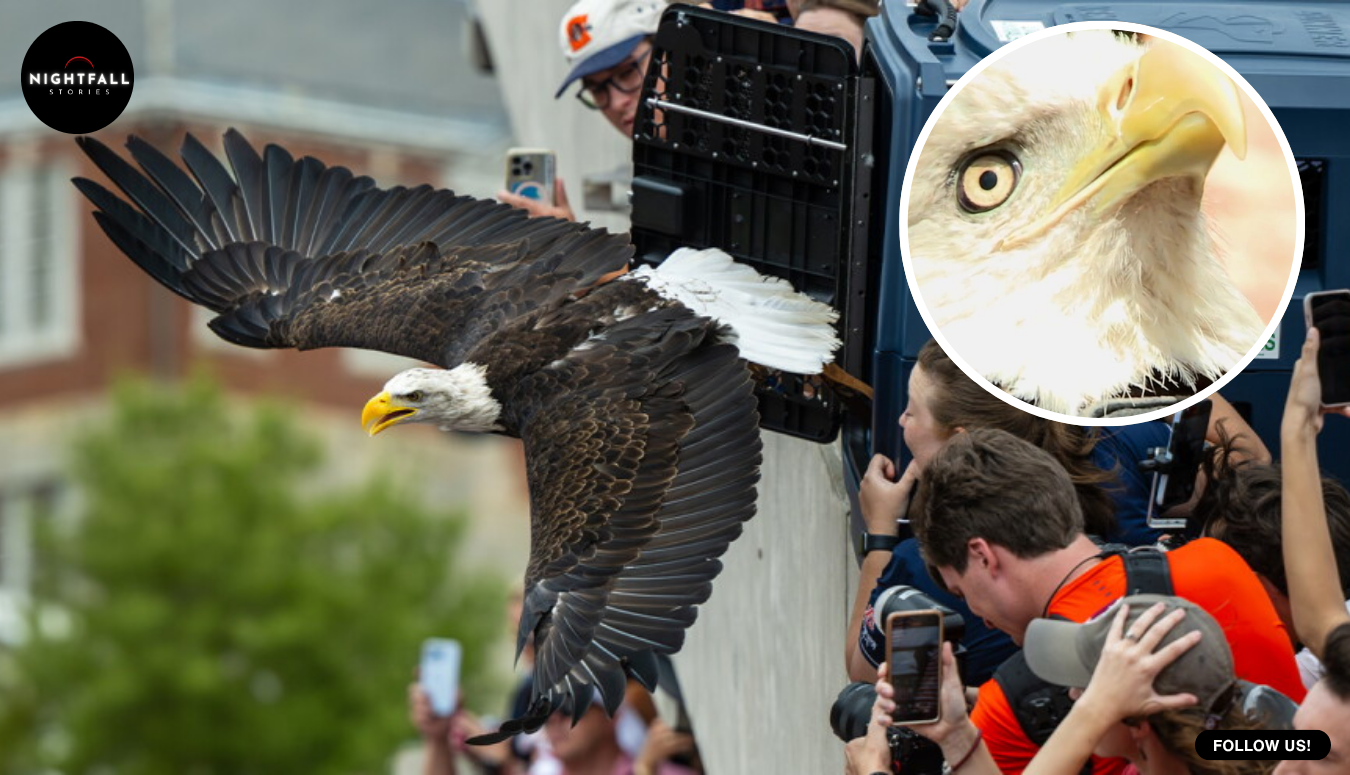
    A bald eagle was found on the ground near Prattville, Alabama on the last day of the year, unable to get back into the air. When it reached the raptor hospital at Auburn University it had two fractures in one wing, shotgun pellets lodged in its wings and chest, and a dangerous level of lead in its blood. Eight months later it was carried back out to a managed pine forest about ten miles from the spot where it was picked up, and it flew.

    The ten miles is the detail worth holding onto, and the eight months is the part people underestimate. Between those two facts sit two surgeries, months of physical therapy several times a week, and one piece of very bad news that arrived after everyone had already decided the bird was going to make it.

    One caveat belongs up front rather than buried, because readers deserve it. Nearly everything documented about this case comes from Auburn University itself, in a feature its own communications office published about its own hospital. A regional television station in Alabama reported the release at the time, which puts an independent eye on the fact that a bald eagle was let go, but the clinical account is single-sourced to the institution that treated the bird. No independent veterinary record, no wildlife-agency case file and no investigation document has been published. The people are named and their roles are checkable, the hospital is real and long-established, and nothing in the account is implausible. But it has not been corroborated in detail by anyone outside Auburn, and this piece will not pretend otherwise.

    With that said, here is what the hospital says happened, and why the hard part was the second operation rather than the first.

    The veterinarian on the case was Amberly Sokoloff, at Auburn’s Raptor Center. The first surgery addressed the two wing fractures, which is the kind of work a raptor hospital does often and does well. Fixing a bird’s wing is not like fixing a dog’s leg, and the difference is not sentimental. A dog that heals with a slightly crooked front leg limps, and then lives a full life limping. A bird that heals with a wing a few degrees out of true cannot fly, and a bald eagle that cannot fly cannot hunt, cannot hold territory and cannot be released. There is no version of a wild raptor that gets by with reduced performance. The margin is absolute, and that is why wing orthopaedics in birds of prey is one of the less forgiving corners of veterinary medicine.

    The surgery worked. Then the wing refractured during recovery, and the bones began knitting together in the wrong configuration, fusing in a way that threatened the bird’s ability to fly at all. That is a materially worse problem than a clean break. A fresh fracture is a known quantity with a known procedure. A healing error means going back into a wing that has already been operated on once, taking apart what the body has built, and getting a second shot at alignment with less to work with than the first time. Sokoloff operated again.

    The centre’s director, Robyn Miller, has described the recovery as long and grueling, which is not promotional language and is probably the most useful summary available. The physical rehabilitation ran two to three times a week over months. For a raptor that means controlled flight work: the bird has to rebuild the specific muscles, the range of motion in the repaired joint and the stamina to carry its own weight for a sustained period, and all of it has to be assessed by people who can tell the difference between a bird that is flying and a bird that is getting away with it. A rehabilitator watching an eagle cross a flight enclosure is reading wingbeat symmetry, height held, and whether the animal can still do it on the fourth pass. There is no self-reporting from the patient. There is only what the handlers can see.

    Then there is the lead, which is the part of this story that is much bigger than one bird.

    Auburn says the eagle’s lead levels were dangerous on admission. No figure has been published, so no figure belongs here. What can be said, on the record of institutions that study this specifically, is how widespread it is. The Raptor Center at the University of Minnesota, which has built a long-term dataset by testing every eagle it admits, reports that between eighty and ninety percent of the more than 150 bald eagles it takes in each year show some lead in their blood, and that between a quarter and a third have documented lead toxicity. That is not an occasional accident. That is a background condition of being a bald eagle in North America.

    The mechanism is the part most people do not know, and it is not shooting. Lead rifle bullets and lead shot fragment violently on impact, breaking into hundreds of pieces that spread well beyond the wound, by the Minnesota centre’s account up to about eighteen inches from it. Hunters field-dress deer and leave the gut pile behind, or an animal is wounded and never recovered, and in winter a carcass on open ground is exactly what a scavenging eagle is built to find. The bird swallows soft lead fragments along with the meat. Lead does not need to be a bullet to do harm; it needs only to be eaten. The Minnesota centre lists the effects, which include gastrointestinal and neurological damage, weakness and seizures, and notes that most seriously affected eagles either die or have to be euthanised. The solution it argues for is narrow and practical: non-lead ammunition, which does not require anyone to stop hunting.

    So this eagle was carrying both routes at once. Pellets in its body from somebody shooting at it, and lead in its blood from something it ate. Those are two separate events, and the second one was probably not the fault of whoever fired the first.

    Treatment for lead in a bird of prey generally involves chelation, a course of drugs that binds the metal so the body can clear it, alongside supportive care while the animal is too weak to self-feed. Auburn has not published the specifics of what this bird received, so none are claimed here. The relevant point for the case is sequencing: a bird with a toxic metal load is a bird whose body is in no condition to heal bone, which means the lead has to come down before orthopaedic work has much chance of holding. Two problems arrived together and one of them had to be solved first.

    It is also worth noting how a grounded eagle gets to a hospital at all, because it is never the hospital that finds it. Somebody sees a large bird on the ground that should not be on the ground, and makes a call. In the United States handling a bald eagle, even to help it, requires federal authorisation, so the chain usually runs from a member of the public to a wildlife agency or a permitted rehabilitator, and then into a crate and a vehicle. Auburn’s own account of its caseload includes a golden eagle with lead toxicity that arrived in taped-up packing boxes, which tells you how improvised the front end of this system is. Every case in a raptor hospital starts with a stranger deciding not to drive past.

    Shooting a bald eagle is a federal crime. The Bald and Golden Eagle Protection Act prohibits taking the birds without a permit, and it defines taking broadly enough to cover shooting at one, wounding one, or simply disturbing it. A first criminal violation by an individual carries a fine of up to one hundred thousand dollars, up to a year in prison, or both, with a second offence treated as a felony. None of which is directly relevant to this case, because no investigation outcome, no suspect and no charge has been documented anywhere. Shotgun pellets is the hospital’s description of what was in the bird. Who fired them, when, and whether anyone ever looked into it is simply not on the record, and the honest thing is to say that once and move on rather than to build a crime story out of a silence.

    The last stage is the one nobody writes about, and it took real work: deciding where to put the bird.

    A rehabilitated raptor cannot be released wherever is convenient. It needs prey it can actually catch, cover, water, and ideally not an immediate fight with an established resident bird over the same airspace. Releasing a recovered eagle into good habitat that is already fully occupied is a slower way of failing. Stephanie Kadletz, the centre’s assistant director of raptor rehabilitation, ran the search for a site, and the person on the other side of that conversation was Preston Payne, a registered forester with Auburn’s College of Forestry, Wildlife and Environment, who manages the Autauga Experiment Forest.

    That property is a longleaf pine landscape, managed with prescribed burning and timber thinning in a way that keeps the understory open and supports the small mammals, the rodents and rabbits, that a predator needs. What that means in practice is two professionals reading the same stand of trees for different reasons and arriving at the same answer. A forester looks at burn history, canopy spacing and stand structure. A rehabilitator looks at whether a bird with a repaired wing can hunt there next week. Open, burned longleaf is good for an eagle for exactly the reason it is good for a woodpecker or a quail: you can see the ground, and things live on it.

    Longleaf pine is its own quiet comeback story sitting underneath this one. It was once the dominant forest across a vast sweep of the American Southeast, blanketing something like ninety million acres, and a combination of logging, land conversion and decades of fire suppression reduced it to a small fraction of that, bottoming out late last century. Restoration partners put the current figure at more than five million acres, roughly five percent of the historic range, rebuilt deliberately with fire as the main tool. A forest type that depends on burning is a hard sell in a culture that spent a century treating all fire as the enemy. The fact that there was a well-managed longleaf stand ten miles from where this eagle fell, with somebody employed to look after it, is a result of forty years of other people’s unglamorous work.

    The release happened in late summer, with the forester, the rehabilitators and the veterinary staff present. The bird left the crate, flew to a longleaf pine nearby, and within minutes was up on thermals, circling with vultures. That is a better outcome than it sounds. Soaring on a thermal is not a victory lap; it is a functional test. It means the repaired wing can hold a stable shape in rising air for a sustained climb, which is the single most energy-efficient thing an eagle does and the thing it cannot fake.

    Nobody named the bird, which is appropriate. It is tempting to write this animal as a character who fought for its life, and that is not what happened. The eagle did not know it was in a hospital. It did not understand the second surgery, did not consent to physiotherapy, and spent eight months being handled by large frightening primates for reasons entirely opaque to it. It almost certainly experienced the whole episode as an extended ordeal. The choosing, the persistence and the judgment in this story belong to the people: a veterinarian who went back into an already-operated wing, a rehabilitation team that showed up two or three times a week for months with no guarantee, a director who kept the case open, and a forester who knew the right ten square miles.

    Auburn’s Raptor Center has been doing this since 1972, originally set up at the request of the federal wildlife agency to fill a gap in raptor care across the Southeast. It reports more than two thousand birds released since 2000, out of a caseload driven overwhelmingly by human activity: vehicle strikes, lead, barbed wire, power lines, lost habitat. Most of its patients arrive because of something a person did, usually without meaning to.

    The arithmetic of this case is not flattering to anybody. It took one person with a shotgun, plus whatever carcass carried the lead, to put this eagle on the ground. It took a hospital, two operations, a surgeon willing to try twice, months of structured rehabilitation and a forester with a well-burned pine stand to put it back in the air. Eight months of skilled work against an afternoon’s damage.

    It went back up about ten miles from where it came down. Nearly the same sky.

  • Her country’s entire deep-sea collection could be carried in two hands. Then a ship went out for a month

    Her country’s entire deep-sea collection could be carried in two hands. Then a ship went out for a month

    Trinidad and Tobago is a small country with a large ocean. Its waters run to roughly fifteen times its land area, they sit on top of a hydrocarbon province that has been drilled for more than a century, and until last year almost nothing that lives in the deep part of them had ever been collected, catalogued and kept. The national reference collection of deep-sea animals, the physical jars on physical shelves that any future scientist would have to start from, was small enough that a single person could have carried the whole thing across a room.

    Then a research vessel left port with a Trinidadian deep-sea biologist as its chief scientist, spent a month working the country’s own seabed, and came home with more than seven hundred specimens. According to the expedition’s own figures, that single month multiplied the University of the West Indies Zoology Museum’s deep-sea holdings roughly twelvefold. Run the arithmetic backwards on the museum’s own number and the starting point was somewhere around sixty specimens. For an entire nation’s deep ocean. Ever.

    That is the story, and it is a stranger one than the headlines it produced. The coverage went, understandably, to the animals: twenty suspected new species, an octopus, carnivorous sponges, ghost sharks, a dead manta ray lying on the seafloor a kilometre down being slowly taken apart by the things that live there. All of that is real and all of it is lovely. But none of it is the thing that changed. What changed is that a country which had been described, in the most literal sense, by other people’s ships now has its own evidence, in its own museum, with its own catalogue numbers on it.

    The chief scientist was Dr Diva Amon, a Trinidadian who runs the marine research non-profit SpeSeas. Her route to that deck is worth a minute, because it explains why she cared about the jars. She did her master’s and then her doctorate in the United Kingdom, at Southampton and the Natural History Museum in London, working on chemosynthetic environments, the places in the ocean where life runs on chemistry seeping out of the seabed rather than on sunlight. She has described learning, as a student, that the overwhelming majority of the deep ocean has never been explored, and treating that as an instruction rather than a piece of trivia. She went on to manage a seafloor baseline project in the Pacific nodule fields out of the University of Hawaii, where she was credited with describing nine new deep-sea species, and has sailed on something like fifteen research expeditions. She has a Pew marine conservation fellowship. She has done the television thing, descending thousands of feet in a submersible for a streaming series.

    What she had not done, in all of that, was work her own country’s deep water with her own name at the top of the science plan. Almost nobody from the region had. The pattern across the Caribbean has been foreign vessels passing through, taking data that goes home with them, and the host country learning about its own seabed secondhand, if at all. Amon has put that plainly in interviews, and the organisers’ framing of this expedition as the first locally led deep-sea expedition in the country’s history, and the first Caribbean-led one of its kind, is their own claim rather than an independently audited record. It is worth attributing rather than flattening into a bare first. But the claim is doing real work, because it describes a thing that genuinely is unusual: the co-principal investigators were based at the Institute of Marine Affairs and at the University of the West Indies in St Augustine, alongside colleagues from Florida Atlantic, Dalhousie and Calgary, and the people who would be left holding the specimens afterwards were in the room when the decisions were made about what to pick up.

    The work itself ran for a month across the back half of last year, on the Schmidt Ocean Institute vessel Falkor (too) with the remotely operated vehicle SuBastian doing the diving. The hunting method was almost comically simple in description and brutal in execution. Cold seeps, the ecosystems they were after, are places where methane and other fluids leak up through the seafloor. The leak often shows up in the water column as a stream of bubbles, which a ship’s sonar can see from the surface. So you map, you find bubbles, you queue them up, and then you spend your nights and days sending a robot down to look at each one.

    They logged 219 bubble streams. They followed them and confirmed twenty-five active cold seep ecosystems. Those are not good odds, and the misses were not random. Amon has described the frustration of it: a fat, impressive plume of gas that led down to essentially nothing, and then a thin, unpromising little wisp of a bubble stream that opened onto a sprawl of mussels and tube worms. The largest seep community they found covered roughly half an acre of seabed.

    A cold seep is one of the few places on Earth where you can watch a whole food web run without the sun. The methane and sulphide coming out of the sediment feed bacteria, the bacteria live inside the tissues of mussels and tube worms, and those animals become the structure that everything else hangs off: crabs, shrimp, fish, the eelpout that was photographed sitting on a bed of chemosynthetic mussels like a cat on a sofa. The animals are not visiting a vent for warmth. They are eating the planet’s chemistry. On a seabed that has been leased, surveyed and drilled for oil and gas for generations, these are also the specific ecosystems most likely to sit directly in the path of the next well.

    There is a detail in the hunting method that explains why a month is both a long time and nothing at all. An ROV dive is not a quick look. The vehicle has to be lowered through a kilometre or more of water, which takes hours before anybody sees anything, and then it works a transect at walking pace with a pilot driving, a navigator tracking, a biologist calling the shots on what to sample and a watch-keeper logging every observation by timestamp. Then it comes back up, which takes hours again. The ship runs that cycle around the clock, in shifts, for weeks, and everybody on board is doing a job that is half discipline and half staring. Scientists who have spent a month on a vessel tend to talk less about wonder and more about sleep. The romance of the footage is produced by people who were extremely tired.

    By the end of the month the team had mapped 11,335 square kilometres of seafloor at high resolution. That figure is also reported as about thirteen percent of the country’s marine territory, and the two numbers are one achievement expressed two ways rather than two achievements. Before this, by one account, less than a thousandth of one percent of the nation’s deep ocean had been explored at all. Thirteen percent in a month is an enormous jump and an uncomfortable statement at the same time, because it means that after the biggest single effort in the country’s history, the overwhelming majority of its own seabed remains a blank space on the chart.

    They took close to a thousand samples of water, sediment and animals. They froze tissue from eighty-six deep-sea species so that the genetic material survives for work nobody has thought of yet. They recorded at least fifty-four species never before documented in Trinidad and Tobago’s waters, which is a quieter and more solid number than the new-species count, because it describes the state of local knowledge rather than the state of global taxonomy.

    About those twenty suspected new species: suspected is the operative word, and it will stay the operative word for years. A species is not new because a camera saw something odd. It is new when a specialist compares the specimen against everything already described, writes it up, gets it through peer review and publishes a name. That process routinely takes a decade. Several of the twenty will turn out to be known animals in an unfamiliar colour or at an unfamiliar depth. None of them has a name yet, and printing one would be making it up. The octopus that went around the world under framing about a single known specimen is a Graneledone, a possible new species, photographed again after a glimpse years earlier. Possible. Not confirmed.

    Which brings the story back to the shelves, because the shelves are the part that survives the news cycle.

    More than seven hundred specimens went into the Zoology Museum at the University of the West Indies in St Augustine. That is not a press release outcome. That is a logistics problem with a thirty-year tail. Every jar needs the right preservative at the right concentration, and alcohol evaporates, so somebody has to top them up for decades. Every specimen needs a catalogue number, a locality, a depth, a date and a collector, and a record somewhere that a researcher in another country can search. Cryopreserved tissue needs a freezer that does not fail, which means a freezer alarm, and a person whose phone it rings on, and a maintenance budget. Twelve times the holdings means twelve times the cabinet space in a building that was not built with this month in mind.

    That is the least glamorous sentence anyone will write about this expedition and it is the one the whole thing rests on. A photograph is a claim. A specimen in a jar with a number on it is evidence, and it can be re-examined in 2070 by somebody who disagrees with everything the original team concluded. Keeping the collection at home, rather than sending it to a museum in Europe or North America, means the next Trinidadian graduate student does not need a visa and a grant to look at their own country’s animals. That is the actual transfer of power in this story, and it happened in a storeroom.

    The governance side is where it gets pointed. Trinidad and Tobago has, by the account of reporting on the expedition, a single marine protected area, and it is a shallow-water coral reef. There is nothing offshore. No deep-water protected area, and no real management mechanism for the deep seabed, at a moment when the country is weighing drilling in deeper water as its shallower reserves decline. You cannot protect a place you have never described. You also cannot argue about it. A negotiator asking for a buffer around a seep community has nothing to put on the table if nobody has ever collected a mussel from it.

    The oil and gas history makes this sharper rather than softer. Trinidad and Tobago has been a petroleum country for well over a century, with one of the oldest commercial industries in the hemisphere, and the national economy has leaned on gas for decades. That means the offshore seabed has been surveyed, licensed and worked for generations by companies whose seismic data is far better than any public map. The country’s own scientists were, until this voyage, in the odd position of knowing less about the national seafloor than the firms operating on it, and having no independent biological baseline at all. A baseline is the boring word for the thing that makes accountability possible. Without one, there is no before to compare an after to, and any argument about damage becomes a matter of assertion.

    That is the use the expedition’s organisers have stated for the data, in fairly dry language: marine spatial planning, governance, and identifying candidate areas for protection. Amon’s own summary of where things stand has been that the real work starts now, which is the opposite of a victory lap and is probably correct. A map and a cabinet full of jars are not a policy. They are the minimum requirement for having the argument at all.

    The team also spent the month talking to people onshore, running live links from the ship and visiting schools, reaching a few thousand people by the various counts given. That number is reported slightly differently in different places, so treat it loosely. The underlying point does not need precision. A generation of children in a small island country watched a robot a kilometre below their own coastline, piloted on a voyage whose chief scientist went to school where they go to school.

    Twenty suspected new species may come to nothing much. Taxonomy is slow and unsentimental, and some of those animals will quietly turn out to be ordinary. The 11,335 square kilometres will be superseded, eventually, by somebody mapping the rest. What will not change is what sits in St Augustine now. A country that had a few dozen deep-sea specimens to its name has more than seven hundred, held locally, catalogued locally, available to anyone who asks locally. The expedition ended, the ship went elsewhere, and the evidence stayed.

  • For a century, only three animals on Earth were known to grow this way. A jar filled in 1914 helped push the count to thirteen, and answered a question nobody could settle.

    For a century, only three animals on Earth were known to grow this way. A jar filled in 1914 helped push the count to thirteen, and answered a question nobody could settle.

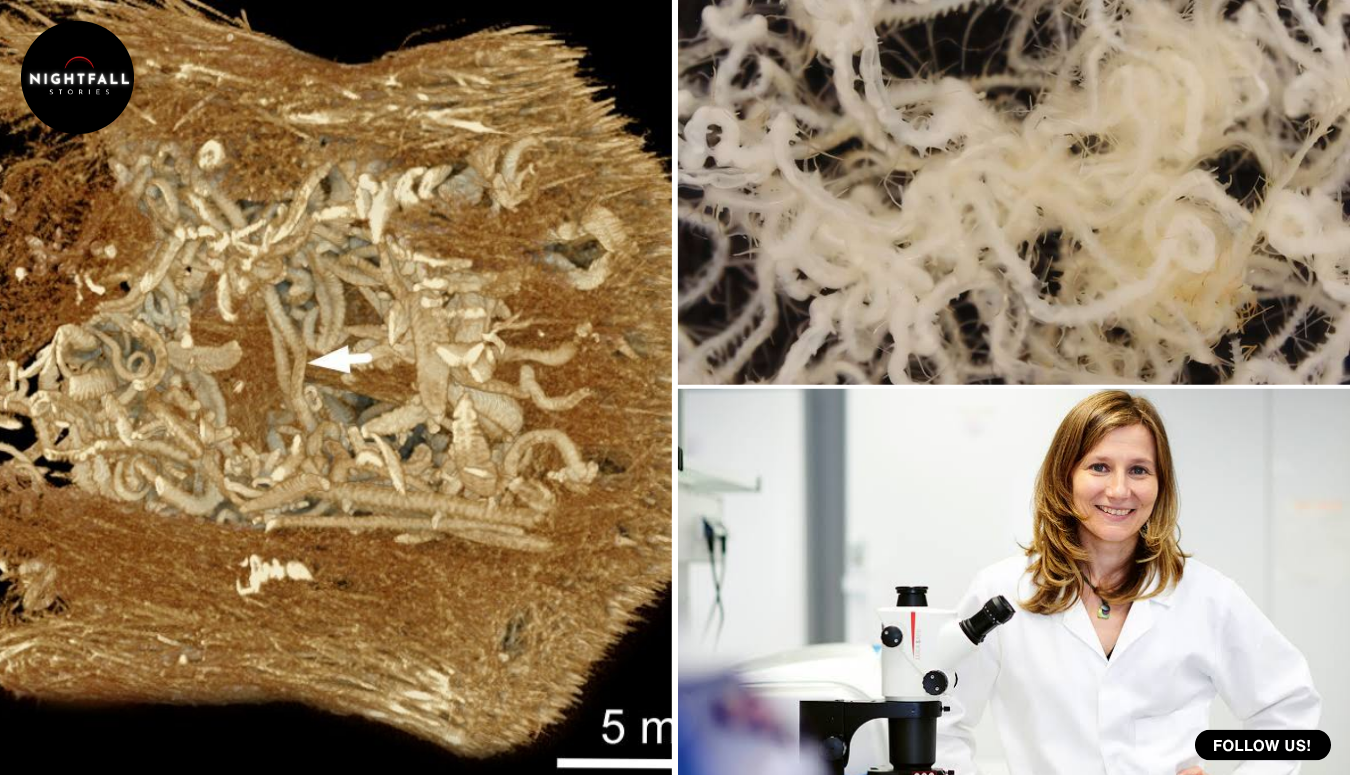
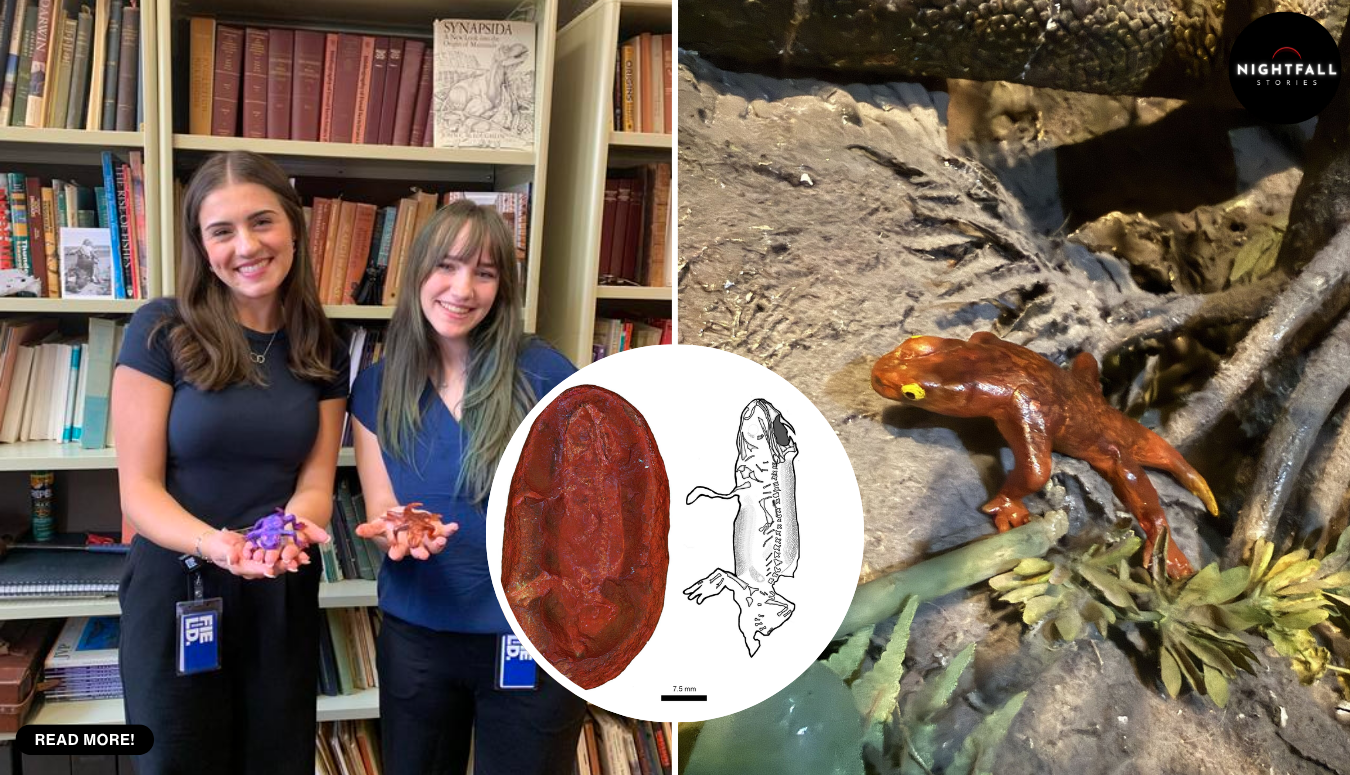
    Among the more than twenty thousand species of annelid worms that science has described, exactly three were known to branch. Not segment, which all of them do, but branch: one head at the front, and behind it a body that forks, and forks again, into a tree of dozens or hundreds of separate rear ends, all of them threaded through the internal plumbing of a living sponge. Three species, out of twenty thousand. A team led by Professor Maria Teresa Aguado at the University of Göttingen has now taken that number to thirteen, adding ten new species and erecting a new genus called Cladosyllis alongside the existing Ramisyllis. Some of the material they worked from was collected in 1914 and has been sitting in spirit in Frankfurt ever since.

    The species count is the headline, and it is not the interesting part. The interesting part is what having thirteen of them instead of three lets you finally ask. With three data points you cannot tell whether an extraordinary body plan is a repeated trick that evolution keeps rediscovering, or a single accident that happened once and then diversified. With thirteen, and with DNA from all of them, you can. The answer, the team reports, is that it happened once. Every branching worm known descends from a single common ancestor in which the branching began. The strangest architecture in the animal kingdom was invented exactly one time.

    It helps to understand how weird the animal actually is, because the description sounds like a mistake in the transcription.

    Take a sponge. A sponge is not a solid object; it is a filter, and its body is riddled with canals through which it pumps seawater to feed. Now put a worm inside those canals. The worm’s head sits at one point in the sponge. From there its body runs into a canal, and where the canal divides, the worm divides with it, growing a second body that continues down the branch. That happens again at the next junction, and the next, until a single animal has filled a large part of the sponge’s internal network with its own branching self. The result is one worm with one mouth and, in a big specimen, hundreds of tails. Its gut is continuous through the whole tree. If you dissolved the sponge away you would be left with something that looks like a root system and is a single individual.

    For most of the time this was known, nobody could examine it properly, which is a large part of why the group stayed at three species. The worm is inside another animal. You cannot see it without destroying the sponge, and if the sponge is a museum specimen collected a century ago, destroying it is not an option worth discussing. The practical effect was that branching worms were studied from fragments: bits of worm teased out, drawn, described, and compared to other bits of worm. Which is a bad way to do taxonomy on an animal whose defining character is the shape of a structure you have just broken.

    The nineteenth century got there first anyway. Syllis ramosa was described from the deep sea in the eighteen hundreds, and it was such an odd report that it hung around the literature for a long time as a curiosity rather than a starting point. A second branching species turned up in 2006, when Christopher Glasby found worms living inside sponges in Darwin Harbour in northern Australia; that animal was formally described in 2012 as Ramisyllis multicaudata, and the genus Ramisyllis was created for it. A third, from Japanese waters, followed a decade later. Aguado was involved in that work, and by then she had been on this group for years. Three species, three widely separated parts of the ocean, and no way to say whether they were relatives or coincidences.

    What changed the problem was a scanner. Micro computed tomography does to a sponge roughly what a medical CT scanner does to a person: it takes X-ray images from hundreds of angles and reconstructs the interior in three dimensions. Point it at a sponge with a worm inside, and because worm tissue and sponge tissue absorb X-rays slightly differently, you can pull the worm out of the reconstruction as a complete object and look at the whole branching tree, junction by junction, without touching the specimen. A jar of preserved sponge that was scientifically opaque in 1914, and in 1960, and in 1990, becomes readable.

    That is the part of this story worth being precise about, because there is a lazy version of it in circulation. The lazy version is that specimens sat forgotten in a drawer until somebody finally bothered to look. That is not what happened, and it is unfair to several generations of curators. The specimens were not forgotten. They were catalogued, maintained, topped up with preservative, and available to anyone who asked, at the Senckenberg Research Institute and Natural History Museum in Frankfurt, where Dr Ekin Tilic is among the study’s authors. What they were not was legible. The question the team wanted to ask, about the internal geometry of a branching body and the relationships between animals that share it, could not be asked of those jars with the tools that existed when the jars were filled. The collection was not neglected. It was waiting for instruments that had not been built yet.

    The second instrument was genetic. The team sequenced DNA from both newly collected material and museum specimens, which is harder than it sounds, because old preservatives chop DNA into short fragments and the oldest material tends to yield the least. Getting usable sequence out of historic wet collections is a specialist craft, and it is the reason a jar from 1914 can contribute to a phylogeny at all. With sequence from across the whole set, the team could build a tree of how these animals are related to each other rather than a list of how they look.

    There is a craft problem hiding underneath all of this, and it is the reason the group resisted sorting for so long. To tell two worm species apart, a taxonomist normally works from a short list of reliable characters: the shape of the head appendages, the arrangement of the bristles, the form of the hooks at the tips of the limbs, the proportions of the first few segments. Those characters work because they are stable within a species and different between species. Branching sabotages that. A branching worm’s most striking feature is the one thing you cannot use, because how much a given individual has branched depends on how old it is and on the geometry of the particular sponge it grew up inside. A small worm in a small sponge and a large worm in a large sponge can be the same species and look nothing alike. Worse, the branch points themselves are anatomically unusual, so a fragment that includes one can look like a different animal from a fragment that does not.

    So the team had to do it the hard way: find characters that were not about branching at all, and check them against genetics rather than assuming they were sound. That is why the micro CT mattered beyond simply seeing inside a sponge. It let them examine the same structures across many specimens in identical orientation, at a resolution that made small consistent differences visible, and then ask whether those differences tracked the DNA. Where they did, they had a character. Where they did not, they had an artefact of growth. Aguado is the scientific curator of the Biodiversity Museum at Göttingen, and she has spent a large part of her working life on this one small group of animals, which is the sort of investment that makes a thirteen-way revision possible at all. Nobody arrives at this from a standing start.

    Thirteen distinct forms came out of it, from three known before. The release describes ten of them as newly discovered species. They come from the Indo-Pacific, from the Red Sea, and from New Zealand, and they span an enormous range of depth: some in shallow-water sponges a diver could reach, others inside deep-sea glass sponges more than a thousand metres down. Glass sponges are a different kind of host altogether, built on a skeleton of silica, and the worms living in them appear to be specialists rather than opportunists. The pattern the team describes is of host preference sorting by region and by depth, which is to say these are not one adaptable worm turning up everywhere. They are a radiation.

    And that radiation resolves into two lineages. One is Ramisyllis, the genus that already existed. The other is Cladosyllis, newly erected, which is what taxonomists do when the animals in front of them are clearly related to a named group but clearly not members of it. The name is not a flourish; it is a load-bearing statement that a group of these species shares an ancestor with each other more recently than any of them does with Ramisyllis, and that lumping them together would hide a real division.

    The division shows up in the body. The two lineages do not branch in the same way. They both end up with a tree, but they build it differently, which is the kind of detail that would be easy to skip past and is actually the most informative thing in the paper. Because if branching had been invented twice independently, you would expect two different mechanisms, and you would explain the difference by saying they are not the same trick at all. The genetics rules that out. The two lineages are descendants of one branching ancestor. So the difference in how they branch is not evidence of separate origins; it is evidence that once an animal has the underlying capacity to fork, the developmental details are free to drift. The ancestor supplied the ability. The lineages then went their own ways about how to exercise it.

    That is a real evolutionary finding and it is worth stating in plain terms. A body plan this extreme has been produced once in the history of a phylum containing tens of thousands of species. It did not arise repeatedly under similar pressures, which is what you would guess if living inside a sponge’s canals simply favoured branching. It arose once, in one lineage, and everything that has it inherited it. That makes branching a historical accident rather than a repeated solution, and it makes the animals that have it a single strange family rather than a category.

    There are also things this work does not settle, and Aguado’s group has been open about them for years. Nobody knows what a branching worm eats, or how. One mouth at the front of a body with hundreds of tails is an obvious problem: the head cannot plausibly move around enough to gather food for the whole tree. Examination of the gut has found very little sponge material in it, which weakens the simplest hypothesis, that the worm is quietly eating its host from inside. One alternative under discussion is that the animal absorbs dissolved organic carbon straight through its skin, which some other marine invertebrates do, in which case the enormous branched surface area inside a sponge’s water canals starts to look less like a puzzle and more like the point. That remains unresolved.

    The relationship with the sponge is also unresolved in a more basic way. If the worm is not eating the sponge, is it harming it at all? Is it paying for its accommodation somehow? Nobody has demonstrated either. What is known is that reproduction happens at the ends: some branches develop into stolons, detachable segments packed with eggs or sperm, which break away to spawn. So the tree is not merely a body. It is also a way of producing a great many reproductive units at once from a great many separate tips, from inside a shelter that a predator would have to demolish a sponge to reach.

    The funding argument in all this is unglamorous and it is the honest lesson. Nobody builds a career, or gets a headline, out of maintaining spirit collections. Topping up alcohol in jars, keeping catalogue numbers legible, holding humidity steady in a basement for a hundred years: it is the least fashionable work in science and it has almost no visible output. What it produced here is ten species, a new genus and an answer to an evolutionary question, entirely from material that was already inside the building before any of the people who used it were born. The 1914 collector could not have imagined micro CT or DNA sequencing. The jar was filled anyway, and kept anyway, and it turned out to contain an argument.

    Aguado has made the point directly, and it is worth relaying in her framing rather than sharpening it into a slogan: this work would have been impossible without access to museum specimens, and collections of this kind are not stores of old samples but resources that keep producing new results. That is a claim a curator has to make repeatedly and usually cannot prove. Here it is proved.

    The count now stands at thirteen. Ten new species, published; a new genus, named; and the branching body plan traced to a single origin. Nothing in it awaits further analysis. The remaining questions are about how the animals live, not about who they are, and the next time somebody wants to ask one of those, the jars will still be in Frankfurt.

  • Two of the rarest sea turtles on Earth washed up looking dead. Nine months later, one of them needed a machine built for human divers.

    Two of the rarest sea turtles on Earth washed up looking dead. Nine months later, one of them needed a machine built for human divers.

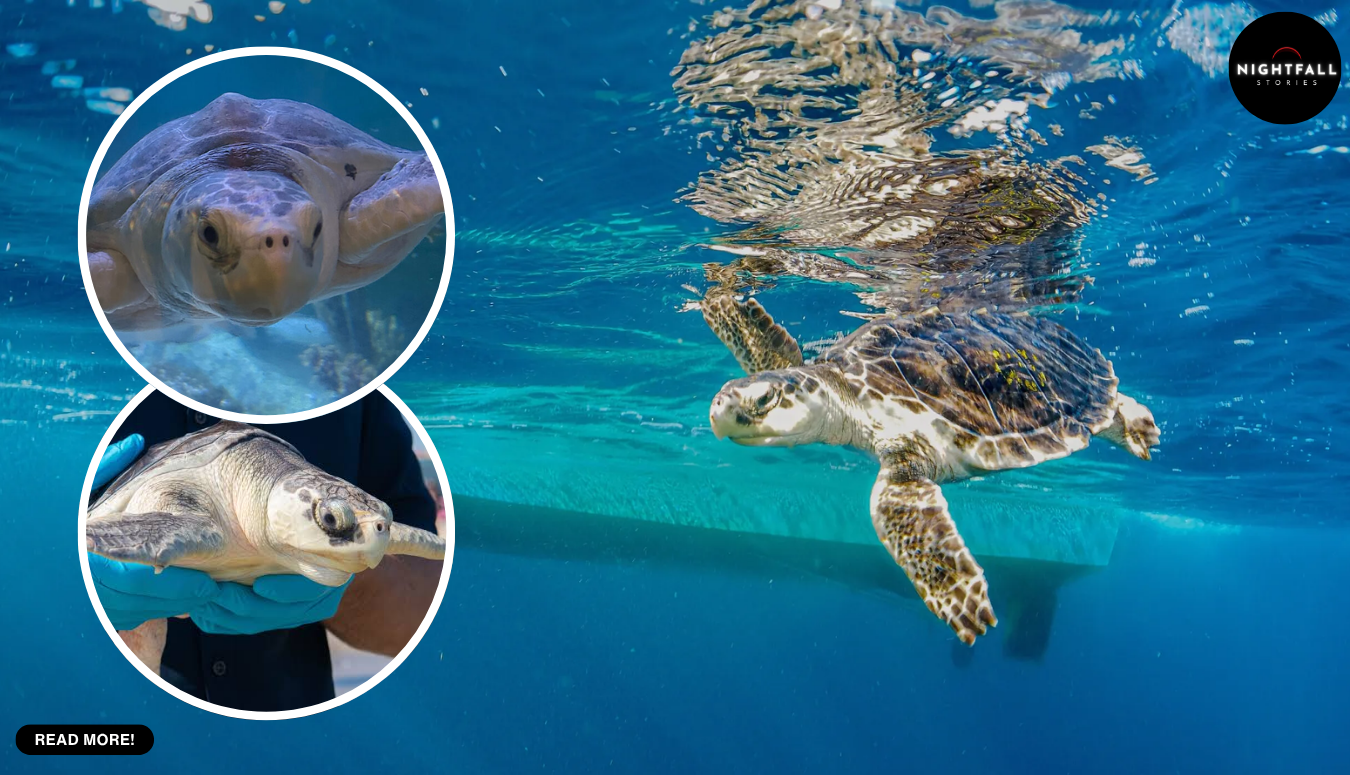
    The two turtles that went into Nantucket Sound off West Dennis Beach this month were the last patients standing from a season that had brought something close to five hundred of them through one hospital door. They were Kemp’s ridleys, the smallest sea turtle in the world and the most endangered, and they had each spent roughly nine months inside the New England Aquarium’s Sea Turtle Hospital in Quincy, Massachusetts. One of them had arrived with a brain injury caused by oxygen starvation and had been treated, for two weeks in the middle of the summer, inside a hyperbaric chamber. The aquarium says that is the first documented use of hyperbaric oxygen therapy to treat a hypoxic brain injury in a sea turtle anywhere.

    That is the ending. The beginning is stranger, and it happens every year on the same stretch of coast, and it looks, to anyone who stumbles across it, like a mass death.

    Cape Cod is a hook. Look at it on a map and the shape is almost cartoonish: a long arm reaching east from the Massachusetts mainland and then curling sharply north and back west, closing around a body of water called Cape Cod Bay. For a sea turtle drifting north on warm summer currents to feed, that hook is a beautiful place to spend a season. Crabs, clear shallows, food everywhere. Juvenile Kemp’s ridleys in particular come up in numbers, feeding and growing, and for months nothing about the arrangement looks like a problem.

    Then autumn arrives and the water starts to cool, and the turtles need to leave. To do that they have to swim south, out of the bay, around the inside of the hook, past the wrist, and back down the open coast. It is a counterintuitive route. A reptile following its instinct to head for open water and warmer latitudes swims south and hits the inside curve of the arm. It swims along the shore looking for a way out and the shore keeps bending it back. Some of them find the opening. A great many do not, and by the time they are still looking, the water has gone cold.

    Sea turtles are reptiles, which means their body temperature tracks the water around them. They have no internal furnace. When the water in Cape Cod Bay drops through roughly 55 degrees Fahrenheit, about 13 degrees Celsius, a turtle’s whole system begins to shut down in sequence. The heart rate falls. Digestion stops. The immune response, which depends on the same chemistry as everything else, slows to something close to nothing. Muscles stop responding. The animal cannot swim, cannot lift its head to breathe reliably, cannot feed. This is what people mean by cold stunning, and the name undersells it, because the animal is not merely chilled. It is in a physiological collapse that will kill it if the water keeps cooling.

    What happens next is why the beaches of Cape Cod Bay look the way they do in late autumn. A stunned turtle cannot swim away from wind and tide, so it goes wherever the water puts it, and the water puts it on the sand. It arrives limp, cold to the touch, sometimes with sand and weed packed around it, frequently not visibly breathing. A person walking a dog in November who finds one has almost no way of knowing it is alive. Its heart may be beating a handful of times a minute. It may take a breath every several minutes. Everything a person instinctively checks for is absent or too faint to find.

    And that is the fact the whole rescue system is built on. Very often the turtle is not dead. It is somewhere that a warm-blooded animal simply does not have an equivalent for, and if it is found in time and warmed correctly, slowly, over hours, it can come back.

    Finding them in time is the part that depends on people willing to walk cold beaches in the dark. Mass Audubon’s Wellfleet Bay Wildlife Sanctuary runs that effort, and it runs on staff plus a large volunteer corps who patrol the bayside beaches through the stranding season, timed to high tides and to whatever the wind has been doing, because onshore wind is what decides whether a drifting turtle lands on sand or stays out in the bay. Volunteers walk in wind chill, in the dark, at hours set by the tide rather than by anybody’s convenience. When they find an animal they mark it, note where it came from, protect it from further cooling, and get it off the beach. Those same beach walks are why the aquarium’s hospital receives live patients rather than a count of carcasses.

    In 2025 that system had an extraordinary amount of work to do. Strandings began in early November. Inside the first two weeks the hospital in Quincy had taken in more than two hundred patients. Intake kept climbing through the end of November and into December. By the middle of December the aquarium’s own tally stood at 473 sea turtles admitted for the season: 404 Kemp’s ridleys, 48 green sea turtles, 21 loggerheads. Coverage of the season’s close put the final live intake at nearly five hundred. Whichever figure you use, the shape is the same. One rehabilitation facility, in a matter of weeks, absorbed several hundred critically ill animals belonging mostly to a species with very little margin left.

    There is also a reason the counts have been getting larger over the years rather than staying flat. Cold stunning on Cape Cod is not new, but the scale of it is. Researchers working on the pattern have pointed to warming water as the driver: the bay stays hospitable later into the autumn, so young turtles have less reason to leave early, and more of them are still inside the hook when the temperature finally drops. The trap has not changed shape. What has changed is how late in the year it springs, and how many animals are inside it when it does. Rehabilitation facilities in the region have accordingly built capacity for seasons that would once have been considered impossible, and the 2025 intake is roughly what that looks like in practice.

    It is worth pausing on what the Kemp’s ridley is, because otherwise the numbers read as a nice animal-rescue story rather than the thing they actually are. Kemp’s ridley is the smallest of the sea turtles, an adult roughly the size of a dinner tray, and it is the most endangered. Its nesting is concentrated in a very small part of the world, which means the species has almost no geographic insurance against a bad year. A juvenile turtle in Cape Cod Bay is a fraction of a percentage point of a global population, and the fraction is not small in the way that phrase usually implies. Every one of those 404 animals mattered arithmetically, not just sentimentally.

    Triage on that scale is a logistics problem before it is a medical one. Each arriving turtle needs to be warmed at a controlled rate, because warming a cold-stunned reptile too quickly is dangerous in its own right. Each needs fluids, because they arrive dehydrated. Each needs assessment for the conditions that ride along with weeks of immune suppression and inhaled seawater: pneumonia, wounds and trauma picked up while being tumbled onto a beach, infections that took hold while the animal had no functioning defence against them. And recovery is measured in months rather than weeks for a straightforward reason. The same cold that stunned the turtle also switched off the immune system that would normally clear an infection, so the infections get a long unopposed head start, and the antibiotics that eventually go to work have to operate in a reptile whose metabolism moves slowly even when it is healthy. Nothing about the timetable can be hurried.

    The hospital’s routine during a peak season is worth picturing, because the popular image of wildlife rescue is a person cradling an animal and the reality is closer to a hospital ward with a shift rota. Turtles occupy individual tubs, each with its own chart. Adam Kennedy, the aquarium’s director of rescue and rehabilitation, runs that side of the operation, and senior veterinarian Dr Kathy Tuxbury is among the clinicians carrying the caseload. Animals are weighed, bloods are drawn, radiographs are taken, antibiotic courses are tracked individually, and a turtle that looked stable on Monday can be the urgent case by Thursday. Multiply that by several hundred at once and the constraint stops being medical knowledge and starts being hands, tubs and heated seawater.

    Most of the 2025 patients recovered through the spring and summer and went back into the ocean in batches, some off Cape Cod, some further south. Two did not, and both for reasons that pushed the hospital past ordinary practice.

    The turtle logged as Shelley Volante had severe sepsis, which is what happens when an infection stops being local and gets into the bloodstream. In this animal it had also reached bone, and there was inflammation through muscle and fat. Sepsis with bone involvement is a hard problem in any species and a harder one in a reptile, because the drugs have to reach tissue with a poor blood supply in a body running at low speed. The aquarium’s team used advanced imaging to find where the damage actually was, then went in surgically and cleaned out an affected joint, a procedure called debridement, which means removing the dead and infected tissue so that what is left has a chance to heal. Then they waited, for months, and treated, and imaged again, and waited.

    The other turtle, logged as Young Frankenstein, had a different and less fixable injury. At some point in the collapse, before or during stranding, the animal’s brain had gone without enough oxygen. That is a hypoxic brain injury, and it is the kind of damage that does not respond to antibiotics or surgery because there is nothing to cut out or kill. In practice it showed up as a turtle whose body was recovering while its behaviour did not. It had trouble navigating. It had trouble finding and taking food. For an animal that has to be able to feed itself and orient in open water before anyone can responsibly release it, that is not a cosmetic problem. It is the whole release criterion, failing.

    Hyperbaric oxygen therapy is an old idea from human medicine, developed largely around diving injuries. The patient goes into a sealed chamber, the pressure inside is raised well above normal atmospheric pressure, and the air they breathe is oxygen rich. The physics is simple enough to state plainly: at higher pressure, far more oxygen dissolves directly into the blood plasma rather than relying on red blood cells to carry it, so oxygen can reach tissue that a normal blood supply is struggling to serve. It is standard care for decompression sickness and carbon monoxide poisoning, and it is used for certain stubborn wounds. It is not standard care for a turtle, because nobody had documented doing it for this.

    Dr Melissa Joblon, the New England Aquarium’s director of animal health, is the named voice on the decision. In the middle of the summer the team began hyperbaric sessions for Young Frankenstein, twice a week over about two weeks. Joblon has described the result as a drastic improvement in the turtle’s ability to navigate and to forage, and she noted that the change was visible after only two treatments. She and the aquarium describe this as the first documented use of hyperbaric oxygen therapy to treat hypoxic brain injury in a sea turtle. That claim belongs to them, and it is worth keeping it in their hands rather than promoting it to a fact of the record. It is a claim about the documented literature, which is a thing that can be wrong in either direction, and the honest version is that the aquarium says it is a first and nobody has come forward to say otherwise.

    What is not in dispute is what the turtle did afterwards. It started navigating. It started eating properly. It kept doing both long enough that the veterinary team was willing to sign off on an animal they had come very close to not being able to release at all.

    Both turtles cleared their final checks in the same week, which is how the last two patients of a five hundred animal season came to go back at the same time. The release happened at West Dennis Beach on the south side of Cape Cod, which puts an animal straight into Nantucket Sound and from there into open water on the correct side of the hook. Local people came out to watch. That is normal for these releases and it is a small good thing in itself, because the same beaches that produce the emergency every November are walked by the people who end up standing in a loose line in September watching the outcome.

    There is no cliffhanger here and no pending result, which is unusual and pleasant. The two turtles are gone. The 2025 cold stunning season is formally closed, nine and a half months after it opened. And the hospital in Quincy is already restocking, because the trigger for the next one is not a date on a calendar but a number on a thermometer. When the water in Cape Cod Bay comes back down through 55 degrees Fahrenheit, the turtles still feeding inside the hook will try to leave, and some of them will not find the way out, and the volunteers will start walking the beaches in the dark again.

    What Young Frankenstein leaves behind is smaller than a species and bigger than one animal. It is a line in the veterinary record: that when a cold stunned sea turtle comes in with a brain that has been starved of oxygen, and it cannot find its food, and everything else you know how to do has already been done, there is now one documented case of somebody trying a diver’s chamber and watching the animal come back. The next hospital that faces the same turtle will not have to invent that from nothing.

  • Eighteen of twenty crane pairs hatched chicks in Louisiana this year. The number the biologists actually celebrated was much smaller

    Eighteen of twenty crane pairs hatched chicks in Louisiana this year. The number the biologists actually celebrated was much smaller

    Ten whooping crane chicks in the marshes of southern Louisiana got big enough to fly this year. That is the record. It beats the previous best of eight, set four years earlier, and the state wildlife agency that runs the programme says it is the most ever produced by any whooping crane reintroduction project in the country.

    Ten. Not eighteen, and not twenty, even though those are the numbers that ended up in most of the headlines.

    Twenty pairs built nests. Eighteen of those pairs hatched chicks. Ten chicks fledged.

    Those three figures describe three completely different things, and collapsing them is the single most common error in coverage of this kind of work. A nest is an intention. A hatch is an egg that opened. A fledge is a young bird that survived long enough to leave the nest on its own wings, which in a whooping crane means roughly three months of being large, conspicuous, flightless and edible in a landscape full of alligators, bobcats, coyotes and raccoons.

    Eighteen of twenty pairs hatching something is a hatching statistic, and it is a genuinely striking one. Sara Zimorski, the Louisiana Department of Wildlife and Fisheries biologist who has overseen the crane project, says it is the highest proportion the programme has ever recorded. It tells you the adults are finding mates, holding territories, building nests in the right places and incubating successfully. That is a lot to get right.

    But eighteen hatches producing ten fledglings also tells you that eight of those families lost their chicks. Nobody writes that number in a headline, and it is the honest other half of a record season.

    Fledging is the number that counts because fledging is the only one that adds a bird to the population. An egg that hatches and then disappears in week five has changed nothing about the flock’s size. This is why the distinction is not pedantry. It is the whole measure of whether a reintroduction is working, and it is exactly where optimistic reporting tends to quietly inflate a result.

    The Louisiana flock now stands at 84 birds, by the count published at the end of the nesting season. Thirty two of them were hatched in the wild, in Louisiana, by wild parents.

    To understand why that second figure is the one the biologists care about, you have to go back to what was there before.

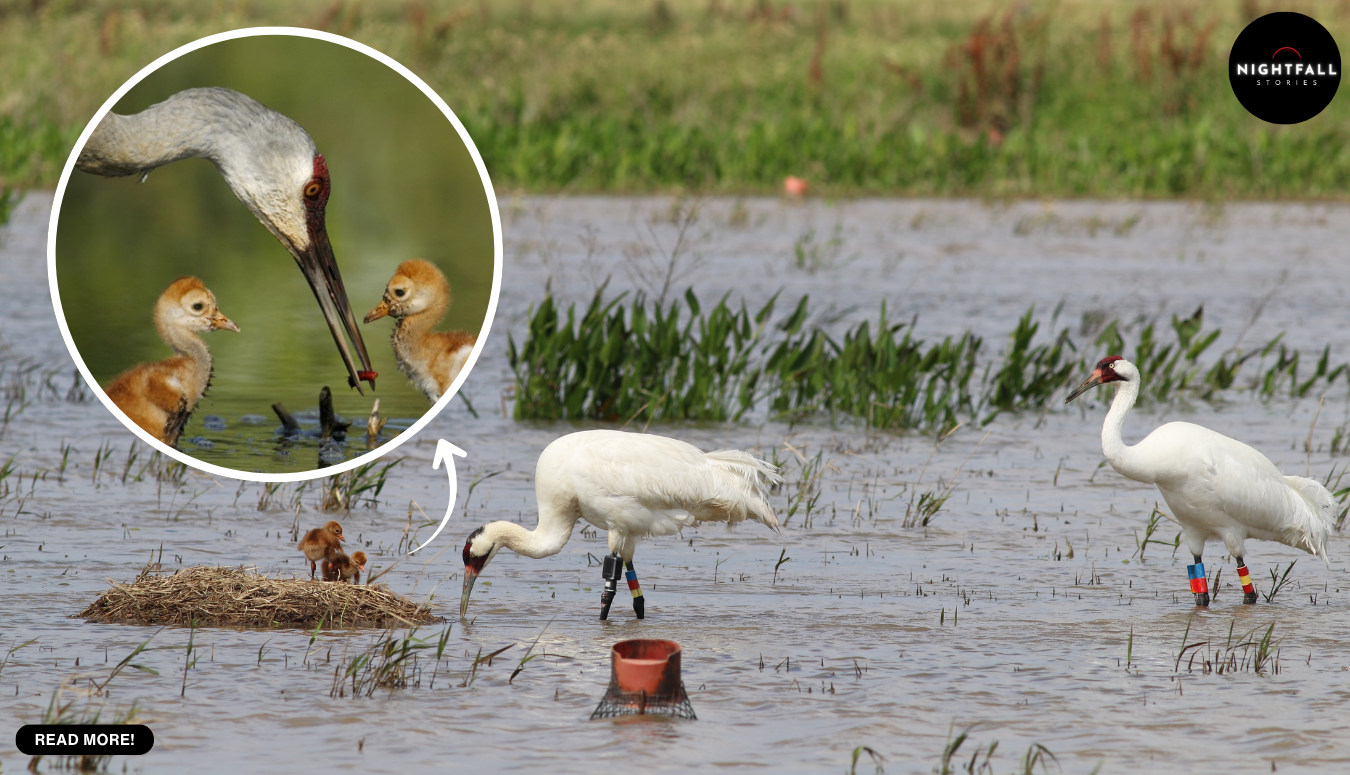
    It helps to know what kind of animal is being counted. A whooping crane stands close to five feet tall, which makes it the tallest bird in North America, with a wingspan that opens to well over seven feet. It is white, with black wingtips and a patch of bare red skin on the crown, and it has a call that carries for miles across flat ground. There is nothing else remotely like it in a Louisiana marsh. You cannot mistake one for anything, and you cannot miss one either.

    Whooping cranes once nested across a large part of North America, including the coastal prairies and marshes of Louisiana. Then they were shot, and their wetlands were drained, and by 1941 there were twenty one left on the entire planet. Twenty one. The species survived the twentieth century on a margin that thin.

    Louisiana lost its resident cranes entirely. For more than seventy five years, no whooping crane hatched naturally anywhere in the state. That gap belongs to Louisiana specifically, not to the species, which continued breeding in Canada throughout. But for the marshes themselves, the bird was simply gone within living memory and then beyond it.

    In 2011, the state started putting them back. Ten captive-reared juveniles were released at the White Lake Wetlands Conservation Area in Vermilion Parish, chosen because the coastal habitat there is still extensive and still wet. The plan was unusual in one important respect: this flock was never meant to migrate. Whooping cranes are famous for enormous seasonal journeys, and teaching reintroduced birds to make them has been one of the hardest problems in the field. Louisiana’s historic population did not migrate, so the reintroduction did not ask the new birds to either.

    Dropping the migration was a real simplification and it came with a real trade. What it removed was the hardest and most failure-prone part of other whooping crane reintroductions: teaching captive-reared young birds a route they had never flown, and then hoping they survived a wintering ground, a summering ground and two long journeys a year between them. Every one of those is a place something can go wrong, and a migratory reintroduction has to succeed in all of them at once.

    What it could not remove was the flip side. A bird that never leaves cannot leave. A migratory flock that loses its breeding grounds still has a wintering ground. A resident flock in a single stretch of coastal marsh has nowhere else, and southern Louisiana is not a place where nothing ever happens to coastal marsh.

    Five years later, in 2016, a pair in the wild hatched a chick. It was the first whooping crane to hatch naturally in Louisiana in more than seventy five years.

    Going from that to ten fledglings in a single season took another decade, and it did not happen because anything dramatic changed. It happened because the birds got older.

    This is the part Zimorski keeps coming back to, and it is one of the least intuitive things about restoring a long-lived species. Whooping cranes are not good at breeding when they are young. A first-time pair is often a bad pair. They pick poor nest sites, they mishandle incubation, they lose chicks to predators they should have avoided, and they frequently fail outright. Then they try again the following year and do slightly better. As a population ages, the proportion of experienced breeders climbs, and the success rate climbs with it. Zimorski’s explanation of this season is essentially that: as the population gets older, more of the breeding pairs are getting it right.

    Which means a reintroduction cannot be judged on its early years, and also cannot be declared finished on one good one. Ten fledglings is what fifteen years of patience looks like arriving all at once.

    The word fledged is doing quiet work in all of this, and it is worth being clear about what it does and does not promise. A fledged crane is a bird that can fly. It is not yet a bird that has survived a year, or found a territory, or bred. Plenty of fledglings die in their first winter. So ten fledglings is not ten future breeders, and nobody involved is pretending otherwise.

    What it is, though, is ten birds that got past the stage where reintroduced populations usually fail. Chick mortality in the first weeks is the bottleneck. Clear it, and the odds improve sharply.

    The counting is unusually honest here, and it is worth saying why. In plenty of conservation stories, the encouraging number is a hatch count, or a nest count, or an estimate of animals released, and the figure that would actually matter, how many survived, is left for a future report that sometimes never comes. This is not one of those. The fledging count is the published number. The chicks reached flight age before anyone announced anything. There is no deferred reckoning hiding inside the good news.

    That does not make the flock safe. Eighty four birds in one place is a small population in a single location, and Zimorski has been direct about what that means. If every bird you have lives in one population in one area, a single bad event, a hurricane, a disease outbreak, a chemical spill across a coastal marsh, could take out the lot. That is the entire logic behind maintaining separate whooping crane populations in different parts of the continent instead of concentrating them where conditions look best. You are not optimising. You are spreading risk.

    There is also the awkward fact of where these birds actually live. The coastal prairie that whooping cranes want in Louisiana is not a wilderness. It is working agricultural country, and cranes forage readily in flooded rice fields and crawfish ponds, which are excellent shallow wetlands from a bird’s point of view and private property from everybody else’s. That is why the crane killed this year was killed at a crawfish pond. It is also why landowner relations are not a soft add-on to this programme but a core part of it. A flock that nests and feeds on farmland survives or does not survive largely at the discretion of farmers, and a reintroduction that has not brought those farmers with it will lose birds faster than it can produce them.

    Most of them have come along, which is the quiet reason any of this works. A great many Louisiana landowners now have enormous white birds wandering their fields and simply let them get on with it.

    The losses are not all environmental either. Cranes in Louisiana get shot. It keeps happening, year after year, to a bird that stands nearly as tall as a person, is bright white, is federally protected and is entirely unmistakable. One was killed at a privately owned crawfish pond earlier this year. Another died over the summer, bringing the count reported in later coverage slightly below the end-of-season figure. Power lines take birds too; a large crane flying at dusk does not see a thin wire in time.

    So every fledgling is expensive. Behind the ten there is a captive breeding operation, with birds raised at facilities including the Freeport-McMoRan Audubon Species Survival Center in New Orleans, where Richard Dunn works as assistant curator. There is tracking, banding, monitoring, nest observation, landowner relations across private farmland and marsh, and law enforcement following up shootings. There are fifteen years of field seasons.

    Against the species as a whole, eighty four birds is a modest share. Fewer than a thousand whooping cranes exist across all populations, wild and captive combined. The one genuinely self-sustaining wild population, which breeds in Wood Buffalo National Park in Canada and winters on the Texas coast, numbered around 557 birds in the most recent count. Everything else, including Louisiana, is still assisted.

    Which brings us to the thing that actually happened this year, and which is not the number ten.

    One of the chicks that fledged in Louisiana was raised by a pair in which both parents had themselves been hatched in the wild, in Louisiana.

    Read that slowly, because it is the point of the entire programme. Neither of those adults came out of a captive breeding facility. Neither was reared by people in a pen, fed by handlers in crane costumes, crated, transported and released into a landscape it had never seen. Both of them hatched in a Louisiana marsh, to parents who were raising chicks there, and grew up as wild birds. And then they built a nest of their own, incubated an egg, and got a chick through to flight.

    That is a second generation of wild-hatched Louisiana cranes producing a third. It is the specific outcome that the 2011 release was designed to reach, and until it happens, a reintroduction is not a population. It is a maintained collection. Birds are added by people, they breed or they do not, and if the additions stop, the numbers fall.

    A pair of wild-hatched parents raising a wild-hatched chick means the loop has closed. The flock is now, at least in part, making itself.

    It is a single pair and a single chick, and nobody involved is claiming otherwise. Thirty two of eighty four birds are wild-hatched, which means the majority of the flock still traces directly to captive rearing, and the release programme has not ended. One second-generation success does not make a self-sustaining population any more than one good season makes a recovered species.

    But it is a threshold, and thresholds only get crossed once. Fifteen years ago there were no whooping cranes breeding in Louisiana at all, and had not been for three quarters of a century. Ten years ago there was one wild-hatched chick, the first in more than seventy five years. This year there were ten fledglings, the most any whooping crane reintroduction anywhere in the country has produced, according to the agency that produced them.

    And in among those ten, in a marsh in southern Louisiana, there is one young crane whose mother and father were both born in that same landscape, wild, to wild parents, with no human hand in it at any point.

    That bird is what the programme was built for. It took fifteen years, a captive breeding network, an agency that kept counting honestly, and a biologist who stayed with the same flock long enough to watch the young pairs become good at it. The ten is the record. The one is the proof.

  • A box truck was stopped in California with two thousand animals inside. The hardest night belonged to four people at an aquarium down the coast.

    A box truck was stopped in California with two thousand animals inside. The hardest night belonged to four people at an aquarium down the coast.

    There were four of them, and they worked until roughly one in the morning.

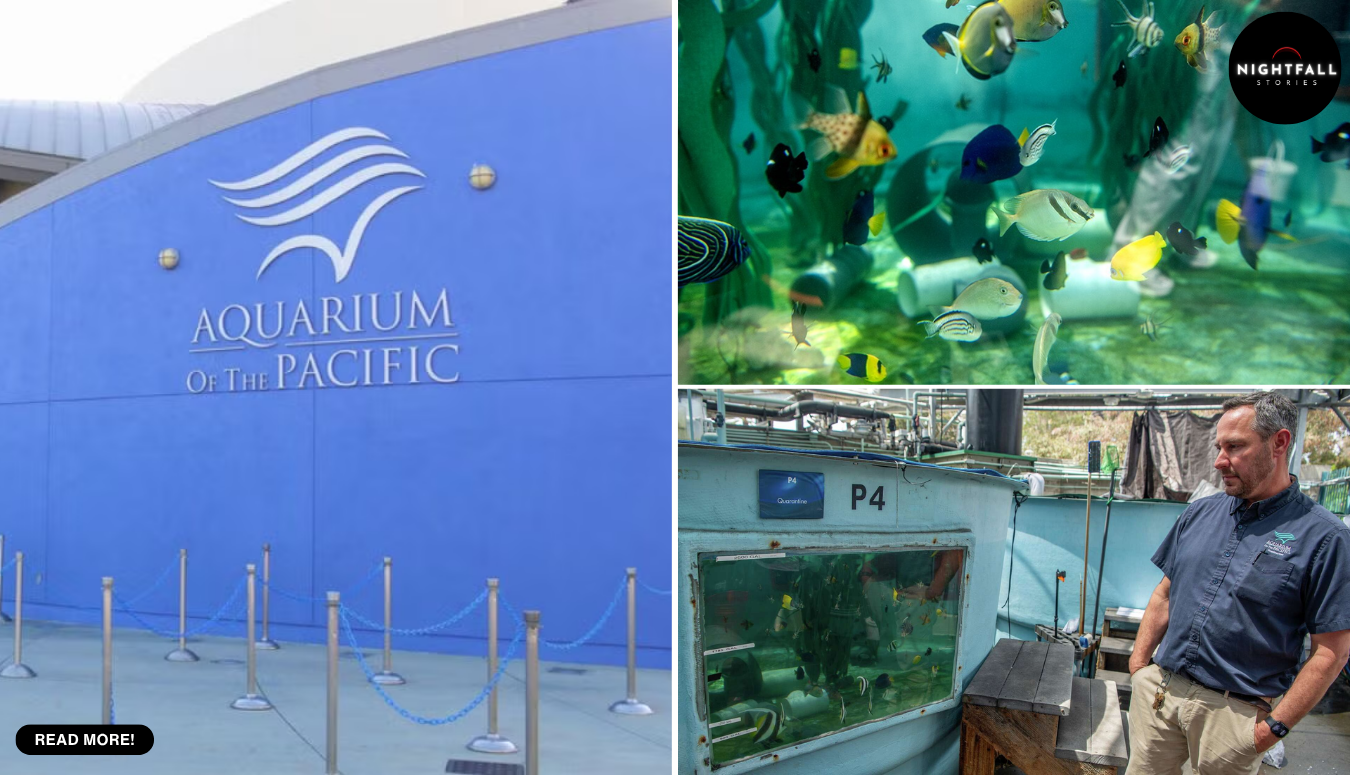
    That is the detail that stays with you once you know the rest of it. Wildlife officials in Southern California stopped a box truck carrying somewhere around two thousand live animals, a mix of reptiles, fish and invertebrates packed for transport. That number belongs to the seizure, not to any one building. Of the animals in that haul, close to five hundred marine creatures were sent on to the Aquarium of the Pacific in Long Beach, arriving in bags and boxes of water on a single day in the middle of last year. Four staff members met them.

    You cannot simply open a bag and pour a fish into a tank. That is the whole practical heart of this story, and it is the part almost nobody outside the profession has any reason to know.

    Nate Jaros, the aquarium’s Vice President of Animal Care, has described what happened next in fairly unglamorous terms. Every bag had to be tested before anything in it was moved. The water an animal travels in stops being water and starts being a chemistry problem within hours. Oxygen falls. The animal keeps breathing and keeps producing waste, and ammonia climbs. As ammonia climbs, the pH of the water tends to drift, and the particular cruelty of the situation is that a low pH partly protects the animal from the ammonia. Raise the pH suddenly, by tipping that bag into a clean, well buffered tank, and the ammonia that was chemically parked becomes chemically active. An animal that survived the truck can die in the tank.

    So the staff tested for pH, for dissolved oxygen, for ammonia, bag by bag. Then they acclimated slowly, letting clean system water in a little at a time, letting temperature and salinity close the gap over a period rather than in a moment. Jaros has called it a very careful process and a very stressful one, which is about as plain a description as the work allows. There is no dramatic version of it. It is hours of small adjustments made by tired people who know that the cost of hurrying is not abstract.

    Stress is the other thing they were fighting, and it is less visible than water chemistry. Animals collected from reefs, bagged, boxed, moved, and then confiscated have been under pressure for a long stretch before anyone at an accredited facility sees them. Most reef fish carry some parasite load in normal life without much consequence. Jaros has pointed out the problem with that: bring an animal into a stressful environment and those loads can start to increase. The animal’s own defences drop at exactly the moment the parasites find their opening. This is why the first stop was not an exhibit but quarantine.

    Alyssa Tillman, the aquarium’s Assistant Curator of Fish and Invertebrates, has explained the logic of that plainly enough. Everything arriving is watched closely in quarantine areas where staff can give immediate care and where any disease that came in with the shipment cannot spread into a collection of thousands of other animals. That is the standard for any arrival, planned or not. An emergency does not lower it. In a sense an emergency raises it, because nobody knows where these animals came from, what they were exposed to, or what they were kept alongside.

    The list of what came through the door reads like a tour of the home aquarium trade. Brownbanded bamboo sharks, a species considered near threatened. Banggai cardinalfish, which are endangered and which have been collected heavily from a very small natural range. Ocellaris clownfish, the ones almost everyone can picture. Yellow longnose butterflyfish, domino damselfish, lemonpeel angelfish, powder blue tang, juvenile emperor angelfish. Alongside the fish came the harder part of the inventory: hundreds of corals, plus clams, shrimp, prawns and snails.

    The corals were their own problem. Jaros has been candid that identification was close to impossible in the moment. There are thousands of coral species, many of them difficult to tell apart even with time and a reference collection, and some of them look nothing like the photographs once they have been out of a reef and inside a box. You cannot care for an animal properly without knowing roughly what it is, because light requirements, flow, feeding and temperature all change with species. The team had to make reasonable working judgements and correct them later.

    The Banggai cardinalfish are worth pausing on, because they explain why a box of small fish can matter out of proportion to its size. They are a striking animal, silver and black with long trailing fins, and they come from a very small natural range in the tropical Pacific. Being desirable and geographically concentrated is a bad combination for a species. Decades of collection for the ornamental trade pushed the wild population down hard enough that the species is now classified as endangered, even though it breeds readily in captivity and captive bred stock is widely available. That is the uncomfortable arithmetic behind a shipment like this one. There was no biological need to take these fish from a reef at all.

    About a quarter of the animals from that first arrival did not survive. Some were already gone when the boxes were opened. Others died within days. That is the honest figure and it deserves to be stated rather than buried, because it is the real measure of what a truck journey does. The people who took them in did not lose those animals. They inherited them already lost, and found out which ones over the following week. Nobody in that building had any control over the part of the journey that killed them.

    What makes this more than a difficult night at one aquarium is the thing that made the phone call possible in the first place, and it did not exist a few years ago.

    Until fairly recently, a wildlife officer who intercepted a shipment of living animals had a genuine institutional problem on their hands. Seized property is usually held. Seized property that breathes cannot be held in an evidence locker. Officers ended up making urgent calls to whichever zoo or aquarium they happened to know, hoping someone had space, water systems and staff free on a weekday afternoon. It worked when it worked and failed quietly when it did not.

    In 2023 the United States Fish and Wildlife Service and the Association of Zoos and Aquariums set up a Wildlife Confiscations Network to replace that improvisation with something closer to a system. The idea is unglamorous and effective. A network of accredited facilities agrees in advance to take confiscated animals, with a known route, known contacts and a vetting committee that decides which organisations are equipped for which species. The Southern California branch of it is the reason a box truck stopped on a highway turned into a set of quarantine tanks the same day rather than a set of decisions nobody was ready to make. The Aquarium of the Pacific was a founding member of that regional network and sits on its vetting committee.

    That structure was tested again a few weeks after the first haul. Near the end of July, a second operation brought roughly three hundred more marine animals, this time after a short stay at a federal wildlife centre in Torrance before they were transferred down to Long Beach. So the aquarium’s real intake across the two events was about five hundred and then about three hundred. Not two thousand. The larger figure describes what officers found in the truck, most of which went to other facilities suited to reptiles and to species an aquarium is not the right home for.

    None of this is occasional. The aquarium has taken part in more than thirty confiscation events since late 2024, and says it has now helped more than three thousand three hundred trafficked animals since joining the network. That number is the quiet headline. It means the summer’s two seizures were unusual in size but not in kind.

    Then comes the part that is a genuinely hard choice rather than a technical one, and it is the reason people in this field talk about confiscation with a certain flatness.

    These animals almost never go home. Returning a confiscated reef fish to the ocean sounds like the obvious good ending and is usually the wrong call. Nobody knows which reef it came from, and releasing an animal into the wrong population can move disease and genetics into places they were not. The animals have often been held in conditions that leave them unfit to compete. For corals and invertebrates the identification problem alone can make release impossible. So the realistic options are placement in an accredited facility with appropriate space and expertise, or a place in an exhibit in Long Beach, and someone has to make that judgement for each of hundreds of animals while they are still in quarantine.

    Quarantine is not a quick holding pen either. Depending on the species and what turns up in testing, an animal may sit behind the scenes for weeks while staff watch for parasites, treat what they find, and confirm the animal is feeding normally before it goes anywhere. Feeding is the tell. A fish that will not eat is a fish still in trouble, whatever the water readings say. Multiply that by several hundred animals across dozens of species with different diets, and the labour involved starts to become clear. This is not a rescue in the sense of one dramatic intervention. It is a long, dull, attentive process carried out by people with day jobs already attached to a working public aquarium.

    Placement was expected to happen inside about two weeks for most of the survivors, moving out to other accredited institutions or into the aquarium’s own displays. That is fast, and it has to be, because holding capacity behind the scenes is finite and the next call is not scheduled.

    It is worth being clear about why a truck like that is worth running at all, without turning it into a lecture. Marine ornamental animals are small, light, and worth a great deal relative to their weight. A single specimen of a sought after species can be worth hundreds of dollars by the time it reaches a home tank, and a coral fragment can be worth more. Much of the supply chain is legal and documented. The illegal share moves through the same channels, with paperwork that does not match the contents, protected species mixed in among unprotected ones, and volumes that make individual animals almost disposable. Losing a quarter of a shipment is a cost of doing business for a trafficker. It is a week of work for the people who end up with the survivors.

    One thing this story does not include, and it should be said rather than implied: there is no public record reachable of charges, a prosecution, or any named defendant in either seizure. Whether anyone faces a case is simply not on the record. The animals are the documented part.

    What the aquarium did get is money. Grant funding routed through the Association of Zoos and Aquariums, drawn from federal pandemic era recovery funds, has gone towards renovations, upgrades and new holding systems intended specifically to expand how much confiscated wildlife the building can absorb at once. More tanks behind the scenes is not a thrilling sentence. It is, in practice, the difference between four people working until one in the morning and four people working until four in the morning, and it is the difference between saying yes to a call and saying not this time.

    The aquarium’s president and chief executive, Jeff Flocken, has framed the whole business in terms of extinction rather than crime, arguing that trafficking damages ecosystems and pushes species towards disappearing, and that answering these calls is something the institution intends to keep doing. That is a mission statement and it reads like one. The version of it that actually happened was less lofty and more convincing: bags on a floor, a water test kit, a coral nobody could name, and a decision about pH made at midnight that determined whether a fish that had already survived a truck would also survive the rescue.

    Most of the survivors are now somewhere with a name and a record, spread across accredited facilities or in tanks in Long Beach where visitors will walk past them without knowing any of this. The quarantine systems behind those walls have been emptied, cleaned and refilled. That is the ending, and it is the right one, because the point of building a network was never any single truck. It was to make sure that the next time officers open a roller door and find two thousand living things stacked inside, the question is which facility takes which animals, and not whether anyone can be found who will pick up the phone.

  • Scientists had not recorded this fish since 1985. A prawn fisher on the Sepik caught two of them the morning after being shown a photograph.

    Scientists had not recorded this fish since 1985. A prawn fisher on the Sepik caught two of them the morning after being shown a photograph.

    The researchers had spent two weeks working their way through the lower Sepik and its tributaries in Papua New Guinea, checking nets, checking market stalls, asking in village after village, and they had not found the fish. They were near the end of the survey. In Imbando Village they showed their photographs to a woman named Helen Asu, who fishes for freshwater prawns with a traditional handheld net called an umben. She looked at the picture and recognised it immediately. She knew the fish. She knew where it lived, in the weedy margins of the river. She said she would help.

    The next morning she came back with two of them.

    The fish was the spinach pipefish, Microphis spinachioides, a slender freshwater relative of the seahorse found nowhere in the world except the Sepik and Ramu river systems. Science had no record of a living specimen since 1985. It had sat on a conservation list of the world’s most wanted lost freshwater fishes, one of ten species chosen at the launch of a global search in 2021, for the simple reason that nobody with a collecting permit and a scientific journal behind them had been able to put their hands on one in four decades.

    Helen Asu found two in a morning, with a net she already owned, in water she already knew.

    That sentence is the whole story, and it is worth being careful about what it means. Because the fish was never lost. It was lost to science, which is a different thing entirely, and the gap between those two statements is where this piece lives.

    The people who live along the Sepik and its tributaries have names for this fish. Several names, in fact, depending on where you are: Karuweng, Inap, Karuwena, Sako. Communities the researchers spoke to could describe its habitat, the vegetated shallows and river edges where it hangs in the water column. They were not being introduced to a mystery animal. They were being asked about a fish they had seen. The four decades of silence were a silence in the scientific literature, not in the lives of the people who fish that river. A species can be absent from every museum catalogue and every peer-reviewed paper on Earth while being an ordinary Tuesday for the person holding the net.

    That distinction sounds pedantic until you consider what conservation does with it. A species with no recent records gets classified as data deficient, which is what the International Union for Conservation of Nature has listed the spinach pipefish as, and data deficient is a bad place to be. It is not a clean bill of health and it is not a warning. It is a shrug. You cannot argue for protecting a river reach, or against a logging concession, or for a fisheries rule, on the basis of a shrug. The absence of data is itself the problem, and the fastest way to fix it turned out to be asking the people who were there.

    The expedition that did the asking was run out of the New Guinea Binatang Research Centre in Madang, an institution built substantially around exactly this principle, that local researchers and local knowledge are the method rather than a courtesy. The survey was led by Jerrica Agebigo, a master’s student at the Papua New Guinea University of Technology attached to the centre, working with her colleague Roger Maikei. They covered the lower Sepik and its tributary systems over roughly two weeks, surveying the river directly, going through what came up in fishing catches, and sitting down with communities to ask what they had seen.

    A note on her name, because it is not consistent in the coverage. Her surname appears as Agebigo in the conservation organisation’s own account and in Papua New Guinea’s national broadcaster, and as Agebo in one international outlet. Two independent sources closer to the work, one of them her own programme partner and one of them a national news service in her own country, agree on Agebigo, and that is the spelling used here. The variant appears to be a transcription error downstream.

    Agebigo has been direct about who made the rediscovery possible. Without Helen Asu’s knowledge, her initiative and her willingness to help, she has said, it might not have happened at all. That is not a diplomatic aside in a press release. It is a description of the mechanism.

    The umben matters here too, more than it might seem. A scientific survey net is built to sample: to sweep a volume of water and catch whatever is in it, indiscriminately, so the catch can be counted and compared. A working net is built to catch a specific thing in a specific place, and the person using it has spent years learning where that place is and what time of day the thing is there. Asu was not out to survey the river. She was out for prawns, which live in the same weedy shallow margins the pipefish does, and she had presumably taken pipefish in that net countless times before without any reason to think twice about it. The survey had the permits and the taxonomy. She had the search image.

    The fish itself is not spectacular to look at, which is part of why it is easy to overlook. It grows to about fifteen centimetres, roughly six inches, thin as a pencil lead, armoured in bony rings like all pipefish, and it holds itself in vegetation where its outline disappears. It moves between fresh and brackish water over the course of its life. Records place it as far as 570 kilometres upstream in the Sepik system, in the May River, and it is also known from the Ramu.

    And like its relatives, it has one of the more remarkable reproductive arrangements in the animal kingdom: it is the male who carries the young. He holds the eggs in a brood pouch beneath his tail, up to around 150 embryos at a time, and gives birth to live young. That is the family trait that makes seahorses famous, and this freshwater cousin in one river system in Papua New Guinea does the same thing.

    It helps to understand the size of the haystack. The Sepik runs more than a thousand kilometres from the highlands to the sea, and it is not a single channel so much as a system: a main river, a web of tributaries with names most atlases leave off, oxbow lakes, floodplain swamps, seasonal wetlands that are water for part of the year and ground for the rest. The whole of it shifts. Channels move, lakes fill and drain, margins advance and retreat with the rains. Dropping a fifteen centimetre fish into that and asking a handful of researchers on a two-week budget to find it is not a reasonable request. It only becomes reasonable if you stop treating the river as a search area and start treating the people who live on it as the survey.

    That is also why the four-decade gap is less mysterious than it sounds. Nobody was looking. Sustained ichthyological fieldwork in the Sepik effectively stopped when the surveys of the late twentieth century wrapped up, and fieldwork of that kind is expensive, logistically punishing, and funded in cycles that rarely last. The fish did not hide. The funding moved.

    The confirmation route is the part that makes this defensible as science rather than as a nice anecdote, and it turns on one man. Identifying a small fish from a photograph is normally a weak claim. Photographs lose the fin ray counts, the ring counts, the proportions that separate similar species, and a careful ichthyologist will refuse to commit. In this case the photographs went to Gerald Allen, the Australian ichthyologist who knows this fish better than anyone living, because he is the reason there were any modern records of it at all.

    Here the popular framing needs correcting. Allen did not describe the species. Microphis spinachioides was described in 1915 by the German ichthyologist Georg Duncker, from material collected long before either living memory or living taxonomy. What Allen did was survey the Sepik. With David Coates, then working for a United Nations development programme in Port Moresby, he carried out an ichthyological survey of the Sepik River system across the years 1978 to 1985, published by the Western Australian Museum, recording 57 species and identifying the spinach pipefish as one of a small handful of fishes endemic to the Ramu and Sepik system alone. Those surveys are where the last scientific records of this fish come from. When the record went quiet in 1985, it went quiet because his survey ended.

    So the symmetry is real, and it is better than the version usually told. The man whose fieldwork produced the last confirmed sighting of this fish looked at photographs taken forty years later, checked them against the features he knew mattered, and confirmed that what Helen Asu had in her hands was the same animal. Very few scientists get to close a loop they opened themselves at the other end of a career.

    The programme behind the expedition is called the Search for Lost Fishes, run by the conservation organisation SHOAL with Re:wild, and it started in 2021. The scope of what it is trying to do is genuinely startling. There are over 300 freshwater fish species worldwide that have not been scientifically recorded for at least a decade and that nobody is willing to declare extinct. Freshwater fish are the blind spot of global conservation: they live in water nobody surveys, in countries where field budgets are thin, and they are small, and they are not charismatic, and when a river changes they disappear without anyone filing a report.

    From the original list of ten most wanted, the spinach pipefish is the third to be found. The Batman River loach in Turkey came back in 2021. The leopard barbel in the Tigris and Euphrates system came back in 2024. Three out of ten in five years is, depending on how you look at it, either an encouraging hit rate or a reminder that seven are still missing.

    Amanda Vincent, the marine biologist who chairs the IUCN specialist group covering seahorses and pipefishes, said the news made her heart sing, which for a scientist speaking about a fifteen centimetre fish in a river most of the world cannot find on a map is about as unguarded as it gets. Her group is the body that will eventually have to decide what the spinach pipefish’s conservation status actually is, and that decision needs numbers the rediscovery does not yet provide.

    Which is why the finding is a beginning rather than an ending for the researchers. Two fish prove existence. They do not tell you how many there are, how far along the river system they range, whether the population is stable or collapsing, or what a viable habitat looks like. The team’s stated next steps are more surveys across the wider Sepik and Ramu basin, and developing environmental DNA methods, which detect a species from genetic traces in a water sample and mean you can confirm presence over a large area without catching anything at all. For a fish this small and this well hidden, that is likely to be the only practical way to map it.

    There is also a warning folded into what the communities told them. People along these rivers report that native fish are declining and that introduced species are becoming more common. They point to sedimentation, to logging, to mining, to riverbank vegetation being cleared, which for a fish that lives in the weedy fringe is the specific habitat being removed. The Sepik is one of the great rivers of the world, over a thousand kilometres of it, largely undammed, and it is not immune to any of that. A species that has just been confirmed alive after forty years of silence has been confirmed alive in a system its own residents say is changing.

    So what actually ended here. The spinach pipefish came off the most wanted list. It went from a gap in a record to a living species with a location, a habitat description, a set of local names, and a photograph confirmed by the person best qualified on Earth to confirm it. A master’s student from Papua New Guinea led the survey that found it, in her own country, on her own river.

    And the fish was found because a woman going out for prawns was asked what she knew, and answered, and then went and got it. The scientific literature will record a rediscovery in 2026. What it should record is that the information had been sitting in Imbando Village the entire time, available to anyone who thought to ask.

  • Two interns spent a summer on a 309 million year old animal nobody had named. Then they had to agree on what to call it.

    Two interns spent a summer on a 309 million year old animal nobody had named. Then they had to agree on what to call it.

    The fossil had been sitting in a drawer at the Field Museum in Chicago under the wrong name, and nobody had looked at it closely enough to notice. It had been collected years earlier at Mazon Creek in Illinois by an amateur fossil hunter, given to the museum, filed as a specimen of a species called Amphibamus grandiceps, and left there. Two undergraduate interns pulled it out, spent a summer working on it, and established that it was not Amphibamus grandiceps at all but an animal science had never described. Which meant they got to name it. Which meant a problem, because there were two of them and only one name.

    They solved it the way you would hope. Allison Sefcovic and Payton Kohlberg both went to their mothers for the honour, and it turned out both of their mothers are called Jean. The animal is now Jeanerpeton mazonensis, which reads roughly as Jean’s crawler from Mazon Creek, and the name went into the permanent scientific record when their paper appeared in the Journal of Vertebrate Paleontology. Two mothers with the same name are attached to a 309 million year old proto-amphibian for as long as the name stands, which under the rules of zoological naming means indefinitely.

    That is a lovely piece of luck and it is also the smallest interesting thing about this story. The bigger one is how the fossil got into that drawer in the first place, because it did not arrive through a funded expedition or a professional dig. It arrived because somebody who does this for love walked a spoil pile in northern Illinois, picked up a lump of ironstone, cracked it open, found something inside, and eventually handed it to a museum instead of a shelf in a spare room. That is not an accident of this one specimen. That is how the entire Mazon Creek record exists.

    Mazon Creek is not a single site. It is a scatter of more than 250 fossil localities across northern Illinois, roughly between the towns of Morris and Essex, about sixty miles southwest of Chicago. Around 309 million years ago, in the Carboniferous, this was a swampy river delta grading into a shallow inland sea, thick with tree ferns and horsetails and the enormous insects that period is famous for. When plants and animals died there, they were buried fast in fine sediment, and iron carbonate cemented around them into hard nodules called concretions. The nodule sealed the body off. What happened next is the reason paleontologists care so much: the soft parts did not simply rot away and leave bone. They left impressions.

    That is unusual to the point of being freakish. Most of the fossil record is bone, shell and tooth, the hard parts, and everything that made the animal an animal is gone. Mazon Creek gives up outlines of bodies, the texture of skin, the shape of an eye. Nearly 800 species have come out of those concretions, including the Tully monster, a creature so strange that arguments about what it even was have run for decades and are not settled. It is found nowhere else on Earth.

    The study of the place began in the middle of the 1800s, and it began with locals. Natural exposures along the creek and its banks started producing fossils near Braidwood around 1855 and near Coal City a few years later, and the first collectors were farmers and townspeople. Some of their names survive in the literature, Joseph Even, S. S. Strong, J. C. Carr, men who were not scientists and who fed material to the scientists who were. Leo Lesquereux had described 71 species of fossil plants from Mazon Creek by 1866 and 180 by 1870. Amos Worthen and Fielding Meek published a run of papers over the following decades. None of that happens without the people who were actually out there in the mud.

    Then came the mine, and the mine changed everything. The Peabody Coal Company ran a strip mine known as Pit 11 near Essex from 1945 to 1974, and stripping coal meant stripping off the fossil-bearing shale above it and dumping it in spoil piles. Peabody let collectors onto those piles. You applied at the mine office on a weekday or found the foreman at the machine shop on a Sunday, and then you walked the heaps looking for nodules of the right shape and colour. This was, for about twenty years, the most productive amateur fossil collecting ground in the world, and the Tully monster came out of it.

    The technique those collectors developed is beautifully low technology. You do not smash a concretion, because smashing it tends to destroy whatever is inside. You take it home, soak it, and put it through freeze and thaw cycles, letting water work into the natural seam until the nodule splits itself along the plane of the fossil. Some collectors have buckets going through that cycle for a year. And the odds are not good. Early accounts of Pit 11 talk about a great number of duds, nodules that open on nothing at all. Others produced shapes so indistinct that collectors just called them blobs, and the blobs were only later worked out to be jellyfish.

    When the mining stopped, Peabody sold Pit 11 to a utility company that built a nuclear generating station there, and land around the cooling pond was leased to the state as a conservation area where collecting is allowed on a seasonal, permitted basis. The community kept going. The Earth Science Club of Northern Illinois has been the institutional home of that community for generations, and the Field Museum now works with its volunteers directly rather than around them.

    That relationship has history behind it. Eugene Stanley Richardson Jr, a Field Museum paleontologist through the Pit 11 decades, made a habit of taking amateur finds seriously, publishing them, and sometimes naming the new species after the person who found it. And the collections themselves came in by the truckload. One collector, Jerry Herdina, left the museum more than 14,000 specimens, nearly all of them from Mazon Creek. A museum drawer holding an undescribed animal is not a sign of neglect so much as a sign of scale. There is far more material in those cabinets than there are people to study it.

    Which brings us back to a misfiled fossil and two students with a summer to spend. Sefcovic, who studies at the University of Michigan, and Kohlberg, at the University of Illinois, came in through the museum’s Women in Science internship programme, in the 2025 cohort. The programme takes high school and undergraduate students from the region around the museum, and it is not a shadowing exercise. Interns work in person, full time, Monday to Friday, on a real project with a real output. Past cohorts have georeferenced insect collections, digitised specimens, and trained machine learning to sort beetles. This one described a new species.

    Their fossil had been swallowed by what paleontologists call a waste bin taxon. When you have a pile of specimens that all look vaguely similar and nobody has the time to sort out which is which, they get lumped under one existing name, and the pile becomes a kind of holding pen. Amphibamus grandiceps was that pen here. Anything squat and salamander-shaped from Mazon Creek could end up inside it. The label is a placeholder pretending to be an identification, and it can sit unchallenged for a century.

    Getting something out of a waste bin taxon is unglamorous work. You prepare the specimen, you photograph it under different lighting to bring out impressions the eye misses, you measure everything, you compare it feature by feature against the animals it has been lumped with and against everything else in the group, and you build the case in the form of a character matrix, a table of anatomical traits that lets you argue formally about where the animal sits. Then you write it up in a form a journal’s reviewers will accept. The postdoctoral researcher Cam So worked with them on that, and the museum’s assistant curator of fossil fishes and early tetrapods, Arjan Mann, ran the lab the work was done in. This was a supervised museum project, not two students alone in a basement, and it is a better story for it.

    What they found was worth the summer. In the Jeanerpeton fossil you can see scales along its back, the small belly ribs called gastralia, and impressions where its eyes were. Sefcovic has said that what is really remarkable about Mazon Creek is that it preserves details you almost never get, things like toe pads and the outline of a body. So explained that the team found enough evidence of an anatomically distinct animal to pull Jeanerpeton out of the waste bin and stand it up on its own.

    The animal itself was small, squat, somewhere between a frog and a salamander in overall build, living in a hot coastal swamp where the American Midwest is now. It is not an amphibian in the modern sense. It belongs to the broad early group that modern amphibians came out of, which is why the museum has been calling it a proto-amphibian, and the point of describing it properly is that it pushes features we think of as amphibian characteristics back to about 309 million years ago. Soft tissue, not bone, is what made that case possible. Bone alone would have left it in the bin.

    Naming is also more procedural than it sounds, and the procedure is what makes it permanent. A new animal name is only valid if it is published in a form the international rules recognise, with a description that distinguishes the animal from its relatives, and with one physical specimen designated as the anchor for the name. That specimen becomes the reference point forever. If anyone in two hundred years wants to argue about what Jeanerpeton mazonensis actually is, the argument has to be settled against that one nodule in a Chicago drawer. This is why getting a specimen out of a waste bin taxon matters beyond tidiness. Until somebody does the work, the animal has no anchor and effectively does not exist as a unit that science can reason about.

    It also helps to know what the world around this animal looked like, because it explains why so much of it survived. The Carboniferous is the period that laid down most of the coal humanity has burned, and it did that by growing enormous quantities of plant matter in wet lowlands and then burying it before it could fully decay. Low oxygen in waterlogged sediment is what stopped the rot, and the same conditions that made coal seams made the concretions above them. The mine and the museum are looking at two products of the same process. The coal company was after the seam. What it shovelled aside to reach the seam was the fossil record, and the only reason any of it was saved is that people with no professional stake showed up to carry it away by hand.

    There is a wider run of work behind this. Mann and the research associate Jason Pardo published in Science earlier this year on juvenile fossils of embolomeres, crocodile-shaped early tetrapods, from the same deposits, and the finding was that these animals had no tadpole stage and nothing like amphibian metamorphosis. That contradicts an assumption that had stood for a long time about how vertebrates made the move onto land. The specimens were centimetres long. And they came from collectors: Mann named Paul Demkovich, Ben Riegler, Rich Rock and Tom Testa, and said plainly that the discovery would not have been possible without citizen science.

    He has also said something that ought to unsettle anyone who assumes the site is worked out, which is that he believes more concretions are still sitting in those spoil piles than have ever been collected. Nearly two centuries in, the best guess is that most of Mazon Creek has not been opened yet.

    So there is a chain here, and it is worth naming in full. An amateur collector walked a pile of mine waste and found a nodule. They cracked it, kept it, and gave it away to an institution rather than keeping it as an ornament. A museum accessioned it and filed it, wrongly, and it waited. Two undergraduates were handed a summer and the drawer, and with a postdoc and a curator behind them they worked out that the label was wrong. A journal agreed. And the name that now sits in the permanent record belongs to two women called Jean who did not dig anything up, who as far as the public record shows had nothing to do with paleontology, and whose daughters decided that this was the thing they wanted to do with a once in a lifetime privilege.

    The collector’s name is not in any of the public accounts of this species, and that is worth sitting with. The person whose find made the whole thing possible is described only as an amateur collector who donated the specimen. It is entirely possible they are still alive, still in northern Illinois, still cracking nodules, and have no idea that the lump they pulled out of a spoil heap has a name now, and two mothers behind the name.

    That is the part that will stay with you. A formal species name is one of the very few things a person can put into the world that does not expire. Papers get superseded. Museums reorganise. Exhibits come down. But once a name is validly published, it is in the nomenclatural record, and the only way it moves is if later researchers decide the animal belongs somewhere else, in which case the species half of the name usually travels with it. Two students had that in their hands for one summer, and they gave it to their mothers.

  • Pollen was never the perfect bee food. Scientists found out what honeybees do about it

    Pollen was never the perfect bee food. Scientists found out what honeybees do about it

    Honeybees have a problem with pollen, and it is not the one anyone expected. Researchers led by Oxford University took pollen from 99 flowering plant species, broke the protein down into its building blocks, and lined those up against the protein in a honeybee’s own body. Almost nothing matched. Most pollen carries the wrong ratios of the amino acids a bee cannot make for itself. And when the team fed bees a diet loaded with one of those amino acids, histidine, the bees did something telling. They stopped eating. Not a little less. Significantly less, as if the meal in front of them had turned from food into a warning.

    That finding, published earlier this year in the journal Current Biology, quietly overturns one of the friendliest assumptions in pollinator science. For decades, the shorthand has been simple and comforting: nectar is the sugar, pollen is the protein, plant more flowers and the bees will be fine. The nectar half of that holds up. The pollen half turns out to be a lot more complicated, and the reason is almost embarrassingly obvious once someone says it out loud.

    Nectar exists to be eaten. A plant makes it as a bribe, an open payment to anything that will carry pollen from one flower to another. It is advertising with a sugar budget behind it. Pollen is not that. Pollen is the plant’s male gamete, its genetic material, the thing the whole transaction is actually about. A plant has no evolutionary interest in making its own sperm delicious and nutritionally ideal for the animal it is trying to get to deliver it. Some pollen gets eaten because that is the cost of doing business. None of it is designed as a balanced meal.

    Geraldine Wright, a professor in Oxford’s Department of Biology who has spent much of her career on how insects taste and regulate what they eat, has been circling this question for years. Her lab works on the machinery underneath feeding: how a bee detects what is in a droplet, how that information reaches the brain, what happens when the signals disagree. The pollen study grew out of that, and the approach was less glamorous than it sounds. Someone had to collect and chemically analyse pollen from 99 plant species across 26 botanical families, which is the kind of work that does not photograph well and takes a very long time.

    Then came the comparison. An animal’s tissue tells you, roughly, what that animal needs to build itself. If you know the amino acid profile of a honeybee, you know the target. Ten essential amino acids sit at the centre of the problem, essential meaning the bee has no way to manufacture them and must get them from food. Line the pollens up against the target and the mismatch is not subtle. Some pollens are short on what a bee needs. Others are overloaded on one amino acid relative to the others, which sounds harmless and is not.

    This is where the study gets genuinely interesting, because the trouble with amino acids is not just scarcity. It is proportion. Protein is not a single ingredient that a body absorbs and banks. It is a set of parts that have to arrive in something close to the right ratio to be assembled into anything useful. Turn up with too much of one part and the body cannot simply shelve the surplus for later. It has to process it, break it down, get rid of the nitrogen left behind. That costs energy, and past a point it does real damage. Excess of a single amino acid is a recognised problem in animal nutrition across species. Too much of a good thing is not a figure of speech here. It is a metabolic bill.

    So the researchers built synthetic diets. Rather than guessing from field observations, they made artificial foods that reproduced the amino acid profiles found in different real pollens, plus one built to mirror the bee’s own tissue, which is as close to a theoretically perfect protein as you could design. Newly emerged worker bees, young enough not to have eaten much of anything yet, were given these diets under controlled conditions, and the team watched what they did.

    The bees offered the diet matching their own tissue profile behaved exactly as a well-fed animal should. They ate more. They gained more weight. They shifted the balance of what they consumed toward protein rather than carbohydrate, which is what an animal does when the protein on offer is worth eating. The bees given profiles copied from actual pollens ate less. And the clearest signal came from histidine. When histidine ran high relative to the branched chain amino acids, particularly leucine and isoleucine, intake dropped sharply.

    The bees were not tasting a poison and spitting it out. The response looks like a post-ingestive one, which means the information arrives after the food does. Something downstream of the mouth registers that the ratios are wrong and sends back an instruction to stop. That is a much more sophisticated piece of physiology than simple taste rejection. It means a bee has some internal accounting system capable of noticing not just how much protein it has eaten but whether the protein is the right shape, and of acting on that assessment by shutting down appetite.

    Sit with that for a moment. An insect with a brain smaller than a sesame seed is running a nutritional audit in real time and overriding its own hunger on the result. Anyone who has ever felt genuinely unable to face another bite of something rich will recognise the feeling from the inside, even if the chemistry is different.

    It is worth being precise about why this matters more for an insect than it might for us. A honeybee worker emerging from her cell is not finished. She still has to build up the glands in her head, lay down fat body, develop the tissue she will need for whichever job the colony hands her, and she has a narrow window of days to do it in. The protein she eats in that period is not topping up a reserve. It is the raw material for finishing her own construction. Get the ratios wrong at that stage and the consequence is not a bad week. It is a bee that never quite becomes what she was supposed to become, in a colony that needs her to.

    Histidine is a useful example of how unforgiving the arithmetic is. It is not a villain. Bees need it, we need it, it goes into proteins across the body and plays a part in a range of ordinary functions. The problem is entirely relational. Histidine only becomes a signal to stop eating when it arrives in a large enough share relative to the branched chain amino acids sitting alongside it. Change nothing about the absolute amount and simply raise leucine and isoleucine, and the same quantity of histidine stops being a problem. The bee is not reading a list of ingredients. She is reading a balance sheet.

    Which leaves the obvious question. If pollen is this badly matched to what bees need, how have honeybees managed to build some of the most successful societies in the animal kingdom on it? The answer is that they do not eat pollen the way we imagine. They cook.

    A foraging honeybee does not gather from one plant and return with a single flower’s worth of protein. She packs pollen from whatever is flowering, and back at the hive it goes into cells with nectar and glandular additions and is left to ferment. That is bee bread, and it is already a blend, which mathematically smooths out the extremes. A pollen that is wildly high in one amino acid gets diluted by pollens that are not. Mixing does what mixing always does, and pulls everything toward the middle.

    Then comes the second step, which is the one that really matters. Young nurse bees eat the bee bread and convert it, through glands in their heads, into the secretions they feed to larvae. Royal jelly is the famous version of this, the substance that turns an ordinary female larva into a queen, but the same principle applies to the brood food given to workers. The research found that the amino acid profile of royal jelly is a better match to honeybee tissue than bee bread, and bee bread is a better match than raw pollen. Each processing step moves the food closer to the target.

    Wright’s read on this is that the glandular secretions are not an accident. She predicts that honeybees evolved to produce them precisely because they solve the pollen problem, manufacturing what is effectively an ideal food for their young out of raw material that was never ideal to begin with. A colony takes in a chaotic, unbalanced, plant-serving substance at one end and turns out a precisely tuned baby food at the other. Nurse bees are running a refinery.

    It is a lovely piece of biology and it should come with a chill, because most bees cannot do any of this.

    There are somewhere north of 20,000 bee species in the world, and the overwhelming majority are nothing like a honeybee. They do not live in vast colonies. They have no nurse caste, no shared pantry, no glandular processing line. A solitary bee, and most bees are solitary, does something much simpler and much more exposed. She digs or finds a cavity, packs it with pollen, lays an egg on the pile, seals it and leaves. The larva eats what it was given. Whatever ratios were in that pollen are the ratios that larva gets, uncorrected, for its entire development. There is no blending, no fermenting, no second pass. Bumblebees sit somewhere in between, social but without the honeybee’s elaborate processing.

    Which means the honeybee finding is not really about honeybees. It is a measurement of how much correction a bee needs, taken on the one species that can correct. For everything else, the correction has to happen before the pollen is collected, in the range of plants available to forage from. A solitary bee’s only version of mixing is flying to enough different species.

    That is where this stops being an interesting laboratory result and starts being a practical problem, because it cuts across how pollinator conservation is usually done. The standard instinct is abundance. Plant more flowers. Put in a wildflower strip, sow a pollinator mix, leave the verge uncut. All of that is good and none of it is enough on its own, because abundance and diversity are not the same thing. A large planting dominated by two or three showy species that are cheap to seed and reliably germinate can look like a triumph and still function, for a solitary bee, as a shop stocked entirely with one item.

    The researchers make this point directly. If pollen quality varies this much between plant species, and if most bees have no way to blend their way out of a bad profile, then what matters is the range of what is flowering, not just how much of it there is. The measure of a good pollinator planting is how many genuinely different plant families a bee can reach within her foraging distance, and that distance can be very short for a small solitary species. Diversity is not a nice extra on top of abundance. For a bee with no nurse caste behind her, it is the whole mechanism.

    It also reframes what counts as a generous garden. Plant families differ far more from each other than species within a family do, which is why the study’s count of 26 families matters as much as its count of 99 species. A border with a dozen daisies in it, however pretty and however different the flower colours, is offering a narrower nutritional range than a smaller patch running a legume, a mint, a borage relative and a carrot family umbel. The same logic applies to timing. A bee provisioning a nest late in the season cannot forage from something that finished flowering in spring, so a planting that peaks all at once leaves gaps that no amount of peak abundance covers.

    There is a further implication for anyone keeping bees. The habit of feeding colonies sugar syrup or pollen substitute through lean periods is normal beekeeping practice and often the difference between a colony surviving and not. But if the protein source has an amino acid profile the bees cannot correct far enough, the calories are arriving without the parts. A colony can be fed and still be short of what it needs to build bodies. The study points toward designing supplements around ratios rather than crude protein totals, which is a harder specification to hit but a more honest one.

    None of this means the flowers you planted are wasted or that pollen is bad for bees. Bees have been living on pollen for something like 100 million years and have built elaborate machinery to make it work. What the research does is remove a comfortable piece of shorthand and replace it with something more demanding. Pollen was never a gift. It was always a compromise, and the bees have been quietly managing that compromise the entire time, in a way nobody had properly measured until someone sat down with 99 plant species and a mass spectrometer and checked.

    The work was led from Oxford’s Department of Biology with collaborators at the University of Southampton, Newcastle University, Lancaster University and the Bee Research Center at the Hebrew University of Jerusalem, a spread that tells you something about how much ground the question covers. It took biochemistry, behavioural experiments, field collection and a good deal of patience to answer a question that sounds like it should have been settled a century ago.

    And the answer changes what a helpful person can usefully do. The useful instruction is no longer plant more flowers. It is plant more kinds of flowers, from as many different families as your space allows, flowering across as much of the season as you can manage, and resist the pull toward the one variety that looks best and spreads fastest. A bee arriving at a patch is not counting blooms. She is assembling a body out of parts, and she needs the parts to come from more than one supplier.

    The honeybee worked that out long before anyone published it. She just had a hive full of nurses to do the cooking. Most of her relatives are flying home alone with whatever they could find, and what they found is what their young will have to grow on.