Category: Animals

  • He was jumping up and down in an empty badland before anyone believed him

    He was jumping up and down in an empty badland before anyone believed him

    There were four shallow dents in the dirt, and almost nobody on Earth would have stopped for them.

    They were not dramatic. They were not standing in relief, glowing, obviously ancient. They were four faint depressions in a stretch of crumbling badland in southwestern North Dakota, each one roughly three feet long, each one with the vague suggestion of three toes, spaced about thirteen feet apart in a line that ran a little over twenty feet before the rock gave out.

    A high school science teacher named Kent Hups stopped for them. And when he understood what he was looking at, he did what any of us would do and almost none of us will ever get the chance to do. He started jumping up and down in the middle of nowhere, shouting at nobody, alone with the thing he had just found.

    What he had found, according to a paper that took more than a year to arrive, is very probably the first sequence of footprints ever documented from a fully grown Tyrannosaurus rex. Not a footprint. A trackway. An animal walking.

    That distinction is the whole story, and it is worth sitting with for a second, because it is genuinely strange once you notice it.

    We have a lot of T. rex. Museums around the world hold skeletons with names people actually know, Sue and Stan among them, and the Hell Creek Formation where Hups was standing has produced more of them than almost any rock unit on the planet. We know roughly how heavy they were. We know what their teeth could do. We have scanned their skulls and modelled their bite and argued for decades about their arms.

    What we have almost none of is a record of one of them simply going somewhere.

    Bones are an animal after it stops. A footprint is an animal in the middle of a Tuesday. Before this find, researchers had only a couple of isolated tracks attributed to adult tyrannosaurs anywhere, single impressions with nothing on either side of them, which tells you an animal stood in one spot and nothing at all about how it moved. Four prints in a row is different. Four prints in a row is a stride, and a stride is arithmetic, and arithmetic gets you a speed.

    The speed, in this case, is the least monstrous number imaginable. The team put the animal at somewhere around three and a half to four and a half miles per hour, and at least one account of the work puts the lower end slightly below that, so the honest version is that it was walking at about the pace of a person who is mildly late for something. No thundering. No chase. Sixty six and a half million years ago, in a warm coastal floodplain that would eventually become North Dakota, one of the largest land predators that ever existed was ambling.

    That number is going to disappoint anybody hoping for a monster, and it should not. It lands right in the middle of one of the longest running arguments in the field, which is how fast a Tyrannosaurus rex could actually move. Estimates have swung wildly over the decades, from sprinting predators in early films to modelling work suggesting that an animal weighing several tonnes would shatter its own legs trying to run at all. Most researchers now land somewhere in between, with a comfortable walk as the everyday pace and real debate about the upper limit.

    A trackway does not settle that argument, because a trackway only records what one animal did on one afternoon. What it does is give the argument a real data point instead of a model. This one, whatever it was, was not sprinting and not lumbering. It was walking the way a large calm animal walks when it has somewhere to be and no reason to hurry.

    Tyler Lyson, the senior curator of vertebrate palaeontology at the Denver Museum of Nature and Science, has put the appeal of it plainly. Bones tell you an enormous amount, he has said, but footprints capture a moment of behaviour, and a trackway lets you follow an animal as it actually moved across a landscape. For T. rex, he added, that is incredibly rare.

    Here is the part the internet mostly skipped, and it is the part that makes Hups a person rather than a lucky anecdote.

    He did not find this last week. He found it in the summer of last year, and he did not find it by wandering off on his own. He was volunteering on a research expedition in the badlands near Marmarth, on federal land administered by the forest service, working alongside museum staff. Hups teaches science at Northglenn High School in Colorado and holds a research associate position at the Denver museum, which is the kind of arrangement that lets a person with a day job and real expertise keep doing the work they love without pretending to be a full time academic.

    So the picture is not a lone hiker stumbling onto treasure. It is better than that. It is a man who has spent years learning to see what is in front of him, out in the field on his own time, recognising something in a surface that other trained people had walked across.

    He spotted one track first. Then, once he knew what shape he was looking for, he found three more.

    And then, very reasonably, the professionals were not immediately convinced.

    Lyson has been open about being sceptical at the start, which is not a slight against Hups. It is how this works. Extraordinary claims in palaeontology have a long and embarrassing history of falling apart, and trace fossils are especially treacherous because erosion produces round hollows in soft rock all the time. A three foot dent in badland mudstone is a three foot dent in badland mudstone until you can demonstrate otherwise. If the first reaction of a senior curator to a volunteer’s dinosaur find were unfiltered enthusiasm, the field would be full of nonsense.

    What followed instead was slow, unglamorous and completely unlike the version of science that fits in a headline. The team scanned the tracks at high resolution in the field and built three dimensional digital models of them. Those files then travelled, which is the detail that quietly delights me, across an ocean. The lead author on the resulting study is Peter Falkingham, a palaeobiologist at Liverpool John Moores University in England, who examined the tracks on a computer and in virtual reality without ever needing to crouch in the North Dakota dust. He has described the workflow almost casually, as colleagues scanning in the field and sending the data over for him to visualise.

    It is a small modern miracle that barely gets mentioned. A man in a classroom in Colorado finds something. A team documents it in three dimensions. A researcher four thousand miles away walks around the footprints in a headset.

    The paper landed this month in the Journal of Vertebrate Paleontology, with Falkingham as lead author and Hups credited alongside museum researchers including Lyson, Evan Tamez-Galvan and Antoine Bercovici. So when you see this story described as a fresh discovery, the truth is gentler and more interesting. The finding is a year old. The verification is what is new. The gap between the shouting in the field and the printed paper is the part where science actually happened.

    The title of the paper is worth repeating, because it is a model of scientific honesty and most coverage sanded it down. It describes a large three toed trackway from the Hell Creek Formation as likely attributable to an adult Tyrannosaurus rex. Likely. Not certainly.

    That hedge is earned. The surfaces of the prints are heavily fractured and hold very little anatomical detail beyond their size and the number of toes, which means nobody can point at a diagnostic feature and close the case. What the researchers have instead is a stack of evidence that all leans the same way. The prints are enormous, roughly a metre each. They are three toed, matching the foot plan of a large theropod. The stride fits a walking speed consistent with an animal of that size. And the rock they sit in, at that exact locality near Marmarth, has produced abundant Tyrannosaurus rex skeletal material for years.

    Put another way, nothing else we know of was that big, built like that, walking there, then. It is a strong circumstantial case rather than a signature, and the team said so in their own title rather than waiting for someone else to point it out.

    The Hell Creek Formation itself deserves a mention, because it is one of the most emotionally loaded slabs of rock on the planet. It spans roughly sixty six to sixty eight million years and stretches across parts of Montana, the Dakotas and Wyoming, and its upper layers are the last chapter of the age of dinosaurs. At around sixty six million years, everything in this story stops. The asteroid arrives, the sky changes, and the animals in these sediments become the final generations of a world that had run for a hundred and sixty million years.

    So the trackway sits about half a million years before the ending. Whoever left those prints was walking through the last act without any idea there was one.

    It is worth understanding how improbable it is that any of this survived at all, because that improbability is most of why trackways are so scarce.

    A bone can sit in the ground for a very long time. A footprint is not an object. It is the absence of one, a shape briefly pressed into soft sediment, and the default outcome for a footprint is that it fills in, dries out, washes away or is walked over within days. To become a fossil it needs ground that was soft enough to take an impression but firm enough to hold it, then a quick burial by something gentle, mud or fine sand, then tens of millions of years of not being crushed, cooked or dissolved, then an erosion cycle that exposes it again at the exact moment a human being with the right training happens to be standing there.

    Most footprints ever made have vanished. Every animal that has ever lived took millions of steps and left behind, statistically, nothing. That is why we have museum halls full of tyrannosaur skeletons and, until now, no sequence of tyrannosaur footsteps.

    The prints are not staying where they are. Three of the four are being lifted by helicopter, wrapped in plaster and burlap the way large fossils have been moved for more than a century, and taken to the Denver Museum of Nature and Science. The digital models were made first, precisely so that nothing is lost if the physical removal goes badly, which is standard practice now and would have been science fiction a generation ago.

    The rest of the story is smaller and, I think, better.

    Kent Hups kept a three dimensional replica of one of the tracks and put it in his classroom. Teenagers who a year earlier might have described palaeontology as a thing that happens to other people in documentaries now share a room with a full size copy of something their teacher found. One student reportedly came away struck by the simple fact that it had once been a real animal, which is not a bad summary of what the entire field is for.

    Hups has talked about the discovery in the terms you would hope a teacher would use. He tells his students that science starts with curiosity and careful observation, and he has said he never imagined that could lead him somewhere like this. He has also described still feeling like he might wake up from it, and referred to the tracks, with obvious affection, as his babies.

    Hups is also not the first non professional to hand that particular museum something significant. The Denver collection includes a young tyrannosaur nicknamed Teen Rex that was spotted by a group of children out fossil hunting with a relative, and institutions across the discipline lean heavily on volunteers, amateurs and research associates who do the walking that no budget could ever pay for. Palaeontology covers an enormous amount of ground with a very small number of salaried people, and the arrangement only works because a lot of people love it enough to spend their holidays squinting at rock.

    There is a version of this story that is about luck. I do not think that is the right one.

    Thousands of people cross the badlands of the northern plains every year. Serious researchers have worked that formation for over a century. The four depressions were not hidden, they were simply unremarkable to anyone who had not spent years training their eye to notice the difference between a hollow and a footprint. Hups was not handed anything. He was carrying, unpaid and off the clock, exactly the kind of attention that the work requires, and he pointed it at a patch of ground on a day when it mattered.

    What settles this, in the end, is not the fame. It is the record.

    For as long as people have argued about Tyrannosaurus rex, the arguments have run on bones, which is to say on the aftermath. Now, for the first time, there is a documented line of footprints that very probably belongs to a grown one, and it shows an enormous animal moving at an unhurried walk across a floodplain, one foot then the other, for twenty three feet of preserved ground before the rock ran out.

    That animal was going somewhere. We will never know where. But a science teacher stood in an empty field, saw four dents that everyone else had stepped over, and decided they were worth shouting about, and now the rest of us get to watch something take a walk sixty six and a half million years after it finished.
  • They went looking for the smallest monkey in the world and did not hear a thing

    They went looking for the smallest monkey in the world and did not hear a thing

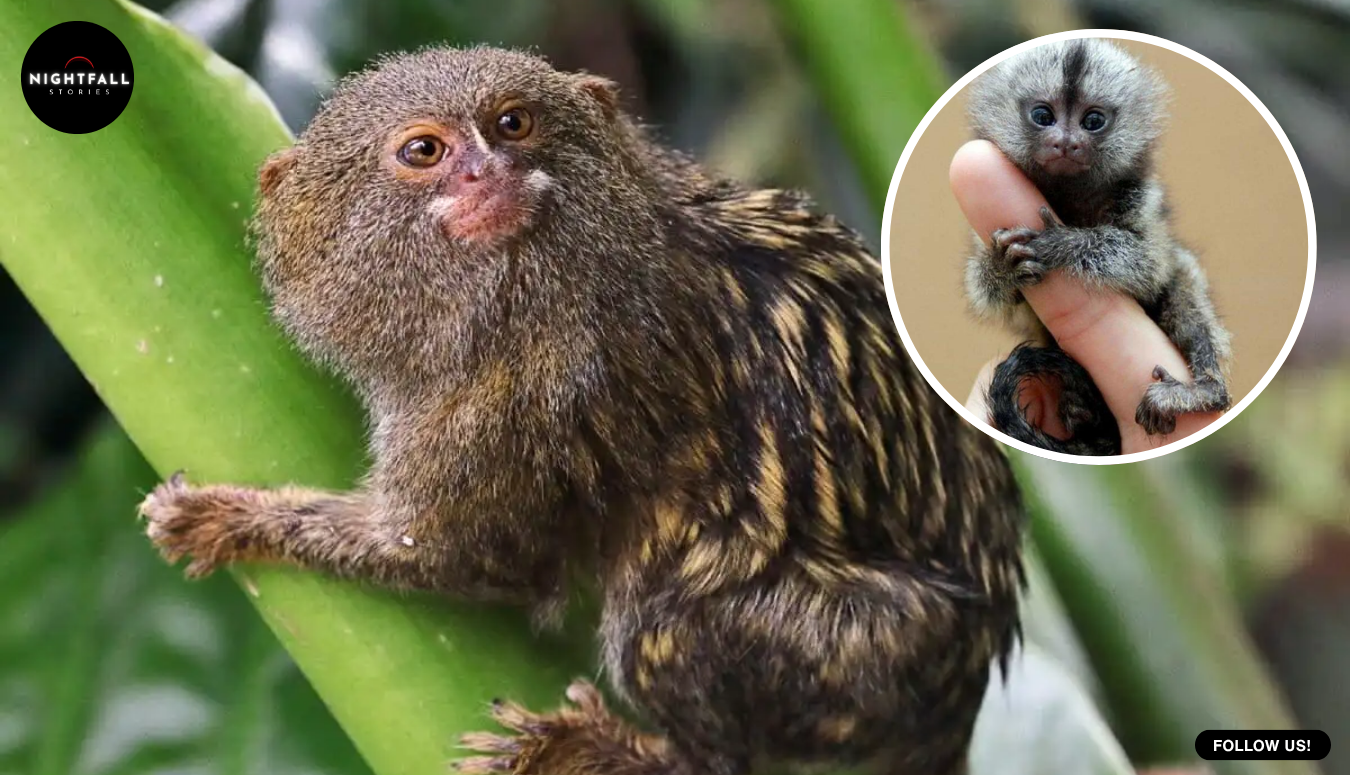
    There is a monkey in the western Amazon that weighs about as much as a small apple. Adults are somewhere around a hundred grams, maybe a bit more depending on whose measurements you trust, with a body barely longer than your palm and a tail longer than the body. They live in the tangled middle layers of riverside forest, they gouge holes in bark with specialised front teeth and drink the gum that seeps out, and they can flatten themselves against a trunk and simply stop existing as far as your eyes are concerned. They are called pygmy marmosets, and they are the smallest monkeys on Earth.

    A team in the Ecuadorian Amazon recently went looking for them using sound instead of sight. They put passive acoustic recorders out through the forest around a Siekopai community called Siekoya Remolino, in territory where people have lived and hunted and watched animals for generations and where elders could point to the places these monkeys used to be. The recorders ran. The audio came back. Nobody has confirmed a single pygmy marmoset call in it.

    That is the result. And the interesting thing about it, the thing worth spending a few minutes on, is that it does not mean what most people’s instinct says it means.

    Start with why sound was the plan at all. If you are trying to survey an animal the size of a pygmy marmoset in dense Amazonian forest, your eyes are close to useless. The animals are tiny, cryptic, mottled in exactly the colours of bark and lichen, and they specialise in not moving. Camera traps are set up for creatures that walk past at knee height on a trail, which is not what a marmoset does. You could put ten skilled observers in that forest for a month and come out with almost nothing, and you would not know whether that meant the monkeys were gone or that you were bad at finding them.

    Sound, in principle, solves that. Pygmy marmosets are noisy for their size. They have a layered vocal repertoire that changes with distance: short trills used when the group is tight together and feeding, a rapid repeated call for medium range contact, and a long call for when individuals get properly separated. If you can pick those calls out of a recording, you have a detection without ever having seen an animal. Better still, a recorder does not get bored, does not scare anything away, and runs for weeks in a place where a human observer would last an afternoon.

    It helps to know how these monkeys actually live, because it explains why finding them is so hard. A group is usually somewhere between two and nine animals, most often about six, built around a breeding pair and their offspring from several successive litters, which typically arrive as twins and get carried and fed by the whole group rather than just the mother. That group does not roam. It anchors itself to a small number of gum trees, the ones it has spent weeks carving holes into, and it works that patch over and over. The holes keep producing as long as they are reopened, so a pygmy marmoset family can occupy a territory you could walk across in a couple of minutes and stay there for a long time. They also lick up insects that come to the sap, which is a nice piece of economy.

    All of that means the animals are not spread evenly across a forest. They are in clumps, tied to particular trees, and the space between clumps can be entirely empty. A recorder hung a short distance away from one of those clusters may as well be hung in a different country.

    So the team, working with the conservation technology outfit Neblina Labs and with the community, combined three things that do not normally get combined. They had the acoustic recorders. They had the community’s own territorial monitoring work, including camera traps already out in the forest. And they had something harder to buy: a map built from what people remembered. Where the marmosets had been seen. Which stretches of riverbank used to have them. Where they had stopped turning up.

    The researcher leading the work, Nicolás Schuldt Durán, has described these animals as extremely sensitive to disturbance, and that observation did not come from a paper. It came from the people living there, who say the monkeys become scarce when the forest around them is degraded. That is the reason anyone is chasing this species with microphones in the first place. If they really do disappear early, before the bigger and more obvious wildlife does, then their presence or absence is a readout on how intact a forest actually is. A living gauge, rather than a satellite image that tells you the canopy is still standing while everything underneath it quietly empties out.

    Then the pilot returned no confirmed detections, and this is where you have to be careful, because there are two very different sentences available and only one of them is true.

    The false one is: the pygmy marmosets are gone from that forest.

    The true one is: in this deployment, over this period, in these locations, with these detection methods, nobody confirmed a pygmy marmoset call.

    The gap between those is enormous, and it is not a technicality. It is the central problem in all wildlife survey work, and it has a name. If you detect an animal, you know it was there. Presence is close to proof, assuming you identified the sound correctly. But a non-detection is compatible with a long list of scenarios, and only one of them is that the animal is absent.

    Consider what else could produce silence. The recorders might have been in the wrong places, a few hundred metres off from where a group actually lives, which in a species with a home range this small is easy to do. The animals might have been present and simply quiet during the recording window, because vocal activity in primates swings with the time of day, the season, group size, whether a group is feeding or resting, and whether there is anything worth calling about. The calls might be in the recordings and not yet found, because a pilot project is often building its detection model at the same time as it collects the data, and an automated classifier that has not been trained on enough verified examples of a call will happily miss every instance of it. The calls might sit at frequencies awkward for the equipment, since marmoset vocalisations run very high and have reportedly been described as reaching toward the top of what people can hear. Rain, insects and river noise can bury a faint high call entirely. And the survey might have simply been too short, which is the most likely explanation of all for an animal that occurs at low density in patchy habitat.

    Statisticians who work on this have a whole framework for it, built on the idea that detection probability is always less than one and you have to estimate it rather than assume it. The practical consequence is straightforward: you cannot get to absence from one round of surveying. You get to absence, or rather to a defensible probability of absence, by repeating the survey in the same places enough times that you can separate “not there” from “there and not heard.” One deployment cannot do that. It was never going to.

    Which means the honest reading of this pilot is that it is inconclusive about the monkeys, and genuinely useful about almost everything else.

    Because the recorders did not come back empty. They came back loaded with the sound of a functioning Amazonian forest, which is a dataset with a long shelf life. Birds, frogs, insects, other primates, the whole layered racket that a rainforest produces around the clock. That material can be mined for years, and it can be re-searched later with better models, which is a thing you cannot do with a field notebook. If somebody trains a reliable pygmy marmoset classifier two years from now, they can run it back over this audio and find out whether the calls were in there the whole time.

    The pilot also produced the classifiers themselves, or the beginnings of them, plus a set of decisions about where to put the equipment next and how long to leave it there. The team’s stated plan is longer deployments, placement guided by the community’s mapping of where the monkeys historically were, and a wider set of biodiversity indicators alongside the marmoset rather than instead of it. In other words, a search that found nothing produced the method for the search that might. That is not a consolation prize. In field ecology that is more or less how the first season is supposed to go.

    It is also worth understanding the physical scale of what these projects generate, because it shapes what can go wrong. An acoustic unit left in a forest is running on batteries and writing to memory cards, so it almost never records continuously. It records on a schedule, a few minutes on and a few minutes off, or a set block at dawn and another at dusk, and every gap in that schedule is a gap where a call could have happened unheard. What comes back is still an enormous amount of audio, far more than any person could listen to, which is why the automated classifier is not a luxury but the only way through. And a classifier is only as good as the verified examples it was trained on. For a well studied bird you can find thousands of labelled recordings. For the calls of the smallest monkey in the world, in one specific corner of Ecuador, you may be starting close to scratch.

    There is also something quietly important about who is doing the looking. The Siekopai are not a large nation. There are something like seven hundred in Ecuador and perhaps a thousand or so in total counting those on the Peruvian side of the border. They were forced out of a core part of their ancestral territory, a wetland region they call Pë’këya, during a border war in the 1940s, and they spent generations trying to get back. A few years ago a provincial court in Ecuador ruled in their favour and ordered that ownership of more than forty two thousand hectares there be recognised, the first time the country had granted Indigenous land title inside a protected area. It was treated, correctly, as a landmark.

    It has also not been simple. Reporting since then has described the title itself as still undelivered, with deadlines missed, a judge threatening penalties, and a competing claim from another community complicating everything. Mediation has been discussed. A legal victory and a resolved situation turn out not to be the same thing.

    Set that beside the marmoset survey and you can see why it matters that the two are connected. A community fighting to hold territory benefits enormously from being able to say, with evidence, what lives in it and what condition it is in. Conservation technology companies talk about this in the language of measurement and verification, of being able to demonstrate ecological impact with the kind of evidence that funders and courts take seriously. Underneath the jargon is something simpler. If you can prove the forest is alive, you have an argument. If all you have is the assertion that it is alive, you have a weaker one.

    And the people who live there were never going to be just the local guides on this. The map of where the marmosets used to be is not background colour; it is the sampling design. Without it, you would be scattering recorders across a large forest more or less at random, and your chance of landing near a group of hundred gram monkeys with small home ranges would be close to nothing. Generations of observation is what turns an impossible search area into a shortlist.

    It is worth saying plainly what nobody yet knows. It is not established that pygmy marmosets have declined at this site. They are listed as vulnerable globally, and the pressures on them are well documented: habitat loss as riverside forest is cleared, and capture for the pet trade, which this species suffers from precisely because it is small and appealing and easy to imagine in a cage. But global status is not local status, and the community’s impression that there are fewer than there used to be is exactly the kind of observation that a survey is meant to test rather than confirm. It might turn out to be right. It might turn out that the monkeys are there in reasonable numbers and were missed. Both outcomes are still live.

    What you can say is that somebody is now set up to find out, which was not true before. The equipment is proven in that environment. The community mapping exists. The processing pipeline exists. There is a baseline recording of the whole soundscape to compare future years against. And crucially, everyone involved has been open about the fact that the first pass found nothing, rather than quietly reframing a null result as a preliminary finding or letting it disappear.

    That openness is rarer than it should be. There is a strong pull in conservation work, as in science generally, toward announcing what was found and staying quiet about what was not, because funding follows discoveries. A team saying, in public, that they listened hard and heard nothing, and that this does not yet prove anything either way, is doing the unglamorous thing correctly.

    So the story does not end with a monkey. It ends with an open question and a much better way of asking it. Somewhere in that stretch of Amazon, there may be small groups of the smallest monkeys in the world moving slowly up trunks, gouging holes in bark, trilling to each other at frequencies at the edge of human hearing, and not one of them has said anything into a microphone yet.

    The recorders are going back out, for longer this time, in places chosen by people who know where to look. If the monkeys are there, sooner or later somebody is going to hear them.

  • The rock star got a message from a museum. It was not about music.

    The rock star got a message from a museum. It was not about music.

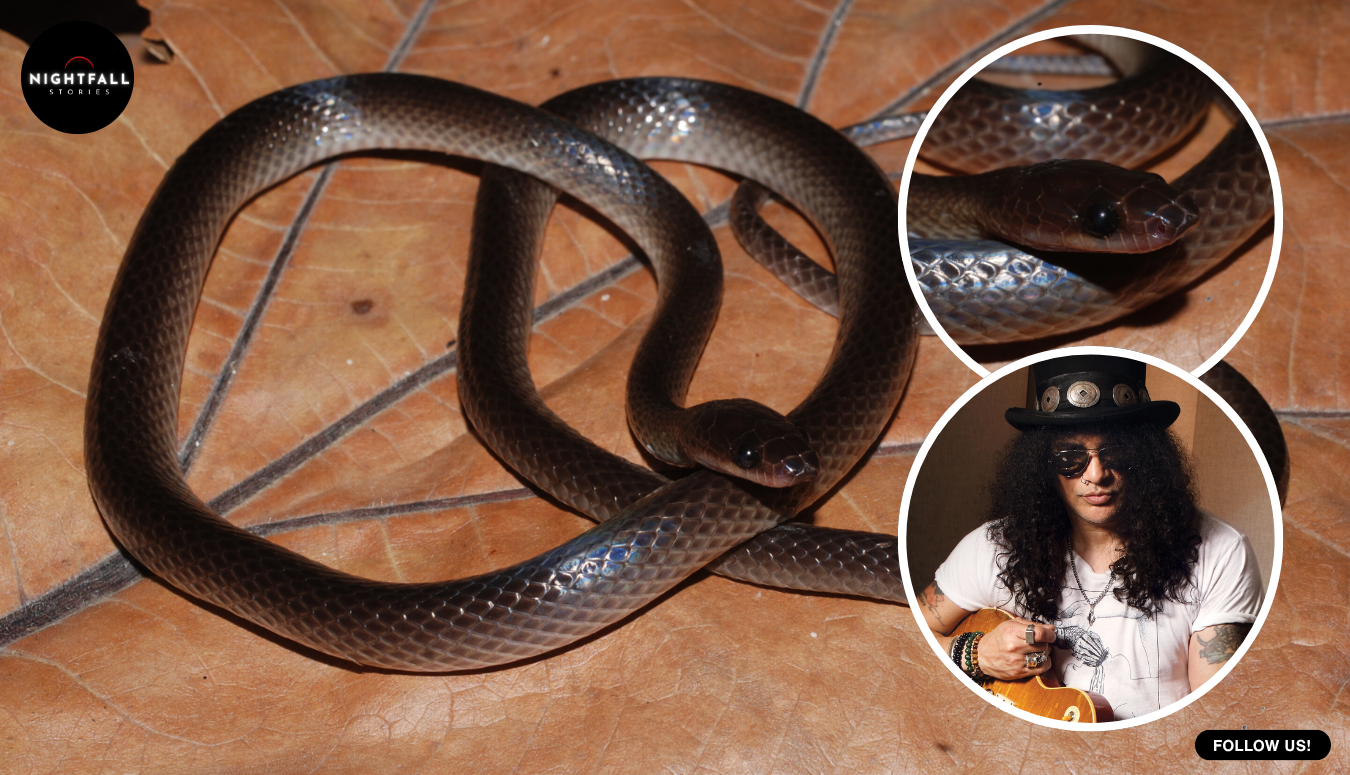
    Somewhere in the collections of a natural history museum in Chicago there is a snake in a jar, about the length of your forearm and then some, reddish-brown all over, with no stripes or bands or blotches to make it interesting. It is not venomous. It is not enormous. It is the sort of animal that a person could step over in the dark without ever knowing it was there. And for twenty years, nobody knew what it was.

    It has a name now. The name is Lielaphis slashi, and it belongs to the top-hatted guitarist from Guns N’ Roses, who has kept snakes since he was eleven years old and who turned up at the museum in person to meet the animal that now carries his name.

    That is the short version, and it is a good story on its own. The longer version is better, because it is about what actually happens to a small brown snake between the moment somebody picks it up in a forest at night and the moment it gets a name, and about why that gap was two decades long, and about a scientist who kept a magazine from her childhood on a shelf for thirty years without ever imagining what it would eventually be good for.

    Start with the forest. In 2006, a herpetologist named Chris Austin was doing night fieldwork in Sandaun Province, in the northwestern lowlands of Papua New Guinea. Austin is a curator at the Louisiana State University Museum of Natural Science, and looking for snakes after dark in New Guinea is a very specific kind of work. Groundsnakes there tend to sit at the base of big trees once the sun goes down, which means you walk with a torch, slowly, checking tree roots, in a country that also happens to hold some of the most seriously venomous snakes on the planet. Austin has said the nocturnal ones are especially hard to find, which is a mild way of describing a job where the animal you want is small, brown and hidden and the animal you do not want is also out there.

    There is a detail in the fieldwork photographs that makes the whole enterprise feel less abstract. Austin is standing in the field with colleagues from the Papua New Guinea National Museum and Art Gallery, in ordinary clothes, in ordinary bush, in a place that does not look remotely like a laboratory. This is what the front end of taxonomy actually is. Somebody walks around at night for weeks, finds a few dozen animals, and ships them home with catalogue numbers attached, and then the interesting part happens years later in a building thousands of miles away.

    He found this one in secondary forest. It looked like a groundsnake. It went into a jar, into a collection, into a catalogue, filed under a species that had already been described. That is not carelessness. It is the correct thing to do when an animal looks exactly like something already known, and this one did.

    Here is the problem with New Guinea groundsnakes, and it is the reason the story has a twenty-year hole in the middle of it. They all look the same. The genus is full of medium-sized terrestrial snakes that are nocturnal, secretive, poorly recorded and almost uniform in appearance. They also have what the researchers politely call a complex taxonomic history, meaning that for more than a century scientists have been shuffling them between genera, lumping them together, splitting them apart, and generally disagreeing. The genus these snakes now sit in, Lielaphis, was itself only recently brought back into use after years out of circulation. When the animals in front of you are effectively indistinguishable by eye, you cannot count on your eye.

    What eventually cracked it was genetics. Tianqi Huang, the first author on the study, is a researcher who has worked across the Field Museum and Rutgers University, and the team ran a stack of modern genetic analyses on the group. The snake from Sandaun Province came back genetically distinct from everything else in the genus. Not slightly unusual. Distinct.

    Once the DNA said look again, the physical differences started to show up. The scale counts are not the same. This species runs somewhere in the range of a hundred and sixty-five to a hundred and eighty-one ventral scales along the belly, with eighty-three to a hundred and seven divided scales under the tail, seventeen rows of scales around the middle of the body, and a cream-coloured underside that may darken very slightly toward the tail. Those numbers are not exciting to read. They are how snake identification actually works, and they are the difference between an animal that exists on paper and an animal that does not.

    The team also ran ecological modelling and found that this snake prefers different conditions from its closest relatives, which is another argument for it being its own thing rather than a regional variation on something known. The description was published in the taxonomic journal Zootaxa. With it, the genus Lielaphis went from nineteen species to twenty.

    None of that, by itself, would have travelled beyond people who read taxonomy journals for a living. What made it travel was the second word in the name.

    Sara Ruane is the associate curator of herpetology at the Field Museum and the senior author on the paper. She has been obsessed with reptiles since she was a child, which is the standard origin story for herpetologists and is also, in her case, the load-bearing detail. Back in the mid-1990s, a copy of Reptiles Magazine came out with Slash on the cover, holding a python. She was a kid. She read it. She kept it.

    Thirty years later, with a species that needed a name, she went back and reread that old interview. What struck her was not the celebrity of it. It was that he talked about loving museums and zoos and natural history, which is precisely the set of things she has spent her career inside. A scientific name is permanent in a way almost nothing else is, and naming one after somebody is a real statement about what you think is worth honouring. She and her co-authors chose him for his long public advocacy for snakes, zoos and museums, which is stated plainly in the paper’s etymology section under his legal name, Saul Hudson.

    The advocacy is not decorative. At his peak he kept something like eighty snakes, mostly boas and pythons, including Burmese pythons, reticulated pythons, red-tailed boas, Dumeril’s boas, anacondas and kingsnakes, in enclosures he treated as part of the furniture. He had been keeping them since childhood. He eventually gave the collection up, and his reason for doing so is one of the most relatable things a rock star has ever said about a hobby: feeding all of them by himself had turned into a job, and he missed when it was simpler.

    He described himself, in response to the naming, as a long-time herpephile, and said he was honoured and humbled. Then he came to Chicago. There is a photograph from that visit of Ruane standing beside him in the museum holding up her copy of the magazine, the one with his face on it, the face now standing next to her. Behind them is the kind of room most visitors never see, shelves of jars, a collection built across more than a century.

    It is worth sitting with what that room is, because it is the actual engine of this story. Museum collections look like storage and function like a time machine. An animal collected in 2006 can be reexamined in 2026 with technology that did not exist when it was picked up, by scientists who were not yet working when it went into the jar. The specimen does not degrade into uselessness. It waits. There are drawers in institutions all over the world full of animals that are quietly new to science and are simply waiting for somebody to run the right test on them, and the researchers on this paper have said outright that they expect more undescribed species in this same group.

    That is a cheerful thought and also an uncomfortable one, because the waiting is not free. The forests in that part of New Guinea are under pressure from agriculture, including coffee farming, and from mining. Ruane has been direct about it: the habitat this snake comes from is being eaten into. An animal can be lost before it is ever described, which means it can be lost without anyone being able to say what was lost, because there is no name to put on the loss. Conservation runs on lists, and lists run on names. A species that has not been described does not appear in an impact assessment, does not appear in a protected-species schedule, does not appear anywhere at all.

    New Guinea is the largest tropical island on Earth and one of the most biologically rich places anywhere, with an enormous share of its plants and animals found nowhere else. It is also one of the least thoroughly surveyed. Those two facts together are why a snake can sit unrecognised for twenty years in a well-run museum: not because anyone was asleep, but because the backlog of undescribed life from that island is genuinely vast and the number of people qualified to work through it is genuinely small. Every described species is one item cleared from a queue that nobody has ever seen the end of.

    The habit of naming species after people is older than most of the institutions that do it, and it has always been a bit of a mixed bag. Plenty of patronyms honour funders and collectors and colonial officials, and a fair number honour people who would not survive a modern background check. In recent years scientists have argued publicly about whether the practice should continue at all. What tends to get lost in that argument is that a patronym is one of the very few chances a working scientist gets to point at something in the wider world and say publicly that it mattered to them. Ruane pointed at a guitarist who spent his whole life telling people that snakes were worth caring about, which is, on the evidence, a defensible use of the privilege.

    That is the honest argument for why taxonomy matters, and it is not a romantic one. Ruane has made the point that every species needs to be recognised before anyone can understand how an ecosystem actually works. You cannot model a food web out of blanks.

    The paper itself is also a reminder that this kind of work is not done by lone heroes. Seven people are on it. Alongside Huang, Austin and Ruane there is Justin Bernstein, who has worked at Slippery Rock University and the American Museum of Natural History, Jackson Roberts of the Virginia Museum of Natural History, Jeffrey Frederick of the University of Kentucky, and Bulisa Iova of the Papua New Guinea National Museum and Art Gallery. That last name matters more than it might look. Research on New Guinea’s wildlife has a long history of specimens leaving the country and the science happening elsewhere, and having the national museum on the author line is a small correction to that pattern. Austin’s own fieldwork photographs from Sandaun Province show him working alongside colleagues from that same institution.

    As for the snake, it lives a life nobody has watched properly. It comes out at night. It has enlarged teeth at the back of its mouth rather than fangs at the front, which is the standard toolkit for an animal that eats small lizards and reptile eggs rather than anything that needs subduing. It does not constrict. It poses no danger to a human being whatsoever, which is the detail most worth repeating, because the first instinct a lot of people have about a snake story is fear and this is an animal about the length of a violin that hunts geckos in the dark.

    Almost everything else about it is a blank. Nobody has documented its breeding, its lifespan, how many there are, or how widely it ranges. The scientists who named it are open about that. Describing a species is not the end of the work. It is the point at which the work becomes possible, because now there is something to ask questions about.

    There is a neat symmetry in how this ended up. A child reads a magazine because a guitarist she thinks is cool is holding a python, and the coolness is the hook but the python is the point, and she grows up to run a herpetology collection. Decades later she is holding a jar containing an animal that has been nameless since before she had the job, and the name she reaches for is the one from the cover. The guitarist, meanwhile, had been a kid who liked snakes long before he was famous, and stayed one through eighty enclosures and a touring career and giving the whole collection up again.

    Neither of them planned any of it. That is usually how this goes. Scientific names are a strange kind of permanence, more durable than records or awards or buildings, because as long as the species is recognised the name travels with it through every paper and field guide and database that will ever mention it. It does not expire. It does not go out of fashion.

    Somewhere in the northwestern lowlands of New Guinea, in forest that is being pressed in on from several directions at once, there are more of these snakes moving around the roots of big trees after dark, doing exactly what they were doing twenty years ago when a man with a torch happened to walk past one of them. They have no idea any of this happened. They have a name now anyway, and because of that, somebody can finally start arguing for them.

  • Eight thousand miles of open ocean, and they knew where to knock

    Eight thousand miles of open ocean, and they knew where to knock

    There is a stretch of the North Pacific, hundreds of miles from any coastline, where the law effectively runs out. No country owns that water. No police force patrols it. A fishing boat working out there answers to exactly one government, the one whose flag is painted on its stern, and that government may be six thousand miles away and not especially interested.

    So when a small boat pulls alongside in that emptiness and officers in survival suits climb the ladder onto the deck, the first thing to understand is that almost nobody aboard the approaching boat has the power to arrest anybody. They cannot seize the catch. They cannot detain the crew. They cannot order the vessel anywhere.

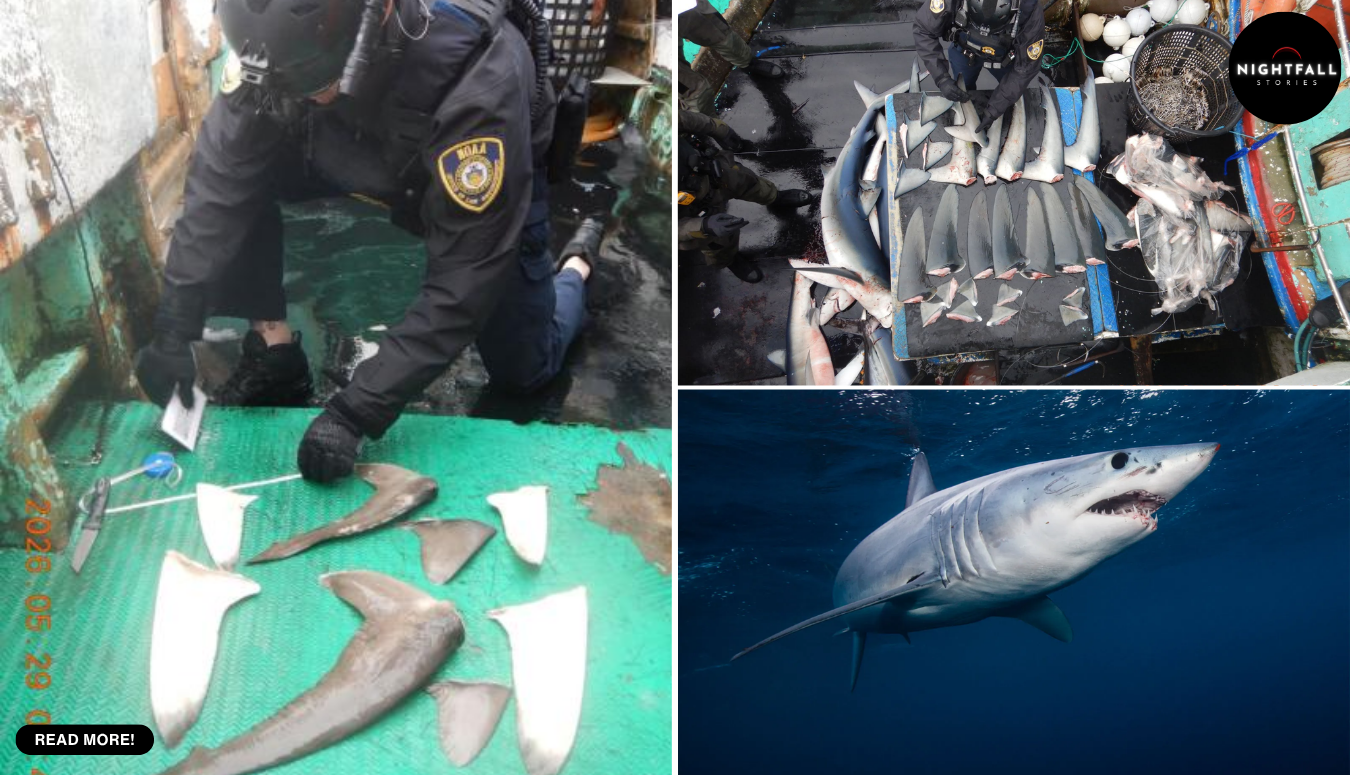
    What they can do is look. And this year, across a patrol that ran for about two months and covered a distance you would struggle to picture, what they found on dozens of those decks was dozens of apparent violations, including shark finning, gear designed to catch sharks that is not allowed to be aboard, prohibited species in the hold, catch records that did not match the catch, and vessels fishing without the simple measures that keep seabirds off the hooks.

    The operation is called North Pacific Guard, and despite how new all of this sounds, it has been running in one form or another for more than thirty years. It started as an enforcement response to the United Nations moratorium on high-seas driftnets, those enormous walls of mesh that caught everything that swam into them, and over the decades it widened into a general effort against illegal, unreported and unregulated fishing across the northern Pacific.

    It is not one country’s operation. It is a working arrangement between several, and this year the at-sea backbone of it was a Canadian ship, the coast guard vessel Sir Wilfrid Laurier, carrying Canadian fishery officers, Canadian coast guard crew, federal police, and enforcement officers from the United States, with the Japanese fisheries agency, the Japan Coast Guard and Korean authorities working the same problem from their own platforms.

    Canada’s fisheries department put the patrol at more than 23,000 kilometres over roughly two months. The American fisheries agency, describing the deployment of its own enforcement officers, gave the figure as more than 8,000 nautical miles. The two numbers cover slightly different things and should not be blended into one, but either way the distance is absurd. This was a very long time at sea to go knocking on doors.

    Nineteen Canadian fishery officers took part, five of them on the aerial side of the operation rather than the ship. Between them the sea patrol monitored several hundred fishing vessels, spoke with more than five hundred crew members, and conducted thirty full boardings on the high seas. Those thirty boardings produced fifty-two potential violations, according to the Canadian department’s own count.

    Thirty boardings sounds modest until you think about what one of them involves. You are in open ocean. You launch a small boat off a moving ship into whatever the swell happens to be doing. You come alongside a working fishing vessel that may be considerably larger than the boat you are standing in, with a crew who were not expecting you and may not share a language with you, and you climb up. Then you spend hours going through a vessel you have never seen before, in spaces that were not designed for visitors, trying to establish what has been caught, how it was caught, what is on the books and what is not.

    The violations that came back are worth reading slowly, because each one is a different kind of problem. Shark finning is the removal of fins with the rest of the animal discarded, which is prohibited under the conservation rules that apply in these waters, and it turned up in the inspection results. So did gear specifically prohibited because of what it is designed to catch. So did prohibited species aboard. So did misreporting of catch, bycatch and discards, which is the quiet one and arguably the most corrosive, because every fisheries quota in the world is calculated from numbers that boats report about themselves.

    And so did failures to use seabird protection measures, which is the violation most people have never heard of. Longline vessels set lines with thousands of baited hooks. Albatrosses and petrels follow the boats, take the bait as it goes into the water, get hooked and drown. The fixes are not exotic. Streamer lines that scare birds away from the sinking bait, weighting that gets hooks under the surface faster, setting at night. They cost very little and they work, which is why leaving them off is treated as an offence rather than an oversight.

    The air side of the operation found its own set of problems. Flying out of Hokkaido in northern Japan, surveillance crews surveyed 344 fishing vessels and identified twenty-one further potential violations, including shark finning, the killing of dolphins, pollution from vessels, and boats that were not properly marked. That last one matters more than it sounds. A vessel with no clear identifying marks is a vessel that cannot easily be reported, traced or matched to a registry, and unmarked boats are a standing feature of illegal fishing everywhere.

    Then there is the part that makes the whole enterprise feel almost fragile. Having spent two months and a very large amount of fuel documenting fifty-two potential violations at sea and twenty-one more from the air, the officers did not prosecute anyone. They could not. On the high seas, jurisdiction over a fishing vessel belongs to its flag state, and only to its flag state. So every case was packaged up and passed on, confidentially, to the government whose flag the vessel flew and to the regional fisheries management organisations that set the rules in that part of the ocean.

    The reason it works that way is not an oversight. It is the deliberate design of the law of the sea. Outside any nation’s exclusive economic zone, the flag a ship flies is the legal thread connecting it to a government, and that government is the one responsible for making it behave. The system was built on the assumption that every flag state would take that duty seriously. In practice some do, some are overwhelmed, and a few run registries that exist mainly so that a vessel can fly something, which is the weakness the whole enterprise of high-seas enforcement is built around rather than able to fix.

    The regional fisheries management organisations sit on top of that. They are treaty bodies where the countries fishing a particular stock in a particular ocean agree what the limits are, what gear is allowed, which species are off the table and what protections have to be used. They have no police force either. Their power is the power to list a vessel, to name it, and in the worst cases to cut it out of the legal market so that no member state will let it land a catch. A referral from a patrol like this one is the raw material for that.

    What happens next is somebody else’s decision, in another country, on another timetable. The referral might end in a serious penalty. It might end in a licence being pulled or a vessel being barred from fishing altogether. It might end in nothing at all, and the officers who spent hours counting fins and comparing logbook entries against what was actually in the freezer will not necessarily ever be told which.

    That is a strange job to hold. You are not building a case you will see through. You are building a case you will hand to a stranger. The entire value of your work rests on whether it is documented well enough, photographed clearly enough and written up carefully enough that an official on the other side of the world, reading it cold, decides to act.

    The Americans involved have described it in roughly those terms. An assistant director in the enforcement arm of the US fisheries agency, Benjamin Cheeseman, framed the officers’ work as directly protecting both the integrity of the oceans and the livelihoods of fishermen back home who play by the rules, which is the honest business case for all of it. Every tonne taken illegally is a tonne that comes out of a shared stock, and the people who lose most from that are the operators who report their catch accurately and stop fishing when their quota runs out.

    The United States ran a separate leg with its own vessel, the cutter Midgett, on a twenty-five day patrol that produced eight high-seas boardings and identified three potential breaches of conservation measures along with further issues including illegal shark fin harvesting. The officer who led that effort noted that the operation has been pushing back on illegal fishing on the high seas for more than three decades, with a direct effect on American fish stocks and the seafood economy that depends on them.

    What is new this year is smaller than a ship and probably more important. For the first time, a Canadian fishery officer sailed aboard a Japanese patrol vessel while a Japanese officer sailed aboard the Canadian one. That is a swap, not a policy, and it will not make any headlines. But an enforcement system that depends entirely on one country trusting another country’s paperwork gets better the moment officers have actually worked alongside each other, seen how the other side runs a boarding, and know a name to put on an email.

    Canada’s fisheries minister, Joanne Thompson, made the wider point plainly enough when the results were released, which is that protecting fish stocks does not stop at a national boundary. It is the kind of line ministers say. It also happens to be the entire technical problem. Fish do not observe borders, fleets follow fish, and the water where most of the fishing pressure lands is water nobody governs.

    The ship did other work along the way, because ships at sea always do. The Canadian coast guard crew took water samples for microplastics research and gathered environmental data while they were out there, the sort of piggybacked science that gets done because a vessel is already crossing an ocean and may as well be useful. They also rescued three people from a sailing vessel in distress, which is a reminder that a coast guard ship is a coast guard ship first, whatever else it has been sent to do.

    One detail from the patrol imagery is worth pausing on, because it explains how catch gets laundered. Fishing vessels on long voyages often do not sail home with what they have caught. They pass it across at sea to a refrigerated carrier vessel, which takes the fish to port while the fishing boat stays out working. That transfer is called transshipment, and where it is properly observed and reported it is simply efficient. Where it is not, it is the point at which the origin of a fish becomes untraceable, because several boats’ catches are mixed in one hold and nobody ashore can say which came from where.

    That is why a logbook discrepancy is treated as seriously as a net. The paperwork is the only part of a high-seas fishery that follows the fish all the way to a plate, and if the paperwork is fiction, every downstream promise about sustainable sourcing is fiction too.

    It is worth being careful about what this year’s results do and do not prove. No vessel names have been released. Nobody has been charged. The violation counts are the enforcement agencies’ own characterisation of what their officers observed, not findings of any court, and the word potential is doing real work in every one of those numbers. Some of those fifty-two will turn out to be administrative confusion. Some will turn out to be worse than they looked.

    What the numbers do show, fairly reliably, is a rate. Thirty boardings, fifty-two potential violations. That is not a picture of a handful of rogue operators in an otherwise orderly fishery. That is a picture of a place where the rules are widely treated as optional, which is what you would expect in the only large part of the planet where enforcement depends on a ship happening to be nearby and the crew of that ship having the fuel, the weather and the daylight to come and look.

    There is a version of this story that is bleak, and it is not hard to write. Two months, an ocean crossing, an international crew, and at the end of it a stack of reports mailed to governments that may or may not open them.

    But there is a better way to read it, and the officers who do this work seem to hold onto it. The high seas are not actually lawless. They are governed by rules that a lot of countries agreed to and that almost nobody is physically present to enforce. Presence is the entire product. A fleet that knows a patrol might turn up behaves differently from a fleet that knows one never will, and thirty boardings scattered across thousands of miles of water do not just generate fifty-two reports. They generate a rumour, passed between boats, that somebody is out there.

    That is a thin thing to build ocean governance on. It is also, for now, most of what exists. The alternative is nobody knocking at all, and everyone who works this stretch of water knowing it.

  • The museum’s 120-year-old mascot is now working a poaching case

    The museum’s 120-year-old mascot is now working a poaching case

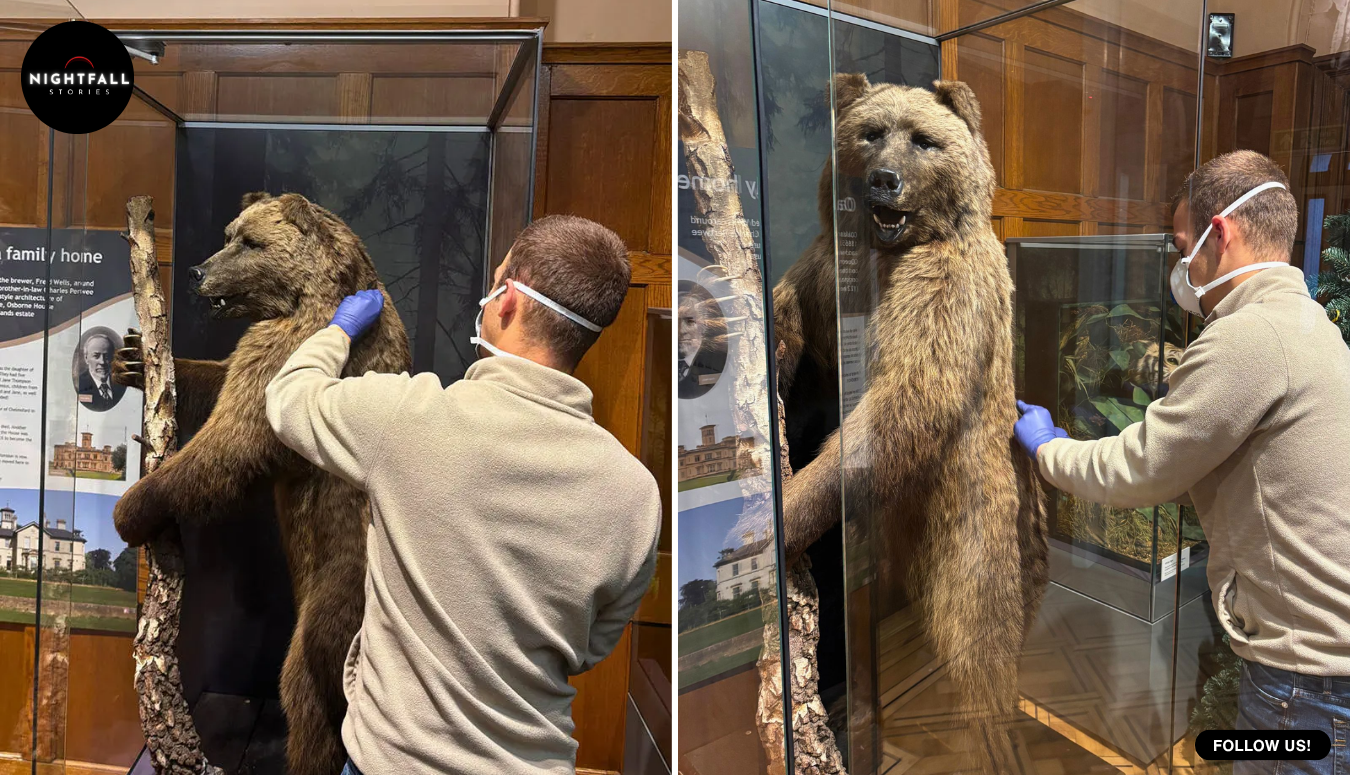
    For most of a century, the brown bear standing in a small English museum has been the least serious object in the building. Children have hugged him. Toddlers have been named after him, sort of, because the museum’s under-fives club is called Boris Bear Cubs. He has been in the same room since 1932, watching school groups file past, and nobody who patted his flank on the way to the cafe ever thought of him as evidence of anything.

    He is evidence now. A forensic science researcher asked the Museum of Chelmsford whether she could take hair from him, the museum thought about it and said yes, and those hairs are being turned into a reference library that could eventually help identify bear poaching across Europe using nothing more expensive than a microscope.

    That last part is the whole point, and it is worth slowing down on, because it explains why a 120-year-old taxidermy bear in a municipal museum suddenly matters. When wildlife officers seize a bag of fur, or find a tuft snagged on a fence, or open a crate at a border post and find something that might be bear and might be dog, the gold-standard answer is DNA. DNA is reliable, DNA is accepted in court, and DNA is also expensive and slow and requires a functioning laboratory with trained staff and a supply chain of reagents. A great deal of the world’s poaching happens a long way from any of that.

    A microscope is different. A decent comparison microscope is a one-off purchase that lasts decades, needs no consumables, and can sit in a regional office in a country where sending a sample abroad for sequencing would eat a year’s enforcement budget. If you can look at a hair down a microscope and say with confidence that it came from a brown bear rather than a boar, a dog or a cow, you have a screening tool that works where the expensive tool does not. You can triage. You can decide which seizures are worth sending for full analysis and which are not.

    The catch is that this only works if somebody has already done the boring, unglamorous work of building the reference. Microscopic hair identification is a comparison discipline. You are not reading a barcode, you are matching what is in front of you against what is known, and the known part has to exist first. For domestic animals it largely does. Hayden Leigh, the researcher behind the project, has pointed out that there are hundreds of studies on dog hair and cat hair and the general run of household species, because those are the animals that turn up in ordinary criminal casework. Somebody’s jumper has cat hair on it. A burglar’s car has dog hair in the footwell. The forensic literature followed the caseload.

    It helps to know what an examiner is actually looking at, because hair down a microscope is not the featureless thread it appears to be in daylight. There is an outer cuticle covered in overlapping scales, and the pattern those scales make differs between species in ways that are consistent enough to be diagrammed. There is a medulla running down the core, sometimes continuous, sometimes fragmented, sometimes absent altogether, and its structure is one of the strongest species indicators there is. There is pigment distribution, banding along the length, the shape of the hair in cross section, the way it tapers, the root. A trained examiner reads those features together rather than relying on any single one, and with a good reference set the species-level call can be made quickly and cheaply.

    There is a caution attached to all of this that the field has learned the hard way. Microscopic hair comparison has a bruised reputation in human forensics, because for decades examiners in some jurisdictions testified that a hair from a crime scene matched a specific person, and a major review in the United States later concluded that a large share of that testimony had overstated what the science could support. The lesson was not that microscopy is worthless. It was that microscopy cannot individualise. Saying this hair came from that one particular human being is a claim the technique cannot carry. Saying this hair came from a bear rather than a dog is a completely different order of question, and it is the question the method is genuinely good at. Work like this stays carefully on the right side of that line, which is also why the reference set has to be built properly rather than assembled from whatever was lying around.

    Wild species did not get the same treatment. The animals most likely to be trafficked are, in many cases, the animals least likely to have a published reference set, which is an absurd situation when you think about it for more than a second. Brown bears live across Romania, Bulgaria, Russia and a scatter of other countries, they are protected in most of them, and they are still killed illegally for parts and trophies. The hair is there at almost every stage of that trade. The reference to match it against largely is not.

    Which brings the problem back to a very practical question. Where do you get bear hair to study, in quantity, without harming a bear?

    You cannot walk up to a wild one. Zoo animals are possible but limited and heavily managed. Confiscated material is tied up in live cases and often degraded. The obvious remaining source is the one nobody thinks about, which is the enormous quantity of dead animals already sitting in museum cabinets, killed long ago by people with very different attitudes, and now doing nothing except being looked at.

    Leigh’s argument, made when she approached the museum, was that taxidermy specimens can do real forensic work. They let you examine authentic animal hair in a controlled and ethical way. Nothing new dies. The animal in the case was killed generations ago by somebody else for reasons that have nothing to do with science, and this at least turns that into something useful.

    The museum did not say yes automatically. Taxidermy collections sit awkwardly in modern museums, and the staff were conscious that Boris is not a specimen to the people who visit him, he is a character. Sampling a beloved object is not a small ask. After some consideration, they agreed, and a small amount of hair came off a bear who has been standing still since before most of the people in the building were born.

    The research question underneath it is narrower and more interesting than it first sounds. Leigh is not simply cataloguing what brown bear hair looks like. She is asking whether it looks the same everywhere on the same bear.

    That matters enormously in real casework, and it is the kind of thing that only becomes obvious when you imagine the actual moment of seizure. An officer does not recover a complete pelt with a map attached. They recover a tuft. A few strands. A clump from the inside of a container. Nobody knows whether that came from the shoulder, the belly, the rump or the face, and if hair characteristics vary significantly across an animal’s body, then a match against a reference built from one region might fail against a sample taken from another. The whole method would be quietly unreliable in exactly the situation it was built for.

    So the work involves comparing hair from different parts of the same animal, measuring how the microscopic features shift, and working out how wide a reference set has to be before it can be trusted. It is slow and it is repetitive, and it is the difference between a technique that stands up to cross-examination and one that does not.

    There is a second practical wrinkle that the work has to account for. Museum hair is old hair. It has been treated with whatever preservatives were normal at the time, exposed to a century of light and dust, and handled by an unknown number of hands. Any reference built from historic taxidermy has to be honest about how those decades might have altered the features being measured, and about which characteristics survive that treatment unchanged and which do not. Structural features like scale pattern and medulla tend to be more robust than colour, which is one reason the emphasis falls where it does. It is another slow question with no shortcut around it.

    Leigh graduated with first-class honours in forensic science and has carried the work forward into doctoral research at the University of Staffordshire, supervised by Professor Claire Gwinnett, who leads the university’s forensic fibre and microplastic research group. Gwinnett’s career is a good illustration of how narrow trace evidence expertise turns out to be weirdly portable. She works on fibres, hair, glass and paint, and the same skills that let you say which jumper shed which thread also let you count microplastics in seawater, which is why her group ended up doing environmental pollution work alongside criminal casework. She teaches wildlife crime investigation, and has collaborated with a wildlife forensic academy in South Africa, where the gap between what a court needs and what a field officer can actually produce is not a theoretical problem.

    There is an honest limit to state here, and it should be stated before anybody gets carried away. This is research in progress. There is no peer-reviewed paper yet, no validated protocol published for other laboratories to adopt, and no case that has gone to court on the back of it. Nobody has been convicted of anything because of Boris. What exists is a well-framed question, a growing reference set, and a plausible route from one to the other. That is how forensic methods actually begin, and most of the techniques that now look inevitable in a courtroom spent years at exactly this stage, being checked by somebody in a lab coat who was not yet allowed to claim very much.

    The museum, meanwhile, got an unexpected second story out of the whole thing. Going back through their own files while the research was being arranged, staff turned up paperwork suggesting that Boris may not have been a male bear at all, and may have been a juvenile rather than an adult. The name has been on him since long before anyone currently working there arrived, and the records behind it are thin. Settling the question properly would mean intrusive genetic testing on a historic specimen, which is not something a museum does casually to an object that generations of visitors think of as a friend. So the mystery sits there, unresolved, and the museum seems fairly relaxed about it.

    That tension is running quietly through the entire project. A taxidermy bear is a relic of an attitude to animals that most museums now find difficult, and Chelmsford has not pretended otherwise. A council representative involved in the decision acknowledged the discomfort directly while making the obvious point in its favour, which is that if a bear killed a century ago can help stop bears being killed now, that is about the best available outcome for an object that cannot be undone. It highlights, as she put it, the scientific value of historic taxidermy collections in a century that did not create them.

    The museum has leaned into it rather than hiding it. This autumn it is running a public talk with Leigh and Gwinnett called Behind the Case: A Bear Poaching Investigation, and the hook is not a slideshow. Visitors get to look at Boris’s hairs under a microscope themselves. Whatever else that does, it collapses the distance between a display case and a laboratory in a way that no amount of interpretive signage manages, because the thing under the lens is the thing in the corner of the room they just walked past.

    It is also a small correction to how people think about museum collections generally. The usual assumption is that a specimen in a case is finished, a closed book, an object whose job is to be looked at. In practice a very large amount of modern science runs on material collected by people who had no idea what it would later be used for. Natural history collections have been mined for evidence of pesticide accumulation, historic disease, shifting body size under climate change and shrinking ranges, all of it recoverable from animals gathered by Victorian collectors with completely different intentions. The collector’s purpose does not constrain the specimen’s usefulness. It just determines what happened to be kept.

    Boris is now part of that. A bear shot somewhere in Europe around 120 years ago, stuffed, sold, installed in an English market town in the 1930s, and stood in the same spot ever since while the world rearranged itself around him, has become a physical standard against which future evidence might be measured. He did not do anything. He never does. That is rather the point of him.

    What happens next is undramatic and will take years, which is the usual shape of anything that ends up being genuinely useful. The reference set grows. The variation between body regions gets measured and written up. If it holds, the work gets published, and other researchers try to break it, and if they cannot, it eventually filters into training material and then into the toolkits of people who investigate wildlife crime for a living in places where the nearest sequencing facility is a plane ride away. Somewhere down that chain, an officer looks at a hair through a lens and knows what they are holding.

    The bear will not be there for that. He will be in Oaklands Park, in the same room, being photographed by children who have no idea, and who will keep calling him Boris regardless of what the files eventually say.

  • He flew 14,100 kilometres across eight countries, then came home to the wrong meal

    He flew 14,100 kilometres across eight countries, then came home to the wrong meal

    The transmitter on his back had been sending back a dot on a map for well over a year, and for most of that time the dot did something no one had planned for. It went north. Then it kept going north. By the time it turned around, the bird carrying it had crossed eight countries and covered roughly 14,100 kilometres, which is further than the distance from London to Sydney, and he had done it in about four months of on and off travel without a single person telling him where to go.

    He came home in the middle of last month. Within days the dot stopped moving, and the same technology that had turned him into a minor conservation celebrity became the thing that led a search team up a mountain to a crime scene.

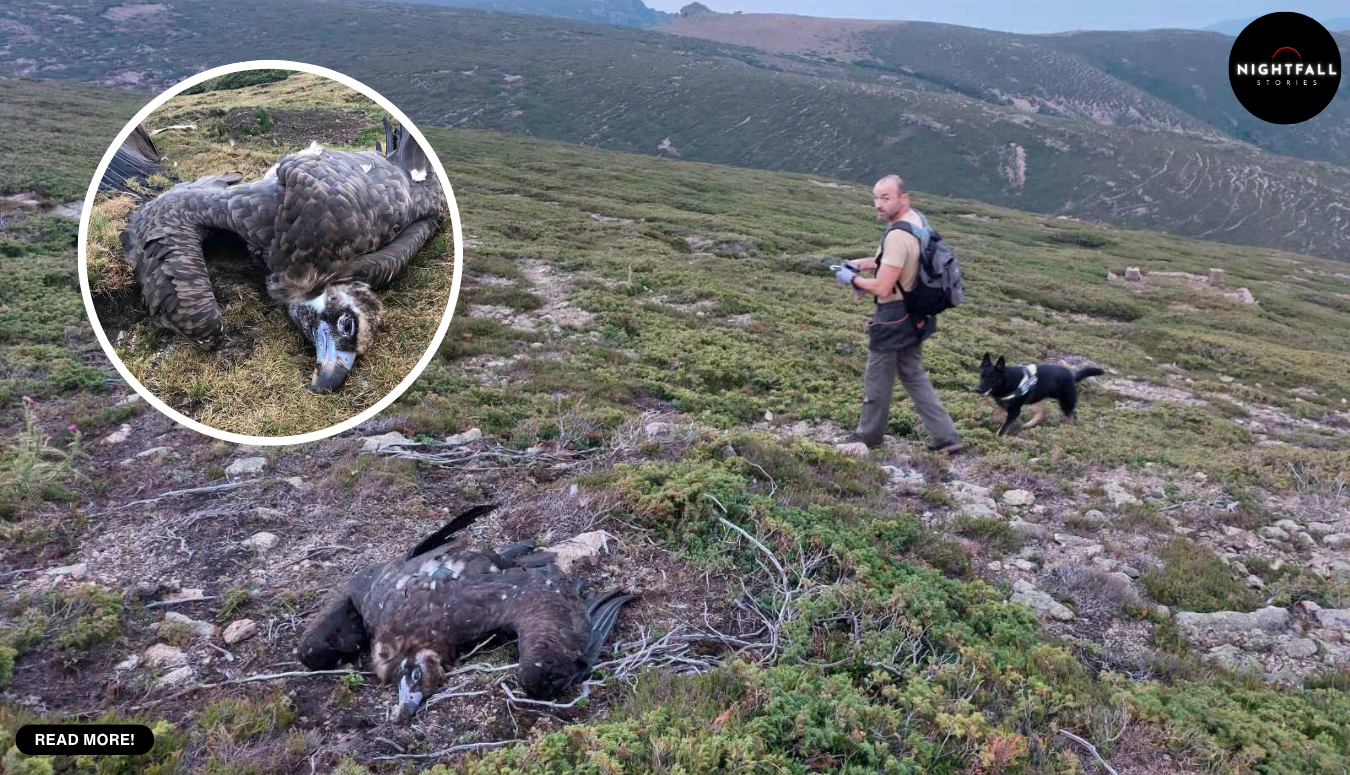
    His name was Boev. He was a bearded vulture, one of the strangest and most beautiful large birds in Europe, and he was the first of his species to fly free in Bulgaria in more than half a century. He was found dead at over 1,800 metres on the slopes below Botev Peak, in the Central Balkan National Park, alongside seven other vultures and a raven, scattered across a mountainside around the remains of a cow. A 36 year old man has since been charged. The case is live, nothing has been decided by any court, and the details below are allegations and findings in progress rather than conclusions.

    To understand why the loss of one bird set off this much activity, it helps to know what a bearded vulture actually is, because almost nothing about it is what people picture when they hear the word vulture.

    It is enormous, with a wingspan that can reach nearly three metres, and it does not have the bald head and hunched shoulders of the vultures in cartoons. It has a feathered neck, a pale head, dark bristles under the chin that give it its name, and a habit of deliberately staining its own plumage a rusty orange by bathing in iron rich mud and springs. Nobody is entirely certain why it does this.

    And then there is the diet, which is genuinely unique among vertebrates. The bearded vulture eats bones. Not meat off bones, bones. Somewhere between seventy and ninety percent of what it consumes is skeleton, which it can digest because its stomach acid is roughly as strong as battery acid and can break down a large bone inside a day. When a bone is too big to swallow, it picks the bone up, carries it fifty to a hundred and fifty metres into the air, and drops it onto rock to shatter it and get at the marrow. Young birds are clumsy at this. It can take up to seven years to get properly good at it.

    Europe nearly lost the species entirely. By the early twentieth century it had been shot, trapped and poisoned out of most of its range on the back of a false reputation for carrying off lambs and, in some folklore, children. The recovery has been one of the longest and most patient conservation projects on the continent. Captive breeding began in earnest decades ago, releases into the Alps started in the late 1980s, and more than two hundred birds have gone out there since, enough to re establish a breeding population where there was none. In Spain the number climbed from around thirty birds to over a thousand inside twenty five years. The species is still listed as near threatened, and poisoning remains one of the largest single reasons it dies.

    Bulgaria was the next chapter. The Balkan mountains are good bearded vulture country, high, rocky and full of the wild and domestic grazing animals whose remains the birds depend on, and the species had simply been erased from them. Last year, under a long running European restoration programme coordinated by Green Balkans with the Vulture Conservation Foundation and partners across Bulgaria and Romania, the first young birds were brought in and released at a nature park in the country’s east.

    Boev was one of them. He had hatched at a zoo in the Czech Republic in the winter of last year, was moved to Bulgaria, and was released at the age of ninety four days. Every released bird in a programme like this carries a satellite tag, because the entire point is to find out what they do, where they settle, and what kills them.

    What Boev did was leave.

    Beginning in the spring, according to the tracking data published by the Vulture Conservation Foundation, he went on a tour that even the people watching the map found hard to believe. Serbia. Romania. Hungary. Slovakia. Poland. Czechia, where he had hatched, though he had never seen the outside of it. Germany. And then the Netherlands, which is about as far from a Balkan crag as a mountain vulture can get, a flat, dense, sea level country with no cliffs and no mountain carrion. Over a hundred and twenty three days he covered around 14,100 kilometres. The distance figure and the country count are the programme’s own, calculated from his tag.

    This is normal for the species in one sense and extraordinary in another. Young bearded vultures wander enormously before they settle, sometimes for years, and the huge loops they make across Europe are part of how the reintroduced populations have started to find each other. But the scale of Boev’s route, in a bird from a programme trying to establish a population that has not existed in living memory, made him something of a mascot. People followed the dot.

    In the middle of last month the dot came home. He was back in Bulgaria on the thirteenth, having flown the whole way south again, and for a few days everything looked like the best possible outcome for a release programme: a bird that had seen half a continent and chosen to return to the mountains he was let go in.

    Then the tag stopped.

    A stationary transmitter is not automatically bad news. Birds roost. Tags fail. But the team went to look, and the coordinates put them high on the north side of the range in the Central Balkan National Park, on steep ground near the winter route to Botev Peak. What they found there was not one dead bird.

    Eight vultures were dead across the mountainside: Boev, five cinereous vultures, which are the largest birds of prey in Europe, and two griffon vultures. A raven was dead too. Around them, the remains of a cow.

    The terrain is the part that most people miss when they read a line like that. These are not birds that die in a tidy heap. They feed, they move off, and they come down wherever the poison catches them, which meant the search team spent days working a mountainside above 1,800 metres, walking from one GPS fix to the next, because several of the dead birds were also carrying transmitters from the same monitoring programmes. The tracking data that had been a conservation story for a year became, in the space of a morning, the evidence map for a criminal investigation. Without the tags, according to the organisations involved, nobody would have known where to look, and in all likelihood nobody would have known the birds had died at all.

    A trained detection dog was brought in to help work the site. Specialists carrying out examinations in the field reported physical reactions themselves while handling the carcasses, which is what made everyone involved certain very early that they were dealing with something potent rather than a natural die off. Samples went to three international laboratories. A vet with Green Balkans said publicly that a decoy had been found near the spot where the birds died and that she believed the poison was a serious one. Full toxicology results were still pending at the point this account was assembled, so the substance has not been independently confirmed here.

    The police moved quickly. Officers from the regional department at Karlovo, together with national police and a unit that handles organised crime, detained a 36 year old man from the area a few days after the birds were found. The case was opened as pre trial proceedings under the district prosecutor’s office in Plovdiv and referred to the environmental and wildlife crimes section of the national police. Investigators said they had found evidence connecting him to the poisoning, and, according to the police statement at the time, the detained man made admissions.

    The allegation, as the prosecution has put it, is this. A calf belonging to him had died after a bear attack. The carcass was left out in a high pasture area. The prosecutor alleges that a strong poison banned for use across the European Union was placed in the remains, and that the bait was intended for wild predators rather than for birds. Vultures found it first, because that is exactly what vultures are built to do. Anything that eats carrion in that landscape was going to reach it before a bear did.

    At the bail hearing, his lawyer put the other side of it. He argued that his client keeps horses, goats and cattle, including local breeds, and would have no reason to poison his own livestock, and that the bail figure was too heavy for the family. The court set bail at roughly the equivalent of about 3,500 US dollars, payable within a week, and released him. The judge’s reasoning, as reported, was that his family circumstances and the absence of any sign he would flee or repeat the offence did not justify holding him. The defence indicated it would appeal the amount. He is charged, he has not been tried, and both the prosecution’s account and his lawyer’s answer are on the record as claims, not findings.

    Under Bulgarian law, poisoning protected wildlife can carry up to five years in prison and fines in the region of 12,000 US dollars. Whether a case like this gets that far is a different question, and it is the reason conservation groups across Europe have been unusually loud about this one.

    Poison baiting is an old practice with an ordinary motive behind it. Someone loses livestock to a predator, or expects to, and puts out something lethal in a carcass. It is illegal essentially everywhere in Europe and it is very hard to police, because it happens on remote ground, it leaves few witnesses, and by the time anything is found the evidence has usually been eaten or has rotted. Wildlife poisoning cases mostly go unreported and unpunished, not because the laws are weak on paper but because investigations are under resourced and the different authorities involved rarely coordinate. Convictions are rare enough that when one lands it gets written up across the continent.

    One did recently, in the Czech Republic. A 52 year old hunter put carbofuran into fish remains near his pond to kill otters, and the bait killed two white tailed eagles, two otters, two foxes, a buzzard and a stone marten. He was given two years in prison and a fine of about 11,000 US dollars, with the court valuing the animals lost at over 27,000 dollars. Conservationists noted at the time that it was only the third wildlife poisoning conviction in that country, which tells you as much about the enforcement record as it does about the crime.

    What has happened since in Bulgaria is more interesting than the usual round of statements. The interior ministry asked Green Balkans for a list of every known vulture poisoning case in recent years, and the organisation handed one over. A meeting was set up between the environment ministry, the interior ministry and the Vulture Conservation Foundation about what stronger action would actually look like. Separately, conservation staff have been sitting down with the people who use the high pastures, the graziers and livestock keepers whose losses to predators are the reason poison ends up in a carcass in the first place, to talk about what poison baiting is and what it does. That last part is the one most likely to change anything, because a prosecution deters after the fact and a conversation with a herder who has just lost a calf to a bear is the only thing that works before it.

    The birds are not replaceable in a simple sense, but they are replaceable in a practical one, and that is the only comfort available here. Cinereous and griffon vultures still breed in the Balkans in numbers, and the bearded vulture programme has more young birds coming through the captive breeding network in Europe and more releases planned. The loss of eight birds in a single day is a serious setback for a population being rebuilt from nothing, and it is also the kind of setback these programmes were designed to absorb, because everyone running them has always known that poison, not weather or disease or luck, is the thing most likely to kill their birds.

    Boev’s route across eight countries is still in the data, and it is arguably worth more now than it was when it was just a good story. It showed that a bird released from a standing start in Bulgaria will range across most of Europe and come back. It showed that the population being built there is connected to everything else happening on the continent, not stranded on one mountain range. And the tag that recorded all of it did the last thing it was ever going to do, which was to put a search team on the right slope, in the right hour, next to a poisoned carcass that would otherwise have quietly disappeared into the ground with nobody ever knowing it had been there.

  • A snake that should have been too inbred to succeed

    A snake that should have been too inbred to succeed

    Somewhere in the years after the Second World War, a small number of brown treesnakes came off a ship or a cargo plane on Guam and slid into the forest. Nobody counted them. Nobody saw them arrive. Best estimates say it was a handful of animals, possibly fewer than you could hold in two hands, and by every rule biologists teach undergraduates, that should have been the end of the story.

    A founding group that small carries almost no genetic variation. Cousins breed with cousins, the same faulty copies of the same genes keep meeting each other, fertility drops, immune systems get brittle, and the population fizzles out within a few generations. It is one of the most reliable patterns in conservation biology, and it is the reason rescuing a species from very low numbers is so hard.

    The brown treesnakes did not fizzle out. They multiplied into one of the densest snake populations ever recorded anywhere on Earth, reaching an estimated 30,000 animals per square mile in parts of Guam at the peak. They climbed into the canopy and ate the island’s birds, nest by nest, until nine of the eleven native forest bird species were gone from the wild. They climbed power lines and bridged the gap between conductors, shorting the grid over and over, at an ongoing cost to the island’s economy of roughly 4.5 million dollars a year in outages and repairs. Eighty years on, they are still there, and there is still no known way to remove them entirely.

    So the question that sat unanswered for decades was not how much damage they did. That part was obvious to anyone who walked into a Guam forest and noticed the silence. The question was how a population that inbred managed to do it at all.

    A team led out of the University at Buffalo, working with scientists from the United States Geological Survey, has now published an answer, and it is the kind of answer that makes you rethink what you thought you were looking at. The paper appeared in Science Advances last summer, with Christopher Osborne as first author, now at SUNY Oswego, and Trevor Krabbenhoft at Buffalo as the corresponding author. Their finding is that the brown treesnake genome was never as impoverished as everyone believed. The diversity was there the whole time. The tools just could not see it.

    Here is the part that is genuinely interesting. For most of the history of genome sequencing, the standard method chopped DNA into very short fragments, read them, and then reassembled the pieces by matching the overlaps, a bit like rebuilding a shredded book from strips of paper. That approach is superb at spotting tiny differences, the kind where one individual has a G and another has an A at the same position. It is close to useless at spotting the large-scale stuff. If a whole chunk of DNA has been duplicated, deleted, flipped around or picked up and moved to a different chromosome entirely, the short-read method reassembles it against a reference and quietly smooths it over. You get a genome that looks tidy and uniform because the messy parts were invisible.

    Long-read sequencing reads much longer stretches of DNA in one continuous pass, so those big rearrangements stop hiding. When the team applied it to brown treesnakes, they found more than 19,000 structural variants across the population. These are not typos. They are whole paragraphs moved, repeated or removed. Taken together, they involve something close to eight times more DNA than all the single-letter differences combined.

    That is the whole argument in one number. Everyone had been measuring the snake’s genetic diversity using the metric that happened to be measurable, concluded it was low, and moved on. The diversity that mattered was in a form nobody was counting.

    What makes it more than a technical footnote is where those variants cluster. They are not scattered evenly. They pile up in two groups of genes in particular: the genes involved in immunity, and the genes involved in smell.

    Immunity is the easy one to understand. An inbred population usually has a narrow immune repertoire, which is why small isolated populations get wiped out by a single disease that a diverse population would shrug off. If the brown treesnakes carried far more variation in those genes than anyone realised, they arrived on a new island with a better set of defences than their founder numbers suggested.

    Smell is where it gets specific to this animal and to what happened on Guam. The brown treesnake is nocturnal and hunts largely by chemical cues, flicking its tongue and reading the air. It does not need to see a sleeping bird to find one. Guam’s forest birds had evolved over a very long time on an island with no snake that hunted like this, so their nesting behaviour offered no defence against a predator that could simply follow a scent up a tree in the dark. A predator with unusually sharp chemosensory equipment, arriving among prey animals with no evolved answer to it, is close to a worst case.

    The researchers raised one further possibility that is almost unsettling in its neatness. In their native range across Australia, New Guinea and the Solomon Islands, brown treesnakes eat each other. Cannibalism is a normal part of how those populations regulate themselves. On Guam, they largely do not, and the team suggests the enhanced sense of smell may be why. Levi Gray, one of the researchers, put the idea in terms of recognition: the snakes on Guam may be able to smell that another snake is close kin, something more like a sibling than a meal. In a population descended from a handful of founders, almost every snake you meet is close kin. A behaviour that normally caps a population may have switched itself off precisely because the population was inbred.

    That is a genuinely strange loop. The bottleneck that should have destroyed them may have removed the brake.

    It is worth being careful about what the study does and does not establish. The researchers are explicit that they do not yet know whether these structural variants were already present in the founding snakes or arose after the invasion. Answering that requires sequencing native populations in Australia and the South Pacific and comparing them directly, which is the obvious next piece of work and has not been done yet. So the honest version is this: the diversity is real and measurable, its origin is still open, and the link to the invasion’s success is a strong inference rather than a proven mechanism.

    Even hedged that way, the implications run in two directions at once, and the second one is the reason this paper matters far beyond Guam.

    The first direction is uncomfortable. If invasive species carry reservoirs of adaptive potential that standard genetic surveys miss, then the reassuring assumption that a small invading population will collapse on its own is not safe. Risk assessments that estimate how likely a stowaway population is to establish itself have generally leaned on founder numbers and measured diversity. Those assessments may have been reading the wrong gauge.

    The second direction is genuine good news, and Osborne has said as much. The same logic applies to species we are trying to save. Endangered populations get written off as genetically exhausted on the basis of exactly the measurements that turned out to be incomplete here. A tiny surviving population of some bird or mammal, declared too inbred to have a future, may be carrying structural variation that nobody has looked for, because looking for it requires sequencing technology that has only recently become routine. Flexibility in the genome that we could not detect is not the same as flexibility that is not there.

    It also lands in a forest that has kept changing long after the birds went quiet. Ecologists comparing Guam with neighbouring islands in the same chain, where native birds still hold on, found that Guam’s jungle carried as many as forty times more spiders. The team behind that work, led by Haldre Rogers and published in an open-access journal well over a decade ago, did it the unglamorous way, walking transects for months with tape measures and counting webs. The explanation is simple once you see it. Birds eat spiders and birds tear through webs as they fly. Remove the birds and the webs stay up.

    That is what an ecosystem missing a whole functional group looks like from the inside, and it is a reminder that the snake’s real damage is not the list of species it erased. It is everything downstream of that list, in a forest where nothing eats what the birds used to eat and nothing carries seeds where the birds used to carry them.

    Which brings the story back to the birds, and to the only part of it that has anything resembling a happy turn.

    Among the species the snakes took was the sihek, the Guam kingfisher, a small bird with a cinnamon head and a startlingly loud voice for its size. By the 1980s it was gone from the wild. What saved it was an unglamorous decision made just in time: a small number of birds were taken into captivity, and for nearly four decades the entire species existed only in breeding facilities, passed between zoos, its studbook managed like a bank account that could never be overdrawn. Every sihek alive descends from that handful. It is, in its own way, the same bottleneck problem as the snake, viewed from the opposite side.

    Returning them to Guam was not possible, because the snakes are still there and a released kingfisher would simply be food. So conservationists did something sideways instead. A couple of years ago, nine captive-bred sihek were flown to Palmyra Atoll, a remote and snake-free scrap of land in the central Pacific, more than 3,000 miles from Guam. Six were released first, each carrying a small radio tracker, and the rest followed. It was the first time in roughly four decades that the species existed outside a cage.

    They survived. All nine made it through their first year in the wild. Four pairs staked out territories and built nests, and the following spring three pairs laid eggs, which was the first wild sihek breeding since the species vanished from Guam. Those eggs did not hatch, which is not unusual for young birds on their first attempt, and the teams monitoring them treated it as a step rather than a failure. Palmyra was never meant to be the destination. It is a practice ground and a data source, a place to learn how these birds behave when nobody is feeding them, so that the knowledge exists for the day they can go home.

    That day depends entirely on the snakes, which is why the genome paper is not an abstract curiosity to the people working on Guam.

    Control efforts there have become inventive out of necessity. The most effective landscape-scale tool so far is startling when you first hear about it: helicopters fly over forest that is impossible to reach on foot and fire out thousands of small biodegradable cartridges, each containing a dead mouse with an acetaminophen tablet attached. The ordinary painkiller in most bathroom cabinets is lethal to brown treesnakes at a dose roughly equivalent to what you would give a child, while being comparatively low risk to Guam’s other wildlife. The cartridges are designed to snag in the canopy where the snakes hunt rather than drop to the ground where they would not. Trials run by federal wildlife scientists showed sharp falls in snake activity that persisted for about a year, with the notable caveat that the largest and best-fed snakes were the ones most likely to survive, which is exactly the kind of detail that suggests the dose needs work.

    Alongside that sit detector dogs working cargo before it leaves the island, traps, hand capture, environmental DNA sampling that can pick up a snake’s presence from traces left in the environment, and citizen volunteers removing animals in park areas. It is a long, grinding, unfinished effort whose most important measure of success is not on Guam at all. It is Hawaii, where a single established brown treesnake population has been estimated to cost hundreds of millions of dollars a year in electrical damage alone, never mind what it would do to birds that have exactly the same evolutionary blind spot Guam’s did.

    So the genome study lands in the middle of practical work, not on a shelf. Knowing that the snakes have unexpected depth in their immune genes matters if anyone ever seriously pursues a biological control agent, because a pathogen deployed against a population with a broad immune repertoire will not do what the models say. Knowing that the olfactory genes are where the variation piles up matters for trap design and lure chemistry, because the sense being exploited turns out to be the snake’s most variable asset rather than a fixed target.

    The thing that stays with you, though, is the correction itself. For decades the brown treesnake sat in textbooks as a puzzle, an animal that succeeded in defiance of population genetics. It turns out it was not defying anything. The rules were fine. We were reading the animal with an instrument that could not see the thing that mattered, and the invisible thing was doing all the work.

    There is a version of that sentence that applies to the kingfishers too, sitting in their nests on an atoll in the middle of the ocean, descended from a founding group as small as the snakes’ and written off for years as a species with nothing left in the tank. Nobody has sequenced them the way the snakes were sequenced. Somebody probably should.

  • The last continent that did not have it now has it

    The last continent that did not have it now has it

    The bird was a brown skua, and it was dead on a beach at the eastern end of a national park in southwestern Australia, a few hundred kilometres along the coast from the nearest city of any size. Someone found it, someone sent samples away, and a laboratory confirmed what a lot of people had spent four years quietly dreading. The official notification went out the following day, and it is a short, dry document that says one very large thing: highly pathogenic avian influenza H5N1, clade 2.3.4.4b, in a wild bird in Australia, for the first time.

    That is the confirmed fact, and it is worth keeping it separate from everything that has been said around it, because plenty has.

    For roughly four years the H5N1 panzootic had been working its way through the world’s wild birds with a thoroughness nothing quite like it had managed before. It moved through Europe, through Africa, through North and South America. It reached the Antarctic Peninsula. It killed birds in numbers that stopped being countable and started being estimated. Hundreds of millions of poultry have been culled or died worldwide since this thing started moving. More than 600 wild bird species and around 100 mammal species have been affected. Seabird colonies in the North Atlantic lost large shares of their breeding birds in a single season. In South America it ran down the Pacific coast and killed pelicans, other seabirds and sea lions in very large numbers, and then it reached the Antarctic, which is where the southern route into Australia began. And through all of it Australia held, the one inhabited continent where this particular virus had never been detected in a wild bird. Australian biosecurity officials were asked about it constantly, and the honest answer was always the same. Not yet.

    There is an important footnote to the “last continent” framing that got lost in a lot of the coverage, and it deserves to be said plainly, because it changes how you read the mainland detection. Australia’s remote sub-Antarctic territory had already been hit. On Heard Island, a glaciated speck in the Southern Ocean thousands of kilometres from anywhere, H5N1 arrived around the middle of the previous year, most likely carried in by wildlife moving from the French-administered Crozet Islands roughly 1,800 kilometres away. Australian Antarctic Program scientists surveyed the damage, and the numbers are hard to hold in your head. Among southern elephant seal pups, average mortality across the island ran at about 76 per cent, and in some areas it reached 97 per cent. Out of a total pup production of around 17,000, roughly 13,000 died. Six vertebrate species tested positive, including king penguins, gentoo penguins and Antarctic fur seals. Working out the scale of it took drones, because Heard Island’s coastline is not something a small team can walk, and counting bodies from the air was the only way to turn an obvious catastrophe into a number anyone could publish. Surveys the following summer found several hundred dead adult king penguins, though that was a small proportion of a very large colony.

    So the virus was not knocking on Australia’s door. It was already inside the outermost room. What fell in June was the mainland.

    The skua matters as much as the location does. Brown skuas are big, powerful, scavenging seabirds that make their living partly by eating things that are already dead, and they move between the sub-Antarctic islands and the southern coasts of Australia and New Zealand. Epidemiologists had drawn that exact route on a map years earlier as the most likely way in. Scavengers eat infected carcasses, scavengers travel long distances, scavengers do not respect quarantine zones. The bird that brought it was the bird everyone said would bring it, which is a strange thing to be right about.

    The detection site was Cape Le Grand National Park, near the coastal town of Esperance in Western Australia, about 700 kilometres southeast of Perth. A southern giant petrel at the same site was also suspected. Samples went to the national high-containment animal laboratory for confirmation, and the international notification followed immediately, which the World Organisation for Animal Health went out of its way to note approvingly. Australia has a long record of reporting fast even when reporting fast is inconvenient, and it reported this within a day.

    Then came the part nobody can control.

    Here is what has been confirmed since, because this is where it is easy to slide from fact into fear. Within about ten weeks of that first skua, Australian authorities had logged more than 350 confirmed detection events. The virus has turned up in six states and territories. More than twenty species of bird have tested positive, and the list reads like a survey of the southern Australian coastline: greater crested terns, silver gulls, Pacific gulls, black-faced cormorants, little penguins, Australasian gannets, several petrel and shearwater species, white-fronted terns. It also reached birds nobody associates with the sea at all, including Australian magpies, ravens, a peregrine falcon and a southern boobook owl.

    It has crossed into mammals too, which is the part that gets virologists’ attention. Confirmed mammal cases include long-nosed fur seals and an Australian sea lion on Kangaroo Island, a common dolphin in South Australian waters, and a red fox in Adelaide. Every one of those is consistent with what H5N1 has done elsewhere in the world over the past four years, and none of them is evidence of the virus adapting to spread between mammals.

    The first mass die-off came in early August, off the coast south of Adelaide. Aerial surveillance spotted dead greater crested terns at Cape Jaffa, and the count came in at 49 dead birds with another 35 visibly sick. That was small enough to describe precisely, which is exactly why it is worth recording, because two weeks later it stopped being that kind of number. Three separate mass mortality events were confirmed across South Australian islands, on Troubridge Island off the Yorke Peninsula and on the North and South Page islands near Kangaroo Island, and the combined toll passed a thousand greater crested terns. On King Island, off Tasmania, 28 little penguins and three terns were found dead in the same week.

    The state premier in South Australia called it a significant escalation and said the loss of more than a thousand birds was deeply concerning. The federal agriculture minister was blunter about what comes next, telling people to expect more spread and larger numbers of wildlife affected. The environment minister put it in the flattest possible terms: you cannot stop wild birds flying and you cannot stop wild animals moving, and that means more events like this one.

    Two things have not happened, and both belong in any honest account.

    Australia’s commercial poultry industry has not recorded a single H5N1 infection. Farms have been locking down since the June detection, and so far the virus has stayed in wildlife. This is a genuinely important distinction and it is one people keep getting wrong, because Australia has had high pathogenicity bird flu in poultry before. Those were H7 viruses, a different subtype entirely, and they behaved differently. The most recent H7 outbreaks were contained and eradicated, and Australia was formally declared free of high pathogenicity avian influenza in poultry the year before the skua turned up. Blending the two together produces a story that is not true. The H7 outbreaks were a poultry emergency that was closed out. This is a wildlife event, so far.

    And no human case has been recorded in Australia. The Australian Centre for Disease Control’s assessment is that most bird flu viruses do not spread easily from animals to people and that the risk to Australians is very low. That is not reassurance for its own sake, it is what the global numbers look like. Across roughly ten months spanning the arrival in Australia, twelve human H5N1 infections were reported anywhere in the world, in Bangladesh, Cambodia and India, and three of those people died. No person-to-person transmission was identified in any of them. Every case involved close contact with infected animals or contaminated environments. The public health advice in Australia is correspondingly simple and mostly about wildlife rather than people: do not touch sick or dead birds, keep your distance, keep pets away, and report what you find to the emergency animal disease line.

    What is genuinely at stake here is not human health. It is a set of animals that exist in very small numbers in very few places.

    That is why the most remarkable part of this story is not the virus at all. It is what Australia did with four years of warning.

    On Phillip Island, off the Victorian coast, there is a little penguin colony famous enough that tourists come at dusk to watch the birds walk up the beach. Wildlife staff there have spent months catching those penguins one at a time, giving each one an injection, and then catching the same bird again three or four weeks later for a booster. The target is up to 5,000 penguins on Phillip Island and up to 800 more at the St Kilda colony in Melbourne. It is one of the largest wildlife vaccination programmes of its kind ever attempted anywhere, and it was possible only because the same organisation had already run the trials, years earlier, that showed little penguins mount a decent immune response to the vaccine without long-term ill effects. Somebody did that unglamorous preparatory work when the virus was still on another continent.

    It is worth understanding how unusual this is. Vaccinating wild animals against a disease is something conservation biology almost never does, and for good reasons. You have to catch every individual, which for most species is impossible. You have to catch most of them twice. Handling stresses the animal and can itself cause deaths. The vaccine has to be tested on that particular species, because what is safe in a chicken is not automatically safe in a seabird. And you have to be confident that the population is small enough and concentrated enough for the effort to actually change the outcome, rather than being a gesture that makes everyone feel better while the virus goes around it. Penguin colonies that come ashore in the same place every night, and a critically endangered parrot that spends part of its life in an aviary, happen to be two of the rare cases where the arithmetic works.

    At Cleland Wildlife Park in South Australia, around a hundred birds were vaccinated. And in Tasmania, where H5 spread across the state and had produced 54 confirmed cases by the start of September, keepers began vaccinating the orange-bellied parrot.

    That bird deserves a paragraph of its own. The orange-bellied parrot is one of the rarest parrots on Earth. It breeds in one remote corner of southwest Tasmania and migrates across open water to the mainland, and the entire wild population is estimated at fewer than a hundred individuals. There is a captive breeding facility near Hobart holding several hundred more, and those captive birds are the reason the species still exists at all. Roughly 350 of them are being vaccinated, two shots each, over a programme running into the following year, before the birds are released at Melaleuca in the far southwest. The Tasmanian environment minister did not soften it: the virus threatens the species’ existence.

    Beyond the parrot, conservation bodies have flagged which Australian species are most exposed, and the logic is uncomfortable but straightforward. The birds at greatest risk are the ones that nest in enormous dense colonies in a handful of locations, because that is a perfect setting for a respiratory virus. Christmas Island frigatebirds. Abbott’s booby. Gould’s petrel. Australian pelicans. Black swans. Species where a single bad season at a single breeding site could take out a meaningful share of the world population.

    The other projected worry, and it is a projection rather than an observation, is ducks. If H5N1 establishes itself in Australia’s waterfowl, the virus stops being a coastal problem and starts moving inland along wetlands and river systems into the interior, where almost nobody is watching and almost nothing can be surveyed. That has not been confirmed. It is the scenario that keeps the modelling teams busy.

    Ask the people actually doing this work how it is going and the answers are exhausted rather than dramatic. One veterinary pathologist working through the South Australian cases described the situation as pretty overwhelming. Wildlife vets have been telling rescuers and volunteers that biosecurity, the boring business of gloves and disinfectant and not carrying the virus home on your boots, is by far the most important thing anyone can do.

    So did the drills work? Partly, and the honest answer is the useful one. Nothing was ever going to stop a scavenging seabird flying across the Southern Ocean and dying on a beach. Australia did not prevent the arrival, and no country has. What four years of preparation bought was a laboratory that could confirm the virus in days, a notification that went out within twenty four hours, a surveillance system that caught the first mass mortality from a helicopter, a public reporting line people actually use, and a vaccine programme that was ready to run on the day it was needed instead of being designed from scratch in a crisis.

    It also bought something less tangible. Nobody had to argue about whether this was real.

    Out on the islands the terns are still dying, and the counts are still coming in, and the season ahead will decide how much of this becomes permanent. But the picture worth holding onto is a smaller one. It is a wildlife officer on a windy beach in the dark, holding a little penguin that weighs about as much as a bag of sugar, while a colleague finds the right spot with a needle. Then letting it go. Then picking up the next one. Four thousand nine hundred and ninety nine to go.

    They are not going to save every bird. They knew that before they started. They are doing it anyway.

  • Twenty-six per cent of the world’s insect records come from one small island

    Twenty-six per cent of the world’s insect records come from one small island

    Here is a number that should not be possible. Roughly a quarter of every insect observation held in the world’s biggest biodiversity database comes from the United Kingdom. Not from Brazil, which contains a fifth of the Amazon. Not from Indonesia, which has more islands than most people can name. From one cool, damp, thoroughly surveyed island group off the northwest coast of Europe, a place with fewer than sixty species of butterfly, in a world that has tens of thousands.

    Meanwhile more than eighty per cent of all insect species on Earth live in the tropics.

    That gap is the subject of a paper published in the journal BioScience earlier this month by a team of researchers spread across eight countries, led by Dr Shawan Chowdhury at Monash University in Australia, with Krushnamegh Kunte of the National Centre for Biological Sciences in India among the senior authors. Their argument is not that anyone did anything wrong in Britain. British naturalists have been counting moths and beetles in their gardens for the better part of two centuries, and the resulting record is one of the great unglamorous achievements of amateur science. The argument is about what happens when that record becomes the default picture of insect life for the entire planet.

    To understand why that number is so lopsided, it helps to know how the British record came to exist. It was not built by a government programme. It was built by clergymen with butterfly nets, by factory workers who ran moth traps in the back garden, by schoolteachers and railway clerks and retired accountants who kept notebooks for fifty years and then left them to a museum. Britain industrialised early, it had a leisured middle class with a hobby, and natural history became something ordinary people did on Sundays. Two centuries of that habit, digitised, is what a quarter of the world’s insect record looks like.

    It is easy to check the claim yourself, and I did. The Global Biodiversity Information Facility, usually shortened to GBIF, is the open database where museums, universities, government agencies and citizen science apps pool their records. It is the closest thing the planet has to a single ledger of what lives where, and it is what sits underneath an enormous amount of applied conservation work: extinction risk assessments, protected area design, environmental impact reports, the range maps in the back of field guides. Ask it how many insect occurrence records it holds worldwide and the answer comes back at around 340 million. Ask how many of those come from the United Kingdom and the figure is roughly 80 million. That is about twenty four per cent by my count, and the paper puts it at nearly twenty six per cent, a difference that comes down to which snapshot of a constantly growing database you are looking at. Either way, the shape of the thing is the same. One country supplies something close to a quarter of what science formally knows about where insects are.

    Now run the same query for Brazil. Around three million records. Indonesia, one of the most insect-rich countries that has ever existed, comes back with well under a million. The entire nation of Indonesia has roughly one per cent of the British total.

    This is not because there are fewer insects there. It is because there are fewer people being paid to write them down, fewer institutions to store the specimens, and fewer journals willing to publish the results in a language the database can read.

    That last point turns out to matter enormously, and it is the first of four barriers the researchers identify. A great deal of tropical insect research does exist. It is simply invisible. It gets published in national journals, in regional languages, in university bulletins that never get indexed, in theses that sit on a shelf in a departmental library and nowhere else. To an international database, work that is not in English and not in a major indexed journal might as well not have happened. The knowledge is real. The pipeline that would carry it into global science is missing.

    The second barrier is the raw data shortfall, and the team breaks it into parts that each have their own fix. There is almost no systematic long-term insect monitoring in tropical countries, the kind of repeated annual counting that lets you say whether a population is rising or falling rather than just that it exists. Citizen science, which now drives an enormous share of temperate insect records, has barely taken hold in most tropical regions. There are nowhere near enough trained taxonomists, the specialists who can look at a small brown beetle and say which of several thousand small brown beetles it is. This is a genuine global bottleneck and it is getting worse rather than better. Describing a new species properly is slow, meticulous, poorly funded work that produces very few citations, which in a modern university career structure makes it close to professional suicide. The people who can do it are ageing out, their positions are being converted into something more fundable, and the queue of undescribed specimens in the world’s collections keeps growing. There are drawers in museums right now holding insects nobody has ever named, collected decades ago, waiting for a person who no longer exists in sufficient numbers. And the specimens that have been collected are often physically inaccessible, sitting in drawers in institutions with no scanner, no database and no funding to make a catalogue.

    The third barrier is infrastructure, which is the polite word for money. Tropical countries face financial constraints that have nothing to do with scientific ambition. Museum collections are scarce and frequently under-resourced. Computing capacity for the kind of modelling that modern conservation planning requires is limited. Some of the richest insect habitats on Earth sit in places where fieldwork carries genuine security risks.

    And the fourth barrier is the one that makes the other three sting. Even where the knowledge exists, it very often does not turn into conservation action. Insects are almost absent from national conservation planning in most of the world. They rarely appear on protected species lists. They are rarely factored into how a reserve boundary is drawn. A tiny fraction of insect species have ever been assessed for extinction risk at all, and the ones that have tend to be the charismatic ones, the big showy butterflies and the dragonflies people like looking at. Everything else is classed as data deficient, which is a technical term that means nobody knows, and which in practice functions as permission to do nothing.

    Somewhere inside all of this sits a practice the paper names directly, and the name has stuck because it is so exact. Parachute science. A research team from a wealthy country flies into a tropical nation, collects specimens or data, flies home, publishes in an international journal, and leaves behind essentially nothing. No local co-author with a leading role. No copy of the dataset in a national repository. No training, no equipment, no next step. Local researchers who did the actual finding, who knew which valley to walk up and which tree the thing sits on, are treated as field assistants rather than colleagues. The country supplies the biodiversity and receives a citation, if that.

    The corrosive part is not just the unfairness. It is that parachute science produces a body of knowledge that cannot be maintained. A one-off survey tells you what was there on one afternoon. Conservation needs to know what is happening over decades, and only people who live there can produce that.

    To show what the alternative looks like, the team worked through a single country in detail, using butterflies in Bangladesh as a test case. Butterflies are a reasonable bellwether because they are large, colourful, popular with amateurs and relatively well studied compared with, say, parasitic wasps.

    The first thing they did was go looking for the invisible literature, and they found it. There were 111 published studies on the butterflies of Bangladesh. Only 34 of them had appeared in international journals. More than two thirds of the country’s own butterfly science had never reached the databases that global conservation planning draws on. And of those 111 studies, only three were focused on conservation itself. The research existed. It described, it listed, it recorded. It almost never reached the point of saying what should be protected and how.

    Then they did something that sounds slightly absurd until you see the result. They went on Facebook.

    There are active amateur naturalist groups in Bangladesh where people post photographs of butterflies they have seen, usually with a location and a date attached, often with an identification argued out in the comments by people who genuinely know what they are looking at. The researchers treated those posts as data. When they compiled the results, they found records for 167 of the country’s 169 threatened butterfly species.

    One hundred and sixty seven out of one hundred and sixty nine. Sitting in plain sight, on a social media platform, uploaded for free by people who were not being paid and in most cases were not being counted as contributors to science at all.

    That is the whole argument of the paper in one finding. The knowledge gap is not always a knowledge gap. Sometimes it is a plumbing problem. The observations have already been made. They are just not in the pipe.

    With those records folded in, the team could do the kind of analysis that had previously been impossible for the country. They could map where species actually occur rather than where researchers happen to have visited. They could check how well the existing protected areas cover the ranges of threatened species, and the answer was not encouraging. They could model how habitat suitability is likely to shift as the climate changes, and the projection there is bleak: something in the order of forty two per cent of the country’s butterfly species face a meaningful risk of disappearing locally.

    None of that could have been said a few years ago. Not because the butterflies were hiding, but because nobody had connected the amateur photographs to the museum drawers to the untranslated papers.

    It is worth stopping for a second on why any of this matters beyond the satisfaction of a well-filled database, because insects are the kind of subject people nod along to without quite feeling. Insects pollinate around eighty per cent of wild plant species. They are the direct food supply for roughly sixty per cent of bird species. They break down dead material, turn over soil, control the populations of other insects that would otherwise eat crops, and sit at the bottom of food chains that end in things people do care about. Estimates of how many insect species exist run somewhere between fourteen and thirty million, and the overwhelming majority have never been formally described at all. When conservationists talk about biodiversity loss, insects are most of the biodiversity.

    And every serious decision about them, every extinction risk assessment, every protected area boundary, every climate range projection, is built from data. If a quarter of that data comes from one temperate island and a tropical megadiverse nation contributes one per cent, then the models are being trained on a sample that does not resemble the world.

    The fix the researchers propose is deliberately unglamorous, which is probably why it might work. Go and find the regional literature that already exists, including in languages other than English, and connect it to expert networks in the countries concerned. Expand citizen science in the tropics, and expand it past the photogenic species, because somebody has to count the flies too. Build and fund national biodiversity collections so that specimens stay in the country that produced them and can actually be consulted. Digitise the drawers that already exist. Treat social media observations, local naturalist knowledge and Indigenous knowledge as real evidence rather than colour.

    And, running through all of it, change who holds the pen. The framework is explicit that international partnerships have to be structured so local researchers lead, that national regulations and benefit-sharing rules are followed rather than worked around, and that the country supplying the biodiversity retains sovereignty over the data about it.

    Chowdhury’s framing of the problem is blunt, and it has less to do with discovery than people expect. The task is not primarily to go out and generate vast quantities of new information. It is to get much better at finding, connecting and using the knowledge that has already been produced by people whose names are not on the papers.

    There is something quietly hopeful buried in that. A knowledge gap caused by there being nothing to know would be a hard problem, and an expensive one, and slow. A knowledge gap caused by the observations existing in the wrong format, in the wrong language, on the wrong platform, credited to the wrong people, is a solvable problem. Somebody in Bangladesh already photographed 167 of those 169 threatened butterflies. Somebody in a university in Dhaka already wrote the paper that nobody outside the country read.

    The insects were never missing. The people counting them were just never invited in.

  • The insect everyone swats at spent this summer not showing up

    The insect everyone swats at spent this summer not showing up

    There is one guest nobody invites to a summer picnic and everybody expects anyway. The wasp arrives around the time the food does, hangs over the jam, dive bombs the glass of cider, and gets swatted at by six people at once who all miss.

    Across Britain this year, it mostly did not come.

    That is the observation, and it came from the one person in the country best placed to notice, because finding wasps is her job. Seirian Sumner is a professor of behavioural ecology at University College London, and she has spent her career on social wasps at a time when hardly anybody else wanted to. When she wrote up what she was seeing, the detail that stuck was not grand. It was that her students could not get hold of enough wasps to run their experiments.

    And the ones that did turn up were small. Not slightly small. Spring small, in the middle of summer, which for anyone who knows how a wasp colony is supposed to work is the strange part.

    Here is the thing she was careful to say, and it deserves to be said just as plainly here, because a lot of the coverage that followed lost it. These are anecdotes, not data. There is no peer reviewed finding. There is no confirmed population count for the year. What there is, at the moment, is a specialist noticing an absence that does not match anything she has recorded before, and saying so out loud while the counting is still going on.

    Which makes this a story about the gap between noticing something and knowing it, and about a national experiment that happens to be positioned exactly in that gap.

    The experiment is called the Big Wasp Survey. It started in 2017, and the method is about as unglamorous as science gets. Ordinary people put a small amount of beer in a trap, hang it in the garden for a set number of days during a fixed window in late summer, then send in what they caught so it can be identified to species. That is it. Beer, a bottle, a week, a post.

    The first year, more than 2,300 people signed up and about 1,294 of them actually returned results, which produced 6,680 wasps identified to species. The breakdown was tidier than you might expect. Common yellowjacket and German yellowjacket split the catch almost evenly at around 44 per cent each, European hornets made up about 6 per cent, and a handful of other species accounted for the rest. Later, DNA work on those samples produced a genuinely useful result, which was that the common yellowjacket across the country behaves as one large interconnected population rather than a patchwork of separate local ones.

    None of that sounds dramatic. It is, however, the only national wasp monitoring this country has. And when Sumner wrote up her observation in high summer, the survey had not yet started sampling for the year. The traps go out in a window in August and another at the turn of the month. So the person raising the alarm was doing it in the one part of the calendar where she could not yet check.

    That is not a flaw in the story. That is the story.

    The beer trap is doing something clever with all of that. It is cheap enough that thousands of people can run one, it is standardised enough that the results can be compared between a garden in the far north and a garden in the south, and it is timed to the exact stretch of the year when workers are out and easy to catch. It also produces physical specimens rather than sightings, which means species can be confirmed under a lens and, as the DNA work showed, interrogated years later for questions nobody was asking at the time. That is a lot of scientific return for a bottle of cheap lager.

    To understand why small wasps in August are a signal rather than a curiosity, you have to know what a wasp colony’s year looks like, and it is more precarious than the picnic version suggests. A social wasp colony does not overwinter. Every single nest you have ever ducked away from was built from nothing that year by one female, working alone.

    A queen comes out of hibernation in spring, finds a cavity, chews wood into paper, builds a few cells, lays into them, and then feeds and raises that first tiny batch of workers entirely by herself. There is no colony to help her. If she dies in that window, or if the weather keeps her from foraging long enough, that is the end of it. Nothing is left behind. The whole enterprise rests on one insect having a good few weeks in spring.

    Once those first workers emerge, the arithmetic flips. They take over foraging, the queen switches to laying full time, and the colony scales up fast through the summer until it is the loud, confident, jam stealing operation everyone recognises. Workers that emerge early are naturally small, because there were few foragers to feed the larvae. By late summer they should be noticeably bigger, because by then there are hundreds of adults bringing food in.

    So small workers in August mean one of two things, and possibly both. Either the colonies never built up enough foraging capacity to feed their larvae properly, or the larvae developed too fast in unusual heat and emerged underfed and undersized. Neither of those is the signature of colonies that simply started late.

    There is a reason beer works, and it is the same reason wasps become a nuisance in the first place. For most of the summer a worker wasp is not interested in your food at all. She is hunting protein, caterpillars and flies and aphids, to carry back to the larvae in the nest. What she gets in return, from the larvae themselves, is a drop of sugary liquid. That exchange is the engine of the whole colony, and it is why a wasp ignores you in June.

    Late in the season the queen stops laying, the larvae run out, and the sugar supply that kept the workers going simply ends. Thousands of adults are suddenly unemployed, hungry for sugar and with nothing to do. That is the wasp at your table. It is not aggression. It is an entire workforce made redundant at once, going looking for the only thing it still wants. They find fallen fruit, they find your drink, and they get clumsy and bold in a way that reads as malice and is closer to desperation.

    Meanwhile a small number of new queens have been produced, mated, and left to find somewhere to spend the winter under bark or in a shed. Everyone else dies with the first hard cold. The nest is never reused. Next spring the whole thing starts again from those few hibernating females, which is why a bad spring does not dent a colony so much as delete a generation of them.

    Which brings in the weather, and here the numbers need handling with care. Sumner points at a spring of extremes, warm dry stretches broken by cold damp spells and chilly nights, hitting precisely during the period when lone queens are most exposed. Then came the heat. Social wasps are reported to have a critical thermal maximum somewhere around 45 degrees Celsius, and during the summer’s heatwaves ground surfaces in the country reportedly exceeded 50. For scale, honeybees are generally put at around 49. Wasp nests, especially the ones started in shallow ground cavities and banks, sit right where that heat lands.

    That figure of 50 degrees at the ground surface is the one to hedge, and it is worth saying why. It is a surface temperature, not an air temperature, and it comes through a comment piece rather than a published dataset. It is entirely plausible and it is not a measurement anyone has yet tied directly to a count of dead nests.

    There is also a serious counterargument, and it comes from the same expertise. Social wasps are supposed to be tough. Nests are insulated by their own paper construction. Workers cool them behaviourally, fanning and carrying water. The diet is broad rather than specialist, which usually protects an animal when one food source fails. On paper, a wasp should ride out a bad summer better than a fussier insect would. That is exactly why a summer this quiet is interesting rather than expected.

    And there is a longer pattern underneath it. Wasp numbers swing wildly year to year, far more than most insects. Last year was the opposite of this one, a boom year following a warm dry spring, with the predictable wave of newspaper stories about plagues of wasps. The absence of those same stories this year was, oddly, one of the first clues anybody noticed. An analysis published years ago that pulled together nearly four decades of records from a handful of English sites found the same thing in the long data: enormous swings, boom and bust, driven largely by what the weather does in a narrow spring window.

    So the honest question is not whether wasps have crashed. It is whether the swings are getting wilder, and whether the window a queen needs is being squeezed from both ends, by heat that arrives too early and cold that returns too late.

    There is one more pressure being raised, and it comes from people who deal with wasps commercially rather than academically. Pest controllers say they have had far fewer callouts for nest removal this year, which is its own kind of evidence, collected by accident. One of them has also flagged a different problem entirely: spring trapping campaigns aimed at invasive Asian hornets are not selective, and native wasp queens reportedly end up in those traps too, during the exact weeks when the loss of a single queen costs an entire colony. That claim comes from a pest control operator rather than a study, and it is worth knowing about rather than treating as settled.

    Now the part that decides whether any of this matters to anyone who does not love wasps, which is nearly everyone.

    Sumner and colleagues went through more than 500 academic papers a few years ago, covering roughly 33,000 species of stinging wasps, and put together the case that wasps do the same categories of work bees do while receiving almost none of the credit or the funding. Wasps are predators, and they are efficient ones. They take aphids and caterpillars in volume, which is to say they eat the things that eat crops. Insect predation as a global pest control service has been valued at somewhere around 416 billion dollars a year, and wasps are barely counted in that figure at all, mostly because nobody has done the work to count them.

    They pollinate too, which surprises people. The review found evidence of wasps visiting 960 plant species, and 164 of those are completely dependent on wasps for pollination, meaning that without wasps those plants simply do not reproduce. Global insect pollination is valued at well over 250 billion dollars a year. Wasp venom and saliva have antibiotic properties, and yellowjacket venom has been studied for possible use against cancer cells. In parts of the tropics, wasp larvae are already food.

    That is a substantial resume for an insect whose entire public identity is ruining a barbecue.

    The funding gap is the reason this summer is so hard to resolve. Bees get monitored, mapped, modelled and mourned. Wasps get a citizen science project running on beer and goodwill, because the people who fund insect research fund the insects people like. The consequence is that when something unusual happens to wasps, the country’s ability to say what actually happened comes down to how many strangers hung a bottle in a hedge in August.

    Two caveats before the end. The first is geographic. Everything here is Britain. There is no comparable set of reports from elsewhere, and it would be wrong to read this as a global event. The second is the one Sumner put first, and it still stands. Nothing here is a confirmed population decline. It is an absence, described precisely by somebody qualified to describe it, waiting on a count.

    That count is happening now. The traps went out in the usual late summer windows, the returns come in afterwards, and the samples get sorted and identified species by species, the same way they have been for close to a decade. For most of those years the survey has been building a baseline that nobody had an urgent reason to look at. This year it has a question waiting for it, which is the situation every long running monitoring project secretly hopes for and never quite expects.

    And if the traps come back light, the finding will not be that a nuisance went away. It will be that a predator, a pollinator and a decomposer went quiet at the same time, and that the only reason anyone can put a number on it is that ordinary people spent nine summers counting an insect they do not like.

    The wasps may well be back next year. They usually are, and a boom summer would surprise nobody. But this is the first time the absence of something everybody swats at has been measurable, and that is worth more than the picnic it did not ruin.