There is a stretch of the North Pacific, hundreds of miles from any coastline, where the law effectively runs out. No country owns that water. No police force patrols it. A fishing boat working out there answers to exactly one government, the one whose flag is painted on its stern, and that government may be six thousand miles away and not especially interested.
So when a small boat pulls alongside in that emptiness and officers in survival suits climb the ladder onto the deck, the first thing to understand is that almost nobody aboard the approaching boat has the power to arrest anybody. They cannot seize the catch. They cannot detain the crew. They cannot order the vessel anywhere.
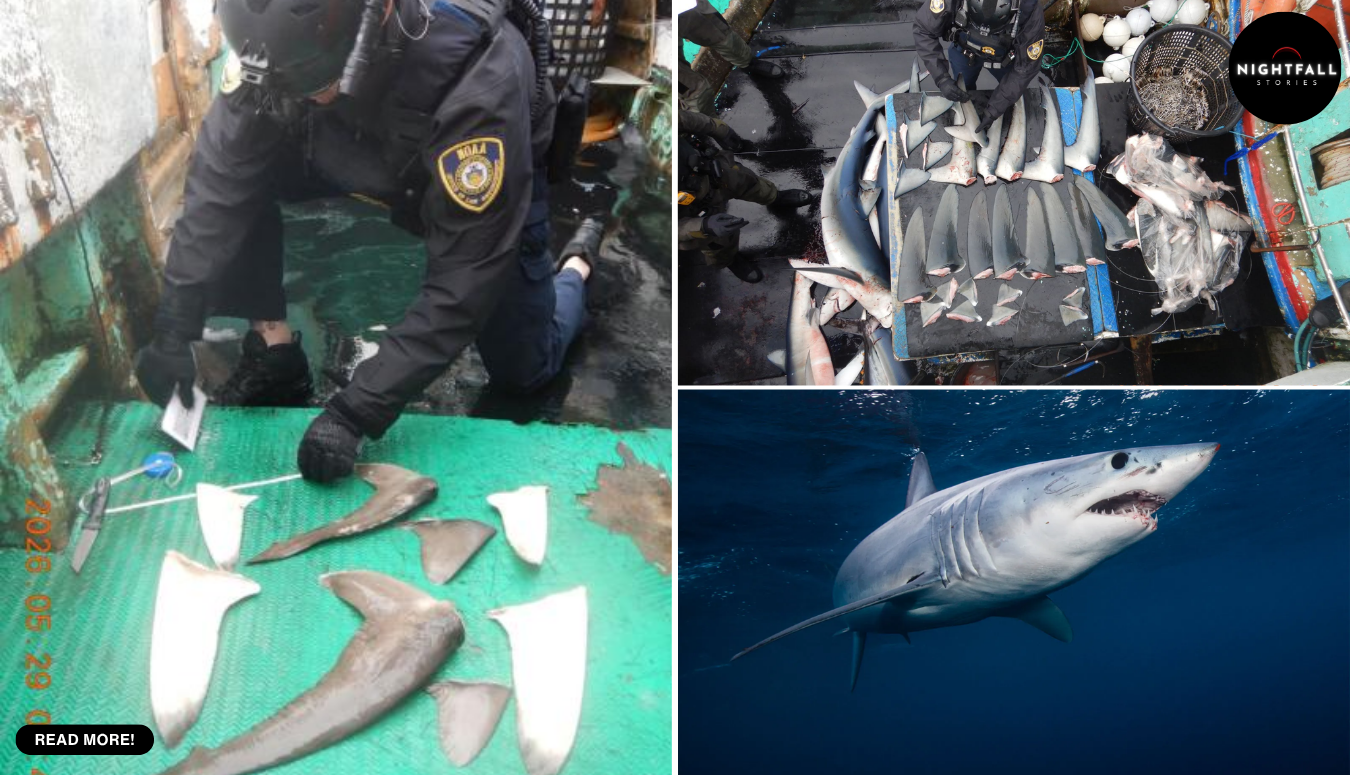
What they can do is look. And this year, across a patrol that ran for about two months and covered a distance you would struggle to picture, what they found on dozens of those decks was dozens of apparent violations, including shark finning, gear designed to catch sharks that is not allowed to be aboard, prohibited species in the hold, catch records that did not match the catch, and vessels fishing without the simple measures that keep seabirds off the hooks.
The operation is called North Pacific Guard, and despite how new all of this sounds, it has been running in one form or another for more than thirty years. It started as an enforcement response to the United Nations moratorium on high-seas driftnets, those enormous walls of mesh that caught everything that swam into them, and over the decades it widened into a general effort against illegal, unreported and unregulated fishing across the northern Pacific.
It is not one country’s operation. It is a working arrangement between several, and this year the at-sea backbone of it was a Canadian ship, the coast guard vessel Sir Wilfrid Laurier, carrying Canadian fishery officers, Canadian coast guard crew, federal police, and enforcement officers from the United States, with the Japanese fisheries agency, the Japan Coast Guard and Korean authorities working the same problem from their own platforms.
Canada’s fisheries department put the patrol at more than 23,000 kilometres over roughly two months. The American fisheries agency, describing the deployment of its own enforcement officers, gave the figure as more than 8,000 nautical miles. The two numbers cover slightly different things and should not be blended into one, but either way the distance is absurd. This was a very long time at sea to go knocking on doors.
Nineteen Canadian fishery officers took part, five of them on the aerial side of the operation rather than the ship. Between them the sea patrol monitored several hundred fishing vessels, spoke with more than five hundred crew members, and conducted thirty full boardings on the high seas. Those thirty boardings produced fifty-two potential violations, according to the Canadian department’s own count.
Thirty boardings sounds modest until you think about what one of them involves. You are in open ocean. You launch a small boat off a moving ship into whatever the swell happens to be doing. You come alongside a working fishing vessel that may be considerably larger than the boat you are standing in, with a crew who were not expecting you and may not share a language with you, and you climb up. Then you spend hours going through a vessel you have never seen before, in spaces that were not designed for visitors, trying to establish what has been caught, how it was caught, what is on the books and what is not.
The violations that came back are worth reading slowly, because each one is a different kind of problem. Shark finning is the removal of fins with the rest of the animal discarded, which is prohibited under the conservation rules that apply in these waters, and it turned up in the inspection results. So did gear specifically prohibited because of what it is designed to catch. So did prohibited species aboard. So did misreporting of catch, bycatch and discards, which is the quiet one and arguably the most corrosive, because every fisheries quota in the world is calculated from numbers that boats report about themselves.
And so did failures to use seabird protection measures, which is the violation most people have never heard of. Longline vessels set lines with thousands of baited hooks. Albatrosses and petrels follow the boats, take the bait as it goes into the water, get hooked and drown. The fixes are not exotic. Streamer lines that scare birds away from the sinking bait, weighting that gets hooks under the surface faster, setting at night. They cost very little and they work, which is why leaving them off is treated as an offence rather than an oversight.
The air side of the operation found its own set of problems. Flying out of Hokkaido in northern Japan, surveillance crews surveyed 344 fishing vessels and identified twenty-one further potential violations, including shark finning, the killing of dolphins, pollution from vessels, and boats that were not properly marked. That last one matters more than it sounds. A vessel with no clear identifying marks is a vessel that cannot easily be reported, traced or matched to a registry, and unmarked boats are a standing feature of illegal fishing everywhere.
Then there is the part that makes the whole enterprise feel almost fragile. Having spent two months and a very large amount of fuel documenting fifty-two potential violations at sea and twenty-one more from the air, the officers did not prosecute anyone. They could not. On the high seas, jurisdiction over a fishing vessel belongs to its flag state, and only to its flag state. So every case was packaged up and passed on, confidentially, to the government whose flag the vessel flew and to the regional fisheries management organisations that set the rules in that part of the ocean.
The reason it works that way is not an oversight. It is the deliberate design of the law of the sea. Outside any nation’s exclusive economic zone, the flag a ship flies is the legal thread connecting it to a government, and that government is the one responsible for making it behave. The system was built on the assumption that every flag state would take that duty seriously. In practice some do, some are overwhelmed, and a few run registries that exist mainly so that a vessel can fly something, which is the weakness the whole enterprise of high-seas enforcement is built around rather than able to fix.
The regional fisheries management organisations sit on top of that. They are treaty bodies where the countries fishing a particular stock in a particular ocean agree what the limits are, what gear is allowed, which species are off the table and what protections have to be used. They have no police force either. Their power is the power to list a vessel, to name it, and in the worst cases to cut it out of the legal market so that no member state will let it land a catch. A referral from a patrol like this one is the raw material for that.
What happens next is somebody else’s decision, in another country, on another timetable. The referral might end in a serious penalty. It might end in a licence being pulled or a vessel being barred from fishing altogether. It might end in nothing at all, and the officers who spent hours counting fins and comparing logbook entries against what was actually in the freezer will not necessarily ever be told which.
That is a strange job to hold. You are not building a case you will see through. You are building a case you will hand to a stranger. The entire value of your work rests on whether it is documented well enough, photographed clearly enough and written up carefully enough that an official on the other side of the world, reading it cold, decides to act.
The Americans involved have described it in roughly those terms. An assistant director in the enforcement arm of the US fisheries agency, Benjamin Cheeseman, framed the officers’ work as directly protecting both the integrity of the oceans and the livelihoods of fishermen back home who play by the rules, which is the honest business case for all of it. Every tonne taken illegally is a tonne that comes out of a shared stock, and the people who lose most from that are the operators who report their catch accurately and stop fishing when their quota runs out.
The United States ran a separate leg with its own vessel, the cutter Midgett, on a twenty-five day patrol that produced eight high-seas boardings and identified three potential breaches of conservation measures along with further issues including illegal shark fin harvesting. The officer who led that effort noted that the operation has been pushing back on illegal fishing on the high seas for more than three decades, with a direct effect on American fish stocks and the seafood economy that depends on them.
What is new this year is smaller than a ship and probably more important. For the first time, a Canadian fishery officer sailed aboard a Japanese patrol vessel while a Japanese officer sailed aboard the Canadian one. That is a swap, not a policy, and it will not make any headlines. But an enforcement system that depends entirely on one country trusting another country’s paperwork gets better the moment officers have actually worked alongside each other, seen how the other side runs a boarding, and know a name to put on an email.
Canada’s fisheries minister, Joanne Thompson, made the wider point plainly enough when the results were released, which is that protecting fish stocks does not stop at a national boundary. It is the kind of line ministers say. It also happens to be the entire technical problem. Fish do not observe borders, fleets follow fish, and the water where most of the fishing pressure lands is water nobody governs.
The ship did other work along the way, because ships at sea always do. The Canadian coast guard crew took water samples for microplastics research and gathered environmental data while they were out there, the sort of piggybacked science that gets done because a vessel is already crossing an ocean and may as well be useful. They also rescued three people from a sailing vessel in distress, which is a reminder that a coast guard ship is a coast guard ship first, whatever else it has been sent to do.
One detail from the patrol imagery is worth pausing on, because it explains how catch gets laundered. Fishing vessels on long voyages often do not sail home with what they have caught. They pass it across at sea to a refrigerated carrier vessel, which takes the fish to port while the fishing boat stays out working. That transfer is called transshipment, and where it is properly observed and reported it is simply efficient. Where it is not, it is the point at which the origin of a fish becomes untraceable, because several boats’ catches are mixed in one hold and nobody ashore can say which came from where.
That is why a logbook discrepancy is treated as seriously as a net. The paperwork is the only part of a high-seas fishery that follows the fish all the way to a plate, and if the paperwork is fiction, every downstream promise about sustainable sourcing is fiction too.
It is worth being careful about what this year’s results do and do not prove. No vessel names have been released. Nobody has been charged. The violation counts are the enforcement agencies’ own characterisation of what their officers observed, not findings of any court, and the word potential is doing real work in every one of those numbers. Some of those fifty-two will turn out to be administrative confusion. Some will turn out to be worse than they looked.
What the numbers do show, fairly reliably, is a rate. Thirty boardings, fifty-two potential violations. That is not a picture of a handful of rogue operators in an otherwise orderly fishery. That is a picture of a place where the rules are widely treated as optional, which is what you would expect in the only large part of the planet where enforcement depends on a ship happening to be nearby and the crew of that ship having the fuel, the weather and the daylight to come and look.
There is a version of this story that is bleak, and it is not hard to write. Two months, an ocean crossing, an international crew, and at the end of it a stack of reports mailed to governments that may or may not open them.
But there is a better way to read it, and the officers who do this work seem to hold onto it. The high seas are not actually lawless. They are governed by rules that a lot of countries agreed to and that almost nobody is physically present to enforce. Presence is the entire product. A fleet that knows a patrol might turn up behaves differently from a fleet that knows one never will, and thirty boardings scattered across thousands of miles of water do not just generate fifty-two reports. They generate a rumour, passed between boats, that somebody is out there.
That is a thin thing to build ocean governance on. It is also, for now, most of what exists. The alternative is nobody knocking at all, and everyone who works this stretch of water knowing it.