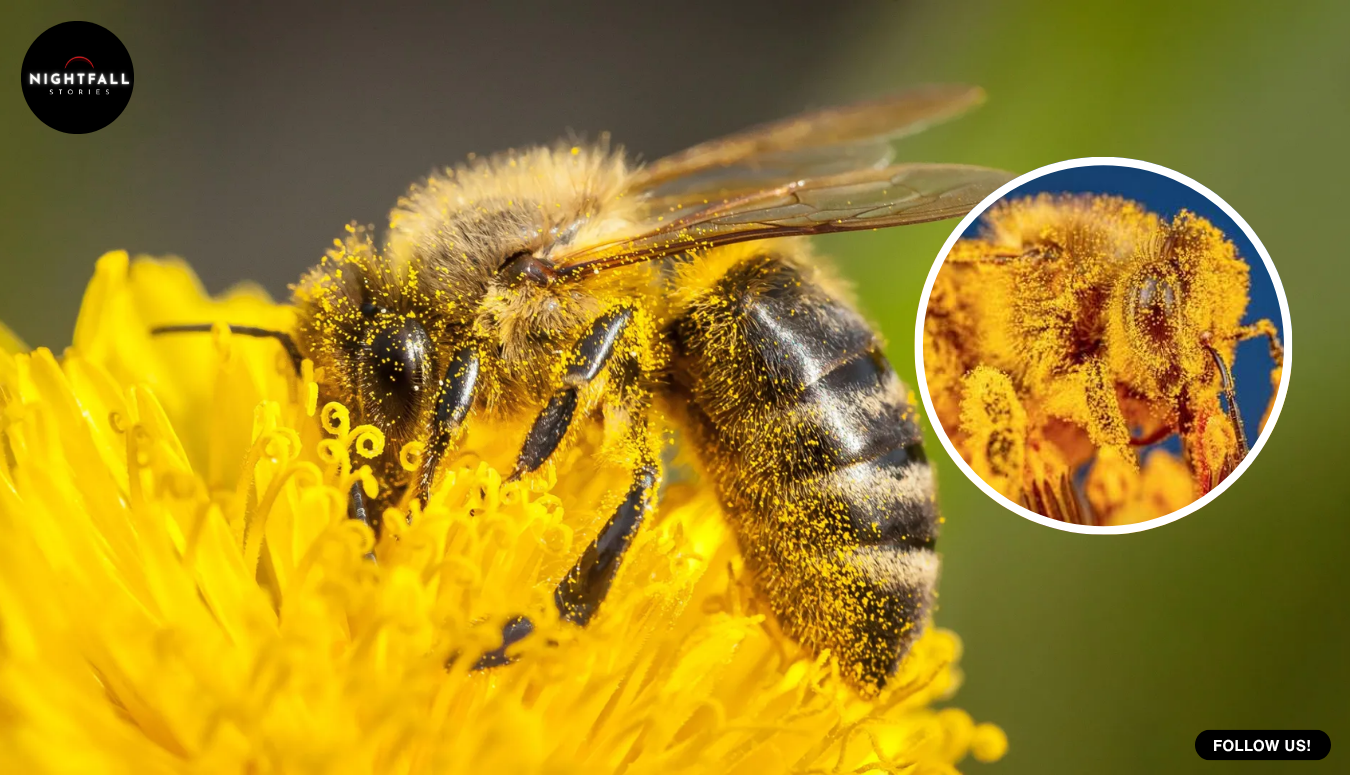
Honeybees have a problem with pollen, and it is not the one anyone expected. Researchers led by Oxford University took pollen from 99 flowering plant species, broke the protein down into its building blocks, and lined those up against the protein in a honeybee’s own body. Almost nothing matched. Most pollen carries the wrong ratios of the amino acids a bee cannot make for itself. And when the team fed bees a diet loaded with one of those amino acids, histidine, the bees did something telling. They stopped eating. Not a little less. Significantly less, as if the meal in front of them had turned from food into a warning.
That finding, published earlier this year in the journal Current Biology, quietly overturns one of the friendliest assumptions in pollinator science. For decades, the shorthand has been simple and comforting: nectar is the sugar, pollen is the protein, plant more flowers and the bees will be fine. The nectar half of that holds up. The pollen half turns out to be a lot more complicated, and the reason is almost embarrassingly obvious once someone says it out loud.
Nectar exists to be eaten. A plant makes it as a bribe, an open payment to anything that will carry pollen from one flower to another. It is advertising with a sugar budget behind it. Pollen is not that. Pollen is the plant’s male gamete, its genetic material, the thing the whole transaction is actually about. A plant has no evolutionary interest in making its own sperm delicious and nutritionally ideal for the animal it is trying to get to deliver it. Some pollen gets eaten because that is the cost of doing business. None of it is designed as a balanced meal.
Geraldine Wright, a professor in Oxford’s Department of Biology who has spent much of her career on how insects taste and regulate what they eat, has been circling this question for years. Her lab works on the machinery underneath feeding: how a bee detects what is in a droplet, how that information reaches the brain, what happens when the signals disagree. The pollen study grew out of that, and the approach was less glamorous than it sounds. Someone had to collect and chemically analyse pollen from 99 plant species across 26 botanical families, which is the kind of work that does not photograph well and takes a very long time.
Then came the comparison. An animal’s tissue tells you, roughly, what that animal needs to build itself. If you know the amino acid profile of a honeybee, you know the target. Ten essential amino acids sit at the centre of the problem, essential meaning the bee has no way to manufacture them and must get them from food. Line the pollens up against the target and the mismatch is not subtle. Some pollens are short on what a bee needs. Others are overloaded on one amino acid relative to the others, which sounds harmless and is not.
This is where the study gets genuinely interesting, because the trouble with amino acids is not just scarcity. It is proportion. Protein is not a single ingredient that a body absorbs and banks. It is a set of parts that have to arrive in something close to the right ratio to be assembled into anything useful. Turn up with too much of one part and the body cannot simply shelve the surplus for later. It has to process it, break it down, get rid of the nitrogen left behind. That costs energy, and past a point it does real damage. Excess of a single amino acid is a recognised problem in animal nutrition across species. Too much of a good thing is not a figure of speech here. It is a metabolic bill.
So the researchers built synthetic diets. Rather than guessing from field observations, they made artificial foods that reproduced the amino acid profiles found in different real pollens, plus one built to mirror the bee’s own tissue, which is as close to a theoretically perfect protein as you could design. Newly emerged worker bees, young enough not to have eaten much of anything yet, were given these diets under controlled conditions, and the team watched what they did.
The bees offered the diet matching their own tissue profile behaved exactly as a well-fed animal should. They ate more. They gained more weight. They shifted the balance of what they consumed toward protein rather than carbohydrate, which is what an animal does when the protein on offer is worth eating. The bees given profiles copied from actual pollens ate less. And the clearest signal came from histidine. When histidine ran high relative to the branched chain amino acids, particularly leucine and isoleucine, intake dropped sharply.
The bees were not tasting a poison and spitting it out. The response looks like a post-ingestive one, which means the information arrives after the food does. Something downstream of the mouth registers that the ratios are wrong and sends back an instruction to stop. That is a much more sophisticated piece of physiology than simple taste rejection. It means a bee has some internal accounting system capable of noticing not just how much protein it has eaten but whether the protein is the right shape, and of acting on that assessment by shutting down appetite.
Sit with that for a moment. An insect with a brain smaller than a sesame seed is running a nutritional audit in real time and overriding its own hunger on the result. Anyone who has ever felt genuinely unable to face another bite of something rich will recognise the feeling from the inside, even if the chemistry is different.
It is worth being precise about why this matters more for an insect than it might for us. A honeybee worker emerging from her cell is not finished. She still has to build up the glands in her head, lay down fat body, develop the tissue she will need for whichever job the colony hands her, and she has a narrow window of days to do it in. The protein she eats in that period is not topping up a reserve. It is the raw material for finishing her own construction. Get the ratios wrong at that stage and the consequence is not a bad week. It is a bee that never quite becomes what she was supposed to become, in a colony that needs her to.
Histidine is a useful example of how unforgiving the arithmetic is. It is not a villain. Bees need it, we need it, it goes into proteins across the body and plays a part in a range of ordinary functions. The problem is entirely relational. Histidine only becomes a signal to stop eating when it arrives in a large enough share relative to the branched chain amino acids sitting alongside it. Change nothing about the absolute amount and simply raise leucine and isoleucine, and the same quantity of histidine stops being a problem. The bee is not reading a list of ingredients. She is reading a balance sheet.
Which leaves the obvious question. If pollen is this badly matched to what bees need, how have honeybees managed to build some of the most successful societies in the animal kingdom on it? The answer is that they do not eat pollen the way we imagine. They cook.
A foraging honeybee does not gather from one plant and return with a single flower’s worth of protein. She packs pollen from whatever is flowering, and back at the hive it goes into cells with nectar and glandular additions and is left to ferment. That is bee bread, and it is already a blend, which mathematically smooths out the extremes. A pollen that is wildly high in one amino acid gets diluted by pollens that are not. Mixing does what mixing always does, and pulls everything toward the middle.
Then comes the second step, which is the one that really matters. Young nurse bees eat the bee bread and convert it, through glands in their heads, into the secretions they feed to larvae. Royal jelly is the famous version of this, the substance that turns an ordinary female larva into a queen, but the same principle applies to the brood food given to workers. The research found that the amino acid profile of royal jelly is a better match to honeybee tissue than bee bread, and bee bread is a better match than raw pollen. Each processing step moves the food closer to the target.
Wright’s read on this is that the glandular secretions are not an accident. She predicts that honeybees evolved to produce them precisely because they solve the pollen problem, manufacturing what is effectively an ideal food for their young out of raw material that was never ideal to begin with. A colony takes in a chaotic, unbalanced, plant-serving substance at one end and turns out a precisely tuned baby food at the other. Nurse bees are running a refinery.
It is a lovely piece of biology and it should come with a chill, because most bees cannot do any of this.
There are somewhere north of 20,000 bee species in the world, and the overwhelming majority are nothing like a honeybee. They do not live in vast colonies. They have no nurse caste, no shared pantry, no glandular processing line. A solitary bee, and most bees are solitary, does something much simpler and much more exposed. She digs or finds a cavity, packs it with pollen, lays an egg on the pile, seals it and leaves. The larva eats what it was given. Whatever ratios were in that pollen are the ratios that larva gets, uncorrected, for its entire development. There is no blending, no fermenting, no second pass. Bumblebees sit somewhere in between, social but without the honeybee’s elaborate processing.
Which means the honeybee finding is not really about honeybees. It is a measurement of how much correction a bee needs, taken on the one species that can correct. For everything else, the correction has to happen before the pollen is collected, in the range of plants available to forage from. A solitary bee’s only version of mixing is flying to enough different species.
That is where this stops being an interesting laboratory result and starts being a practical problem, because it cuts across how pollinator conservation is usually done. The standard instinct is abundance. Plant more flowers. Put in a wildflower strip, sow a pollinator mix, leave the verge uncut. All of that is good and none of it is enough on its own, because abundance and diversity are not the same thing. A large planting dominated by two or three showy species that are cheap to seed and reliably germinate can look like a triumph and still function, for a solitary bee, as a shop stocked entirely with one item.
The researchers make this point directly. If pollen quality varies this much between plant species, and if most bees have no way to blend their way out of a bad profile, then what matters is the range of what is flowering, not just how much of it there is. The measure of a good pollinator planting is how many genuinely different plant families a bee can reach within her foraging distance, and that distance can be very short for a small solitary species. Diversity is not a nice extra on top of abundance. For a bee with no nurse caste behind her, it is the whole mechanism.
It also reframes what counts as a generous garden. Plant families differ far more from each other than species within a family do, which is why the study’s count of 26 families matters as much as its count of 99 species. A border with a dozen daisies in it, however pretty and however different the flower colours, is offering a narrower nutritional range than a smaller patch running a legume, a mint, a borage relative and a carrot family umbel. The same logic applies to timing. A bee provisioning a nest late in the season cannot forage from something that finished flowering in spring, so a planting that peaks all at once leaves gaps that no amount of peak abundance covers.
There is a further implication for anyone keeping bees. The habit of feeding colonies sugar syrup or pollen substitute through lean periods is normal beekeeping practice and often the difference between a colony surviving and not. But if the protein source has an amino acid profile the bees cannot correct far enough, the calories are arriving without the parts. A colony can be fed and still be short of what it needs to build bodies. The study points toward designing supplements around ratios rather than crude protein totals, which is a harder specification to hit but a more honest one.
None of this means the flowers you planted are wasted or that pollen is bad for bees. Bees have been living on pollen for something like 100 million years and have built elaborate machinery to make it work. What the research does is remove a comfortable piece of shorthand and replace it with something more demanding. Pollen was never a gift. It was always a compromise, and the bees have been quietly managing that compromise the entire time, in a way nobody had properly measured until someone sat down with 99 plant species and a mass spectrometer and checked.
The work was led from Oxford’s Department of Biology with collaborators at the University of Southampton, Newcastle University, Lancaster University and the Bee Research Center at the Hebrew University of Jerusalem, a spread that tells you something about how much ground the question covers. It took biochemistry, behavioural experiments, field collection and a good deal of patience to answer a question that sounds like it should have been settled a century ago.
And the answer changes what a helpful person can usefully do. The useful instruction is no longer plant more flowers. It is plant more kinds of flowers, from as many different families as your space allows, flowering across as much of the season as you can manage, and resist the pull toward the one variety that looks best and spreads fastest. A bee arriving at a patch is not counting blooms. She is assembling a body out of parts, and she needs the parts to come from more than one supplier.
The honeybee worked that out long before anyone published it. She just had a hive full of nurses to do the cooking. Most of her relatives are flying home alone with whatever they could find, and what they found is what their young will have to grow on.