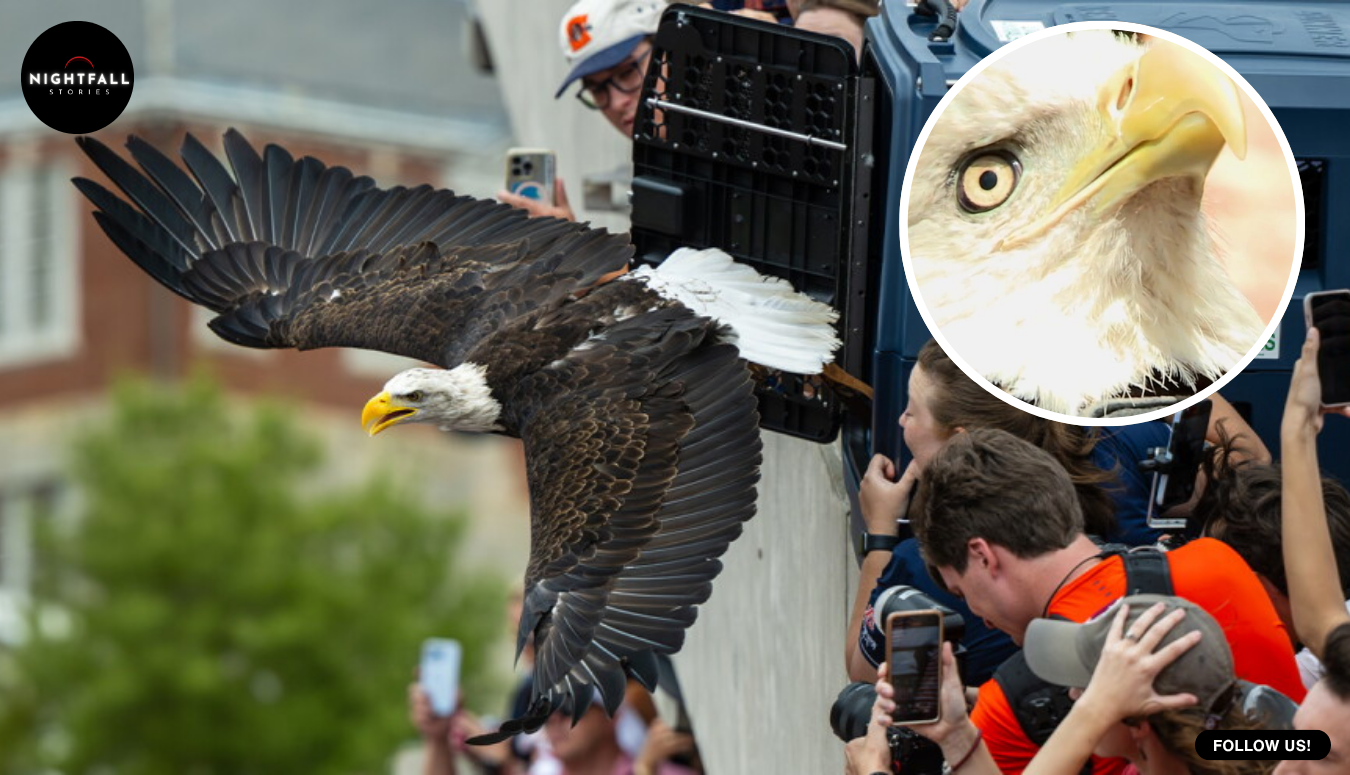
A bald eagle was found on the ground near Prattville, Alabama on the last day of the year, unable to get back into the air. When it reached the raptor hospital at Auburn University it had two fractures in one wing, shotgun pellets lodged in its wings and chest, and a dangerous level of lead in its blood. Eight months later it was carried back out to a managed pine forest about ten miles from the spot where it was picked up, and it flew.
The ten miles is the detail worth holding onto, and the eight months is the part people underestimate. Between those two facts sit two surgeries, months of physical therapy several times a week, and one piece of very bad news that arrived after everyone had already decided the bird was going to make it.
One caveat belongs up front rather than buried, because readers deserve it. Nearly everything documented about this case comes from Auburn University itself, in a feature its own communications office published about its own hospital. A regional television station in Alabama reported the release at the time, which puts an independent eye on the fact that a bald eagle was let go, but the clinical account is single-sourced to the institution that treated the bird. No independent veterinary record, no wildlife-agency case file and no investigation document has been published. The people are named and their roles are checkable, the hospital is real and long-established, and nothing in the account is implausible. But it has not been corroborated in detail by anyone outside Auburn, and this piece will not pretend otherwise.
With that said, here is what the hospital says happened, and why the hard part was the second operation rather than the first.
The veterinarian on the case was Amberly Sokoloff, at Auburn’s Raptor Center. The first surgery addressed the two wing fractures, which is the kind of work a raptor hospital does often and does well. Fixing a bird’s wing is not like fixing a dog’s leg, and the difference is not sentimental. A dog that heals with a slightly crooked front leg limps, and then lives a full life limping. A bird that heals with a wing a few degrees out of true cannot fly, and a bald eagle that cannot fly cannot hunt, cannot hold territory and cannot be released. There is no version of a wild raptor that gets by with reduced performance. The margin is absolute, and that is why wing orthopaedics in birds of prey is one of the less forgiving corners of veterinary medicine.
The surgery worked. Then the wing refractured during recovery, and the bones began knitting together in the wrong configuration, fusing in a way that threatened the bird’s ability to fly at all. That is a materially worse problem than a clean break. A fresh fracture is a known quantity with a known procedure. A healing error means going back into a wing that has already been operated on once, taking apart what the body has built, and getting a second shot at alignment with less to work with than the first time. Sokoloff operated again.
The centre’s director, Robyn Miller, has described the recovery as long and grueling, which is not promotional language and is probably the most useful summary available. The physical rehabilitation ran two to three times a week over months. For a raptor that means controlled flight work: the bird has to rebuild the specific muscles, the range of motion in the repaired joint and the stamina to carry its own weight for a sustained period, and all of it has to be assessed by people who can tell the difference between a bird that is flying and a bird that is getting away with it. A rehabilitator watching an eagle cross a flight enclosure is reading wingbeat symmetry, height held, and whether the animal can still do it on the fourth pass. There is no self-reporting from the patient. There is only what the handlers can see.
Then there is the lead, which is the part of this story that is much bigger than one bird.
Auburn says the eagle’s lead levels were dangerous on admission. No figure has been published, so no figure belongs here. What can be said, on the record of institutions that study this specifically, is how widespread it is. The Raptor Center at the University of Minnesota, which has built a long-term dataset by testing every eagle it admits, reports that between eighty and ninety percent of the more than 150 bald eagles it takes in each year show some lead in their blood, and that between a quarter and a third have documented lead toxicity. That is not an occasional accident. That is a background condition of being a bald eagle in North America.
The mechanism is the part most people do not know, and it is not shooting. Lead rifle bullets and lead shot fragment violently on impact, breaking into hundreds of pieces that spread well beyond the wound, by the Minnesota centre’s account up to about eighteen inches from it. Hunters field-dress deer and leave the gut pile behind, or an animal is wounded and never recovered, and in winter a carcass on open ground is exactly what a scavenging eagle is built to find. The bird swallows soft lead fragments along with the meat. Lead does not need to be a bullet to do harm; it needs only to be eaten. The Minnesota centre lists the effects, which include gastrointestinal and neurological damage, weakness and seizures, and notes that most seriously affected eagles either die or have to be euthanised. The solution it argues for is narrow and practical: non-lead ammunition, which does not require anyone to stop hunting.
So this eagle was carrying both routes at once. Pellets in its body from somebody shooting at it, and lead in its blood from something it ate. Those are two separate events, and the second one was probably not the fault of whoever fired the first.
Treatment for lead in a bird of prey generally involves chelation, a course of drugs that binds the metal so the body can clear it, alongside supportive care while the animal is too weak to self-feed. Auburn has not published the specifics of what this bird received, so none are claimed here. The relevant point for the case is sequencing: a bird with a toxic metal load is a bird whose body is in no condition to heal bone, which means the lead has to come down before orthopaedic work has much chance of holding. Two problems arrived together and one of them had to be solved first.
It is also worth noting how a grounded eagle gets to a hospital at all, because it is never the hospital that finds it. Somebody sees a large bird on the ground that should not be on the ground, and makes a call. In the United States handling a bald eagle, even to help it, requires federal authorisation, so the chain usually runs from a member of the public to a wildlife agency or a permitted rehabilitator, and then into a crate and a vehicle. Auburn’s own account of its caseload includes a golden eagle with lead toxicity that arrived in taped-up packing boxes, which tells you how improvised the front end of this system is. Every case in a raptor hospital starts with a stranger deciding not to drive past.
Shooting a bald eagle is a federal crime. The Bald and Golden Eagle Protection Act prohibits taking the birds without a permit, and it defines taking broadly enough to cover shooting at one, wounding one, or simply disturbing it. A first criminal violation by an individual carries a fine of up to one hundred thousand dollars, up to a year in prison, or both, with a second offence treated as a felony. None of which is directly relevant to this case, because no investigation outcome, no suspect and no charge has been documented anywhere. Shotgun pellets is the hospital’s description of what was in the bird. Who fired them, when, and whether anyone ever looked into it is simply not on the record, and the honest thing is to say that once and move on rather than to build a crime story out of a silence.
The last stage is the one nobody writes about, and it took real work: deciding where to put the bird.
A rehabilitated raptor cannot be released wherever is convenient. It needs prey it can actually catch, cover, water, and ideally not an immediate fight with an established resident bird over the same airspace. Releasing a recovered eagle into good habitat that is already fully occupied is a slower way of failing. Stephanie Kadletz, the centre’s assistant director of raptor rehabilitation, ran the search for a site, and the person on the other side of that conversation was Preston Payne, a registered forester with Auburn’s College of Forestry, Wildlife and Environment, who manages the Autauga Experiment Forest.
That property is a longleaf pine landscape, managed with prescribed burning and timber thinning in a way that keeps the understory open and supports the small mammals, the rodents and rabbits, that a predator needs. What that means in practice is two professionals reading the same stand of trees for different reasons and arriving at the same answer. A forester looks at burn history, canopy spacing and stand structure. A rehabilitator looks at whether a bird with a repaired wing can hunt there next week. Open, burned longleaf is good for an eagle for exactly the reason it is good for a woodpecker or a quail: you can see the ground, and things live on it.
Longleaf pine is its own quiet comeback story sitting underneath this one. It was once the dominant forest across a vast sweep of the American Southeast, blanketing something like ninety million acres, and a combination of logging, land conversion and decades of fire suppression reduced it to a small fraction of that, bottoming out late last century. Restoration partners put the current figure at more than five million acres, roughly five percent of the historic range, rebuilt deliberately with fire as the main tool. A forest type that depends on burning is a hard sell in a culture that spent a century treating all fire as the enemy. The fact that there was a well-managed longleaf stand ten miles from where this eagle fell, with somebody employed to look after it, is a result of forty years of other people’s unglamorous work.
The release happened in late summer, with the forester, the rehabilitators and the veterinary staff present. The bird left the crate, flew to a longleaf pine nearby, and within minutes was up on thermals, circling with vultures. That is a better outcome than it sounds. Soaring on a thermal is not a victory lap; it is a functional test. It means the repaired wing can hold a stable shape in rising air for a sustained climb, which is the single most energy-efficient thing an eagle does and the thing it cannot fake.
Nobody named the bird, which is appropriate. It is tempting to write this animal as a character who fought for its life, and that is not what happened. The eagle did not know it was in a hospital. It did not understand the second surgery, did not consent to physiotherapy, and spent eight months being handled by large frightening primates for reasons entirely opaque to it. It almost certainly experienced the whole episode as an extended ordeal. The choosing, the persistence and the judgment in this story belong to the people: a veterinarian who went back into an already-operated wing, a rehabilitation team that showed up two or three times a week for months with no guarantee, a director who kept the case open, and a forester who knew the right ten square miles.
Auburn’s Raptor Center has been doing this since 1972, originally set up at the request of the federal wildlife agency to fill a gap in raptor care across the Southeast. It reports more than two thousand birds released since 2000, out of a caseload driven overwhelmingly by human activity: vehicle strikes, lead, barbed wire, power lines, lost habitat. Most of its patients arrive because of something a person did, usually without meaning to.
The arithmetic of this case is not flattering to anybody. It took one person with a shotgun, plus whatever carcass carried the lead, to put this eagle on the ground. It took a hospital, two operations, a surgeon willing to try twice, months of structured rehabilitation and a forester with a well-burned pine stand to put it back in the air. Eight months of skilled work against an afternoon’s damage.
It went back up about ten miles from where it came down. Nearly the same sky.