Somewhere in the pile of more than eight thousand suggestions, eleven people who had never met each other, who had no way of coordinating and almost certainly had no idea the others existed, sent in exactly the same word.
Populi. Latin, genitive, singular. Of the people.
That is the detail that makes this story worth your time, and it is not the detail that got reported. The headline figure everywhere was eight thousand, which is a measure of how many people were paying attention. Eleven is a measure of something much rarer. Eleven is a crowd of strangers independently reasoning their way to the same answer, and in the end it is why a small animal recovered from five and a half kilometres down in the Pacific is now called Ferreiraella populi.
Start with the animal, because it is genuinely strange and the strangeness is the reason anyone was asked.
It is a chiton. If the word means nothing to you, you have still probably seen one: an oval, slightly armoured thing clamped to a rock in a tide pool, with eight overlapping plates running down its back like a segmented shield. Chitons are molluscs, relatives of snails and clams, and they are one of the oldest designs still in service. Most of the ones people encounter live in the shallows and scrape algae off stone, which they do with a tongue reinforced with iron minerals. That is not a metaphor. Chitons grow some of the hardest teeth in the animal kingdom by incorporating iron into them, and they wear them down and replace them continuously, like a conveyor of chisels.
This one does not live in a tide pool. The holotype, the single physical specimen that the name is permanently attached to, came up from 5,506 metres of water in the Izu-Ogasawara Trench, in the northwestern Pacific about 150 kilometres east of the trench axis, off Japan. It is small, roughly 17 millimetres by 9.5, oval, and pale. And it was not found on rock. It was found on wood.
This is the part that makes deep-sea biologists lean forward. A tree falls into a river, washes out to sea, waterlogs, and sinks. On the way down it stops being a tree and becomes something else entirely: a parcel of concentrated food arriving in one of the emptiest habitats on the planet, where almost nothing falls and almost everything is hungry. Sunken wood on the deep seafloor builds its own ecosystem, a temporary island with specialists that exist nowhere else and that somehow find each new log across enormous distances of nothing.
Chitons are one of the groups that made the jump, and they committed to it. There are two entire families of chiton found only on sunken wood, and the genus this new species belongs to, Ferreiraella, is the sole member of one of them. It now holds ten species, all of them wood dwellers. The evidence suggests they are not actually eating the wood. They appear to be living one step up, grazing on whatever colonises it, which is a more interesting kind of specialisation: not adapted to a food, adapted to an address.
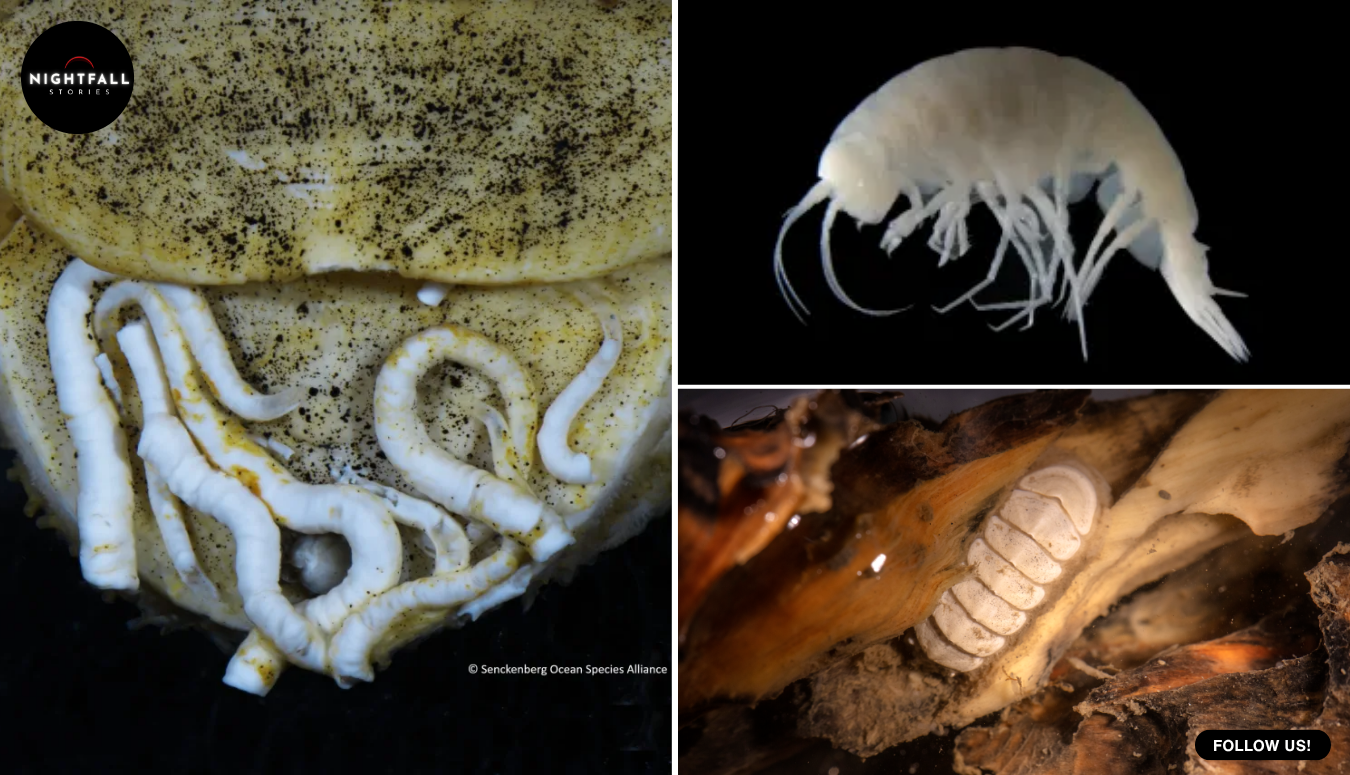
The new species also travels with company. Related animals in the group are frequently found hosting small tube-building worms on the rearmost plate, riding along on the back of something that is itself riding a sunken log two kilometres below the reach of light.
So that is what eight thousand people were naming. The question is how they came to be asked, and the answer requires being precise about who did what, because this story is very easy to tell wrongly.
The naming was run by the Senckenberg Ocean Species Alliance, a programme based at the Senckenberg Research Institute and Natural History Museum in Frankfurt, Germany, with the publisher Pensoft and with the science video channel True Facts. True Facts is made by Ze Frank, whose deadpan narration over wildlife footage has built an audience of something over four million subscribers, and whose particular gift is making people care about an animal for eight minutes without flattering them or dumbing anything down. He put the chiton in front of that audience and invited them to suggest a scientific name.
Here is what he did not do, and what the coverage sometimes implies. There was no public vote. The audience did not choose the name, and the scientists were not bound by the result. The arrangement was an open competition for suggestions, with the authors of the scientific description selecting the final name themselves, taking into account which suggestions the participating community had got genuinely excited about. The channel supplied reach and announced the outcome in a follow-up video. The scientists supplied the animal, the description, the judgement and the legal responsibility for the name.
One further wrinkle, and it is a nice one. The scientific paper carries nine authors, and the list includes Hosea Frank, listed as an independent researcher in New Jersey. By all public accounts that is Ze Frank, who performs under a shortening of his own first name. So the video maker is not an outside promoter attached to a science story. He is on the paper. That is unusual and worth saying plainly, and it is also worth not overstating: the taxonomic work, the dissections, the electron microscopy and the species diagnoses were done by specialists including Julia Sigwart of Senckenberg and Goethe University Frankfurt, who ran the naming and is the authority on the species, Chong Chen of the Japan Agency for Marine Earth Science and Technology, who photographed the animal where it lived, Enrico Schwabe of the Bavarian State Collection for Zoology, and colleagues at Frankfurt.
Now, the reason eight thousand suggestions is a smaller achievement than it sounds. Most of them could never have been used, and not because they were bad.
Naming a species is not a branding exercise. It is a legal act, governed by a rulebook called the International Code of Zoological Nomenclature, and the code is strict in ways that catch almost every enthusiastic amateur suggestion. The name has to be a two-part name, genus plus species epithet. It has to be formed in Latin or latinised, and it has to behave grammatically, which is why populi, a genitive, works and a plain English word does not. It has to be unique within the genus, forever. It has to be published in a permanent, obtainable, dated work, with a formal description attached, and tied to a designated type specimen physically deposited in a museum collection where any future scientist can go and examine it. For this chiton that specimen now sits in Frankfurt under a catalogue number, and that specimen, not the description and not the photographs, is what the name legally means.
The code also forbids some things people find surprising. You may not name a species after yourself. You may honour anyone else, including a donor, a colleague, a spouse or a cartoon character, but your own name is off limits, which is the single most elegant rule in the whole document. Names that would give offence are prohibited. And the decision is effectively irreversible: once a name is validly published it stands, even if it turns out to be ugly, misleading, or based on a mistake about where the animal lives. Taxonomy has centuries of accumulated names that everyone agrees are wrong and nobody can change.
There is one more requirement that did not exist a generation ago and matters enormously now. For most of the history of taxonomy, a name became real when it was printed on paper, because paper was the permanent record. The code has since been amended to accept electronic publication, but only on conditions: an electronic-only work has to be registered in an official online register of zoological names before the name counts, and it has to carry a persistent digital identifier so the publication can still be located when the journal’s website has long since changed shape. This description was published electronically in an open-access journal with a permanent identifier attached. Without that registration step the paper could have been read by a million people and the name would still have been nothing.
Set that against eight thousand submissions arriving in roughly a week, many of them jokes, many of them references to the same handful of films and games, many of them not Latin at all, and a great many of them duplicates. The team’s job was not to pick a favourite. It was to find, inside a flood, a name that was legally valid, grammatically sound, not already taken, not offensive, meaningful about either the animal or the circumstance, and capable of being read aloud in a seminar in fifty years without anyone wincing.
Which is where the eleven come in.
Convergence is the most informative thing a crowd can do. When thousands of people answer an open question and the answers scatter, you learn about the range of the crowd. When eleven of them, in isolation, produce an identical answer that nobody suggested to them, you learn that the answer was sitting there in the structure of the problem, waiting to be noticed. Those eleven people were not reacting to the animal’s appearance. They were reasoning about what was actually happening: a species was being named by the public, so the species should be named for the public. The name describes the process that produced it.
The runners-up are good enough to show by contrast why that won. One was Ferreiraella stellacadens, shooting star, after the pattern of small holes across the shell plates. The other was Ferreiraella ohmu, after a creature from a Studio Ghibli film, chosen partly to honour Japan, where the animal was found. Both are lovely. Both are also about the animal, or about a culture, and the thing that made this particular naming unusual was neither of those. Populi was the only serious contender that was about the experiment itself.
There is a quiet argument buried in that choice, and it is aimed squarely at a practice the museum world has relied on for years. Naming rights get sold. Institutions auction the privilege of putting a donor’s surname on a new species, and the money funds real research, and nobody involved pretends it is anything other than a transaction. This naming did the inverse. It gave the privilege away, to a crowd, for free, and then recorded that fact in the name itself, permanently, in the only language taxonomy accepts.
Not everyone in the field loves this kind of exercise, and the objection is reasonable. The scientific record is permanent and shared, and once a frivolous name enters it, every researcher for the next two hundred years is stuck writing it in their papers. There are species out there named after bands, actors and in-jokes, and a working taxonomist who has to type one of them into a grant application does not always find it funny. The counter-argument is that the alternative was never a dignified silence. The alternative was the specimen sitting unnamed in a drawer for fifteen years, which does far more damage to the record than a cheerful epithet ever has. And populi is not a joke. It is a straightforwardly formed Latin genitive that states, accurately, how the name came about. It would pass unremarked in any taxonomic paper written a century ago.
The practical point underneath all of this is less charming and more urgent. The bottleneck in marine biology is not finding new animals, it is describing them. Expeditions return with far more unfamiliar species than there are taxonomists to formally name them, and specimens sit in jars and drawers for years waiting their turn. Sigwart has put the normal lag from discovery to published name at ten years, if not twenty. This chiton was described about two years after it was found, and the only reason is that the programme behind it was built specifically to shorten that interval. The paper it appeared in belongs to a series designed to let many taxonomists publish stand-alone species descriptions together rather than each waiting to assemble a monograph alone. This instalment described three new chitons at once: the Japanese one, another from Madagascar, and a third from Papua New Guinea. Only one of the three got a crowd.
The urgency is deep-sea mining. The seafloor around and beyond trenches like this one is being surveyed for commercial extraction, and the regulatory machinery for deciding what may be disturbed runs entirely on names. An environmental assessment cannot list an animal it cannot call anything. A protected species list cannot include a jar labelled with a station number. A scientist cannot publish a comparison, a population estimate or a range map for something that has no handle. The name is not decoration on top of the science. It is the thing that makes the animal visible to every system humans use to count and protect anything at all.
So there is a drawer in Frankfurt with a small pale animal in it, taken from a sunken log at the bottom of the Pacific, and a number on the drawer, and a name that will outlive everyone involved. The scientists did the work. The channel brought the audience. And the word on the label was arrived at, independently and without consultation, by eleven people scattered across the internet who each thought the same thought at roughly the same time and typed it into the same box.
None of them will ever be identified. That, if you think about it for a second, is the most fitting possible outcome for a name that means of the people.