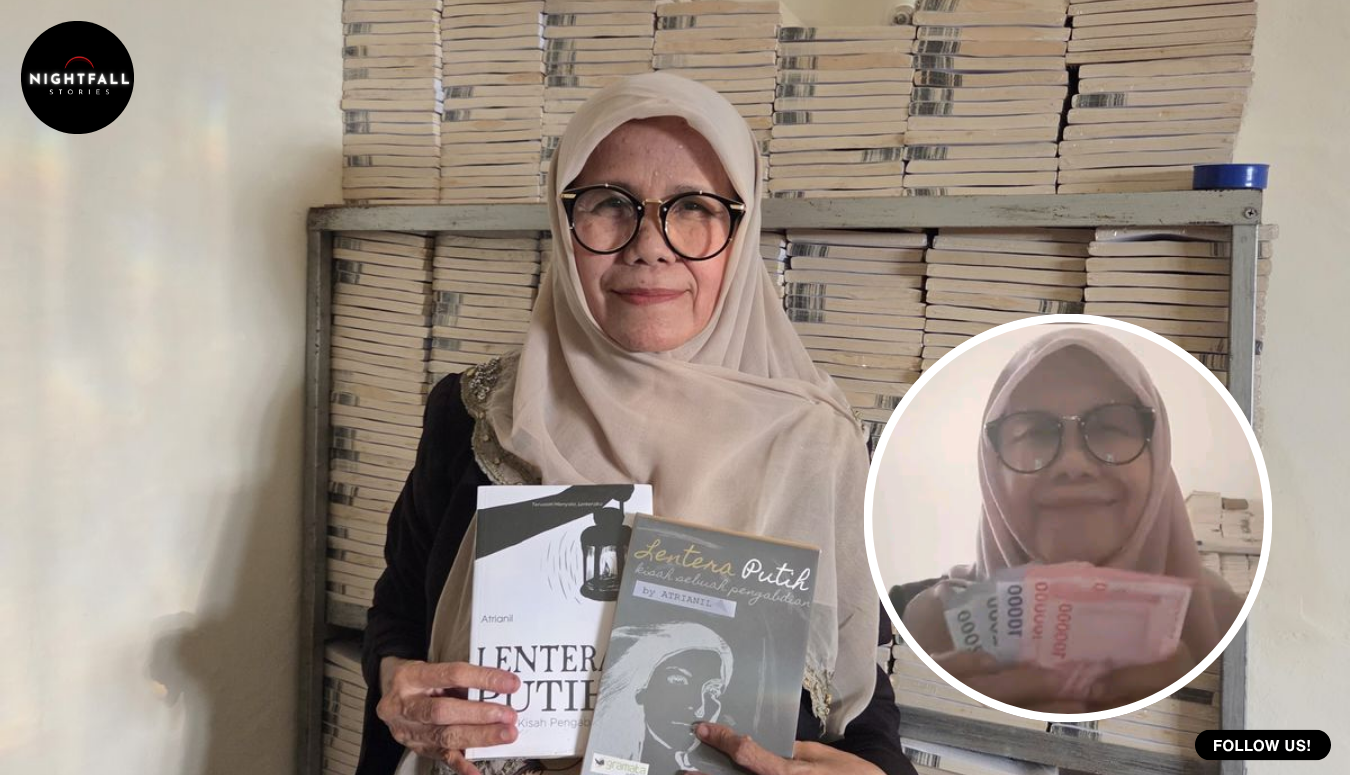
The envelope was brown, the ordinary kind a school office keeps in a drawer, and the number written on it was 414,000 rupiah. At the exchange rate of the month she retired, that came to roughly twenty three dollars. It was the last money Atrianil was paid for teaching, and it arrived at the end of forty years at the same private vocational school in West Jakarta.
She is sixty three. Her pupils have called her Bu Ijah for decades, and it was Bu Ijah, not any reporter, who put the envelope on camera. She posted it to her own social account in June, late in the month, a few days after her final working day. Within about a week the clip had been picked up by national media, the teachers’ association had been asked to comment, and Indonesia’s largest daily had run an editorial whose headline was simply the two numbers side by side: 414,000, and forty years.
The first thing worth settling is whether the figure means what it looks like. It does. When the school was asked, it confirmed that 414,000 rupiah was the whole of her monthly pay, not a residual or a part payment. The teaching allowance was inside it. So was the transport money. There was no second envelope.
A second number makes the first one legible. The minimum monthly wage for the province of Jakarta this year is 5,729,876 rupiah, about three hundred and twenty dollars, set by the provincial government and binding on employers of ordinary workers. Her pay was a little over seven percent of it. She was not being underpaid against that floor, because the floor did not apply to her. That is the part of the story that takes some explaining, and it is the reason the story is worth more than a sad number.
Before going further, a word about where all of this comes from, because it matters here more than usual. There is one original. A Kompas reporter interviewed her and the school in the days after the clip spread, and effectively everything that has circulated since, across national outlets, aggregators and regional titles, traces back to that reporting. It reads like eight or ten independent confirmations and it is one. Kompas is not reachable from where this piece was researched, so the figures here were cross checked against pickups that reproduce them consistently, against the school’s confirmation as reported, and against the public response from the teachers’ association, which is independent of the original interview. Her own account includes one further episode from early in her career, concerning money she says she was asked for and refused. It is a striking claim and it appears in exactly one chain of reporting that could not be read at source, so it is left out here rather than repeated on trust. Everything below is either confirmable or flagged as her account.
The category she belonged to is called guru honorer. The English rendering, honorary teacher, is misleading, because nothing about it is ceremonial. An honorary teacher is a working teacher without civil service status. In a state school, the local education office or the school itself hires them outside the national establishment, usually because there are classes to cover and no funded civil service post to cover them with. In a private school, which is where Bu Ijah worked, the employer is a foundation, and the foundation decides what it pays out of whatever fees and donations it collects. There is no national pay scale in that arrangement. There is no accrual of pension rights. There is, in the plainest terms, no mechanism by which forty years of continuous service converts into anything at the end of it except a last envelope.
The scale is not marginal. According to ministry figures drawn from the national education database late last year, Indonesia had about 3.42 million educators, and 21.42 percent of them held non permanent status. That is roughly one in five of the people standing in front of classrooms, and the share is heaviest at primary level. A separate official count puts 237,196 non ASN teachers in state schools as registered and permitted to keep teaching through the end of this year, under a ministry circular issued earlier in 2026. The circular was widely read as a threat and the government insisted it was the opposite, a stabilising measure to stop regional authorities from cutting those teachers loose before replacements existed. Either way, the date at the end of it is real. The civil service law passed in 2023 set a horizon for clearing up non permanent employment, and the end of this year is when that horizon arrives for teachers.
The route out, for those who get one, is a scheme called PPPK, a contract form of government employment that carries a salary scale and benefits without full civil service tenure. Converting honorary teachers into PPPK posts is the government’s main answer, and the ambition is large, more than nine hundred thousand conversions across five years. Here is the mechanical reason it was never going to reach Bu Ijah. PPPK positions are government positions, allocated to government schools. A teacher employed by a private foundation is not competing for a slot that happens to be scarce. She is outside the pool. The education ministry’s own director general for teachers set out that distinction at a parliamentary hearing late last year, and the policy conversation since has been about whether teachers who pass PPPK selection might be posted into private schools, which is a different question entirely, about redistributing existing public employees rather than recruiting the people already doing the work.
So forty years in a private vocational school produced no eligibility for anything. That is not an oversight in her case. It is how the category is built.
Nor is her number an outlier at the bottom of a broadly decent distribution. A survey of teachers carried out in the first week of May 2024 by the research institute IDEAS with the charity Dompet Dhuafa, covering 403 teachers across twenty five provinces, found that 20.5 percent of honorary teachers were paid under 500,000 rupiah a month, around twenty eight dollars, and that 74.3 percent were paid under two million rupiah, around a hundred and twelve dollars. Fewer than one in a hundred cleared five million. The sample is modest and the figures are two years old, so they should be read as an indication rather than a census. The indication is that a fifth of the honorary workforce lives in the band Bu Ijah’s envelope sits in.
There is a detail in her last year that says more about the arrangement than any of the figures. By her own account, she had cut her teaching down to two days a week by the end, in order to reach the forty year mark at all. Forty years was not a term of employment she was serving out. It was a number she went after, on a timetable she had to shrink to afford, at a school that was paying her less per month than a single day of minimum wage work in her own city would have earned.
The pay also sat behind a gate she was never going to get through. The large allowances in the system, the professional allowance of two million rupiah a month and the remote region allowance of the same size, go to certified teachers, and certification runs through a professional training programme that more than seven hundred and fifty thousand teachers passed through across the last two academic years. The basic incentive, the smallest of the three, is the one aimed at the uncertified. An uncertified teacher at a private foundation school is therefore at the bottom of both ladders at once, too far outside the public establishment to be converted and too far from certification to be topped up.
What that produces, across the workforce rather than in one case, is a teaching profession that largely does something else as well. The same survey of 403 teachers found 55.8 percent holding a second job. Private tutoring was the commonest, which at least keeps them in their own trade, followed by trading, farming, manual labour, making online content and driving motorcycle taxis. The researchers also recorded what teachers pawn when something goes wrong in a given month, and the list ran from gold wedding gifts to motorbikes. None of that is about Bu Ijah specifically, and there is no reporting on whether she took outside work. It is about the shape of the thing she spent forty years inside.
The teachers’ association that responded to her case put harder cases on the record. Its national coordinator, Satriwan Salim, called the situation deeply sad and then named two he said his organisation had documented: a part time contract teacher in Dompu, in the eastern islands, paid 135,000 rupiah a month, about seven dollars and fifty cents, and another in West Java paid 50,000 rupiah, under three dollars. His association’s demand is narrow and unglamorous, which is usually a sign it is serious: a minimum wage floor for non civil service teachers, pegged to the regional labour minimum the way it is for every other kind of worker. It has also gone to the constitutional court over this year’s state budget law. The budget in question runs to about 769 trillion rupiah for education, something in the order of forty three billion dollars, which is the figure that makes the envelope hard to argue away.
There is a particular arithmetic in the government’s own relief scheme that lands without any need to raise the volume. From this year, non civil service teachers who qualify receive a monthly incentive raised from 300,000 rupiah to 400,000 rupiah, about twenty two dollars, paid to 377,143 recipients at a cost of around 1.8 trillion rupiah. Certified teachers get a professional allowance of two million rupiah a month, and teachers in remote regions get a special allowance of the same size, with the whole package passing fourteen trillion rupiah. The state’s top up for an underpaid teacher, in other words, is almost exactly the size of Bu Ijah’s entire salary. Whether she ever drew it is not documented anywhere that could be verified, and given the eligibility routes run through state school registration, it would be unsafe to assume she did.
It is tempting, at this point, to make her into an argument, and she should not be one. The honest shape of her forty years is not devotion to a wage. She has said, in the reporting that exists, that she stayed because of the pupils and because leaving felt like abandoning something she had built, and she has also been plain that the money was an injury rather than a sacrifice she was content with. By her own account she raised the practical grievance of an age limit on a Jakarta support payment for educators, which cut off at sixty and therefore cut off her. She has objected to the word honorer itself being thrown around in public as a label for a kind of person. Those are the complaints of someone who thought she was owed better, not of someone who had made peace with less. Treating her as a parable of cheerful endurance would get her wrong, and it would also let the system off.
Which brings this to an ending that is not satisfying, and should not be dressed up. Nothing happened to her. The clip spread, the association spoke, a national newspaper wrote its editorial, and there is no documented outcome for Atrianil: no reinstatement on better terms, no pension granted, no public fund, no official intervention on her behalf that can be sourced. It is possible something private was done and was never reported. It is not possible to claim it. Three months on, the only verifiable facts of her retirement are the ones she put up herself.
What she actually did, in the last week of a forty year career, was to document it. She did not write a manifesto or address a rally. She held up the envelope with the number on it, the one piece of paper in the whole story that nobody has disputed, and let the arithmetic do the work. That turned out to be the most effective thing anyone involved has done. The association’s wage floor has not been legislated. The deadline at the end of this year is still a deadline, with 237,196 people in state schools on the near side of it and an unknown larger number in private schools who are not even counted in that figure. The category that produced her envelope is still producing envelopes.
She taught in the same place for four decades and walked out with twenty three dollars and no pension. The number is not a scandal because it is small. It is a scandal because it is accurate, because the school was right that it was the total, and because it was arrived at legally, by a system that knows exactly how many people are inside it.