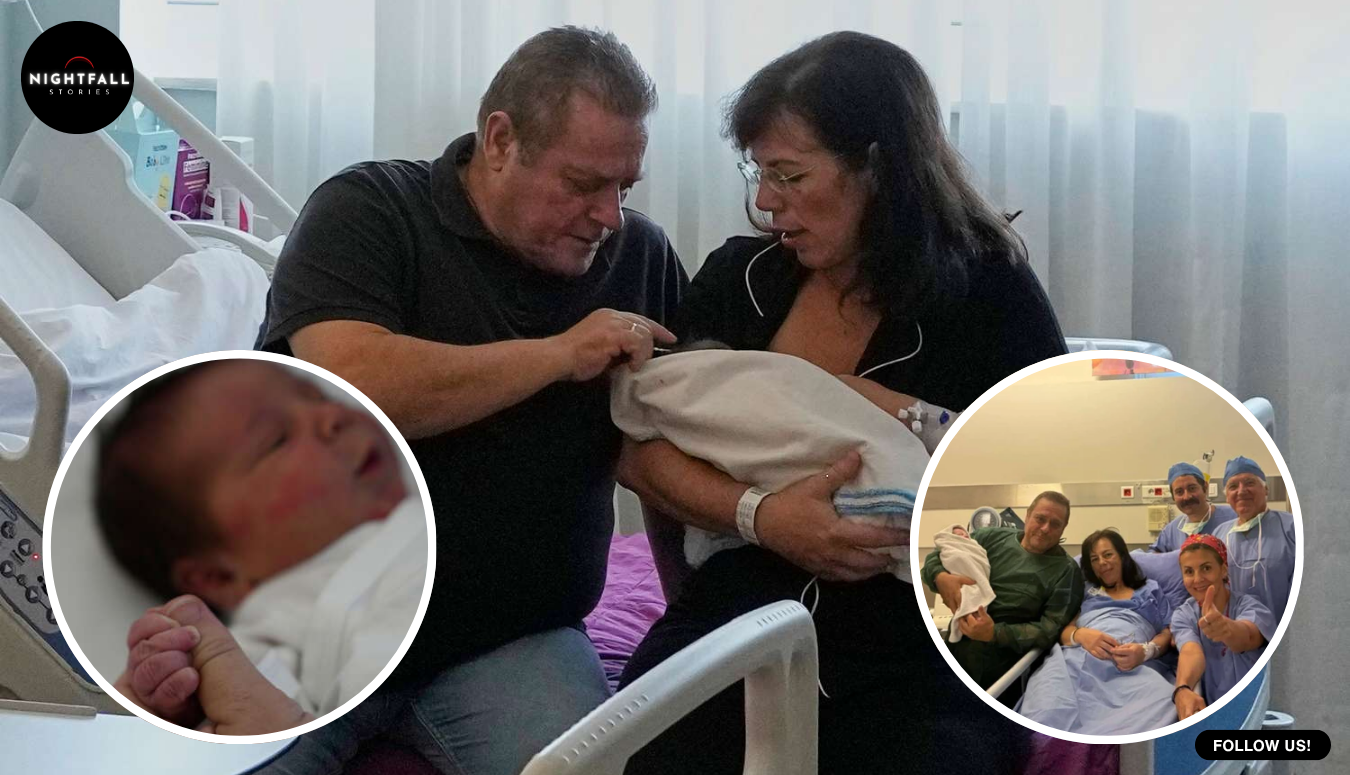
In a laboratory in Athens there is a tank of liquid nitrogen holding nine embryos that nobody is permitted to use. They were frozen in the spring of 2004, along with three others from the same cycle. One of those others became a boy. Another, twenty two years later, became the girl who was born last month to a fifty four year old woman working against a deadline written into Greek law.
The deadline is the reason this story exists in the shape it does, so it is worth getting it exactly right, because the published accounts did not.
Greece sets a statutory ceiling on medically assisted reproduction by the age of the woman being treated. Under Law 4958/2022, passed in the summer of that year, that ceiling is fifty four. The same law created a second layer on top of it: a woman between fifty and fifty four cannot simply book a transfer, she needs a specific authorisation from the National Authority for Medically Assisted Reproduction. Before 2022 the limit sat lower, at fifty by most readings of the earlier framework. Some Greek outlets covering this birth reported the current ceiling as fifty five. Independent legal and clinical summaries of the statute put it at fifty four, and that is the figure the article is built on.
Christina Rapti-Tzelepi was already fifty four when the transfer went ahead. By her own account she had a window of about two months. That phrasing is hers, not a calculation anyone has published, and it is the only honest way to state it, because what the law caps is not easy to translate into a date on a calendar from the outside. What is clear is the sequence. She was at the far edge of what Greek law allowed, the edge was approaching, and the decision could not wait for her to be ready to make it.
It is also worth being clear that the window had to cover paperwork as well as medicine. Because she was over fifty, the transfer was not a matter between a woman and her clinic. It required the national authority’s authorisation first, and an authorisation has to be applied for, assessed and granted before a thaw can be scheduled. Whatever the exact number of weeks, the clock was running on an administrative process as much as a clinical one, and it started in the weeks after a funeral.
She and her husband, Konstantinos Raptis, had conceived through IVF in the early 2000s. Twelve embryos from that round were frozen on 17 March 2004 at the Genesis Athens clinic. One of them was transferred and became their son, Georgos. The remaining eleven stayed in the tank.
Last October, Georgos was killed in a road accident. He was twenty one.
There is no good way to write the next part, and the temptation to make it mean something is exactly the thing to resist. What happened is procedural. The couple decided, in the weeks after their son’s death, to use one of the embryos still in storage, and Greek law gave them until Christina’s next birthday to do it. The transfer took place in December, the pregnancy ran to thirty nine weeks and two days, and in September a girl was born weighing 3,490 grams, about seven pounds eleven ounces. The clinic’s gynaecologist, Dr Konstantinos Pantos, who is also a senior office holder in the Greek society for reproductive medicine, handled the case.
Pantos has said publicly that in his working life he had never seen a couple carry so much sadness through a pregnancy. That is not the line a clinic usually offers a reporter, and it is more useful than any amount of uplift, because it describes what this actually was. Christina has said the grief in that period was extreme. Her hope, as she has put it, was that the pregnancy might close a chapter. Neither of them has described the baby as a replacement for anything, and nobody writing about them should either. A child was born to two people who had been bereaved and who were running out of legal time. Those are two facts standing next to each other, not one fact explaining the other.
What is genuinely remarkable here, and what makes this a story about more than one family, is the physics of the thing. An embryo that has been in liquid nitrogen since 2004 has been held at roughly minus 196 degrees Celsius for more than two decades. At that temperature the biological processes that constitute ageing essentially stop. The embryo does not get older in any meaningful sense. It is not sitting in slow decline, waiting. It is paused.
The hard part is not the waiting, it is the two ends of it. Freezing a cluster of cells and thawing it again without destroying it is the whole game, and the technique used in 2004 was very likely not the technique a clinic would use today. The method that dominated then was slow freezing, a gradual cool down with cryoprotectant. The method that dominates now is vitrification, an extremely rapid cooling that takes the water in the cells to a glassy state without letting ice crystals form. Vitrification gives markedly better survival on thaw, which is why it took over. Genesis Athens has not said publicly which of the two was used on this batch, and that is a real gap in the account rather than a detail. An embryo that survived twenty two years of storage and a thaw after slow freezing is a different technical claim from one that was vitrified.
The storage itself also required somebody to keep saying yes. Greek regulation sets the standard cryopreservation period at five years, extendable on written consent to the bank holding the material. Twenty two years in a tank is therefore not passive. It is a file that kept being renewed, a fee that kept being paid, a decision taken again and again by two people who had the child they had wanted and still did not close the account. Nobody in 2004, 2009 or 2014 signing another extension was planning for what the 2020s would turn out to hold. They were just not ready to say no.
Then there is the claim that got attached to this birth almost immediately, and it needs taking apart, because the most widely circulated version of it is wrong.
One Greek national broadcaster headlined the birth as a world first and reported that it beat a previous record of eighteen years set in Japan. That does not survive five minutes of checking. In 2020 a girl in the United States was born from an embryo that had been frozen for around twenty seven years. In 2022 twins were born there from embryos frozen for about thirty. In July 2025 a boy was born from an embryo frozen for more than thirty years, a case that was recognised by Guinness World Records. Twenty two years is a long interval. It is not the longest, and it is not close to the longest.
The narrower claim the clinic itself makes is different and more defensible, and it should be reported as the clinic’s claim rather than as fact. Genesis Athens has described this as the longest documented storage of a woman’s own embryo, created from her own egg, resulting in a live birth. The distinction matters: the longer intervals on record involve donated embryos transferred to a woman who was not the egg provider, whereas here a woman in her fifties carried a pregnancy from an egg she produced in her early thirties. The clinic says it intends to submit the case to an international journal. That has not happened yet, there is no peer review behind it, and other Greek coverage declined to make any superlative claim at all, calling the case only particularly rare. Readers should file this as interesting and unconfirmed.
What is not in dispute is where the case has landed politically, and this is where the family has chosen to put itself.
Nine embryos from that 2004 cycle are still in storage, and under current Greek law the couple cannot use any of them. Christina has turned fifty five. The ceiling does not bend for a woman who has just completed a healthy pregnancy at fifty four, and she has said plainly that she considers the law unfair in her case. She has also said she worries about her daughter growing up without a sibling, which is a thought about the living child rather than the dead one.
Konstantinos has described the whole thing as a race against time and has argued for raising the cap, on the grounds that older women have a large capacity for considered, unconditional love. Pantos has made the clinical version of the same argument: that an age limit set purely on date of birth takes no account of the actual condition or circumstances of the woman in front of the doctor, and that this couple in particular should have been allowed to grieve without a statutory clock running over them.
The counter argument is not hard to state, and the law exists for reasons. Pregnancy at fifty four carries materially higher risks of hypertensive disorders, gestational diabetes, prematurity and surgical delivery, and a fixed ceiling is an administrable rule where a case by case assessment is not. A country that lets a national authority approve individual applications between fifty and fifty four has already built in the flexibility it was willing to build. Whether the top of that range sits in the right place is a legitimate argument, and the family is now making it in public.
The 2022 law that set the current ceiling was, in fairness, a liberalising measure rather than a restrictive one. The same package raised the age limit from fifty, allowed women to freeze their eggs for social as well as medical reasons, and removed the requirement for a husband’s consent before a woman could do it. Greece moved in the direction this family wants. It simply stopped at a number that, four years later, fell on the wrong side of one woman’s birthday.
It is landing in a country with a demographic problem it talks about constantly. Greek births fell by more than 2,800 in 2025 against the year before, continuing a long decline. The average age of a first time mother in Greece reached 31.2 in 2024, above the European Union average of 29.9, and births to mothers over forty have risen substantially over the past two decades. A nation that is having fewer children, later, is a nation in which the question of when the law should stop helping people have them is not abstract.
Christina’s own message to other couples has been simple and slightly at odds with how cautiously the medical community tends to talk: that the science is safe. That is a stronger statement than the evidence supports as a general claim, and it is her statement rather than her doctor’s. What her case does establish, in a single well documented instance, is narrower and still striking. A cluster of cells frozen in 2004 came out of a tank twenty two years later, implanted, developed normally and was delivered at term at a healthy weight. Whatever else is arguable, that happened.
The parts of this story that will travel are the parts that are easiest to get wrong. It is not a record. It is not supernatural, and nobody involved has reached for that register. It is not a tidy ending to a bereavement, and the doctor who was in the room has gone out of his way to say that it did not feel like one.
What it is, is a narrow technical fact and a narrow legal one, pressed against each other hard enough to produce a person. Modern cryopreservation can hold an embryo essentially indefinitely, far longer than any statute was written to contemplate. Greek law can only reproduce one day at a time, in the body of a woman who is getting older on a schedule the tank does not share. In this case the two were about eight weeks from missing each other.
And the nine that are left will go on sitting at minus 196 degrees, not ageing, not deciding anything, while two people who have already argued their way to one birth try to persuade a parliament that the number in the statute should have a few more years in it.