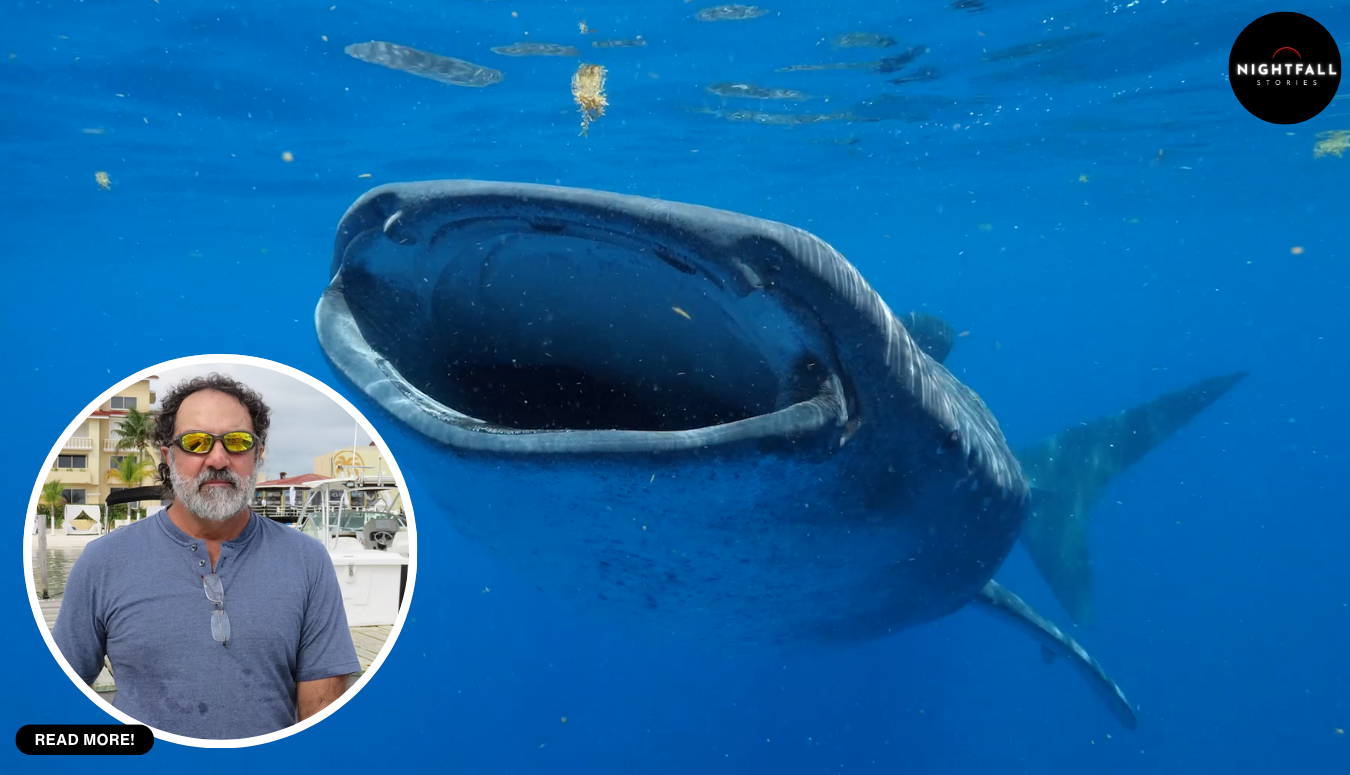
In July, in warm green water off the Yucatan Peninsula, Rafael de la Parra swam up alongside a male whale shark roughly 26 feet long, which is about eight metres of animal, and fitted a satellite transmitter to its dorsal fin. He had done exactly that to exactly that shark four times before.
The first was in 2017. That tag reported for something like a couple of weeks and then went quiet, which in telemetry terms is close to a total loss. The second went on in 2018. Then 2020. Then 2023. Then this one.
Stitch the five deployments together and you get the number that put this animal into the news: more than 34,000 miles of recorded movement, accumulated across more than 3,400 days, which is a shade under a decade. The team behind it, the Guy Harvey Research Institute at Nova Southeastern University, working with the Guy Harvey Foundation, the Mexican conservation organisation Ch’ooj Ajauil AC and the University of Rhode Island, describe it as the longest record of any shark’s movements yet assembled. That claim is theirs, and it is worth saying so plainly rather than treating it as a settled entry in a book of records somewhere, because no previous benchmark is named alongside it in any of the announcements.
The shark has a name. The researchers call him Milo, and that is where a story like this usually goes wrong, so it is worth getting the awkward part out of the way early. Nothing in nine years of satellite data tells you what a whale shark wants, prefers, remembers or feels about anything. What the data tells you is where a body was, and roughly when, and that is a narrower and more useful thing.
Start with the water he was tagged in, because the whole project depends on it. Every summer, off the north eastern tip of the Yucatan, whale sharks gather in numbers that are genuinely hard to believe if you have only ever seen one. Hundreds of them, sometimes more, drifting at the surface in loose crowds, feeding. They are not hunting anything. They are filtering, and what they are filtering is spawn, dense clouds of fish eggs released in open water. The sharks sit there with their mouths open and strain it out.
That aggregation is the only reason any of this is possible. A whale shark is the largest fish alive and it spends almost all of its life somewhere you cannot reach it. For a few weeks a year, in one patch of Mexican water, the largest fish alive comes to the surface and stays there, distracted, for hours. If you want to put a piece of hardware on one, that is your window, and it is the window de la Parra has been working in for years.
Tagging it is not elegant. Someone goes into the water with the animal, swims to keep pace with it, and attaches the transmitter to the dorsal fin while the shark is moving. The tags used on Milo since 2018 are fin mounted, which matters more than it sounds. A fin mounted transmitter sits where the fin breaks the surface, so the antenna can clear the water and talk to a satellite in close to real time. That is a different and better proposition than a tag that logs quietly for months and then pops off and uploads a compressed summary, and it is the design de la Parra has said, in his own words, he first trialled on this particular shark.
Which explains the 2017 failure, and why it is more interesting than it looks. The first attempt returned almost nothing. That is not unusual. It is close to normal. Most shark tracks in the scientific literature end in weeks or months, and the reasons are mundane and relentless. Tags shed. Attachments work loose on an animal that grows, scrapes, dives and accelerates. Saltwater corrodes. Batteries flatten. Marine growth coats the housing and the antenna until the signal cannot get out. A tag on a wild shark is a small piece of consumer electronics bolted to something enormous that does not want it there, and the surprise is not that they fail but that any of them last.
There is also a trade off built into the hardware that most coverage skips. A transmitter has a finite power budget, so the people who deploy it have to decide in advance how often it talks. Report a position every time the fin breaks the surface and you get beautiful resolution for a short while and then a dead battery. Report on a schedule, a set number of hours a day or a set number of days a week, and the tag lasts far longer but the track comes back as a dotted line rather than a solid one. Everything you see described as a shark’s route is really a series of estimated positions with straight lines drawn between them, and the distance quoted is the sum of those straight lines. The real animal did not swim in straight lines.
That is not a criticism of the method, it is just what the method is. But it is why a figure like 34,000 miles should be read as a floor rather than a measurement. A shark that wandered, circled and doubled back between two reported positions covered more water than the line on the map, not less.
So a nine year record is not the result of one brilliant deployment. It is the result of four more deployments on the same animal, which raises the question that is actually the quiet achievement in this whole story. How do you know it is the same animal?
You know because of the spots. A whale shark carries a pattern of pale spots and bars across its flanks, and that pattern is individual, in the way that a fingerprint is individual. Photograph a known stretch of flank, usually behind the gills, and you can match it against a catalogue of previously photographed animals. Add the shape of the dorsal fin, which carries its own nicks and contours, and the identification becomes solid. That is how Milo was recognised in 2018, and again in 2020, and again in 2023, and again this year, and it is a method that costs almost nothing and holds up over the length of an animal’s life.
Without it there is no story. With it, five separate tags stop being five unrelated data sets and become one biography.
The route that biography describes is wider than most people would guess. The recorded movements cover the Gulf of Mexico, the northern Caribbean islands, water well east of Bermuda, and a northern limit off Massachusetts. A tropical filter feeder working the latitude of New England is not a glitch. Whale sharks follow food, and productive water in the western North Atlantic in late summer is a long way north of where the postcards put them. But seeing one individual do it, repeatedly, across years, is a different kind of evidence from knowing that the species can.
Mahmood Shivji, who directs the Guy Harvey Research Institute and runs the analysis end of the project, has made roughly that point about what the data shows. His reading is that Milo has demonstrated how flexible whale sharks can be, and that the animal is plainly capable of long range movements out into the open Atlantic rather than staying tied to the coastal systems where people usually encounter the species.
Flexibility is the right word, and it is worth pulling apart what it can and cannot be made to mean, because this is where coverage of a story like this tends to overreach.
What a single long track does establish is unusually clean. It shows that one identified animal used a very large area of ocean across most of a decade, crossing between the waters of many different countries and out into the high seas. It shows that the same animal returned to the same Mexican aggregation repeatedly, because that is where it was found and re tagged. And it shows behavioural range within one individual, which is something you simply cannot extract from a population average. If you tag two hundred whale sharks for three months each, you learn what whale sharks tend to do. You do not learn whether any single whale shark is capable of doing several very different things in different years. Milo’s record suggests that one is.
What it does not establish is the part that needs saying out loud. The figure is cumulative, not continuous. Five tags across nine years means gaps, and in those gaps the animal was wherever it was and nobody knows. The 34,000 mile total is a sum of tracked distance, not a complete life route, and the round numbers in circulation, 34,000 miles and 3,400 days, both look like figures that have been tidied for a press release rather than reported to the decimal. One animal is also one animal. Milo is a male of a particular size doing particular things, and nothing about his movements tells you what female whale sharks do, or what juveniles do, or what the population as a whole does. Satellite positions are also estimates with error attached, not pins on a map, and distance calculated between successive estimates is an approximation of a path rather than a measurement of one.
And the number that gets quoted most carelessly is the lifespan. You will see it said that Milo could live to be more than 125 years old. That estimate comes from separate research, including work from the same institute, into how long whale sharks as a species may live, and it is an estimate about the species rather than a prediction about this shark. Nobody knows how old Milo is. Nobody can tell you how long he has left.
Set against all that, the thing the project has actually bought is less dramatic and more useful than a record. Whale sharks are listed as endangered. The pressures on them are fishing, both targeted and incidental, and ship strikes, which are a serious problem for a very large animal that spends a lot of time feeding at the surface in busy water. Protecting an animal like that is almost entirely a question of jurisdiction. You cannot protect something effectively in one country’s waters if it spends a third of its year in three others and a stretch of each year in international water where nobody is responsible for it.
The Mexican aggregation itself is a managed and heavily visited place, with a swim with tour industry built around it, because a surface feeding whale shark is both easy to reach and easy to injure. Whatever protection applies there, none of it follows the animal when it leaves.
Range data is the argument that forces those conversations. If you can show, with position data rather than inference, that a single protected individual from a Mexican aggregation turns up east of Bermuda and off the New England coast, then shipping lane decisions and fisheries rules thousands of miles apart stop being somebody else’s problem. That is the practical return on nine years of tags, and it is why the team keeps going back rather than banking the record and moving on.
There is a precedent inside the same programme, which is part of why they knew it was worth the persistence. Years before this, the same institute tracked a female whale shark they called Rio Lady, tagged in the same Mexican water, who made long loops out into the Caribbean and the Gulf and came back to the place she started from more than once. At the point Milo had been tracked for 351 days, that was already being described as the longest continuous whale shark track in the Atlantic. The programme has been building toward a long individual record for a while, and Milo is what happened when the method and one cooperative animal lined up.
Which leaves the man in the water. De la Parra has been going back to the same stretch of Yucatan coast for years, in the same few weeks of the year, looking at flanks and matching spots, and has now found and tagged the same shark five separate times. The first time he did it the tag failed almost immediately and gave him close to nothing. He went back.
That is the part that is not a number. A record of this length does not come out of better hardware, although the hardware got better. It comes out of somebody being willing to do a difficult, repetitive thing in the same place for nearly a decade on the chance that one animal would show up again, and then doing the unglamorous photographic work to prove that it had.
The fifth tag is on now, somewhere in the Atlantic, reporting. If it holds as long as the others have, the track gets longer, the gaps in the biography get narrower, and the argument for protecting a fish that belongs to no country at all gets a little harder to wave away. If it sheds next month, which is still the likeliest single outcome for any tag on any shark, then the plan is the one it has always been. Wait for summer, get back in the water, and look for the spots.