













On a Thursday morning last month, a primary school teacher climbed off a boat onto a concrete landing on the western side of Stromboli, walked up a path that no vehicle has ever used, and let herself into a room belonging to the village church. She had arrived the day before, because there is no way to arrive on the morning you are needed. By the time she opened the door, a bell was ringing in a hamlet of roughly thirty people for the first time in more than twenty years, and the register she was about to open had exactly one name on it.
The name belongs to a six year old girl, and we are not going to print it. In a place where everybody knows everybody and the entire school roll is one child, naming her would identify her to every person who will ever read about her, and she did not choose any of this. The people who did choose it are the ones worth writing about: her mother, who spent years asking the Italian state for a classroom and eventually got one; a teacher who took a posting that almost nobody would take; a mayor, an education official and an archbishop who each had to sign something; and a set of rules that said a primary class needs fifteen pupils and then, for once, said otherwise.
The mother is Monica Abbate. She has lived in Ginostra since she was eighteen, which makes her one of the small number of people who stay through the winter rather than one of the summer population, and she serves as the municipality’s delegate for the hamlet, an unpaid local role that mostly involves asking Lipari town hall for things that larger places take for granted. Reporting on the reopening credits her with having fought for it for a very long time, and the figure that keeps appearing is twenty years.
That figure is worth slowing down on, because the honest version is slightly different and slightly more interesting. Twenty years is how long the school was shut. Abbate is in her mid thirties by the accounts of reporters who met her, and she arrived on the island as a teenager, so twenty years of personal campaigning does not quite add up and no source actually claims it in those words. What is documented is that she pushed for public services in a settlement that had almost none, that the school was the one she pushed hardest for, and that the paperwork which finally did it is recent and specific. A formal request went in at the start of this year. The Sicilian regional school office authorised the class eleven days later, inside the annual plan that decides which school sites in the province of Messina open, merge or close. The campaign was long and vague. The decision was fast and dated.
To understand why it took so long, you have to understand what Ginostra is, and it is not a picturesque detail. It sits below the volcano on the side of Stromboli that faces away from the main village, and it is reachable only by sea. There are no roads and no cars. Goods come up from the landing on the backs of fewer than a dozen mules and donkeys, which is not a heritage attraction but the actual logistics system: if you buy a washing machine, a donkey brings it. There is no mains water. It arrives periodically by tanker ship and is stored, supplemented by rainwater. Mains electricity and running water did not exist here at all until 2004, which is to say that people were living without either within living memory of almost every reader of this sentence. Power now comes from photovoltaic panels and generators near the marina. There is no street lighting.
The population numbers do not agree, and it is better to report the disagreement than to split the difference. The French newspaper feature that produced the most detailed account of the reopening puts the winter population at about thirty. Italian agency reporting from the same period puts it at about forty. Older census material also lands near forty. In summer the houses fill with visitors and the figure can reach a few hundred. All of those can be true at once, depending on who counts as resident and which week you ask, and the range itself is the point: this is a community small enough that a single family’s decision changes the arithmetic.
Underneath the charm, there is a hard fact, and it is the reason there was a school to reopen in the first place. Ginostra once had enough children to need a classroom. Then it did not. Depopulation on the smaller Aeolian islands has been running for generations, driven by the ordinary things that empty villages everywhere, work and schools and hospitals, and in Ginostra’s case sharpened by the volcano. At the end of 2002 a flank collapse on Stromboli sent landslides into the sea and generated a tsunami that flooded houses along the shore, twisted metal structures and dragged furniture out of homes onto the rocks. Ash fell across the island. Most residents left on ferries. The civil protection authorities closed Stromboli to visitors while an alarm system was worked out. Nobody was ordered to leave permanently, and plenty came back, but an event like that does not help a place hold on to young families, and the school closed in roughly that era. A reopening is a good news story. A closure is the news story underneath it, and it is the bigger one.
The rule that stood in the way is not unreasonable in itself. Italian regulations set a floor of about fifteen pupils to form a primary class, which exists so that regional authorities cannot quietly run schools with two children and one exhausted teacher as a substitute for proper provision. The floor can be lifted, and a government measure from last year explicitly allows regional education offices to grant waivers for island areas. Getting the waiver required the parents to ask, the municipality of Lipari under mayor Riccardo Gullo to back the request, the head of the local comprehensive institute to forward it, and the provincial and regional school offices, with the Messina superintendent Patrizia Muscolino involved, to approve it. None of that is dramatic. All of it is the thing that actually takes twenty years, which is the unglamorous truth about most campaigns of this kind. You do not win them with a speech. You win them when the right official signs a form in January.
The school belongs to the Istituto Comprensivo Isole Eolie, a single institution that runs seventeen school sites spread across seven islands, from nursery through to lower secondary. It is an administrative arrangement that would look absurd on the mainland and is simply necessary here, because each island has a handful of pupils and none of them can share a bus. Until this autumn, the smallest class in the group, and by most reckonings the smallest in the country, was on Alicudi, an island of around a hundred people where the schoolhouse is reached by climbing something in the order of three hundred and fifty steps up from the shore. It had two pupils. Ginostra has now halved that record.
The classroom itself is a room in the parish of San Vincenzo Ferreri, recently renovated, handed over rent free by the archdiocese of Messina, Lipari and Santa Lucia del Mela under an open ended loan agreement signed off by Archbishop Giovanni Accolla. There is no school building available, so the church gave up a room, which is a reminder that in very small places institutions substitute for one another out of necessity rather than ideology. A school with one pupil does not need a gym or a staff room. It needs a dry room, a table, a door that locks, and a teacher who is physically present.
Finding that teacher was the part that could not be solved by paperwork. When the waiver was granted at the start of the year, two questions were still open in the coverage: where the classroom would go, and who would stand in it. Both have since been answered. The teacher is Laura Mongi, and the accounts of where she came from do not match, so here is both. Italian agency reporting from the first day of term describes her as forty two years old, originally from Gela in southern Sicily and resident in Messina, who came out to the island the day before lessons started. The longer French feature, published a couple of weeks later, describes her as having come from the outskirts of Milan. Those are not easy to reconcile, and there is an obvious possible explanation, that a Sicilian teacher had been posted to the north and transferred back, which is one of the most common career shapes in Italian teaching. But no source says that, so it stays a possibility rather than a fact. What is not in dispute is that she was not already living in Ginostra, because almost nobody is, and that taking the job meant moving to a place with no road out.
Consider what the posting actually involves. One teacher, one pupil, the whole primary curriculum, no colleagues in the building, no supply cover within an hour, and a commute that depends on hydrofoils which in winter simply do not run when the sea says no. Housing has to be arranged in a village where the housing stock is largely holiday lets. Supplies arrive by boat and then by donkey. If a child in an ordinary class has a bad week, the class carries her. Here there is no class to carry anyone, and the relationship between the adult and the child is the entire institution. Teachers who take island posts tend to describe them as either the best or the worst year of their working lives, and on the evidence available this one walked up from the landing, met her pupil at the door, introduced herself by first name and asked whether they should go in.
The reason any of this matters beyond one village is the timetable of the boats, which is the real argument the family made. The alternative to a school in Ginostra was not a slightly longer journey. Hydrofoil schedules do not line up with the start and end of lessons, and for several months of the year the crossing cannot be relied on at all. A six year old attending school on Lipari would have meant one parent renting a second home off the island for the school year, or the family leaving for good. That is the mechanism by which small places die, and it is not sentimental to say so. It is a transport problem wearing the costume of an education problem.
Set against the national picture, the Ginostra classroom is swimming hard upstream. Italy is losing pupils at a rate that would close a city’s worth of schools every few years. The country’s schools had something in the order of one hundred and thirty thousand fewer pupils this year than the year before, and roughly a million fewer than in the 2017 to 2018 academic year. The median age is around forty seven. About a quarter of the population is over sixty five, the highest share in Europe, and only around twelve per cent is under fourteen, among the lowest. In that context, the default direction of travel for any school with a small roll is closure and consolidation, and most of the decisions being made in regional offices this year are about merging sites, not opening them. One room with one child does nothing to change those numbers. What it changes is the precedent, which is why people in other small places were watching.
Some of them were watching with a grievance. On Filicudi, another Aeolian island in the same school district, a ten year old named Tiziana wrote to the Italian prime minister asking to be allowed to finish her schooling at home. She is about to age out of the provision that exists. The waivers that saved Ginostra apply to nursery and primary classes, and not to lower secondary, so families on these islands are told, in effect, that their children may stay until eleven and must then leave. The local course that would have let her continue was not restored, on the grounds that it would require eight teachers for a single pupil. Her own answer, reported in the Italian press, was that the course has historically run with two. A senator has raised the case in parliament, citing the constitutional articles on equality and on the right to education. And on the same morning that Ginostra’s bell rang, Filicudi was reportedly still waiting for a teacher who had not arrived, with the family refusing an offer of remote lessons as a substitute.
That is the honest shape of this story. A classroom opened on an island with no roads because a handful of adults kept asking, and a parallel request a short boat ride away did not. The waiver is granted year by year, which means the campaign is not over, it has merely changed from asking for a school to asking for the same school again next summer. In five years the pupil will reach the age at which the rules currently say she has to go, and unless something changes, her mother will be back in the same office making the same argument about boats.
None of which makes the morning less real. A teacher came a long way to a place that is hard to reach, a priest handed over a room, an official signed a waiver, and a woman who has spent most of her adult life in a village of a few dozen people got back a service that village had lost before her daughter was born. The register has one name on it. The point was never the name. The point was that a family living on the far side of a volcano, where the water comes by ship and the shopping comes by donkey, now has the same ordinary choice everyone else has, which is to stay.
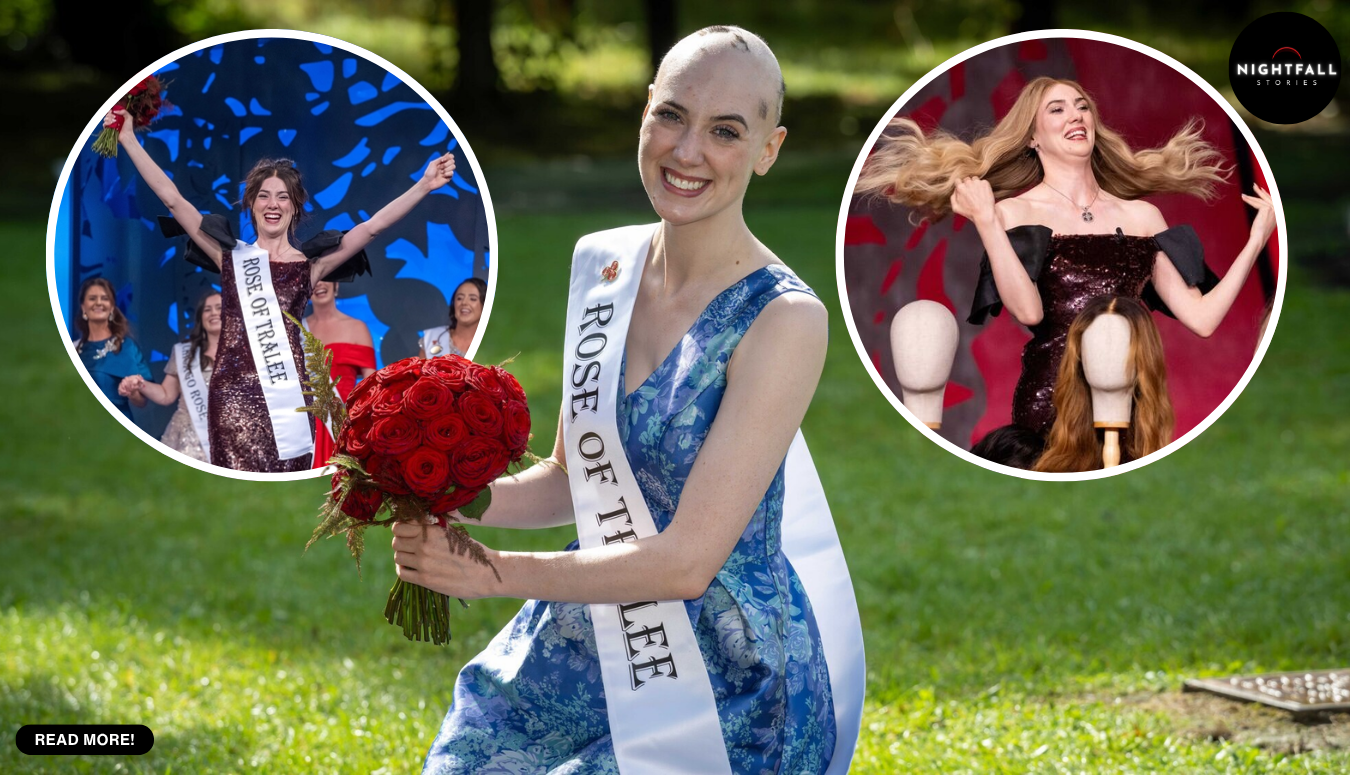
The trolley was the giveaway. Every other woman on that stage had a party piece, a song or a dance or a recitation, and Caoilfhinn Ni Choiligh came out with a wheeled rail of wigs, like a props cart. She went along them. Then she reached up, took off the dark one she had walked on in, and put a blonde one on instead, and explained that this was the point, that she can change her hair whenever she likes and that a wig is an accessory you can have styled before you ever put it on.
Then she took that one off too, and finished the rest of her interview bare headed, in front of a live audience in a sports arena in Kerry and a national television audience watching the biggest broadcast night in the Irish calendar.
The following night, out of thirty two women, the judges picked her. She is the 2026 Rose of Tralee.
What makes this worth more than a clip is what she did next, which was go back to the course she had already enrolled on. Caoilfhinn Ni Choiligh works in retail in Mullingar, in the Irish midlands, and she is training to be a wig maker. Not a wig seller. A maker. Of all the things that could have followed a moment like that, the one she chose was a hand trade.
First, though, the thing that almost every piece of international coverage gets wrong about the event itself, because it changes how you read her twelve minutes on that stage.
The Rose of Tralee is not a beauty pageant. That is not a defensive line from the festival’s own press material, it is how the thing is actually built. There is no swimsuit round. There never has been. Appearance is not scored. The published criteria are personality and suitability to act as an ambassador for the year, and the festival talks about aspirations, ambitions, intellect, social responsibility and Irish heritage. In practice each Rose gets an interview on stage with the host, a few minutes of conversation about who she is and what she cares about, and a party piece if she wants one.
It started in 1959, got up by a handful of local business people in Tralee, in County Kerry, to pull visitors into the town. It was open only to women from Tralee at first, then to the county, and from 1967 to any woman of Irish birth or Irish descent anywhere in the world, which is why the lineup every year includes Roses from Chicago, New York, Sydney, Dubai and London alongside the thirty two counties. There is an upper age limit of twenty nine. Since late 2021 married women and transgender women have been eligible. Unmarried mothers were excluded until 2008, which is the kind of detail that tells you more about the institution’s history than any brochure.
And here is the irony sitting at the centre of it. The festival is named after a nineteenth century ballad about a woman called Mary, and the entire burden of that song is that she was lovely to look at. The event named after it has spent decades insisting, correctly, that it is not judging anyone on their looks. Ireland has never quite stopped arguing about whether that works. The lovely girls jibe has followed it around for thirty years. Every August there are the memes and the eye rolls and somebody writing that it has had its day.
Which is the context that a trolley of wigs was wheeled into.
Caoilfhinn Ni Choiligh is from Mullingar in County Westmeath. She has had alopecia areata since she was fifteen, which she has talked about openly and at length in her own words, and which is the only basis on which it appears here. She has described what the start of it felt like in a way that nobody else writing about her has improved on: that when you lose your hair there is a bit of grief in it, because you are losing a small piece of yourself.
Fifteen is a specific cruelty of an age for that to happen, for reasons that need no elaboration to anyone who was ever fifteen.
She is twenty five in most of the reporting and twenty six in some of it, and both are probably right, because she said in the summer that she had turned twenty five the previous August, which puts her birthday within days of the festival itself. Earlier this year she passed the ten year mark, and she has said that was the thing that moved her. Ten years in, she worked out that she had accumulated practical knowledge that would be useful to somebody else, and that sitting on it was a waste.
So she started putting herself out there, which is her phrase, not an interviewer’s. She co founded a support group called The Hair Loss Haven with her friend Saoirse. It runs meetups and events for people losing their hair, from any cause, and the work it does is the unglamorous specific sort: when do you get your first wig, what do you do about the in between stage, how do you handle the day you tell people. A clinic can tell you what is happening to your scalp. It cannot tell you what to say to your manager. She gets a steady traffic of messages from strangers asking exactly those questions.
She has form on this kind of thing. Before any of it she had worked with Comhairle na nOg, Ireland’s network of local youth councils, and with the Irish Second Level Students’ Union, which are both organisations where the entire job is getting young people’s own views into rooms that would otherwise decide without them.
She was chosen as the Westmeath Rose on a June evening at a hotel in Athlone, out of a field of twenty women. Then came the Rose Tour, which is a genuinely odd piece of Irish tradition in which the whole group travels the country together for a fortnight before the festival, and then Tralee.
The clothes detail is worth a line, because it is the opposite of the image people have of this event. The gown she wore on the night she was crowned was rented, from a shop in her own town called The Dress Collective.
About the stage itself. She has been candid that she thought hard about whether to do the wig segment at all, and that the hesitation was not stage fright. It was the risk of being flattened into one fact about herself, of becoming the alopecia Rose and nothing else for a year. She decided to do it anyway, on the grounds that it genuinely has shaped who she is and that pretending otherwise would be its own kind of lie. She has since said that taking the wig off on the opening night was the highlight of the whole thing, and the part of it she is proudest of.
There is a strong temptation, in a story like this, to park the whole thing on the word brave and go home. It is worth resisting, partly because it is lazy and partly because she herself keeps steering away from it. Her line after she won was not about courage. It was that you can be a Rose whatever your imperfections and whatever your background. Her line to younger girls was that they should never let anybody dull their confidence. And the line she gave afterwards about the crying, hers and the audience’s, was that emotion is powerful and is not something we should be apologising for, which is a more interesting sentence than any of the headlines written around it.
Now the part that nobody expected, and the reason this is a story with an ending rather than a clip with a caption.
Wig making is a real trade and a dying one. A machine made wig is sewn: wefts of hair stitched in rows onto a cap, fast and cheap and recognisably a wig from across a room. A hand made one is knotted. Someone sits with a tiny hook and a base of lace or fine mesh and ties hair into it a few strands at a time, controlling the direction each one lies in, thinning the density at the front so the hairline looks like it grew there, building a parting that reads as scalp. It is close, slow, repetitive work and the difference between a good one and a bad one is almost entirely in the hands of the person who made it. The people who can do it properly are not numerous and they are not young.
That is the thing Caoilfhinn Ni Choiligh is studying for, while working in retail to pay for it. Her route into it was not a careers fair. It was eight or nine years of being a customer, of wearing the things daily, of knowing from the inside which seams itch and which partings fool nobody and what it costs in confidence when a wig is slightly wrong.
The money is the quiet scandal underneath all of this, and it is worth stating plainly because it is the part that shapes everyone else’s experience of hair loss and not just hers. In Ireland there is a state grant towards a hairpiece, wig or hair replacement, introduced in 2022 under the Department of Social Protection’s Treatment Benefit Scheme. It names alopecia areata specifically among the conditions it covers, along with hair loss from cancer treatment, scarring alopecias and hair loss after surgery, trauma or burns. You can claim it once in a calendar year. The ceiling is five hundred euro, which is roughly five hundred and eighty dollars.
That is a real improvement on nothing, and nothing is what existed before 2022. It is also a long way short of what a good hand made human hair wig costs, which is why the second hand market, the online guesswork and the long silent misery of wearing something that does not quite sit right are all still thriving. Somebody has to actually make the things, and make them well, and know what they are for.
So the arc of it is this. A fifteen year old loses her hair. She spends a decade learning, by necessity, everything there is to know about an object most people never think about. At twenty five she decides the knowledge is worth something to other people, starts a support group, and then goes on the most watched television programme in her country, takes the object off in front of about half a million people, and talks about it. Then she wins, which was not the plan, and now she has a year of public engagements and a car and a travel voucher worth around twenty nine thousand dollars, and she is still going to her wig making classes.
The prize list has one accidentally perfect item in it, by the way. Among the travel voucher and the loan of an electric car and the free hotel room in Tralee, the new Rose of Tralee receives a year of hair styling services from the local further education college. Nobody designing that package was thinking about a winner with alopecia. She can presumably put it to use, given that she owns more hair than most people in the arena.
The year ahead is a job, not a tiara. A Rose does school visits and charity work and openings and interviews, somewhere upwards of a hundred engagements, in Ireland and abroad. She has said she does not want the whole twelve months to be about her hair, and she is right to want that, because she is also a person who has worked on youth representation for years and who is halfway through qualifying in a skilled trade.
But she knows exactly what the hair bought her. Her own reckoning of the stage moment was not that she had been inspiring. It was that she had a platform for a few minutes, that she wanted to say her piece about something that matters to her, and that if one person watching who was in the middle of losing their hair saw a woman take a wig off and keep talking, that was the whole point and she had got it done.
The wig she pulled off on that stage is now the thing she is learning to build. Strand by strand, with a hook, badly at first, the way everybody learns a trade. It is not a metaphor. It is a course, with assessments, and she has to pass it.

The mathematics paper came back at 145. The anatomy paper came back at 139. The total was 721 against a stated maximum of 800, and it was good enough for first place nationally in the medical stream. Guo Bin is nineteen. He has been blind since he was six, when he was badly hurt by another person in Shanxi province, and he read every one of those papers with his fingers.
The number that travelled around the Chinese internet was 721. The part almost nobody carried correctly, in Chinese or in English, was which examination it belonged to.
It was not the gaokao. That matters, and not because of pedantry. China runs a second national entrance examination, sat on a different day, on different papers, with its own ranking and its own allocation of university places, and it exists only for candidates with disabilities. Its name in Chinese is dan kao dan zhao, which translates roughly as separate examination, separate admission. Guo Bin sat that one. When the reports say he came first in the country, the country they mean is the field of blind and low vision candidates who sat the medical papers on that route, which is a few hundred people rather than the thirteen million or so who sit the ordinary gaokao.
That sounds, written down, like a deflation. It is the opposite. Once you understand what the second examination is and where it came from, the 721 stops being a feelgood number and starts being a genuinely interesting one.
The route was invented at the exact university Guo Bin has now registered at. In 1987, Changchun University, in Jilin province in China’s northeast, opened a college of special education and became the first institution in the country to admit students with disabilities through a separate examination of its own. Before that, a blind school leaver in China had essentially nowhere to go. The ordinary examination was not available in braille and universities were not obliged to take anyone who could not sit it.
Over the following decade the model spread. Nanjing University of Chinese Medicine, Tianjin University of Technology, Beijing Union University, Liaoning Normal University and others built their own versions. By the late 2010s there were somewhere in the region of twenty three institutions in China running the separate route.
The catch was always the menu. For most of the route’s life, the majors on offer to blind candidates were a short and predictable list: massage, music, and fine art, with business management added for candidates with physical disabilities. The logic was employment, and in practice it meant that if you were blind and academically strong in China, your reward for being academically strong was a place on a massage course.
The second thing worth knowing is that the separate route is no longer the only one. In 2014, for the first time, blind candidates were able to sit the ordinary gaokao on braille papers. Three years later the education ministry set out twelve specific accommodations that candidates with disabilities are entitled to ask for, braille and large print papers and extra time among them. Two roads now exist, and a candidate picks one.
You can see both of them operating inside a single school. At the Wuhan School for the Blind, where Guo Bin spent twelve years, this year’s leaving cohort split. Five pupils sat the ordinary gaokao. Twelve took the separate route. Sixteen of them ended up with university places. That is the real texture of the thing, and it is a long way from the way the story was told in English, where the exam was simply called the gaokao and the distinction evaporated.
Guo Bin took the separate route and he took the medical stream, which is where the choice gets interesting, because he did not take the obvious thing at the end of it.
He is registered at Changchun University on two degrees at once. Traditional Chinese medicine, which sits broadly inside the historic track and is the respectable, well worn path for a blind student with a good head for study. And computer science and technology, which is not on that path at all. One half of his timetable is the oldest answer China has to the question of what a blind graduate does for a living. The other half is a bet that the answer has changed.
That is not nothing for someone who has been reading by hand since he was seven. His mathematics teacher at the Wuhan school, Zheng Xiaokun, described the method plainly enough: where a sighted pupil takes in a diagram at a glance, Guo Bin would touch the braille over and over and reason the problem through again and again until it held. Braille mathematical notation is its own language, linear where print is spatial, and it is slow. Science came through tactile models, recordings, screen readers, and a lot of repeated explanation out loud.
The school he did all that in is older than most of the city around it. It opened in 1919 as a mission school for blind girls and was renamed the Wuhan School for the Blind in 1952. In more than a century it has put thousands of children through, and since 2009 it has sent more than a hundred and twenty of them on to higher education.
What a residential blind school actually teaches is not what people assume. New pupils there start with a compulsory week of orientation and mobility, and the course begins at the school gate, because the first thing you have to own is the route in. Boarding starts from the fourth year. Dormitory doors are fitted with voice alerts so that a corridor can be read by ear. Alongside the academic timetable there is daily life skills training, cooking, laundry, keeping your own things in order, and eighteen arts clubs running under the name Six Dot Angels, after the six dots of a braille cell. There is also a tuina wing with practice rooms, where pupils on the vocational track put in thousands of hours of hands on work.
The school’s own line about its pupils is that they have simply swapped one way of looking at the world for another, which is a better sentence than most of what has been written about Guo Bin.
He did not arrive there by accident. After he was hurt in 2013, his family had offers from schools in Beijing and in Guangzhou as well. According to the reporting by the Hubei Daily group, which broke and has owned this story throughout, they chose Wuhan because of how two members of staff behaved towards them: a vice principal named Zhou Dejun, and a music teacher named Zhang Long. Guo Bin enrolled in the spring of 2014.
Zhang Long is the second person in this story, and not a supporting one. He is now a vice principal of the school himself. He was Guo Bin’s homeroom teacher for nine of the twelve years and his mentor for all of them, and he came at the boy sideways, through music, on the theory that a six year old who had lost his sight needed something to do with his hands before he needed a curriculum.
It worked to a degree that is slightly absurd. Guo Bin plays the ocarina, the bass, the Native American flute and at least two more wind instruments, depending on which account you read. In 2015 he was one of the founders of VMV, described in the Chinese coverage as the first blind electronic band in Hubei province, in which he played bass. For years he was up at half past four in the morning to get an hour of practice in before school. The band built an online following in the tens of thousands.
The city did its share too. The education authorities waived his fees and his books and paid a monthly living allowance. The school employed his father as campus security and his mother as a residential life teacher, which meant the family moved with him instead of handing him over. His sister went to a local primary school. Charitable foundations covered the rest. None of that makes the arithmetic of a 721 any less his, but it is the honest answer to how a child from a village in Shanxi ends up doing braille calculus in Hubei.
And then, at the end of all of it, the part of the story that is actually about leaving.
On the sixth of September, Guo Bin walked into Changchun University as its four thousand eight hundred and eighty third new student of the intake. He came in his school uniform, with his parents, his sister, the school’s principal Zheng Feng, and Zhang Long. He had admitted beforehand that he was nervous about an unfamiliar place. On the day he said he was excited, and that it was his first time in Changchun.
Changchun is about a thousand miles from Wuhan, in the far northeast, where the winters are serious. It is also, because of that college founded in 1987, one of the few campuses in China with nearly four decades of practice at having blind undergraduates on it. Senior students came out to meet him. There were welcome boards at the gate, and Zhang Long walked him along them one by one.
Then they went to the dormitory, and Zhang Long did the thing that the whole twelve years had been for. He took him round the room starting from the door, a piece at a time, until Guo Bin could get from the doorway to his own bed without help. The next task was the route from the dormitory to the canteen, which the two of them walked until it was learned.
That is what a teacher of blind children does on the last day. Not a speech. A floor plan, transferred by hand, and then a walk to where the food is.
They had one more day. On the seventh they went out to the Changchun World Sculpture Park, and when they reached a cast of Rodin’s The Thinker, Zhang Long solved the problem the way the school had taught him to solve every problem. He stood in the pose himself, let Guo Bin feel the shape of it, the angle of the back, the fist against the jaw, the line of the arm on the knee, and then stepped away and let him copy it. Guo Bin got it. Zhang Long, by the account of the Hubei reporters who were there, kept nodding, which was wasted on his pupil and presumably not on anyone else watching. His line was that not being able to see is all right, that looking at the world with your hands and listening to it with your ears and feeling it with your heart is quite enough.
Then he went home to Wuhan, which is the ending, and the reason this is a story rather than a score.
Guo Bin has been explicit about what he wants the two degrees for. His stated wish, repeated in every interview he has given, is to finish at Changchun and go back to the Wuhan School for the Blind as a teacher. He wants the job that Zhang Long has. He has said he wants to use what happened to him and what he has learned to look after other visually impaired children and give them a future, which is a nineteen year old’s way of saying he would like to be the person at the dormitory door next time.
It is worth sitting with the shape of that for a second, because it is unusual. The conventional version of this story ends at the gate, with the score and the admission letter and a line about overcoming. This one ends with the pupil planning to walk back in the other direction, into the building, to do the slow unglamorous work of teaching a seven year old which way the canteen is.
There is one more thing to say honestly, and it concerns the 721 itself. The examination Guo Bin topped is a smaller, separate, parallel system, and reasonable people in China argue about whether it should still exist in its current form. Keeping it means keeping a route that works, with places reserved and papers designed for the candidates who sit them. Keeping it also means keeping a narrower menu and a ranking that is not directly comparable to anyone else’s. The 2014 opening of the ordinary gaokao to braille papers was celebrated precisely because it offered a way out of that enclosure, and the twelve pupils at Guo Bin’s own school who chose the separate route this year, against five who did not, suggest the question is live.
Guo Bin is now inside both arguments at once. He is a product of the separate system, first in it, and he is studying the subject that the separate system was built to channel blind students into, alongside the subject it never offered them. If the computer science half works, he will be an argument for the menu getting longer. If he goes back to Wuhan and teaches, he will be an argument for the school.
Either way, the number on the paper was 721, the maths was 145, and the last thing anyone taught him before he was left to it was the way to the canteen.
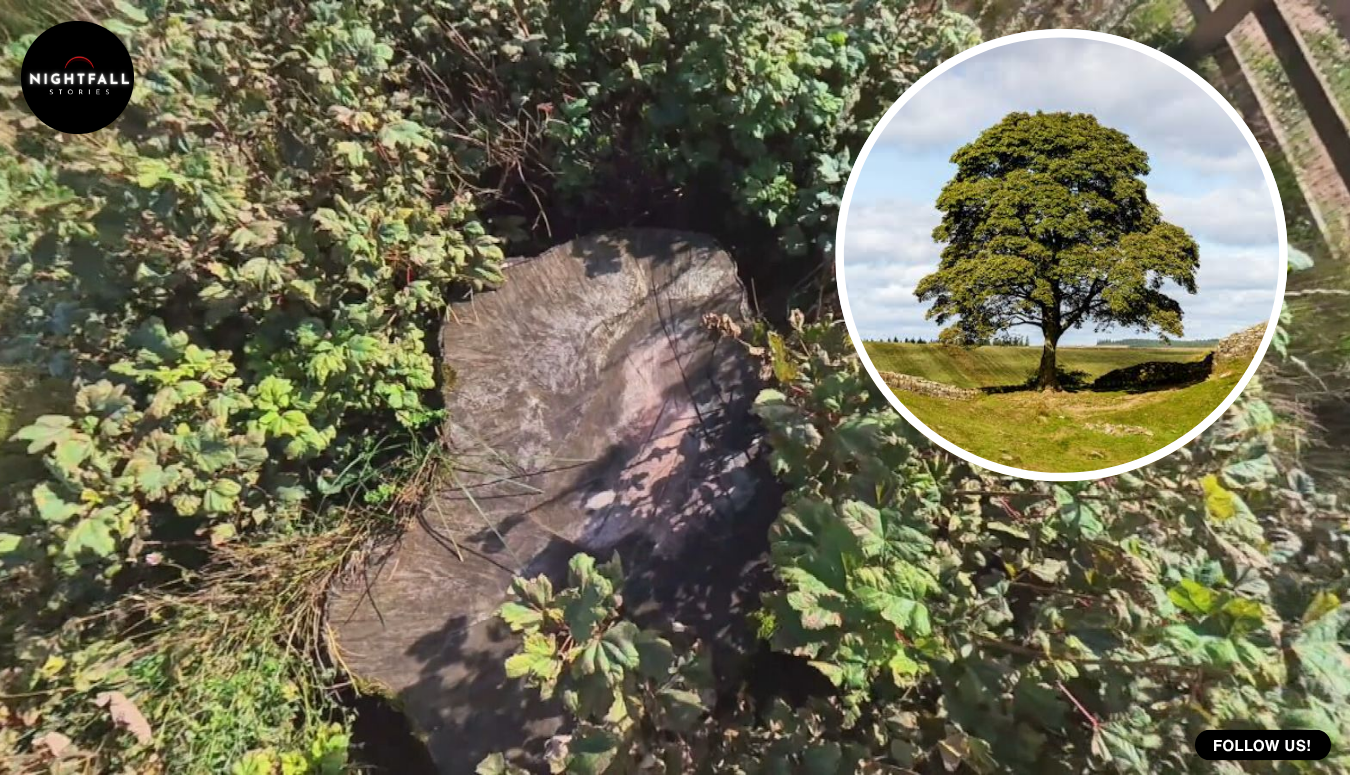
On a summer walk two years ago, a ranger called Gary Pickles went up to Sycamore Gap on Hadrian’s Wall to plan a guided walk and found something nobody had promised was coming. Around the raw edge of the stump where one of the most photographed trees in Britain used to stand, there were about a dozen tiny green shoots. Each carried between one and six leaves. The park measured them at two to four centimetres, and the comparison it used was a coin, because that is genuinely the scale we are talking about. You could have covered any one of them with a twenty pence piece.
Three years after the tree was felled in one night, those shoots have become a thick ring of leafy growth standing two to three feet tall all the way around the stump. That is the state of the thing now, reported by the National Trust and attributed to Andrew Poad, its general manager at Hadrian’s Wall, who says the growth is really encouraging and that the protective measures taken at the site are paying off. It is a genuine two year progression, and anyone who saw the coin sized shoots photographed in 2024 and assumes that is still the picture is two years out of date.
And here is the part that has not made the headlines. A thick ring of shoots is not a tree coming back. It is a stump doing something very particular, and what the people responsible for the site do next will decide whether Sycamore Gap ends up with one tree again or something that looks nothing like the thing in all the photographs.
Start with what is actually happening in the wood, because the biology is the best part of this story and it is almost never explained properly.
A felled sycamore is not a dead sycamore. Cutting the trunk off takes away the leaves, which is how a tree feeds itself, but it leaves two things intact: a root system that has spent a century storing sugars, and a layer of dormant buds sitting under the bark around the base. Those buds have been there the whole time, doing nothing, held in check by chemical signals coming down from the canopy above. Remove the canopy and the signals stop. The buds get released all at once, with the full stored energy of a hundred year root system behind them and no leaves left anywhere to compete for it.
The result is not one careful replacement stem. It is a scramble. Dozens of buds break at the same moment and every one of them goes for the light, which is why regrowth from a cut stump comes as a ring rather than a single shoot, and why it is so fast. In the first season after cutting, the energy available per shoot is tiny, which is why 2024 produced coin sized sprouts. Once those first leaves start feeding the system, the growth rate changes completely, and two to three feet in the following couple of seasons is exactly what a healthy sycamore stool does.
Humans have known about this for thousands of years and built an entire woodland economy on it. It is called coppicing. You cut a tree down to the base on a rotation, the stump throws up a crop of straight poles, you come back in a decade or two and cut those, and the stool regrows again, more or less indefinitely. Some coppice stools in British woodlands are far older than any of the single trunked trees around them, precisely because they keep getting cut. Sycamore is one of the species that does it extremely readily.
Which means the thing on Hadrian’s Wall right now is, botanically speaking, a coppice stool. That happened by accident, after a crime, to a tree that nobody ever intended to coppice, and it is the reason the regrowth story is more complicated than good news.
Because a coppice stool left alone becomes a multi stemmed thicket. Not a tree with a trunk and a crown, but a cluster of upright stems fanning out from a wide base, all roughly the same age, all competing. That is a perfectly healthy plant. It is not the silhouette that made Sycamore Gap famous. The tree that stood there was a single trunked sycamore of about fifteen metres, planted as a landscape feature in the late nineteenth century by the Newcastle lawyer John Clayton, who spent decades excavating and preserving stretches of Hadrian’s Wall and put a tree in a dip in the ridge because it would look right there. It did. For well over a century it sat in that gap in a way that photographers could not leave alone.
So the decision ahead is a real one, and it is not a technicality. Leave all the shoots and you get a stool: vigorous, resilient, almost certainly long lived, and shaped like a bush. Reduce the shoots down to one and you are attempting to grow a single trunked tree out of the side of an old stump, trying to recreate the thing in the photographs. That second option has costs. Choosing a leader means cutting away healthy growth and concentrating everything on one stem, which is slower and more fragile. A stem growing from the edge of a stump does not have the structural geometry of a trunk growing from its own roots, and the union where it meets the old wood can be a weak point for decades. The old stump will eventually rot from the middle, which is normal and not fatal, but it does mean a single chosen stem has to establish its own root support as the thing it is standing on decays beneath it.
There is a second reason the fencing matters, and it is older than any heritage site. The shoots coming off a cut stump are soft, green and highly palatable, and they appear at exactly the height a grazing animal browses. Coppice workers have fenced or stacked brush around their stools for centuries for precisely that reason, because a stool that gets browsed hard in its first years can be set back season after season until it gives up. Sycamore Gap sits in open, grazed upland where there is very little else growing tall, and anything tender at knee height is conspicuous. The ring of shoots has got to two or three feet, which is roughly the height at which it stops being a snack and starts being a thicket, and getting it through that window was never guaranteed.
The place itself is part of the difficulty. The gap is a dip in a hard ridge of rock, high, thin soiled and fully exposed to weather coming across open country. That is exactly why the original tree was so striking, because it was the only vertical thing for a long way in either direction, and it is also why growing a replacement there is harder than growing one in a sheltered garden. Wind pulls at young stems and rocks their root plate, and a late frost can take the first flush of leaves off a stool that has just spent stored energy producing them. None of that is fatal to a sycamore, which is a famously tough species and happy in bad ground. It does mean progress at this site is measured in seasons that go well rather than in a straight line.
Nobody has published a decision. The reporting says rangers will manage the growth depending on how it develops, which is the honest answer rather than an evasive one, because at two to three feet you cannot yet tell which stems are going to be strong and which are going to sulk. But the choice is coming, and it is a choice between a healthy plant and a recognisable one.
It is also worth saying clearly what is not known. There is no published arboricultural assessment of this stump’s long term prospects. Vigorous regrowth in year three is a very good sign and it is not a guarantee. Stools can push out a mass of shoots on stored energy and then falter if the root system has been damaged or if the stems get weakened by disease or weather. The two to three feet figure comes from the Trust and the reporting, not from a survey anyone has published. The Times put it about as well as it can be put: it will be many years before the tree regains anything like its old presence. Three years in, what can honestly be said is that the stump is alive, well fed and growing fast.
Which brings up the strangest problem at the site, and the most awkward one to talk about, because the threat is not vandalism. It is affection.
The protective measures Poad named are fencing, reducing soil compaction around the roots and limiting human disturbance. Soil compaction is the one that matters most and the one people least expect. Tree roots do not need soil so much as they need the spaces between it. A root takes in water and oxygen through the pores and gaps in loose ground, and the fine feeding roots near the surface are the ones doing most of that work. When thousands of feet walk over the same few square metres, the soil squeezes shut. The pores close, water runs off instead of soaking in, oxygen cannot get down, and the fine roots in the top layer suffocate. It is slow, invisible and entirely capable of killing a tree that looks fine above ground.
And the people doing it came out of love. In the weeks after the felling, Sycamore Gap turned into a place of pilgrimage. People walked up to stand by the stump, left flowers and notes, and brought children to see it. Some had scattered ashes at that tree, or been proposed to under it, or had it as the backdrop in a photograph on a wall at home. Asking those people to stay off the ground is a genuinely uncomfortable request, which is presumably why the Trust’s language is about fencing and limiting disturbance rather than telling anyone off. The visitors were never the problem. Their footsteps were. Those are different things and the site is managed on that distinction.
Alongside the stump there is a second project running, and it is a quieter kind of success. Seed and material recovered from the tree were taken away and grown on, and from that stock came forty nine saplings, one for each foot of the original tree’s height. They have been distributed across the country to schools, parks, national parks and charities, under the name Trees of Hope. One went to King Charles for Windsor Great Park. A section of the trunk itself was moved off the ridge and later put on display at a visitor centre nearby, where people can stand next to a cut face of hundred year old wood.
There is something clarifying about those saplings. Each one is genetically the same tree, grown from its own seed line, and not one of them is the Sycamore Gap tree. The thing that was lost was never the genetics. It was a particular organism in a particular dip in a ridge beside a Roman wall, in a landscape where almost nothing else grows tall, which is why it photographed the way it did and why it ended up in a film and on bedroom walls and in people’s memories of specific days. You can plant the same sycamore in forty nine places and give forty nine communities something to look after, and you still have not replaced the one in the gap. The only candidate for that is the stump.
The crime itself can be told briefly, which is the right way to tell it. The tree was cut down on a windy night in late September 2023, when storm winds covered the sound of a chainsaw. Two men, Daniel Graham and Adam Carruthers, were convicted of criminal damage and jailed for four years and three months, with the damage to the tree assessed at more than six hundred thousand dollars in value and further damage to the ancient wall where the trunk fell across it. No motive that satisfies anybody has ever been established. That is the whole of it, and it is background to this story rather than the subject, because the interesting thing about Sycamore Gap now is not the men who cut it. It is what the stump did afterwards.
What it did was behave exactly as sycamore wood behaves when you cut it, which is to say it refused to accept the premise. The buds under the bark did not know anything had happened except that the canopy was gone. Within a year they had produced a dozen specks of green you could cover with a coin. Within three they had produced a ring of growth up to the height of a child, dense enough that the reporting calls it thick, in a spot that thousands of people walk past.
The decision still to come is the part worth watching. Somewhere in the next few seasons, somebody at the National Trust is going to stand in front of that stump and decide how many stems it keeps. Everything the site becomes for the next hundred years sits in that call: a broad, multi stemmed stool that will outlive everyone involved and look nothing like the photographs, or one chosen stem given everything, aimed at a silhouette in a dip on a ridge that people still drive for hours to see. The tree, for its part, has already done the hard half. It grew back without being asked. The rest is up to us.
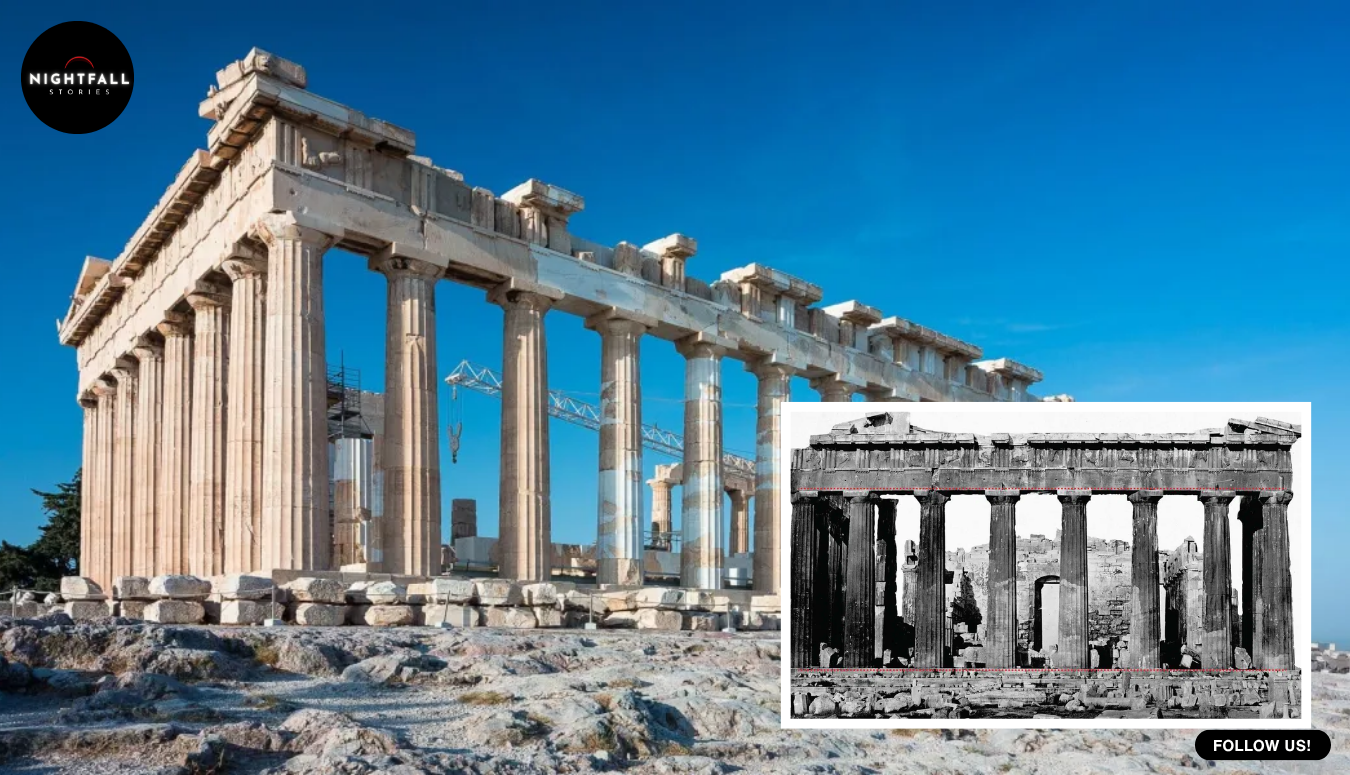
The Parthenon’s floor is not flat. Walk along the long south side of the temple and the marble platform under your feet rises gently towards the middle and falls away again at the far corner, like a very long, very shallow hill. For about two thousand years the explanation has been the same, and it is one of the most repeated facts in the history of building: the Greeks curved it on purpose, because a perfectly straight line that long would look as if it sagged, and the curve was there to cancel the sag out.
Alain Goriely went and worked out how big that curve actually is. Across the whole length of the platform, it rises roughly six centimetres. Two and a bit inches, spread over a stretch of stone longer than two buses. His argument, published in Royal Society Open Science under the title The Illusion of Illusions, is that a deviation that small cannot possibly be doing the job attributed to it, because at any distance from which a human being actually looks at the Parthenon, nobody can see six centimetres of anything. And the illusion it is supposed to be correcting, he says, does not reliably exist in the first place.
Goriely is not an archaeologist and does not pretend to be. He is the Statutory Professor of Mathematical Modelling at Oxford, a Fellow of the Royal Society, and he directs both the Oxford Centre for Industrial Applied Mathematics and the International Brain and Mechanics Trauma Lab. His day job is the mathematics of things that grow and bend: plant tendrils, elastic rods, the mechanics of brain tissue under impact. He has written books on biological growth and on applied mathematics. Curved structures and how they behave are, in a fairly literal sense, his specialism, which is why a classical temple with a measurably curved base ended up on his desk at all.
What he brought to it was the one question that two millennia of commentary had somehow skipped. Not whether the Parthenon is curved, which is beyond dispute and has been measured to fractions of a millimetre. Not whether the curves are beautiful, which is a matter of taste. The question was simply this: is the correction big enough to correct anything?
Start with where the story came from, because that turns out to matter. The Parthenon was finished around the middle of the fifth century before our era, roughly 432 BC by the usual reckoning. The earliest surviving written claim that Greek builders adjusted their buildings to defeat optical distortion comes from Vitruvius, the Roman architect and writer, working something like four centuries later. That gap is worth sitting with. Vitruvius was further in time from the men who cut the Parthenon’s blocks than we are from the first printing presses in Europe. He was not interviewing the builders. He had no access to their notes, their drawings, or their reasoning. He was an educated Roman explaining why Greek buildings looked the way they did, in a treatise meant to teach architecture to his contemporaries, and the explanation he offered was elegant, plausible and entirely unsupported by any evidence he bothered to supply.
That single late source became the received account. It was repeated, elaborated and eventually treated as something the Greeks themselves had told us. Then, in the nineteenth century, something happened that made the story feel confirmed rather than inherited. Francis Penrose went to Athens in the 1840s and 1850s and surveyed the temple with extraordinary care, and his measurements showed the curves were real. The platform did rise. The columns did swell. The corner columns were thicker. The whole building leaned very slightly inwards.
Here is where a subtle logical slip got locked in. Penrose proved the refinements existed. He did not, and could not, prove why. But the combination of Vitruvius saying the Greeks corrected illusions, and a Victorian surveyor demonstrating that the geometry really was adjusted, read to everyone as a case closed. The explanation and the measurement had shaken hands, and nobody checked whether they were actually compatible.
Goriely’s paper counts at least twelve separate optical corrections that have been claimed for the Parthenon over the centuries. Twelve. Each one a confident statement about what the builders were compensating for. He goes through them and finds that the illusions in question are either not real or far too small for the eye to register, and in several cases both.
Take the sagging horizontal, the oldest and most famous of the lot. The claim is that a long, straight horizontal line, seen against the sky, appears to droop in the middle, so the builders arched it to compensate. Goriely’s point is blunt: there is no good evidence that long horizontal lines inherently look as though they dip. It is an assertion that has been passed along rather than tested. You can test it yourself on any long bridge parapet or railway platform, and most people, looking honestly, see a straight line looking straight.
Then there is the Hering illusion, which does exist and is a genuine, well documented quirk of human vision. Put a pair of parallel lines across a radiating fan of other lines and the parallel pair appears to bow. It is a real effect, demonstrated thousands of times on paper. The trouble is getting from a printed diagram to a building made of stone. The Parthenon’s columns are vertical and rather widely spaced, the geometry is three dimensional, and the conditions that produce the Hering effect on a flat page do not obviously transfer to a colonnade seen in sunlight from forty metres away. Goriely argues the effect simply is not clearly present on a structure like this.
And then the columns themselves. Entasis is the name for the slight outward swell in a Greek column, the way it is not a plain cylinder or a simple cone but bulges almost imperceptibly around its lower middle. The standard story says a straight-sided column looks pinched or concave, and the swell restores it to apparent straightness. Goriely did the arithmetic on the Parthenon’s own columns. The maximum bulge is about eighteen millimetres. Less than the width of a thumb, on a column around ten metres tall, viewed from the distance at which human beings stand. At that scale the swell is, by his account, barely perceptible from normal viewpoints, which makes it a strange thing to install as a correction if the aim was for anyone to notice the result.
The corner columns get a similar treatment. The classic claim is that an outer column seen against bright sky looks thinner than its neighbours seen against the dark wall behind, so the corner columns were thickened to even things up. Goriely finds the set of positions from which that compensation would actually work is so narrow as to be practically useless. A building does not get viewed from one surveyed spot. It gets viewed from the slope you climb, the road below, the ridge opposite, the shade of the gateway, from near and far and off to the side. A correction that only functions at a single vantage point is not a correction.
If the optical account is wrong, the obvious next question is what the refinements were for, and this is where Goriely’s paper is admirably willing to be unglamorous. The curved platform, he suggests, may well be about water. Rain falling on a dead flat marble floor sits there and works its way into joints. A floor that rises in the middle sheds it off the edges. That is not mysticism, it is plumbing, and it is exactly the sort of thing that experienced builders do without writing a treatise about it. As for the swelling columns, the explanation may be no deeper than that they look better: a slightly convex profile reads as alive and organic where a ruler-straight one reads as dead. Greek sculptors were not shy about preferring the shape that looked right. Goriely also notes that the swell cannot have been structural in the way sometimes suggested, because marble under the load of that roof would crush long before it would buckle.
It is a deflating set of answers, and the temptation is to use it as a punchline. That would be unfair, because the deflating answers are probably the correct ones, and they are also more interesting than they first appear. They describe craftsmen solving practical problems and trusting their eyes, rather than philosophers encoding a theory of perception into limestone. The Parthenon does not become less remarkable if its builders were shedding rainwater and chasing a profile that pleased them. If anything it becomes more human.
It is also worth being fair to Vitruvius, who has spent the last few weeks being treated in headlines as a man who got it wrong. He was not conducting a fraud. He was doing what every writer about the distant past does, which is to offer the most coherent account available to him, and his account had the enormous advantage of making sense. Of course they corrected for the eye. Look how carefully everything else is done. A people who could carve the Parthenon frieze would hardly have been careless about the floor. The reasoning is reasonable. It is simply not evidence, and the problem was never Vitruvius. The problem was everybody afterwards who stopped treating it as a guess.
That is the part of this story with teeth, and it has nothing to do with Athens. A claim lasted two thousand years, made it into essentially every architectural education in the Western world, got repeated in textbooks, on plaques, by guides standing on the Acropolis every day of the summer, and was believed by people who were in every other respect rigorous. It survived not because anyone had verified it but because it was repeated by people who assumed somebody else had. All it ever needed was for one person to ask how many centimetres we were talking about, and to compare that number against what is known about the limits of human vision. That took until now. Nobody was hiding anything. Everybody just took it on trust.
Goriely’s own summary of the position is careful, and worth reporting precisely because it is narrower than the headlines around it. His conclusion is that there is insufficient historical evidence and no scientific evidence for the extraordinary claim that the Parthenon’s refinements were implemented as optical corrections. Read that again and notice what it does not say. It does not say the refinements are accidental. It does not say the builders were unsophisticated. It does not say they never thought about how the building would look. It says the specific, confident, universally repeated explanation has nothing underneath it.
And there is plenty the paper does not settle, which an honest account has to say out loud. It cannot tell us what the builders actually intended, because no Greek source survives that explains the refinements at all, and absence of a stated reason is not proof of the reason Goriely prefers. Drainage is a hypothesis, a sensible one, not a demonstration. Nor does a perception threshold argument fully close the door: vision is strange, and effects below the level at which you can consciously measure a difference can still, in some circumstances, shift how something feels. A six centimetre rise over that distance is far too small for anyone to see as a curve. Whether it contributes nothing whatsoever to the impression the building makes is a harder claim, and the paper’s strongest ground is the first part rather than the second.
Then there is the question of what the field says back, and here the honest answer is that it has not said much yet. The work has been widely covered, in Greece and beyond, but at the time of writing no named architectural historian or classical archaeologist appears to have published a substantive response. Specialists in Greek architecture have spent careers on this building and some of them will not accept a mathematician’s verdict quietly, nor should they have to. The arguments they are likely to make are predictable and legitimate. That ancient intention is a historical question as much as a geometric one. That the refinements come as a package, platform and columns and inward lean and corner thickening together, and a package suggests a programme rather than a dozen unrelated habits. That the perceptual literature on real buildings in real light is thinner than the literature on diagrams. None of that has been argued in print yet. When it is, the exchange will be the valuable part, and anyone reading about this now should hold the conclusion loosely until it happens.
What is not in doubt is the number, and the number is the whole story. Six centimetres. One mathematician, a published measurement already lying in the record since the 1850s, and a question nobody had put to it. The Parthenon still stands on its hill with its floor very slightly arched and its columns very slightly swollen, exactly as it has for twenty-four centuries, and it is still one of the most carefully made objects human beings have ever produced. The only thing that has changed is the sentence we say about it, which turns out to have been written by a Roman four hundred years too late, and believed by everyone since because it sounded like the kind of thing that ought to be true.







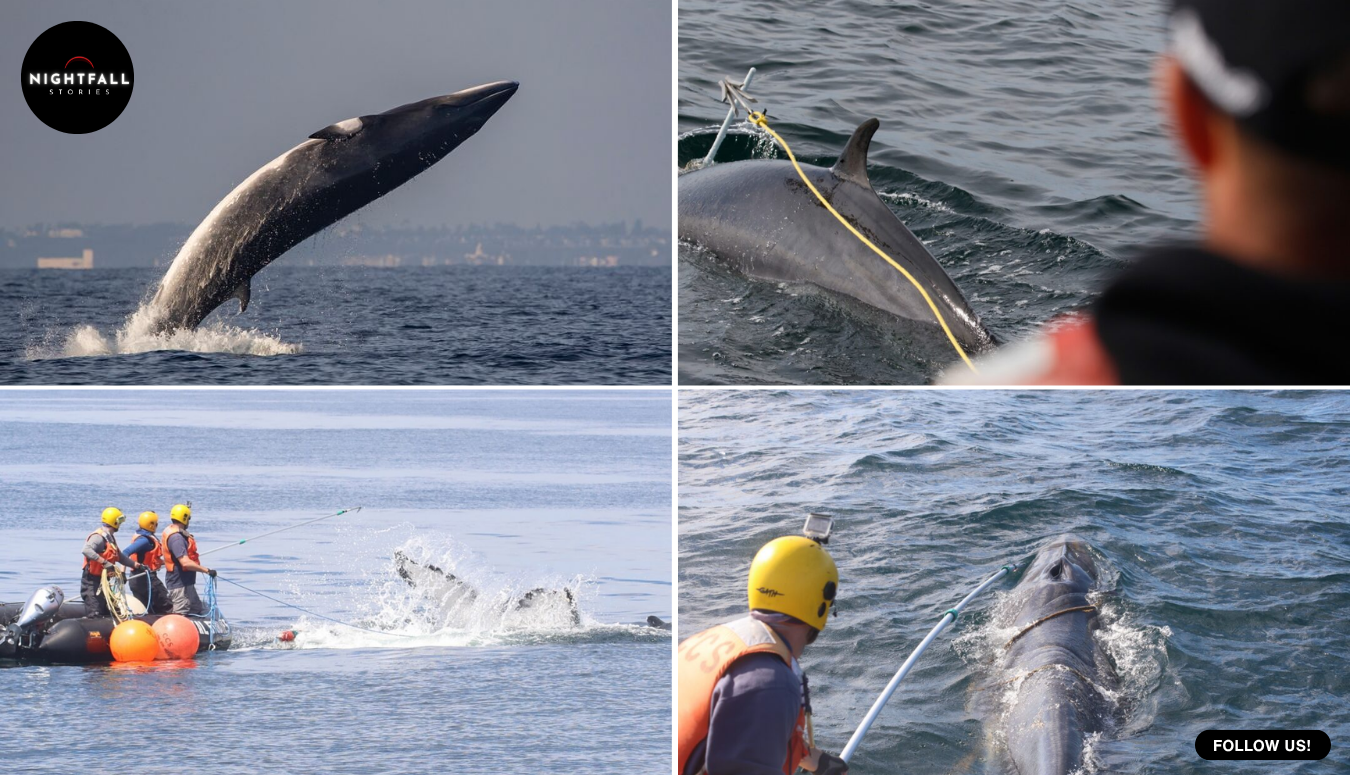
The whale was eighteen feet long, which for a minke is close to full grown, and the rope had found the worst possible position on it. A buoy line from fishing gear had gone in through the animal’s mouth, wrapped around its head and trailed back along its body to a point just forward of the tail. It could still swim. It could still breathe. What it almost certainly could not do was feed.
Getting that rope off took a crew from the Center for Coastal Studies in Provincetown about an hour and a half of searching and then roughly two hours of work, during which they brought their boat up alongside the animal somewhere close to fifty times. Not once. Not three times in a dramatic final push. About fifty approaches on a free-swimming whale in open water in Cape Cod Bay, each one a chance to catch a line with a grapple, almost all of them failures.
That number is the whole story, and it is worth sitting with before anything else, because it is the opposite of how whale rescues are usually told. There was no moment of understanding between species. The animal was not cooperating. It was doing what an eighteen-foot wild animal does when a boat comes at it, which is leave, and the people on the boat had to come back and do it again.
The call came in on a Saturday morning a few weeks ago. A whale watching vessel out of Hyannis had seen a minke towing a buoy, which is the classic signature of an animal dragging gear. A charter fishing boat reported a second sighting about two miles further east but could not stay with it. Both reports went to the entanglement hotline run by the Center’s Marine Animal Entanglement Response team, and that is where the first piece of luck in this story sits, because an entangled minke whale that has been seen once is usually not seen again.
Scott Landry directs that team, and his assessment of relocating the animal at all was that it was very lucky. Minke whales are the smallest of the baleen whales in these waters and by far the hardest to work with. A North Atlantic right whale is enormous, slow and relatively predictable. A humpback is big enough to be followed and often surfaces on something like a rhythm. A minke is compact, fast, erratic and spends very little time at the surface. It can be gone in a direction nobody expected in the time it takes to coil a line. Everything that makes a minke a difficult animal to study makes it a difficult animal to save, and it is precisely why fifty approaches were needed rather than five.
The team went out on their boat, the Ibis, with support from the Coast Guard out of Station Provincetown. Aboard were two trainees from France, part of an international exchange that moves disentanglement technique between countries: Willy Dabin from the Pelagis Observatory and the French national research agency CNRS, and Livier Schweyer from the Iroise Marine Natural Park. Whatever else those two took home, they got to watch the least glamorous and most instructive version of the job.
Before that, though, there was the search, and ninety minutes of it is a long time on the water. Two reports two miles apart do not give you a position, they give you a direction and a guess. A minke surfaces briefly and low, shows very little of itself and leaves almost no footprint on the water. The thing the crew were actually looking for was not a whale at all. It was a buoy moving the wrong way, against the set of the tide, because that is what an animal towing gear looks like from a distance.
It also matters that the rope was where it was. Gear wrapped around a fluke or a flipper is damaging and can be lethal over months, but an animal with its tail fouled can still eat. Gear through the mouth and around the head is the configuration responders least want to see, because a baleen whale feeds by taking in water and straining it, and rope running through that apparatus interferes with the one thing the animal has to do several times a day to stay alive. An entangled whale that cannot feed is on a clock, and nobody can read the clock from outside. That is why these responses happen on the day the report comes in, in whatever weather there is, rather than on the day conditions would be pleasant.
The problem in front of them was not cutting the rope. Cutting rope is easy. The problem was holding on to a whale.
This is where the technique gets genuinely strange, because the method the Center uses to control an entangled whale was borrowed, deliberately and explicitly, from the whaling trade. Nineteenth century whalers used an approach called kegging. Having harpooned an animal, they would attach large floats, kegs, to the line, so that the whale had to drag the buoyancy with it. The drag tired it out and the floats kept it at or near the surface where the boats could stay with it. The crews that now spend their lives undoing damage to whales use the same physics for the opposite purpose. Attach buoyancy to the gear the animal is already carrying, and the whale slows, surfaces and becomes something a small boat can work beside without being dragged under.
Before you can keg anything, though, you have to get a line on the whale, and that is the part Landry described as incredibly difficult on this particular animal. The tool for it is a grapple, thrown or set to catch the trailing gear. On a fast minke surfacing briefly and unpredictably, you get a second or two of chance per approach. That is what the fifty approaches bought: not fifty attempts at a rescue, but fifty attempts at a single preliminary step.
Once they had the line, the cutting tool was a knife on the end of a pole with a hooked blade, shaped so that it can be pushed past rope and then pulled back to slice from the inside out, cutting the line rather than the animal. Working alongside the whale from the small boat, the crew got that hook onto the rope at the head and cut it.
What happened next took seconds. The whale opened its mouth and released all of the remaining gear. Then it swam off, free of the rope.
That is the documented outcome, and it is important to state it precisely. The record says the whale was freed of the entangling gear and swam away. The record does not say the whale survived. Nobody followed it. Minke whales are not individually catalogued and tracked the way North Atlantic right whales are, and no re-sighting or assessment of its longer-term condition has been reported. Landry called it a nearly miraculous disentanglement, which is a statement about the operation, not a prognosis for the animal. An animal that has been unable to feed properly for an unknown period carries consequences that do not resolve the moment the rope comes off. The honest end point here is that the gear is off and the whale went away under its own power, and that is where the evidence stops.
There is one more element in Landry’s account that changes how you read the whole thing, and it is uncomfortable. His reading of the configuration was that the whale had very likely been anchored in the fishing gear originally, held in place, and that some well-intentioned mariner had cut the rope at some point, probably believing that was help. By his assessment it made things worse for the whale and harder for the responders.
It is worth understanding why, because the instinct behind that cut is one almost anyone would have. A whale held fast in gear is a whale in obvious distress, and cutting the rope that holds it looks like the obvious kindness. But an anchored whale is a whale you can find, a whale that is still in one place when trained responders arrive, and a whale whose gear is under tension in a known direction. Cut the anchor and you have converted a stationary problem into a mobile one. The animal is now a fast-moving target somewhere in a large bay, still wearing most of the rope, and the chances of anyone ever seeing it again drop sharply. The first sighting is usually the only sighting.
That is the reason the entanglement response network is structured the way it is, and the reason the authorities are so insistent that the public report rather than intervene. Responders in this network train for a long time before they are authorised under a federal permit to approach an entangled whale closely, let alone cut gear off one, and the network is tiered by species and difficulty, with the most restricted level covering work on North Atlantic right whales. The federal fisheries agency’s own guidance on this is about as blunt as official guidance gets. People, including trained and authorised responders, have died attempting to rescue entangled whales.
Hold that next to the picture of a small boat coming alongside an eighteen-foot animal fifty times. This is not a feel-good activity. It is dangerous, repetitive, technical work done close to a large frightened animal that can injure or kill a person without any intention of doing so, in a boat, on the open water, for hours.
And it is work with a genuine lineage. The Center’s disentanglement programme is the oldest in the United States, and it began with a single humpback on Thanksgiving Day in 1984. The whale had been tangled in gill netting for months. Charles Mayo, known as Stormy, and David Mattila took a crew out, including Mayo’s father, and improvised: a grapple anchor tied to large plastic floats, buoyancy added to the gear the animal was already carrying, which is kegging in everything but name. Four hours later the whale was free. It was seen the following spring on Stellwagen Bank, breaching and swimming, which is about as good an outcome as that kind of story gets.
Mayo had named that whale Ibis, after a mark on it that reminded him of an Egyptian hieroglyph. The boat the team works from in Cape Cod Bay today carries the same name.
In the four decades between those two animals, a piece of improvisation became a profession. The grapple, the kegging floats, the hooked knife on a pole, the decision rules about when to approach and when to stand off, the training ladder, the permits, the hotline, the exchange programmes that put two French responders on an American boat for a season: all of it grew out of people working out, case by case, how to get rope off an animal that cannot be asked to hold still.
The reason it had to become a profession is the scale of the underlying problem, and this is where the story stops being about one whale. Entanglement in fixed fishing gear is one of the central threats to large whales in the North Atlantic. The mechanics are grim and simple. Rope interferes with swimming, feeding and breathing. Gear that stays on an animal for months can cause infection, starvation, loss of a flipper or a fluke, blood loss, strangulation or drowning. For the North Atlantic right whale, a species down to a few hundred animals, entanglement is one of the main reasons the population has been in sustained trouble.
The argument about what to do runs through gear design: breaking strengths in rope, vertical line reductions, seasonal closures, and on-demand or so-called ropeless systems that keep line out of the water column until a trap is retrieved. Those debates are real and they are not resolved, and it is worth being careful about how they are framed, because the people on the other side of them are working fishermen whose livelihoods depend on the answer, not villains. Nobody sets a trap in order to entangle a whale. The gear is doing what gear does.
In this particular case, nothing in the record establishes which fishery the rope came from, and it would be unfair and unfounded to guess. The rope was a buoy line. That is as far as the documentation goes.
What the record does establish is a sequence. Two vessels reported an animal towing a buoy. A team went out and spent about ninety minutes finding it again, which by their own account was the lucky part. They then spent roughly two hours approaching a fast, unpredictable whale close to fifty times to catch a trailing line with a grapple. They got the line, held the animal alongside, cut the rope at the head with a hooked blade, and within seconds the whale opened its mouth, dropped the rest of the gear and left.
No one on that boat called it heroic. Landry’s own description of the hardest part, catching the line, was that it was incredibly difficult, and his description of the outcome was that it was nearly miraculous, which in context reads less like triumph and more like a man acknowledging how often this does not work. For every minke relocated after a first sighting, there are others that are seen once with a buoy behind them and never seen again. Those animals do not appear in the reporting, because nothing happened to them that anyone could write down.
That is the real weight of the fifty approaches. Not that a whale was saved, which is more than the record supports, but that a crew kept coming back to a moving animal in open water, failing, turning the boat, and coming back, until one approach out of about fifty landed.
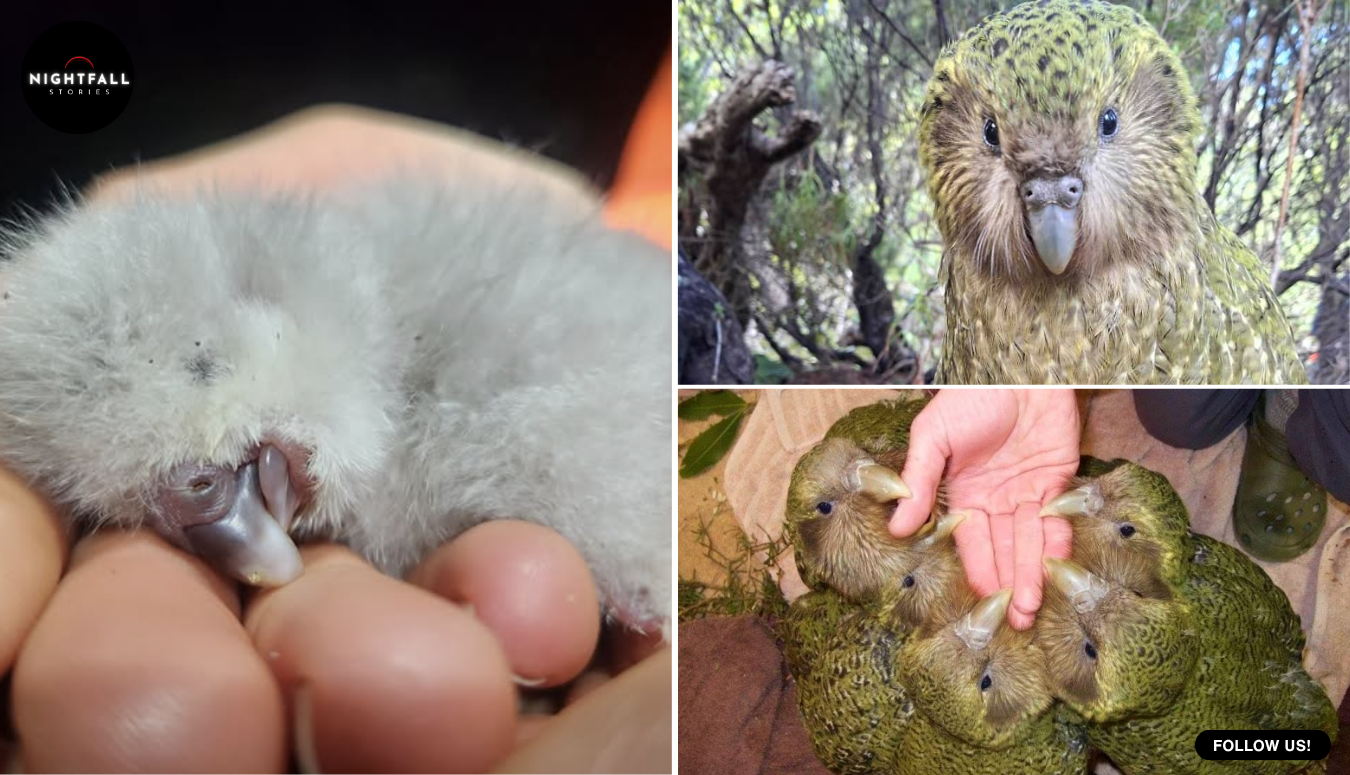
The number is 325. That is the official count of every kākāpō alive, published by New Zealand’s Department of Conservation, and it is the first time the total has been above 300 in what the department itself estimates is around 75 years. Ninety of those birds are chicks from the most recent breeding season, which is a record for a single season, and none of them were counted until they reached 150 days old, because that is the age the programme treats as the point where a chick has a real chance of making it.
That last detail tells you most of what you need to know about how this recovery works. Nobody in the Kākāpō Recovery programme counts an egg. Nobody counts a hatchling. The number only moves when a bird has survived five months, and the people who manage this species have learned the hard way not to celebrate early.
Deidre Vercoe is the department’s Kākāpō Recovery Operations Manager, which means the logistics of the whole operation land on her desk. Her reaction to the milestone was not triumphant. She pointed out that there had been a four-year gap between breeding seasons, so it was a relief to finally see the population move after all that waiting, and she was clear that there is still a long road of recovery ahead. Ninety chicks in one season is a record. It is not a finish line.
To understand why a number in the low hundreds counts as good news, you have to go back to where the modern programme started. In 1995 the known population was 51 birds. Twenty of them were female. Thirty-one were male. That is the genetic base every kākāpō alive today is descended from, with the partial exception of one famous bird, and it is the single most important constraint on everything that has happened since.
A kākāpō is a strange animal even by the standards of a country full of strange animals. It is the heaviest parrot in the world, with large males reaching around four kilograms, which is roughly nine pounds, and it cannot fly. Some of the lighter females can manage a sort of controlled glide down from a height, but that is the limit of it. They are nocturnal. They are moss green and mottled, which is beautiful camouflage against a forest floor and useless against an animal that hunts by smell. They can live for sixty to ninety years, which means a bird hatched in the programme’s early days may still be breeding now. And they have a distinctive sweet, musty smell, which is charming to the researchers who work with them and was catastrophic once rats, cats and stoats arrived.
Their breeding biology is the other problem, and it is the one that makes the arithmetic so slow. Kākāpō do not breed every year. They breed when the rimu tree fruits heavily, a phenomenon called masting, which happens irregularly, roughly every two to four years and sometimes less often than that. When the rimu does not mast, there are no chicks at all. Not fewer chicks. None. An entire calendar year can pass in which the most intensively managed bird in the world produces nothing, and the team spends it on health checks, transmitter changes and waiting.
So the line from 51 to 325 is not a line. It is a staircase with long flat stretches and at least one step downward. In 2019 an outbreak of aspergillosis, a fungal respiratory disease, moved through the population. More than twenty birds were taken into veterinary care, a secondary outbreak on Whenua Hou later that year killed two juveniles, and the following year there was no breeding season at all. A programme that had just come off a strong breeding year found itself losing adults and juveniles it had worked years to produce. Anyone writing this story as a smooth upward climb is writing fiction. The count is a snapshot of one moment, and the people who publish it know exactly how fast a snapshot can change.
The most recent season gives you the honest ratio of effort to result. Seventy-nine females nested. Between them they produced 258 eggs. More than half of those eggs never hatched. By the time the dust settled, roughly a third of all eggs laid had produced a chick that survived to the 150-day mark. Ninety birds out of 258 eggs is a good season by kākāpō standards, and it is also a reminder that most of the work does not pay off.
There were individual surprises inside that number. One male called Tūterangi, ten years old and breeding for the first time, fathered ten surviving chicks with six different females. For a species where the whole management challenge is spreading a narrow gene pool as widely as possible, a new male suddenly contributing at that scale is a genuinely useful event, not just a nice anecdote.
The hands-on reality of this programme is hard to overstate. Essentially every adult kākāpō wears a transmitter, so the team knows where each individual bird is and can tell when a female has started nesting. Nests are monitored. Eggs are sometimes moved, swapped or incubated artificially. Chicks are sometimes hand-reared. Adults are fed supplementary pellets from smart hoppers that recognise individual birds and ration them, because a female that is too heavy produces too many male chicks and a female that is too light does not breed at all. Artificial insemination has been used to get genes from under-represented males into the next generation. Birds are weighed, blood-tested and flown between islands.
That intensity is the reason the species still exists, and it is also a problem in itself, because a population that only survives under that level of care is not really recovered. Tāne Davis, who represents Te Rūnanga o Ngāi Tahu on the Kākāpō Recovery Group, made exactly that point about the most recent season. The programme deliberately trialled several approaches aimed at reducing intensive management, testing how much the birds can do on their own. That is the direction the whole thing has to move in eventually, and the fact that the record season was also a season of stepping back a little is more significant than the record itself.
Ngāi Tahu’s involvement here is not a line in a press release. The iwi is a partner in the recovery of a taonga species on and around its own territory, and Davis sits on the group that makes the decisions. His contribution to the milestone announcement was a point about origins rather than numbers. All but one of the founders of the modern population came from Rakiura, the large island at the southern end of New Zealand that English speakers often call Stewart Island. That is where the birds that saved the species were found in the late twentieth century, after decades in which conservationists had feared the species was functionally gone. The one exception was a male from Fiordland, a bird named Richard Henry after the conservationist who had tried to move kākāpō to safety in the 1890s and watched the stoats follow them.
That 1890s attempt is worth a moment, because it explains the shape of everything that came after. In 1894 Richard Henry moved several hundred kākāpō to Resolution Island in Fiordland, which was supposed to be out of reach of introduced predators. Within about six years stoats had got there, and in time the entire relocated population was gone. The first serious conservation translocation in New Zealand’s history failed completely, and it failed for exactly the reason every kākāpō decision is still made around today, which is that an island is only a sanctuary for as long as nothing swims to it.
Then came the long search. Between 1949 and 1973 the New Zealand Wildlife Service mounted more than sixty expeditions into Fiordland looking for survivors. They found six birds. All six were male, and all but one died within months of being taken into captivity. A renewed effort from 1974 turned up another eighteen birds by 1977, and those were male too. For most of three decades, the working assumption had to be that the species was down to a handful of elderly males in the wet mountains of the southwest, booming into the dark for females that no longer existed.
What changed it was a sound. In 1977 searchers heard booming in southern Rakiura, and the population they found there was something like two hundred birds. By 1980 females had been confirmed among them. That is the moment the species stopped being a eulogy and became a programme. Over the following years the Rakiura birds, which were being eaten by cats and were declining where they stood, were moved out to island sanctuaries in batches. Even then it kept going wrong. Rats took chicks on the islands. In the season before the modern programme began, at least a dozen chicks were produced and three survived. That is the context for the figure of 51.
So the people reading out 325 this year are not standing at the top of a curve. They are standing at the far end of a sequence that includes one complete failure in the 1890s, sixty fruitless expeditions, three decades of finding only males, a rescued population that kept shrinking after it was rescued, and a disease outbreak within living memory of everyone currently on staff.
Rakiura matters because it is the long-term goal. The three islands the birds currently breed on, Whenua Hou, also called Codfish Island, Pukenui, also called Anchor Island, and Te Kāhaku, also called Chalky Island, are small, intensively managed and kept free of introduced predators at considerable cost. Rakiura is the ancestral habitat, orders of magnitude larger, and nowhere near predator free. Making it safe enough for kākāpō is a project at a completely different scale from anything the programme has done so far.
Which brings you to the part of this story that the number obscures. The three breeding islands are filling up.
This is the awkward consequence of success, and it is the live tension inside the programme right now. Ninety new birds have to live somewhere. Kākāpō are territorial, males display at leks and need space to do it, and an island has a finite amount of rimu on it. Several commentators have reached for the phrase housing crisis, which is journalists’ shorthand rather than the department’s own framing, but the underlying constraint is real and the department does not dispute it. You can raise a record number of chicks and still be no closer to a self-sustaining species if there is nowhere new for them to go.
The department’s early modelling suggests the next breeding season could fall in 2028, a two-year gap rather than the four-year one that just ended. On the face of it that is excellent news. In practice it sharpens the problem, because it means another cohort may arrive before the space question has been answered.
There is one more unusual element worth explaining, because it is rare in conservation and it has mattered here. The programme’s national partner is Meridian Energy, a New Zealand electricity company, which has backed it since 2016. Over the course of that partnership the population has grown by more than 200 birds. Long-term corporate funding of a single species recovery programme is not common, and the reason it matters for kākāpō specifically is the breeding cycle. A programme that produces nothing for four years at a stretch is extremely hard to fund on annual grant cycles tied to annual results. Money that does not flinch during the flat years is worth more than its face value.
What makes this recovery genuinely unusual is how small and how documented it is. There is no estimate here, no statistical model of an unseen population, no confidence interval. There are 325 birds and the programme knows all of them individually. It knows their parents, their weights, their genetic contribution and in most cases their personalities. The staff name them. When one dies, somebody writes it down.
That is also why the milestone is being handled so cautiously by the people closest to it. A population of 325 individually known animals is still a population that a single bad fungal season, a single predator incursion onto a single island, or a single failed rimu mast could knock back by years. The last time the number was above 300, nobody was counting. There were no transmitters, no smart hoppers, no recovery group, no funding partner. The birds were simply still numerous enough not to have been noticed disappearing yet, and then they were not.
So the honest version of this story is not that the kākāpō has been saved. It is that a programme which started with 51 birds and 20 females has, across thirteen breeding seasons and one disease outbreak and one entirely blank year, more than six-folded a population it can account for bird by bird. And its reward for doing that is a new problem it cannot solve on the islands it currently has.
The number to watch next is not the population. It is the acreage.

Before any tiger was released into the lower Ili river delta in southeastern Kazakhstan, 205 Bukhara deer had to be put there. Then more than a hundred kulan, the wild ass of the Central Asian steppe, had to be moved in. Reed beds and tugai forest, the dense riverside woodland that gives a big cat somewhere to lie up during the day, had to be replanted, reportedly to the tune of around 37,000 seedlings and cuttings. A reserve of 450,000 hectares had to be legally created, staffed and patrolled. Compensation arrangements had to be agreed with the villages on its edge, before a single claim could be made against them. Sixteen years of this went by.
Only at the end of all that did a female Amur tiger called Umit walk out of a holding enclosure and into open country, on the last day of July, wearing a satellite collar. She is reported to be the first tiger living wild in Kazakhstan in more than seventy years.
The order of those events is the whole story, and it is the part that tends to get lost. Reintroducing a large predator is not an animal problem. It is a food problem, a cover problem, a law problem and a neighbour problem, and the animal is the last variable you add, not the first. Put a tiger into a landscape with nothing in it to eat and you have not restored anything. You have released a tiger into somebody’s livestock.
Kazakhstan announced its intention at an international tiger conservation forum in 2010. What it was proposing to restore was not the Amur tiger at all. The cat that used to live along the rivers of Central Asia was the Caspian tiger, also called the Turan tiger, an animal of riverside thickets rather than mountains, which hunted wild boar and deer in the reed country around the great inland lakes. It was hunted hard, its riverside forests were cleared for cotton and cropland, and its prey was shot out from under it. In Kazakhstan the last confirmed record is from 1948. By the 1970s the subspecies was gone everywhere.
It is worth saying what tugai forest actually is, because the word does a lot of work in this project and means nothing to most readers. Tugai is the ribbon of woodland that grows along desert and steppe rivers in Central Asia, usually a tangle of poplar, willow, tamarisk, oleaster and dense reed, fed by the river rather than by rainfall. It is narrow, it is green in the middle of country that is not, and it concentrates everything. Deer come to it for browse and shade, boar for the roots and the water, birds for the cover. A tiger in this part of the world was a tugai animal, moving along the river corridor as if along a road. Clear the tugai and you have not merely removed scenery. You have removed the corridor, the shade, the ambush cover and the prey in one operation, which is largely how the Caspian tiger was eliminated. It was shot, certainly, and shot deliberately and in organised campaigns. But what finished it was the conversion of riverside forest to farmland across its entire range.
There is nothing left to bring back. No Caspian tigers survive in captivity. Nobody has a frozen cell line. So the entire programme rests on a substitution, and that substitution rests on a single piece of genetics.
In 2009 a team led by Carlos Driscoll published a study in PLOS ONE that sequenced mitochondrial DNA from museum specimens of Caspian tigers, some of them more than a century old. What they found was that the Caspian tigers carried a mitochondrial haplotype differing from the one shared by every living Amur tiger by exactly one nucleotide, a single letter change at one position in one gene. In evolutionary terms that is almost nothing. The two populations were not separate lineages that had been apart for a long time. They were the ends of one continuous range that had been cut in half relatively recently, probably as human settlement spread through the corridor between them. The authors concluded that, given how close the relationship is, living Amur tigers would be an appropriate genetic source if anyone ever tried to put tigers back where the Caspian tiger used to be.
That paper is the licence under which every spade of this project has been turned. It is worth noting that the authors were careful in a way that press coverage of their work usually is not. They said plainly that a single mitochondrial change may not be enough to settle whether the two should be treated as separate categories at all, that nuclear DNA would make the case firmer and is much harder to recover from old specimens, and that the morphological question was unresolved. In 2017 an international assessment of cat taxonomy went further and folded both into a single mainland subspecies, which on paper makes the substitution not a substitution but a reintroduction of the same animal.
Not everyone finds that satisfying, and the objection is reasonable. A tiger from the snow forests of the Russian Far East is not behaviourally identical to a tiger that evolved in hot reed beds beside a desert lake, whatever their mitochondria say. Body size, coat, prey preference and tolerance for heat are shaped by more than one gene. The honest position is that the genetics make the attempt defensible rather than guaranteed, and that the first few animals are a test of exactly that question.
Which is why the preparation mattered more than the paperwork. The reserve, Ile-Balkhash, sits in the delta where the Ili river runs into Lake Balkhash, and it was formally established in 2018 after years of groundwork. Between 2018 and 2024 the team released 205 Bukhara deer into it, a species that itself had been reduced to remnant populations along Central Asian rivers. More than a hundred kulan were relocated in. Roe deer and wild boar numbers were allowed to build. The tugai forest and reed beds were replanted, a figure of about 37,000 seedlings and cuttings being carried by several outlets, which should be read as the planting effort in the South Balkhash area rather than a count of surviving mature trees.
None of that is glamorous and none of it photographs well, which is roughly why most people heard about this project only when a tiger was involved. But it is the difference between a reintroduction and a stunt. Deer take years to establish. Replanted riverside forest takes longer. You cannot compress it, and if you try to skip it the predator you release simply walks out of the reserve looking for protein, which is precisely the failure mode that turns a conservation programme into a livestock dispute within a season.
The tigers themselves came from Russia. Four wild Amur tigers were caught in Khabarovsk Krai in the Russian Far East and flown to Kazakhstan, arriving in the spring. The handover was arranged between the two governments and was timed around a presidential visit, which is worth stating and not worth dwelling on. The animals are the same animals whoever stood next to the crate.
Umit, whose name means hope in Kazakh, is the adult female of the group and she was judged ready first. That choice is not arbitrary, and the logic behind it is the same logic that governs most staged releases of large carnivores. A female generally holds a smaller range than a male, which means a smaller chance of her leaving the reserve in her first season. She has less reason to travel, because a male’s movement is driven largely by the search for females and there are none out there to find. And she is the half of the equation that eventually produces cubs, so establishing a settled resident female is worth more to the programme than establishing a male who has nothing to settle next to. Releasing her first means the project finds out whether the landscape works before it takes on the harder animal. Her collar is a satellite and mobile-network unit that transmits her position and a read on her condition, and the monitoring protocol around it is one of the more interesting details of the whole operation. The reserve has mapped her range into zones. While she is in what the team calls the green zone, the safe core where water and prey concentrate, the collar reports roughly every twelve hours. If she moves into a zone flagged yellow or red, meaning closer to people and livestock, the reporting interval tightens to hourly or every couple of hours, so that staff know where she is almost in real time and can get ahead of a problem rather than respond to one. Camera traps cover the rest.
In the weeks after her release she did something the team had hoped for and could not assume. She settled. She established a territory along the reed-lined shoreline, marked it, and stayed inside it, in country that specialists noted resembles the riverside habitat she came from in the Russian Far East more than you might expect of a place two and a half thousand miles away. The prey is there: tugai deer, kulan, wild boar, all of them drawn to the same water she is. Reserve staff declined to publish how far she has ranged, which is a sensible precaution for a single collared animal in a country where she is the only one of her kind.
The neighbours are the part of this that cannot be engineered away. There are four villages around the edge of the reserve, home to something like 6,000 people, in a region where herding and fishing on Lake Balkhash are how households eat. A tiger that takes a cow is not an abstraction to them. The programme’s answer has been to put the mechanisms in place before the risk arrived rather than after: compensation schemes agreed in advance of the release, local education work, and an early warning system built on the collar data, so that a tiger moving towards livestock generates a phone call rather than a dead animal and a furious owner. Stuart Chapman, who leads the global tiger programme at the conservation organisation WWF, has been among those pointing out that this groundwork is what makes the difference between a reintroduction that holds and one that collapses in its second year. Whether it holds here will be decided by the first serious livestock loss, not by anything written so far.
There was also a smaller episode in the days after the release that says something about how this story travels. A photograph went around social media presented as a candid shot of the newly freed tiger in the wild. Kazakhstan’s Ministry of Ecology and Natural Resources put out a statement saying the image did not correspond to reality and showed signs of having been generated by artificial intelligence. The ministry’s reasoning was partly technical and partly logical: Umit is wearing a collar that reports her position continuously to reserve staff, so a tourist stumbling across her by chance and getting a clean frame was never a plausible account of where the picture came from. The ministry warned that circulating fabricated images could carry legal consequences and asked people to check official channels. It is a small thing, but it tells you that the demand for pictures of this animal considerably exceeds the supply, and that the gap is already being filled with invented ones.
The real supply is thin on purpose. A single collared female in a reserve the size of a small country, monitored by camera traps and a handful of staff, is not a photogenic subject, and the ministry’s press service holds essentially all the imagery that exists of her release.
What makes this a programme rather than a gesture is the queue behind her, and the queue has conditions attached rather than dates. The adult male of the Russian group, named Amur, is still in an adaptation enclosure. He was held back after behavioural testing and the team has not committed to when he will be retested, which is a more candid position than announcing a release window and then missing it. A male is a much bigger risk than a female: he will range further, he will come into contact with people sooner, and he is the animal that has to work for breeding to happen at all. Testing him properly is worth more than releasing him quickly.
The two cubs, Turan and Ussuri, were around six or seven months old when they arrived and are being held in enclosures until they are at least eighteen months and possibly two years, each to be assessed individually before anything is decided. They are being fed on rabbit and boar meat, which is to say on the kind of prey they will have to catch themselves later. Separately, a pair of captive Amur tigers, Bogdana and Kuma, were transferred from the Netherlands in 2024 and are kept in an enclosure for breeding rather than release. They have not produced cubs yet.
So the position is this. One wild tiger is out, collared, inside 450,000 hectares that were stocked with her food before she arrived. One adult male is waiting on a behavioural assessment with no promised date. Two cubs are waiting on their own growth. One captive pair is waiting on biology. And the deer, the kulan, the boar and the replanted reed beds that made any of it possible are still the only part of the project that has been running for sixteen years.
The tiger is the headline. The deer were the work.