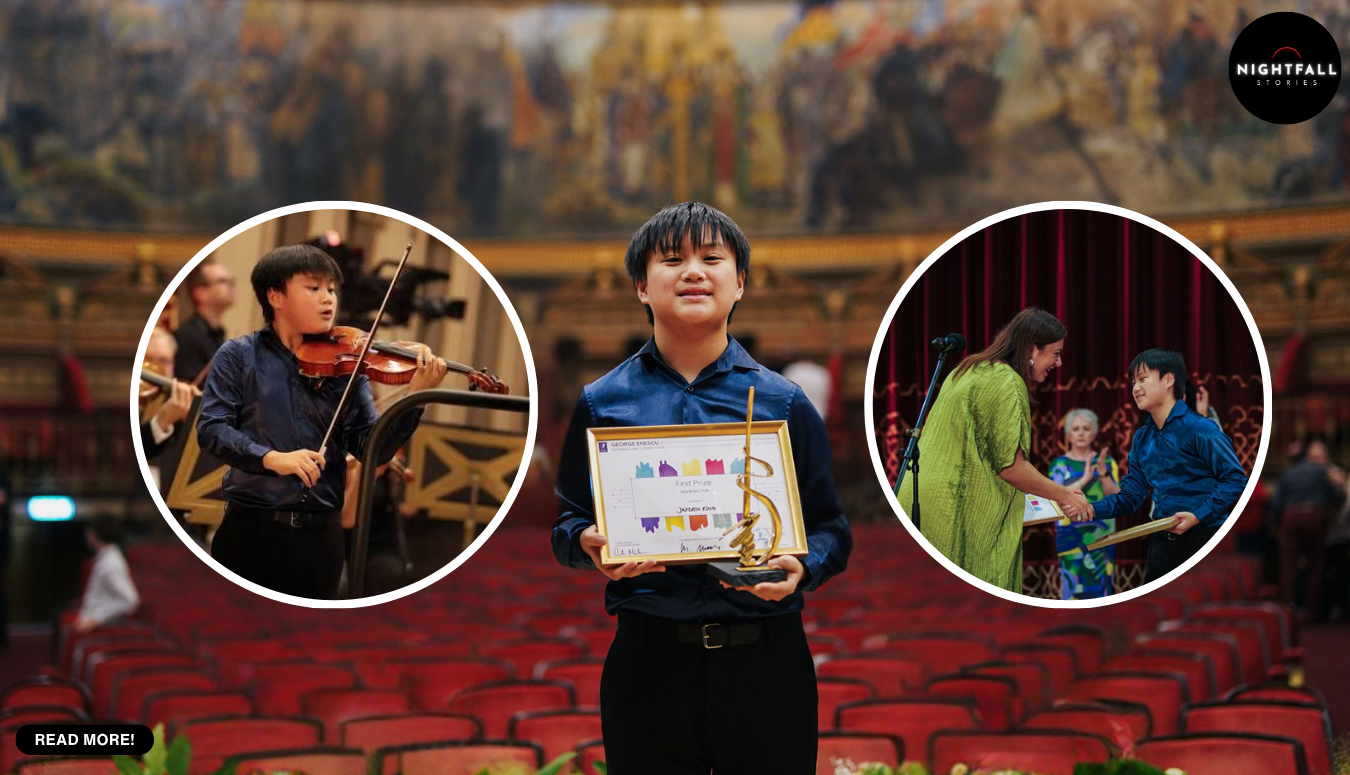
The headline fact is that an eleven-year-old walked out onto the stage of the Romanian Athenaeum, played the Tchaikovsky Violin Concerto with a professional orchestra behind him, and won first prize at a competition that has been running since 1958. No winner that young had ever happened there before, in any section, on any instrument.
But that is not actually the interesting part, and anyone who knows how violin competitions work will tell you the same thing. Children can be taught to play very hard music very fast. It happens more often than the general public realises, and it proves less than people assume. The fact that should make you sit up is a smaller prize that Jayden King also collected that night, worth about two thousand three hundred dollars, for the best performance of a piece that had existed for a matter of months and that nobody in the building had a tradition for.
Start with the room. The George Enescu International Competition holds its violin final at the Athenaeum in Bucharest, a domed concert hall from the end of the nineteenth century that is the single most loaded venue in Romanian musical life. The George Enescu Philharmonic Orchestra plays, this year under the British conductor Harry Ogg. Three finalists survive to that stage, and this time the three of them were an eleven-year-old, a twenty-year-old Italian named Francesco Papa, and a twenty-eight-year-old South Korean named Eun Che Kim. The two older players both chose the Sibelius concerto. King chose Tchaikovsky.
That choice deserves a moment, because the Tchaikovsky has a history of humiliating people. The composer wrote it in about a month in 1878 and handed it to Leopold Auer, the great teacher of the age, who declined to play it and said parts of it were not suited to the nature of the instrument. The premiere had to be abandoned. It sat unplayed for three years until Adolph Brodsky took it on in Vienna, where the most feared critic in Europe wrote that the violin had not been played so much as beaten black and blue, and produced a line about music that stinks to the ear which has outlived almost everything else he ever published. Tchaikovsky dedicated the piece to Brodsky, presumably out of gratitude for the sheer nerve of it.
It is around thirty five minutes long. It opens with an Allegro moderato that spends most of its length climbing, then hands the soloist a cadenza that sits at the top of the instrument for an uncomfortable stretch. The middle movement, the Canzonetta, is the trap: it is slow, quiet, exposed and entirely about tone and phrasing, with nothing technical to hide behind, and it runs without a break into a finale of scales and fast triads and a coda designed to leave the player audibly out of breath. It is a piece that punishes stamina and punishes taste in different movements. Doing it at eleven means doing it with a smaller instrument, smaller hands and a fraction of the physical strength the music was written to assume.
He did it, and the jury gave him first prize, about seventeen thousand five hundred dollars, chaired by the violinist Mihaela Martin with a panel of eight others including Ida Kavafian, Nemanja Radulović and Kathleen Winkler. The audience, voting separately, gave him their award too, which is worth noting because audiences and juries very often disagree, and a room full of people who have sat through three concertos in one evening tend to reward the performance that moved them rather than the one that was cleanest.
Now back to the prize that matters more. Every edition of this competition commissions a new piece that all the violinists have to play, and for the twentieth edition the composer was Lembit Beecher, an American whose grandparents’ world was Estonian. The piece is called Still Life with Fallen Stone. It runs about five minutes, it is for solo violin with no accompaniment at all, and it came out of the Valley of the Temples in Sicily, a field of broken Greek columns lying in the grass. Beecher has described it beginning on a bright Sicilian morning with the stones sitting quietly among the insects, and the violin’s fragmentary opening gestures gradually turning into something else: a regilaul, an old Estonian sung form, drawn from transcriptions his great-grandfather made more than a century ago. The piece, by his own account, is about the way our reconstructions of the past end up being mostly reflections of ourselves.
Think about what that asks of a performer. There is no recording to imitate, because there barely is one. There is no lineage of famous interpretations to borrow a decision from. There is no orchestra to carry the rhythm and nowhere to put a weak bar. A player has five minutes of solo line to decide what the piece is about, and the whole field is making that decision at the same time from the same printed page, which makes it the purest comparison in the entire competition. It is the one round where a teacher cannot have done the thinking in advance, because there was nothing to think about in advance.
That is the prize Jayden King won, against a field of adults, and it is the reason the easy story about a child who can play fast does not survive contact with what actually happened.
There is one more thing about the name on the door. George Enescu, who died in Paris in the middle of the last century, was himself the youngest student ever admitted to the Vienna Conservatory, at the age of seven, and he graduated from it at twelve with a medal. He went on to become a composer, a conductor, a pianist good enough to accompany professionally, and one of the most revered violin teachers who has ever lived, with Yehudi Menuhin, Arthur Grumiaux, Ida Haendel and Ivry Gitlis among the people who sat in front of him. Pablo Casals said of him that he was the greatest musical phenomenon since Mozart, which is the kind of thing musicians say about each other and almost never mean.
So a competition founded in his memory handing its top violin prize to an eleven-year-old is not quite the anomaly it looks like from outside. It is, if anything, a fairly exact echo of the man it is named for, including the part where a seven-year-old at a conservatory grew up into someone whose lasting contribution turned out to be teaching and composing rather than being astonishing on a stage. The early start was never the point of Enescu’s life. It was the doorway.
The scale of what he came through is worth saying plainly. Something like a hundred and eighty five violinists entered. Fifty were selected to compete in Bucharest. Twelve went through to the second round, six to the semifinals, three to the final. The competition has run since 1958, paused for over two decades, and has produced first prize winners in the violin section including Silvia Marcovici, Alexandru Tomescu and Anna Tifu. The youngest person to have won anything at the top of it before now was the cellist Jaemin Han, who took the cello section at fifteen a few years ago. Eleven is not an incremental record. It is four years below a mark that already looked like an outlier.
Getting to a final like that is not one performance. It is weeks in an unfamiliar city and a series of rounds, each with its own required repertoire, including at least one substantial work by Enescu himself, whose violin sonatas are notoriously awkward and are the reason a separate prize exists for playing them well. Every round is played to the same jury, in public, with the previous round still in everyone’s ears. By the time anyone reaches a concerto final they have already been assessed for several hours of playing, which is another reason the result is harder to dismiss than a single lucky night would be.
The other results are worth keeping in view, because a competition is not one person. Papa took second prize and also won the award for the finest performance of an Enescu sonata, which in this competition is close to a separate honour of its own, given whose name is on the building. Kim took third. A German violinist, Mariam Abouzahra, was given a prize aimed at players the competition expects to hear from in future. These are careers too, and the twenty-eight-year-old who came third has been doing this for two decades and will still be doing it in another two.
What the competition itself has released about King’s path is short and mostly a list of dates. He started the violin at three. He made his first appearance with an orchestra at six. At seven he was accepted into the pre-college division at Juilliard, where he studies with Masao Kawasaki, a teacher whose students have been turning up in the later rounds of international competitions for a very long time. Earlier in the same year as the Enescu win, he took second prize at the Henri Marteau competition in Germany and won another European prize. That is the entire public record, and it is the entire record this piece is going to use, because he is a child and the rest of his life is not anybody’s material.
The uncomfortable question is not whether he can play. That has been answered by nine jurors and an audience of strangers in a hall he had never performed in. The question is what a first prize does to a diary when the person holding it is eleven years old.
This particular prize is not only money. It carries concert engagements across the following two seasons, appearances at future editions of the festival, and what the competition describes as mentorship and artistic representation. For a twenty-eight-year-old, that is a career unlocking. It is exactly the runway a young professional needs and rarely gets, and the difference between a laureate who builds something and one who fades is usually whether those first two years of dates actually materialise.
For an eleven-year-old the same package is a genuinely complicated object. Concert dates mean travel, and travel means school missed, and the repertoire he would be asked for is repertoire that takes a physical toll on a body that is still growing. The violin world has a long and not especially proud history of children who were extraordinary at twelve and gone by twenty two, sometimes because of injury, more often because the thing that was thrilling in a small player became merely competent in a large one, and nobody had built anything underneath it. It also has the opposite history, players who started absurdly young and simply kept going for fifty years without drama. There is no way to know from the outside which of those this is, and the people who will decide are not the ones writing about it.
What can be said is that the evidence from that night points away from the fragile version. A child who has been drilled to perform one showpiece does not also win the prize for the newly written piece that nobody has ever heard. Those are different skills. The first is preparation, and preparation can be installed in someone by an adult. The second is judgement, and judgement is not transferable. To be the most convincing player of Still Life with Fallen Stone in a field that included people old enough to have children of their own, he had to read a score nobody could help him with and decide what it meant, and then hold that decision steady for five minutes alone on a stage in a foreign country with a competition riding on it.
The honest summary of the Enescu final is not that a small boy played a big concerto, which is a thing that happens. It is that the same person, in the same week, produced a Tchaikovsky that survived comparison with two adults playing Sibelius, and the most persuasive account anybody gave of a brand new piece of music, and did it well enough that the jury broke a record standing since the year the competition was founded, and the audience independently arrived at the same answer.
Beecher wrote that his piece is about the past being reconstructed into a reflection of whoever is doing the reconstructing. It is a nice accident that the player who made the strongest case for it has barely any past to reconstruct yet. Everything he did on that stage he did with material that is still arriving, and he will play the same five minutes differently at twenty and differently again at forty, if he is still playing at all.
That is the part worth wishing for him, more than the money and more than the record. Not that he stays remarkable, because remarkable at eleven is a thing the world takes an interest in and then puts down. Just that in thirty years he is still walking out in front of an orchestra somewhere, playing something written by someone still alive, and finding out what he thinks it means.