Blog

  • They went looking for the smallest monkey in the world and did not hear a thing

    They went looking for the smallest monkey in the world and did not hear a thing

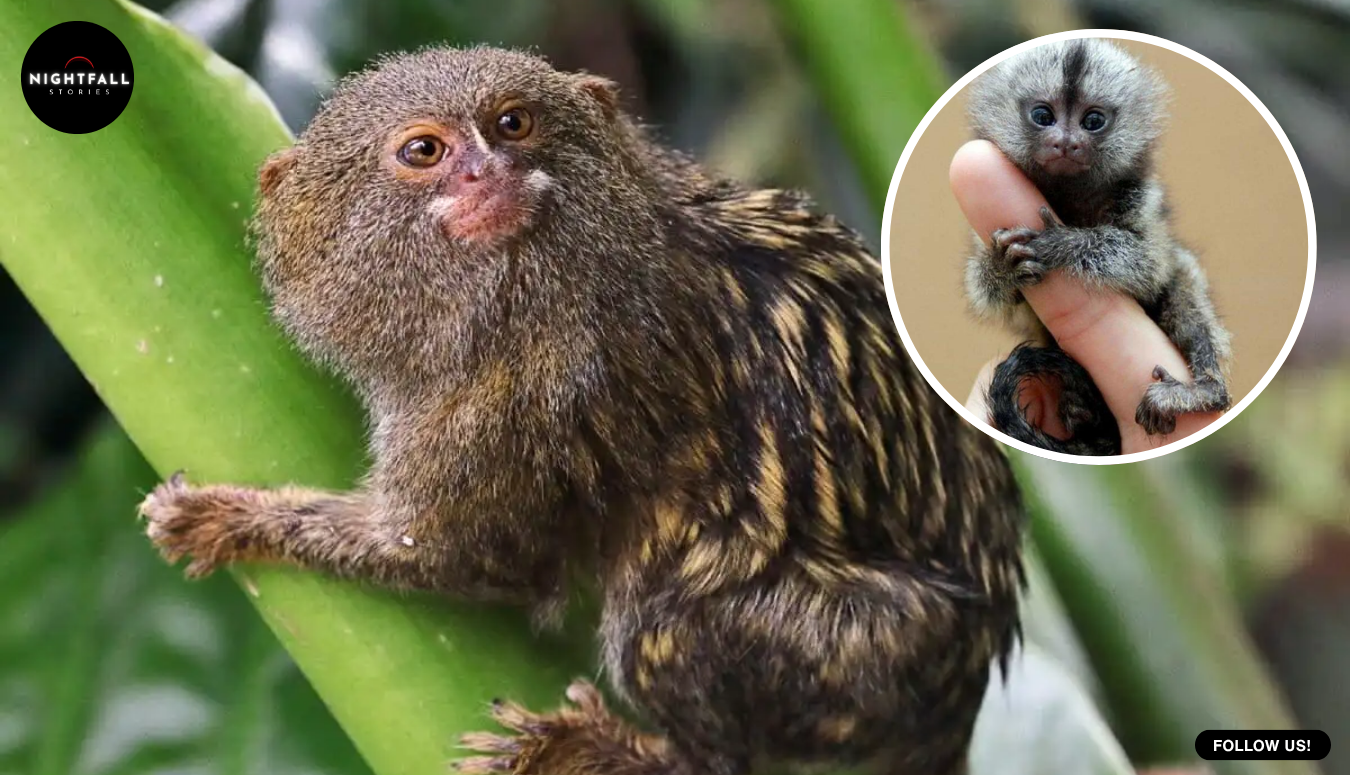
    There is a monkey in the western Amazon that weighs about as much as a small apple. Adults are somewhere around a hundred grams, maybe a bit more depending on whose measurements you trust, with a body barely longer than your palm and a tail longer than the body. They live in the tangled middle layers of riverside forest, they gouge holes in bark with specialised front teeth and drink the gum that seeps out, and they can flatten themselves against a trunk and simply stop existing as far as your eyes are concerned. They are called pygmy marmosets, and they are the smallest monkeys on Earth.

    A team in the Ecuadorian Amazon recently went looking for them using sound instead of sight. They put passive acoustic recorders out through the forest around a Siekopai community called Siekoya Remolino, in territory where people have lived and hunted and watched animals for generations and where elders could point to the places these monkeys used to be. The recorders ran. The audio came back. Nobody has confirmed a single pygmy marmoset call in it.

    That is the result. And the interesting thing about it, the thing worth spending a few minutes on, is that it does not mean what most people’s instinct says it means.

    Start with why sound was the plan at all. If you are trying to survey an animal the size of a pygmy marmoset in dense Amazonian forest, your eyes are close to useless. The animals are tiny, cryptic, mottled in exactly the colours of bark and lichen, and they specialise in not moving. Camera traps are set up for creatures that walk past at knee height on a trail, which is not what a marmoset does. You could put ten skilled observers in that forest for a month and come out with almost nothing, and you would not know whether that meant the monkeys were gone or that you were bad at finding them.

    Sound, in principle, solves that. Pygmy marmosets are noisy for their size. They have a layered vocal repertoire that changes with distance: short trills used when the group is tight together and feeding, a rapid repeated call for medium range contact, and a long call for when individuals get properly separated. If you can pick those calls out of a recording, you have a detection without ever having seen an animal. Better still, a recorder does not get bored, does not scare anything away, and runs for weeks in a place where a human observer would last an afternoon.

    It helps to know how these monkeys actually live, because it explains why finding them is so hard. A group is usually somewhere between two and nine animals, most often about six, built around a breeding pair and their offspring from several successive litters, which typically arrive as twins and get carried and fed by the whole group rather than just the mother. That group does not roam. It anchors itself to a small number of gum trees, the ones it has spent weeks carving holes into, and it works that patch over and over. The holes keep producing as long as they are reopened, so a pygmy marmoset family can occupy a territory you could walk across in a couple of minutes and stay there for a long time. They also lick up insects that come to the sap, which is a nice piece of economy.

    All of that means the animals are not spread evenly across a forest. They are in clumps, tied to particular trees, and the space between clumps can be entirely empty. A recorder hung a short distance away from one of those clusters may as well be hung in a different country.

    So the team, working with the conservation technology outfit Neblina Labs and with the community, combined three things that do not normally get combined. They had the acoustic recorders. They had the community’s own territorial monitoring work, including camera traps already out in the forest. And they had something harder to buy: a map built from what people remembered. Where the marmosets had been seen. Which stretches of riverbank used to have them. Where they had stopped turning up.

    The researcher leading the work, Nicolás Schuldt Durán, has described these animals as extremely sensitive to disturbance, and that observation did not come from a paper. It came from the people living there, who say the monkeys become scarce when the forest around them is degraded. That is the reason anyone is chasing this species with microphones in the first place. If they really do disappear early, before the bigger and more obvious wildlife does, then their presence or absence is a readout on how intact a forest actually is. A living gauge, rather than a satellite image that tells you the canopy is still standing while everything underneath it quietly empties out.

    Then the pilot returned no confirmed detections, and this is where you have to be careful, because there are two very different sentences available and only one of them is true.

    The false one is: the pygmy marmosets are gone from that forest.

    The true one is: in this deployment, over this period, in these locations, with these detection methods, nobody confirmed a pygmy marmoset call.

    The gap between those is enormous, and it is not a technicality. It is the central problem in all wildlife survey work, and it has a name. If you detect an animal, you know it was there. Presence is close to proof, assuming you identified the sound correctly. But a non-detection is compatible with a long list of scenarios, and only one of them is that the animal is absent.

    Consider what else could produce silence. The recorders might have been in the wrong places, a few hundred metres off from where a group actually lives, which in a species with a home range this small is easy to do. The animals might have been present and simply quiet during the recording window, because vocal activity in primates swings with the time of day, the season, group size, whether a group is feeding or resting, and whether there is anything worth calling about. The calls might be in the recordings and not yet found, because a pilot project is often building its detection model at the same time as it collects the data, and an automated classifier that has not been trained on enough verified examples of a call will happily miss every instance of it. The calls might sit at frequencies awkward for the equipment, since marmoset vocalisations run very high and have reportedly been described as reaching toward the top of what people can hear. Rain, insects and river noise can bury a faint high call entirely. And the survey might have simply been too short, which is the most likely explanation of all for an animal that occurs at low density in patchy habitat.

    Statisticians who work on this have a whole framework for it, built on the idea that detection probability is always less than one and you have to estimate it rather than assume it. The practical consequence is straightforward: you cannot get to absence from one round of surveying. You get to absence, or rather to a defensible probability of absence, by repeating the survey in the same places enough times that you can separate “not there” from “there and not heard.” One deployment cannot do that. It was never going to.

    Which means the honest reading of this pilot is that it is inconclusive about the monkeys, and genuinely useful about almost everything else.

    Because the recorders did not come back empty. They came back loaded with the sound of a functioning Amazonian forest, which is a dataset with a long shelf life. Birds, frogs, insects, other primates, the whole layered racket that a rainforest produces around the clock. That material can be mined for years, and it can be re-searched later with better models, which is a thing you cannot do with a field notebook. If somebody trains a reliable pygmy marmoset classifier two years from now, they can run it back over this audio and find out whether the calls were in there the whole time.

    The pilot also produced the classifiers themselves, or the beginnings of them, plus a set of decisions about where to put the equipment next and how long to leave it there. The team’s stated plan is longer deployments, placement guided by the community’s mapping of where the monkeys historically were, and a wider set of biodiversity indicators alongside the marmoset rather than instead of it. In other words, a search that found nothing produced the method for the search that might. That is not a consolation prize. In field ecology that is more or less how the first season is supposed to go.

    It is also worth understanding the physical scale of what these projects generate, because it shapes what can go wrong. An acoustic unit left in a forest is running on batteries and writing to memory cards, so it almost never records continuously. It records on a schedule, a few minutes on and a few minutes off, or a set block at dawn and another at dusk, and every gap in that schedule is a gap where a call could have happened unheard. What comes back is still an enormous amount of audio, far more than any person could listen to, which is why the automated classifier is not a luxury but the only way through. And a classifier is only as good as the verified examples it was trained on. For a well studied bird you can find thousands of labelled recordings. For the calls of the smallest monkey in the world, in one specific corner of Ecuador, you may be starting close to scratch.

    There is also something quietly important about who is doing the looking. The Siekopai are not a large nation. There are something like seven hundred in Ecuador and perhaps a thousand or so in total counting those on the Peruvian side of the border. They were forced out of a core part of their ancestral territory, a wetland region they call Pë’këya, during a border war in the 1940s, and they spent generations trying to get back. A few years ago a provincial court in Ecuador ruled in their favour and ordered that ownership of more than forty two thousand hectares there be recognised, the first time the country had granted Indigenous land title inside a protected area. It was treated, correctly, as a landmark.

    It has also not been simple. Reporting since then has described the title itself as still undelivered, with deadlines missed, a judge threatening penalties, and a competing claim from another community complicating everything. Mediation has been discussed. A legal victory and a resolved situation turn out not to be the same thing.

    Set that beside the marmoset survey and you can see why it matters that the two are connected. A community fighting to hold territory benefits enormously from being able to say, with evidence, what lives in it and what condition it is in. Conservation technology companies talk about this in the language of measurement and verification, of being able to demonstrate ecological impact with the kind of evidence that funders and courts take seriously. Underneath the jargon is something simpler. If you can prove the forest is alive, you have an argument. If all you have is the assertion that it is alive, you have a weaker one.

    And the people who live there were never going to be just the local guides on this. The map of where the marmosets used to be is not background colour; it is the sampling design. Without it, you would be scattering recorders across a large forest more or less at random, and your chance of landing near a group of hundred gram monkeys with small home ranges would be close to nothing. Generations of observation is what turns an impossible search area into a shortlist.

    It is worth saying plainly what nobody yet knows. It is not established that pygmy marmosets have declined at this site. They are listed as vulnerable globally, and the pressures on them are well documented: habitat loss as riverside forest is cleared, and capture for the pet trade, which this species suffers from precisely because it is small and appealing and easy to imagine in a cage. But global status is not local status, and the community’s impression that there are fewer than there used to be is exactly the kind of observation that a survey is meant to test rather than confirm. It might turn out to be right. It might turn out that the monkeys are there in reasonable numbers and were missed. Both outcomes are still live.

    What you can say is that somebody is now set up to find out, which was not true before. The equipment is proven in that environment. The community mapping exists. The processing pipeline exists. There is a baseline recording of the whole soundscape to compare future years against. And crucially, everyone involved has been open about the fact that the first pass found nothing, rather than quietly reframing a null result as a preliminary finding or letting it disappear.

    That openness is rarer than it should be. There is a strong pull in conservation work, as in science generally, toward announcing what was found and staying quiet about what was not, because funding follows discoveries. A team saying, in public, that they listened hard and heard nothing, and that this does not yet prove anything either way, is doing the unglamorous thing correctly.

    So the story does not end with a monkey. It ends with an open question and a much better way of asking it. Somewhere in that stretch of Amazon, there may be small groups of the smallest monkeys in the world moving slowly up trunks, gouging holes in bark, trilling to each other at frequencies at the edge of human hearing, and not one of them has said anything into a microphone yet.

    The recorders are going back out, for longer this time, in places chosen by people who know where to look. If the monkeys are there, sooner or later somebody is going to hear them.
  • Fifty animals, one forest, and a volcano fifty kilometres away

    Fifty animals, one forest, and a volcano fifty kilometres away

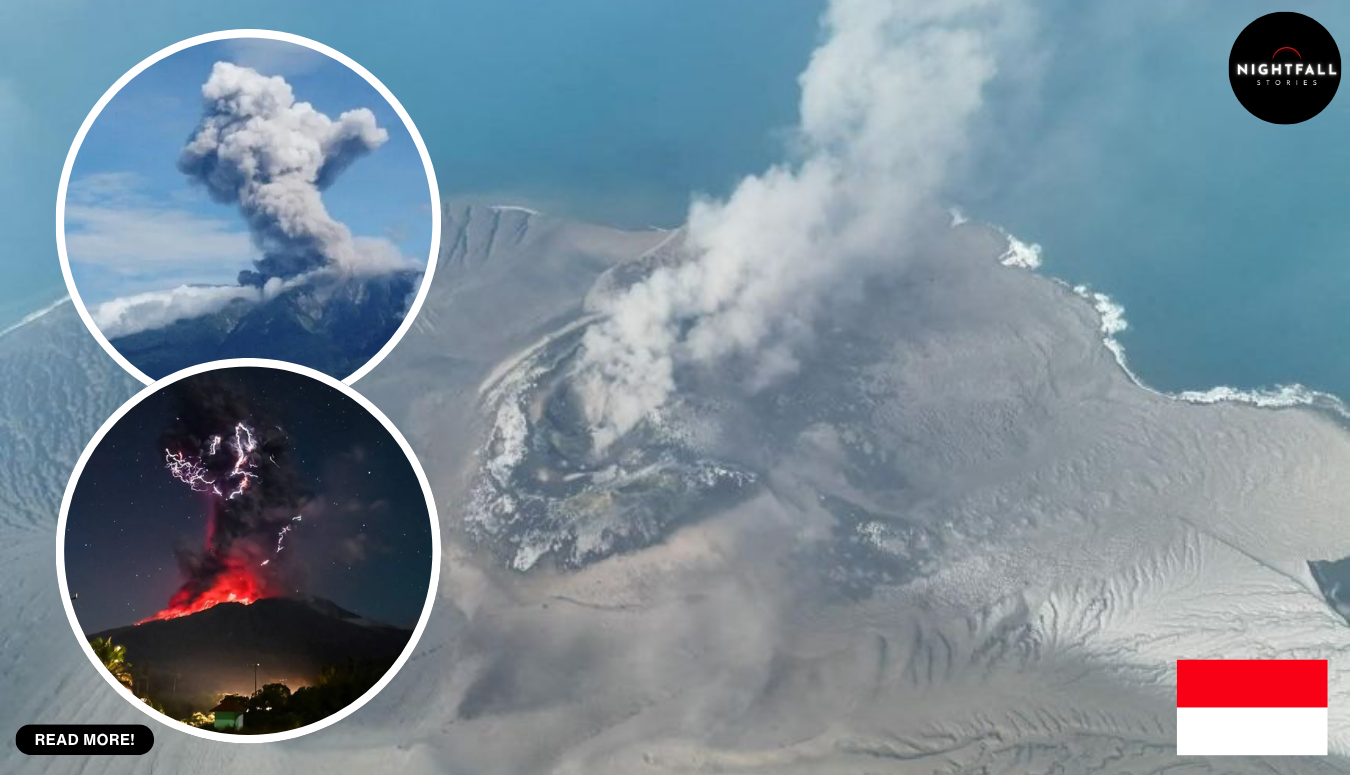
    When Anak Krakatau started throwing ash into the sky again this month, the first calls that went out in Indonesia were about airports and ferry routes and whether Jakarta could keep flying. Nearly three thousand flights were disrupted. Ash drifted across five provinces. The country’s volcanology agency pushed the alert to the second highest of its four levels and drew a three kilometre ring around the crater that nobody is allowed to cross.

    But there was a second set of phone calls happening at the same time, quieter, and about something much smaller than an airport. Roughly fifty kilometres from that crater, across a stretch of open water, sits a peninsula of lowland forest and swamp called Ujung Kulon. Every wild Javan rhinoceros left alive on the planet lives there. Not most of them. All of them. One park, one population, one very bad day away from a species ending.

    So while the ash was still falling, park staff went out to check on the animals, and the answer came back reassuring. Ardi Andono, who runs Ujung Kulon National Park, said the rhinos were unharmed. Riszki Is Hardianto, a wildlife researcher at the Indonesian watchdog group Auriga Nusantara, said no rhino deaths had been reported either. The volcano had not touched them.

    That is the good news, and it is real, and it is also where the story gets complicated, because the harder question is not whether the rhinos survived the eruption. It is how many rhinos there were to survive it in the first place. And on that, the people who watch this species most closely do not agree at all.

    The Indonesian forestry ministry’s figure sits in the range of eighty seven to a hundred animals. Save the Rhino International, one of the conservation organisations that has worked on this species for decades, puts the number at around fifty. Those are not two slightly different estimates of the same thing. That is a gap big enough to swallow the entire species twice over, and it exists because of an argument about what counts as a rhino you can count.

    Here is the part that stays with you. In a report published a few years ago, Auriga Nusantara went through the official population tally and found something strange in the arithmetic. Eighteen animals in the official count, nine males and nine females, had not been photographed alive by a camera trap in years. They were still on the list. The system was built so that once an animal had been recorded, it stayed recorded until somebody produced proof that it had died. No body, no deletion. Of those eighteen, the report said, three were in fact already confirmed dead, a female some years earlier and a male and a female after that, and none of those deaths had been publicly announced, even though new calves were being announced regularly.

    Sit with the shape of that for a second. It is not fraud in the dramatic sense. It is something more ordinary and in some ways more worrying: a counting rule that only ever pushes the number up. Births get added. Deaths get added only when somebody stumbles across a carcass in a rainforest that swallows things whole. Under that rule, a population can look like it is slowly growing at exactly the moment it is quietly shrinking.

    The environment ministry did not dismiss the finding outright. It acknowledged at the time that fifteen rhinos had no recent camera trap sightings, and it acknowledged indications of poaching in an internal circular. What it did not do was open the underlying data for outside scrutiny, which is how you end up with two numbers in public and no way for anyone outside the system to reconcile them.

    Then came the part that turned an accounting dispute into something much darker. Police investigating a wildlife trafficking network reported that poachers had claimed responsibility for killing twenty six Javan rhinos over a period of several years. If that claim is anywhere near accurate, it accounts for something close to a third of everything the official count said was out there. Six suspects were arrested. Others were still being sought, including at least one person who appeared to have access to information about where rhinos had recently been recorded, which is not a detail you want in a story about a park with a single population of anything. A collector who had paid roughly thirty thousand dollars for horns was picked up. One convicted poacher received twelve years, reportedly among the heaviest sentences Indonesia has handed down for a wildlife crime.

    For thirty years before that, Ujung Kulon had reported essentially no poaching. It had been held up as the one place where this had been solved. The rhinos were behind a wall of remoteness and patrols and the simple fact that almost nobody knew how to find them. Then somebody did.

    This is why the volcano matters even though the volcano did no harm. Anak Krakatau is not a hypothetical. It is the child of the 1883 eruption, a new cone that pushed itself permanently above the waterline in 1930 and grew for most of a century. Then one night, a chunk of its own flank slid into the sea. The tsunami that followed killed more than four hundred people along the coasts of the Sunda Strait and injured many thousands more. The volcano lost around two thirds of its own volume in the process, dropping from well over three hundred metres to barely a hundred. It has been rebuilding ever since, and it now stands somewhere around a hundred and fifty metres again.

    Nobody planned for that. The warning systems of the time were built to detect tsunamis generated by earthquakes, and a mountain collapsing sideways into the water does not announce itself with a seismic signature anyone was watching for. The wave arrived at coastal towns with no siren in front of it.

    Those same coasts include the shoreline of the peninsula where the rhinos live. And rhinos, for all their armour plating, are large animals in low, flat, coastal forest. Modelling of tsunami hazard for the park has been done and published. The scenarios are not comforting. You do not need the whole population to be swept away for it to be over, because a species this small does not have the numbers to absorb a bad year.

    Which brings us to the one decision that would fix this, and to a rhino called Musofa.

    The logic is obvious to anyone who has ever been told not to keep all their savings in one account. If every individual of a species lives in one place, then anything that can happen to that place can happen to the species. Disease. A tsunami. A fire. A shift in vegetation. So for years the plan has been to establish a second, managed group, somewhere those animals can be watched, treated, bred and protected without every risk being shared by every animal at once.

    Late last year, for the first time in the history of Javan rhino conservation, they tried to move one.

    Musofa was a male. He walked into a pit trap on a Monday evening. Two days later he was inside the Javan Rhino Study and Conservation Area, a managed and fenced site, where teams planned to monitor him intensively and, eventually, to support breeding. It was framed as a step toward stabilising the population and giving the species a more structured future.

    He died two days after that.

    The necropsy told a story nobody had known while he was out in the forest. Musofa had chronic disease affecting his stomach, his intestines and his brain, along with a heavy parasitic burden and extensive degeneration in his organs. He also carried old wounds from fights with other rhinos, though those were not identified as what killed him. He had, by the look of it, been a sick animal for a long time. The forest had simply never told anyone.

    It is worth being careful about what that death does and does not prove. It does not prove that translocation kills Javan rhinos. One animal is not a trial. What it does show, brutally, is how little anyone can know about the health of individuals in a population that is monitored almost entirely through motion triggered cameras in dense vegetation. A camera trap can tell you an animal was alive at a moment. It cannot tell you that the animal has parasites in its brain.

    And there is a correction worth making here, because the story has often been told as though moving Musofa was the attempt to give the species a second home. It was not, quite. The site he was moved to sits within the same national park. It is a fenced and managed area inside the existing range, not a separate landscape somewhere else on the island. It is a step toward the eventual goal rather than the goal itself. The single habitat problem that the eruption highlighted is still, at this moment, unsolved. All of the rhinos are still in one forest.

    The forest itself has its own slow problem. An invasive palm called arenga has been spreading through parts of the park for years, growing thick and shading out the low plants that rhinos actually eat. Conservation teams have spent enormous effort cutting it back. It is the kind of threat that does not make headlines because nothing dramatic happens on any given day. The habitat just gets a little less edible, year over year.

    There is also a problem that no amount of patrolling fixes, and it is written into the animals themselves. Geneticists looking at this species have suggested that something on the order of a hundred individuals would be needed simply to hold on to the genetic diversity that is left. If the true figure is closer to fifty, the population is already below the line where diversity can be maintained, which means that even a group that stops being killed and stops being crowded out of its food can keep losing something. Inbreeding does not announce itself. It shows up decades later as calves that do not thrive and immune systems that cannot handle a pathogen the population has never met.

    That is the quiet reason the second site matters so much more than it sounds like it should. It is not only about spreading the risk of a wave or a disease outbreak. It is about creating a situation where animals can be seen, weighed, treated and paired deliberately, rather than hoped about from a distance. Musofa is the argument for it and the warning about it at the same time.

    Everything anyone knows about these rhinos comes through cameras strapped to trees in humid forest, triggered by movement, producing frames that then have to be matched to individuals by the shape of skin folds and horn and scars. It works remarkably well for a species that will not tolerate being followed. It also means the data is a series of glimpses, and every conclusion drawn from it is a conclusion about glimpses. When a rhino stops appearing, there are two possible explanations, and only one of them is that the camera missed him.

    There is a version of this species’ history that makes all of it feel inevitable. Javan rhinos once ranged across a huge sweep of Asia. There was a mainland population too, in Vietnam, hanging on in a national park, and for a while it looked like it might survive. Genetic work eventually established that the group had dwindled to a single animal. That animal was found dead, shot, its horn taken. The mainland subspecies was declared gone. That is what the end actually looks like: not a bang, but a slow narrowing until there is one, and then none.

    So what is different this time, and is anything?

    A few things, honestly. The camera trap network has recorded calves in recent years, which means animals are still breeding in the wild without any help. Patrols were stepped up sharply after the poaching case broke. The prosecution that followed carried real prison time, which matters in a business where the calculation has usually been that the penalty is survivable. Independent groups like Auriga are now auditing the official numbers in public, which is uncomfortable for everyone involved and is also probably the single most useful thing happening, because a conservation programme that cannot count its animals cannot know whether it is working.

    And the response to the eruption was, in its own way, a good sign. The volcano flared, and within days there were people in the field checking on fifty or eighty or a hundred animals, and two separate organisations, one government and one independent watchdog, both said the same thing in public: no rhino deaths. Those two groups disagree profoundly about the population. They did not disagree about this.

    The rhinos, for what it is worth, would have felt the eruption as sound and grit and a change in the light. They are not animals that panic easily. They are solitary, mud loving, thick skinned browsers that spend their lives moving quietly through dense cover, and they have been doing it in that peninsula since long before anyone was counting them.

    The ash has mostly settled. Anak Krakatau is still on alert, still ejecting material in bursts, still watched constantly by instruments that did not exist the last time it did something catastrophic. Officials have been urging people to ignore the rumours circulating about imminent tsunamis and to follow the official channels instead, which tells you something about how raw the memory still is along that coast.

    Somewhere on the other side of that water, in a forest with an invasive palm problem and a poaching problem and a counting problem, there are perhaps fifty rhinos, or perhaps a hundred, and nobody can tell you with confidence which. They survived the volcano. The thing they have not survived yet is the fact that there is only one place left where they can be.

  • You cannot see these fires from the road.

    You cannot see these fires from the road.

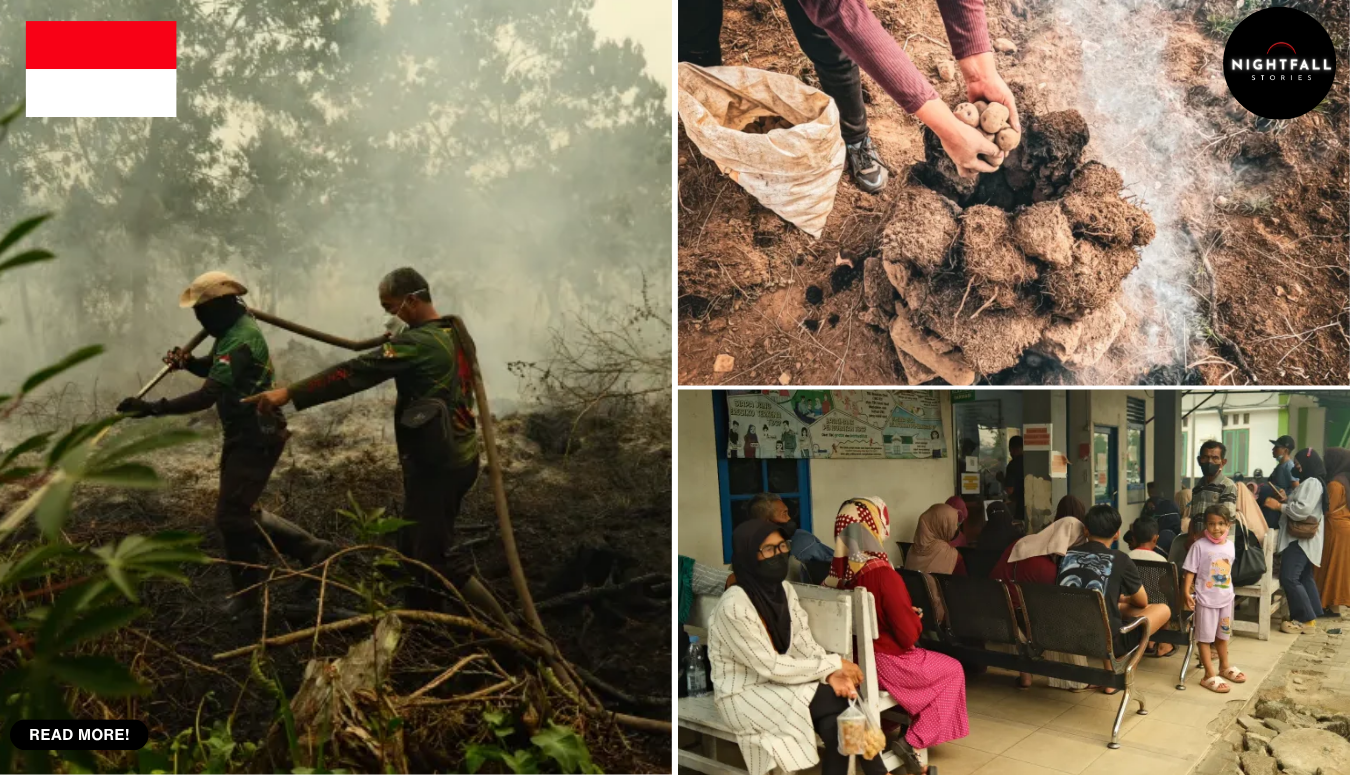
    The fires making the news in Indonesia right now are the ones you can photograph. Orange light in the trees, helicopters with water buckets slung underneath, firefighters in yellow standing in a field of black stumps. Those are real, and they are bad, and they are not the ones that scientists are most worried about.

    The worst fires there are underground. They burn down through metres of dried-out peat, moving slowly sideways through the soil like a cigarette working its way along a mattress, and they put out almost no flame at all. You can stand on ground that is on fire. You can drive past a landscape that is burning and see nothing except haze. Satellites built specifically to spot fire from orbit look down at these and, a lot of the time, register nothing, because they are trained to find heat at the surface and a peat fire does not give them a hot spot to find.

    And once one starts, there is more or less no putting it out. Water goes onto the surface and the fire is not at the surface. Firebreaks stop a fire that travels above the ground and this one is travelling below it. The practical answer, the one the people who study this give without much softening, is that it burns until the rains come.

    Right now the rains are not coming, and that is the whole crisis in one sentence.

    A strong El Nino has settled over the Pacific, and it has been joined by a positive phase of the Indian Ocean Dipole, which is the equivalent weather pattern in the ocean to Indonesia’s west. Those two things together do something very specific to the region: they make the dry season drier and longer. Robert Field, a researcher at Columbia University who built the Global Fire Weather Database, has described the current fire activity as tracking sharply upward in a way that looks a lot like 2015, and has pointed at the El Nino as the reason the dry season is biting harder than usual.

    In early August, roughly ninety percent of the country got little or no rain at all. On one day at the end of that month, satellites logged nearly a thousand active hotspots. By the first days of September, only about three weeks into the fire season, the fires had already released something in the region of ten percent of the total greenhouse gas emissions that came out of the entire catastrophic 2015 season. Three weeks in. Ten percent of a full disaster.

    To understand why this particular kind of fire is so much worse than a normal forest fire, you have to know what peat actually is. It is not soil. It is thousands of years of dead plants that fell into waterlogged ground and never fully rotted, because the water kept the oxygen out. Layer on layer on layer, stacked up over millennia, in some places many metres deep. It is, functionally, an enormous underground store of carbon that has been sitting safely underwater since before recorded history.

    Wet peat does not burn. Dry peat burns extremely well. It is essentially fuel, and it has been accumulating for a very long time.

    Indonesia holds about thirty-six percent of the world’s tropical peatlands, concentrated across Kalimantan, Sumatra and Papua. That number alone tells you why what happens there is not a local story.

    The thing that turns a safe carbon store into a fuel store is drainage. Through the 1990s, huge areas of peat swamp were cut through with canals to drain the water off, initially in an effort to convert the land to rice growing, later to make room for oil palm and other plantations. The rice project failed. The canals stayed. A drained peatland is a peatland with its fire protection removed, and in a dry year it becomes something you could not design better if you were trying to build a fire that cannot be extinguished.

    So when a fire is lit at the surface, and most of them are lit deliberately as the cheapest way to clear land, it does not stay at the surface. It goes down.

    It is worth being precise about why land gets burned, because the lazy version of this story blames whoever is holding the match and stops there. Fire is used to clear land because it is close to free. Machinery is not free. Labour is not free. Burning off a field costs a box of matches and an afternoon, and it also leaves behind ash that acts as fertiliser. That calculation is the same for a family with two hectares and for a company with twenty thousand, and it has been the same for a very long time. What changed was not the tool. What changed was the ground underneath it, when drainage turned wetland into something that catches.

    The physics of what happens next has its own name. Smouldering combustion is fire without flame: a slow, oxygen-starved reaction that creeps through porous fuel at relatively low temperature and sustains itself for as long as there is dry material to work through. It is the same process that keeps a lit cigarette going in an ashtray with nobody drawing on it. Scale that up to a carbon deposit several metres deep and hundreds of square kilometres wide and you have a fire that can run for months, drop below the reach of anything poured on top of it, travel under a road and come up on the other side, and produce vastly more smoke per unit of fuel than open flame does, because incomplete burning is exactly what makes smoke.

    That is where the measurement problem comes in, and the measurement problem is not a technicality. It is arguably the heart of the story.

    Fire detection from space works by looking for thermal anomalies, patches of ground that are much hotter than they should be. The instruments doing that work over Indonesia include MODIS, on NASA’s Aqua satellite, and VIIRS, on newer platforms. Both are very good at what they were built to do. Neither was built for this. A smouldering peat fire under an intact forest canopy can be hot enough to be destroying an ancient carbon store and cool enough at the surface, and hidden enough beneath leaves, that the sensor passes over without flagging it.

    Then there is the second layer of the problem, which is almost perverse. Mark Cochrane, an ecologist at the University of Maryland Center for Environmental Science, has made the point that the very worst smoke events are the hardest ones to see from orbit. The smoke is thick enough to block the satellite’s view of the fires producing it. The situation gets worse, and the data gets thinner, at exactly the same time.

    Sit with that for a second. The official numbers, the hotspot counts, the burned-area figures, the emissions estimates, are all downstream of instruments that systematically lose sensitivity as conditions deteriorate. Which means the official numbers are close to certain to be an undercount, and the undercount is worst in the worst moments.

    Shi Jun Wee, a graduate student at the University of Maryland, is working on the fix. Together with NASA and the MapBiomas mapping initiative, the project is building detection algorithms aimed specifically at fires burning under canopy, the ones the standard method misses. It is a good example of how unglamorous a lot of climate work actually is. No dramatic rescue, no new machine. Somebody sitting with satellite data trying to teach software to find a fire that does not look like a fire.

    The reason it matters is that you cannot manage what you cannot count. A government cannot send crews to a fire it does not know exists. An emissions inventory that misses the underground component gives a country a cleaner-looking ledger than reality supports. And a peat fire that nobody has logged is one that gets to keep burning down through a carbon store for weeks without anybody deciding whether to intervene.

    The emissions difference is not marginal. Compared with other tropical forest fires, peat fires have been found to produce roughly three times as much fine particulate matter, five times as much sulphur dioxide, three times as much organic carbon and about twice as much methane and carbon monoxide. Everything bad about smoke, multiplied.

    Fine particulate matter is the number that reaches into people’s lungs. These are particles small enough to pass through the body’s filters and into the bloodstream, and they are the reason a peat fire hundreds of kilometres away is a medical problem rather than an inconvenience.

    Across Sumatra, Kalimantan, Sulawesi, Java and Papua, that is what has been happening. The Indonesian health ministry has reported that around 3.4 million people are at risk of respiratory infection. Clinics in affected areas have described handling fifty to seventy patients a day with persistent coughs and raw throats. Pregnant women and young children are the groups flagged as most vulnerable, which is the usual and grim pattern with air pollution, because small bodies process more air relative to their size and developing lungs do not recover from insult as reliably as adult ones.

    Millions of schoolchildren have been pushed onto remote learning. Nine national parks have closed. Flights have been delayed. In West Kalimantan, which has had some of the worst of it, residents have described conditions unlike anything in their living memory, with fire reaching the edges of everything they had.

    The domestic detail that has stuck with people is the ash. One mother in an affected area described sweeping every single day and the ash simply returning, and her children being ill on and off for a month straight. That is what a peat fire season is at ground level. Not a wall of flame. A grey film on every surface, over and over, and a child who does not get better.

    The volunteers fighting it have been open about the conditions. One described the situation as very serious and listed the problems plainly: not enough water, visibility ruined by haze, and shortages of the protective equipment and basic supplies crews need to work in smoke all day. The national government has moved, deploying dozens of helicopters and aircraft, water pumps and thousands of personnel, and distributing more than 260,000 face masks. A mask is a reasonable thing to hand someone. It is also an admission that the air itself is now the hazard and that nobody can switch it off.

    The haze has not stayed inside the country’s borders, either. It has drifted across the region, which is what has made Indonesian fire seasons a recurring diplomatic problem for decades rather than a domestic one.

    All of this has happened before, which is the part that makes 2026 feel less like an accident and more like a test.

    1997 was catastrophic. 2015 was catastrophic. The 2015 season released around 1.75 billion tonnes of greenhouse gas equivalents and did an estimated 16.1 billion dollars of economic damage. A study by researchers at Harvard and Columbia estimated that the haze from that season was linked to roughly 100,300 premature deaths across the region, a figure that regional governments disputed at the time and which remains a modelled estimate rather than a body count, but which gives a sense of the scale at stake when the air over a populated region becomes unbreathable for weeks.

    After 2015, Indonesia did act. There was a serious push into peatland restoration, and the centrepiece of it was blocking the canals, which is exactly the right instinct: if drainage is what made the peat flammable, then rewetting it is what makes it safe again. There was work on wetland restoration, on building firefighting capacity, and on preventing accidental ignitions. Some of it demonstrably worked. Peat restoration has been shown to reduce fire risk where it has been carried out properly.

    The trouble is the scale of what had to be undone. Decades of canals cut across an area the size of a small country cannot be reversed in a decade, and rewetting peat is slow, expensive, politically awkward work that runs directly against the interests of whoever is farming the drained land. In the first half of 2026, before the season even properly started, around 100,000 hectares burned, and roughly half of that was peatland. That is the reform’s report card, and it is a mixed one. The system is better than it was. It is not better enough for an El Nino.

    There is one more thing about peat fires that makes them different from almost every other disaster in the news, and it is the timescale.

    When a normal forest burns, the carbon released came out of the atmosphere over the lifetime of those trees, decades, maybe a century or two, and the forest can pull some of it back in as it regrows. When peat burns, the carbon coming out went into the ground over thousands of years. It cannot be put back on any timescale that means anything to a person alive today. Peat accumulates at something on the order of a millimetre a year. A fire can take a metre of it in a season.

    That is not damage. That is deletion.

    So what happens next is, uncomfortably, out of anybody’s hands in the short term. The fires below the surface will keep going until the wet season arrives in force and the water table comes back up, and then most of them will stop, and the smoke will clear, and the flights will resume, and the children will go back to classrooms. The headlines will end. The canals will still be there.

    The longer game is the one being played by people like Wee, sitting with satellite data trying to teach an algorithm to see a fire that gives off no visible flame, and by the restoration crews damming canals one at a time, and by the researchers who keep making the same point to anyone who will listen: the ground itself is the problem, and until the water goes back into it, every strong El Nino is going to do this again.

    Somewhere under a stand of trees in Borneo right now there is ground that looks completely ordinary. No smoke, no light, nothing to photograph. A metre down, something laid there before any of this was a country is quietly going up, and it has been doing that for weeks, and nobody has written it down.

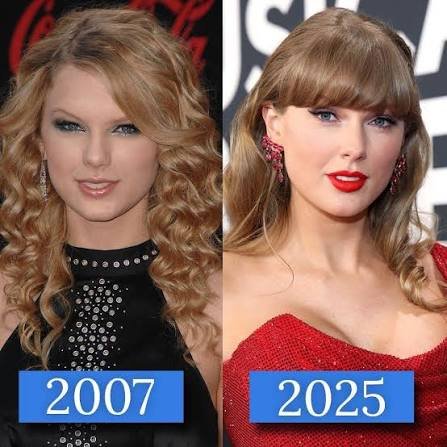
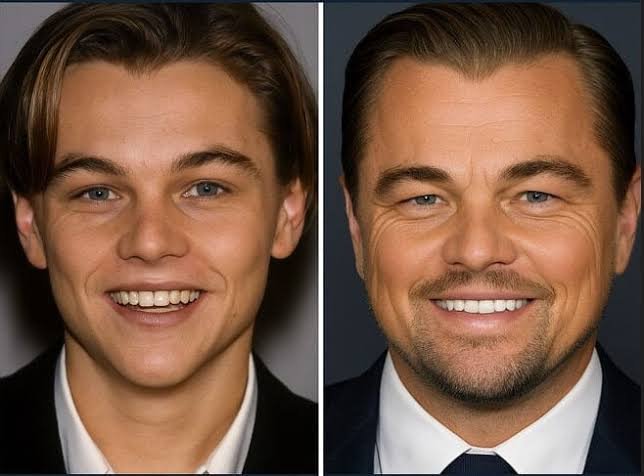
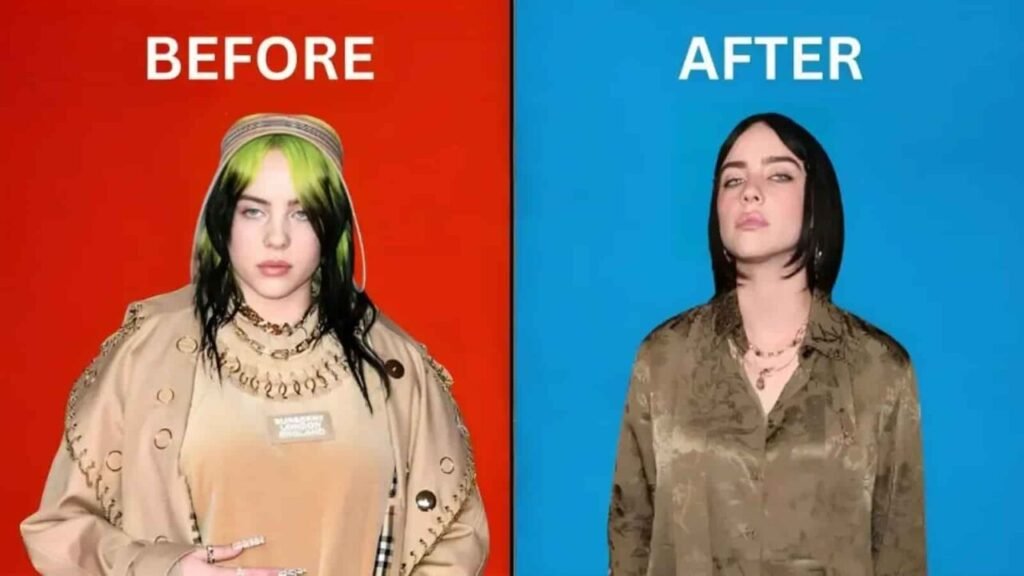
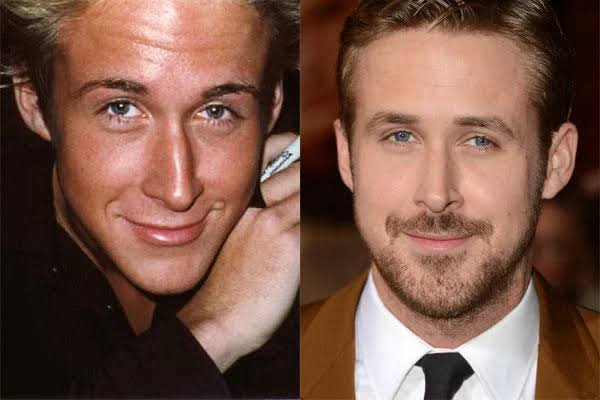
  • Celebrities who looked completely different at the start of their careers

    Celebrities who looked completely different at the start of their careers

  • The rock star got a message from a museum. It was not about music.

    The rock star got a message from a museum. It was not about music.

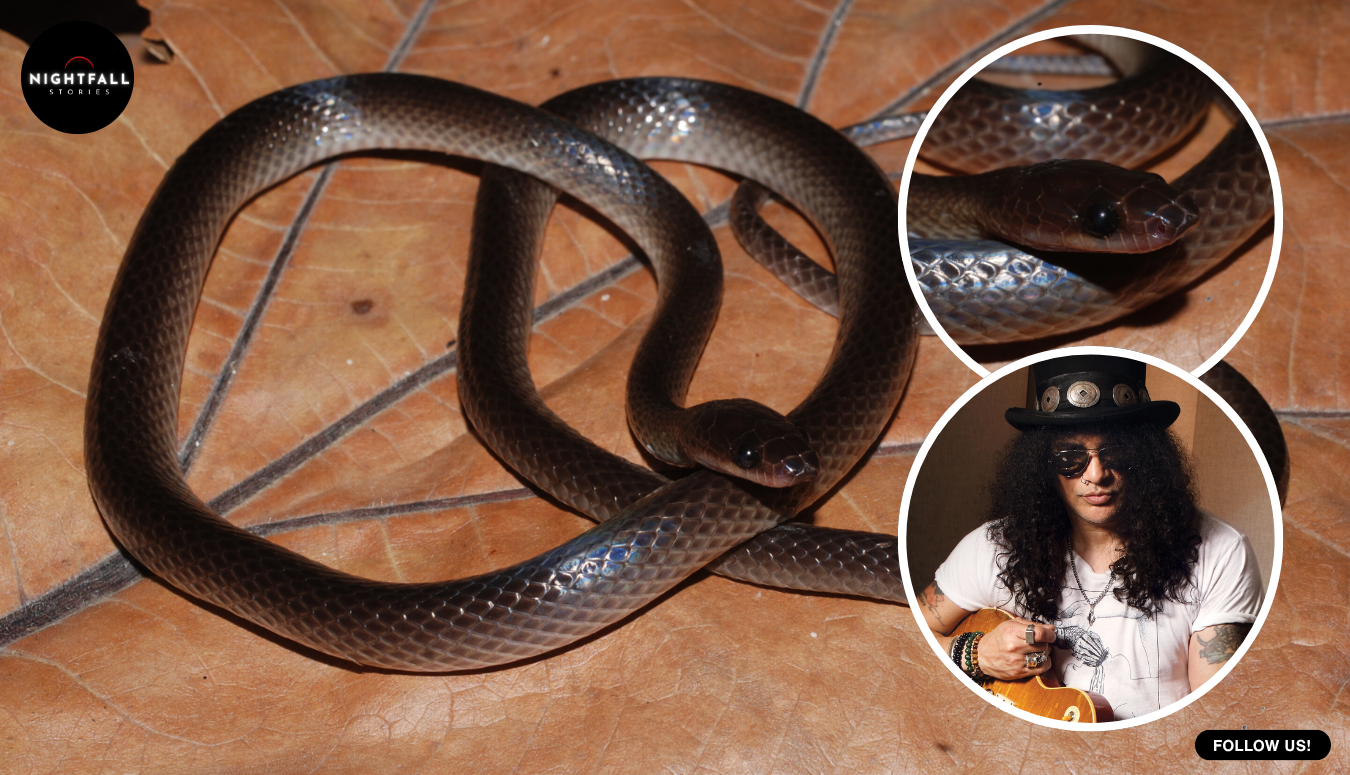
    Somewhere in the collections of a natural history museum in Chicago there is a snake in a jar, about the length of your forearm and then some, reddish-brown all over, with no stripes or bands or blotches to make it interesting. It is not venomous. It is not enormous. It is the sort of animal that a person could step over in the dark without ever knowing it was there. And for twenty years, nobody knew what it was.

    It has a name now. The name is Lielaphis slashi, and it belongs to the top-hatted guitarist from Guns N’ Roses, who has kept snakes since he was eleven years old and who turned up at the museum in person to meet the animal that now carries his name.

    That is the short version, and it is a good story on its own. The longer version is better, because it is about what actually happens to a small brown snake between the moment somebody picks it up in a forest at night and the moment it gets a name, and about why that gap was two decades long, and about a scientist who kept a magazine from her childhood on a shelf for thirty years without ever imagining what it would eventually be good for.

    Start with the forest. In 2006, a herpetologist named Chris Austin was doing night fieldwork in Sandaun Province, in the northwestern lowlands of Papua New Guinea. Austin is a curator at the Louisiana State University Museum of Natural Science, and looking for snakes after dark in New Guinea is a very specific kind of work. Groundsnakes there tend to sit at the base of big trees once the sun goes down, which means you walk with a torch, slowly, checking tree roots, in a country that also happens to hold some of the most seriously venomous snakes on the planet. Austin has said the nocturnal ones are especially hard to find, which is a mild way of describing a job where the animal you want is small, brown and hidden and the animal you do not want is also out there.

    There is a detail in the fieldwork photographs that makes the whole enterprise feel less abstract. Austin is standing in the field with colleagues from the Papua New Guinea National Museum and Art Gallery, in ordinary clothes, in ordinary bush, in a place that does not look remotely like a laboratory. This is what the front end of taxonomy actually is. Somebody walks around at night for weeks, finds a few dozen animals, and ships them home with catalogue numbers attached, and then the interesting part happens years later in a building thousands of miles away.

    He found this one in secondary forest. It looked like a groundsnake. It went into a jar, into a collection, into a catalogue, filed under a species that had already been described. That is not carelessness. It is the correct thing to do when an animal looks exactly like something already known, and this one did.

    Here is the problem with New Guinea groundsnakes, and it is the reason the story has a twenty-year hole in the middle of it. They all look the same. The genus is full of medium-sized terrestrial snakes that are nocturnal, secretive, poorly recorded and almost uniform in appearance. They also have what the researchers politely call a complex taxonomic history, meaning that for more than a century scientists have been shuffling them between genera, lumping them together, splitting them apart, and generally disagreeing. The genus these snakes now sit in, Lielaphis, was itself only recently brought back into use after years out of circulation. When the animals in front of you are effectively indistinguishable by eye, you cannot count on your eye.

    What eventually cracked it was genetics. Tianqi Huang, the first author on the study, is a researcher who has worked across the Field Museum and Rutgers University, and the team ran a stack of modern genetic analyses on the group. The snake from Sandaun Province came back genetically distinct from everything else in the genus. Not slightly unusual. Distinct.

    Once the DNA said look again, the physical differences started to show up. The scale counts are not the same. This species runs somewhere in the range of a hundred and sixty-five to a hundred and eighty-one ventral scales along the belly, with eighty-three to a hundred and seven divided scales under the tail, seventeen rows of scales around the middle of the body, and a cream-coloured underside that may darken very slightly toward the tail. Those numbers are not exciting to read. They are how snake identification actually works, and they are the difference between an animal that exists on paper and an animal that does not.

    The team also ran ecological modelling and found that this snake prefers different conditions from its closest relatives, which is another argument for it being its own thing rather than a regional variation on something known. The description was published in the taxonomic journal Zootaxa. With it, the genus Lielaphis went from nineteen species to twenty.

    None of that, by itself, would have travelled beyond people who read taxonomy journals for a living. What made it travel was the second word in the name.

    Sara Ruane is the associate curator of herpetology at the Field Museum and the senior author on the paper. She has been obsessed with reptiles since she was a child, which is the standard origin story for herpetologists and is also, in her case, the load-bearing detail. Back in the mid-1990s, a copy of Reptiles Magazine came out with Slash on the cover, holding a python. She was a kid. She read it. She kept it.

    Thirty years later, with a species that needed a name, she went back and reread that old interview. What struck her was not the celebrity of it. It was that he talked about loving museums and zoos and natural history, which is precisely the set of things she has spent her career inside. A scientific name is permanent in a way almost nothing else is, and naming one after somebody is a real statement about what you think is worth honouring. She and her co-authors chose him for his long public advocacy for snakes, zoos and museums, which is stated plainly in the paper’s etymology section under his legal name, Saul Hudson.

    The advocacy is not decorative. At his peak he kept something like eighty snakes, mostly boas and pythons, including Burmese pythons, reticulated pythons, red-tailed boas, Dumeril’s boas, anacondas and kingsnakes, in enclosures he treated as part of the furniture. He had been keeping them since childhood. He eventually gave the collection up, and his reason for doing so is one of the most relatable things a rock star has ever said about a hobby: feeding all of them by himself had turned into a job, and he missed when it was simpler.

    He described himself, in response to the naming, as a long-time herpephile, and said he was honoured and humbled. Then he came to Chicago. There is a photograph from that visit of Ruane standing beside him in the museum holding up her copy of the magazine, the one with his face on it, the face now standing next to her. Behind them is the kind of room most visitors never see, shelves of jars, a collection built across more than a century.

    It is worth sitting with what that room is, because it is the actual engine of this story. Museum collections look like storage and function like a time machine. An animal collected in 2006 can be reexamined in 2026 with technology that did not exist when it was picked up, by scientists who were not yet working when it went into the jar. The specimen does not degrade into uselessness. It waits. There are drawers in institutions all over the world full of animals that are quietly new to science and are simply waiting for somebody to run the right test on them, and the researchers on this paper have said outright that they expect more undescribed species in this same group.

    That is a cheerful thought and also an uncomfortable one, because the waiting is not free. The forests in that part of New Guinea are under pressure from agriculture, including coffee farming, and from mining. Ruane has been direct about it: the habitat this snake comes from is being eaten into. An animal can be lost before it is ever described, which means it can be lost without anyone being able to say what was lost, because there is no name to put on the loss. Conservation runs on lists, and lists run on names. A species that has not been described does not appear in an impact assessment, does not appear in a protected-species schedule, does not appear anywhere at all.

    New Guinea is the largest tropical island on Earth and one of the most biologically rich places anywhere, with an enormous share of its plants and animals found nowhere else. It is also one of the least thoroughly surveyed. Those two facts together are why a snake can sit unrecognised for twenty years in a well-run museum: not because anyone was asleep, but because the backlog of undescribed life from that island is genuinely vast and the number of people qualified to work through it is genuinely small. Every described species is one item cleared from a queue that nobody has ever seen the end of.

    The habit of naming species after people is older than most of the institutions that do it, and it has always been a bit of a mixed bag. Plenty of patronyms honour funders and collectors and colonial officials, and a fair number honour people who would not survive a modern background check. In recent years scientists have argued publicly about whether the practice should continue at all. What tends to get lost in that argument is that a patronym is one of the very few chances a working scientist gets to point at something in the wider world and say publicly that it mattered to them. Ruane pointed at a guitarist who spent his whole life telling people that snakes were worth caring about, which is, on the evidence, a defensible use of the privilege.

    That is the honest argument for why taxonomy matters, and it is not a romantic one. Ruane has made the point that every species needs to be recognised before anyone can understand how an ecosystem actually works. You cannot model a food web out of blanks.

    The paper itself is also a reminder that this kind of work is not done by lone heroes. Seven people are on it. Alongside Huang, Austin and Ruane there is Justin Bernstein, who has worked at Slippery Rock University and the American Museum of Natural History, Jackson Roberts of the Virginia Museum of Natural History, Jeffrey Frederick of the University of Kentucky, and Bulisa Iova of the Papua New Guinea National Museum and Art Gallery. That last name matters more than it might look. Research on New Guinea’s wildlife has a long history of specimens leaving the country and the science happening elsewhere, and having the national museum on the author line is a small correction to that pattern. Austin’s own fieldwork photographs from Sandaun Province show him working alongside colleagues from that same institution.

    As for the snake, it lives a life nobody has watched properly. It comes out at night. It has enlarged teeth at the back of its mouth rather than fangs at the front, which is the standard toolkit for an animal that eats small lizards and reptile eggs rather than anything that needs subduing. It does not constrict. It poses no danger to a human being whatsoever, which is the detail most worth repeating, because the first instinct a lot of people have about a snake story is fear and this is an animal about the length of a violin that hunts geckos in the dark.

    Almost everything else about it is a blank. Nobody has documented its breeding, its lifespan, how many there are, or how widely it ranges. The scientists who named it are open about that. Describing a species is not the end of the work. It is the point at which the work becomes possible, because now there is something to ask questions about.

    There is a neat symmetry in how this ended up. A child reads a magazine because a guitarist she thinks is cool is holding a python, and the coolness is the hook but the python is the point, and she grows up to run a herpetology collection. Decades later she is holding a jar containing an animal that has been nameless since before she had the job, and the name she reaches for is the one from the cover. The guitarist, meanwhile, had been a kid who liked snakes long before he was famous, and stayed one through eighty enclosures and a touring career and giving the whole collection up again.

    Neither of them planned any of it. That is usually how this goes. Scientific names are a strange kind of permanence, more durable than records or awards or buildings, because as long as the species is recognised the name travels with it through every paper and field guide and database that will ever mention it. It does not expire. It does not go out of fashion.

    Somewhere in the northwestern lowlands of New Guinea, in forest that is being pressed in on from several directions at once, there are more of these snakes moving around the roots of big trees after dark, doing exactly what they were doing twenty years ago when a man with a torch happened to walk past one of them. They have no idea any of this happened. They have a name now anyway, and because of that, somebody can finally start arguing for them.

  • It sank in 1917. The problem started later.

    It sank in 1917. The problem started later.

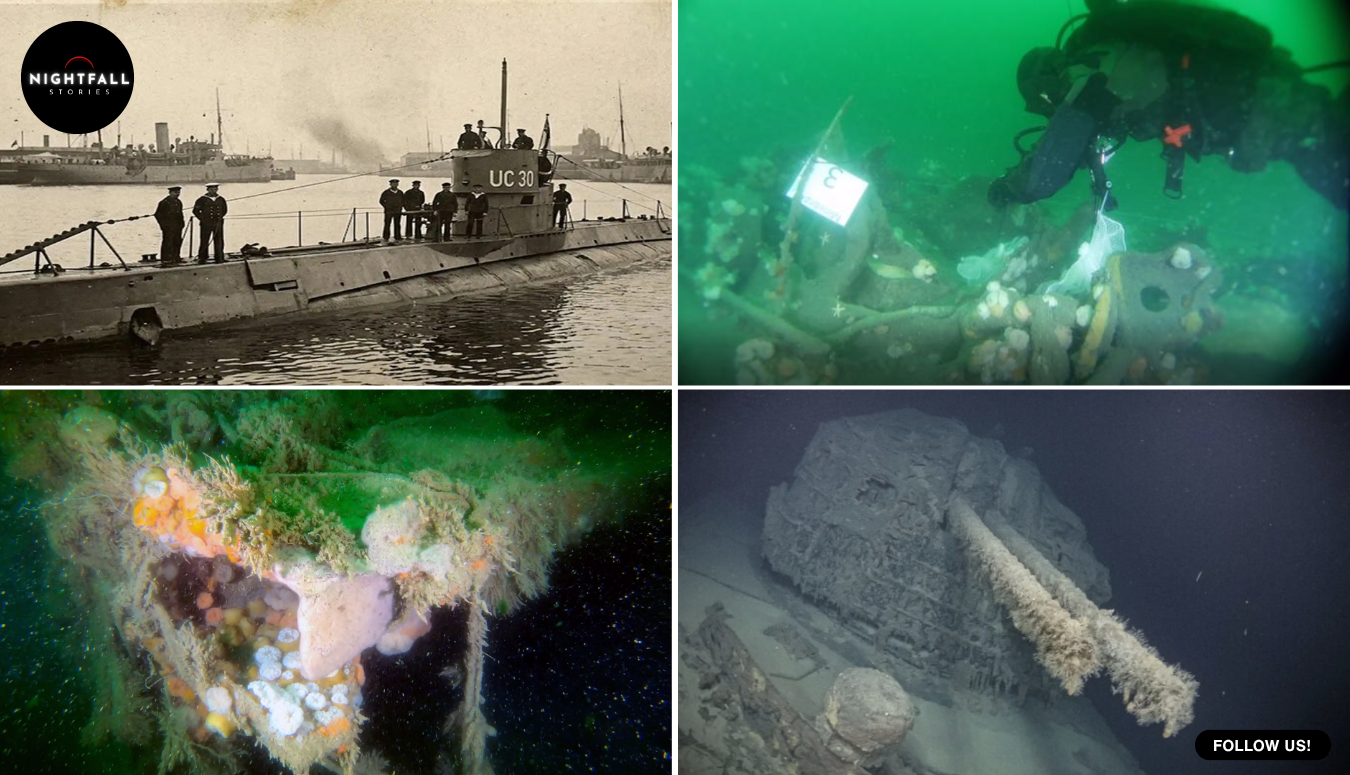
    The submarine was going home when it died. It had given up on its mission, turned back towards Germany, and was crossing a stretch of shallow water off the Danish coast when it ran into a British mine. Twenty-six or twenty-seven men went down with it, depending on which record you read. So did eighteen sea mines and six torpedoes that had never been used.

    For ninety-nine years, nobody knew exactly where it was. Then a Danish diver found it, sitting on the seabed in water shallow enough that you can reach it and cold enough that it has not rotted away. And a team of scientists went out to it with steel cages full of mussels, because they wanted to answer a question that nobody had thought to ask for most of a century.

    The question was simple. The explosives are still in there. Where are they going?

    The answer, published in a marine pollution journal by researchers from Aarhus University working with colleagues in Germany, is that they are going into the water, into the seabed, and into the animals living on the hull. Not in dramatic quantities. Not in a way that would hurt anyone swimming past. But measurably, continuously, and in a way that is going to get worse rather than better, because the thing holding it all in is a steel shell that has been dissolving since the year it sank.

    The wreck is UC-30, a German minelaying submarine of a type built in a hurry during the First World War. It was a small boat by any standard, under fifty metres long, with a crew of around twenty-six and a job that was mostly invisible. Minelayers did not hunt ships in the way the famous U-boats did. They crept into shipping lanes, dropped mines through vertical tubes in the bow, and left. Whatever happened afterwards happened to somebody else, days or weeks later, with no submarine anywhere near.

    UC-30 was commissioned in the summer of 1916 and lasted less than a year. Over four patrols it sank five vessels, three merchant ships and two requisitioned trawlers. Its commander, a man in his early thirties named Heinrich Stenzler, went down with the boat. His body came ashore in Denmark and was eventually identified and taken home to Germany for burial, which makes him one of the very few of that crew to have a grave anywhere at all. The rest are still where they were.

    That matters for what happens next, and it is worth saying early. This is a war grave. It is not a dumping ground that somebody can simply lift and take away, and any conversation about cleaning it up has to sit alongside the fact that the men who loaded those mines are still inside the hull.

    The wreck was rediscovered in 2016, off the Danish coast near the island of Romo, by Gert Normann Andersen, a diver who has spent a working lifetime locating lost ships in these waters. It lies in an area of the North Sea that is busy with fishing, shipping and, increasingly, offshore construction, and it was catalogued as a historical find rather than an environmental one.

    The study that changed that was led by Kathrine Juul Andresen, a geoscientist at Aarhus University, with collaborators including a toxicologist at the University Medical Center Schleswig-Holstein and researchers connected to Germany’s Alfred Wegener Institute. The fieldwork was not straightforward. Civilian diving on the wreck is not permitted, for reasons that become obvious when you remember what is stacked inside it, so the sampling was carried out by divers from the Royal Danish Navy.

    They took water. They took sediment. They took starfish and common mussels off the hull. And then they did something cleverer, which is the part of this study that makes it more than a spot check.

    They took healthy blue mussels, the ordinary edible kind, put them in steel cages, and had the divers fix those cages to three different wrecks. Alongside UC-30 there was SMS Mainz, a German light cruiser from the same war, and a Second World War transport ship. The mussels stayed down for around eleven weeks, filtering seawater the way mussels do, which is to say constantly and indiscriminately. A mussel is a very good instrument. It cannot be told where to look, it does not need power, and whatever is in the water ends up in its tissue.

    When the cages came up, the mussels from UC-30 had accumulated the highest concentrations of TNT of the three sites.

    That is the finding, and the way Andresen has put it publicly is about as plain as science gets: they found traces of TNT in the wildlife, in the seabed and in the water column, and pollution is definitely happening. In the seawater around the wreck the measured TNT was roughly 72.6 nanograms per litre, which is a number worth translating. A nanogram per litre is a part per trillion. This is not a spill. It is a seep, at a concentration you would need very sensitive equipment to notice at all.

    But the team also found the compounds TNT turns into once it is out in the world, the ones labelled 2-ADNT and 4-ADNT, which are what you get when bacteria or seawater start breaking the original molecule apart. Finding the breakdown products alongside the parent compound is how you know this is an ongoing process rather than a one-off release. Something is leaking now.

    And the mussels were not merely carrying the stuff. The researchers reported significant differences in the activity of the enzymes those animals use to process foreign chemicals, the biological equivalent of a liver working harder than it should. That is a sign of stress, and it is the difference between saying a pollutant is present and saying it is doing something.

    There is a quiet irony in using a mussel for this. The animals were not placed there as victims of an experiment so much as recruited as instruments, and the reason they work is the same reason they colonised the wreck in the first place. A submarine hull on a sandy seabed is a rare hard surface in an otherwise featureless place, and marine life takes any hard surface it can get. Within a few decades a wreck like this becomes one of the richest patches of habitat for miles, crusted with mussels and patrolled by starfish and fish that have nowhere else to shelter. The thing that makes it a good home is the same thing that makes it a slow leak.

    None of this means the North Sea is poisoned, and the researchers have been careful not to say that. The contamination appears to be local, clustered around the wreck itself rather than spread across the region, and Andresen has said openly that more work is needed to establish how far from a wreck the effect actually reaches. Nobody has suggested that seafood from these waters is unsafe.

    What makes the study unsettling is not the concentration. It is the direction of travel.

    Steel in seawater corrodes. It has been corroding since the day the boat went down, and every year there is a little less of it between the explosive filling in those mines and the open sea. The mines are inside vertical tubes in the hull, which is both a blessing and a problem: they are contained, for now, by two layers of metal that are both running out. Andresen’s own warning is that this will worsen as the wreck continues to deteriorate and exposes more of the material inside. The clock does not tick down. It ticks up.

    And UC-30 is one wreck.

    A survey commissioned by Denmark’s environmental authority a couple of years ago counted 10,127 wrecks in Danish waters alone. Around fifteen per cent of them date from the two world wars. Not all of those were carrying explosives, and some are buried deep enough in sediment that they are probably sealed off from the water. But the proportion that are both war-era and armed is not small, and Denmark is one country with one coastline.

    Widen the frame and the figure becomes genuinely hard to absorb. Experts estimate that around 1.6 million tonnes of conventional munitions are lying in German waters of the North Sea and the Baltic. A large part of that was not lost in combat at all. It was deliberately dumped after the wars ended, when the fastest way to make a defeated country’s ammunition disappear was to load it onto barges and tip it over the side into shallow water. Nobody at the time was thinking about what the steel casings would be doing eighty years later, because nobody expected anyone to still be thinking about it.

    It is worth understanding why so much of it ended up in the sea in the first place, because it was not carelessness so much as a decision that looked reasonable at the time. At the end of both wars there were mountains of shells, bombs and mine casings that somebody had to make safe in a hurry, in countries with wrecked infrastructure and no appetite for storing high explosive near towns. The sea was deep, it was close, and it was assumed to be effectively infinite. Barges went out, cargo went over the side, and the paperwork, where there was any, was often vague about exactly where. That is part of why mapping is now the first job: a great deal of this material is not where the records say it is, if the records exist at all.

    So there is now an entire slow-moving problem sitting on the floor of some of the busiest seas in the world, and almost nothing about it is easy to solve.

    The obvious answer, blowing the munitions up where they lie, is the one that has historically been used and the one the researchers are most wary of. Detonating old explosives underwater does not make the chemistry go away. Depending on currents and the nature of the seabed, it can take material that was concentrated in one place and distribute it over a much wider area, while also killing anything nearby with the pressure wave. Recovering the munitions instead is safer for the environment and far more dangerous for the people doing it, and it is expensive on a scale that has kept most governments from starting.

    Germany has begun to spend real money on recovery, and there is European funding behind work on robotic systems that could map where munitions are and eventually lift them without putting a diver next to a hundred-year-old detonator. That is the direction the field is moving: find everything first, prioritise what is actually leaking, and leave alone the wrecks that sediment has already sealed. Some of these sites are genuinely less of a risk left undisturbed than dug up, and knowing which is which is most of the work.

    There is also an argument for a kind of humility here. One of the toxicologists involved in this research has made the point that with a carcinogen, there is no threshold at which you can declare a dose harmless in principle, only doses too small to measure a harm from. That is a scientist’s framing rather than a public health warning, and it should be read as the former. The practical risk to a person eating mussels from the North Sea today is not what this study is about. It is about whether we should be comfortable with a curve that only goes one way.

    What lifts this above an environmental audit, though, is what the wreck actually is.

    UC-30 was a machine for killing people at a distance, and it failed at that more often than it succeeded, and then it killed its own crew on the way home. Those eighteen mines were built to destroy ships full of men who would never have seen the thing that got them. The submarine sank before it could use them, which at the time would have been counted as a small mercy.
    A hundred and nine years later, the mines are doing the only thing left available to them. They are leaking, slowly, into a patch of seabed covered in mussels and starfish, and into the tissue of animals that have made a home out of the hull. The submarine has become a reef. It is also still, chemically, a weapon that has not finished going off.

    The team at Aarhus is not calling for the wreck to be raised or the site to be closed. What they are asking for is that these thousands of sites stop being filed as maritime history and start being treated as infrastructure that needs monitoring, because that is what they now are. Andresen’s own summary of the task ahead is modest and a little bleak: they are looking for the gentlest solutions available, because there is unfortunately no easy way to clean any of it up.

    That is probably the honest ending. Nobody is going to fix this in one go. The best realistic outcome is that the wrecks that are leaking get found, the worst of them get carefully emptied, and the rest get watched.

    The men inside UC-30 have been dead for more than a century, and the war they fought in ended before their grandchildren were born. The cargo they were carrying is still out there in the dark, still doing its job in the only way it has left, one molecule at a time, into the mussels.

  • Keith Richards is on it, and so are thirty-three other people, and it is not an album by any of them

    Keith Richards is on it, and so are thirty-three other people, and it is not an album by any of them

    Six songs turned up at once, and no two of them belong in the same room. There is a Travis Scott track produced by one half of Daft Punk. There is a country song from Morgan Wallen and a reggaeton one from Rauw Alejandro. There is a strange, lovely thing with PinkPantheress and Fred again.. and an Argentine duo and a French house producer all tangled together. And then there is an 82-year-old Rolling Stone, singing a blues song from 1961 over not much more than a guitar and a drum kit.

    They are not labelmates. They did not collaborate. Most of them have probably never met. What they have in common is that all of their new songs were made for a video game that does not come out until November, and they are going to be sold together on a record with thirty-four tracks on it, twenty-eight of which nobody outside the building has heard.

    That is the first thing worth being honest about. This is an announcement, not a release. Grand Theft Auto VI: The Album was unveiled by Rockstar Games and Atlantic Records, and it is set to arrive on the same day as the game itself, which is now scheduled for the nineteenth of November. Six songs are out. The rest exist only as a promise and a pre-order page. Anyone telling you the album is good or bad right now is guessing, because roughly four fifths of it has not been played to a single person outside the project.

    But the announcement is the story, and it is a bigger one than the tracklist makes it look. To see why, you have to understand what game soundtracks have normally been, and what this one is doing differently.

    For about thirty years, the Grand Theft Auto series has been the most influential music curator in games, and it did that almost entirely with other people’s records. The trick was the car radio. You stole a car, you hit a button, and you landed in the middle of a fake radio station with fake adverts and a fake presenter playing real songs. The early games leaned on the eighties. Later ones spread out into everything. By the time the fifth game arrived, the in-game stations were being curated by people like Flying Lotus, Frank Ocean and Lee Scratch Perry, and a generation of players discovered entire genres because they got stuck in traffic in a fictional city.

    That model runs on licensing. A publisher goes to whoever owns an old recording, agrees a fee, and drops the finished song into the game. The money flows backwards, towards catalogue, towards whoever already made something. It is the same machine that puts songs in films and adverts, and for forty years it has been the way screen work and music have done business with each other.

    What Rockstar and Atlantic are doing here inverts that. Thirty-four tracks, made for this, released as a record in their own right, with a major label putting its distribution behind it. The money is flowing forwards, towards new work, towards artists writing to a brief. It is not the first time a game has commissioned music, and it is not even the first time this game series has done it. Five years ago, Dr Dre put six previously unheard tracks into an expansion for Grand Theft Auto Online, with Anderson .Paak and DJ Pooh involved, and it was treated as a genuine music event rather than a bonus feature. But that was six songs inside a game update. This is a full-length album with a release date, physical formats and a chart run ahead of it.

    It is worth pausing on how strange that is from the artist’s side. Writing to a brief is normal in film scoring and almost unknown in pop. A songwriter asked to produce something for a fictional city has to work out what that city sounds like before they can write a chorus for it, and they have to do it without hearing the game, because the game is not finished. Several of the six released songs sound like an answer to a mood board rather than a genre: heat, engines, money, somewhere humid and slightly dangerous. That is a harder commission than it looks, and it explains why the roster leans on artists who already deal in atmosphere.

    There is a reason a label would want in, and it is not sentiment. The audience here is enormous in a way that is hard to hold in your head. The publisher’s own figures put the previous game at around 225 million copies sold, and the series as a whole at roughly 465 million. Those are sales of a single piece of software, not streams, not views. Very few things on earth reach that many people at all, and almost nothing reaches them for hundreds of hours each.

    And the music effect is measurable now, which it was not in the early days. When Rockstar put out an extended look at the new game, Spotify reported that a 1979 soft-rock single by Captain and Tennille, Do That to Me One More Time, jumped by something in the region of 130,000 per cent in three days. That is not a typo, and it is the kind of number that only happens when a song reaches an audience that had no idea it existed. Another track on the same trailer, by Elderbrook and Bob Moses, reportedly rose about a thousand per cent. A duo who had their last big moment before most of the game’s players were born got handed a second one by a car chase.

    Once a placement can do that, the calculation changes for everyone involved. An artist is no longer licensing an old song into a game for a fee. They are being handed a distribution channel that behaves like a broadcast network, and being asked to write something new for it. That is why the roster looks the way it does. Nobody assembles Morgan Wallen, Travis Scott, Yung Lean, Future, Metro Boomin, Rauw Alejandro and PinkPantheress for the same record unless the thing binding them is not a genre but a place. The place, in this case, is a fictional one: Vice City and the surrounding state of Leonida, a version of Florida that exists only as code.

    Which brings us back to the man who does not fit.

    Keith Richards did not write a new song. He recorded Bright Lights, Big City, a Jimmy Reed record from 1961, and that detail matters more than it looks. The album is being described as thirty-four original tracks, and it is worth being precise about what that means: original to this project, recorded for it, not available anywhere else. It does not mean every one of them is a newly written composition. Richards took a sixty-five-year-old blues and made a new recording of it, stripped down to guitar, drums and a voice that sounds like it has been left out in the weather.

    If you know anything about where the Rolling Stones came from, that choice is not random at all. Jimmy Reed was one of the Chicago blues musicians that a handful of English teenagers built an entire career on top of. Richards has spent decades talking about Reed as a genius, and specifically about the sound he found, the way a musician can invent a single recognisable noise and live inside it forever. Reed’s records were simple on the surface and almost impossible to copy properly, which is exactly the sort of thing that obsesses a young guitarist.

    So the oldest person on this tracklist responded to a commission from a video game company by reaching back to the record that made him want to play in the first place. There is a loop in that which nobody planned. A blues song cut in Chicago at the start of the sixties, absorbed by a boy in England, carried through sixty years of stadiums, and now dropped into a simulated Florida for an audience of people who will mostly hear it while driving a stolen car.

    Reed’s own life is worth knowing, because it complicates the easy version of this. He was a Mississippi-born musician who had a run of hits in the late fifties and early sixties with a shuffle so relaxed it sounded like it was about to fall over, and he spent much of his career unwell and badly served by the business around him. The English bands who adored him sold far more records with his sound than he ever did with it. A new recording of one of his songs, on a release this large, is not restitution for any of that. But it does put his name in front of an audience that has never had a reason to hear it, which is the one thing the machine around this album is genuinely good at.

    The physical side of the release tells its own story about where music sits in all this. There is a CD for about twenty dollars, which in itself is a small act of defiance in a streaming era. There is a standard vinyl edition, two transparent magenta discs with blue splatter through them, for around fifty dollars. And then there is the limited edition, two records filled with blue liquid that moves when you tilt them, with its own artwork and packaging, at roughly 125 dollars.

    The detail that makes people laugh, and it is a fair laugh, is this: the boxed copy of the game itself reportedly contains a download code rather than a disc. Buy the album and you get an actual physical object. Buy the game and you get a piece of card with letters on it. The soundtrack is the more tangible product, which would have sounded like nonsense at any point in the last forty years of either industry.

    None of this guarantees the record is worth hearing. Twenty-eight tracks are still unknown, and a compilation assembled by committee across five genres could easily end up as a sequence of singles that do not want to sit next to each other. Rockstar has also said the album is not the whole musical picture, that the in-game radio stations and what they are calling a dynamic score are separate things still to be detailed. So even the people paying attention do not yet know how much of the game’s actual music this album represents.

    There is also the small matter of the game arriving at all. It has moved twice. It was expected one year, then pushed into the spring of the following one, then pushed again to November. Anyone who has followed a big release knows that a date is a hope until the thing is in people’s hands, and a soundtrack tied to a launch day moves when the launch day moves.

    What can be said, with the six songs that exist, is that the brief seems to have been taken seriously. The Travis Scott track has Guy-Manuel de Homem-Christo behind the board, which is not a name that turns up on a throwaway. The Yung Lean song has Future and Metro Boomin on it, which is a strange and specific combination that nobody would assemble by accident. The collaboration with PinkPantheress and Fred again.. and CA7RIEL and Paco Amoroso and Etienne de Crecy has five acts from four different scenes on one song, and the fact that it holds together at all is a small achievement.

    And Richards, by simply refusing to do anything modern, may have made the most interesting statement on the whole record. He was invited to participate in the biggest entertainment launch of the year, and he answered with a blues song older than most of the people who will hear it.

    For the artists involved, the practical stakes are clear enough. A song on this album is not competing for radio play or a playlist slot in the usual way. It is going to land in front of an audience that will be doing something else while it plays, in a world built to make them want to hear it again. That is a genuinely different kind of exposure, and it is why an act with nothing left to prove and an act with everything to prove both said yes to the same phone call.

    For everyone else, the thing to watch is whether this works well enough that other publishers copy it. If a thirty-four track commissioned album attached to a game charts the way a major artist’s album charts, then the industry’s relationship with games stops being a licensing side-door and becomes a front entrance. Labels have been edging towards that for years without committing. A record like this, with a major behind it and a launch that cannot be ignored, is the first real test.

    Until November, though, there are six songs and a pre-order page, and a lot of people arguing about a record that nobody has heard. The honest position is that the interesting part has already happened, and it is not musical. It is that a video game company can now call an 82-year-old guitarist, a country star, a reggaeton singer and a Swedish rapper in the same week, and all of them will clear their calendars. Twenty years ago the call would not have been made. Ten years ago it would not have been returned.

    The record might be a mess. The list of names on it already means something.

  • Half of the alien everyone assumed was computer-generated was a man with a hamster ball

    Half of the alien everyone assumed was computer-generated was a man with a hamster ball

    A lot of people walked out of Project Hail Mary this year convinced that Rocky, the five-legged rock-shaped alien who steals the entire film, was made of pixels.

    Rocky was not made of pixels, or at least not mostly. Roughly half of what ended up on screen is a physical object, built from a thin fibreglass shell in a creature workshop in London, operated by a small team of puppeteers standing just outside the frame. The person leading that team, and doing the voice, is a New York theatre artist named James Ortiz who had never worked on a film before in his life. And the way he worked out how the thing should move, before any of it existed, involved climbing inside a large transparent ball and running around a room shouting.

    That is the actual behind-the-scenes story, and it came out in a run of interviews Ortiz gave in the spring, shortly after the film reached cinemas. None of it is breaking news. The film has been out for months and has since arrived on streaming. What makes it worth sitting with is that it quietly contradicts what almost everyone assumes about how a big-budget science fiction creature gets made now, and it explains why this particular one landed with audiences when so many expensive digital creatures do not.

    Project Hail Mary is adapted from Andy Weir’s novel, directed by Phil Lord and Christopher Miller, and it cost somewhere in the region of two hundred million dollars. Ryan Gosling plays a middle school science teacher who wakes up alone on a spacecraft with no memory of how he got there, works out that he is humanity’s last chance at stopping the sun from going dark, and then discovers that he is not alone out there. The other party is an alien engineer from a different star system who breathes ammonia, communicates in musical tones, and looks something like a boulder with legs.

    The film made more than six hundred and eighty million dollars worldwide and ended the year as one of the biggest releases of 2026. Reviews were strong. And the character that people would not stop talking about afterwards was the rock.

    Ortiz is forty-two. He was born in Albany and grew up in Texas, and he got into puppetry as a child after a touring marionette company came through. He studied acting, then spent about fifteen years building a career in a corner of theatre that almost nobody outside theatre pays attention to. He co-created and starred in a show called The Woodsman, a largely wordless piece about the origin of the Tin Man from Oz, which ran off-Broadway three separate times and won him an Obie. He designed the puppets for a Broadway revival of Into the Woods, which means he is the man responsible for Milky White, the cow, a construction that reviewers spent a surprising amount of ink on. He built the dinosaurs for a Broadway production of The Skin of Our Teeth and picked up a Drama Desk award for it.

    So he was not an unknown. He was well known to about four thousand people who go to a lot of theatre in New York, which is a very different thing from being known.

    The bridge to the film was Neal Scanlan, the creature effects supervisor who came up through Jim Henson’s workshop and has spent decades building things that breathe and blink without a computer’s help. Scanlan’s pitch to Ortiz, as Ortiz has told it, was about as flattering as a sentence can be in that line of work. Scanlan told him that Ortiz was going to be Frank Oz, and that he, Scanlan, was building Yoda for him.

    That is not just a compliment. It is a description of a working method. In the original Star Wars films, Yoda was constructed around what one performer could physically do with his hand and his voice, and the scenes were built to accommodate that. Scanlan was proposing the same arrangement, which meant designing the puppet backwards from Ortiz’s performance rather than designing a creature and then asking someone to animate it.

    Building him physically was not an isolated decision. It fitted a production that had already chosen to do as much as possible in front of the lens. Reporting on the film notes that no chroma key was used, meaning no green screen, and that the sets were shot for real. The cinematographer, Greig Fraser, varied the aspect ratio depending on where in the story a scene sat, so that flashbacks to Earth are shaped differently from the scenes aboard the ship. The finished digital footage was even put onto film stock and then scanned back in, purely to pick up the warmth that comes with it. On a production making those choices, a real object in the room is not a nostalgic indulgence. It is consistent with everything else.

    There is a thematic argument for it too, and the people who made it have said as much. The story is about two beings from different worlds figuring out how to talk to each other with nothing in common but physics and patience. If your actor is talking to a mark on a stand, the central relationship in the film is the one thing on set that is not really happening.

    Rocky’s design took a while to settle. The version that finally worked reportedly started as a rough sculpt in polystyrene, knocked out late one night, which turned out to have more feeling in it than any of the smoother attempts that came before. The team learned early that stillness killed the character. If Rocky stopped moving, even briefly, he stopped reading as alive and went back to being a prop. So Rocky had to be in motion almost constantly, which is a punishing rule for the people holding him up.

    What got built was not one puppet. It was a family of them, each solving a different problem.

    The main build was the fibreglass shell, thin and light, designed and cast in layers and then painted so that it would catch light like stone rather than plastic. It had surprisingly few moving pieces, because Ortiz and Scanlan concluded that the character’s expressiveness would come from how it was carried rather than from mechanisms inside it.

    Then there was a version Ortiz specifically asked for, built along the lines of bunraku, the Japanese puppet theatre tradition that goes back to the seventeenth century and in which several performers operate one figure together, in the open, with rods. Ortiz has said the appeal is that bunraku is inherently collective, several people operating one body at once, and it can be dropped into a shot quickly when the schedule is tight. The crew nicknamed that one Bun-Rocky.

    There was a fully animatronic build that the team called the Waldo, for positions where no human arm could reach. It did not have its own controls in any conventional sense. Instead, the puppeteers operated yet another Rocky off to the side of the set, handling it directly, and the animatronic mirrored whatever they did to it. The performance was still coming out of somebody’s hands. It was just happening a few metres away from the thing the camera could see.

    And there was a small, floppy Rocky covered in tracking dots, whose entire job was to be a reference object for the visual effects artists at Framestore. When the digital version had to take over, the animators had a real physical performance to match rather than an idea of one.

    The hamster ball belongs to a specific problem. There is a part of the ship where Rocky moves around inside a transparent sphere, and no puppeteer could be inside that frame without appearing in the shot. So before any of it was designed, Ortiz got hold of a large clear ball, got inside it, and ran through the space shouting his lines and crashing into things, working out the physics of the character by being the character. It is a very theatre solution to a very film problem, and it produced the reference that the animators eventually worked from for those sequences.

    The final split between the physical puppet and the digital one has been described by Christopher Miller as roughly half and half, and Ortiz’s own accounts land in the same territory. Some coverage put the practical share higher, and one write-up went as far as describing Rocky as entirely practical with computer work used only to erase the puppeteers, which does not match what the directors themselves have said. The honest version is that Rocky is around half physical and half animated, that the animation was built directly on top of what the puppeteers did on set rather than replacing it, and that the sequences where the digital version takes over are mostly the ones the puppet physically could not perform.

    Ortiz did not work alone. He put together a crew he called the Rocketeers, reportedly including Scarlet Wilderink, Claire Roi Harvey, Arina Ii and Darcy Collins, and they operated the character as a unit. That is a detail worth pausing on, because it is the opposite of how creature performance is usually credited. Rocky is not one person’s performance. It is a group of people agreeing, in real time, on what a body is doing.

    The part that changed the film, though, is what happened with Gosling.

    Ortiz was on the set for every scene Rocky appears in. When he was not underneath or behind the puppet, he was in a booth a few steps from the camera, reading Rocky’s lines live so that Gosling had an actual person to act against instead of a tennis ball on a stick. He has said he made Gosling a promise early on, which was that puppetry can be extremely technical and rigid, but that whatever else happened, the two of them would always be able to improvise together.

    They took him at his word. Lord and Miller let the two of them run, and takes stretched out to forty and forty-five minutes of the pair of them simply playing, trying variations, throwing new lines at each other, seeing what a human and a rock might say to each other after a long time alone in space. Very little of that survives in a two-hour film. All of it shows up in the texture of the relationship, which is the thing critics kept singling out.

    There is one more turn in this. Ortiz was never supposed to be the voice.

    The plan, as these plans usually go, was that he would do a working voice on set so that Gosling had something to respond to, and that afterwards a recognisable actor would come in and record the real thing. It did not happen. The directors listened to what they had, and decided that trying to reproduce a performance that had already been built moment by moment with Gosling in the room would make the result worse, not better. So the voice in the finished film, run through processing to make it sound like an alien producing musical tones, is the puppeteer.

    The film went to streaming a few months after its cinema run, which is where a second and much larger wave of people met Rocky and went looking for how he was done. That is roughly when the interviews Ortiz had already given in the spring started circulating again, which is why a lot of readers encountered this story long after it was first told.

    Which means a man who spent fifteen years making cows and tin men and dinosaurs for New York theatre audiences ended up designing, operating and voicing the breakout character of a film that made two thirds of a billion dollars, on his first ever film job. His performance has since been talked about as a genuine awards possibility, which raises an old and unresolved question, because there is no category anywhere for what he actually did. He is not exactly a voice actor, not exactly a supporting actor, not exactly a visual effects artist. He is a puppeteer, which is a job the film industry has never really known where to file.

    None of this is a case against digital effects, and nobody involved has made that argument. Framestore and the other houses did enormous work on Rocky and the character would not exist without them. The argument, if there is one, is quieter than that. It is about the difference between an actor performing opposite nothing and an actor performing opposite a person who is right there, holding something up, improvising back.

    You cannot see that difference in a single frame. You can feel it across a whole film, and several hundred million people apparently did, even while assuming they were watching a computer.

  • Movies everyone quoted in the 2000s

    Movies everyone quoted in the 2000s

    Every high school hallway was full of people trying to make fetch happen.
  • Her last show lost all fifty-three times, and the one that finally won is about the end of the world

    Her last show lost all fifty-three times, and the one that finally won is about the end of the world

    There is a number that followed Rhea Seehorn around for years, and it is fifty-three.

    That is how many times her previous show, Better Call Saul, was nominated for a Primetime Emmy across six seasons. It won none of them. Not one. By the time the series ended, it held the record for the most Emmy nominations by a scripted show with nothing to show for any of them, a statistic so lopsided that entertainment writers stopped treating it as bad luck and started treating it as a running joke about the Television Academy itself.

    Seehorn played Kim Wexler on that show, the lawyer who held the whole thing together, and for most of its run she was not even part of the fifty-three. She was nominated twice, both times in the final stretch, both times in supporting actress, and she lost both. Then, on a Monday night in Los Angeles, her name was read out for lead actress in a drama, and she walked up to collect the first Emmy of a career that had been running for roughly a quarter of a century. She was fifty-four years old.

    The show she won it for is called Pluribus, and it is about what happens when everybody on Earth becomes happy at the same time, and one woman does not.

    That premise is almost too neat, given the shape of her career, and it would be easy to write the whole thing up as a tidy piece of poetry. It is worth resisting, because the actual story is less tidy and more interesting. It is about a specific kind of acting that awards are structurally bad at seeing, an actor who kept doing it anyway for decades, and a night where she spent her three minutes at the microphone mostly talking about other people.

    Start with the losing, because it is genuinely strange. Better Call Saul was not a cult show that nobody watched. It was the follow-up to Breaking Bad, made largely by the same people, and it was widely considered one of the best dramas of its era. Critics loved it. Audiences stayed with it for six seasons. And every single year, it was nominated across the board and sent home empty-handed, in acting, in writing, in directing, in the top series category. The industry press eventually gave the phenomenon its own genre of article. There is a whole subgenre of think pieces attempting to explain it, most of them landing somewhere around the idea that the show was too quiet and too slow-burning to win a category decided by voters watching a single submitted episode out of context.

    Seehorn was the sharpest example of that problem. Kim Wexler is a character built almost entirely out of restraint. She is a woman who makes enormous decisions with her face and almost never announces them. There is no monologue you could clip and send to voters. Her best work happens in the space between two lines, in a pause before she signs something, in the way she holds a cigarette. For years, the standard entertainment-press ritual on nomination morning was a list of snubs with her name near the top of it, and for three consecutive seasons in the middle of the show’s run she was not nominated at all, which by then had become the thing everybody expected and nobody could explain.

    She also did something in the final season that tells you more about her than any of the nominations did. She directed an episode. It was her first time directing anything for television, and she was the first member of the cast to be handed an episode of that show. She prepared for it the way a person prepares for something they are frightened of doing badly, sitting in on other directors’ shoots, going through shot lists, spending weekends with the cinematographer and the assistant director working out how each sequence would be built. She was specific about small things, like refusing to use a point-of-view shot unless it was actually doing a job in the story, and she wanted the episode’s opening, which starts out looking pleasant, to curdle by the end of the sequence. Critics singled the episode out. The Television Academy did not.

    She was not a newcomer waiting to be discovered, either. She had been working steadily since the late 1990s. She grew up in a military family, in a household where her mother worked as an executive assistant for the Navy and her father worked in naval counterintelligence, and she went to university intending to be a visual artist. She has said she came to acting sideways, through theatre, after studying art. She spent years on stages in Washington, then moved into television, and did the thing that most working actors actually do, which is a long run of solid parts in shows that came and went. She was the best friend in a network sitcom that ran two seasons. She turned up for a handful of episodes of Veep. She was, by any honest measure, a successful working actor and nowhere near a household name.

    She also changed her name along the way. She was born Deborah Rhea Seehorn and started going by her middle name, having said she wanted a clean start after being bullied over the first one as a child. It is a small detail, but it sits oddly well beside everything else about her, which is a career built by quietly declining to be the version of herself that other people had assigned.

    Then Vince Gilligan, who created Breaking Bad and co-created Better Call Saul, wrote a show for her.

    The way that happened is worth knowing, because it was not a phone call out of the blue. After Better Call Saul ended, Seehorn went to Gilligan and his co-creator Peter Gould and effectively asked them to find something else for her to do. Gould reportedly steered her toward Gilligan on the grounds that Gilligan had something he needed to say. Gilligan described the idea to her. She said yes to it before a single script existed.

    Pluribus arrived on Apple TV+ in late 2025, nine episodes released across about seven weeks. The setup is that an extraterrestrial contagion sweeps the planet and converts humanity into a single, serene, collective mind. Everybody is connected. Everybody is content. Nobody argues, nobody suffers, and nobody is alone ever again. It is not framed as an invasion so much as an upgrade that nobody consented to. A very small number of people, reportedly thirteen worldwide, turn out to be immune, and Seehorn plays one of them.

    Her character, Carol Sturka, is a bestselling author of romantic fantasy novels who is faintly embarrassed by her own work, and she is grieving, and she is furious. Seehorn has described Carol as raw, defensive, angry and funny, which is close to the opposite of the character that made her famous. Kim Wexler withheld everything. Carol withholds nothing, and her feelings are so loud that they physically affect the people around her.

    The detail that gives the character away is in her office. Seehorn worked with the show’s set decorator on how the room should look, and they decided that Carol would arrange serious literary novels where visitors could see them while dumping her own romance paperbacks on the floor in piles, the way you would treat something you were ashamed of having produced. Nobody says any of that out loud in the show. It is just sitting there in the furniture, which is exactly the kind of acting decision that does not fit in a clip reel. The hive mind is not hostile to her. That is the point. It is relentlessly kind to her. It wants to help. It will do essentially anything she asks, because the last thing a perfectly harmonious species wants is for one person to be miserable. And she spends the season refusing, trying to reverse something that everyone else experiences as the best thing that ever happened to them.

    Gilligan has said publicly that he built the show partly because he had grown tired of writing villains after two decades of them, and the result is a story with no bad guy at all, only an unbearable amount of niceness aimed at one woman who will not take it.

    Critics responded the way you would expect. The series holds a near-perfect approval score on Rotten Tomatoes and strong marks from the aggregated critics. It picked up a Peabody. It landed on the year-end institutional lists. And when the nominations for the 78th Emmy Awards came out, Pluribus had eighteen of them, including outstanding drama series.

    Seehorn had already won a Golden Globe and a Critics’ Choice award for the role by then, which meant that by the time the Emmy ceremony came around she was not the sentimental underdog. She was the favourite. There is something slightly funny about that, after all those years of being the person everyone agreed had been robbed. The robbery narrative had finally been overtaken by the plain fact that she was giving the best performance on television that year and most people watching had noticed.

    The ceremony was held at the Peacock Theater in downtown Los Angeles, hosted by Mariska Hargitay, who was the first woman to host the show in fifteen years. The night belonged mostly to other people. A comedy called Widow’s Bay took fourteen awards, a record haul for a comedy in a single year. The Pitt won outstanding drama series. Matthew Rhys became the first person ever to win two lead acting Emmys on the same night, in two different categories. Allison Janney won her eighth acting Emmy and tied the all-time record.

    And Jean Smart won lead actress in a comedy for Hacks, her fifth in that category, which meant she had won every single year she was eligible for it. That is the cleanest possible contrast with Seehorn, and the two results sat there next to each other on the same list. One actor who never lost, and one who had watched her previous show lose fifty-three straight times. Both of them, on the same night, holding the same statue.

    What Seehorn did with her time at the microphone is the part worth keeping.

    She opened by telling the room she was on a beta blocker and that it was not helping much, which is a fairly disarming way to admit to being terrified in front of several thousand people and a live network broadcast. Then, instead of talking about her own long wait, she pulled out a card.

    Keri Russell, one of the other nominees in her category, had sent it to her. On it was a line from Gloria Steinem about being linked rather than ranked. Seehorn read it out to the room and used it to say something about the other four women she had just beaten, all of whom, she pointed out, had done brilliant work that year. It is the sort of gesture that can look performative when it is done badly, and this did not, mostly because she had the physical card in her hand and had clearly decided in advance that this was what she was going to do with the biggest moment of her professional life.

    The rest of the speech was a list of names. She thanked Gilligan for the role, and for something more specific than that, which was building a set where people felt safe enough to try things that might not work. She named actors. She named writers and producers and the casting team. She named background performers, which almost nobody does. When the music started telling her to stop, she kept going anyway.

    Pluribus took four Emmys in total across the two ceremonies, including outstanding writing in a drama series for Gilligan. A second season had already been ordered before the awards arrived, so the show will be back regardless of what any voting body thinks of it.

    Asked afterwards where she planned to put the trophy, Seehorn did not say a shelf or a mantelpiece. She said it was going in her garage, which she has partly converted into an office and a painting studio, and which she described as one of her favourite places to be.

    Which brings the whole thing back around, because painting is what she was doing before acting, back when she was a student who had not yet worked out that theatre was the thing. She spent about twenty-five years becoming one of the most respected actors of her generation, went almost that entire time without a single major award, and when she finally got one she took it home and put it in the room where she paints.

    There is no lesson in that, and she has not offered one. She just kept doing the quiet version of the work for a very long time, in a business that mostly rewards the loud version, until somebody wrote her a part about a woman who refuses to be swept along with everybody else. Then a room full of her peers finally agreed with what the critics had been saying since roughly 2017.

    Fifty-three to nothing, and then one.