The thing to understand first is the ground.
In the north of Bangladesh, where the Brahmaputra comes down wide and heavy out of the mountains, the river carries so much silt that it builds land out of it. Shallow banks rise inside the water, dry out, firm up, and become islands. People move onto them, because the soil is good and because nobody else wants it and because they have nowhere else to go. They plant, they build, they have children there. And then the river takes the island back. Sometimes over years. Sometimes in a single flood season. The land that was there in the spring is water by the autumn, and a new island has appeared four kilometres downstream.
These are the chars, and by the Ramon Magsaysay Award Foundation’s reckoning at least one in twenty Bangladeshis live on them.
Now try to put a clinic on one.
You cannot. That is not a figure of speech or a funding problem. You cannot build a hospital on land that has a known expiry date and no fixed coordinates, which means that for most of modern Bangladeshi history the people living on the chars were outside the health system entirely, not because anyone had decided to exclude them but because the system is made of buildings and the chars are not made of anything permanent. A peer-reviewed evaluation published last year found that only about 35 percent of char residents were reaching public health services at all, and that roughly 80 percent of them counted as ultra poor. People with no permanent address also tend to end up with no documents, which cascades into no school enrolment, no land title and no entitlement to anything that requires you to prove where you live.
That cascade is worth spelling out, because it is the quiet half of the problem and it is not medical at all. A birth that happens on a char with no registrar nearby is a birth that may never be recorded. A child who is never recorded cannot easily be enrolled in a school, cannot sit a national exam under their own name, and later cannot open an account, claim a benefit, inherit land or prove they are a citizen of the country they have lived in their whole life. Erosion does the same thing to adults: when the island goes, so does the address on every piece of paper attached to it. In the survey that researchers ran across these communities, 43 percent of respondents had no formal education at all. That figure is not really a statement about schools. It is a statement about paperwork.
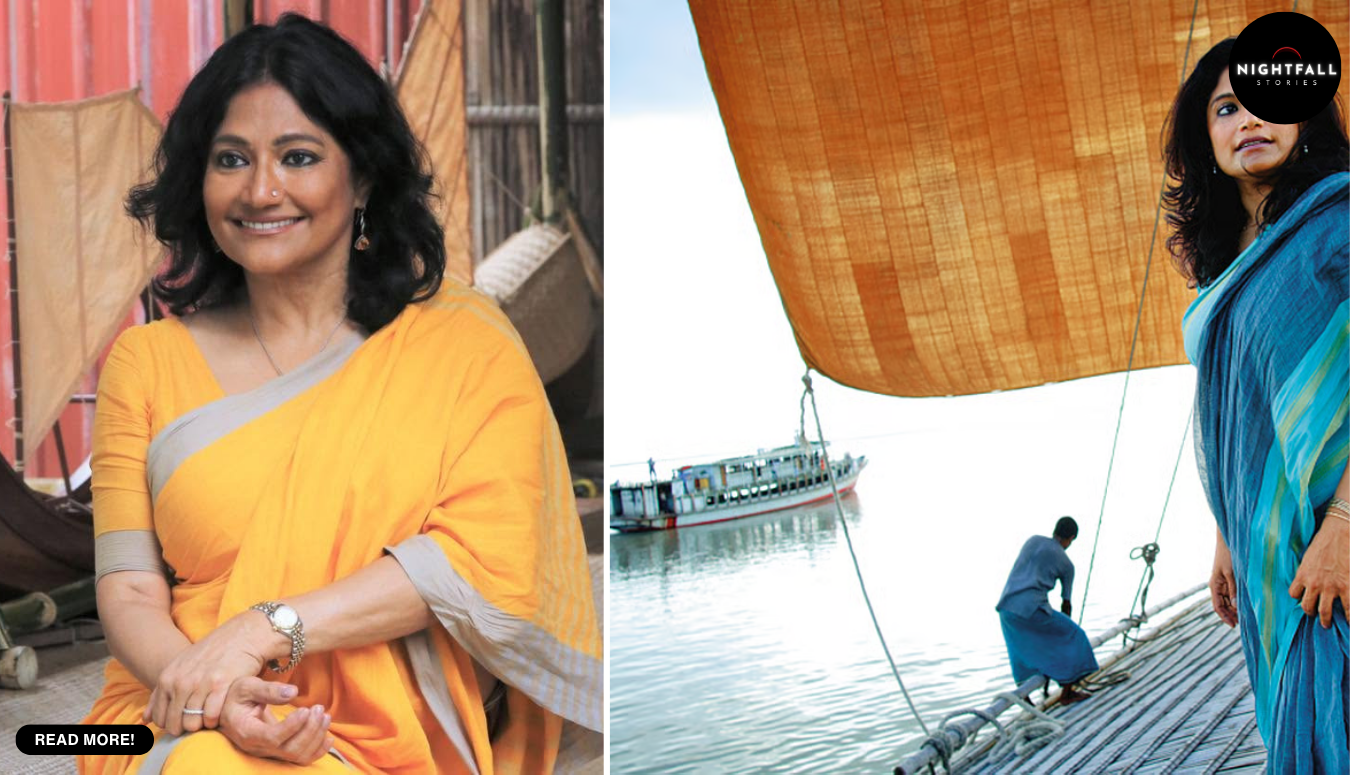
So in 2002 a Bangladeshi woman named Runa Khan did the obvious thing, which nobody had done. If the patients cannot come to the hospital and the hospital cannot stand still, put the hospital on the water.
She converted a barge. It had been brought over from France, and it became the Lifebuoy Friendship Hospital, and it went up the Brahmaputra to the islands. In the years since, according to figures published by the corporate partner that has funded it since the beginning rather than by Runa Khan’s own organisation, that single vessel has treated more than 816,000 patients, delivered around 1.35 million separate health services, run 489 surgical camps and performed more than 19,000 operations. In one recent year alone it saw 48,784 patients, of whom about 4,400 needed a specialist and 987 needed surgery.
Last year the Magsaysay Foundation named her one of its awardees, with a citation that turns on a single idea: that in her hands, privilege became not an entitlement but a responsibility, not a family legacy to protect but a gift to be shared. She is due to receive it in Manila later this year.
That is the sentence doing the real work, and it needs the biography to make sense of it.
Runa Khan was born in 1958 into one of the most comfortable families in the country. By the Foundation’s own description she started out exempt from almost everything that made life hard for most Bangladeshis. And for the first two decades of her working life she did nothing that would predict any of this.
She studied geography, taking a degree at a college in Calcutta and a second one in Dhaka. In 1979 she was teaching kindergarten and junior school children in Chittagong, and what preoccupied her then was not poverty or medicine but pedagogy. She had noticed that her students were being trained to memorise and reproduce rather than to understand, and she set about fixing it, writing textbooks built around getting children to interpret information instead of storing it, and developing her own teaching methods for motivating them conceptually. She also ran a clothing boutique that employed around forty women.
That is a complete and respectable life. Teacher, textbook author, small business owner. Most people who have built that by their late thirties spend the next thirty years maintaining it.
In 1997 she went to visit a char.
What happened on that visit is not something she has elaborated at length, and it would be dishonest to embroider it. What is on the record is that she saw how people were living on an island in the Brahmaputra and did not go back to her previous life. Five years later, at an age when the overwhelming majority of people have stopped starting things, she founded Friendship with 24 field staff and four people in an office, and a boat.
It is worth sitting with the gap between those two facts. She was about 39 when she saw the chars and about 44 when the hospital ship started work. She was not a doctor. She was not a development professional. She had no institutional platform in health, no technical training in it, and no obvious reason to think she could build anything in it. What she had was an unusual willingness to accept that the problem was a geography problem rather than a charity problem, and that the answer therefore had to be a vessel.
A boat is not a sentimental choice here and it is important not to read it as one. It is the correct engineering answer to a specific physical constraint. A hospital ship can reach a community that has no road, no jetty and no stable shoreline, because it does not need any of those things. It can relocate when the island relocates. It can carry an operating theatre, diagnostic equipment and a specialist team to a population of a few thousand people, stay as long as the caseload justifies, and then move to the next population a few hours upriver, which no building can do and no ambulance can do because there is nothing for an ambulance to drive on. When the river rearranges itself, the hospital rearranges itself too. That is the entire insight, and almost everything else Friendship built came out of following it honestly.
A second ship, the Emirates Friendship Hospital, later joined the first on the same river, and between them, over roughly a decade and a half, the two vessels were documented in that independent evaluation as having served something in the order of 1.2 million individual people. Friendship itself now says it operates seven hospital ships along with two land hospitals, around 550 mobile clinics, roughly 700 trained community medic aides and 137 economic development hubs, and that it reaches about 7.5 million people a year. Those are the organisation’s own figures and they should be read as such. The two hospital ships named above are the ones an outside research team has actually audited, and Friendship’s own health pages describe two floating hospitals on the Brahmaputra specifically, so the higher vessel count presumably includes coastal and other craft doing different jobs. The reach figures have not been independently checked by anybody we could find, and a charity’s account of its own scale is not the same category of fact as a surgical log.
What has been independently checked is more interesting than the headline numbers anyway, and it points somewhere the publicity material does not.
A research team evaluating the model surveyed 760 people in the char communities it serves. Most of the respondents were women. Forty three percent had no formal education. Two thirds were living on less than about 1,620 dollars a year. And when the researchers asked which part of the service people had actually used in the previous six months, the answer was not the ship. Just under 13 percent had gone to a hospital ship for a common illness. More than 90 percent had used something else: a satellite clinic, or a community medic aide.
The medic aides are the part of this that deserves the attention, and they are the reason the model did not stay a charity.
They are women recruited from the chars themselves. They live on the islands they serve, they are trained by Friendship in primary care, health education and counselling, and they are the first point of contact for their own neighbours. Some go on to further training as community skilled birth assistants, which means prenatal and postnatal care and attending deliveries, on an island, where the alternative is a boat journey to a town. Some carry mobile phones so they can consult a doctor remotely. Above them sit the satellite clinics, led by paramedics, which come round on a weekly, fortnightly or monthly rotation. The ship is the top tier, and it is for the things the other two tiers cannot do: the cataract, the cleft lip, the club foot, the operation.
The model also travelled, which is the test of whether something is a system or a one-off. The same three tiers were put to work on the coast, where the hazard is salt and cyclones rather than erosion, with static clinics built for communities too far from anything else and a land hospital in the coastal belt, and they were extended to serve refugee populations sheltering in the south of the country. None of that needed a new idea. It needed the same one applied to different water.
Which means the thing at the centre of this story is not actually the vessel. The vessel is the piece that makes the headlines and the photographs, and it does work no clinic could. But the system only functions because the overwhelming majority of care is delivered by women who already lived there, which is also why it keeps functioning when the ship is two hundred kilometres away. An organisation that employed 28 people at the start now employs more than 7,500, and by its own account most of them come from the communities it serves. The cost side bears this out in a way that is almost comically small: the independent evaluation found char residents were charged somewhere between five and nine cents at a satellite clinic, against a registration fee of around 2.79 dollars at the nearest private alternative. Across every service the researchers costed, from antenatal care to treating a child’s diarrhoea, the per-patient cost came out below the private option.
Eighty three percent of the people surveyed said they were satisfied with the service overall. Fewer, about 43 percent, were fully satisfied with what they were charged, which is the kind of unflattering detail that tends to get left out of award citations and is worth keeping in, because five cents is still five cents when your annual income is under two thousand dollars.
The work spread outward from medicine, as it generally does once you are the only organisation that turns up. Friendship says it has brought more than 30,000 children into prefabricated schools that can be taken down and moved when the island goes, that it has trained over 10,000 people in rescue and relief for flood seasons, that it has planted mangroves on the coast, and that it has helped char residents get the birth registrations and citizenship papers that unlock everything else. Its health teams say they immunise over 6,500 char children a year and screen more than 18,000 women annually for cervical cancer, treating around 150 of them for pre-cancerous changes.
There is an obvious way to write the ending of this, and it would be wrong. The obvious ending is the prize: Manila, the Metropolitan Theater, a woman from a comfortable Dhaka family receiving one of Asia’s more serious honours for having spent the second half of her life on a river. It is a good scene and she has unquestionably earned it, and the Foundation’s board explicitly credited her empathy for the poorest and her courage, vision and tenacity.
But an award is a thing that happens to a person once, and the point of what she built is that it does not depend on her.
The truer ending is on an island that may not exist in twenty years, where a woman who grew up on that island, or on one very like it, has been trained to take blood pressure and deliver a baby and recognise the illness that needs a boat. She is not waiting for anyone. She is the nearest thing to a hospital her neighbours have, and when the river finally eats the ground she is standing on, she will move with everyone else and go on doing it from wherever they land next.
That is what the boat was for. Not to bring medicine to the chars, which would have been a gesture, but to buy enough time and reach to train the people who were already there. Runa Khan was 44 when she started, which is late, and she was not a doctor, which is a bigger gap than it sounds. What she worked out, and what most people with her advantages never have to work out, is that the people on those islands were not short of resilience. They were short of a hospital that could follow them.
So she built one that floats.